
Portable Washing Machines Market Size and Share
Market Overview
| Study Period | 2020 - 2031 |
|---|---|
| Market Size (2026) | USD 1.92 Billion |
| Market Size (2031) | USD 2.69 Billion |
| Growth Rate (2026 - 2031) | 6.94 % |
| Fastest Growing Market | Asia Pacific |
| Largest Market | Asia Pacific |
| Market Concentration | Medium |
Major Players *Disclaimer: Major Players sorted in no particular order Image © Mordor Intelligence. Reuse requires attribution under CC BY 4.0. | |
Portable Washing Machines Market Analysis by Mordor Intelligence
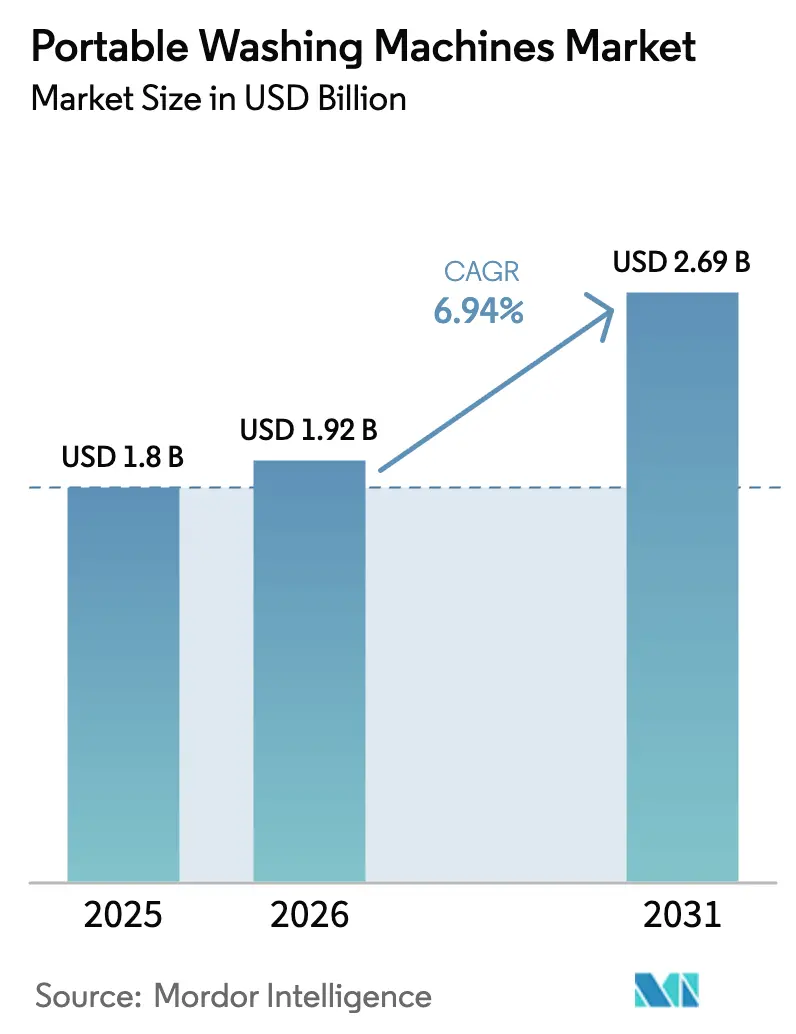
Portable washing machines market size in 2026 is estimated at USD 1.92 billion, growing from 2025 value of USD 1.80 billion with 2031 projections showing USD 2.69 billion, growing at 6.94% CAGR over 2026-2031. Urbanization, shrinking living spaces, and rising disposable income push consumers toward compact laundry solutions that match full-size performance. Rapid progress in inverter motors, IoT connectivity, and water-saving programs keeps the portable washing machines market firmly aligned with new U.S. energy and water rules that take effect in 2028[1]. Regional demand remains balanced against stricter eco-design laws, which favor brands able to meet higher Modified Energy Factor and lower Integrated Water Factor thresholds. Asia-Pacific’s dominance reflects strong middle-class growth, while e-commerce broadens access in North America and Europe. Producers that can localize final assembly, shorten lead times, and embed smart features are well placed to defend margins in an increasingly competitive field.
Key Report Takeaways
- By product type, top-load units led with 64.35% of the portable washing machine market share in 2025, while front-load machines are expanding at a 7.55% CAGR through 2031.
- By capacity, below 5 kg models dominated 2025 sales with a 54.20% revenue share; however, above 7 kg units are set to grow at 7.85% CAGR, the fastest among all capacities.
- By power source, electric models retained 89.20% of the portable washing machine market size in 2025; solar-ready machines are expected to expand at an 8.10% CAGR to 2031.
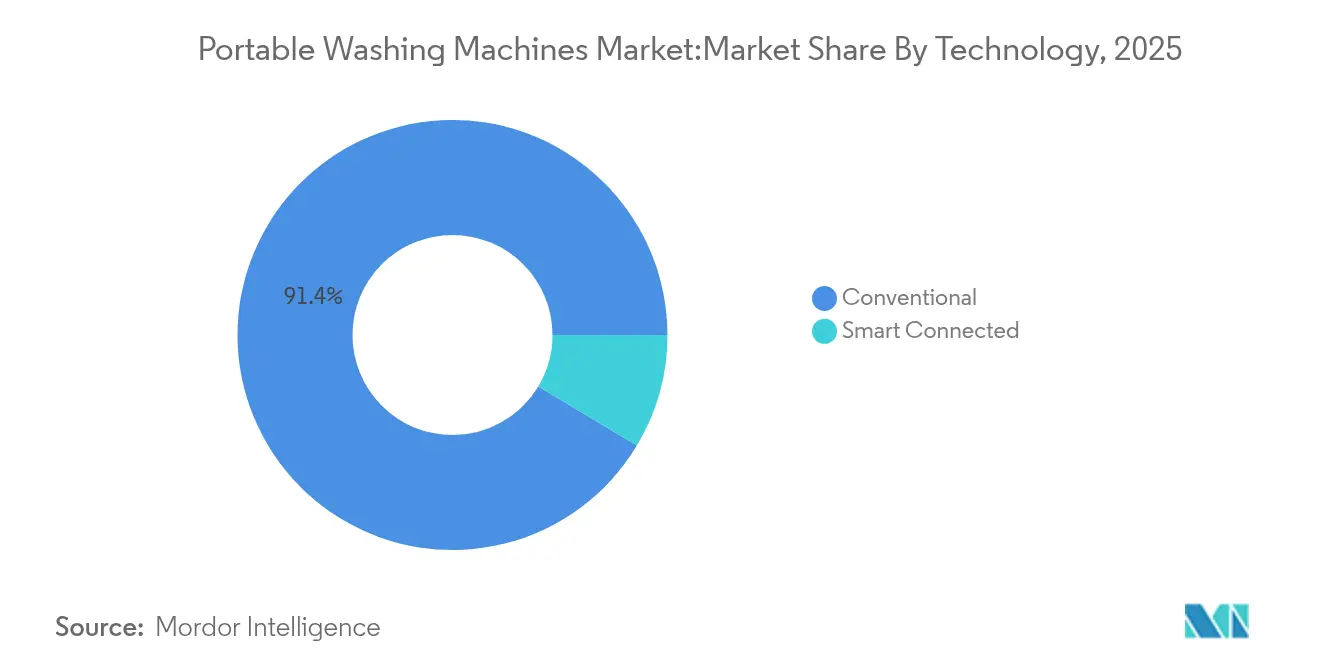
- By technology, conventional units held the greatest share of 91.40% in 2025, and Smart Connected adoption is forecast to keep pace at 8.45% CAGR.
- By end user, the residential buyers commanded 69.10% of the portable washing machine market size in 2025; the commercial segment is growing at a 6.95% CAGR.
- By distribution channel, B2C/retail held the top share of 80.90% 2025, and the online segment is scaling at 8.50% CAGR, reflecting stronger direct-to-consumer models.
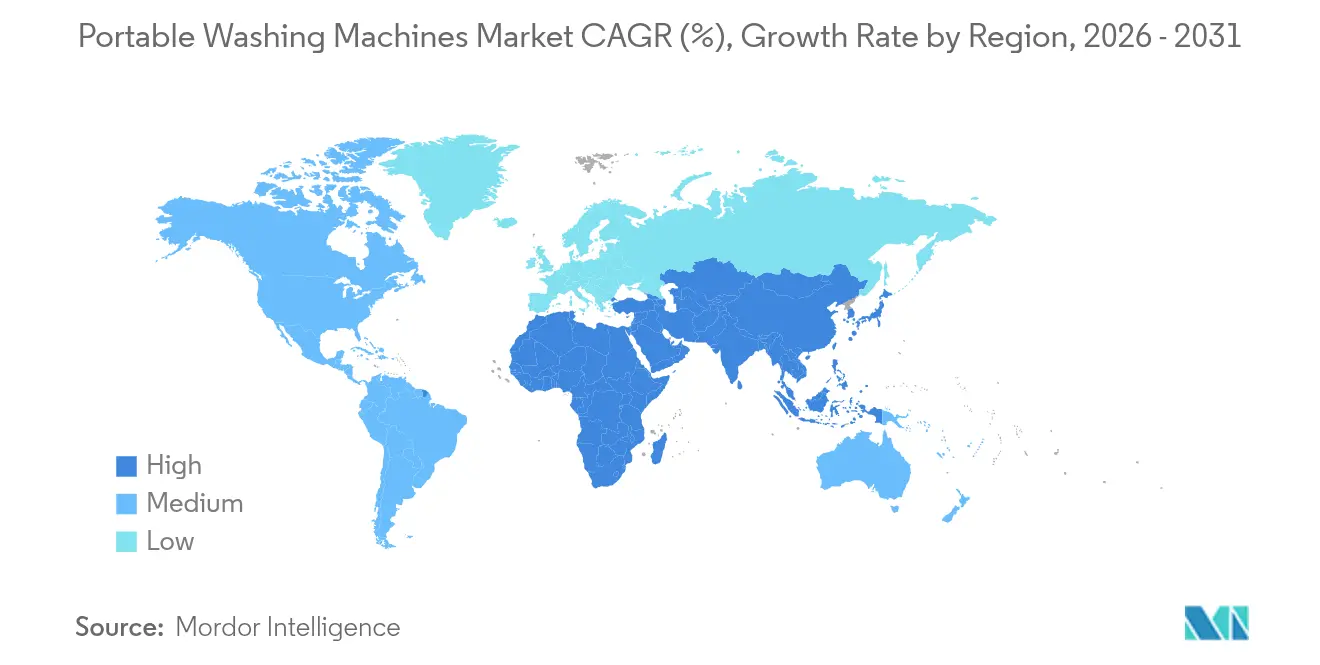
- By geography, Asia-Pacific accounted for a 38.70% slice of the portable washing machine market share in 2025, and is advancing at a 7.45% CAGR.
Note: Market size and forecast figures in this report are generated using Mordor Intelligence’s proprietary estimation framework, updated with the latest available data and insights as of 2026.
Market Trends and Insights
Drivers Impact Analysis of Portable Washing Machines Market*
| Driver | (~) % Impact on CAGR Forecast | Geographic Relevance | Impact Timeline |
|---|---|---|---|
| Rising Disposable Income of Urban Micro-Households | +1.8% | Asia-Pacific core, spill-over to Latin America | Medium term (2-4 years) |
| Rapid Product Innovation (Inverter, IoT, Energy-Saving) | +1.5% | Global, early adoption in North America & the EU | Short term (≤ 2 years) |
| Expansion of E-Commerce Appliance Channels | +1.2% | Global, most pronounced in emerging markets | Short term (≤ 2 years) |
| Van-Life & Recreational Vehicle Boom Demanding Off-Grid Washing Solutions | +0.8% | North America & EU, niche Australia | Medium term (2-4 years) |
| Solar-Powered Humanitarian Housing Deployments | +0.4% | Africa, the Middle East, and disaster-prone regions | Long term (≥ 4 years) |
| Source: Mordor Intelligence | |||
Rising Disposable Income of Urban Micro-Households
Urban micro-households are the fastest-growing buyer group for portable washers. Whirlpool and Hindustan Unilever promote first-time adoption in India through joint campaigns that couple stain-removal detergents with compact appliances. Better income prospects let entry-level consumers shift from hand washing to mechanized laundry without sacrificing floor space. Property developers continue to favor smaller apartments, which reinforces demand for compact formats. Add-on sales of detergents optimized for low-water cycles increase lifetime revenue per unit and deepen brand loyalty. This dynamic keeps the portable washing machines market firmly anchored to consumer buying power in large urban centers.
Rapid Product Innovation (Inverter, IoT, Energy-Saving)
Technological leapfrogging sits at the heart of market differentiation. Samsung extended its Bespoke AI range with a compact model that suggests the ideal cycle and flags maintenance needs[2]. LG and Samsung now battle in 25 kg combo machines that fold heat-pump drying into a small footprint, indicating engineering gains that spill into the portable segment. Compliance with 2025 DOE test methods pushes every brand to lift Modified Energy Factor scores, prompting broader use of inverter drives and low-noise pumps. Such enhancements unlock premium pricing, narrow the resource-efficiency gap with full-size washers, and widen the global appeal of the portable washing machines market.
Expansion of E-commerce Appliance Channels
Digital retail changes how shoppers research and buy appliances. Rich product pages outline unit dimensions, electrical needs, and installation steps that bricks-and-mortar stores cannot match at scale. Instant customer reviews build trust among buyers who lack product experience. Online sales shorten the path between factory and living room, trimming channel margins and fueling faster price discovery. Manufacturers also gain data on buyer behavior, guiding iterative design cycles that match emerging needs. These gains explain why the portable washing machines market registers the highest online growth rate among major household appliance categories.
Van-life & Recreational Vehicle Boom Demanding Off-Grid Washing Solutions
The rise of remote work and outdoor living turns vans and recreational vehicles into rolling homes. Demand centers on 12 V or solar-ready washers that handle light loads without straining battery banks. Brands incorporate collapsible tubs, fold-out handles, and onboard filtration to conserve water. Though niche, this customer base pays above-average prices for autonomy and low weight. Secondary demand stems from boat owners, disaster response teams, and mobile clinics, all of which need laundry in places without grid power. The segment raises overall average selling prices and opens fresh pockets of growth within the portable washing machines market.
Restraints Impact Analysis of Portable Washing Machines Market*
| Restraint | (~) % Impact on CAGR Forecast | Geographic Relevance | Impact Timeline |
|---|---|---|---|
| Abundant Laundromats & On-Demand Laundry Apps | -1.1% | Urban centers globally, strongest in North America & EU | Short term (≤ 2 years) |
| Limited Load Capacity vs. Conventional Washers | -0.9% | Global, particularly affecting larger households | Medium term (2-4 years) |
| Durability & Performance Perception Gaps | -0.7% | Emerging markets, price-sensitive segments globally | Medium term (2-4 years) |
| Tightening Small-Appliance Energy Regulations | -0.6% | North America, EU, with gradual expansion to APAC | Long term (≥ 4 years) |
| Source: Mordor Intelligence | |||
Abundant Laundromats & On-Demand Laundry Apps
Well-capitalized laundromat chains and mobile laundry platforms compete on convenience, especially in dense cities where apartment space is scarce. Pay-per-use pricing reduces upfront costs and appeals to travelers and students. App-based pickup services extend reach into premium neighborhoods, further eroding appliance ownership incentives. Markets that deregulate utility pricing may see commercial laundries gain further advantage through volume discounts. While this dynamic softens near-term growth, portable models still appeal to users who demand control over hygiene, fabric care, and operating schedules.
Limited Load Capacity versus Conventional Washers
Portable washers rarely exceed 7 kg per cycle, forcing larger families to split loads and consume more time. The gap widens as full-size machines stretch to 15 kg while raising per-cycle efficiency, making the larger format more economical per kilogram of laundry. Manufacturers respond by packing larger drums into slim cabinets and adopting more efficient motor layouts. Hisense’s 4-in-1 heat-pump model shows that technical ceilings continue to rise[3]. Yet capacity will remain a structural restraint until major breakthroughs in drum geometry emerge.
*Our forecasts treat driver/restraint impacts as directional, not additive. The impact forecasts reflect baseline growth, mix effects, and variable interactions.
Portable Washing Machines Market Segment Analysis
By Product Type:
Front-Load Growth Reshapes the MixTop-load machines still dominate 2025 demand with 64.35% market share, especially among first-time buyers in price-sensitive regions where washer ownership remains below 35%. Simpler mechanics, familiar ergonomics, and easier maintenance protect this position. Bulk procurement by micro-finance programs further lifts volumes in Southeast Asia. Yet as smart displays, inversion motors, and precision dosing migrate across product lines, the front-load value proposition strengthens and shifts global buyer preference. This shift is instrumental in the 6.94% headline CAGR recorded for the portable washing machines market.
Front-load variants, though less familiar to legacy buyers, are expanding at a 7.55% CAGR and will keep rising their portion of the portable washing machines market share next to top-load leaders. Engineers cite lower water usage and gentler tumble action that meets new energy metrics. Early adopters view the frontal door and horizontal drum as premium cues that justify a higher price. Manufacturers streamline supply by adapting full-size front-load components to portable formats, lowering the incremental cost per unit. Enhanced wash quality also trims detergent use, a small but visible benefit to eco-aware households.


By Capacity:
Polarized Preferences Guide Design StrategyThe below 5 kg class dominated 2025 sales with a 54.20% revenue share, supported by single-person flats, student dorms, and senior living complexes. Lower sticker prices, lighter shipping weight, and plug-and-play setup make these compact washers an easy upgrade from hand washing. Brands address noise and vibration, two key concerns in high-rise living, by adding suspension pads and variable-speed drums. At the opposite end, above 7 kg models are the fastest-growing slice, advancing at 7.85% CAGR through 2031 and steadily enlarging their slice of the portable washing machines market. Their broader drum size closes the performance gap with mid-size conventional units, making them popular in suburban homes, co-living spaces, and smaller hotels.
Between the two extremes lies the 5–7 kg tier, which serves couples and small families that want a versatile appliance while retaining a smaller footprint. Flexible dosing, custom soak programs, and steam cycles push the average selling price higher in this sub-segment. As inverter motors unlock greater torque within the same cabinet, all capacity tiers gain wash quality improvements without inflating energy bills. The resulting spectrum of drum sizes lets vendors tailor marketing messages to distinct micro-segments of the portable washing machines market rather than chase one “average” customer.
By Power Source:
Electric Leads, while Solar Options EmergeThe power source, electric models, retained 89.20% of the portable washing machine market size in 2025.Plug-in electric models represent the mainstream of the portable washing machines market and will keep their lead for the forecast period. They link directly to household sockets and do not require auxiliary chargers, making them suitable for rental properties. Efficiency gains arrive via brushless direct-drive motors that cut stand-by consumption, while thermal sensors reduce overheating risk in tight cabinets. Brands with global footprints ship the same universal-voltage control boards worldwide, lowering cost and parts inventory.
The solar-ready machines are expected to expand at an 8.10% CAGR to 2031. Solar-ready DC units remain a single-digit niche today but answer the sustainability push in off-grid settlements, humanitarian camps, and remote lodges. Non-profit collaborations, such as Whirlpool Foundation’s support of The Washing Machine Project, distribute hand-crank and solar-enabled units in disaster relief zones. Technical hurdles include panel sizing, battery depth-of-discharge, and water storage. As lithium-ion prices fall, market penetration is expected to expand in Africa and island states, broadening the portable washing machines industry footprint. Manual washers will persist as ultra-low-cost choices where shipping power sources are impractical.
By Technology:
Smart Features Transition from Novelty to StandardConventional non-connected units still led global volume in 2025, but Wi-Fi and Bluetooth modules are rapidly moving from premium add-ons to baseline expectations. BSH Home Appliances has begun shipping Matter-compatible units, paving the way for plug-and-play integration with third-party smart-home hubs. Remote monitoring of remaining cycle time and machine health reduces user anxiety about leaks in rented spaces. Brands also test subscription programs for firmware upgrades and performance analytics, opening new revenue lines beyond hardware.
Price used to be the chief obstacle for technology, yet the cost of cloud services per unit has fallen below USD 1 annually. Vendors collect anonymized run data that reveal regional washing habits, informing targeted detergent partnerships and future design tweaks. As these feedback loops tighten, the portable washing machines market gains a data-centric layer that lifts both margins and customer retention.
By End User:
Residential Core with Expanding Commercial HorizonsResidential buyers account for 69.10% of the global revenue, while the commercial segment maintains a 6.95% CAGR. Smaller living units, flexible lease contracts, and high mobility drive demand for appliances that can roll into a closet at move-out time. College dormitories and micro-apartments install built-in kitchenettes but rarely provide shared laundry, steering tenants toward personal portable washers. In mature markets, homeowners purchase a portable machine as a secondary washer, reserved for delicate or specialty fabrics.
Commercial establishments form the fastest-emerging opportunity. Hostels, wellness clinics, and recreational camps adopt portable models to avoid major plumbing retrofits. After the Kahramanmaraş earthquake, relief agencies used compact washers to sanitize bedding in temporary shelters, underscoring resilience benefits. The mix of cyclical tourism and rising climate-related disruptions means authorities and NGOs will continue procuring mobile laundry infrastructure, a trend that lifts non-residential demand within the portable washing machines market.
By Distribution Channel:
Digital Commerce Accelerates the CycleOnline marketplaces command the leading share and a 8.50% CAGR. Brands control storefront aesthetics, publish video installation guides, and bundle extended warranties, building trust where hands-on experience is impossible. Return logistics improve yearly, lowering perceived risk for buyers. Electronic payment penetration in South and Southeast Asia unlocks new buyer pools, while buy-now-pay-later plans enable larger average order sizes.
Multi-brand physical stores still attract shoppers who want to test noise levels or inspect hose connectors. They remain critical in markets with limited home-delivery reliability. Exclusive brand outlets deliver curated experiences for premium lines, offering concierge installation and IoT onboarding. Direct B2B sales cover bulk orders for hotels, hostels, and healthcare facilities. This multi-channel matrix drives wide geographic coverage for the portable washing machines market, balancing margin and reach.
Geography Analysis
APAC Portable Washing Machines Market
Asia-Pacific ranks first by revenue and posts a 7.45% CAGR through 2031. China’s domestic makers benefit from clustered supply chains, keeping average selling prices lower than Western equivalents. India’s household penetration level, still under 20%, sets a large runway for growth. Whirlpool and Hindustan Unilever’s joint promotion illustrates how detergent and appliance brands cooperate to convert first-time buyers. Rising urban wages and limited floor space keep consumers gravitating toward compact washers even as full-size ownership moves up the income curve.
North America Portable Washing Machines Market
North America registers mid-single-digit growth. The U.S. energy rule scheduled for 2028 pressures manufacturers to cut kilowatt-hour consumption, driving new model launches every 18 months. The van-life trend also fuels demand for 12 V and solar-capable washers that run in mobile dwellings. Mexico consolidates its role as a manufacturing hub, supplying the U.S. and Canada while building a domestic mid-tier consumer base. Online fulfilment hubs in California and Texas cut delivery times, reinforcing regional supply resilience within the portable washing machines market.
Europe Portable Washing Machines Market
Europe maintains a low-to-mid single-digit CAGR. High urban density, stringent water tariffs, and mature online retail ease adoption. Government rebates support energy-efficient purchases, nudging consumers toward inverter-driven portable models. German-based BSH Home Appliances reported 4.1% North American growth in Laundry Care for 2024, proving that European engineering resonates abroad. Meanwhile, Eastern European countries with expanding middle classes display above-average take-up, closing the gap with Western peers.
Mordor Intelligence provides coverage of the portable washing machines market across other key regional markets, including Middle East, Europe, and Asia, each with their regulatory frameworks and demand patterns. Detailed country-level analysis extends to United States incorporating local coverage and market participation, as required.
Regulatory Landscape
Regulatory actions across major markets anchor near-term product design and testing requirements. The European Union’s Commission Implementing Decision 2025/72, effective January 15, 2025, mandates harmonized testing with EN 60456:2016/A12:2023 for household washing machines, which strengthens energy and water performance disclosure across the EU. In China, GB/T 4288-2025 was issued on October 5, 2025 and implemented on May 1, 2026, pushing manufacturers to refresh compliance documentation for portable units sold there.
On the United States side, the U.S. Department of Energy issued a Notice of Proposed Rulemaking on July 2, 2026 to change the standards-setting process for home appliances, with support from the Association of Home Appliance Manufacturers. This follows earlier DOE test procedure updates that shaped how Modified Energy Factor and Integrated Water Factor are pursued across portable units, and it frames the regulatory backdrop for new product development.
Value Chain Analysis
Upstream sourcing includes steel and plastics for cabinets and drums, inverter-driven motors, pumps and valves for water handling, and control electronics that enable smart features. Compliance-driven design requirements push suppliers to align with EU EN 60456:2016/A12:2023 and China GB/T 4288-2025, while European energy benchmarks favor dual-inverter heat-pump subsystems and low-GWP refrigerants such as R290. Production increasingly relies on automated dispensing and testing to improve performance and consistency.
In the midstream, contract manufacturers and assemblers handle stamping, motor and pump integration, electronics assembly, and final testing, with increasing emphasis on repeatable test results aligned to regional procedures such as the DOE test procedure updates effective July 16, 2025. Downstream distribution splits between mass-market retailers and online marketplaces, while off-grid and specialty channels (RV and outdoor segments) support niche portable formats.
Competitive Landscape
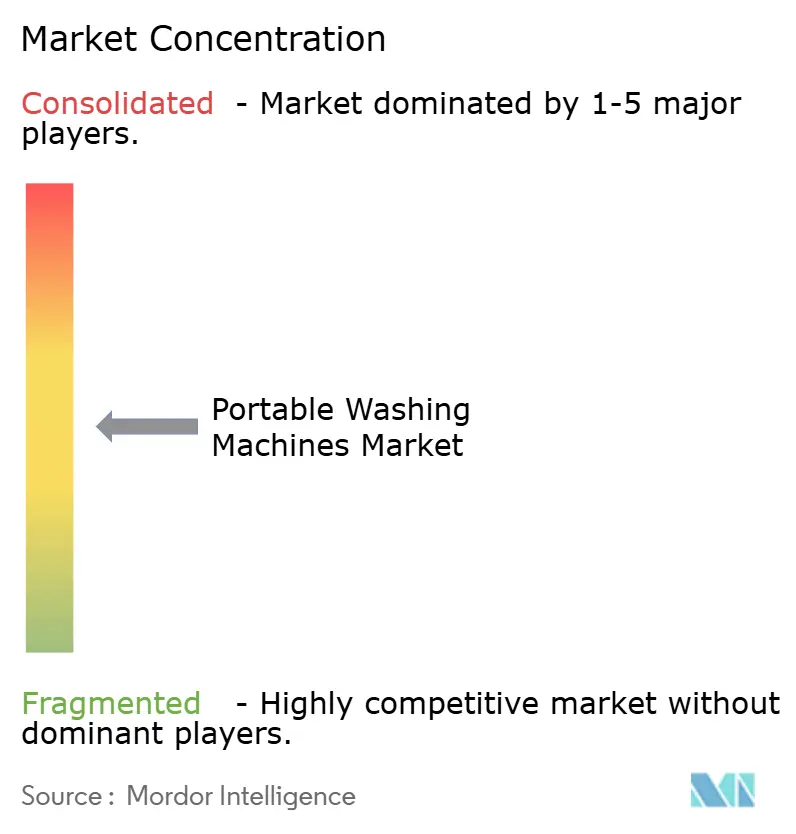
The portable washing machines market shows moderate concentration. Haier, Midea, Samsung, LG, Whirlpool, Hisense, and BSH Home Appliances collectively control more than half of the global volume. Competitive differentiation now centers on water use, noise reduction, and smart-home pairing rather than simple cost. Samsung and LG spar over AI-driven cycle optimization in large-capacity washer-dryer portfolios, with lessons feeding back into smaller formats. Hisense’s heat-pump launch validates Chinese brands’ growing R&D depth.
Regional investments align with reshoring and near-shoring goals that cushion supply risk. North American makers expand U.S. and Mexican plants to limit trans-Pacific freight exposure. Component suppliers for pumps, valves, and PCBAs diversify across Vietnam and Indonesia, enhancing resilience. Collaboration remains pivotal: Whirlpool works with detergent brands for after-sales cross-promotion, while Bosch partners with connectivity alliances to future-proof interoperability. Such strategies foster stickier customer relationships and safeguard pricing power across the portable washing machines industry.
Portable Washing Machines Industry Leaders
-
LG Electronics
-
Whirlpool Corporation
-
Midea Group
-
Samsung Electronics
-
Haier Smart Home Co., Ltd.
- *Disclaimer: Major Players sorted in no particular order
Portable Washing Machines Market Companies Covered in this Report
- Haier
- LG Electronics
- Whirlpool Corporation
- Samsung Electronics
- Midea Group
- Panasonic
- Bosch-Siemens Hausgeräte (BSH)
- Electrolux AB
- GE Appliances
- Danby
- Godrej & Boyce
- Videocon
- Costway
- Black+Decker
- Giantex
- Della
- RCA Appliances
- TCL
- Sharp
- Pyle Audio
- Comfee
- Magic Chef
Market Opportunities and Future Outlook
Market innovation is clustering around all-in-one heat pump washer-dryer units that reduce the need for laundry transfer, exemplified by Samsung Bespoke AI Laundry Combo (2026 models) and LG HeatPump WasherDryer. AI-led functionality is also used as a product differentiator, including AI Wash & Dry systems that sense load weight, fabric type, and soil levels to optimize water, detergent, and cycle duration.
Energy management integration via smart platforms such as SmartThings Energy supports real-time consumption monitoring and cycle optimization, with claims of reductions in energy usage by up to 70 percent. For buyers prioritizing space constraints, compact built-under designs keep Europe as a key focus market for uptake.
Recent Industry Developments in Portable Washing Machines Market
- June 2026: Lidl launched a foldable CLEANMAXX mini washing machine (1 kg capacity) for a limited-time retail promotion. The device expands access to ultra-compact laundry options in mass-market channels and tests consumer receptiveness to highly portable units. The launch indicates a push toward ultra-compact, battery-inclusive models in mass-market channels.
- June 2026: Aldi commenced sales of a foldable portable washing machine under its Adventuridge brand for travel and camping applications. The rollout broadens access to foldable portable washers in discount retail and reflects cross-category demand for compact, on-the-go solutions. The development also shows portable-format demand building through non-traditional appliance retailers.
- January 2026: Ningbo Keyi Electric Appliance Co., Ltd. obtained EU CE Certification for its 2026 DC Mini Washing Machine. Regulatory clearance supports European market access for compact washer models and allows the company to substantiate product safety and performance claims. The certification adds another compliant offering for portable DC washing units in Europe.
Portable Washing Machines Market Report Scope and Research Methodology
Market Definition and Coverage
This market covers portable washing machines that are designed to be moved and used in smaller homes, temporary housing, RVs, and similar settings, and it is measured as the value of products sold in USD during the study period.
Scope exclusions: Fixed, full-size built-in laundry washers and paid laundry services are not counted in this market sizing.
Segments Covered in This Report
- By Product
- Top Load
- Front Load
- By Capacity
- Below 5 kg
- 5–7 kg
- Above 7 kg
- By Power Source
- Electric (AC)
- Manual/Hand-Crank
- Solar-Compatible DC
- By Technology
- Smart Connected
- Conventional
- By End User
- Residential
- Commercial (e.g., Hostels, Clinics, Campgrounds)
- By Distribution Channel
- B2C/Retail
- Multi-brand Stores
- Exclusive Brand Outlets
- Online
- Other Distribution Channels
- B2B/Directly from the Manufacturers
- B2C/Retail
- By Geography
- North America
- Canada
- United States
- Mexico
- South America
- Brazil
- Peru
- Chile
- Argentina
- Rest of South America
- Asia-Pacific
- India
- China
- Japan
- Australia
- South Korea
- South East Asia (Singapore, Malaysia, Thailand, Indonesia, Vietnam, and Philippines)
- Rest of Asia-Pacific
- Europe
- United Kingdom
- Germany
- France
- Spain
- Italy
- BENELUX (Belgium, Netherlands, and Luxembourg)
- NORDICS (Denmark, Finland, Iceland, Norway, and Sweden)
- Rest of Europe
- Middle East And Africa
- United Arab of Emirates
- Saudi Arabia
- South Africa
- Nigeria
- Rest of Middle East And Africa
- North America
Data Sources, Market Sizing, and Validation
Desk Research
Desk research was used to build the fact base around household appliance demand, housing patterns, and trade flows that influence portable washer sales. We reviewed public datasets and standards guidance, including the US Energy Information Administration for household energy context, the US Department of Energy for clothes washer efficiency rules, UN Comtrade for import and export direction, and World Bank and UN population and urbanization indicators to size the demand pool.
In addition to official sources, we checked company annual reports, investor presentations, product specification sheets, and retailer category listings to understand typical capacities, feature adoption, and pricing ranges. Where available, paid subscriptions were used in a limited way for company financials and intelligence, patent lookups, and shipment-level import and export checks. This helped when public trade categories were broad and could not fully isolate portable units. The desk research sources listed here are illustrative only, and many other public and paid references were used for data collection, cross-checks, and clarification.
Primary Interviews and Surveys
Primary work focused on validating how portable washers are positioned versus compact full-size washers, and on confirming how demand shifts across apartments, RV usage, and student housing. We spoke with manufacturers, distributors, retailers, and service partners across major regions to pressure-test assumptions on price bands, feature premiums such as quick wash and low-water programs, and the channel mix before finalizing the model inputs.
Distribution of primary research fieldwork respondents
| Company type | Respondent position | Region |
|---|---|---|
| Top tier: 37% | CXOs: 17% | APAC: 39% |
| Mid tier: 45% | Functional/Unit leaders: 25% | EMEA: 36% |
| Smaller Players: 18% | Managers: 58% | Americas: 25% |
Market-Sizing & Forecasting
Sizing starts with a top-down build where appliance demand is reconstructed by combining household counts, small-space living indicators, and trade and sales signals that indicate portable washer availability and uptake in each region. We then sanity-check the totals through selective bottom-up approximations, such as sampled price points by capacity, channel checks on online versus offline mix, and a light roll-up of supplier and distributor signals to keep the numbers realistic.
Key inputs used in the model include urbanization and household formation, the share of renters and smaller dwellings, import intensity for small home appliances, average selling price movement by capacity band, and adoption of water and energy saving programs tied to efficiency standards. For forecasting, scenario analysis is used so demand can be adjusted based on housing starts, consumer spending on appliances, and expected price normalization. These assumptions are tested with expert views gathered during interviews. Where data gaps exist in smaller countries, proxy indicators like appliance import trends and household counts are used first, then adjusted using regional penetration patterns.
Data Validation & Update Cycle
Before results are finalized, the model outputs are compared against independent signals such as trade direction, category pricing ranges, and the implied unit volumes that the market value would suggest. When variances are large, we review the underlying assumptions on adoption, channel split, and pricing, and we trigger follow-up calls when what multiple respondents report does not align with the model.
A second analyst review is applied to key tables and the forecast logic, followed by a final pass that checks currency conversion timing and year alignment. Reports are refreshed annually, and interim updates are made when major events materially change demand or supply conditions. Right before delivery, the latest public updates and interview feedback are re-checked so the client receives the most current view.
Mordor Intelligence's Portable Washing Machines Market Sizing Compared With Other Published Estimates
It is common to see different published market sizes for portable washing machines, even when the topic name looks the same. Differences usually come from what gets counted as "portable," which years are used as the base, and whether pricing is built from real retail bands or from broad appliance averages.
The spread is also driven by how adjacent categories are handled, such as compact full-size washers, mini washers meant mainly for travel, and semi-automatic twin tub units that are sold in different regions at very different prices. Another gap often comes from currency conversion timing and how frequently assumptions are refreshed when input costs and promotion intensity shift. The table reflects these practical choices, with the main mismatch coming from category overlap and pricing logic, which is treated more tightly in the count used by Mordor Intelligence.
Benchmark comparison
| Source | Market Size | Gaps in Research Methodology |
|---|---|---|
| Mordor Intelligence | USD 1.92 B (2026) | |
| Trade Journal A | USD 0.87 B (2024) | Uses a narrower "portable mini" scope and anchors the value to a 2024 base year, which can exclude larger portable units and understate the impact of higher-capacity price points. |
| Global Consultancy B | USD 8.66 B (2025) | Likely folds in broader washing machine categories or compact fixed installations, and it applies a higher long-horizon growth profile that can inflate totals if portable-only definitions are not enforced. |
Looking across the three figures, the lower estimate mainly reflects a smaller product definition, while the higher estimate points to scope expansion into adjacent washer categories. By keeping the count tied to portable-only use cases and checking price bands against real channel ranges, the sizing stays easier to trace and explain for planning teams.
Key Questions Answered in the Report
What is the current value of the portable washing machines market?
The portable washing machines market size is USD 1.92 billion in 2026 and is expected to reach USD 2.69 billion by 2031.
Which region holds the largest share of global sales?
Asia-Pacific leads the portable washing machines market due to rapid urbanization, rising incomes, and dense living conditions that favor compact appliances.
What growth rate can the market expect through 2031?
The market is forecast to register a 6.94% CAGR during the 2026–2031 period.
Which product type is expanding the fastest?
Front-load portable washers post the highest growth, advancing at 7.55% CAGR as consumers seek superior water and energy efficiency.
How are online channels influencing sales?
Online platforms already capture the highest share and grow at 8.50% CAGR because they allow detailed product comparisons, flexible payment options, and direct deliveries that fit compact living scenarios.
What impact will new U.S. energy standards have on manufacturers?
Updated Department of Energy test procedures, effective in 2025 and stricter standards in 2028, compel brands to improve Modified Energy Factor and Integrated Water Factor scores, accelerating innovation in inverter motors and smart wash algorithms.