
Portable Ultrasound Bladder Scanner Market Size and Share
Market Overview
| Study Period | 2020 - 2031 |
|---|---|
| Market Size (2026) | USD 193.27 Million |
| Market Size (2031) | USD 245.65 Million |
| Growth Rate (2026 - 2031) | 4.91 % |
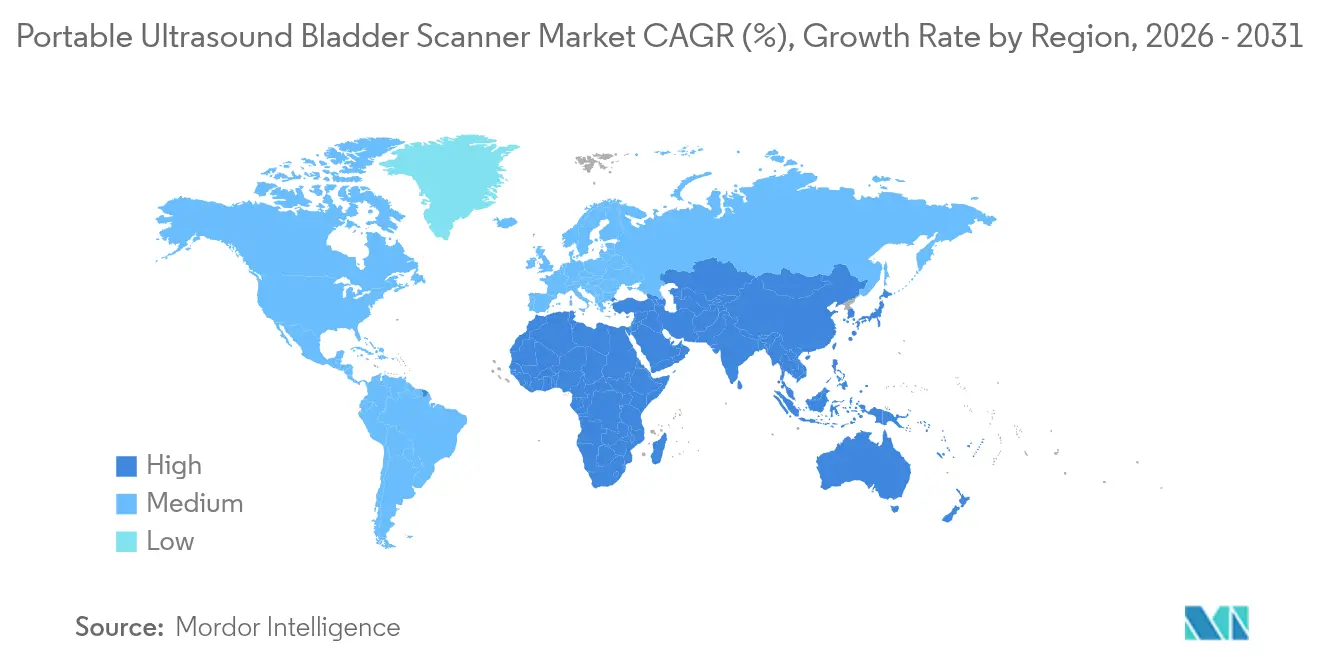
| Fastest Growing Market | Asia Pacific |
| Largest Market | North America |
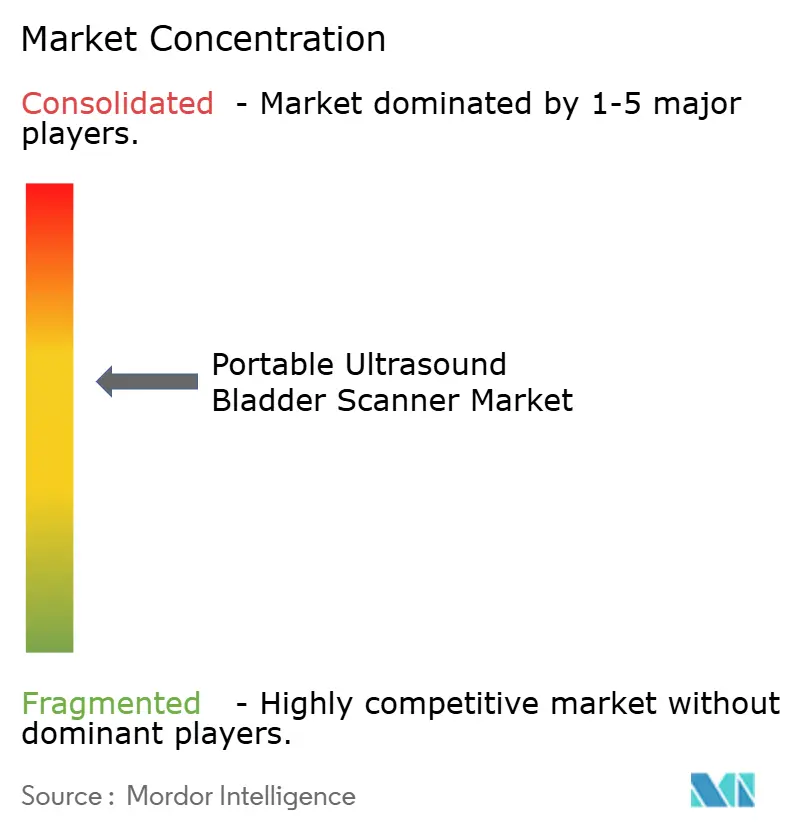
| Market Concentration | Medium |
Major Players *Disclaimer: Major Players sorted in no particular order Image © Mordor Intelligence. Reuse requires attribution under CC BY 4.0. | |
Portable Ultrasound Bladder Scanner Market Analysis by Mordor Intelligence
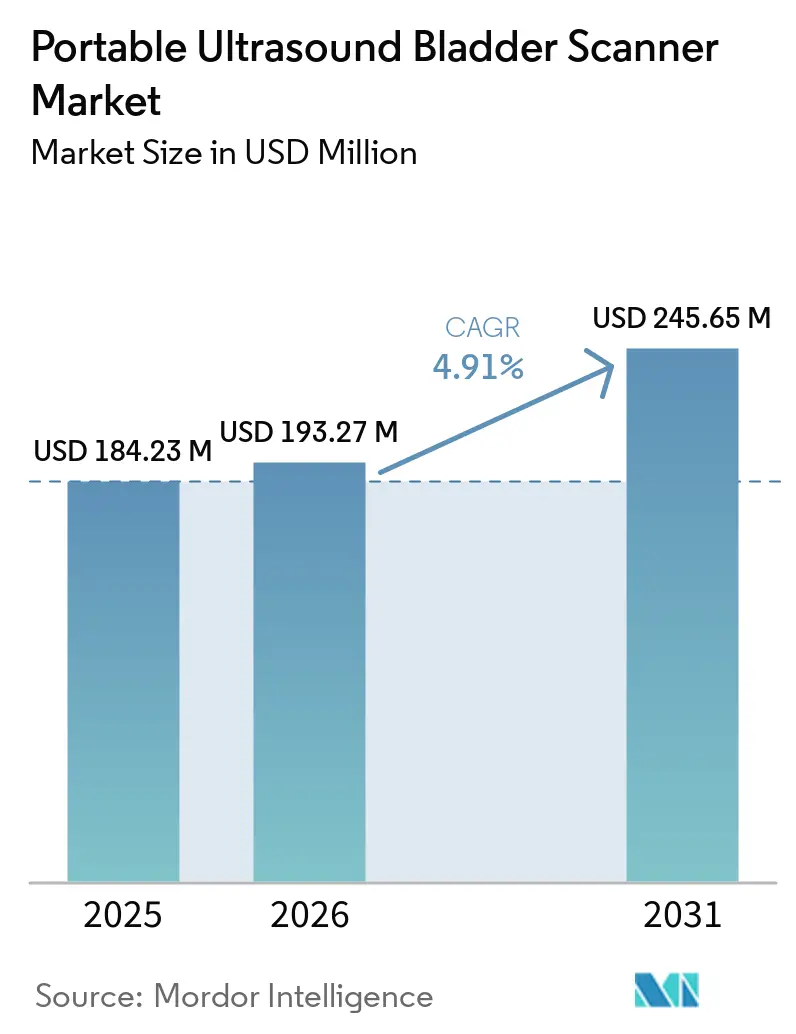
Portable Ultrasound Bladder Scanner market size in 2026 is estimated at USD 193.27 million, growing from 2025 value of USD 184.23 million with 2031 projections showing USD 245.65 million, growing at 4.91% CAGR over 2026-2031.
This growth continues even as the technology matures and competition intensifies. Aging populations, miniaturization of ultrasound components and favorable reimbursement updates sustain demand, while regulatory complexity and operator-training gaps temper adoption. Market leaders are responding with AI-enabled automation, portfolio expansion and targeted solutions for long-term care, home-care and ambulatory environments. Alongside these drivers, the market is witnessing sharper segmentation dynamics and geographic expansion. Competition features global imaging giants and agile start-ups; both groups are embedding AI to improve accuracy and cut scan time. The single biggest barrier is the persistent shortage of trained users, partly offset by AI tools that automate image capture and interpretation.
Key Report Takeaways
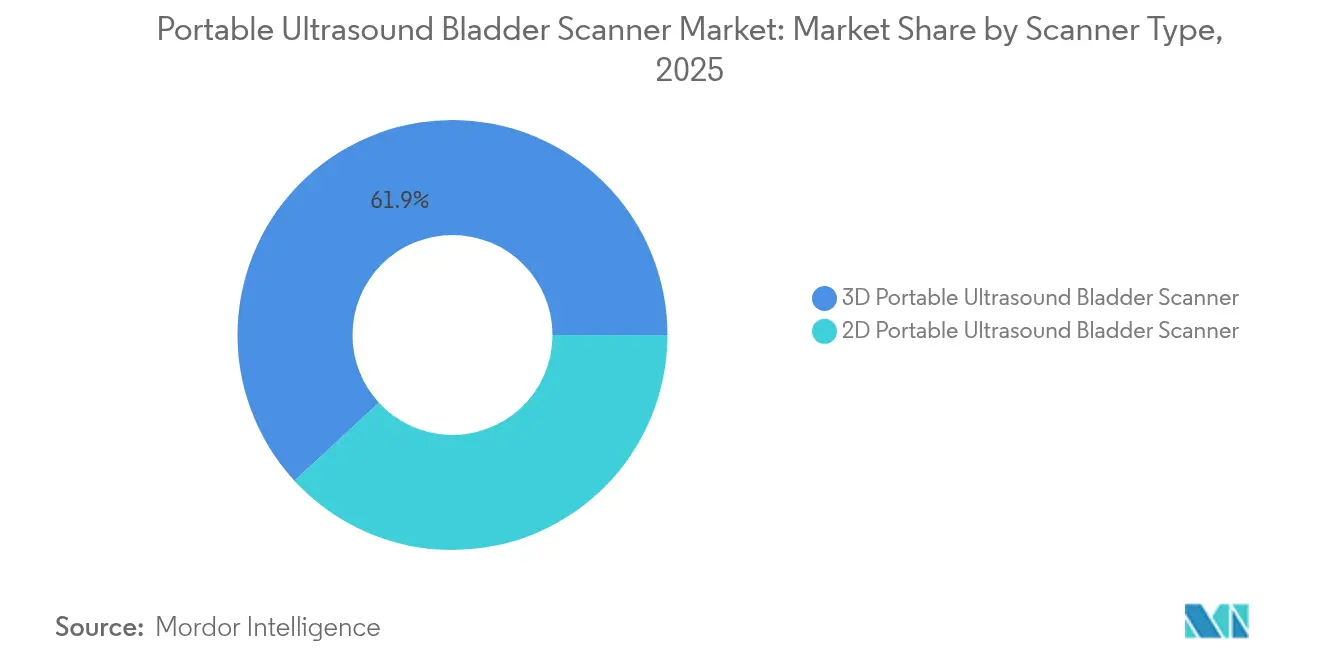
- By scanner type, 3D technology captured 61.85% of the portable ultrasound bladder scanner market share in 2025; 2D technology is expanding at an 8.61% CAGR through 2031.
- By device type, handheld units led with 54.10% revenue share in 2025, while the same segment is projected to post an 10.91% CAGR between 2026 and 2031.
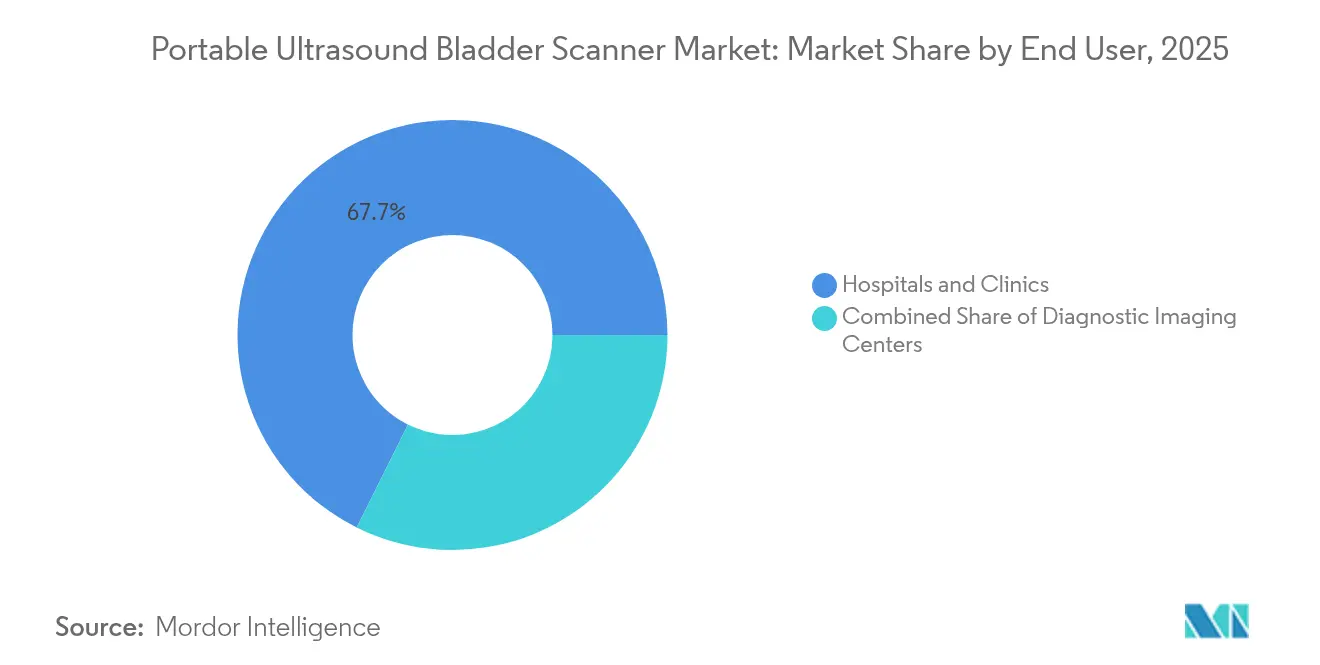
- By end-user, hospitals and clinics held 67.65% of the 2025 portable ultrasound bladder scanner market size, whereas home-care and long-term care facilities are accelerating at 12.83% CAGR during 2026-2031.
- By geography, North America commanded 39.25% of the 2025 portable ultrasound bladder scanner market share; Asia-Pacific is set to grow at 9.57% CAGR to 2031.
Note: Market size and forecast figures in this report are generated using Mordor Intelligence’s proprietary estimation framework, updated with the latest available data and insights as of 2026.
Market Trends and Insights
Drivers Impact Analysis of Portable Ultrasound Bladder Scanner Market*
| Driver | (~) % Impact on CAGR Forecast | Geographic Relevance | Impact Timeline |
|---|---|---|---|
| Ageing population surge | +1.8% | North America, Europe, East Asia | Long term (≥4 years) |
| Healthcare shift toward non-invasive POC | +1.5% | North America, Western Europe | Medium term (2-4 years) |
| Continuous innovation in portable platforms | +1.2% | Global | Medium term (2-4 years) |
| Growing adoption of POCUS | +1.0% | Developed healthcare markets | Short term (≤2 years) |
| Rising prevalence of urological disorders | +1.6% | Global | Long term (≥4 years) |
| Integration of AI & smart imaging | +1.4% | Global, innovation hubs in North America & Europe | Medium term (2-4 years) |
| Source: Mordor Intelligence | |||
Ageing Population Surge Elevating Demand for Bladder-Volume Monitoring
The number of people aged 65 years and older is climbing at an unprecedented pace, escalating incidence of benign prostatic hyperplasia and related urinary complications. Scientific Reports highlighted 112.5 million BPH cases globally in 2024, with highest prevalence in Eastern Europe, Central Latin America and Andean Latin America. Medicare data further indicate urinary incontinence in 11.2% of beneficiaries, rising to 20.6% in skilled nursing facilities. These demographics elevate routine bladder-volume monitoring, making a compelling clinical and economic case for the portable ultrasound bladder scanner market and wider adoption of bladder scanners.
Healthcare Shift Toward Non-Invasive Point-of-Care Diagnostics
Clinical protocols now prioritize infection reduction, patient comfort and rapid decision-making. A 2024 acute-stroke study showed UTIs falling to 4.0% after portable bladder ultrasound adoption, while length-of-stay dropped simultaneously.[1] Medicare’s 2025 Physician Fee Schedule introduced telehealth and caregiver-training codes that encourage remote diagnosis tools.[2] These reforms directly support accelerated uptake in home-care and community settings.
Continuous Innovation in Portable & Handheld Ultrasound Platforms
Manufacturers improve hardware and embed AI algorithms that automate bladder detection and volume calculation. Verathon’s ImageSense keeps error within ±7.5% between 100-999 mL. Samsung Medison bought Sonio to infuse AI across its line-up. Memory-efficient segmentation algorithms further boost 2D performance on resource-constrained chips, cutting cost while sustaining quality .
Growing Adoption of POCUS in Emergency, Critical-Care & Primary Settings
POCUS devices shorten triage times and enhance bedside decision-making. A 2024 cross-sectional comparison of six handheld units found narrowing image-quality gaps; factors like battery life and probe size now drive purchasing.[3] Robotic ultrasound prototypes combine sonographer and radiologist roles into one reinforcement-learning-guided unit, pointing to lower operator dependency. Oncology departments use bladder ultrasound to ensure accurate CyberKnife dosing, illustrating expanding application breadth.
Restraints Impact Analysis of Portable Ultrasound Bladder Scanner Market*
| Restraint | (~) % Impact on CAGR Forecast | Geographic Relevance | Impact Timeline |
|---|---|---|---|
| Shortage of skilled operators | -1.3% | Emerging markets, rural areas | Medium term (2-4 years) |
| Variable reimbursement frameworks | -0.9% | Fragmented healthcare systems | Short term (≤2 years) |
| Complex regulatory approval processes | -0.7% | Regions with multi-agency oversight | Medium term (2-4 years) |
| Limited accuracy in complex cases | -0.6% | Patients with pelvic organ prolapse or obesity | Long term (≥4 years) |
| Source: Mordor Intelligence | |||
Shortage of Skilled Operators for Ultrasound Interpretation
Formal ultrasound training remains limited across primary-care and long-term care facilities. Although AI features such as automated bladder outlining cut learning curves, these tools still require integration spending and user confidence. Smaller providers hesitate to invest without immediate reimbursement certainty.
Variable Reimbursement & Coding Frameworks Across Regions
Medicare’s 2025 rule acknowledged telehealth ultrasound but omitted specific bladder-scan codes, creating ambiguity. The NIH SEED program emphasized that reimbursement clarity can equal regulatory approval in importance. Manufacturers must customize commercial strategies country by country, delaying uniform rollouts.
*Our forecasts treat driver/restraint impacts as directional, not additive. The impact forecasts reflect baseline growth, mix effects, and variable interactions.
Portable Ultrasound Bladder Scanner Market Segment Analysis
By Scanner Type:
3D Lead, 2D Accelerating3D scanners held 61.85% of 2025 revenue within the portable ultrasound bladder scanner market. Their volumetric precision suits complex anatomy, including prolapse cases where catheterization error risk is high. Nonetheless, 2D scanners are scaling at 8.61% CAGR during 2026-2031 as algorithmic upgrades tighten accuracy bands. Memory-efficient segmentation now runs on lower-cost processors, driving down average selling prices and widening addressable demand. Procurement teams increasingly compare price-performance ratios rather than absolute accuracy, allowing 2D to penetrate resource-constrained settings. The portable ultrasound bladder scanner market size for 2D systems is therefore projected to expand faster than for 3D, though the latter retains hospital preference for high-acuity wards.
Advances in handheld form factors compound the 2D opportunity. Integrated AI makes capturing orthogonal views less operator-dependent, while Wi-Fi connectivity streamlines record transfer. Leading 3D vendors respond by bundling software licenses and extended warranties. Resulting competition improves total cost of ownership for all scanner types, sustaining double-digit shipment growth across emerging economies.

By Device Type:
Handhelds Outperform Cart-Based UnitsHandheld devices generated 54.10% of 2025 revenue and are on track for 10.91% CAGR to 2031 double the overall portable ultrasound bladder scanner market rate. Clinical trials show handhelds match cart-based diagnostic accuracy for bladder measurements, yet offer bedside convenience and lower maintenance. This parity expands their use in emergency rooms, nursing homes and home-visit programs. The portable ultrasound bladder scanner market size attached to handhelds is forecast to breach USD 151.3 million by 2031, representing the category’s sustained dominance.
Traditional mobile-cart and bench-top units still serve intensive-care wards needing large displays and multi-probe capability. They integrate with hospital PACS systems and remain crucial where traceability rules mandate full DICOM compliance. AI add-ons now optimize these larger systems too, making them relevant even as handhelds gain ground. Decision-makers thus allocate budgets across both tiers, ensuring ecosystem continuity and driving software subscription revenues for manufacturers.
By End User:
Home-Care Gains Momentum over HospitalsHospitals and clinics controlled 67.65% revenue in 2025 due to entrenched procurement cycles and procedure volumes. Yet the portable ultrasound bladder scanner market is tilting toward decentralized care. Home-care and long-term care facilities record a 12.83% forecast CAGR, underpinned by bundled reimbursement for remote diagnostics and a shift of geriatric services out of hospital walls. Studies show catheterization rates fall 80% when care teams adopt portable scanners, verifying economic returns in community settings.
Diagnostic imaging centers and ambulatory surgery centers are secondary but strategic buyers. They deploy scanners to accelerate throughput and reduce urinary retention complications in day-case procedures. Vendors therefore tailor service contracts, offering mobile-first designs for home-care providers and networked configurations for centralized imaging chains. Such segmentation strategies assure manufacturers access to varied growth pockets inside the portable ultrasound bladder scanner market.
Geography Analysis
North America and LATAM Portable Ultrasound Bladder Scanner Market
North America leads with 39.25% 2025 revenue in the portable ultrasound bladder scanner market, powered by Medicare beneficiaries’ high urinary-incontinence prevalence and supportive device coding. FDA down-classification has shortened time-to-market, fostering quicker portfolio refreshes. Canada trails the United States yet follows similar adoption trajectories, whereas Mexico’s private hospitals spearhead demand within Latin America.
Europe Portable Ultrasound Bladder Scanner Market
Europe ranks second. Germany posts the highest unit volumes, driven by multi-facility nursing home adoption where indwelling catheter prevalence reached 13.4%. The United Kingdom and France follow, leveraging national health priorities that target hospital-acquired infection reduction. Southern Europe accelerates as aging demographics stretch public healthcare budgets, elevating interest in cost-effective bladder monitoring.
APAC Portable Ultrasound Bladder Scanner Market
Asia-Pacific delivers the swiftest growth at 9.57% CAGR. China benefits from state investments in primary clinics and the world’s largest elderly cohort. Domestic vendors supply affordable scanners, but multinationals retain premium hospital tiers. Japan’s super-aged society drives high per-capita utilization, while India’s growing middle class catalyzes urban uptake. Strategic acquisitions, such as Samsung Medison’s AI push, further stimulate the regional portable ultrasound bladder scanner market.
MEA and South America Portable Ultrasound Bladder Scanner Market
Middle East & Africa and South America show steady but uneven progress. GCC states’ hospital modernizations include bladder-scanner deployments, yet rural access lags. Brazil and Argentina dominate South American sales within private urban networks. Urban-rural divides therefore shape localized marketing tactics and after-sales footprints.
Regulatory Landscape
Portable ultrasound bladder scanners are regulated as medical devices in major markets, and the United States commonly uses the FDA 510(k) pathway for Class II ultrasound imaging systems (21 CFR 892.1560). A key compliance inflection point is the FDA Quality Management System Regulation (QMSR) effective February 2, 2026, which incorporates ISO 13485:2016 by reference and shifts quality-system expectations toward ISO-aligned documentation and inspection practices.
For global commercialization and supply continuity, manufacturers also manage product standards and trade administration requirements that influence time-to-market and landed cost. In cross-border shipments, these devices fall under HS code 9018.12 (ultrasonic scanning apparatus), making correct classification important for customs clearance across regions. Recent US market access activity includes FDA 510(k) clearance for Astrasono Technology Co., Ltd. (K250331, September 2025), reflecting continued supplier onboarding within the established regulatory framework.
Competitive Landscape
Market concentration is moderate. Verathon tops the field through its BladderScan line and ImageSense AI, reinforcing brand loyalty via accuracy claims. GE Healthcare Technologies and Philips diversify from broad ultrasound portfolios into dedicated bladder units, leveraging global service channels. Samsung Medison’s purchase of Sonio signals major imaging vendors’ intent to secure AI talent.
Disruptors include Butterfly Network and Clarius Mobile Health. Butterfly pivoted beyond general ultrasound, launching iQ+ Bladder in May 2024 to address specialized workflows. Clarius won FDA clearance for Bladder AI in January 2024, offering cloud-enabled volume calculation. Start-ups emphasize SaaS revenue, remote updates and subscription models, challenging legacy hardware-centric approaches.
Strategic moves also target underserved segments. Exo’s Iris handheld integrates SweepAI, positioning for home-visits and paramedic fleets. Partnerships with telehealth providers embed bladder scanning into virtual care pathways. The resulting ecosystem competition enhances device capability, lowers unit prices and broadens access across the portable ultrasound bladder scanner market.
Portable Ultrasound Bladder Scanner Industry Leaders
-
Becton, Dickinson and Company
-
dBMEDx Inc.
-
GE Healthcare Technologies Inc.
-
Caresono Technology Co., Ltd.
-
Echo-Son SA
- *Disclaimer: Major Players sorted in no particular order
Portable Ultrasound Bladder Scanner Market Companies Covered in this Report
- Verathon
- GE Healthcare Technologies Inc.
- LABORIE Medical Technologies Corp.
- dBMEDx
- Caresono Technology Co., Ltd.
- Vitacon US LLC
- EchoNous (Signostics Inc.)
- Sonostar Technologies
- Beckton Dickinson
- Wuhan Tianyi Electronic
- MCube Technology Co., Ltd.
- SRS Medical Systems Inc.
- Echo-Son SA
- Butterfly Network, Inc.
- Clarius Mobile Health Corp.
- SonoScape Medical Corp.
- Vave Health
- Mindray Bio-Medical Electronics Co., Ltd.
- Koninklijke Philips
- Meike Co., Ltd. (CubeScan)
Read Analysis of Portable Ultrasound Bladder Scanner Companies
Market Opportunities and Future Outlook
The most actionable opportunity is scaling bladder scanning into decentralized care settings where operator skill varies and workflows require fast, repeatable measurements. Standardized clinical training and protocolization support this shift, including the NSW Agency for Clinical Innovation (ACI) clinician toolkit that codifies indications and measurement steps for non-sonographer users. This aligns with the broader need to reduce operator dependency emphasized across long-term care and home-care deployments.
Additional commercial pull comes from continued FDA clearances that widen product choice and raise feature competition around automation and point-of-care usability. For example, the FDA 510(k) clearance for Edgecare, Inc. EdgeFlow UW20 (K252237, April 2026) and Astrasono A3Pro (K250331, September 2025) adds to the set of available bladder-volume scanners. As portfolios expand, vendors can differentiate through AI-assisted volume calculation, workflow integration, and compliance-ready design (including adherence to widely used safety and performance standards for diagnostic ultrasound systems), which can lower training burden and support broader rollout beyond acute-care imaging departments.
Recent Industry Developments in Portable Ultrasound Bladder Scanner Market
- April 2026: Edgecare, Inc. received US FDA 510(k) clearance for the EdgeFlow UW20 bladder scanner (K252237). The clearance adds another option for providers seeking dedicated bladder-volume assessment in point-of-care workflows and reinforces the pace of new product entries under the established Class II pathway.
- July 2025: GE HealthCare received US FDA 510(k) clearance for its Venue and Venue Go ultrasound primary imaging systems (K251322). While not limited to bladder scanning, the clearance supports broader point-of-care ultrasound deployments where bladder assessment can be incorporated into multi-purpose bedside imaging platforms.
- May 2024: Butterfly Network launched iQ+ Bladder, expanding from general-purpose handheld ultrasound into a dedicated bladder scanning workflow. This increased competitive pressure on specialized bladder-scanner incumbents by bringing a software-driven platform approach into bladder volume measurement use cases.
Portable Ultrasound Bladder Scanner Market Report Scope and Research Methodology
Market Definition and Coverage
This market covers revenue generated from portable ultrasound bladder scanners that are used to noninvasively estimate bladder volume and post-void residual in clinical care, supporting urinary retention assessment and catheterization decisions.
Scope exclusions: The model excludes general-purpose ultrasound systems and urology disposables. It also excludes procedure fees that may be billed separately from device sales.
Segments Covered in This Report
- By Scanner Type
- 2D Portable Ultrasound Bladder Scanner
- 3D Portable Ultrasound Bladder Scanner
- By Device Type
- Handheld Portable
- Mobile-Cart
- Bench-top
- By End User
- Hospitals & Clinics
- Diagnostic Imaging Centers
- Ambulatory Surgical Centers
- Home-Care & Long-Term Care Facilities
- By Geography
- North America
- United States
- Canada
- Mexico
- Europe
- Germany
- United Kingdom
- France
- Italy
- Spain
- Rest of Europe
- Asia-Pacific
- China
- Japan
- India
- Australia
- South Korea
- Rest of Asia-Pacific
- Middle East & Africa
- GCC
- South Africa
- Rest of Middle East & Africa
- South America
- Brazil
- Argentina
- Rest of South America
- North America
Data Sources, Market Sizing, and Validation
Desk Research
Desk work was used to set boundaries for what qualifies as a portable ultrasound bladder scanner and to map the demand-side need for bladder volume monitoring. References included public and official sources such as the US FDA device database, the US Centers for Medicare and Medicaid Services (for related coding context), the CDC (for urinary health burden indicators), and the World Health Organization for broader care delivery signals.
To keep inputs grounded, we also used company annual reports, investor decks, product specification sheets, and clinical guidelines posted by medical associations. Reputable healthcare press coverage was reviewed for launch and pricing context. In a few cases, paid subscriptions were used only to speed up financial checks, patent lookups, and scanning for tenders and publicly announced procurement. These desk sources are illustrative rather than exhaustive, and additional public documents were reviewed to fill gaps, validate assumptions, and resolve definition questions.
Primary Interviews and Surveys
Primary discussions were run with a mix of hospital procurement stakeholders, clinicians using bladder scanners in wards and outpatient settings, and distributor or service-side participants who see real purchase cycles. For global coverage, inputs were balanced across mature and developing healthcare systems so assumptions on adoption, replacement cycles, and typical selling prices could be checked and corrected where needed.
Distribution of primary research fieldwork respondents
| Company type | Respondent position | Region |
|---|---|---|
| Top tier: 39% | CXOs: 12% | APAC: 47% |
| Mid tier: 43% | Functional/Unit leaders: 33% | EMEA: 30% |
| Smaller Players: 18% | Managers: 55% | Americas: 23% |
Market-Sizing & Forecasting
Sizing starts with a top-down build that links eligible care settings to bladder-scan usage, then converts that demand pool into device value using realistic replacement timing and average selling price bands. In practice, model inputs reflect inpatient and post-operative care volumes, urinary retention and catheterization risk indicators, the shift toward point-of-care ultrasound, and purchasing cycles in hospitals and long-term care settings.
After the total is formed, we validate it through selective bottom-up checks. Where public disclosures exist, we roll up a sample of supplier revenues, validate typical ASP ranges using product catalogs and tenders, and confirm channel mix through distributor interviews. When data is thin, gaps are handled by using proxy adoption rates from similar portable ultrasound categories, then correcting them using region-specific interview feedback.
For the forecast, scenario analysis was the main approach, supported by trend checks on hospital capital budgets, technology refresh (2D versus 3D mix), and expected penetration changes across regions. Assumptions are kept explicit so a reader can follow how each input affects the final number.
Data Validation & Update Cycle
Before finalizing, outputs are checked against independent signals, including how quickly installed bases can realistically expand given replacement cycles and procurement lead times. When variances show up, we investigate whether they can be explained by real demand or price movement. If the change cannot be justified, assumptions are revised and the relevant experts are re-contacted.
A multi-step internal review is then completed so definitions, units, and conversions stay consistent across regions and years. The report is refreshed annually, with interim updates when material events occur, such as major regulatory actions, product launches, or pricing shifts. Right before delivery, we run a final pass to ensure the numbers align with the latest confirmed information.
Mordor Intelligence's Portable Ultrasound Bladder Scanner Market Size Measured Against Other Published Estimates
Published values for this market can differ even when the topic sounds identical, because each publisher may draw the line differently between portable bladder scanners and broader ultrasound devices. Variations also come from different base years and currency timing.
By tracking installed-base replacement cycles and refreshing ASP bands using procurement and distributor checks, Mordor Intelligence keeps the scope focused on portable bladder scanner device revenues tied to bladder volume and post-void residual measurement, excluding multi-purpose ultrasound carts and service-heavy totals.
Benchmark comparison
| Source | Market Size | Gaps in Research Methodology |
|---|---|---|
| Mordor Intelligence | USD 193.27 M (2026) | |
| Global Consultancy A | USD 280.90 M (2024) | Uses a different base year and appears to anchor the total on a broader point-of-care ultrasound demand pool, which can pull in adjacent portable ultrasound revenues beyond bladder-only scanning. |
| Industry Publisher B | USD 245.30 M (2023) | Starts from an earlier year and likely applies a wider device-definition boundary (including non-portable or multi-purpose bladder assessment platforms), which can lift the market value even if unit demand is similar. |
The spread is mainly explained by scope boundaries and year anchoring, and then secondarily by how price progression is assumed across regions. When the model is traceable to care-setting usage, replacement timing, and realistic ASP ranges, the final market size is easier to reproduce and to stress-test for planning.
Key Questions Answered in the Report
What is the current portable ultrasound bladder scanner market size and projected growth?
The portable ultrasound bladder scanner market size is USD 193.27 million in 2026 and is forecast to reach USD 245.65 million by 2031, growing at a 4.91% CAGR.
Which scanner technology leads the market today?
3D scanners dominate with 61.85% revenue share in 2025 due to superior volumetric accuracy.
Why are handheld scanners gaining popularity?
Handheld units combine hospital-grade accuracy with portability, fueling an 10.91% CAGR between 2026 and 2031.
Which end-user segment is expanding the fastest?
Home-care and long-term care facilities are advancing at 12.83% CAGR as care shifts outside hospitals.
What role does AI play in new bladder scanners?
AI automates bladder detection and volume calculation, reducing operator dependency and improving workflow efficiency.
Which region offers the highest growth potential?
Asia-Pacific exhibits the fastest expansion at 9.57% CAGR, driven by large elderly populations and rising healthcare investment.