
Polycarbonate Diols Market Size and Share
Market Overview
| Study Period | 2021 - 2031 |
|---|---|
| Market Size (2026) | USD 309 Million |
| Market Size (2031) | USD 398.52 Million |
| Growth Rate (2026 - 2031) | 5.22 % |
| Fastest Growing Market | Asia-Pacific |
| Largest Market | Asia-Pacific |
| Market Concentration | Medium |
Major Players *Disclaimer: Major Players sorted in no particular order Image © Mordor Intelligence. Reuse requires attribution under CC BY 4.0. | |
Polycarbonate Diols Market Analysis by Mordor Intelligence
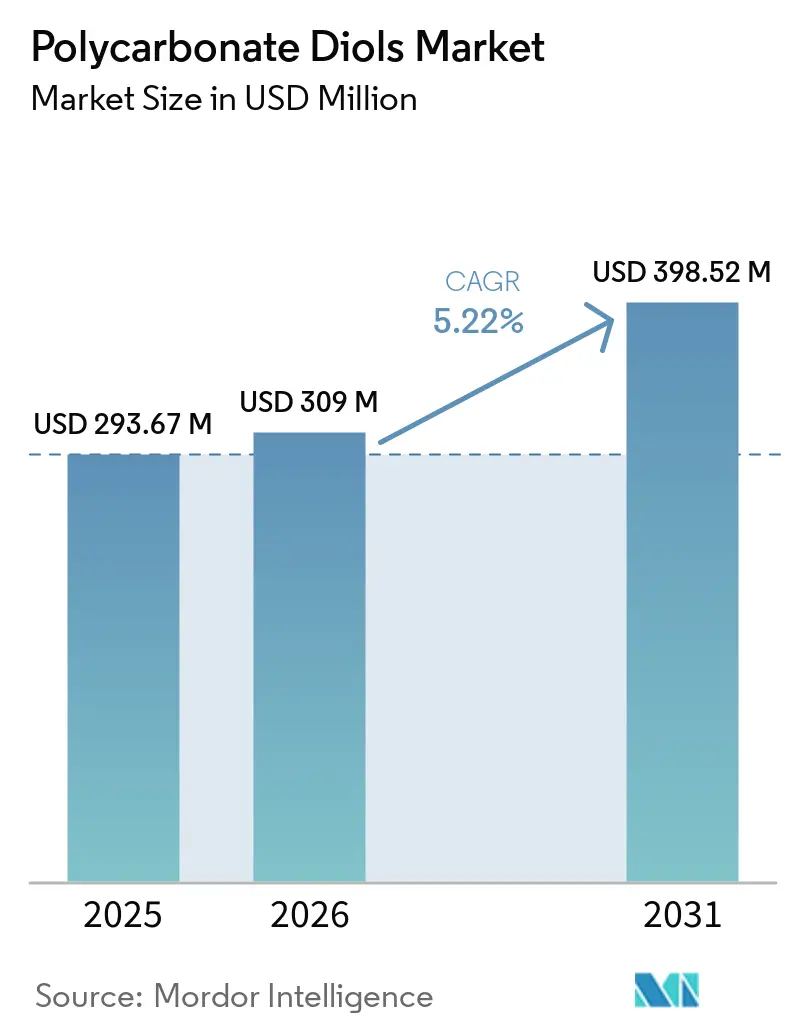
The Polycarbonate Diols Market size was valued at USD 293.67 million in 2025 and is estimated to grow from USD 309.00 million in 2026 to reach USD 398.52 million by 2031, at a CAGR of 5.22% during the forecast period (2026-2031). The polycarbonate diols market is supported by demand for durable polyurethane materials used in automotive interiors, synthetic leather, and industrial coatings. Carbonate linkages help polyurethane systems retain hydrolysis resistance, weatherability, and abrasion resistance in demanding conditions. Waterborne polyurethane dispersions need durable soft-segment materials because water exposure can weaken ester-based alternatives during production and use. Producers are separating specialty portfolios based on bio-based and carbon dioxide-derived materials from standard grades that face greater price pressure. High production costs and lengthy automotive qualification cycles will continue to limit adoption in applications where performance requirements are less demanding.
Key Report Takeaways
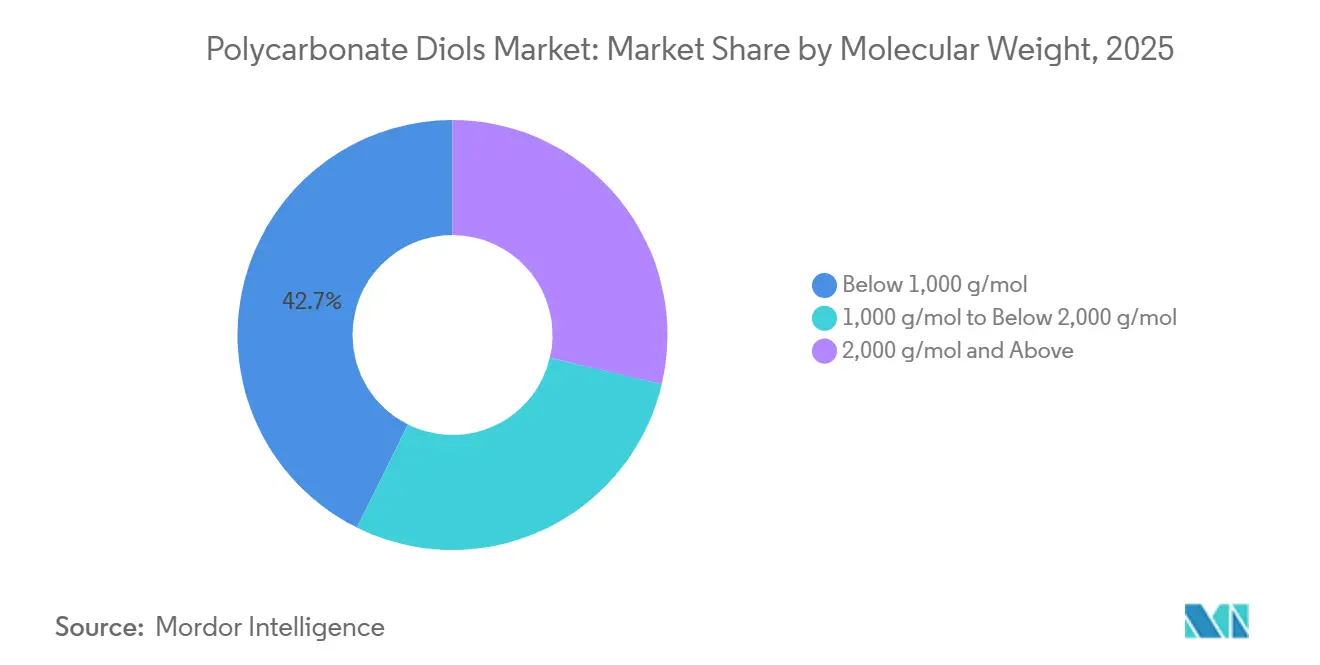
- By molecular weight, 1,000 g/mol to below 2,000 g/mol held 42.67% of the polycarbonate diols market share in 2025 and is projected to advance at a 5.78% CAGR through 2031.
- By form, liquid held 58.11% of the polycarbonate diols market share in 2025, while solid is projected to advance at a 5.95% CAGR through 2031.
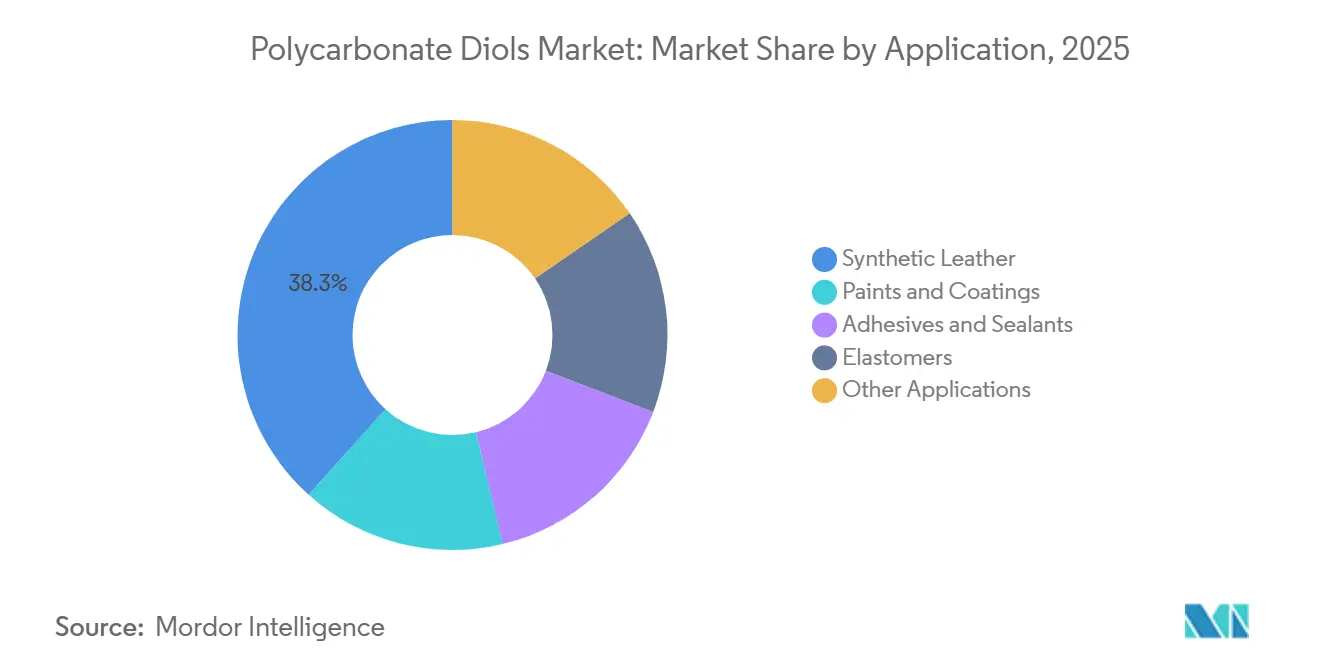
- By application, synthetic leather held 38.34% of the polycarbonate diols market share in 2025 and is projected to advance at a 6.11% CAGR through 2031.
- By geography, Asia-Pacific held 48.86% of the polycarbonate diols market share in 2025 and is projected to advance at a 6.05% CAGR through 2031.
Note: Market size and forecast figures in this report are generated using Mordor Intelligence’s proprietary estimation framework, updated with the latest available data and insights as of January 2026.
Global Polycarbonate Diols Market Trends and Insights
Drivers Impact Analysis*
| Driver | (~) % Impact on CAGR Forecast | Geographic Relevance | Impact Timeline |
|---|---|---|---|
| High-Performance Polyurethane Demand in Automotive Synthetic Leather | +1.6% | Asia-Pacific (China, Japan, South Korea), Germany, Rest of Europe | Medium term (2–4 years) |
| Expansion of Waterborne Polyurethane Dispersions | +1.2% | Global; APAC core, spillover to North America & Europe | Medium term (2–4 years) |
| Stringent Volatile Organic Compound Regulations | +0.9% | North America, EU, China | Short term (≤ 2 years) |
| Demand for Hydrolysis-Resistant Coatings and Elastomers | +0.7% | Global; most acute in North America and Europe | Long term (≥ 4 years) |
| Bio-Based and Carbon-Derived Polycarbonate Diol Development | +0.4% | Europe, Japan, North America | Long term (≥ 4 years) |
| Source: Mordor Intelligence | |||
High-Performance Polyurethane Demand in Automotive Synthetic Leather
Automotive original equipment manufacturers are updating seat, door-panel, and headliner specifications for battery electric vehicles. Enclosed cabins can experience higher humidity, which can accelerate degradation in polyester-based polyurethane materials. A 2025 study found that polycarbonate diol-based polyurethanes retained more than 90% of the original tensile strength after 28 days of immersion at 70 °C. Polyester polyurethane alternatives lost 40% to 70% of their strength under the same exposure conditions. This performance gap is encouraging Tier 1 interior suppliers in China and South Korea to use polycarbonate diols in synthetic leather wet-processing lines for longer warranty programs. The polycarbonate diols market gains demand when interior suppliers treat moisture durability as a required qualification feature rather than an optional upgrade.
Expansion of Waterborne Polyurethane Dispersions
The expansion of waterborne polyurethane dispersions is increasing demand for durable soft-segment materials in leather, wood, and textile finishing. Waterborne systems expose ester linkages to moisture during dispersion preparation, which can reduce material performance before application. Polycarbonate diols can provide a more stable alternative where dispersion particle stability and film properties are important. UBE has commercialized ETERNACOLL polycarbonate diols for waterborne polyurethane dispersions used in digital textile printing binders and durable leather finishing. BASF commissioned a new dispersion production line in Türkiye in October 2025, which illustrates continued investment in waterborne polyurethane capacity. The polycarbonate diols market, therefore, benefits when large coating producers need reliable, high-purity materials for waterborne production assets.
Stringent Volatile Organic Compound Regulations
Volatile organic compound regulations are narrowing the use of solvent-heavy coating formulations. The U.S. Environmental Protection Agency revised product-weighted reactivity limits for aerosol coatings in January 2025[1]“National Volatile Organic Compound Emission Standards for Aerosol Coatings,” Federal Register, govinfo.gov. The limit for vinyl/fabric/leather/polycarbonate coatings declined from 1.55 to 1.45 g O₃/g product, effective July 17, 2025. South Coast Air Quality Management District Rule 1151 amendments took effect in May 2025 and tightened automotive coating limits while phasing out para-chlorobenzotrifluoride (PCBTF) and tert-butyl acetate (t-BAc). These measures encourage polyurethane formulators to develop waterborne systems that maintain abrasion resistance and adhesion performance across major regulatory jurisdictions. The polycarbonate diols market has a clearer route into coating programs when compliance and performance must be achieved in the same formulation.
Demand for Hydrolysis-Resistant Coatings and Elastomers
Coatings and elastomers in offshore wind, marine equipment, outdoor sports products, and premium footwear face extended exposure to moisture. This exposure makes hydrolysis resistance more important for polyurethane selection. A 2025 study reported that carbon dioxide-based polycarbonate diol-derived waterborne polyurethane films achieved water absorption below 8%. The study compared these films with polyethylene carbonate diol (PECD)-based formulations without hydrophobic modification that showed water absorption above 40%. The polycarbonate diols market can benefit as longer warranties and extended product-life requirements make durable material performance a qualification requirement in coatings and elastomers. Suppliers can use this performance to support higher-value material specifications in applications exposed to repeated moisture contact.
Restraints Impact Analysis*
| Restraint | (~) % Impact on CAGR Forecast | Geographic Relevance | Impact Timeline |
|---|---|---|---|
| High Production Cost Relative to Polyester and Polyether Polyols | -0.3% | Global; most acute in North America and Europe | Long term (≥ 4 years) |
| Complex Processing and High-Purity Feedstock Requirements | -0.2% | Global; most acute in emerging markets | Medium term (2–4 years) |
| Qualification Cycles for Automotive and Industrial Formulations | -0.1% | North America, Europe, Japan | Medium term (2–4 years) |
| Source: Mordor Intelligence | |||
High Production Cost Relative to Polyester and Polyether Polyols
Production economics limit the use of polycarbonate diols in cost-sensitive applications. Non-phosgene transesterification requires multi-stage reactor systems, controlled temperature and vacuum distillation, and detailed quality control. These steps are needed to achieve the molecular weight consistency required in high-performance polyurethane applications. Per-metric-ton costs remain 3x to 5x higher than standard polyester polyols and exceed polyether alternatives. The cost difference is most restrictive in general industrial adhesives, standard footwear, and lower-grade coatings, where customers place less value on added durability. The polycarbonate diols market consequently remains focused on applications where hydrolysis resistance and service life justify the additional material cost.
Complex Processing and High-Purity Feedstock Requirements
Polycarbonate diol synthesis needs high-purity diol feedstocks, including 1,6-hexanediol, 1,5-pentanediol, and 1,4-butanediol. Feedstock quality affects color and molecular weight consistency in the final polymer. Supply concentration for specialty diols can transfer upstream price volatility into polycarbonate diol production costs. Solid grades also require heated storage and transfer because common grades melt between 40 °C and 55 °C. These requirements can delay local supply development in South and Southeast Asia, where high-purity diol supply chains and specialized processing capabilities remain limited. The polycarbonate diols market faces slower regional supply expansion, where producers cannot secure suitable feedstocks and temperature-controlled operating systems.
*Our forecasts treat driver/restraint impacts as directional, not additive. The impact forecasts reflect baseline growth, mix effects, and variable interactions.
Segment Analysis
By Molecular Weight: 1,000 g/mol to Below 2,000 g/mol Support Premium Polyurethane Formulations
The 1,000 g/mol to below 2,000 g/mol range accounted for 42.67% of the market revenue in 2025. This range represented the largest part of the polycarbonate diols market size for molecular weight grades. Formulators use these grades because they balance viscosity, isocyanate reactivity, and soft-segment length. This balance supports solution processing and dispersion processing without the heated equipment required for some higher-molecular-weight materials. It also makes the range suitable for established polyurethane production lines that need consistent handling conditions.
The 1,000 g/mol to below 2,000 g/mol range is projected to advance at a 5.78% CAGR through 2031. Automotive synthetic leather and high-performance coatings use these grades where durable polyurethane layers are required. Premium adhesive programs in the polycarbonate diols market use a range where processing balance and hydrolysis resistance are important. Below 1,000 g/mol grades serve UV-curable topcoats and high-gloss furniture laminates that need high hard-segment content and crosslink density. Grades of 2,000 g/mol and above serve elastomers, thermoplastic polyurethane, and long-chain adhesive systems needing flexibility and low-temperature performance.



By Form: Liquid Leads Demand, While Solid Gains Processing Relevance
Liquid held 58.11% of the market revenue in 2025. Its position reflects the convenience of ambient-temperature processing in facilities without heated storage or transfer equipment. Existing polycarbonate diols market supply chains for synthetic leather wet-processing in the Asia-Pacific are largely designed for liquid feedstocks. Waterborne dispersion plants also use liquid materials within established handling systems. Liquid grades support solvent-based adhesive formulations that depend on familiar processing practices.
Solid is projected to advance at a 5.95% CAGR through 2031. Its growth is tied to high-purity melt-processing uses in thermoplastic polyurethane compounding, medical-grade elastomers, and high-performance cable jacketing. These applications need controlled molecular weight distributions that solid materials can provide. Producers in the polycarbonate diols market across Germany, Japan, and South Korea are investing in melt-processing lines that can use solid grades. Liquid and solid materials are not fully interchangeable because the form affects processing conditions and downstream capital needs.
By Application: Synthetic Leather Anchors Both Share and Growth
Synthetic leather accounted for 38.34% of the market revenue in 2025. The application represented the largest contribution to the polycarbonate diols market size. Automotive interiors use polyurethane layers that can resist hydrolysis in humid conditions. Premium footwear also needs durable materials that preserve performance during repeated use. Asian polycarbonate diols market supply chains have integrated these materials into synthetic leather production for demanding customer specifications.
Synthetic leather is projected to advance at a 6.11% CAGR through 2031. Battery electric vehicle interiors support demand because enclosed-cabin conditions can accelerate degradation in polyester-based polyurethane. Paints and coatings use polycarbonate diol soft segments for color stability, abrasion resistance, and waterborne formulation performance. A 2025 study found that polycarbonate diol-modified two-component polyurethane coatings reduced abrasion mass loss by 43% to 71% compared with unmodified controls. Adhesives, sealants, and elastomers have value in terms of resistance to hydrolysis and adhesion to plastic and metal substrates.
Geography Analysis
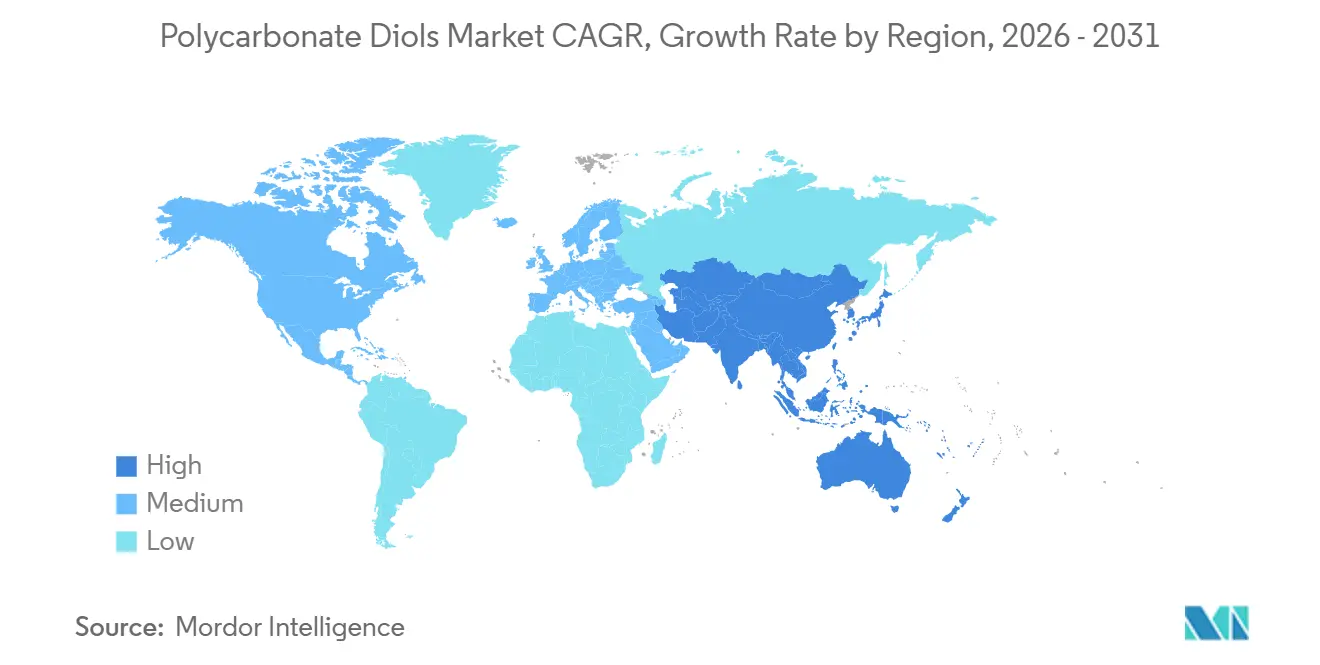
Asia-Pacific held 48.86% of the market revenue in 2025 and is projected to advance at a 6.05% CAGR through 2031. The region has the largest polycarbonate diols market size because China, Japan, South Korea, and the Association of Southeast Asian Nations countries have major synthetic leather, footwear, and industrial coatings supply chains. China is the largest national demand center in the region. Production and consumption are concentrated in the Yangtze Delta, Pearl River Delta, and Bohai Rim industrial corridors. East China’s demand is supported by producers in Jiangsu, Zhejiang, and Shandong.
Japanese producers, including UBE Corporation, Asahi Kasei Corporation, KURARAY CO., LTD., Tosoh Corporation, and Daicel Corporation, have supported export-oriented supply and specialty material development. Japan is shifting its polycarbonate diols market focus toward bio-based and carbon dioxide-derived grades to sustain differentiated positions against lower-cost Chinese standard grades. South Korea supports demand from automotive and footwear manufacturing, including electric vehicle platform programs. India and the Association of Southeast Asian Nations countries add demand through fine chemicals production and expanding coatings conversion capacity. China’s product-specific volatile organic compound standards encourage waterborne polyurethane use in furniture coatings and automotive refinishing.
North America and Europe form a major demand base for high-performance coatings, elastomers, and adhesives. United States regulatory actions in 2025 were driving reformulation in automotive and industrial coating programs, while Canada and Mexico contribute through supply chains linked to United States original equipment manufacturers. Germany and Italy support European demand through automotive, industrial coating, and synthetic leather manufacturing. South America, the Middle East and Africa remain smaller demand pools, where imports and logistics costs can constrain adoption, while hot and humid conditions support durable polyurethane demand.

Competitive Landscape
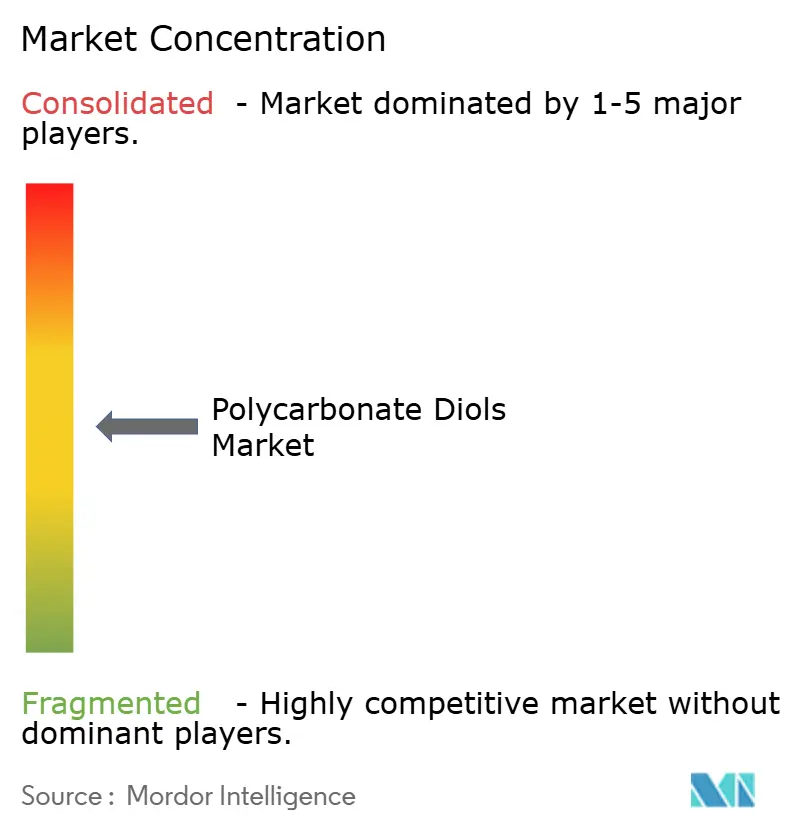
The polycarbonate diols market is moderately concentrated, with the top five players including UBE Corporation, Asahi Kasei Corporation, Covestro AG, Tosoh Corporation, and Mitsubishi Chemical Corporation. These companies compete through scale, technical service, and differentiated specialty grades. Chinese producers, including Wanhua and YuanLi Chemical Group CO.,LTD., compete on pricing for standard grades, especially in the 1,000 g/mol to below 2,000 g/mol range. Wanhua’s polyurethane value chain included 3.8 million metric tons per year of methylene diphenyl diisocyanate (MDI), 1.47 million metric tons per year of toluene diisocyanate (TDI), and 2.32 million metric tons per year of polyether capacity at the end of 2025.
Specialization remains important for suppliers seeking to protect margins in the polycarbonate diols market. Perstorp focuses on renewable-based polycarbonate diols, while Daicel Corporation supplies PLACCEL CD for precision elastomer and medical applications. UBE launched ETERNACOLL BIO in 2025 with 40% to 83% bio-based content, while Mitsubishi Chemical continued to supply BENEBiOL grades with up to 93% bio-based content. Asahi Kasei Corporation announced in May 2026 that it would discontinue Duranol production at Mizushima Works by fiscal year 2030 and maintain supply through Asahi Kasei Performance Chemicals Corp. in China.
Carbon dioxide-based synthesis and waterborne dispersion technology are important areas for product development. A 2025 scientific study reported carbon dioxide-derived polycarbonate macrodiols with molecular weights from 1,000 to 10,000 g/mol and carbonate content above 90%. These routes could reduce reliance on petroleum-derived feedstocks and support proprietary waterborne polyurethane combinations if they can be scaled for commercial use. Covestro AG has expanded polycarbonate compounding capacity in Ohio for automotive, electronics, and healthcare customers[2]“Covestro AG Significantly Expands Production in Ohio,” Covestro AG, covestro.com.
Polycarbonate Diols Industry Leaders
UBE Corporation
Asahi Kasei Corporation
Covestro AG
Tosoh Corporation
Mitsubishi Chemical Corporation
- *Disclaimer: Major Players sorted in no particular order

Recent Industry Developments
- June 2026: Researchers developed a CO₂-based polycarbonate-ether diol through copolymerization of carbon dioxide and propylene oxide, achieving high CO₂ content in the resulting polyol. The development provides a potential pathway for producing more sustainable polycarbonate-based polyurethane feedstocks while reducing reliance on conventional fossil-derived raw materials.
- May 2026: Asahi Kasei Corporation announced plans to discontinue its approximately 3,000-metric-ton-per-year polycarbonate diol production line at Mizushima, Japan, while maintaining supply through its China operations. The supply-chain realignment is expected to reshape regional polycarbonate diols availability while allowing the company to focus resources on higher-value material businesses.


Global Polycarbonate Diols Market Report Scope
Polycarbonate diols are polyol intermediates containing carbonate linkages that are used to produce high-performance polyurethane and other polymer systems. They provide properties such as hydrolysis resistance, durability, flexibility, and chemical resistance to formulated materials.
The Polycarbonate Diols Market is segmented by molecular weight, form, application, and geography. By molecular weight, the market is segmented into below 1,000 g/mol, 1,000 g/mol to below 2,000 g/mol, and 2,000 g/mol and above. By form, the market is segmented into solid and liquid. By application, the market is segmented into synthetic leather, paints and coatings, adhesives and sealants, elastomers, and other applications. The report also covers the market size and forecasts for polycarbonate diols in 15 countries across major regions. For each segment, the market sizing and forecasts have been done on the basis of value (USD).
| Below 1,000 g/mol |
| 1,000 g/mol to Below 2,000 g/mol |
| 2,000 g/mol and Above |
| Solid |
| Liquid |
| Synthetic Leather |
| Paints and Coatings |
| Adhesives and Sealants |
| Elastomers |
| Other Applications |
| Asia-Pacific | China |
| India | |
| Japan | |
| South Korea | |
| ASEAN Countries | |
| Rest of Asia-Pacific | |
| North America | United States |
| Canada | |
| Mexico | |
| Europe | Germany |
| United Kingdom | |
| France | |
| Italy | |
| NORDIC Countries | |
| Rest of Europe | |
| South America | Brazil |
| Argentina | |
| Rest of South America | |
| Middle East and Africa | Saudi Arabia |
| South Africa | |
| Rest of Middle East and Africa |
| By Molecular Weight | Below 1,000 g/mol | |
| 1,000 g/mol to Below 2,000 g/mol | ||
| 2,000 g/mol and Above | ||
| By Form | Solid | |
| Liquid | ||
| By Application | Synthetic Leather | |
| Paints and Coatings | ||
| Adhesives and Sealants | ||
| Elastomers | ||
| Other Applications | ||
| By Geography | Asia-Pacific | China |
| India | ||
| Japan | ||
| South Korea | ||
| ASEAN Countries | ||
| Rest of Asia-Pacific | ||
| North America | United States | |
| Canada | ||
| Mexico | ||
| Europe | Germany | |
| United Kingdom | ||
| France | ||
| Italy | ||
| NORDIC Countries | ||
| Rest of Europe | ||
| South America | Brazil | |
| Argentina | ||
| Rest of South America | ||
| Middle East and Africa | Saudi Arabia | |
| South Africa | ||
| Rest of Middle East and Africa | ||


Key Questions Answered in the Report
What is the size of the polycarbonate diols market?
The Polycarbonate Diols Market size was valued at USD 293.67 million in 2025 and is estimated to grow from USD 309.00 million in 2026 to reach USD 398.52 million by 2031, at a CAGR of 5.22% during the forecast period (2026-2031).
What is driving demand for polycarbonate diols?
Demand is supported by durable polyurethane requirements in synthetic leather, waterborne coatings, elastomers, and adhesives.
Which molecular weight held the largest share in 2025?
The 1,000 g/mol to below 2,000 g/mol range held 42.67% of revenue in 2025.
Which region is expected to grow fastest through 2031?
Asia-Pacific is projected to advance at a 6.05% CAGR through 2031, supported by synthetic leather, footwear, and coatings supply chains.
Page last updated on:


 Your data is secure and never sold or shared.


