
Plasticizers Market Size and Share
Market Overview
| Study Period | 2021 - 2031 |
|---|---|
| Market Size (2026) | USD 20.05 Billion |
| Market Size (2031) | USD 25.66 Billion |
| Growth Rate (2026 - 2031) | 5.06 % |
| Fastest Growing Market | Asia-Pacific |
| Largest Market | Asia-Pacific |
| Market Concentration | Medium |
Major Players *Disclaimer: Major Players sorted in no particular order Image © Mordor Intelligence. Reuse requires attribution under CC BY 4.0. | |
Plasticizers Market Analysis by Mordor Intelligence
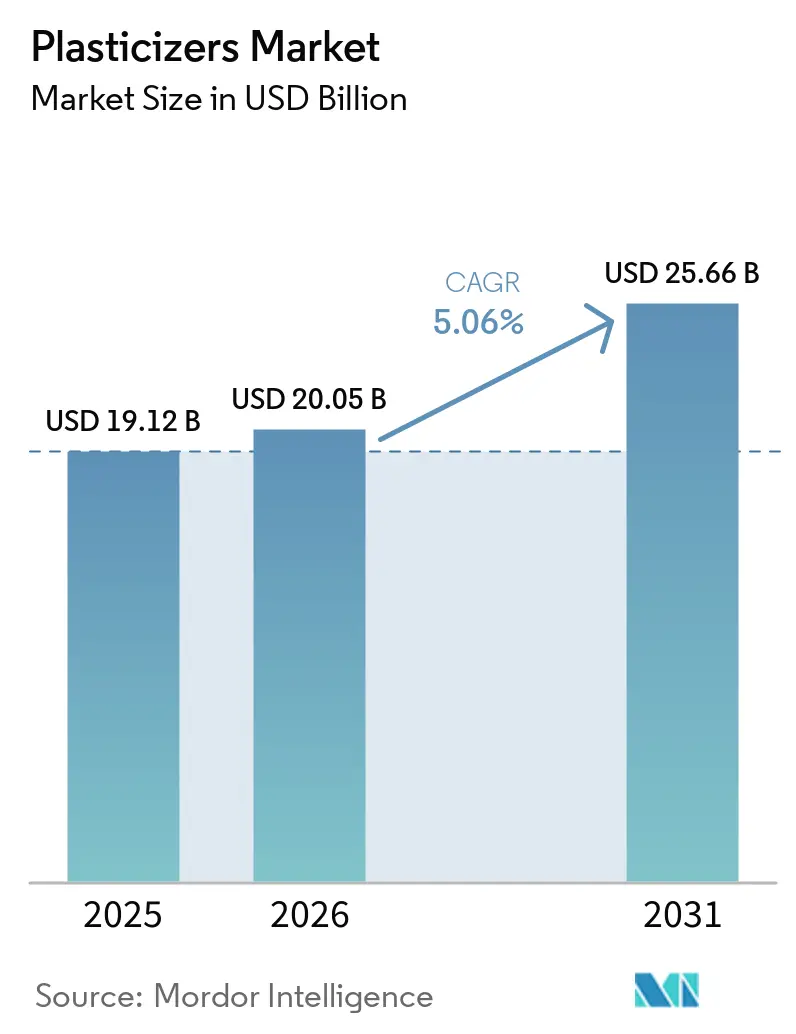
The Plasticizers market size was valued at USD 19.12 billion in 2025 and is estimated to grow from USD 20.05 billion in 2026 to reach USD 25.66 billion by 2031, at a CAGR of 5.06% during the forecast period (2026-2031). Flexible PVC demand continues to support consumption in construction, power distribution, renewable energy systems, and regulated applications. Higher-value specialty grades are gaining relevance as buyers seek materials that meet migration, temperature, and compliance requirements. This shift favors suppliers that can offer both established phthalate products and documented non-phthalate alternatives. Infrastructure programs also provide a steadier base of demand for pipes and cables when construction conditions are uneven. Cost pressure, particularly in commodity grades, remains a key consideration for converters and producers.
Key Report Takeaways
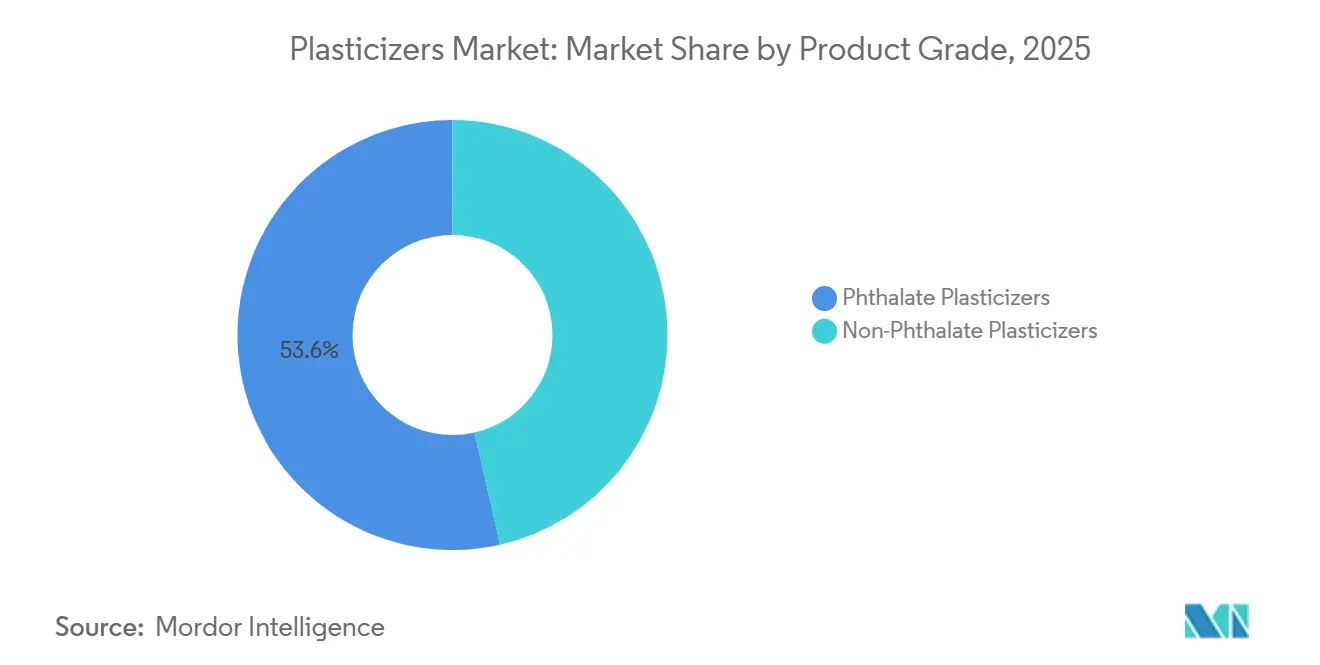
- By product grade, phthalate plasticizers held 53.55% of global revenue in 2025, while non-phthalate plasticizers are forecast to grow at a 5.65% CAGR through 2031.
- By application, wires and cables accounted for 29.12% of global revenue in 2025 and are forecast to grow at a 5.89% CAGR through 2031.
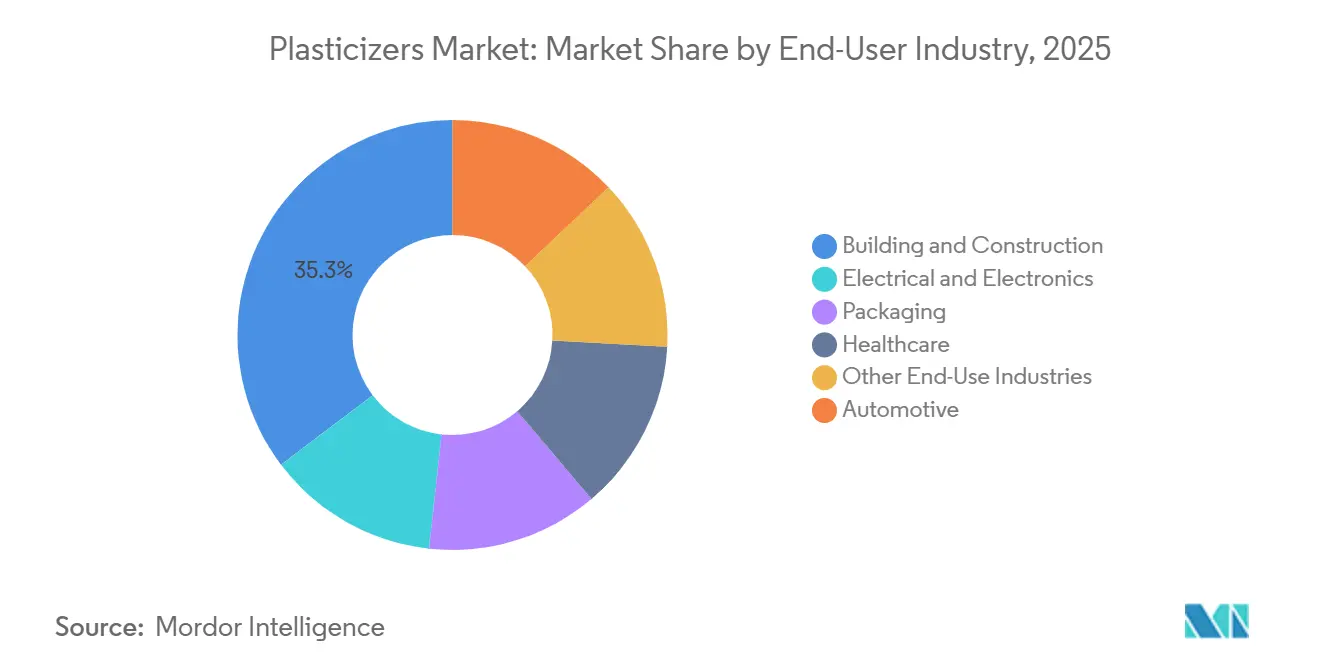
- By end-user industry, building and construction held 35.31% of global revenue in 2025, while electrical and electronics is forecast to expand at a 6.14% CAGR through 2031.
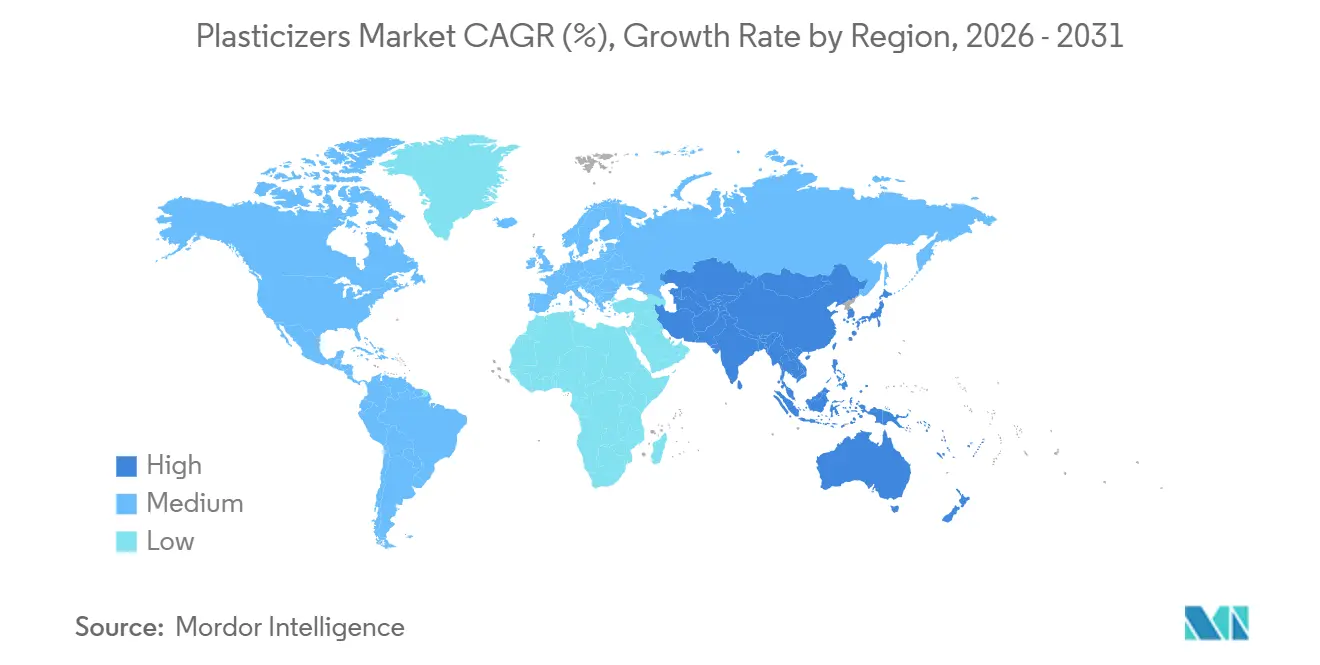
- By geography, Asia-Pacific accounted for 43.54% of global revenue in 2025 and is projected to grow at a 5.95% CAGR through 2031.
Note: Market size and forecast figures in this report are generated using Mordor Intelligence’s proprietary estimation framework, updated with the latest available data and insights as of January 2026.
Market Trends and Insights
Drivers Impact Analysis of Plasticizers Market*
| Drivers | (~) % Impact on CAGR Forecast | Geographic Relevance | Impact Timeline |
|---|---|---|---|
| Flexible PVC Demand in Grid Modernization and Renewable Energy Cabling | +1.4% | Global, concentrated in Asia-Pacific and Europe, accelerating in North America | Medium term (2-4 years) |
| Regulatory-Led Conversion to Non-Phthalate Formulations | +1.2% | Global, with primary enforcement in Europe and North America, with spillover to Japan and South Korea | Long term (≥ 4 years) |
| Electrification of Vehicles and Charging Infrastructure | +0.9% | Global, concentrated in China, Europe, and North America | Medium term (2-4 years) |
| Medical-Device Qualification of Low-Migration Plasticizers | +0.6% | North America and Europe, with emerging markets in Japan and South Korea | Long term (≥ 4 years) |
| High-Temperature Cable Demand in Data Centers and Power Electronics | +0.8% | Global, with primary concentration in North America, Asia-Pacific, and Europe | Short term (≤ 2 years) |
| Source: Mordor Intelligence | |||
Flexible PVC Demand in Grid Modernization and Renewable Energy Cabling
Global electricity grid investment reached USD 400 billion across 2024 and 2025, with spending directed toward renewable interconnections, offshore wind cables, and underground distribution systems. These systems use flexible cable compounds in which plasticizers enhance insulation and jacketing performance. Project owners increasingly require documented performance under repeated exposure to heat and moisture over long operating periods. These qualification requirements narrow the supplier base for cable projects and increase the value of established application documentation. Renewable energy wiring also increases demand for grades that retain flexibility at low temperatures.
Regulatory-Led Conversion to Non-Phthalate Formulations
The European Union continues to regulate specific phthalates under the REACH framework, including restrictions on plasticized articles. Compliance requires converters to assess formulation choices, documentation, and applicable use conditions. Switching to a non-phthalate formulation can require new qualification work for products used in regulated applications, making it difficult to reverse conversion decisions once customers approve a replacement material. Research on chemical regulation has also highlighted the risk of replacing a restricted substance with a closely related alternative that raises similar concerns. The plasticizers market benefits when suppliers can provide compliant options with clear technical and regulatory support.
Electrification of Vehicles and Charging Infrastructure
Global electric vehicle sales reached 20.7 million units in 2025, and public charging infrastructure expanded by 1.8 million charge points that year[1]International Energy Agency, “Global EV Outlook 2025,” IEA, iea.org. Electric vehicles require more wiring content than internal combustion vehicles, particularly in high-voltage electrical systems. Cable assemblies for charging equipment also require flexible materials that can withstand sustained thermal stress. These requirements support the use of higher-temperature plasticizer grades in automotive wiring and charging systems. Vehicle manufacturers are also applying tighter material requirements in new programs, which broadens the role of compliant non-phthalate grades. This demand adds a second growth channel alongside conventional building-and-construction cable demand.
High-Temperature Cable Demand in Data Centers and Power Electronics
Data centers and power electronics require cable systems that operate under sustained heat loads. Plasticizers used in these systems must help maintain dielectric performance and reduce migration or volatilization over long service periods. Trimellitate grades are relevant where thermal stability and low migration are important selection factors, creating a specialized demand area that differs from lower-cost cable applications. The plasticizers market benefits from this requirement because suppliers with qualified specialty portfolios can address performance needs that commodity products may not meet. Changes in specialty feedstock availability can still affect the cost and supply of these grades.
Restraints Impact Analysis of Plasticizers Market*
| Restraints | (~) % Impact on CAGR Forecast | Geographic Relevance | Impact Timeline |
|---|---|---|---|
| Higher Cost of Non-Phthalate Alternatives | -0.8% | Global, with the greatest burden in price-sensitive Asia-Pacific markets | Medium term (2-4 years) |
| Petrochemical Feedstock and Esterification-Capacity Volatility | -0.7% | Global, particularly acute in Europe and China, where 2-Ethylhexanol (2-EH) and trimellitic anhydride (TMA) supply is concentrated | Short term (≤ 2 years) |
| Performance Trade-Offs Across Temperature, Migration, and Fusion | -0.5% | Global, most pronounced in medical-contact and high-heat cable applications | Long term (≥ 4 years) |
| Source: Mordor Intelligence | |||
Higher Cost of Non-Phthalate Alternatives
Non-phthalate alternatives continue to carry a cost burden in applications that are highly sensitive to material costs. Flooring, pipes, coated fabrics, and standard cable insulation often compete on the cost of finished PVC products. This affects the pace at which converters adopt di(2-ethylhexyl) terephthalate (DOTP), diisononyl cyclohexane-1,2-dicarboxylate (DINCH), and other compliant alternatives where regulation does not require a change. The conversion process also involves reformulation, qualification testing, and documentation work. These activities can delay revenue for compounders operating on limited margins. The plasticizers market remains split between regulated applications that require conversion and price-sensitive applications that continue to favor established phthalate grades.
Petrochemical Feedstock and Esterification-Capacity Volatility
Plasticizer economics across the plasticizers market depend on feedstocks such as 2-ethylhexanol, phthalic anhydride, and trimellitic anhydride. Changes in feedstock availability and prices affect esterification operating rates and margins. Lower feedstock prices can reduce incentives for capacity investment when demand is weak. Supply interruptions at integrated European sites can also affect the availability of diisononyl phthalate (DINP) and di(2-propylheptyl) phthalate (DPHP) grades. Specialty products are especially exposed because trimellitic anhydride is produced at a limited number of sites. The resulting supply risk can affect automotive and high-temperature cable applications where substitutes are limited.
*Our forecasts treat driver/restraint impacts as directional, not additive. The impact forecasts reflect baseline growth, mix effects, and variable interactions.
Plasticizers Market Segment Analysis
By Product Grade:
Phthalate Legacy Meets Non-Phthalate MomentumPhthalate plasticizers accounted for 53.55% of the plasticizers market revenue share in 2025. Their position reflects a long-established cost advantage in construction flooring, general cable insulation, and PVC pipe compounding. They remain widely used in markets where substitution regulations have not been imposed. Established DOP and DINP supply chains support continued use across many Asian applications. Familiar processing behavior helps converters maintain productivity and material consistency. A large base of demand persists where these products meet performance and cost requirements. Competitive pricing in commodity grades, however, limits value growth for producers with limited product differentiation. This keeps demand resilient while increasing pressure on suppliers to manage feedstock costs and operating rates.
Non-phthalate plasticizers are forecast to expand at a 5.65% CAGR from 2026 to 2031. Their higher growth reflects regulatory-driven conversion in Europe and North America, as well as increasing use of compliant materials in sensitive applications. DOTP has emerged as a high-output option due to its balance of cost and performance. DINCH is used in medical and sensitive consumer applications where certification and low-migration characteristics influence procurement decisions. The market is therefore moving toward a broader product mix rather than a complete replacement of phthalates. In February 2025, BASF launched International Sustainability and Carbon Certification (ISCC) PLUS-certified biomass-balanced Palatinol DOTP and TOTM grades, along with a Ccycled Palatinol DOTP grade. These products are intended to support customers seeking sustainability-certified materials without reformulating existing products. In October 2024, Evonik expanded production capacity for ELATUR CH and ELATUR DINCD at Marl, Germany.



By Application:
Wires and Cables Drive the Largest Share of DemandWires and cables accounted for 29.12% of the plasticizers market revenue in 2025 and are forecast to grow at a 5.89% CAGR through 2031. Grid expansion, charging networks, data-center power distribution, and communications infrastructure each support cable demand, reducing reliance on any single construction cycle. Flexible PVC remains important in distribution and control cables, which are large consumers of plasticizers. Higher-temperature and lower-migration grades are increasingly relevant in demanding environments where cables operate, creating opportunities for suppliers with documented grades that meet specialized cable specifications.
Flooring and wall coverings remain important applications, supported by commercial renovation and hospitality refurbishment activity. Luxury vinyl tile supports demand in commercial interiors, although weak residential construction in China has limited regional momentum. Films, sheets, and coated fabrics continue to serve packaging, agricultural, protective-textile, automotive-interior, healthcare, and hospitality applications. Pipes and tubing also represent a significant share of aggregate consumption, driven by investments in water and gas distribution in Asia and Latin America. Food-contact regulations affect formulation decisions for packaging films where migration considerations are relevant; the European Union maintains requirements for plastic materials and articles intended to come into contact with food. The market must therefore address both the quantity requirements of conventional flexible PVC and the compliance needs of specialized applications. This balance keeps application demand broad while raising the importance of technical service and testing support.
By End-User Industry:
Construction Anchors Demand While Electronics Drives Margin GrowthBuilding and construction accounted for 35.31% of the plasticizers market demand in 2025. Flexible PVC is used in pipes, roofing membranes, flooring, window profiles, and building wire insulation. This broad use base links demand to public infrastructure, residential construction, and commercial projects. India's housing and infrastructure programs support demand for pipes, flooring, and cables. China's urban development also supports consumption, despite continued pressure in parts of its property sector. Demand remains stable because these products are used across multiple building components, reducing dependence on any single end use in construction. However, the sector remains exposed to regional differences in building activity and converter purchasing conditions.
The electrical and electronics sector is projected to grow at a 6.14% CAGR from 2026 to 2031, making it the fastest-growing end-user industry. Data-center expansion, electric-vehicle electronics, and communications infrastructure are increasing the demand for thermally stable specialty grades. Automotive remained an important end-user segment in 2025, covering dashboards, door trims, seat covers, and underbody coatings. Electric vehicle design may reduce some conventional PVC use in interiors, but additional wiring-harness content supports demand for electrical systems. Healthcare represents a higher-value area as manufacturers replace di(2-ethylhexyl) phthalate (DEHP) in intravenous bags, blood-contact tubing, and catheters with low-migration alternatives. Medical device manufacturers conduct biocompatibility assessments of materials used in patient-contact applications[2]Deutsche Gesetzliche Unfallversicherung, “Human-Biomonitoring Erfasst Weichmacher-Belastung,” DGUV Forum, forum.dguv.de. Packaging demand remained supported in 2025 by flexible, food-safe PVC applications, while migration concerns constrained growth in lower-value commodities. The market increasingly depends on its ability to meet regulated, performance-sensitive end uses.
Geography Analysis
APAC Plasticizers Market
Asia-Pacific accounted for 43.54% of the plasticizers market revenue in 2025 and is projected to expand at a 5.95% CAGR through 2031. China has a large flexible PVC base serving construction, cable, and consumer goods applications. Environmental requirements and procurement standards among export-oriented manufacturers are increasing interest in non-phthalate alternatives. India provides strong regional demand for infrastructure, housing, piping, flooring, and cabling projects. South Korea and Japan supply premium non-phthalate and specialty trimellitate products to regional and global customers.
North America and Europe Plasticizers Market
The North American plasticizers market combines stable construction demand with growth in specialty plasticizers for wire and cable and medical applications. Grid modernization and data-center investment support cable procurement that is less tied to consumer-facing demand for flexible polyvinyl chloride (PVC). Europe has advanced further toward non-phthalate formulations than other major regions. The European plasticizers market relies on diisononyl cyclohexane-1,2-dicarboxylate (DINCH), terephthalates, and bio-based alternatives for medical, food-contact, and sensitive consumer applications. European regulatory requirements increase the value of documented product portfolios and qualified supply chains.
MEA and South America Plasticizers Market
The plasticizers markets in South America, the Middle East, and Africa comprise smaller demand centers linked to construction cycles and industrial diversification. Brazil's 2026 anti-dumping investigation concerning dioctyl phthalate (DOP), dioctyl terephthalate (DOTP), and diisononyl phthalate (DINP) imports signals growing attention to domestic capacity and regional trade flows. The Middle East and Africa benefit from construction pipelines and industrial demand, including projects associated with Saudi Arabia's Vision 2030. Growth is supported by residential construction, infrastructure investment, and wider use of flexible PVC products.

Competitive Landscape
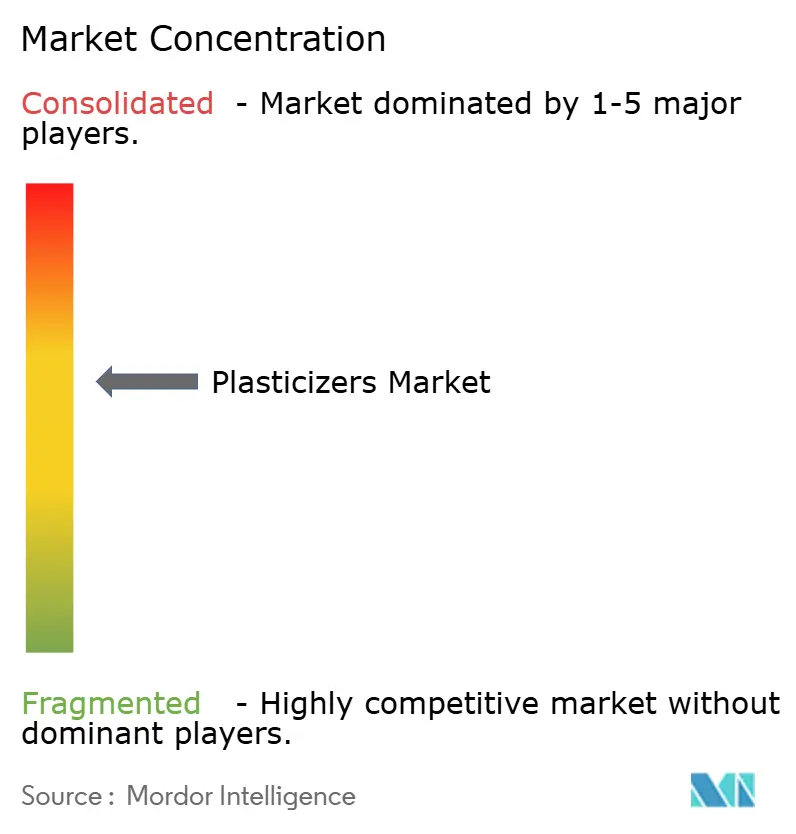
The plasticizers market is moderately consolidated. BASF, Dow, Eastman Chemical, Evonik, ExxonMobil, and LANXESS compete through oxo-alcohol production, esterification, technical support, and product breadth. Their portfolios cover phthalate and non-phthalate products, enabling them to serve established and regulated applications. Asian producers such as Bluesail Chemical, LG Chem, Nan Ya Plastics, and UPC Technology Corporation compete strongly in cost-sensitive DOP and DINP categories. South Korean and Chinese DOTP and trioctyl trimellitate (TOTM) exports add price pressure in European commodity grades.
In 2024, BASF and UPC Technology signed a memorandum of understanding covering the supply of 2-ethylhexanol from BASF's Zhanjiang Verbund site to UPC's South China operations. The arrangement supports feedstock reliability for UPC and strengthens BASF's position in plasticizer alcohols in China. BASF expanded its offering of sustainability-certified plasticizers in North America in 2025. Evonik expanded ELATUR CH and ELATUR DINCD production capacity at Marl in 2024. These developments reflect investment in certified, non-phthalate, and specialty capacity rather than reliance on commodity products alone.
Technology control is important in non-phthalate applications. Evonik's ELATUR CH uses an INA-based hydrogenation route, supporting a specialized position in medical and food-contact demand. Bio-based platforms such as citrate esters, epoxidized oils, and polymeric esters are relevant for healthcare and food-contact applications. Producers without application engineering capability or documented qualification files face greater difficulty serving premium medical and regulated-consumer demand. This keeps the plasticizers market divided between technically differentiated specialty suppliers and commodity-focused producers.
Plasticizers Industry Leaders
BASF
Dow
Eastman Chemical Company
Exxon Mobil Corporation
LG Chem
- *Disclaimer: Major Players sorted in no particular order
Plasticizers Market Companies Covered in this Report
- Aekyung Chemical
- BASF
- Bluesail Chemical Group Co., Ltd.
- DIC CORPORATION
- Dow
- Eastman Chemical Company
- Evonik Industries AG
- Exxon Mobil Corporation
- LANXESS
- LG Chem
- NAN YA PLASTICS CORPORATION
- Perstorp
- Polynt S.p.A.
- UPC Technology Corporation
- Velsicol Chemical LLC

Recent Industry Developments in Plasticizers Market
- June 2026: Univar Solutions and BASF's Petrochemicals business entered an enhanced strategic partnership, making Univar the exclusive distribution partner for Hexamoll DINCH across the United States and Canada. The agreement combines Univar's North American logistics network with BASF's non-phthalate portfolio, strengthening market access for DINCH in medical, wire and cable, and regulated consumer applications.
- February 2025: BASF launched International Sustainability and Carbon Certification (ISCC) PLUS-certified biomass-balanced grades (Palatinol DOTP Advantage 50 and TOTM Advantage 50) and a Ccycled grade (Palatinol DOTP Ccycled) from its Pasadena, Texas, and Cornwall, Ontario production sites. These sustainability-certified drop-in grades require no customer reformulation and target Environmental, Social, and Governance (ESG) procurement mandates across construction, automotive, wire and cable, and medical markets.


Global Plasticizers Market Report Scope
Plasticizers are chemical additives mixed into polymers such as plastics and rubber to improve flexibility and workability. They function by inserting between polymer chains, reducing friction and lowering the material's stiffness.
The plasticizers market is segmented by product grade, application, end-user industry, and geography. By product grade, the market is segmented into phthalate plasticizers and non-phthalate plasticizers. By application, the market is segmented into wires and cables, flooring and wall coverings, films and sheets, coated fabrics, pipes and tubing, and other applications. By end-user industry, the market is segmented into building and construction, automotive, electrical and electronics, packaging, healthcare, and other end-use industries. The report also covers market size and forecasts for the plasticizers across 16 countries in major regions. The market sizes and forecasts are provided in terms of value (USD).
| Phthalate Plasticizers |
| Non-Phthalate Plasticizers |
| Wires and Cables |
| Flooring and Wall Coverings |
| Films and Sheets |
| Coated Fabrics |
| Pipes and Tubing |
| Other Applications |
| Building and Construction |
| Automotive |
| Electrical and Electronics |
| Packaging |
| Healthcare |
| Other End-Use Industries |
| Asia-Pacific | China |
| India | |
| Japan | |
| South Korea | |
| Rest of Asia-Pacific | |
| North America | United States |
| Canada | |
| Mexico | |
| Europe | Germany |
| United Kingdom | |
| France | |
| Italy | |
| Russia | |
| Rest of Europe | |
| South America | Brazil |
| Argentina | |
| Rest of South America | |
| Middle East and Africa | Saudi Arabia |
| South Africa | |
| Rest of Middle East and Africa |
| By Product Grade | Phthalate Plasticizers | |
| Non-Phthalate Plasticizers | ||
| By Application | Wires and Cables | |
| Flooring and Wall Coverings | ||
| Films and Sheets | ||
| Coated Fabrics | ||
| Pipes and Tubing | ||
| Other Applications | ||
| By End-User Industry | Building and Construction | |
| Automotive | ||
| Electrical and Electronics | ||
| Packaging | ||
| Healthcare | ||
| Other End-Use Industries | ||
| By Geography | Asia-Pacific | China |
| India | ||
| Japan | ||
| South Korea | ||
| Rest of Asia-Pacific | ||
| North America | United States | |
| Canada | ||
| Mexico | ||
| Europe | Germany | |
| United Kingdom | ||
| France | ||
| Italy | ||
| Russia | ||
| Rest of Europe | ||
| South America | Brazil | |
| Argentina | ||
| Rest of South America | ||
| Middle East and Africa | Saudi Arabia | |
| South Africa | ||
| Rest of Middle East and Africa | ||


Key Questions Answered in the Report
What is current market size of Plasticizers Market?
The Plasticizers market size was valued at USD 19.12 billion in 2025 and is estimated to grow from USD 20.05 billion in 2026 to reach USD 25.66 billion by 2031, at a CAGR of 5.06% during the forecast period (2026-2031).
Why are wires and cables important for plasticizer demand?
Wires and cables held 29.12% of revenue in 2025 and are forecast to grow at a 5.89% CAGR, supported by grids, charging, and digital infrastructure.
Which end-user industry is growing fastest?
Electrical and electronics is the fastest-growing end-user industry, with a forecast CAGR of 6.14% from 2026 to 2031.
Which region has the largest share of global revenue?
Asia-Pacific held 43.54% of revenue in 2025 and is expected to grow at a 5.95% CAGR through 2031.
Page last updated on:





