
Plastic Film Capacitors Market Size and Share
Market Overview
| Study Period | 2020 - 2031 |
|---|---|
| Market Size (2026) | USD 2.58 Billion |
| Market Size (2031) | USD 3.27 Billion |
| Growth Rate (2026 - 2031) | 4.86 % |
| Fastest Growing Market | Asia Pacific |
| Largest Market | Asia Pacific |
| Market Concentration | Medium |
Major Players
*Disclaimer: Major Players sorted in no particular order Image © Mordor Intelligence. Reuse requires attribution under CC BY 4.0. |
|
Plastic Film Capacitors Market Analysis by Mordor Intelligence
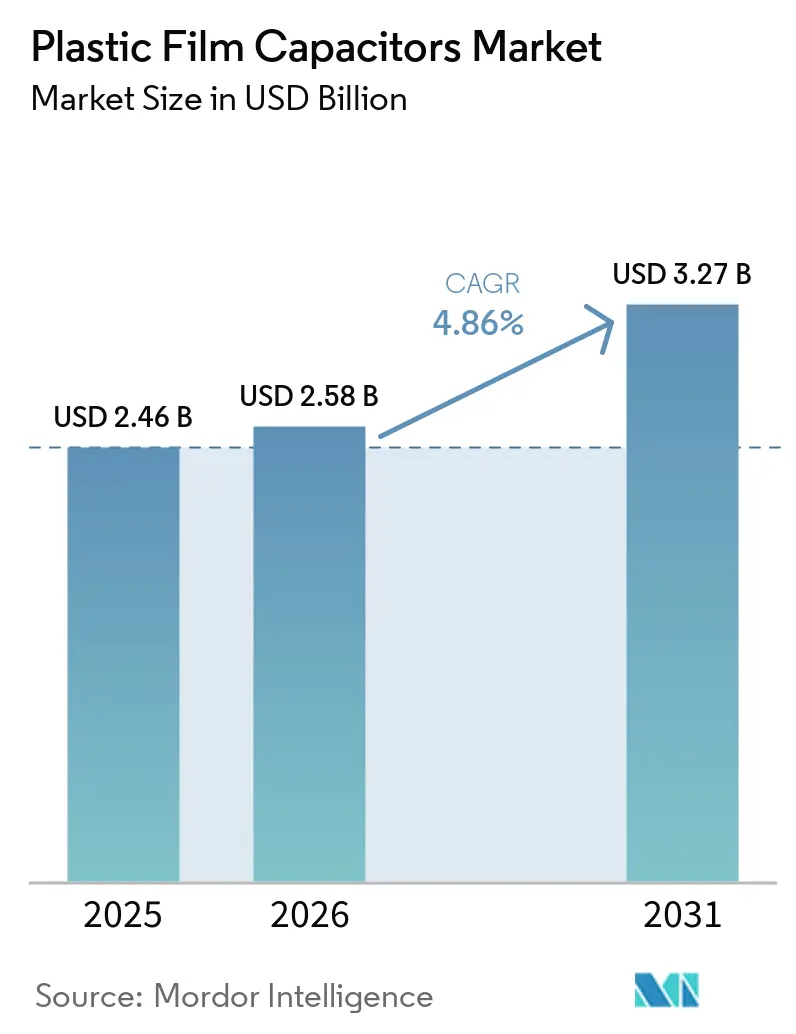
The plastic film capacitors market size is expected to grow from USD 2.46 billion in 2025 to USD 2.58 billion in 2026 and is forecast to reach USD 3.27 billion by 2031 at 4.86% CAGR over 2026-2031. Robust demand in e-mobility powertrains, renewable-energy converters, and 5G infrastructure anchors this growth, while polypropylene continues to dominate commercial volumes. Rising adoption of SiC/GaN power devices is shifting design priorities toward low-ESR, high-frequency performance, encouraging material innovation and higher-voltage designs. Regional production incentives in Asia-Pacific, India’s USD 24 billion PLI scheme, and Brazil’s BRL 186.6 billion (USD 35.09 billion) digitalization drive are accelerating localized capacity additions, tempering supply-chain concentration risks. Competition remains moderate but intensifying: legacy leaders such as TDK and Vishay face agile specialists that tailor form factors for next-generation traction inverters and grid-scale filters.[1]Resin and aluminum price swings remain the most immediate margin threat, yet vertical integration and hedging strategies are helping large vendors buffer volatility.
Key Report Takeaways
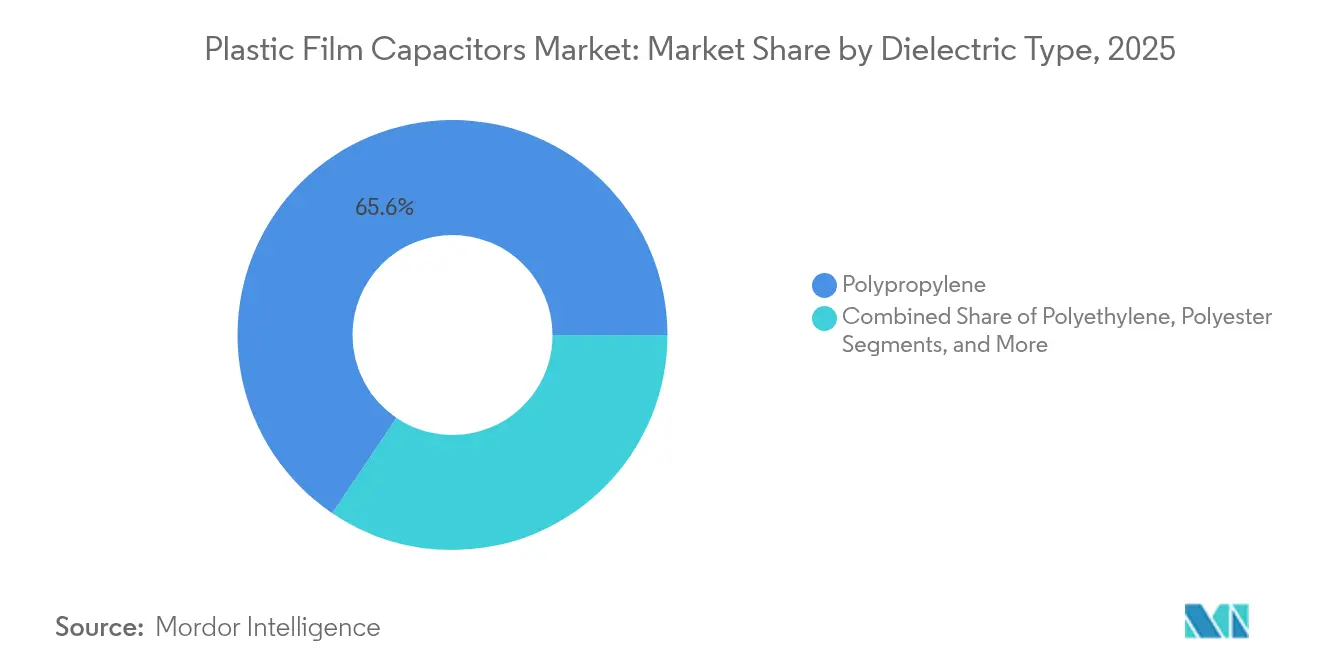
- By dielectric type, polypropylene held 65.55% of the plastic film capacitors market share in 2025, while polyphenylene sulfide is projected to rise at a 5.63% CAGR through 2031.
- By voltage rating, the 100–1,000 V range accounted for 53.35% of the plastic film capacitors market size in 2025; ratings above 1,000 V lead growth at a 4.72% CAGR.
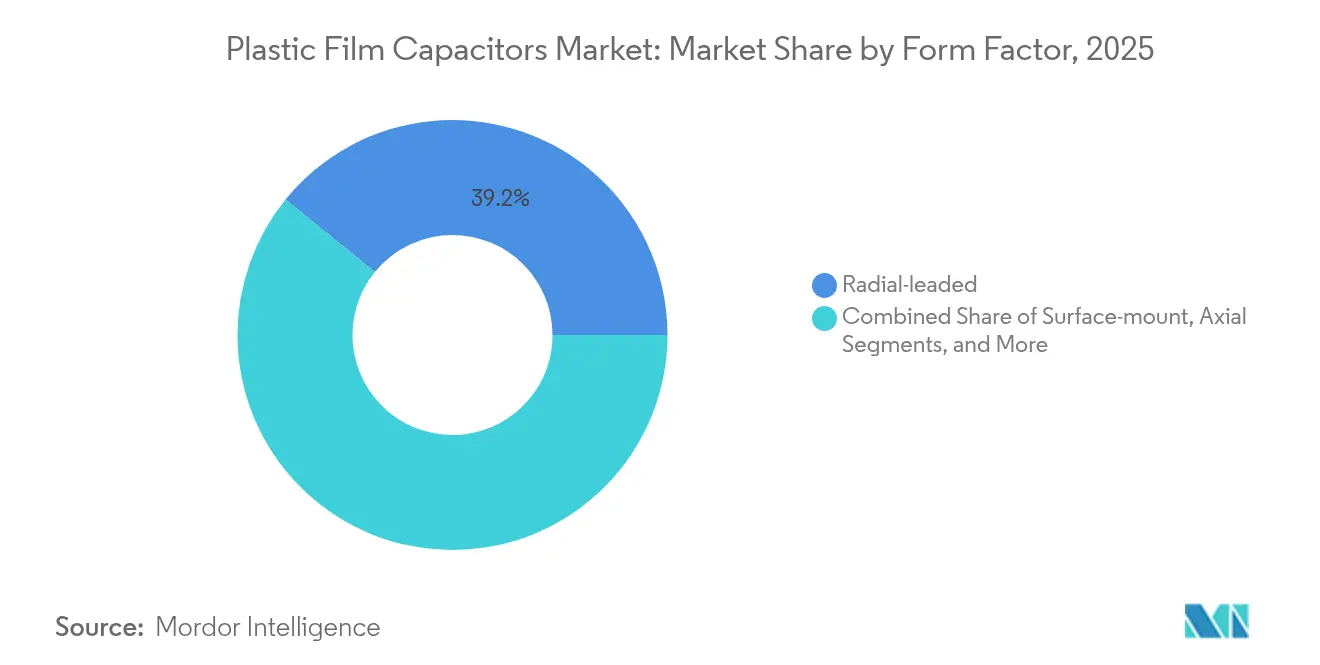
- By form factor, radial-leaded designs led with 39.15% revenue share in 2025, whereas stack and box packages exhibit the fastest expansion at 5.24% CAGR to 2031.
- By application, automotive captured 30.75% of the plastic film capacitors market share in 2025, and renewable-energy uses are advancing at a 5.93% CAGR through 2031.
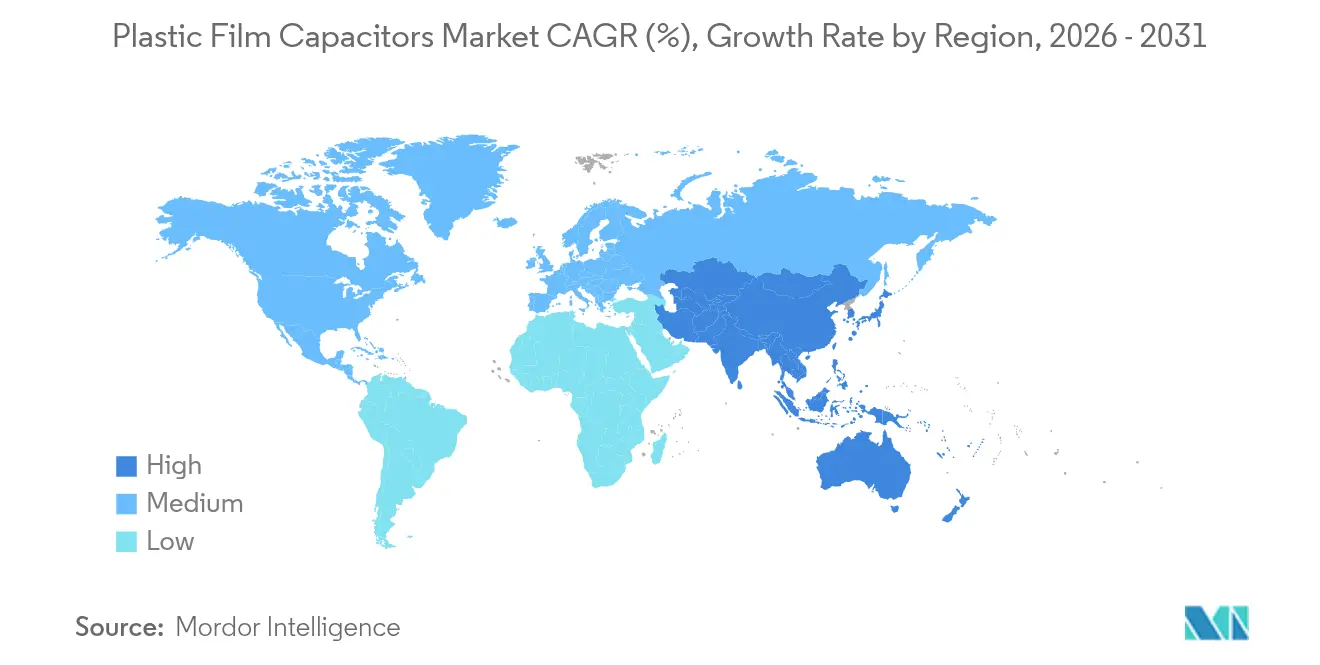
- By geography, Asia-Pacific commanded 43.80% of the plastic film capacitors market size in 2025 and is progressing at a 6.42% CAGR to 2031.
Note: Market size and forecast figures in this report are generated using Mordor Intelligence’s proprietary estimation framework, updated with the latest available data and insights as of 2026.
Market Trends and Insights
Drivers Impact Analysis of Plastic Film Capacitors Market*
| DRIVER | (~) % IMPACT ON CAGR FORECAST | GEOGRAPHIC RELEVANCE | IMPACT TIMELINE |
|---|---|---|---|
| DC-link demand for EV traction inverters | +1.2% | Global, China-Europe-the United States. | Medium term (2-4 years) |
| Shift toward SiC/GaN power devices | +0.8% | Asia-Pacific, North America | Long term (≥4 years) |
| Grid-scale renewable DC filters | +0.9% | Europe, China | Medium term (2-4 years) |
| 5G base-station miniaturization | +0.4% | Asia-Pacific, North America | Short term (≤2 years) |
| Government localization mandates | +0.6% | India, Brazil | Long term (≥4 years) |
| Circular-economy push for PP film recycling | +0.3% | Europe, North America | Long term (≥4 years) |
| Source: Mordor Intelligence | |||
Surge in DC-link Demand for EV Traction Inverters
Electric vehicles multiply capacitor content per car by up to five times, as every traction inverter, onboard charger, and auxiliary converter requires high-capacitance DC-link banks. TDK’s xEVCap line targets this need with ripple-current endurance and 105 °C operation, shipping in volume from its Gravataí plant.[2] Automakers pledging 50% electric sales by 2030 lock in multi-year visibility for capacitor procurement as battery pack voltages climb from 400 V to 800 V architectures. The plastic film capacitors market benefits directly, since film devices exhibit self-healing behavior critical to inverter reliability over 15-year vehicle lifetimes. Supply-chain depth is widening as India and Brazil court EV-component investors with fiscal incentives, reducing geographic risk for OEMs. As charging infrastructure scales, auxiliary DC filters in fast-chargers further reinforce volume momentum.
Rapid Shift Toward SiC/GaN Power Devices
Wide-bandgap semiconductors operate above 20 kHz, forcing designers to favor low-ESR dielectrics. Polypropylene retains leadership because of low losses, but nanocomposite PPS films with boron-nitride fillers now deliver triple energy density at 200 °C without dielectric breakdown, broadening design latitude for aerospace and industrial drives.[3] Declining SiC device prices unlock mainstream industrial retrofits, where 2–3% efficiency gains translate into lower electricity bills and carbon footprints. Power-module makers increasingly list film capacitors on qualified material sheets, diverting share from aluminum electrolytics in high-frequency roles. The trend compresses development cycles as OEMs co-design capacitors and power modules to meet EMI, thermal, and life targets simultaneously. Suppliers able to metallize ultra-thin films while maintaining partial-discharge margins gain a cost-performance edge.
Grid-scale Renewable Integration Requiring High-voltage DC Filters
Solar and wind farms necessitate 1,000 V-plus DC filters with 20-year lifespans, aligning component life with PV module warranties. Brazil’s smart-grid roadmap, co-funded by JICA, calls out switched capacitor banks as critical for voltage regulation across vast transmission corridors. [4] Metallized polypropylene meets utility needs through self-healing and stable capacitance under thermal cycling, outperforming ceramic or electrolytic alternatives. Large projects demand thousands of parts per substation, generating lumpy but lucrative orders. Policy mandates for renewable share targets in Europe and China sharpen procurement cycles, offering suppliers headroom for premium pricing. As battery-energy-storage systems proliferate, high-voltage film capacitors also service DC-bus smoothing in megawatt-scale inverters, reinforcing secular demand.
Miniaturization Pressure from 5G Base Stations
Network equipment vendors race to shrink power-conversion footprints within dense radio units. DC/DC converter modules now integrate stack or box film capacitors that pack higher volumetric capacitance and shed heat efficiently, enabling slimmer antenna-mast enclosures.[5]5G rollouts in China, South Korea, and the U.S. push equipment counts into the millions, sustaining near-term volume. Higher operating frequencies amplify EMI concerns, making low-ESR film capacitors essential for stability. Surface-mount MLCCs compete below 100 V, but film technology prevails in 200–600 V rails that feed power amplifiers. Rapid replacement cycles in telecom sites also favor components with predictable aging curves and field-replaceable formats.
Restraints Impact Analysis of Plastic Film Capacitors Market*
| RESTRAINT | (~) % IMPACT ON CAGR FORECAST | GEOGRAPHIC RELEVANCE | IMPACT TIMELINE |
|---|---|---|---|
| Polypropylene and aluminum price volatility | -0.7% | Global, Asia-Pacific hubs | Short term (≤2 years) |
| BOPP film extrusion concentration | -0.5% | Global, China-centric | Medium term (2-4 years) |
| Fire-safety compliance costs in e-mobility | -0.4% | North America, Europe | Medium term (2-4 years) |
| MLCC competition below 100 V | -0.6% | Consumer electronics | Long term (≥4 years) |
| Source: Mordor Intelligence | |||
Volatility in Polypropylene and Aluminum Prices
Polypropylene resin accounts for nearly half of capacitor Bill-of-Materials, leaving profitability exposed to petrochemical cycles. In early 2024, prices spiked before easing as additional refinery streams came online, squeezing quarterly margins for second-tier producers. Aluminum foil costs followed energy-price swings, further complicating forecasting. Large vendors hedge through multi-quarter contracts and own film extrusion lines, but smaller firms lack leverage, raising consolidation pressure. Sudden commodity jumps risk lengthening customer lead times as vendors reprioritize allocations toward higher-margin orders. Although resin prices stabilized by late 2025, commodity super-cycles remain an ever-present threat.
Supply-Chain Concentration in BOPP Film Extrusion
Natural disasters, trade sanctions, or logistics blockades therefore ripple rapidly through capacitor supply chains. European capacity additions, such as a recent 36,000-tonne line in Germany, help diversify sourcing, but equipment lead times exceed 18 months. Custom metallization and inline plasma treatments needed for high-voltage grades further restrict the qualified supplier pool. Vendors mitigating risk through dual sourcing and in-house metallization enjoy tighter quality control yet incur higher capital intensity.
*Our forecasts treat driver/restraint impacts as directional, not additive. The impact forecasts reflect baseline growth, mix effects, and variable interactions.
Plastic Film Capacitors Market Segment Analysis
By Dielectric Type:
Polypropylene Retains Scale While PPS Climbs into High-Heat NichesPolypropylene held 65.55% of the plastic film capacitors market share in 2025, a result of favorable cost-to-performance ratios and mature extrusion know-how. The segment generated the bulk of the plastic film capacitors and is set to expand steadily alongside mainstream automotive inverters. PPS films, meanwhile, are charted to grow 5.63% annually, boosted by aerospace and under-hood EV electronics that demand 150 °C endurance. Nanocomposite research validates PPS’s ability to withstand 500 MV/m breakdown stress while maintaining dielectric stability to 200 °C. OEMs gravitate toward PPS for turbo-charged SiC modules where polypropylene derates aggressively above 105 °C. Despite higher material cost, total system savings accrue by eliminating auxiliary cooling or increasing power density.
Polyethylene and polyester continue to service cost-sensitive lighting ballasts and motor-run capacitors, but face substitution from slimmer polypropylene grades. PTFE persists in microwave and RF filters for aerospace thanks to ultralow dissipation factors. Advanced aramid-fiber composites under development target missiles and space power buses operating beyond 200 °C, yet commercial uptake remains niche. ESG priorities are nudging the polypropylene mainstream toward bio-circular feedstocks that cut scope-3 emissions without altering performance, potentially defending its volume advantage well into the forecast horizon.

By Voltage Rating:
Mid-Voltage Remains Core as >1 kV Builds MomentumThe 100–1,000 V band captured 53.35% of the plastic film capacitors market size in 2025, catering to EV traction, industrial drives, and telecom power shelves. Design-for-manufacture partnerships keep unit costs competitive, safeguarding volume. Above 1,000 V, penetration is rising at a 4.72% CAGR on the back of solar inverters and HVDC converters connecting wind clusters to grids. High-voltage devices leverage thicker films and edge-folded metallization to deter partial discharge, supporting premium ASPs and double-digit margins. Below 100 V, ceramic encroachment intensifies, yet audio, lighting, and premium SMPS designers still specify film for its benign failure mode and low microphonics.
Forthcoming 800 V EV platforms will gradually shift content into the 600–1,200 V bracket, expanding addressable opportunities. IEC 61071 updates expected in 2026 will codify thermal-cycling and humidity tests more stringently, likely favoring established suppliers with proven dielectric formulations.
By Form Factor:
Stack and Box Designs Shrink Volume Without Sacrificing PerformanceRadial-leaded parts maintained 39.15% of 2025 revenue, protected by after-market serviceability and legacy through-hole PCB footprints. However, space-constrained EV chargers and 5G radios propel stack and box packages, which condense capacitance by interleaving foils vertically within molded housings. The plastic film capacitors market enjoys a 5.24% CAGR in this sub-segment as module makers embed capacitors directly onto DBC substrates, slashing loop inductance and thermal resistance. Surface-mount offerings answer mid-range density targets but carry solder-reflow stress penalties that require thicker end-spray layers.
Axial cans linger in railway and oil-and-gas gear where mechanical shock profiles dictate symmetric leadouts. Yet the cost of bespoke winding machinery curtails fresh axial capacity builds. In aggregate, form-factor evolution mirrors the electronics industry’s pivot toward 3D packaging and co-packaged power, encouraging capacitor suppliers to co-locate design teams with module houses for faster layout iterations.
By Application:
Automotive Dominates Today; Renewables Deliver the Next Leg of GrowthAutomotive seized 30.75% of plastic film capacitors market share in 2025 as global xEV sales cleared 15 million units. Each inverter embeds multiple 400–800 V film banks that smooth battery ripple currents up to 600 A. In 2026, automotive demand alone is worth more than USD 793.5 million, and safety-critical functional-safety specs ensure robust ASPs even amid commodity pressure. Renewable-energy systems follow closely, delivering the fastest 5.93% CAGR as utility-scale PV and onshore wind integrate grid-code-mandated DC filters. Capital deployment into energy-storage farms adds another high-voltage-hungry use case.
Telecommunications, buoyed by 5G densification, sustains solid mid-single-digit growth, while industrial automation and HVAC inverters contribute a steady base load. Consumer electronics remain susceptible to MLCC substitution, constraining growth. Aerospace, defense, and medical segments together account for less value but secure a disproportionate profit share because of tight qualification regimes and low failure-tolerance service environments.
Geography Analysis
APAC Plastic Film Capacitors Market
Asia-Pacific controls 43.80% of 2025 revenue and leads the plastic film capacitors market at a 6.42% CAGR through 2031. China’s cluster of BOPP extruders supplies domestic component winders and exports film worldwide, underpinning cost leadership. India’s USD 24 billion PLI outlay accelerates local capacitor winding and end-device assembly, creating intra-regional supply redundancy. Japan sustains its reputation for premium automotive and industrial grades, leveraging decades of dielectric process know-how. South Korea’s semiconductor fabs spur demand for high-frequency capacitors in power-management units, while Southeast Asian nations attract capacity relocation tied to China-plus-one strategies.
North America and Europe Plastic Film Capacitors Market
North America remains a technology adopter rather than a volume producer but boasts strong demand in EVs, aerospace, and data-center renewables. Federal incentives under the Inflation Reduction Act are stimulating new battery and inverter lines, indirectly boosting domestic capacitor needs. Europe emphasizes quality and sustainability; German automotive suppliers co-develop stack capacitor arrays with TDK and WIMA to optimize 800 V drive units. RoHS and REACH compliance acts as a natural barrier to low-cost entrants, stabilizing pricing.
South America and MEA Plastic Film Capacitors Market
South America’s profile is rising as Brazil’s BRL 186.6 billion (USD 35.09 billion) digitalization plan and PADIS incentives cultivate semiconductor and passive production. TDK’s Gravataí site already exports more than 80% of its 600 million units, proving regional competitiveness. The Middle East and Africa are nascent but not negligible. Solar mega-projects such as Saudi Arabia’s NEOM and South Africa’s REIPPP program require large DC-filter banks, drawing global suppliers keen to diversify revenue streams. Currency volatility and infrastructure gaps remain obstacles, but declining PV-levelized costs bode well for gradual adoption.
Regulatory Landscape
Plastic film capacitors are governed by a mix of materials standards for capacitor-grade films and end-market compliance regimes, with biaxially oriented polypropylene (BOPP) film specifications acting as a key upstream gate for electrical performance and supply qualification. IEC 60674-3-1:2021 remains a widely referenced international baseline for polypropylene film requirements, and European adoption continues through national standard bodies, such as OVE EN IEC 60674-3-1:2025 in Austria.
Updates to these standards in 2026-2027 introduce another layer of compliance and documentation for film and capacitor suppliers serving automotive, renewable-energy, and industrial power conversion. In July 2026, FprEN IEC 60674-3-1:2026 reached the ballot initiation stage, and China released GB/T 13542.3-2026 on July 2, 2026, with implementation set for February 1, 2027. This tightens the need for cross-region test-method alignment and traceable film-grade sourcing for global programs.
Competitive Landscape
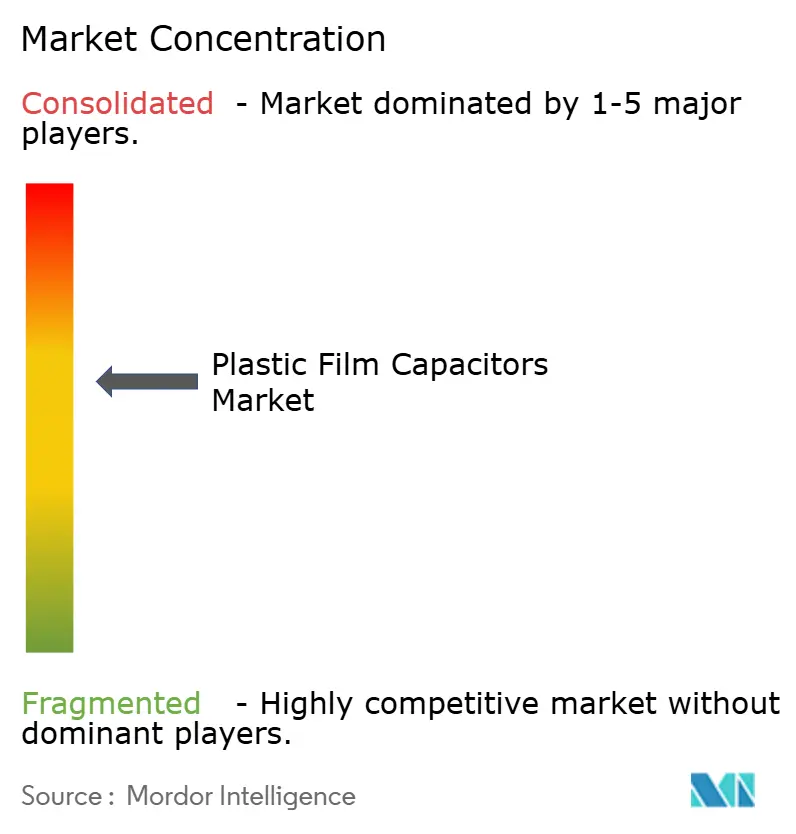
The plastic film capacitors market features moderate fragmentation. The top five suppliers hold significant market share, giving space for nimble specialists to exploit application niches. TDK leads automotive traction, leveraging in-house film lines and global application-engineering hubs. Vishay strengthened its European high-voltage portfolio by acquiring Birkelbach in late 2024, suggesting continued tactical mergers and acquisitions. Panasonic and Nichicon concentrate on consumer and industrial standard parts, defending share with cost-optimized automated winding.
Specialists such as KEMET (Yageo) and WIMA target high-pulse, high-frequency roles in power modules and audio equipment. Contract manufacturers in Taiwan and mainland China bustle at the low end, supplying white-label capacitors to lighting and appliance brands. Technological differentiation now tilts toward dielectric engineering nanocomposite films, edge-folded electrodes, and solid-resin encapsulation to boost partial-discharge inception voltage. Vendors with materials research and development assets and vertical integration can amortize tooling faster and achieve superior field-failure rates.
Strategically, leading companies invest in regional duplication of critical processes. TDK operates metallization plants in Japan, Europe, and Brazil, while Vishay is evaluating U.S. extrusion to align with reshoring incentives. Sustainability is emerging as a soft competitive moat; suppliers publishing cradle-to-gate carbon footprints are favored in automotive RFQs. Overall, rivalry is intensifying, but technical hurdles and certification cycles continue to moderate price warfare.
Plastic Film Capacitors Industry Leaders
-
Panasonic Holdings Corporation
-
Vishay Intertechnology Inc.
-
KEMET Corporation (Yageo Group)
-
TDK Corporation
-
KYOCERA AVX Components Corporation
- *Disclaimer: Major Players sorted in no particular order
Plastic Film Capacitors Market Companies Covered in this Report
- Vishay Intertechnology Inc.
- Panasonic Holdings Corporation
- KEMET Corporation (Yageo Group)
- TDK Corporation
- KYOCERA AVX Components Corporation
- Murata Manufacturing Co., Ltd.
- Cornell Dubilier Electronics, Inc.
- Nichicon Corporation
- Rubycon Corporation
- WIMA GmbH & Co. KG
- Nantong Jianghai Capacitor Co., Ltd.
- Suntan Technology Co., Ltd.
- Hefei Jianghai Film Capacitor Co., Ltd.
- Vishay Polytech Co., Ltd.
- Aerovox Corp.
- Illinois Capacitor (Cornell Dubilier Brand)
- Elna Co., Ltd.
- SRT Microcéramique
- IcEL s.r.l.
- PolyCharge America, Inc.
- Polytronics Technology Corp.
- Dean Technology, Inc.
- Samwha Electric Co., Ltd.
- Shenzhen Yunxing Electronics Co., Ltd.
- EACO Electric Co., Ltd.
- Xiamen Faratronic Co., Ltd.
- Exxelia Group
Market Opportunities and Future Outlook
Opportunity is concentrated in higher-voltage traction-grade DC-link and DC-filter applications, where platform voltage is moving beyond legacy 400 V architectures and qualification demands are tightening around partial-discharge margins, thermal endurance, and package inductance. Supplier product actions reflect that shift: in April 2026, KYOCERA AVX launched traction-grade DC filtering film capacitors using polypropylene-film variants spanning roughly 900 VDC to 3,800 VDC, while Panasonic refreshed its EZP-R metallized polypropylene film capacitor positioning for DC-link and DC-filter roles in solar, wind, and industrial power systems. Together, these moves point to innovation centered on high-voltage capability, segmented metallization, and module-friendly formats designed to integrate with SiC/GaN switching.
Another area of traction is supply-chain resilience and cost transparency across capacitor-grade films and metallization. In mid-2026, passives pricing actions pushed OEMs toward inventory buffers and second-source qualification. With Yageo implementing a broad capacitor price increase effective July 1, 2026 (reported as a large list-price step-up), buyers have stronger incentives to dual-source across regions and to qualify alternate film grades that still meet IEC 60674-3-1 and newer regional equivalents such as GB/T 13542.3-2026. For film-capacitor vendors, this environment supports investment in in-house metallization, closer partnerships with BOPP film producers, and expanded application engineering support in automotive and renewable-energy power electronics, where qualification cycles are long and switching costs are high.
Recent Industry Developments in Plastic Film Capacitors Market
- April 2026: KYOCERA AVX launched the FFLK series traction-grade DC filtering capacitors (dry segmented metallized PP film 900-1,900 VDC; wet metallized PP film 2,000-3,800 VDC) for EV traction systems. The launch expands high-voltage supply chain capabilities for EV powertrains and extends high-temperature dielectric offerings for next-generation automotive inverters.
- April 2026: Panasonic Industry updated EZP-R Series Metallized Polypropylene Film Capacitors for DC-link and DC-filtering applications in solar, wind, and industrial power systems. The update reinforces Panasonic's role in grid and renewables power conversion, supporting broader adoption of film capacitors in energy systems.
- February 2026: Panasonic Industrial Devices ECQ-E(F) Series Film Capacitors (DC Rated) now offered in 630VDC and 1250VDC options, non-inductive, metalized polyester film. The expansion increases voltage range and non-inductive performance for automotive and industrial power modules.
Plastic Film Capacitors Market Report Scope and Research Methodology
Market Definition and Coverage
This market covers revenues generated from plastic film capacitors used for energy storage, filtering, and power conditioning in electronic and electrical systems across end uses such as industrial equipment, automotive electronics, and consumer devices.
Scope exclusions: The sizing excludes non-film capacitor families (such as ceramic, electrolytic, and tantalum) and counts only plastic film based dielectric capacitor products.
Segments Covered in This Report
-
By Dielectric Type
- Polypropylene
- Polyethylene
- Polyester
- Polytetrafluoroethylene (PTFE)
- Polyphenylene Sulfide (PPS)
- Other Dielectric Types
-
By Voltage Rating
- <100 V
- 100V – 1,000 V
- >1,000 V
-
By Form Factor
- Radial-leaded
- Surface-mount
- Axial
- Stack and Box
-
By Application
- Automotive (xEV, Charging)
- Telecommunications (5G, Datacentre)
- Industrial Drives and Inverters
- Aerospace and Defense
- Consumer Electronics
- Medical Devices
- Renewable Energy (PV, Wind)
- Other Applications
-
By Geography
-
North America
- United States
- Canada
- Mexico
-
South America
- Brazil
- Argentina
- Rest of South America
-
Europe
- Germany
- United Kingdom
- France
- Italy
- Spain
- Russia
- Rest of Europe
-
Asia-Pacific
- China
- Japan
- India
- South Korea
- South-East Asia
- Rest of Asia-Pacific
-
Middle East and Africa
-
Middle East
- Saudi Arabia
- United Arab Emirates
- Rest of Middle East
-
Africa
- South Africa
- Egypt
- Rest of Africa
-
Middle East
-
North America
Data Sources, Market Sizing, and Validation
Desk Research
Desk research starts with mapping the demand signals that typically move plastic film capacitor shipments, before the market model is built. We referenced public sources such as UN Comtrade for trade flows, International Energy Agency releases for EV and power sector demand indicators, USITC and Eurostat for industrial and electronics trade context, and IEC publications to understand how film capacitor types and ratings are commonly described.
To make the model usable at a practical level, additional inputs were taken from company annual reports and investor presentations, credible press coverage of capacity additions, and patent databases to track where film materials and electrode designs are getting more activity. In some countries, import and export shipment-level datasets and company financial intelligence subscriptions were also used to cross-check revenue ranges for major suppliers and to avoid obvious over-counting. The sources listed here are illustrative only, and many other public and paid references were used for data collection, validation, and clarification during the study.
Primary Interviews and Surveys
Primary work focused on interviews and structured surveys with participants across the value chain, including component suppliers, distributors, OEM sourcing teams, and design engineers who specify capacitor types in power electronics. These discussions helped confirm which applications are shifting toward film capacitors, how voltage class and package mix are changing, and how pricing behaves under resin and metallized film cost movements across major regions.
Distribution of primary research fieldwork respondents
| Company type | Respondent position | Region |
|---|---|---|
| Top tier: 37% | CXOs: 15% | APAC: 47% |
| Mid tier: 46% | Functional/Unit leaders: 30% | EMEA: 35% |
| Smaller Players: 17% | Managers: 55% | Americas: 18% |
Market-Sizing & Forecasting
Sizing begins with a top-down build that reconstructs demand from electronics production and end-market adoption signals that most consistently pull film capacitors into designs, and then translates that demand into value using observed price bands. Because a single public dataset does not fully explain the market, the totals are then checked using selective bottom-up approximations such as sampled supplier revenue ranges, channel checks on standard part pricing, and volume logic tied to key applications.
In the model, a few inputs do most of the heavy lifting, and they were treated as adjustable levers during validation. These include EV and charging infrastructure build-out, renewable and grid inverter installations, industrial motor drive and power supply demand, mix shifts between through-hole and surface mount form factors, and average selling price movement by dielectric and voltage class. Forecasting is run using scenario analysis supported by expert expectations from primary interviews, followed by smoothing of the time series to keep year-to-year changes consistent with how qualification cycles and capacity expansions actually happen. Where bottom-up checks could not cover smaller manufacturers, gaps were filled using conservative share assumptions that were subsequently pressure-tested with distributor and OEM feedback.
Data Validation & Update Cycle
Validation is done through a set of cross-checks that connect the model outputs to independent signals, and then by reviewing unusual jumps before sign-off. Pricing, volume, and application mix are compared against trade movements, public financial commentary, and what respondents report as realistic design-in and lead-time behavior.
When differences are large, the assumptions are revisited and targeted follow-ups are triggered with interviewees to resolve what caused the variance. Reports are refreshed annually, with interim updates when material events happen, and before delivery a final analyst pass is completed so clients receive the latest updated view available at that time.
Mordor Intelligence's Plastic Film Capacitors Market Size Compared With Other Published Estimates
Published market values for plastic film capacitors can look different even when they sound similar on the surface, because the scope wording and the base year choices are not always aligned. Differences also show up when some publishers blend adjacent capacitor categories into one number, or when they apply optimistic price growth without checking it against real material and application shifts.
One common gap comes from estimates that bundle paper capacitors or hybrid capacitor types into a combined total, which lifts the reported value. In Mordor Intelligence, the market is kept limited to plastic film capacitors only, and the 2026 value is tied back to application pull like EV power electronics and inverter demand, followed by pricing checks by dielectric and voltage class.
Benchmark comparison
| Source | Market Size | Gaps in Research Methodology |
|---|---|---|
| Mordor Intelligence | USD 2.58 B (2026) | |
| Industry Publisher A | USD 3.26 B (2025) | Uses a combined category that includes paper capacitors and hybrid types, so the total is not restricted to plastic film capacitors only. The longer 2025-2035 horizon also tends to smooth near-term constraints, which can inflate the first forecast-year value. |
| Trade Journal B | USD 2.52 B (2024) | Anchors on an earlier base year and appears to mix mounting and application splits without clearly reconciling them to end-use demand signals, which can understate the step-up expected from EV inverters and charging equipment that ramped after 2024. |
The comparison shows that the biggest swings usually come from category inclusion choices and from how base year pricing and demand ramps are treated. By keeping the scope specific to plastic film capacitors and by tying the forecast to a short list of traceable demand and pricing drivers, the estimate stays easier to audit and repeat.
Key Questions Answered in the Report
How large is the plastic film capacitors market in 2026?
The plastic film capacitors market size is USD 2.58 billion in 2026, on course for USD 3.27 billion by 2031.
What is the forecast growth rate through 2031?
Revenue is projected to increase at a 4.86% CAGR over 2026-2031.
Which dielectric material dominates commercial volumes?
Polypropylene holds 65.55% market share thanks to cost efficiency and robust electrical performance.
Which end-use segment buys the most film capacitors today?
Automotive applications lead with 30.75% share, mainly for EV traction inverters and chargers.
Which region offers the fastest capacity expansion opportunities?
Asia-Pacific grows fastest at a 6.42% CAGR, supported by China’s scale and India’s PLI incentives.
What main risk could constrain near-term supplier margins?
Polypropylene resin price volatility and BOPP film concentration remain the most immediate threats.