
Pigment Intermediates Market Size and Share
Market Overview
| Study Period | 2021 - 2031 |
|---|---|
| Market Size (2026) | USD 15.90 Billion |
| Market Size (2031) | USD 20.45 Billion |
| Growth Rate (2026 - 2031) | 5.16 % |
| Fastest Growing Market | Asia-Pacific |
| Largest Market | Asia-Pacific |
| Market Concentration | Low |
Major Players *Disclaimer: Major Players sorted in no particular order Image © Mordor Intelligence. Reuse requires attribution under CC BY 4.0. | |
Pigment Intermediates Market Analysis by Mordor Intelligence
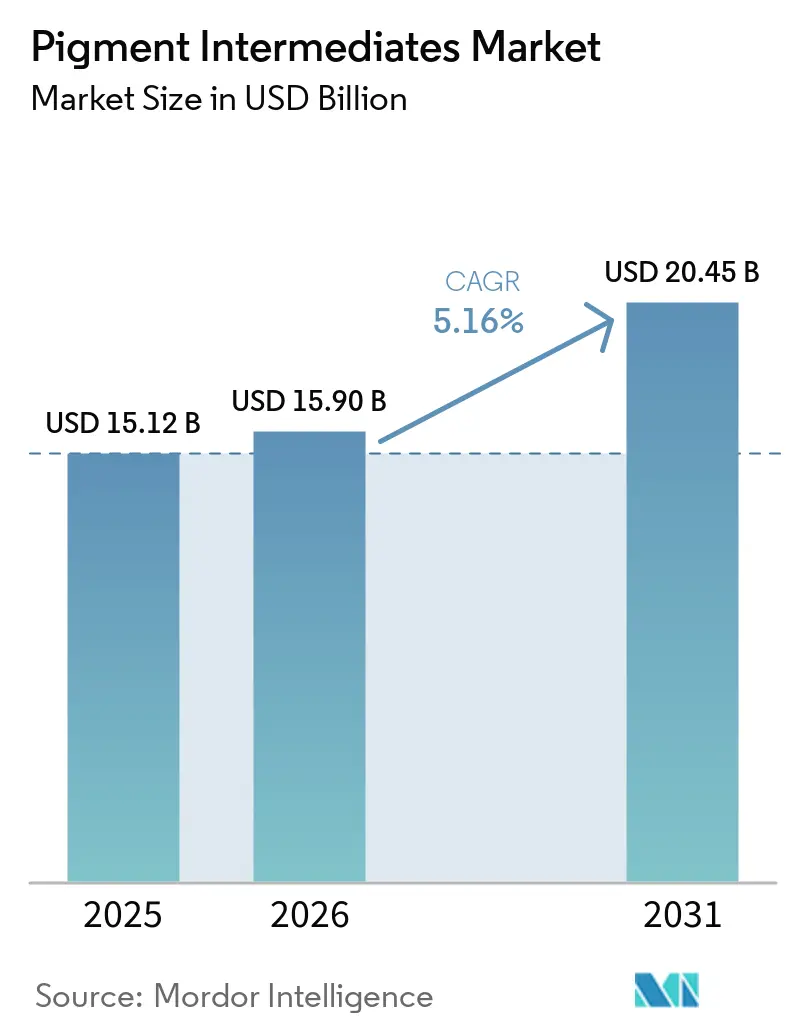
The Pigment Intermediates Market size was valued at USD 15.12 billion in 2025 and is estimated to grow from USD 15.90 billion in 2026 to reach USD 20.45 billion by 2031, at a CAGR of 5.16% during the forecast period (2026-2031). The pigment intermediates market is supported by infrastructure activity, demand from coatings, and wider use of engineered plastics in automotive components. Buyers increasingly evaluate intermediates against heat stability, regulatory documentation, and compatibility with recycled polymers, rather than purchase price alone. This changes purchasing requirements across the pigment intermediates market and places more value on reliable, compliant inputs. Producers are responding through capacity upgrades, supply-chain integration, and lower-emission product lines. Feedstock exposure and environmental compliance remain important limits on margins and output across the pigment intermediates market.
Key Report Takeaways
- By type, organic intermediates held 45.73% of the pigment intermediates market share in 2025 and are projected to advance at a 5.55% CAGR through 2031.
- By application, paints and coatings held 35.22% of the pigment intermediates market share in 2025, while plastics are projected to advance at a 6.02% CAGR through 2031.
- By geography, Asia-Pacific held 46.26% of the pigment intermediates market share in 2025 and is projected to advance at a 5.83% CAGR through 2031.
Note: Market size and forecast figures in this report are generated using Mordor Intelligence’s proprietary estimation framework, updated with the latest available data and insights as of January 2026.
Global Pigment Intermediates Market Trends and Insights
Drivers Impact Analysis*
| Driver | (~) % Impact on CAGR Forecast | Geographic Relevance | Impact Timeline |
|---|---|---|---|
| Growth in Paints and Coatings Demand | +1.4% | Global; strongest in APAC and Europe | Medium term (2-4 years) |
| Expansion of Textiles, Plastics, Paper and Printing Inks | +1.2% | APAC core (China, India, Vietnam), spill-over to MEA | Medium term (2-4 years) |
| Asia-Pacific Manufacturing and Export Capacity Expansion | +1.0% | Asia-Pacific (China, India) | Short term (≤ 2 years) |
| Demand for High-Performance and Sustainable Colorants | +0.8% | Europe & North America, with spillover to APAC | Long term (≥ 4 years) |
| Integration of Pigment Intermediates and Finished Pigment Production | +0.5% | Global; concentrated in APAC and Europe | Long term (≥ 4 years) |
| Source: Mordor Intelligence | |||
Growth in Paints and Coatings Demand
Construction and maintenance work continued to support demand for architectural and protective coatings, which increased demand for colorant inputs in the pigment intermediates market. Construction output in the euro area increased 3.0% in April 2025 from April 2024, supporting coatings consumption in renovation and infrastructure work. Coating formulators are also shifting toward waterborne, powder, and high-solids systems that need tightly specified colorant chemistries. This shift raises demand for intermediates that help finished pigments meet color, durability, and emissions requirements. LANXESS expanded its Scopeblue portfolio in February 2025 with micronized yellow iron oxide pigments that had a product carbon footprint 35% lower than standard Bayferrox grades, based on a TÜV Rheinland-certified life-cycle analysis[1]LANXESS, “LANXESS Expands Scopeblue Portfolio: New Micronized Yellow Pigments with a Reduced Carbon Footprint,” LANXESS, lanxess.com. The pigment intermediates market, therefore, benefits when coating specifications favor documented lower-emission formulations rather than standard grades.
Expansion of Textiles, Plastics, Paper and Printing Inks
Textiles, plastics, paper, and printing inks create demand for different pigment chemistries and purity levels within the pigment intermediates market. Flexible packaging and rigid food-contact containers require colorants that maintain color during polymer processing and meet material documentation needs. Digital inkjet printing raises the need for consistent particle properties and high-purity inputs in pigment dispersions. Textile printing also uses aqueous pigment systems that require intermediates suited to dispersion and application requirements. Paper applications remain relevant where specialty printing grades require controlled color quality and low salt content. These uses create demand across the pigment intermediates market, even as specifications differ by product and processing method.
Asia-Pacific Manufacturing and Export Capacity Expansion
Asia-Pacific manufacturing capacity supports regional supply networks for textiles, packaging, plastics, coatings, and pigments in the pigment intermediates market. China and India remain central to production and export activity, while industrial clusters allow manufacturers to connect intermediate production with downstream pigment processing. BASF stated that its Zhanjiang Verbund site became fully operational in 2025 and that the new capacity was expected to contribute to earnings growth in its Intermediates division during 2026. This investment shows that large suppliers continue to place production assets near major Asian manufacturing bases. Export-oriented output strengthens supply availability for global buyers but can increase exposure to regional operating and compliance conditions. The pigment intermediates market is consequently shaped by both the scale of Asian manufacturing and the degree of integration within those supply chains.
Demand for High-Performance and Sustainable Colorants
Regulatory and customer requirements are shifting demand toward high-performance and sustainable colorants in the pigment intermediates market. The European Union Registration, Evaluation, Authorisation and Restriction of Chemicals (REACH) framework sets rules for chemical substances placed on the European market and influences material selection across the value chain[2]European Commission, “REACH Regulation,” European Commission, europa.eu. These requirements increase the value of intermediates supported by registration records, substance information, and traceable production processes. They also encourage reformulation when established colorant systems no longer fit customer requirements or regulatory expectations. Venator launched its trimethylolpropane (TMP)-free and trimethylolethane (TME)-free TIOXIDE TR81 grade in March 2025 for coatings and plastics applications facing changing restrictions. The pigment intermediates market gains opportunities where suppliers can provide compliant inputs for these reformulation programs.
Restraints Impact Analysis*
| Restraint | (~) % Impact on CAGR Forecast | Geographic Relevance | Impact Timeline |
|---|---|---|---|
| Raw Material and Petrochemical Price Volatility | -0.9% | Global; most acute in APAC and Europe | Short term (≤ 2 years) |
| Environmental, Safety and Waste-Management Compliance Costs | -0.7% | Europe & North America, expanding to APAC | Medium term (2-4 years) |
| Dependence on Concentrated Asian Chemical Supply Chains | -0.5% | Global impact, concentrated in Asia | Medium term (2-4 years) |
| Source: Mordor Intelligence | |||
Raw Material and Petrochemical Price Volatility
Raw materials are a large share of pigment production cost, so changes in aromatic and metal inputs can affect the pigment intermediates market quickly. Organic systems rely on feedstocks such as benzene, aniline, and phthalic anhydride, while phthalocyanine chemistries also depend on copper inputs. Cost pressure is difficult for non-integrated producers to absorb when purchase contracts for finished pigments adjust more slowly than feedstock costs. Producers respond through multi-source purchasing, inventory planning, and closer integration with upstream suppliers. These actions can reduce disruption, but they do not remove exposure to sharp changes in petrochemical or metal costs. The pigment intermediates market remains vulnerable when upstream prices rise faster than downstream selling prices.
Environmental, Safety and Waste-Management Compliance Costs
Environmental, safety, and waste-management requirements raise operating and documentation costs for companies in the pigment intermediates market. Chemical manufacturers need effective wastewater treatment, material records, and quality-control processes to serve regulated applications. The European Union chemicals framework requires businesses to understand and manage risks from substances placed on the market. Companies without integrated treatment systems or mature compliance processes can face higher working-capital needs and greater risks of customer rejection. These requirements can favor better-capitalized producers that can document purity, emissions, and material provenance. They can also limit available supply when smaller facilities cannot meet operating or reporting expectations.
*Our forecasts treat driver/restraint impacts as directional, not additive. The impact forecasts reflect baseline growth, mix effects, and variable interactions.
Segment Analysis
By Type: Organic Intermediates Lead Both Market Share and Growth
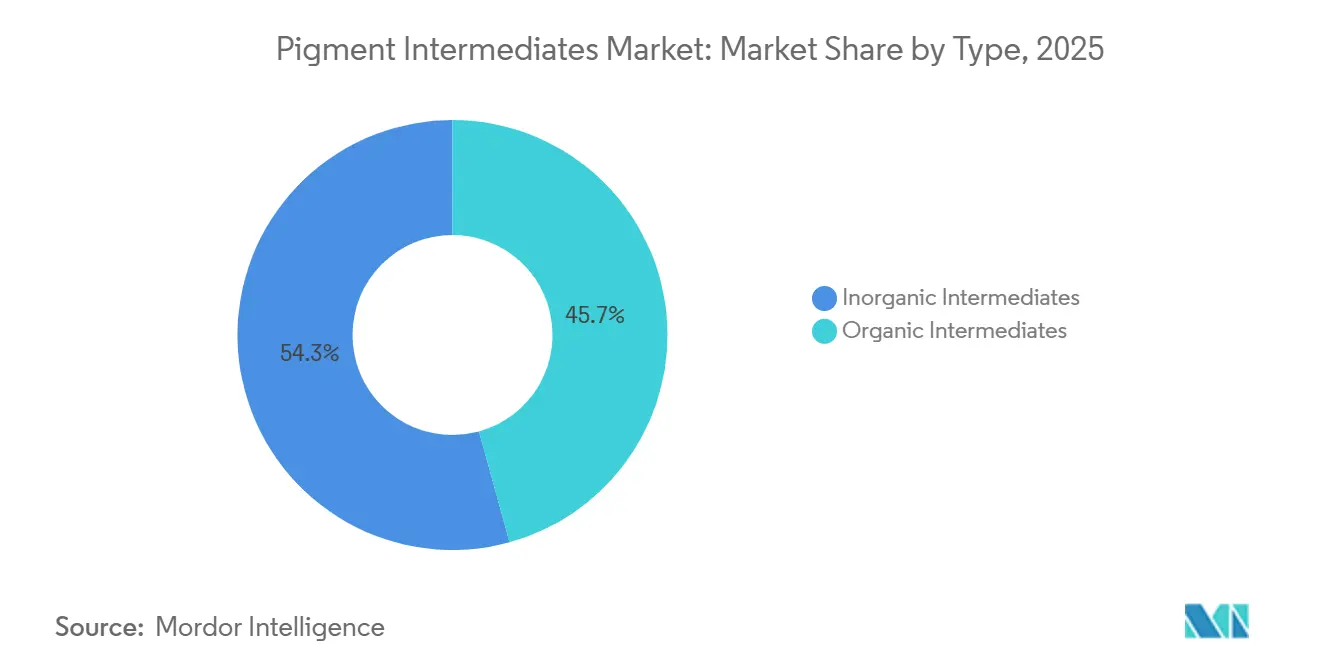
Organic intermediates held 45.73% of demand in 2025. Their use spans azo, phthalocyanine, quinacridone, and benzimidazolone chemistries that serve packaging inks, automotive coatings, plastics, and other colorant applications. The broad end-use base supports demand because each chemistry can meet different color, durability, and processing requirements. Restrictions on lead chromate and cadmium-based systems also support replacement opportunities for organic alternatives in relevant applications under the European Union chemicals framework. Organic intermediates are projected to advance at a 5.55% CAGR through 2031, supported by plastics, digital printing inks, and automotive applications. This growth reflects both new demand and the need for colorant systems that meet higher performance and compliance requirements.
DIC CORPORATION, through its subsidiary Sun Chemical, expanded perylene pigment capacity at its Ludwigshafen facility in November 2025, adding up to 200 metric tons of finished goods and intermediates. The investment supports supply continuity for high-performance pigments used by global customers in coatings, plastics, and automotive applications. It also indicates continued producer attention to organic pigment chemistries where performance requirements are demanding. Inorganic intermediates retain an important role in construction materials and infrastructure applications that use iron oxide, titanium dioxide, and chromium oxide pigments. LANXESS converted a spray dryer at its Krefeld-Uerdingen iron oxide pigment plant to continuous hydrogen operation in August 2026, replacing natural gas in that process. The company stated that the conversion reduced carbon dioxide emissions by 6,000 metric tons per year, showing how producers are addressing emissions expectations in inorganic pigment production.


By Application: Paints and Coatings Provide Scale While Plastics Accelerate
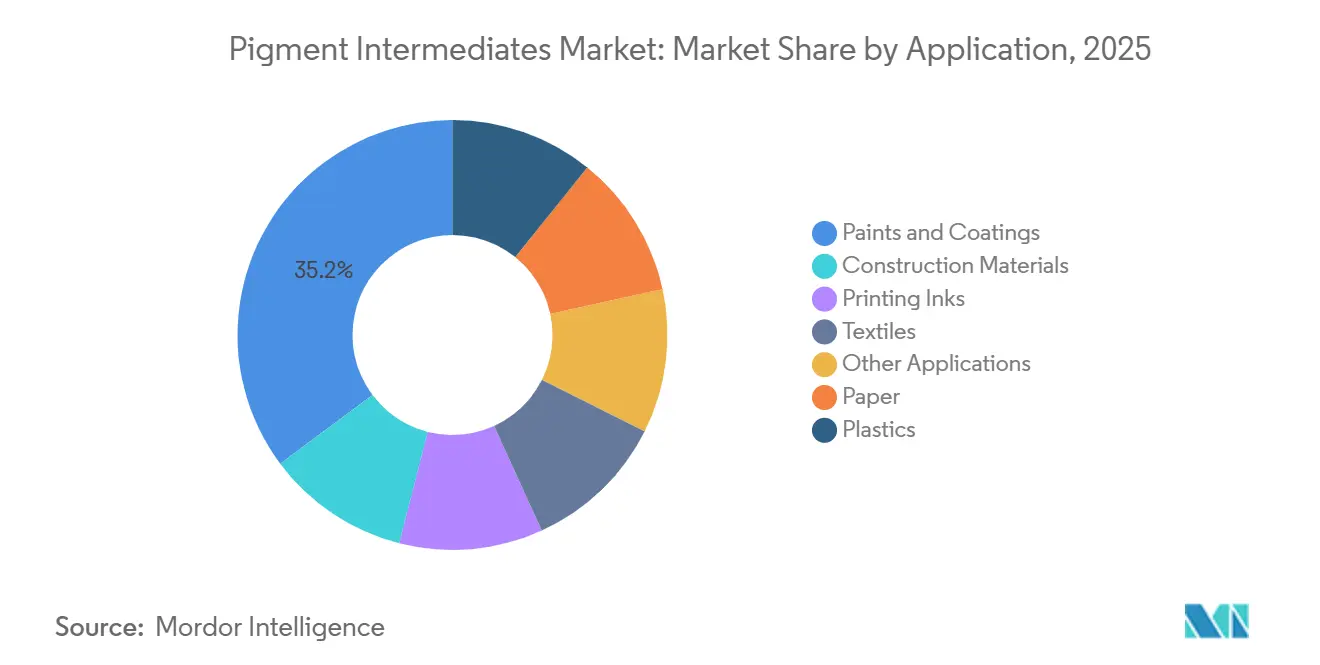
Paints and coatings accounted for 35.22% of the pigment intermediates market size in 2025, supported by architectural, industrial, marine, and automotive coating needs. European construction activity provided a relevant demand signal, with euro area construction output increasing 3.0% year over year in April 2025. Infrastructure work and maintenance cycles require protective coatings, while refinishing supports automotive coating consumption. The application includes a shift toward waterborne, powder, and high-solids systems that need intermediates matched to demanding formulation requirements. Printing inks also require controlled pigment properties as digital printing develops across packaging and textile uses. Textile applications use pigment dispersions and reformulated chemistries that must work within aqueous systems.
Plastics are projected to advance at a 6.02% CAGR through 2031, making them the fastest-growing application in the pigment intermediates industry. Flexible packaging, rigid food-contact containers, and electric vehicle interior components support demand for thermally stable, compliant colorants. The relevant pigment intermediates market size grows where masterbatch producers need inputs that can withstand polymer processing temperatures and retain color consistency. Compliance records are especially important for grades used in food-contact applications or recycled polymer streams. Construction materials, paper, and other applications provide further demand for inorganic and specialty intermediates connected with regional building activity and printing needs. The application mix gives suppliers several routes to growth, but each route requires chemistry, documentation, and process controls suited to its end use.

Geography Analysis
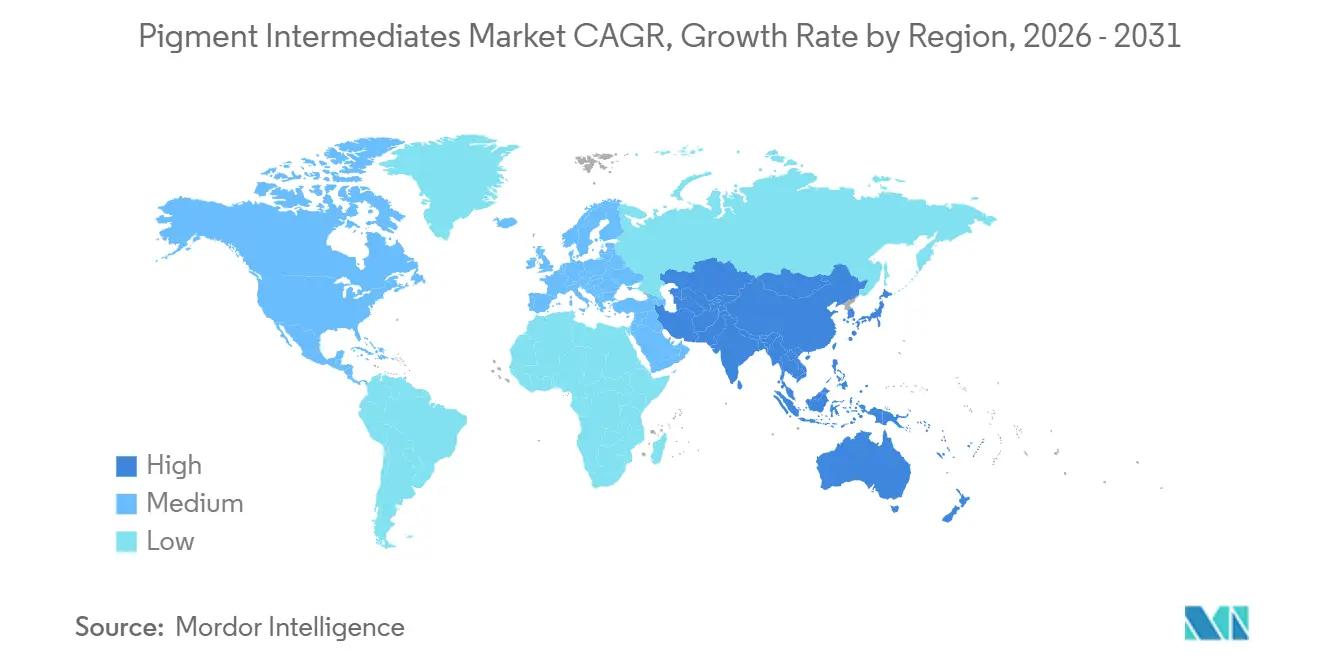
Asia-Pacific held 46.26% of the pigment intermediates market size in 2025 and is projected to advance at a 5.83% CAGR through 2031. The region combines intermediate production, finished pigment processing, and large downstream bases for textiles, packaging, plastics, and coatings. China, India, Vietnam, and South Korea are important parts of these connected manufacturing networks. BASF’s fully operational Zhanjiang Verbund site adds to the region’s production infrastructure and was expected to support earnings growth in the company’s Intermediates division during 2026. Regional growth reflects production scale as well as demand from local and export-oriented downstream manufacturers.
Asia-Pacific’s position in the pigment intermediates market also makes sourcing conditions in the region important for customers elsewhere. Integrated operations can connect intermediate output with pigment manufacturing, which can improve supply coordination and reduce dependence on external purchases. Sudarshan Chemical Industries Limited completed the acquisition of Heubach Group’s global pigment business in March 2025, creating a combined organization with operations across 19 manufacturing sites. Environmental controls and quality certification requirements can further favor large producers with adequate compliance capabilities.
North America and Europe remain important because buyers place a premium on low-migration, documented, and compliant pigment inputs. The United States Geological Survey reported that U.S. exports of synthetic iron oxide pigments increased 23% from 2024 to 2025. This activity reflects continuing demand for synthetic iron oxide pigments in relevant domestic and export uses. South America and the Middle East and Africa offer additional demand linked to construction and infrastructure activity. Producers that meet documentation and substance-compliance requirements can be well placed to serve European buyers, where those requirements form part of purchasing decisions. The pigment intermediates market, therefore, combines high-volume production in Asia-Pacific with specialized requirements in mature regions.

Competitive Landscape
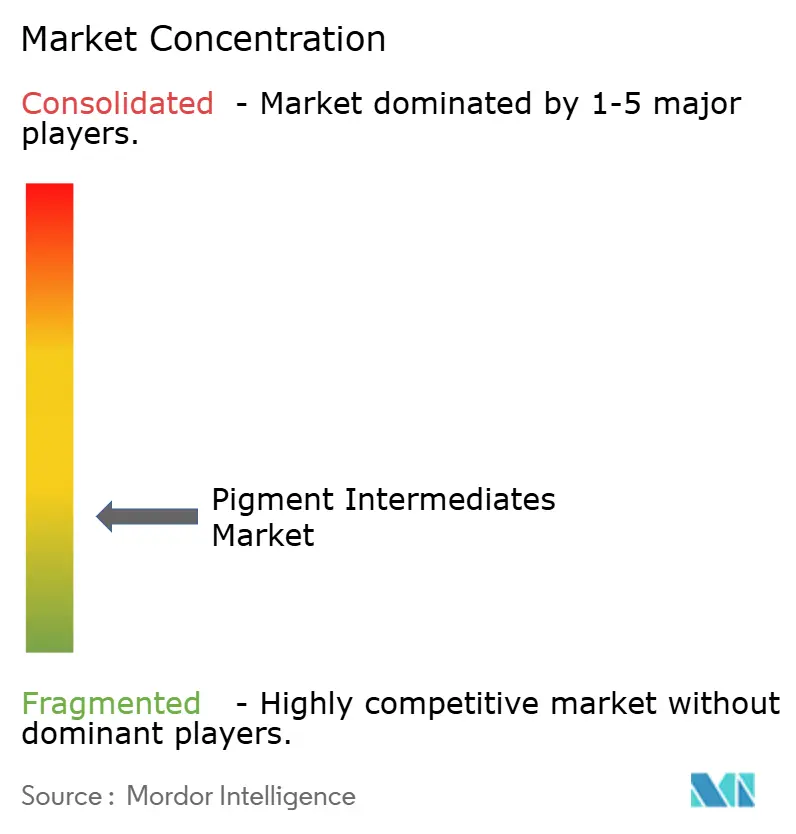
The pigment intermediates market is highly fragmented, with the top five players including BASF, DIC CORPORATION, Sudarshan Chemical Industries Limited, LANXESS, and Huntsman International LLC. Sudarshan Chemical Industries Limited completed its acquisition of Heubach for EUR 127.5 million (approximately USD 138 million), creating a larger global pigment organization with operations across 19 sites. The combined company brings together Sudarshan Chemical Industries Limited, Heubach Group, and the former CLARIANT pigments business. This move increased the importance of scale, manufacturing reach, and supply coordination in the pigment intermediates market.
DIC CORPORATION began Phase 2 of DIC Vision 2030 in fiscal 2026 and identified a JPY 90 billion strategic investment cycle through 2030. Its plan includes structural reforms and supply-chain measures within its Color and Display business, which includes pigments. LANXESS expanded its Scopeblue portfolio in 2025 with yellow iron oxide pigments carrying a 35% lower product carbon footprint than standard Bayferrox grades. These moves show how the pigment intermediates market is being shaped by investment, product documentation, and operational integration.
Competitive strength also depends on whether suppliers can provide material traceability, chemical information, and a consistent supply for regulated end uses. The European Union chemicals framework remains relevant because it defines responsibilities for managing chemical substances and their risks. Producers with established compliance systems can better support customers facing documentation and reformulation requirements. Smaller suppliers can remain relevant where they offer focused chemistries, reliable quality, and targeted regulatory registrations. The pigment intermediates market, therefore, rewards both scale and specialized capability, without supporting a claim that a limited group controls an overwhelming share of global supply.
Pigment Intermediates Industry Leaders
BASF
DIC CORPORATION
Sudarshan Chemical Industries Limited
LANXESS
Huntsman International LLC
- *Disclaimer: Major Players sorted in no particular order

Recent Industry Developments
- August 2026: Vipul Organics commenced commercial production at its new Sayakha, Gujarat, facility, designed for more than 3,600 metric tons per year of pigment production. The facility strengthens the company’s pigment manufacturing base and supports demand for pigment intermediates used in organic pigment production.
- November 2025: DIC CORPORATION, through its subsidiary Sun Chemical, expanded its Ludwigshafen, Germany, facility, adding up to 200 metric tons of perylene pigments and intermediates. The expansion strengthens the supply of specialty pigment intermediates for high-performance color applications in coatings, plastics, and automotive products.


Global Pigment Intermediates Market Report Scope
Pigment intermediates are chemical compounds used as precursor materials in the production of pigments. They provide the chemical basis for developing pigments with desired color, stability, and performance characteristics.
The Pigment Intermediates Market is segmented by type, application, and geography. By type, the market is segmented into organic intermediates and inorganic intermediates. By application, the market is segmented into paints and coatings, construction materials, printing inks, textiles, paper, plastics, and other applications. The report also covers the market size and forecasts for pigment intermediates in 15 countries across major regions. For each segment, the market sizing and forecasts have been done on the basis of value (USD).
| Organic Intermediates |
| Inorganic Intermediates |
| Paints and Coatings |
| Construction Materials |
| Printing Inks |
| Textiles |
| Paper |
| Plastics |
| Other Applications |
| Asia-Pacific | China |
| India | |
| Japan | |
| South Korea | |
| ASEAN Countries | |
| Rest of Asia-Pacific | |
| North America | United States |
| Canada | |
| Mexico | |
| Europe | Germany |
| United Kingdom | |
| France | |
| Italy | |
| NORDIC Countries | |
| Rest of Europe | |
| South America | Brazil |
| Argentina | |
| Rest of South America | |
| Middle East and Africa | Saudi Arabia |
| South Africa | |
| Rest of Middle East and Africa |
| By Type | Organic Intermediates | |
| Inorganic Intermediates | ||
| By Application | Paints and Coatings | |
| Construction Materials | ||
| Printing Inks | ||
| Textiles | ||
| Paper | ||
| Plastics | ||
| Other Applications | ||
| By Geography | Asia-Pacific | China |
| India | ||
| Japan | ||
| South Korea | ||
| ASEAN Countries | ||
| Rest of Asia-Pacific | ||
| North America | United States | |
| Canada | ||
| Mexico | ||
| Europe | Germany | |
| United Kingdom | ||
| France | ||
| Italy | ||
| NORDIC Countries | ||
| Rest of Europe | ||
| South America | Brazil | |
| Argentina | ||
| Rest of South America | ||
| Middle East and Africa | Saudi Arabia | |
| South Africa | ||
| Rest of Middle East and Africa | ||


Key Questions Answered in the Report
What is the size of the pigment intermediates market?
The pigment intermediates market stands at USD 15.90 billion in 2026 and is projected to reach USD 20.45 billion by 2031.
What is driving demand for pigment intermediates?
Coatings, plastics, digital printing, and higher demand for compliant colorant systems support demand across key end uses.
Which type led the market share in 2025?
Organic intermediates held 45.73% of the market share in 2025.
Which application is expected to grow fastest through 2031?
Plastics are projected to advance at a 6.02% CAGR through 2031, supported by packaging and electric vehicle applications.
Page last updated on:





