
Physical AI For Warehouse Handling Market Size and Share
Market Overview
| Study Period | 2021 - 2032 |
|---|---|
| Market Size (2027) | USD 6.99 Billion |
| Market Size (2032) | USD 22.65 Billion |
| Growth Rate (2027 - 2032) | 26.51 % |
| Fastest Growing Market | North America |
| Largest Market | Asia-Pacific |
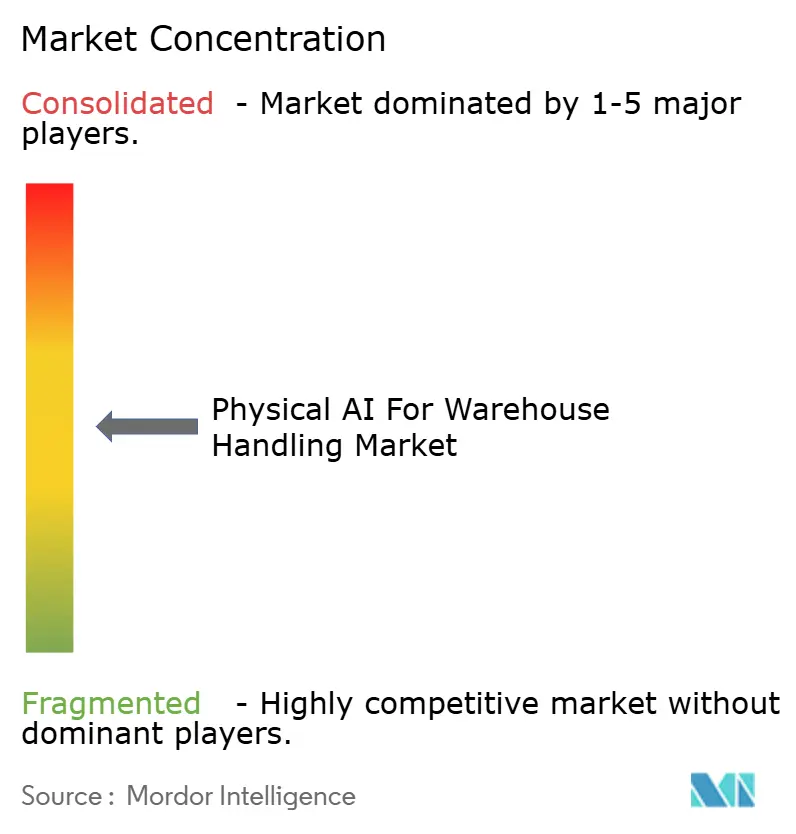
| Market Concentration | Medium |
Major Players *Disclaimer: Major Players sorted in no particular order Image © Mordor Intelligence. Reuse requires attribution under CC BY 4.0. | |
Physical AI For Warehouse Handling Market Analysis by Mordor Intelligence
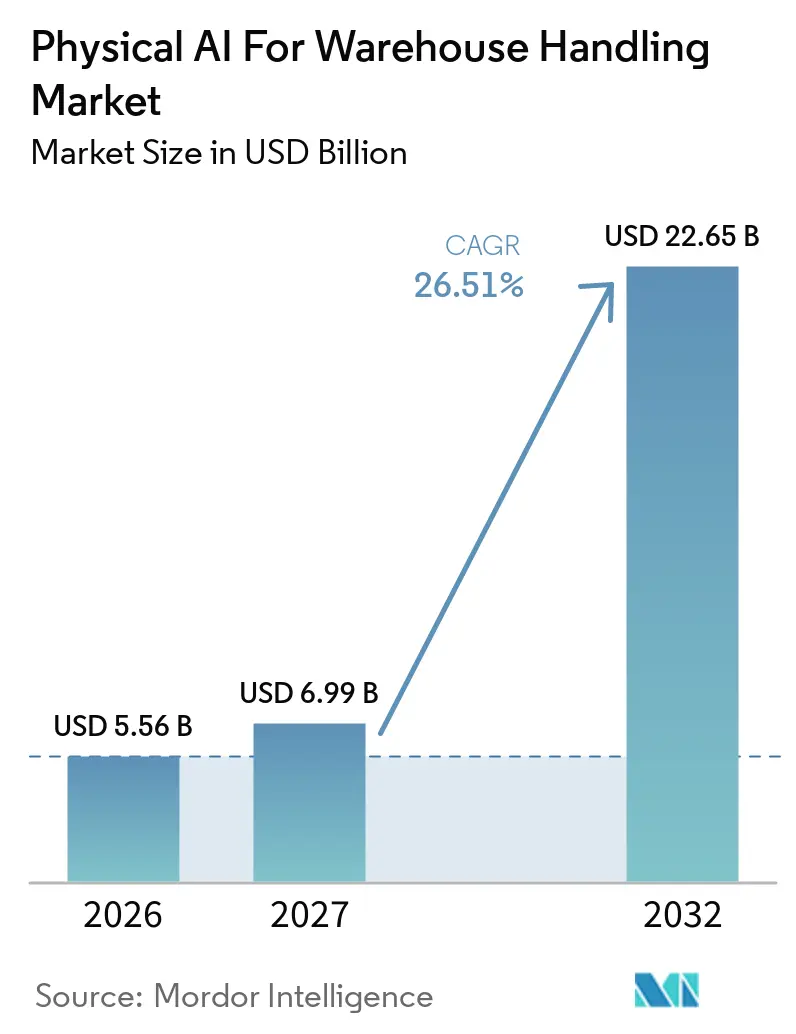
The Physical AI for warehouse handling market size is projected to expand from USD 5.56 billion in 2026 to USD 22.65 billion by 2032, registering a CAGR of 26.51% between 2027 to 2032. The market is moving beyond isolated automated guided vehicle installations toward connected systems that can perceive conditions, select actions, and coordinate work with less manual direction. Warehouse operators face higher labor costs, difficult hiring conditions, and a larger number of stock-keeping units, which raises the value of flexible handling systems. The Physical AI for warehouse handling market is also benefiting from investments in simulation, fleet orchestration, and machine vision that make deployment more practical across varied warehouse layouts. Subscription models are expanding access for operators that cannot make large upfront capital commitments, while established industrial suppliers are adding AI capabilities to their existing hardware lines. Integration cost, facility downtime, and safety validation remain material constraints, particularly where new systems must work within active sites.
Key Report Takeaways
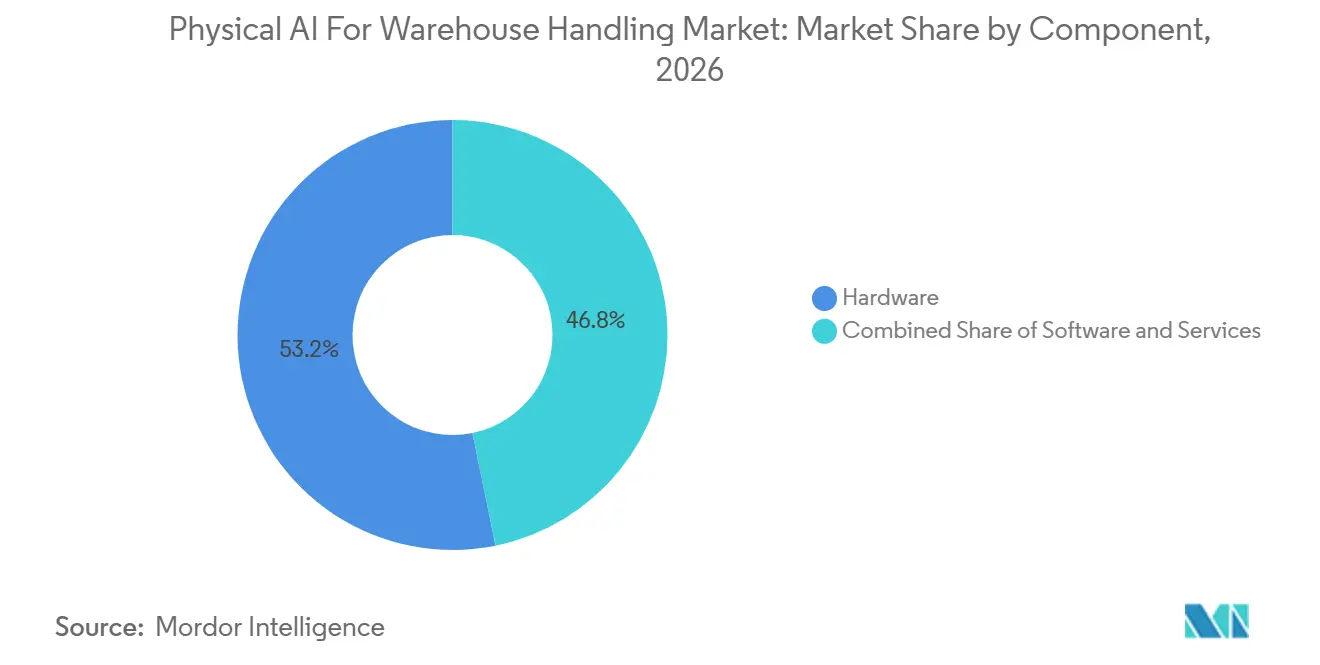
- By component, hardware held 53.21% of the 2026 total, while software is expected to expand at a 27.65% CAGR through 2032 in the physical AI for warehouse handling market.
- By robot and handling system, autonomous mobile robots held 29.87% share in 2026, while robotic picking and piece-picking arms are projected to expand at a 28.11% CAGR through 2032.
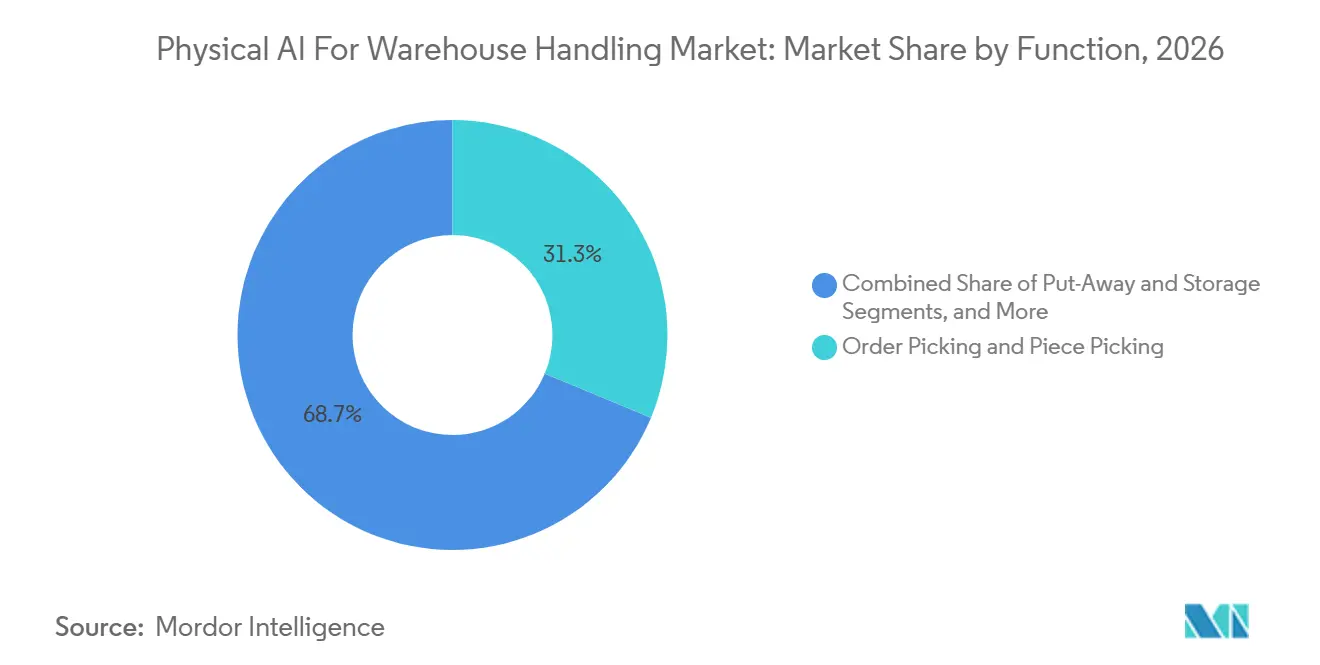
- By function, order picking and piece picking accounted for 31.28% share in 2026, while put-away and storage are forecast to expand at a 27.86% CAGR through 2032 in the physical AI for warehouse handling market.
- By end user, retail and e-commerce held 25.65% share in 2026 and a expected to expand at a 28.34% CAGR through 2032.
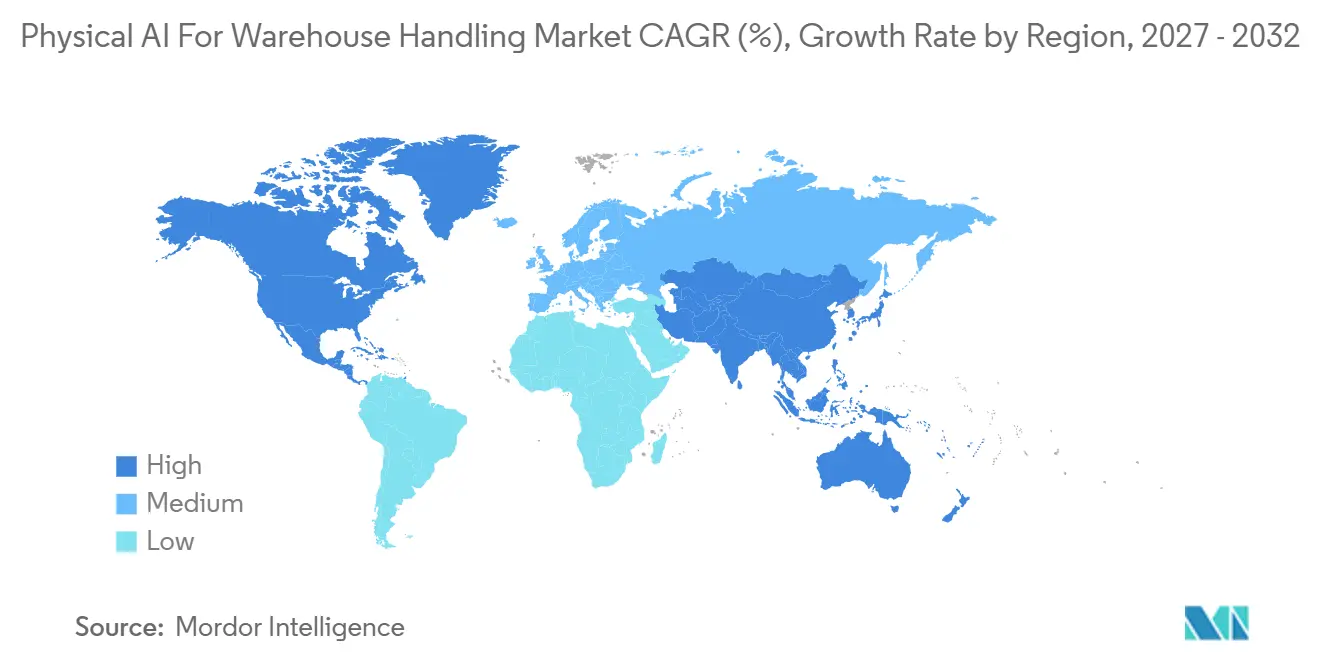
- By geography, Asia-Pacific held 27.86% share in 2026, while North America is projected to expand at a 28.48% CAGR through 2032 in the physical AI for warehouse handling market.
Note: Market numbers in this report are based on Mordor Intelligence's proprietary estimation framework, which combines nine months of actuals with Q4 projections for base year 2026.
Global Physical AI For Warehouse Handling Market Trends and Insights
Drivers Impact Analysis*
| DRIVER | (~) % IMPACT ON CAGR FORECAST | GEOGRAPHIC RELEVANCE | IMPACT TIMELINE |
|---|---|---|---|
| E-Commerce SKU Proliferation and Compressed Delivery Windows | +5.8% | Global, concentrated in North America, China, and Western Europe | Short term (≤ 2 years) |
| Warehouse Labor Scarcity and Wage Inflation | +5.2% | North America, Western Europe, Japan, and South Korea | Short term (≤ 2 years) |
| Multimodal Vision and Grasping Advances | +4.1% | Global, with early adoption in North America and East Asia | Medium term (2-4 years) |
| Robotics-as-a-Service Expanding Access for Mid-Sized Operators | +3.4% | North America, Western Europe, and emerging Asia-Pacific markets | Medium term (2-4 years) |
| Long-Tail Safety Simulation and Virtual Commissioning | +2.7% | Global, with regulatory attention in the European Union, Japan, and North America | Medium term (2-4 years) |
| Interoperable Fleet Orchestration Across Mixed Robot Fleets | +2.2% | North America, the European Union, China, Asia-Pacific, and the Middle East and Africa | Long term (≥ 4 years) |
| Source: Mordor Intelligence | |||
E-Commerce SKU Proliferation and Compressed Delivery Windows
Large online retailers manage extensive product catalogs, illustrating the assortment complexity that fulfillment operations face and the difficulty of maintaining consistent manual processes across a broad range of products. Fixed automation and rule-based robots may require reprogramming when the product mix changes, making them less suited to rapidly changing inventory, short product life cycles, and frequent shifts in order patterns. Seasonal peaks can lift required throughput to 500% above normal, creating conditions that static labor pools and fixed equipment cannot easily absorb without overtime, temporary labor, or reduced service performance. The Physical AI for warehouse handling market therefore benefits when operators need systems that can learn from new pick data and respond to changing demand without a separate workflow design for every item. Amazon announced Project Mercury in September 2026, with plans for more than 1,000 same-day fulfillment centers by 2031 and a 2-year United States capital budget of USD 6.8 billion, demonstrating the scale of its delivery commitments and the potential to accelerate automation investment across fulfillment networks. AI-guided robots can improve their handling performance as more pick events are recorded, which makes reliable deployment data, dependable exception handling, and a clear view of item variation important vendor assets.
Warehouse Labor Scarcity and Wage Inflation
Warehouse labor accounts for 50% to 70% of operating costs, while turnover can reach 150% annually in some facilities, creating recurring demands for recruitment, training, and supervision. The combination of persistent hiring needs, overtime exposure, safety requirements, and training time encourages operators to evaluate automation as a recurring operating decision rather than an occasional capital project. Transportation and warehousing average hourly earnings reached USD 32.78 in September 2026, while warehousing and storage employment declined by 21,600 positions over the same period.[1] Autonomous mobile robot fleets offered on a monthly subscription basis can reduce the financial barrier to adoption when operators need a gradual path to automation and cannot delay improvements until a major capital program is approved. The Physical AI for warehouse handling market is particularly relevant in nonmetropolitan logistics corridors, where labor availability can be more limited than in primary hubs and replacement workers may be difficult to retain. The expected benefits extend beyond direct labor savings, as more stable workflows can also reduce disruptions caused by turnover, overtime, uneven staffing, and the need to move experienced workers between urgent tasks.
Multimodal Vision and Grasping Advances
Vision-language-action models are moving from research settings into practical warehouse tasks, improving the ability of robotic arms to identify, assess, and pick unfamiliar items. These systems combine visual input with task instructions, allowing robots to respond to variation without a separate training sequence for every product, package orientation, or storage presentation. Research on cross-modality fusion for task-oriented grasping underscores its relevance to warehouses with diverse packages, changing assortments, and tasks that demand consistent handling.[2] The Physical AI for warehouse handling market gains from these advances because reliable handling of nonuniform items has remained a difficult step in broader warehouse automation, especially where products arrive in mixed containers. Simulation tools can also create warehouse scenes, test task logic, and support training before robots are deployed on an operating floor, where errors can disrupt normal work. NVIDIA released Cosmos 3 in May 2026 as an omnimodal model designed for physical AI simulation and executable robot actions, supporting the link between synthetic environments, model training, and real robot development.
Robotics-as-a-Service Expanding Access for Mid-Sized Operators
Robotics-as-a-service converts an automation purchase into a recurring operating expense, which can make projects easier to approve within an existing warehouse budget and reduce concern about a large initial payment. A 2025 study by MHI, Peerless Research Group, and The Robotics Group found that 48% of participating organizations used robots in their facilities, compared with 23% 3 years earlier. The same study found that 64% used a robotics-as-a-service or software-as-a-service system, reflecting greater acceptance of recurring commercial models and greater familiarity with paying for technology through operating budgets.[3] The Physical AI for the warehouse-handling industry can reach more mid-sized operators when subscription plans reduce the need for a single large capital commitment and enable linking payment to a defined operating need. Per-hour and per-pick pricing also encourages vendors to demonstrate dependable output, since poor performance directly affects customer economics, service quality, and the value of the contract. This approach can favor providers that combine reliable hardware, support services, transparent performance measures, and software that can be updated across a deployed fleet.
Restraints Impact Analysis*
| RESTRAINT | (~) % IMPACT ON CAGR FORECAST | GEOGRAPHIC RELEVANCE | IMPACT TIMELINE |
|---|---|---|---|
| High Brownfield Integration Cost and Downtime Risk | -2.9% | Global, most acute in North America and Europe | Short term (≤ 2 years) |
| Safety Certification and Cyber-Physical Liability | -1.8% | European Union, North America, and Japan | Medium term (2-4 years) |
| Transparent Packaging and Deformable-SKU Perception Failures | -1.2% | Global, concentrated in pharmaceutical, fast-moving consumer goods, and personal care operations | Medium term (2-4 years) |
| Battery Charging Bottlenecks and Thermal Derating | -0.7% | Global, with high exposure in high-throughput, multi-shift operations | Long term (≥ 4 years) |
| Source: Mordor Intelligence | |||
High Brownfield Integration Cost and Downtime Risk
Brownfield sites often require new systems to accommodate active operations, legacy software, existing racking, building constraints, and customer service commitments that cannot be suspended. A cube storage or automated storage and retrieval system can require 3 to 12 months of work, along with changes to flooring, fire suppression, and power infrastructure.[4] The Physical AI for warehouse handling market faces a slower adoption path, as customers cannot risk service interruption during installation, particularly when a facility supports time-sensitive orders or serves multiple clients. Software and middleware work can add 20% to 35% to the total project cost because warehouse management system and enterprise resource planning integrations require testing, data reconciliation, and detailed exception handling. Safety hardware and risk assessments can add further costs for each robotic cell, especially when the project scope changes after installation or the operating layout has to be adjusted. These conditions can defer deployment in mid-sized facilities even where automation economics appear attractive over the longer term and management recognizes the pressure created by labor shortages.
Safety Certification and Cyber-Physical Liability
Safety requirements influence system design, operating procedures, staff training, and the pace at which new robots are introduced to customer sites. ISO 10218 and ANSI/A3 R15.06-2025 govern industrial robot safety, while ANSI/A3 R15.08 applies to autonomous mobile robot deployments. The International Electrotechnical Commission published IEC PAS 63277:2026 on June 29, 2026, setting out safety and interoperability protocols for autonomous mobile robots and robotic palletizers. Changes to a certified robot cell may require renewed safety validation, adding cost and time for operators who frequently adjust layouts, introduce new tasks, or change access rules for workers. The Physical AI for warehouse handling market also faces unresolved questions about responsibility when software, hardware, integrators, and warehouse staff each affect system behavior during routine operations or in the event of an unexpected event. Smaller suppliers may find the compliance burden more difficult to manage, which can strengthen the position of well-capitalized providers with established safety programs, testing capability, and field support.
*Our forecasts treat driver/restraint impacts as directional, not additive. The impact forecasts reflect baseline growth, mix effects, and variable interactions.
Segment Analysis
By Component: Software Extends the Value of Installed Hardware
Hardware accounted for 53.21% of the Physical AI for warehouse handling market share in 2026, reflecting the costs of autonomous mobile robots, robotic arms, sensors, racks, controls, and other installed equipment. This large share is consistent with a deployment cycle where many customers are building their first broad automation programs rather than making only incremental process changes. Hardware must operate safely around people, goods, racks, and vehicles, so procurement decisions include reliability, payload, floor conditions, battery performance, and availability of local support. Its role also includes the sensing, computing, and power systems that connect physical equipment to warehouse software and operating rules. The component mix shows that automation remains capital-intensive even when the intended benefit comes from better decision-making and improved task coordination, and for buyers, this means that equipment selection cannot be separated from the operating model, site layout, expected volumes, maintenance approach, and the internal capability required to manage a more automated facility.
Software is expected to expand at a 27.65% CAGR from 2027 to 2032, making it the fastest-growing component in the Physical AI for warehouse handling market. Fleet orchestration, warehouse execution applications, perception systems, digital twins, and data tools can be licensed into an expanding installed base as operators add sites and equipment. The software layer is valuable because it can prioritize work, direct robots, reconcile inventory events, and present managers with a shared view of operations. It also supports recurring revenue models and allows vendors to serve multiple hardware platforms when interfaces are available. Services remain important because integration, maintenance, training, change management, and managed deployments determine whether customers can obtain the expected outcome from the equipment, while the value of software is therefore tied to the quality of implementation, the clarity of the operating rules, and the ability of warehouse teams to act on the information that the systems provide.

By Robot and Handling System: Picking Arms Address More Variable Tasks
Autonomous mobile robots held 29.87% of the Physical AI for warehouse handling market share in 2026, supported by their ability to work in many brownfield facilities without extensive fixed infrastructure. Operators can add units as volumes rise, aligning with phased deployment plans and allowing a site to begin with a narrow use case before expanding the scope. These robots are widely used for replenishment, internal transport, goods movement between work areas, and cart or tote movement. Their value is strongest where travel distance, repeatable movement, labor availability, and frequent task handoffs create a clear need for automation. They also provide a practical foundation for fleet management software that coordinates task assignment, traffic flow, charging, and exception handling across a warehouse, helping operations managers balance work across zones, identify congestion, and keep mobile equipment aligned with the changing pace of receiving, picking, replenishment, and dispatch.
Robotic picking and piece-picking arms are projected to expand at a 28.11% CAGR from 2027 to 2032, driven by systems that can recognize a wider range of items and maintain stable grasps. The Physical AI for warehouse handling market benefits as arms move beyond uniform items to goods with nonstandard surfaces, shapes, packaging, and presentation. Automated guided vehicles continue to play a role in high-payload movement along predictable routes, while automated storage and retrieval systems remain important for high-density storage in temperature-controlled and pharmaceutical settings. Humanoid platforms are an emerging part of the Physical AI for warehouse handling market, with limited present revenue but substantial development activity for tasks that require mobility and manipulation in human-designed spaces. Agility Robotics reported that Digit 4 completed more than 65,000 operational hours before Digit 5 was introduced in September 2026, and the appeal of humanoid systems lies in their potential to work in spaces designed for people, although their broader value will depend on dependable performance, safe operation, and a clear fit with warehouse workflows.
By Function: Coordinated Storage and Picking Support Full-Cycle Automation
Order picking and piece picking accounted for 31.28% of the Physical AI for warehouse handling market size in 2026. Picking accounts for a large share of warehouse labor hours and is often the first process in which operators test whether automation can meet output and accuracy requirements. The task directly affects order speed, order accuracy, labor scheduling, and the ability to meet customer delivery commitments during normal and peak trading periods. It also creates a large volume of operational data that can help systems refine pick planning, inventory allocation, and handling behavior over time. The leading position of this function reflects the immediate value of reducing repetitive travel, manual item selection, and congestion between storage and packing areas, and it also shows why warehouse leaders often begin with a discrete picking use case before connecting it to upstream inventory movement and downstream packing, consolidation, and shipping processes.
Put-away and storage is forecast to expand at a 27.86% CAGR from 2027 to 2032, supported by automated storage and retrieval systems and AI-based slotting applications. These tools can reposition inventory using demand signals, item characteristics, and storage rules, helping to reduce travel distance without expanding the facility footprint. Inbound receiving and unloading remain more difficult to automate because mixed pallets and unconstrained truckloads create significant physical variation, although AI-guided depalletizing systems are entering production in select high-volume locations. Replenishment and internal transport are becoming more established uses for autonomous mobile robots as fleet costs decline and operating teams gain experience managing robotic workflows. The Physical AI for warehouse handling market is moving toward connected architectures in which receiving, storage, picking, replenishment, and packing are coordinated rather than automated as separate tasks, and the practical objective is a warehouse where each process can react to the pace and status of the others, rather than a collection of isolated systems that require manual coordination between steps.
By End User: Retail and E-Commerce Combine Scale With Time Pressure
Retail and e-commerce held 25.65% of the Physical AI for warehouse handling market size in 2026. The segment combines high-order volumes, broad assortments, seasonal demand shifts, and delivery requirements, leaving limited time for manual exception handling. Retailers need systems that can support frequent promotions, varied packaging, return processing, and order fulfillment from both centralized and local facilities. This creates demand for flexible equipment that can adapt to different workflows rather than supporting only a single fixed process or a stable set of items. The segment also offers a large base of facilities where operators can gradually extend automation from transport to storage, piece picking, packing support, and inventory management, and this phased approach lets operators assess service performance and workforce adoption in one part of the network before committing to a wider roll-out across facilities with different order profiles.
Retail and e-commerce are expected to expand at a 28.34% CAGR from 2027 to 2032, the highest rate among end users. Third-party logistics and contract logistics operators are also important because their margins and service commitments are closely tied to labor efficiency, customer service levels, and operating reliability across multiple client accounts. Pharmaceuticals and healthcare require high accuracy, strict product-handling discipline, and traceability, which support the use of specialized picking systems such as RightHand Robotics' RightPick platform at Apotea's 30,000-square-meter logistics center in Sweden. Food and beverage operations support demand for automated storage and cold-chain mobile robots, while automotive and industrial users apply systems to bin feeding, kitting, and sequencing. These use cases broaden the Physical AI for warehouse handling market beyond a single warehouse format and increase the need for solutions that meet distinct environmental, quality, and throughput requirements, so suppliers must therefore support a range of goods, handling constraints, customer service standards, and facility conditions while retaining enough flexibility to adapt their systems as the operator's requirements change.
Geography Analysis
Asia-Pacific is projected to account for 27.86% of the regional total in 2026. China combines a large manufacturing base with dense e-commerce fulfillment networks, domestic robot production, and a broad supplier base for sensors, components, and automation equipment. Japan faces demographic pressures that support logistics automation, while South Korea contributes advanced robotics manufacturing capabilities and systems expertise. India and Southeast Asia are expected to add demand through quick-commerce growth, urban fulfillment, and expanding third-party logistics capacity. Japan’s labor constraints further reinforce the value of logistics automation and support demand for systems that reduce repetitive warehouse tasks while maintaining reliable operating routines.
North America is projected to expand at a CAGR of 28.48% from 2027 to 2032. Rising wages, constrained availability of warehouse labor, service-level expectations, and the need to manage peak demand continue to encourage capital-for-labor substitution across logistics operations. The United States represents a major source of regional demand, supported by large retail distribution networks and automation investments. Canada contributes demand from third-party logistics providers, while Mexico adds manufacturing-related warehouse activity through nearshoring. Walmart is expected to invest USD 330 million in a single distribution center, illustrating the scale at which large retailers can fund new operating models and providing a reference point for other operators evaluating automation. These conditions make the Physical AI for warehouse-handling market attractive to suppliers offering subscription models, phased deployments, reliable service support, and systems that can be installed in existing facilities.
Europe is projected to be the third-largest regional market. The United Kingdom, France, Scandinavia, and Benelux are active deployment locations, where labor conditions, distribution density, and high service expectations support investment. KION Group is expected to report automation order intake of EUR 3.599 billion, (USD 3.887 billion) at the 2025 annual average exchange rate, representing a 39.5% increase. Stadium is expected to announce a SEK 300 million investment, (USD 28 million), in an Exotec Skypod system in Sweden in March 2026. South America, the Middle East, and Africa remain earlier-stage markets, where adoption centers on large third-party logistics providers, export-oriented manufacturers, and investments in new logistics capacity.
Competitive Landscape
The Physical AI for warehouse handling market features a moderately concentrated platform layer and a more fragmented deployment layer. NVIDIA provides infrastructure through Isaac, Omniverse, and Cosmos that supports robot development programs by enabling simulation, training, and system testing. Full-stack providers, such as Symbotic and AutoStore, control key elements of the hardware, software, and customer relationship, simplifying accountability for customers. AI-first platforms, including Covariant and GreyOrange, focus on intelligence layers that can operate with partner hardware. Meanwhile, ABB, KUKA, FANUC, and Yaskawa Electric are integrating AI-based perception and fleet-management capabilities into their established industrial hardware portfolios.
KION Group, NVIDIA, and Accenture are expected to announce a collaboration in March 2026 to develop physics-accurate warehouse digital twins using Omniverse, including simulation-based training for autonomous forklifts deployed in GXO’s logistics network. For the Physical AI for warehouse-handling market, this collaboration demonstrates the importance of testing workflows, vehicle behavior, and physical constraints before deploying systems in operational facilities. Symbotic is expected to acquire ARMS Innovations in July 2026 to extend warehouse operations optimization from task execution to inventory and flow management across distribution networks. AutoStore is expected to sign a global strategic supply framework with Amazon in August 2026, establishing terms for potential procurement without creating purchasing commitments at the time of signing. These developments indicate that suppliers compete not only on individual robot performance, but also on software, operational data, deployment capabilities, and the capacity to support large-scale programs over time.
Opportunity areas include mid-market brownfield projects with total project values below USD 2 million, where customization can make it difficult to deliver complete solutions at competitive economics. Mixed-fleet orchestration also presents an opportunity, as operators may use robots from multiple vendors but require a single interface for task management, exception handling, performance monitoring, and reporting. Pharmaceutical automation represents another important opportunity because its requirements for handling accuracy and traceability may exceed the capabilities of general-purpose platforms. Humanoid robot developers, including Agility Robotics, Apptronik, and Figure AI, are targeting tasks that wheeled mobile robots and fixed robotic arms cannot consistently access. The Physical AI for warehouse handling industry remains competitive because customers must balance integration risk, system reliability, safety, service support, and the flexibility to scale across multiple facilities.
Physical AI For Warehouse Handling Industry Leaders
-
Amazon Robotics LLC
-
KUKA AG
-
ABB Ltd.
-
FANUC Corporation
-
Yaskawa Electric Corporation
- *Disclaimer: Major Players sorted in no particular order
Recent Industry Developments
- October 2026: Exotec announced that First Supply's Skypod-equipped distribution center achieved picking speeds 10x faster than manual processes and 4x greater storage capacity within the existing racking footprint.
- September 2026: Agility Robotics unveiled Digit 5, reporting more than USD 300 million in multi-year orders, a 10:1 run-to-charge ratio enabling more than 20 productive hours per day, and a SPAC merger process valuing the company at USD 2.5 billion. Early access to Digit 5 is expected in H1 2027, with general availability for warehouse and distribution operators by the end of 2027.
- August 2026: AutoStore Holdings signed a global strategic supply framework with Amazon, establishing terms for the future procurement of AutoStore systems, with no purchase commitments at signing, formally placing cube-storage automation in Amazon's long-range vendor strategy.
- July 2026: Symbotic acquired ARMS Innovations Ltd., a United Kingdom-based real-time operational intelligence software company, to create a new enterprise category of Warehouse Operations Optimization that extends AI orchestration from task execution to inventory and flow management across entire distribution networks.
Global Physical AI For Warehouse Handling Market Report Scope
The Physical AI for Warehouse Handling Market Report is Segmented by Component (Hardware, Software, and Services), Robot and Handling System (Autonomous Mobile Robots, Automated Guided Vehicles, Robotic Picking and Piece-Picking Arms, and Automated Storage and Retrieval Systems), Function (Inbound Receiving and Unloading, Put-Away and Storage, Order Picking and Piece Picking, and Replenishment and Internal Transport), End User (Retail and E-Commerce, Third-Party Logistics and Contract Logistics, Food and Beverage, Pharmaceuticals and Healthcare, and Automotive and Industrial Manufacturing), and Geography (North America, South America, Europe, Asia-Pacific, and the Middle East and Africa). The Market Forecasts are Provided in Value (USD).
| Hardware |
| Software |
| Services |
| Autonomous Mobile Robots |
| Automated Guided Vehicles |
| Robotic Picking and Piece-Picking Arms |
| Automated Storage and Retrieval Systems |
| Other Robot and Handling Systems |
| Inbound Receiving and Unloading |
| Put-Away and Storage |
| Order Picking and Piece Picking |
| Replenishment and Internal Transport |
| Other Functions |
| Retail and E-Commerce |
| Third-Party Logistics and Contract Logistics |
| Food and Beverage |
| Pharmaceuticals and Healthcare |
| Automotive and Industrial Manufacturing |
| Other End Users |
| North America | United States |
| Canada | |
| Mexico | |
| South America | Brazil |
| Argentina | |
| Rest of South America | |
| Europe | Germany |
| United Kingdom | |
| France | |
| Italy | |
| Spain | |
| Rest of Europe | |
| Asia-Pacific | China |
| Japan | |
| South Korea | |
| India | |
| Rest of Asia-Pacific | |
| Middle East | Saudi Arabia |
| United Arab Emirates | |
| Rest of Middle East | |
| Africa | South Africa |
| Nigeria | |
| Rest of Africa |
| By Component | Hardware | |
| Software | ||
| Services | ||
| By Robot and Handling System | Autonomous Mobile Robots | |
| Automated Guided Vehicles | ||
| Robotic Picking and Piece-Picking Arms | ||
| Automated Storage and Retrieval Systems | ||
| Other Robot and Handling Systems | ||
| By Function | Inbound Receiving and Unloading | |
| Put-Away and Storage | ||
| Order Picking and Piece Picking | ||
| Replenishment and Internal Transport | ||
| Other Functions | ||
| By End User | Retail and E-Commerce | |
| Third-Party Logistics and Contract Logistics | ||
| Food and Beverage | ||
| Pharmaceuticals and Healthcare | ||
| Automotive and Industrial Manufacturing | ||
| Other End Users | ||
| By Geography | North America | United States |
| Canada | ||
| Mexico | ||
| South America | Brazil | |
| Argentina | ||
| Rest of South America | ||
| Europe | Germany | |
| United Kingdom | ||
| France | ||
| Italy | ||
| Spain | ||
| Rest of Europe | ||
| Asia-Pacific | China | |
| Japan | ||
| South Korea | ||
| India | ||
| Rest of Asia-Pacific | ||
| Middle East | Saudi Arabia | |
| United Arab Emirates | ||
| Rest of Middle East | ||
| Africa | South Africa | |
| Nigeria | ||
| Rest of Africa | ||
Key Questions Answered in the Report
What is the size of the Physical AI for warehouse handling market?
The Physical AI for warehouse handling market is valued at USD 5.56 billion in 2026 and is projected to reach USD 22.65 billion by 2032, at a 26.51% CAGR from 2027 to 2032. The outlook reflects the increasing use of connected robot systems for movement, storage, and item handling across warehouse workflows, particularly where operators seek more reliable throughput, less manual travel, and better coordination across daily warehouse activity, and it also reflects a preference for tools that can be introduced in stages, so that managers can test workflow performance, validate safety procedures, train employees, and extend the system only after the initial deployment meets service requirements.
What is driving the adoption of physical AI in warehouse handling?
Larger stock-keeping unit counts, shorter delivery windows, warehouse labor constraints, and higher wage costs are supporting the adoption of flexible handling systems. The Physical AI for warehouse handling market also benefits when operators need a system that can adapt to different goods and changing order patterns, while helping teams manage inventory movement, work allocation, and response times across a facility, and this need is particularly clear when seasonal demand, promotion activity, or a changed product mix creates pressure on the usual picking and replenishment process.
Which component leads warehouse physical AI spending?
Hardware leads with a 53.21% share in 2026 because robots, arms, sensing equipment, and automated storage systems require substantial upfront investment. The leading role of hardware shows that most projects still require a material investment in physical equipment before software benefits can be fully realized.
Which type of warehouse robot is expanding fastest?
Robotic picking and piece-picking arms are projected to expand at a 28.11% CAGR through 2032 as vision and grasping systems handle a wider range of items. The Physical AI for warehouse handling market is using these systems to address tasks where product variation has limited earlier automation approaches.
Which end user is expected to adopt warehouse physical AI the fastest?
Retail and e-commerce are projected to expand at a 28.34% CAGR through 2032, driven by high order volumes, broad assortments, and strict delivery requirements. These operators are prioritizing tools that support consistent service during normal trading and seasonal peaks.
Which region has the strongest outlook for physical AI in warehouses?
Asia-Pacific leads with 27.86% share in 2026, while North America is projected to expand fastest at a 28.48% CAGR through 2032. The Physical AI for warehouse handling market is supported in these regions by strong deployment demand, established automation capability, and labor-related pressures.