
Physical AI For Truck Loading and Unloading Market Size and Share
Market Overview
| Study Period | 2021 - 2032 |
|---|---|
| Market Size (2027) | USD 2.27 Billion |
| Market Size (2032) | USD 7.64 Billion |
| Growth Rate (2027 - 2032) | 27.47 % |
| Fastest Growing Market | North America |
| Largest Market | Asia-Pacific |
| Market Concentration | Low |
Major Players *Disclaimer: Major Players sorted in no particular order Image © Mordor Intelligence. Reuse requires attribution under CC BY 4.0. | |
Physical AI For Truck Loading and Unloading Market Analysis by Mordor Intelligence
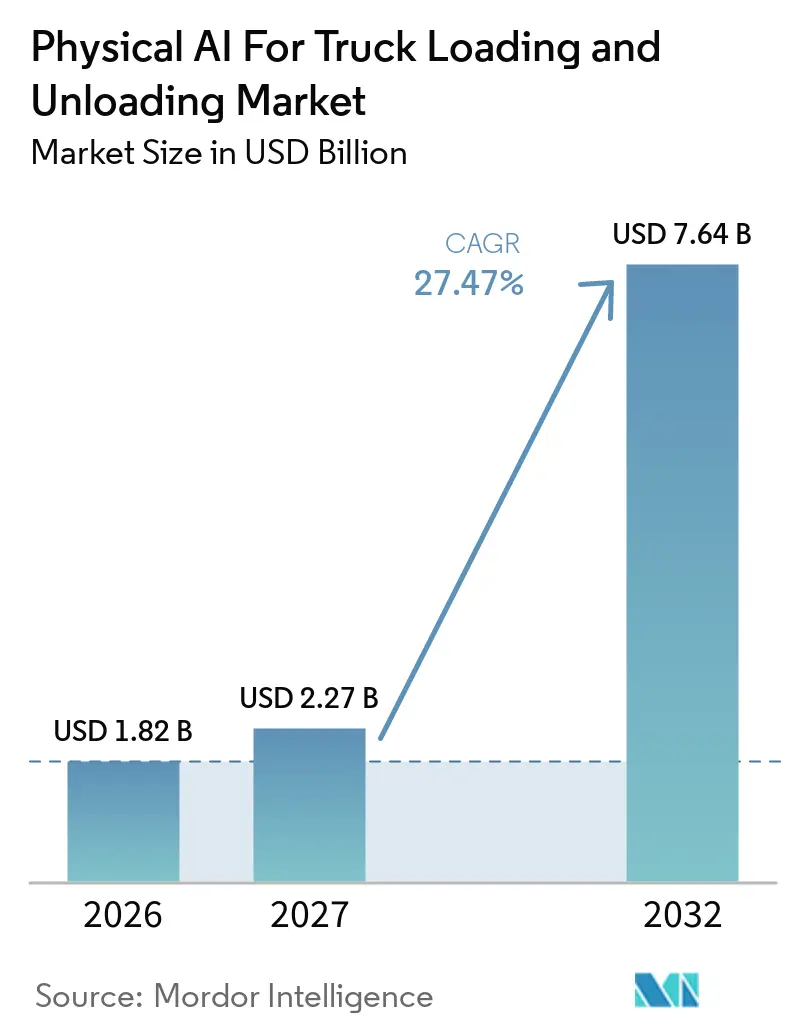
The Physical AI for truck loading and unloading market size is projected to expand from USD 1.82 billion in 2026 and USD 2.27 billion in 2027 to USD 7.64 billion by 2032, registering a CAGR of 27.47% between 2027 to 2032. Demand is centered on dock operations, where manual unloading and loading still constrain inbound fulfillment speed. Labor availability, high parcel volumes, and safety requirements are pushing operators to consider systems that work inside variable trailer environments. The physical AI for truck loading and unloading market also benefits from equipment designs that can be added to existing docks instead of requiring a new building. Suppliers are combining robots, sensing, and control software so facilities can handle more work with fewer manual dock tasks. This creates opportunities for vendors that can show reliable throughput across different trailers, cargo profiles, and operating conditions.
Key Report Takeaways
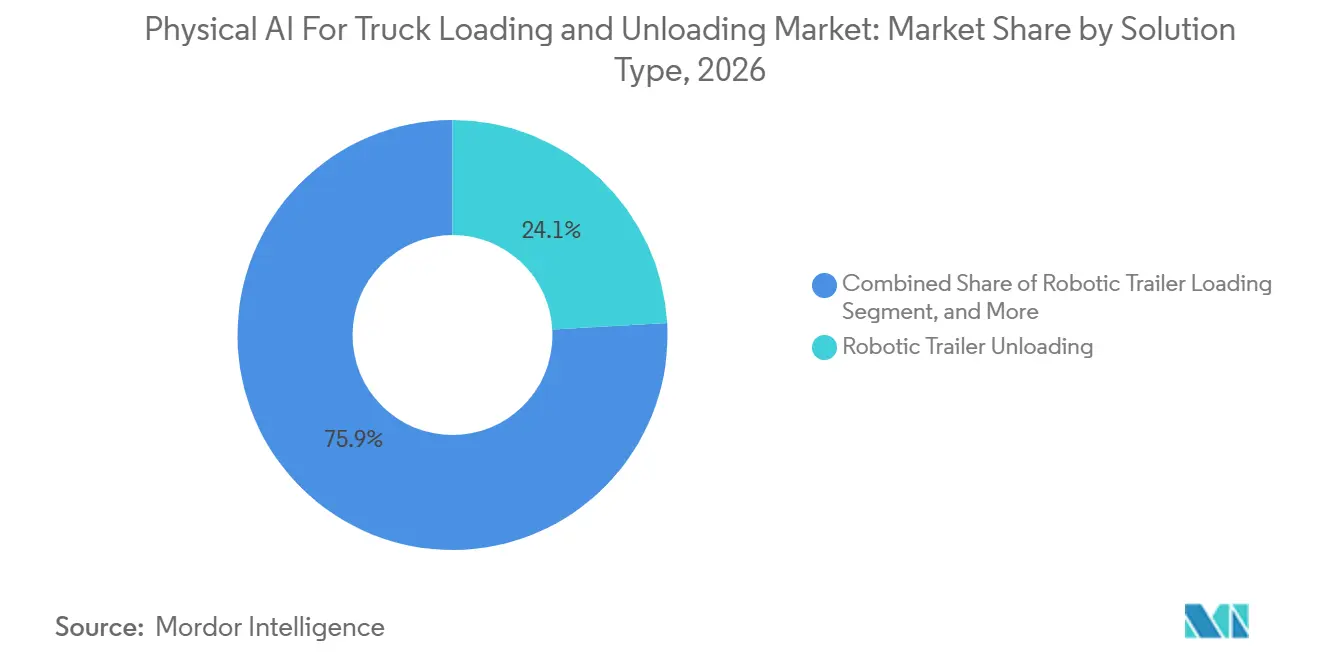
- By solution type, robotic trailer unloading held 24.11% of the physical AI for truck loading and unloading market share in 2026, while autonomous mobile robot loading and unloading is projected to expand at a 29.87% CAGR through 2032.
- By loading and unloading mode, palletized cargo held 32.87% revenue share in 2026, while mixed-SKU and irregular cargo is projected to expand at a 28.11% CAGR through 2032.
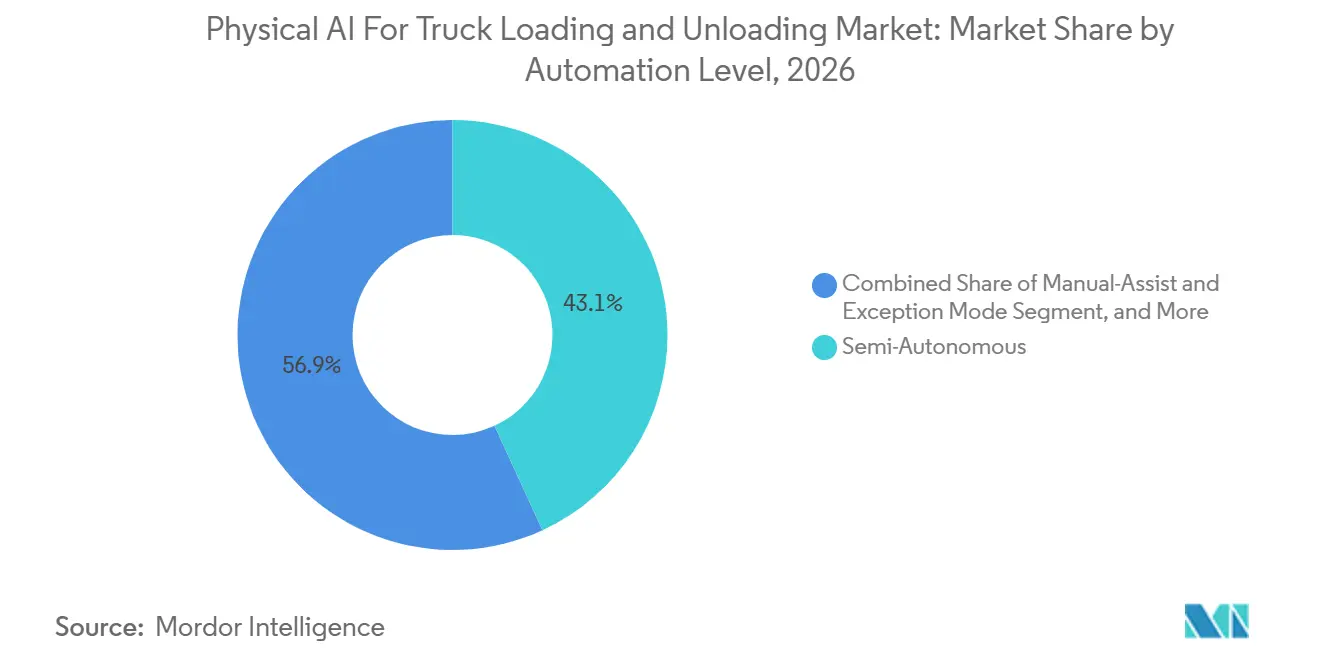
- By automation level, semi-autonomous solutions held 43.12% revenue share in 2026, while fully autonomous solutions is projected to expand at a 29.15% CAGR through 2032 in the physical AI for truck loading and unloading market.
- By end user, retail and E-commerce distribution held 27.65% revenue share in 2026, while parcel and express carriers is projected to expand at a 28.64% CAGR through 2032.
- By geography, Asia-Pacific held 29.88% revenue share in 2026, while North America is projected to expand at a 29.65% CAGR through 2032 in the physical AI for truck loading and unloading market.
Note: Market numbers in this report are based on Mordor Intelligence's proprietary estimation framework, which combines nine months of actuals with Q4 projections for base year 2026.
Global Physical AI For Truck Loading and Unloading Market Trends and Insights
Drivers Impact Analysis*
| DRIVER | (~) % IMPACT ON CAGR FORECAST | GEOGRAPHIC RELEVANCE | IMPACT TIMELINE |
|---|---|---|---|
| E-Commerce and Parcel-Volume Growth | +5.8% | Global, most acute in North America, Asia-Pacific, and Western Europe | Short term (≤ 2 years) |
| Persistent Dock-Labor Shortages and Wage Inflation | +5.2% | North America and Europe, with structural demographic pressure extending to Japan and South Korea | Medium term (2–4 years) |
| Brownfield-Compatible Automation Demand | +4.5% | North America and Europe, emerging in India and Southeast Asian logistics corridors | Medium term (2–4 years) |
| Safety Requirements for High-Risk Dock Work | +3.8% | Global, with the strongest regulatory influence in North America and EU member states | Long term (≥ 4 years) |
| Physical AI Progress in Unstructured Load Environments | +3.4% | North America-centered research and development, with spillover to Asia-Pacific and Europe | Long term (≥ 4 years) |
| Trailer-Dwell and Asset-Utilization Pressure | +2.8% | North America and Europe | Short term (≤ 2 years) |
| Source: Mordor Intelligence | |||
E-Commerce and Parcel-Volume Growth Reshaping Inbound Dock Demand
The physical AI for truck loading and unloading market is supported by higher parcel flows that place more cartons at receiving doors. Facilities must receive, identify, stage, and process these cartons before they can move to sortation or storage. Larger parcel flows increase the number of floor-loaded cartons that facilities must receive and process. Sortation and last-mile delivery have attracted investment in automation for years, while trailer work remains largely manual. This imbalance makes trailer handling a bottleneck for a broader fulfillment network. The physical AI for truck loading and unloading market can address this constraint by linking inbound trailer work with the pace of downstream fulfillment activity.
Persistent Dock-Labor Shortages and Wage Inflation Accelerating Automation Urgency
U.S. warehousing and storage employment stood at 1,831,800 in September 2026, down 21,600 from a year earlier. Average hourly earnings in transportation and warehousing reached USD 32.78 in September 2026, while consumer prices increased 3.4% over the year.[1] Dock work combines repetitive lifting, trailer handling, and a high need for dependable staffing. These working conditions make it harder to maintain stable inbound throughput when facilities rely solely on manual teams. The physical AI for the truck loading and unloading market, therefore, addresses both operational reliability and labor costs. It also gives operators a way to make routine dock handling less dependent on the availability of a full manual shift.
Brownfield-Compatible Automation Lowering the Adoption Barrier
Existing buildings are a central opportunity because facilities often cannot suspend operations for a complete dock rebuild. Movu Robotics reported that 65% of its automated storage and retrieval system installations are performed in existing buildings.[2] STILL introduced its AXL 15 iGo solution in 2026 as a production-series system that does not require fixed dock safety infrastructure.[3] The system is designed to load 30 EPAL pallets in 35 minutes with 2 units. This approach can reduce disruption and broaden the set of docks that can support automation. The physical AI for truck loading and unloading market can benefit when operators can add equipment without major building changes or lengthy operating shutdowns.
Safety Imperatives at High-Risk Docks Driving Compliance-Pull Adoption
Dock operations can expose workers to moving equipment, constrained trailer interiors, and difficult temperatures. Systems that remove workers from trailer interiors can reduce exposure to these conditions. Safety requirements can therefore support the adoption of physical AI for truck loading and unloading independently of labor economics. The use of industrial truck safety standards also affects product design for forklifts and mobile robots operating near people. Vendors must demonstrate that equipment can respond safely to the presence of workers and to unexpected cargo conditions. This makes safety engineering an important consideration throughout purchasing, integration, and daily dock operation.
Restraints Impact Analysis*
| RESTRAINT | (~) % IMPACT ON CAGR FORECAST | GEOGRAPHIC RELEVANCE | IMPACT TIMELINE |
|---|---|---|---|
| High Upfront Investment and Integration Complexity | -3.2% | Global, most acute for mid-market operators in South America, the Middle East, and Africa | Medium term (2–4 years) |
| Long-Tail Variability in Cargo and Trailer Conditions | -2.8% | Global | Long term (≥ 4 years) |
| Limited Physical AI Validation at Production Scale | -2.1% | Global, particularly affecting capital approvals at large operators | Short term (≤ 2 years) |
| Exception Handling and Human-Safety Liability | -1.7% | Global, most acute in jurisdictions with evolving autonomous machinery regulations | Medium term (2–4 years) |
| Source: Mordor Intelligence | |||
High Upfront Investment Constraining Mid-Market Deployment Speed
Full robotic trailer loading or unloading systems can cost from USD 250,000 to more than USD 1 million per dock door, according to the supplied industry benchmarks. The underlying benchmark source was not included, so the figure is retained as supplied context rather than independently supported evidence. Integration with warehouse systems, conveyors, and safety interlocks can add project cost and implementation risk. Large carriers can spread the cost through phased programs across extensive networks. Mid-market third-party logistics providers may face a longer payback period than their normal capital approval window. The physical AI for truck loading and unloading market can therefore advance faster among larger operators than among smaller facilities.
Long-Tail Variability in Cargo and Trailer Conditions Limiting Coverage
Standard cartons support more predictable robotic performance than damaged boxes, wet cartons, or unstructured mixed-SKU stacks. Trailer debris, uneven floors, and nonstandard heights can also require human intervention. The source material states that exceptions can account for 10% to 30% of picks in high-variability facilities, but the reference behind this range was not provided. Systems rated at 700 to 1,500 cases per hour under standard conditions may deliver 400 to 600 cases in mixed-SKU environments, based on the supplied operating context. Vendors must adapt equipment to regional freight patterns and facility conditions, which lengthens sales and integration cycles. The physical AI for truck loading and unloading market, therefore, needs systems designed to deliver useful performance beyond controlled, uniform carton flows.
*Our forecasts treat driver/restraint impacts as directional, not additive. The impact forecasts reflect baseline growth, mix effects, and variable interactions.
Segment Analysis
By Solution Type: Robotic Trailer Unloading Leads as Autonomous Mobile Robots Scale
Robotic Trailer Unloading accounted for 24.11% of physical AI for truck loading and unloading market share in 2026, reflecting an early focus on the most pressing dock task. These systems target manual unloading work that can delay the rest of the receiving process, particularly when cartons must be removed from floor-loaded trailers before normal warehouse flows can begin. Robotic Trailer Loading is gaining attention as unloading deployments establish a reference for related dock applications. FedEx and Dexterity expanded their physical AI deployment for autonomous trailer loading at the Hagerstown Hub in July 2026.[4] Autonomous Forklift Loading and Unloading builds on established forklift automation, although trailer interiors require different sensing from open warehouse floors, where travel paths, lighting, surfaces, and worker separation are usually more consistent.
Autonomous Mobile Robot Loading and Unloading is projected to expand at a 29.87% CAGR through 2032. Mobile platforms can serve multiple dock doors from a shared fleet rather than being fixed at a single location, allowing the operator to direct capacity to the areas with the most immediate work. Vecna Robotics said its CaseFlow platform had more than doubled in demand year over year since its 2025 launch. Dock-to-dock operation creates data across cargo types and dock layouts. That data can support faster adjustments to system performance at individual sites, which strengthens the case for physical AI in the truck loading and unloading market, where dock demand varies across shifts and locations.

By Loading and Unloading Mode: Palletized Cargo Dominates While Mixed-SKU Complexity Fuels Investment
Palletized Cargo held 32.87% of the physical AI for truck loading and unloading market size in 2026. Manufacturing, food and beverage, and retail replenishment commonly use pallet-based flows, which give equipment a more defined load structure than loose-carton trailer work. Autonomous forklifts are a principal option for handling those structured dock operations. STILL presented the AXL 15 iGo in 2026 for autonomous truck loading and unloading without stationary infrastructure. Floor-Loaded Cartons create a different requirement because they need depalletization rather than standard forklift handling, and this requires systems to recognize and collect individual cases from irregular stacks.
Mixed-SKU and Irregular Cargo is projected to expand at a 28.11% CAGR through 2032. E-commerce creates more varied carton mixes at inbound docks, which reduces the usefulness of fixed assumptions about package sequence, placement, and handling geometry. Dexterity states that its Foresight world model considers package placement across 3 spatial dimensions and time. The company states that the system makes these decisions in under 400 milliseconds while considering density, stability, and dual-arm operation. Different modes require distinct grippers, sensors, and performance commitments, reinforcing the need for practical testing in the physical AI for truck loading and unloading market.
By Automation Level: Semi-Autonomous Solutions Anchor the Market While Full Autonomy Accelerates
Semi-Autonomous Solutions held 43.12% revenue share in 2026. This model uses automation for repeated handling cycles while a worker monitors exceptions, allowing a site to retain human judgment for cases that do not fit the normal operating sequence. It offers a practical entry point for companies that need to manage liability associated with autonomous equipment operating near people. Human-in-the-Loop, Manual-Assist, and Exception Mode functions provide the safety systems and supervisory interfaces used by more automated systems. The physical AI for truck loading and unloading industry continues to use these functions as operations move toward higher autonomy.
Fully Autonomous Solutions is projected to expand at a 29.15% CAGR through 2032. High-volume hubs can accumulate operational records that help operators evaluate the removal of routine human supervision, especially where recurring trailer profiles and established work patterns simplify exception management. Information from semi-autonomous deployments can improve how systems respond to known cargo and trailer conditions. The shift depends on proven performance in routine lanes rather than broad claims of universal autonomy. The physical AI for truck loading and unloading market will be shaped by the pace at which these reference deployments gain operational validation.
By End User: Retail and E-Commerce Distribution Anchors Demand While Parcel Carriers Expand Fastest
Retail and E-Commerce Distribution accounted for 27.65% of revenue in 2026. Fast delivery commitments reduce the time available for receiving, which makes dock delays more consequential when a late inbound load affects picking, storage, and outbound order preparation. Third-Party Logistics Providers face similar labor and throughput pressures but must balance investment against contract duration. Manufacturing and Industrial Facilities can provide predictable inbound schedules that support robot and autonomous forklift deployments. Food and Beverage Distribution and Pharmaceutical and Healthcare Distribution also face requirements related to temperature performance and traceability, which can impose additional constraints on technology selection and deployment.
Parcel and Express Carriers is projected to expand at a 28.64% CAGR through 2032. FedEx expanded its collaboration with Dexterity at the Hagerstown Hub to move autonomous trailer loading from a pilot to a larger production deployment. MIT reported that Pickle Robot systems can unload 400 to 1,500 cases per hour. MIT also reported that the technology can remove workers from trailers that reach 130 degrees Fahrenheit during summer. Ports, terminals, and intermodal hubs have longer adoption cycles but can gain from handling a high volume of dock moves, making them a longer-term opportunity for the physical AI for truck loading and unloading market.
Geography Analysis
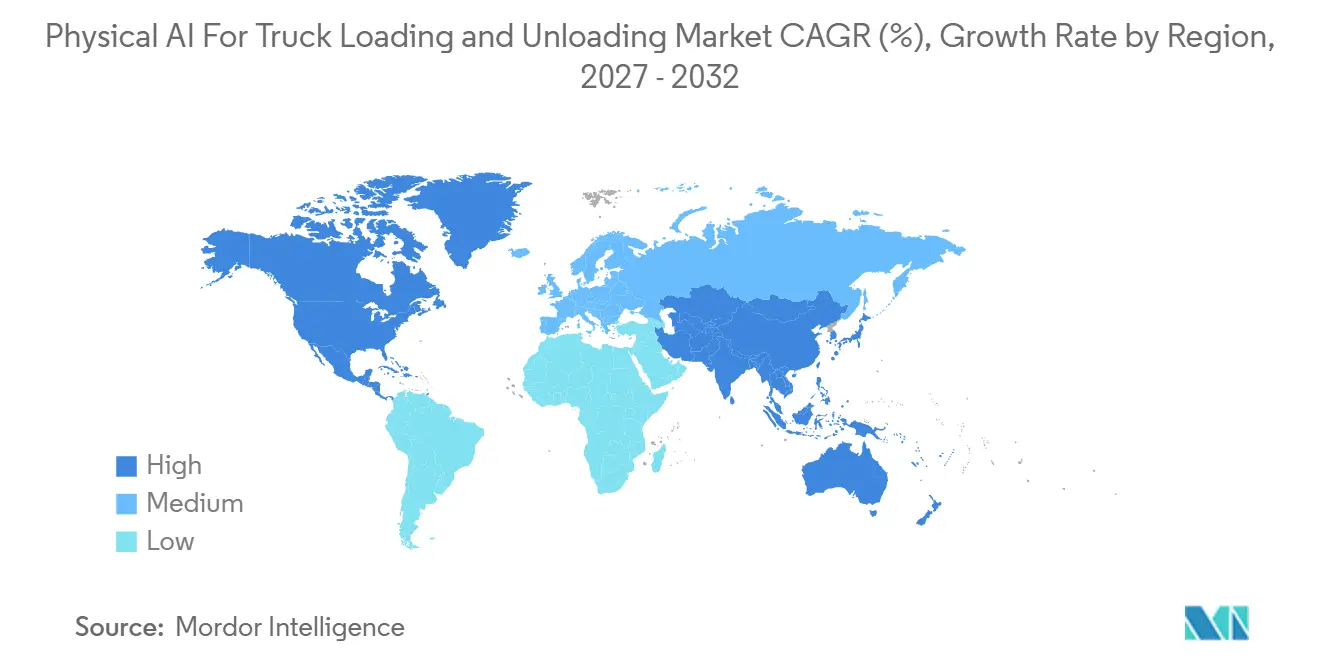
Asia-Pacific is projected to account for 29.88% of the global physical AI for truck loading and unloading market in 2026. China, Japan, South Korea, and Southeast Asia's logistics corridors represent the region’s core demand centers. China’s concentrated manufacturing activity in the Yangtze River Delta supports high volumes of truck loading and unloading operations. Suppliers operating in Japan and China can benefit from proximity to customers, stronger integration capabilities, and localized support. In Japan, collaborative robot standards, alongside ISO standards, shape certification requirements for systems entering the country.
North America is projected to grow at a CAGR of 29.65% through 2032. The region combines high parcel volumes, dock labor constraints, and substantial investment in logistics automation. FedEx is expected to expand its Dexterity deployment at its Hagerstown facility in July 2026, providing an enterprise-scale example of trailer-loading automation. Vecna Robotics is expected to raise USD 31 million in September 2026 to address demand for flexible dock-to-dock automation. The United States leads regional demand, while manufacturing and distribution activities in Canada and Mexico further support market growth.
Europe is a significant operating region for the physical AI for truck loading and unloading market. Germany’s industrial logistics base, the United Kingdom’s parcel networks, and the Netherlands’ intermodal operations support demand for automated loading and unloading solutions. DHL is expected to sign a memorandum of understanding with Boston Dynamics in May 2025 to deploy more than 1,000 additional Stretch robots by 2030. DHL has indicated that the robots can achieve unloading rates of up to 700 cases per hour. South America, the Middle East, and Africa remain early-stage markets, as integration costs can be high relative to local labor costs.
Competitive Landscape
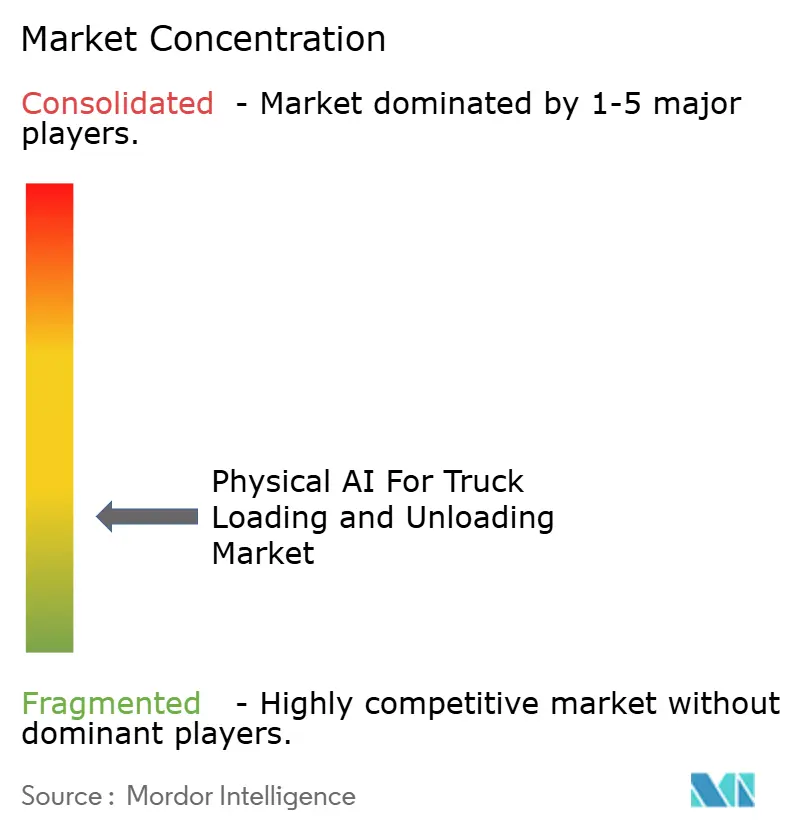
The physical AI for truck loading and unloading market is moderately fragmented. Established intralogistics vendors include Vanderlande Industries, BEUMER Group, Dematic, Daifuku, Honeywell International, Jungheinrich, SSI SCHÄFER Group, and Toyota Industries. Purpose-built solution providers include Pickle Robot, Dexterity, Mujin, Slip Robotics, Gideon Brothers, Contoro Robotics, and Navflex. Established vendors offer extensive service networks, system integration capabilities, and longstanding relationships with major logistics operators. Newer suppliers focus on improving performance in unstructured trailers, accelerating retrofit deployments, and introducing frequent product updates.
Partnerships represent an important competitive strategy in the physical AI for truck loading and unloading market. Pickle Robot and Ambi Robotics are expected to announce an integrated solution in June 2026 for trailer unloading and multipurpose stacking. The company positions the offering as an end-to-end solution that extends from inbound trailer unloading to warehouse receiving. BEUMER Group is also expected to announce a three-year Enterprise Lab collaboration with Fraunhofer IML on mobile robotics in March 2026. These initiatives demonstrate how suppliers are expanding their solution portfolios through partnerships and research collaborations.
White-space opportunities remain in mid-market third-party logistics, pharmaceutical cold-chain docks, ports, and intermodal terminals. These applications require systems that can manage operational variability while meeting capital expenditure and operating cost constraints. Providers are responding with robotics-as-a-service and throughput-based commercial models to reduce upfront investment requirements. The physical AI for the truck loading and unloading industry also faces procurement considerations related to long-term support and integration with connected equipment.
Physical AI For Truck Loading and Unloading Industry Leaders
-
BEUMER Group GmbH & Co. KG
-
Honeywell International Inc.
-
KUKA AG
-
Dexterity, Inc.
-
Boston Dynamics, Inc.
- *Disclaimer: Major Players sorted in no particular order
Recent Industry Developments
- September 2026: Vecna Robotics raised USD 31 million in a round led by Unless, with Drive Capital, Tiger Global, and Highland Capital Partners participating, to scale its dock-to-dock automation platform across North American distribution networks, following CaseFlow demand that more than doubled year over year since the product's 2025 launch.
- July 2026: FedEx and Dexterity announced an expanded collaboration to scale the Foresight world model and the Mech autonomous trailer-loading robot at FedEx's Hagerstown Hub in Maryland, moving from pilot to a significantly larger production scale. Dexterity's CEO described the deployment as a blueprint for network-wide expansion across FedEx's network of tens of thousands of daily trailer-loading operations.
- June 2026: Pickle Robot and Ambi Robotics announced the successful integration of trailer-unloading and multi-purpose stacking systems, creating an end-to-end physical AI pipeline from inbound trailer to warehouse receiving for Fortune 500 retail and logistics operators in response to demonstrated enterprise demand.
- March 2026: STILL GmbH premiered the AXL 15 iGo at LogiMAT 2026 in Stuttgart as the world's first market-ready, production-series autonomous truck loading and unloading solution requiring no stationary dock safety infrastructure, with 2 units loading 30 EPAL pallets in 35 minutes.
Global Physical AI For Truck Loading and Unloading Market Report Scope
The Physical AI for Truck Loading and Unloading Market Report is Segmented by Solution Type (Robotic Trailer Unloading, Robotic Trailer Loading, Autonomous Mobile Robot Loading and Unloading, Autonomous Forklift Loading and Unloading, AI-Enabled Conveyor and Loading-Plate Systems, and Integrated Inbound Dock Platforms), Loading and Unloading Mode (Palletized Cargo, Floor-Loaded Cartons, Mixed-SKU and Irregular Cargo, and Bulk and Specialized Cargo), Automation Level (Fully Autonomous, Semi-Autonomous, Human-in-the-Loop, and Manual-Assist and Exception Mode), End User (Parcel and Express Carriers, Third-Party Logistics Providers, Retail and E-Commerce Distribution, Manufacturing and Industrial Facilities, Food and Beverage Distribution, Pharmaceutical and Healthcare Distribution, Automotive and Component Logistics, and Ports, Terminals, and Intermodal Hubs), and Geography (North America, South America, Europe, Asia-Pacific, and the Middle East and Africa). The Market Forecasts are Provided in Value (USD).
| Robotic Trailer Unloading |
| Robotic Trailer Loading |
| Autonomous Mobile Robot Loading and Unloading |
| Autonomous Forklift Loading and Unloading |
| AI-Enabled Conveyor and Loading-Plate Systems |
| Integrated Inbound Dock Platforms |
| Palletized Cargo |
| Floor-Loaded Cartons |
| Mixed-SKU and Irregular Cargo |
| Bulk and Specialized Cargo |
| Fully Autonomous |
| Semi-Autonomous |
| Human-in-the-Loop |
| Manual-Assist and Exception Mode |
| Parcel and Express Carriers |
| Third-Party Logistics Providers |
| Retail and E-Commerce Distribution |
| Manufacturing and Industrial Facilities |
| Food and Beverage Distribution |
| Pharmaceutical and Healthcare Distribution |
| Automotive and Component Logistics |
| Ports, Terminals, and Intermodal Hubs |
| North America | United States |
| Canada | |
| Mexico | |
| South America | Brazil |
| Argentina | |
| Rest of South America | |
| Europe | Germany |
| United Kingdom | |
| France | |
| Italy | |
| Spain | |
| Rest of Europe | |
| Asia-Pacific | China |
| Japan | |
| India | |
| South Korea | |
| Australia | |
| Rest of Asia-Pacific | |
| Middle East | United Arab Emirates |
| Saudi Arabia | |
| Rest of Middle East | |
| Africa | South Africa |
| Nigeria | |
| Rest of Africa |
| By Solution Type | Robotic Trailer Unloading | |
| Robotic Trailer Loading | ||
| Autonomous Mobile Robot Loading and Unloading | ||
| Autonomous Forklift Loading and Unloading | ||
| AI-Enabled Conveyor and Loading-Plate Systems | ||
| Integrated Inbound Dock Platforms | ||
| By Loading and Unloading Mode | Palletized Cargo | |
| Floor-Loaded Cartons | ||
| Mixed-SKU and Irregular Cargo | ||
| Bulk and Specialized Cargo | ||
| By Automation Level | Fully Autonomous | |
| Semi-Autonomous | ||
| Human-in-the-Loop | ||
| Manual-Assist and Exception Mode | ||
| By End User | Parcel and Express Carriers | |
| Third-Party Logistics Providers | ||
| Retail and E-Commerce Distribution | ||
| Manufacturing and Industrial Facilities | ||
| Food and Beverage Distribution | ||
| Pharmaceutical and Healthcare Distribution | ||
| Automotive and Component Logistics | ||
| Ports, Terminals, and Intermodal Hubs | ||
| By Geography | North America | United States |
| Canada | ||
| Mexico | ||
| South America | Brazil | |
| Argentina | ||
| Rest of South America | ||
| Europe | Germany | |
| United Kingdom | ||
| France | ||
| Italy | ||
| Spain | ||
| Rest of Europe | ||
| Asia-Pacific | China | |
| Japan | ||
| India | ||
| South Korea | ||
| Australia | ||
| Rest of Asia-Pacific | ||
| Middle East | United Arab Emirates | |
| Saudi Arabia | ||
| Rest of Middle East | ||
| Africa | South Africa | |
| Nigeria | ||
| Rest of Africa | ||
Key Questions Answered in the Report
What is the value of the physical AI for truck loading and unloading sector?
The sector totals USD 1.82 billion in 2026 and is projected to reach USD 7.64 billion by 2032, with a 27.47% CAGR from 2027 to 2032. The estimate reflects increasing investment in dock systems that automate loading and unloading work in trailer environments. The physical AI for truck loading and unloading market also reflects the need to improve the pace and consistency of receiving operations.
What is driving the adoption of physical AI systems at truck docks?
Operators are addressing manual dock work, staffing constraints, parcel volume, safety requirements, and the need to automate existing facilities. Brownfield-compatible equipment is important because many sites cannot pause operations or undertake major structural changes. The physical AI for truck loading and unloading market also depends on how well systems fit existing conveyors, workflows, and safety processes across varied operating conditions and daily facility operating routines.
Which solution type has the largest share in this field?
Robotic Trailer Unloading accounted for 24.11% of revenue in 2026. The segment addresses a labor-intensive inbound task that can limit the speed of receiving, storage, and downstream fulfillment when trailer work is delayed. The physical AI for truck loading and unloading market is strongest where trailers arrive with freight that must be handled before other warehouse activities can begin.
Which automation model is expanding most quickly?
Fully Autonomous Solutions is projected to expand at a 29.15% CAGR through 2032. Adoption depends on operational evidence from high-volume sites where regular work patterns and accumulated data support more autonomous handling cycles. Operators still need to assess how systems manage unusual cargo, worker presence, and unplanned interruptions.
Which region leads demand for these systems?
Asia-Pacific held 29.88% revenue share in 2026, while North America is projected to expand at a 29.65% CAGR through 2032. Asia-Pacific benefits from logistics activity in China, Japan, South Korea, and Southeast Asia. North America combines strong parcel demand with labor pressure and high levels of investment in logistics automation.
Why do mixed-SKU trailers remain difficult to automate?
Damaged cartons, variable loads, trailer conditions, and irregular freight can require human intervention and reduce system throughput. These conditions require equipment capable of perceiving, handling, and responding to cargo that does not follow a predictable pattern. They also require realistic testing so performance expectations reflect the actual mix of loads at a facility.