
Physical AI For Cold Storage Material Handling Market Size and Share
Market Overview
| Study Period | 2021 - 2032 |
|---|---|
| Market Size (2027) | USD 1.10 Billion |
| Market Size (2032) | USD 2.84 Billion |
| Growth Rate (2027 - 2032) | 20.89 % |
| Fastest Growing Market | North America |
| Largest Market | Asia-Pacific |
| Market Concentration | Medium |
Major Players *Disclaimer: Major Players sorted in no particular order Image © Mordor Intelligence. Reuse requires attribution under CC BY 4.0. | |
Physical AI For Cold Storage Material Handling Market Analysis by Mordor Intelligence
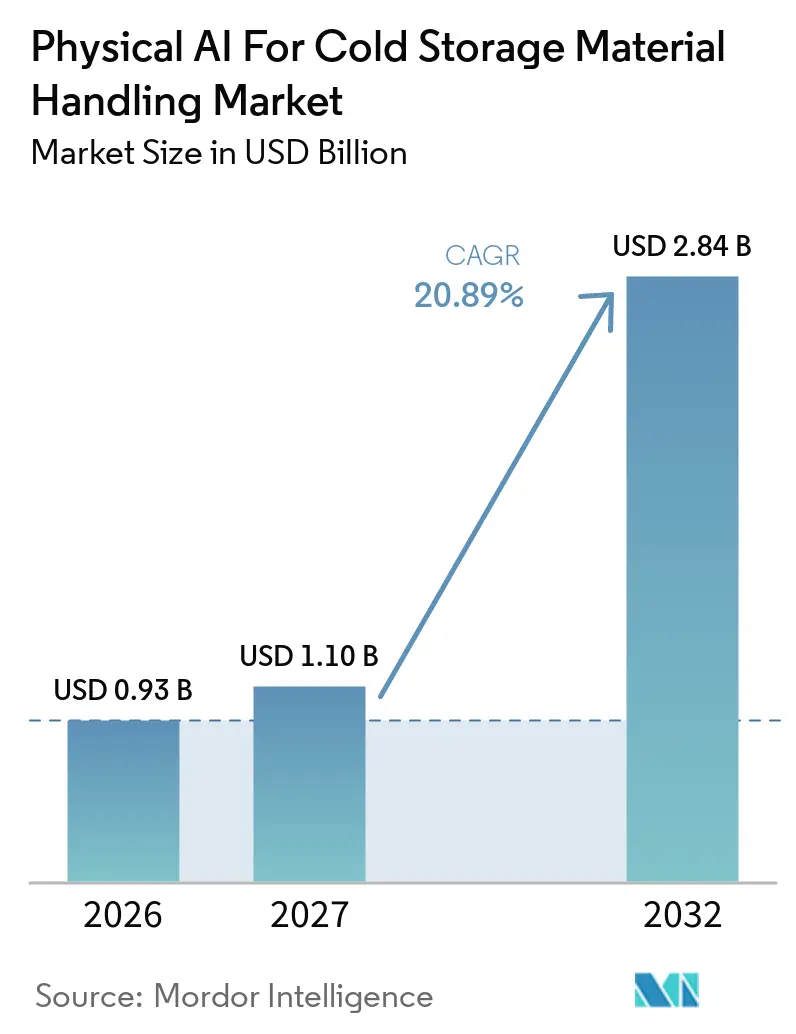
The Physical AI For Cold Storage Material Handling Market size was valued at USD 0.93 billion in 2026 and is estimated to grow from USD 1.10 billion in 2027 to reach USD 2.84 billion by 2032, at a CAGR of 20.89% during the forecast period (2027-2032).
The physical AI for cold storage material handling market is moving beyond trials as operators place sensor-equipped autonomous systems into operating freezer sites. These systems combine automated storage and retrieval systems, autonomous mobile robots, automated guided vehicles, pallet shuttles, and software for fleet coordination, spatial awareness, and maintenance. Cold conditions create a clear need for equipment that can work continuously while protecting product integrity and worker safety. The physical AI for cold storage material handling market also benefits when new cold buildings are designed around automation rather than adapted after construction. Competition is increasingly shaped by orchestration software that can coordinate several equipment types across chilled and frozen areas.
Key Report Takeaways
- By product type, automated storage and retrieval systems held 31.2% of the Physical AI for Cold Storage Material Handling Market share in 2026, while autonomous mobile robots are forecast to grow at a 21.4% CAGR through 2032.
- By component, hardware held 46.8% of the Physical AI for Cold Storage Material Handling Market share in 2026, while software is forecast to grow at a 21.5% CAGR through 2032.
- By end user, food manufacturers and processors held 29.1% of demand in 2026, while pharmaceutical manufacturers are forecast to grow at a 22.9% CAGR through 2032.
- By deployment model, greenfield automated cold stores held 27.7% of demand in 2026, while Robots-as-a-Service is forecast to grow at a 22.3% CAGR through 2032.
- By geography, Asia-Pacific held 27.0% of demand in 2026, while North America is forecast to grow at a 22.6% CAGR through 2032.
Note: Market numbers in this report are based on Mordor Intelligence's proprietary estimation framework, which combines nine months of actuals with Q4 projections for base year 2026.
Global Physical AI For Cold Storage Material Handling Market Trends and Insights
Drivers Impact Analysis*
| DRIVER | (~) % IMPACT ON CAGR FORECAST | GEOGRAPHIC RELEVANCE | IMPACT TIMELINE |
|---|---|---|---|
| Expansion of Temperature-Controlled Food and Pharmaceutical Networks | +5.2% | Global | |
| Labor Scarcity and Safety Risk in Freezer Environments | +4.8% | Global, strongest in North America and Europe | |
| Rising Value of Cubic Storage Capacity | +3.5% | North America, Europe, Asia-Pacific core | |
| AI-Enabled Fleet Orchestration and Dynamic Task Allocation | +3.1% | Global | |
| Cold-Rated Battery and Sensor Engineering | +2.4% | Global, early gains in Asia-Pacific and North America | |
| Continuous Autonomous Inventory Visibility in Freezer Aisles | +1.8% | Global | |
| Source: Mordor Intelligence | |||
Expansion of Temperature-Controlled Food and Pharmaceutical Networks
Cold-chain investment is becoming a long-term requirement for food and life sciences supply chains, which supports equipment demand in the Physical AI for Cold Storage Material Handling Market. In June 2026, UPS announced a USD 48 million investment in 27 temperature-controlled freight cross-dock facilities to support biologics, mRNA platforms, and GLP-1 injectables.[1] Movianto opened a pharmaceutical cold store in Wiesloch, Germany, in September 2026 with 10,000 pallet positions at 2°C to 8°C and 2,400 deep-freeze positions. New validated capacity requires reliable handling and documented temperature control across each movement. Automation can provide a more consistent record of storage activity than manual workflows, where temperature, location, and custody data are logged separately. This favors systems that connect handling equipment with validated operating records.
Labor Scarcity and Safety Risk in Freezer Environments
Freezer work has limited shift durations, warm-up requirements, and high turnover, which reduce productive labor time in cold facilities. The Physical AI for Cold Storage Material Handling Market benefits when goods-to-person designs move workers to warmer areas while mobile equipment retrieves goods from freezer aisles. Locus Robotics expanded its deployment at HelloFresh’s Factor chilled fulfillment operation from 13 to 39 autonomous mobile robots within 3 months in 2025.[2] The system recorded an average mission time of 3 minutes and 36 seconds while helping the site increase its chilled SKU capacity from 100 to 500. These deployments reduce repeated human exposure to sub-zero conditions and allow managers to plan throughput with more stable cycle times. The operating case is therefore based on safety, staffing reliability, and labor costs.
Rising Value of Cubic Storage Capacity
Refrigerated construction is expensive, so cold-store operators place a high value on each available cubic meter. High-bay automated storage systems can increase pallet density without extending the conditioned building footprint. Coldo’s 46-meter cold store in Kuurne, Belgium, has 60,000 pallet positions on 12,000 square meters and uses around 30 Movu Atlas shuttles at minus 25°C. [3] ColdPort announced a USD 500 million joint venture in May 2026 to develop 4 high-bay automated facilities in the United States gateway markets. High-density designs can also reduce door openings, thereby limiting moisture ingress and refrigeration losses. The Physical AI for Cold Storage Material Handling Market is therefore supported by projects where building, refrigeration, and automation decisions are made together.
AI-Enabled Fleet Orchestration and Dynamic Task Allocation
The Physical AI for Cold Storage Material Handling Market is shifting from isolated equipment deployments toward connected fleets of robots, shuttles, cranes, and palletizing systems. KION demonstrated physical AI applications in 2026 and reported a proof of concept for autonomous pallet loading and unloading at Colruyt in Belgium.[4] Symbotic acquired ARMS Innovations in July 2026 to expand real-time warehouse operations optimization capabilities. The software layer can assign tasks across different machines and temperature zones while reducing empty travel and unplanned waiting. Over time, site-specific data on traffic patterns, thermal conditions, and SKU flow can make a platform more difficult to replace. This puts more emphasis on interoperable warehouse execution and machine-control tools.
Restraints Impact Analysis*
| RESTRAINT | (~) % IMPACT ON CAGR FORECAST | GEOGRAPHIC RELEVANCE | IMPACT TIMELINE |
|---|---|---|---|
| High Initial Investment and Long Payback Periods | -2.8% | Global, most acute in South America and Africa | Medium term (2-4 years) |
| Condensation, Frost, and Thermal-Cycling Reliability Risks | -1.9% | Global | Short term (≤ 2 years) |
| Limited Availability of Cold-Environment Integration and Maintenance Skills | -1.2% | Global, most acute in emerging markets | Long term (≥ 4 years) |
| Interoperability and Data-Validation Challenges Across WMS, WES, and MHE | -0.8% | Global | Medium term (2-4 years) |
| Source: Mordor Intelligence | |||
High Initial Investment and Long Payback Periods
A greenfield automated freezer facility requires simultaneous investment in high-bay storage equipment, mobile fleets, software, and cold-rated structural engineering. These costs can extend payback periods beyond five years, slowing approval processes among operators with stringent investment thresholds. Buildings taller than 30 meters may also require vapor barriers, blast-freezing vestibules, and specialized condensation-control systems before automated equipment is installed. Robots-as-a-Service (RaaS) models can reduce upfront capital expenditure; however, contracts typically span five to ten years and require reliable volume forecasts. Cold-rated components, sealed electronics, specialized lubricants, and Arctic-grade batteries can further increase maintenance and insurance costs. Consequently, these factors can constrain adoption among smaller cold-storage operators despite the significant operational benefits of automation.
Condensation, Frost, and Thermal-Cycling Reliability Risks
Sub-zero environments create failure modes that conventional automated guided vehicle (AGV) and autonomous mobile robot (AMR) designs may not adequately address. Frost accumulation on LiDAR windows, condensation during transitions between freezers and loading docks, and changes in lubricant performance can impair navigation systems, robotic joints, and electrical components. For example, a robot moving from a temperature of -25°C to a warmer loading area can accumulate moisture on cold surfaces within seconds. Repeated sanitation cycles can also impose thermal stress on cable routes, sensor housings, and circuit boards. Heated enclosures, air-knife systems, and defrost staging areas can mitigate some of these risks, but they increase costs and operational complexity. Vendors must demonstrate reliable performance under these combined conditions before many operators expand their deployments.
*Our forecasts treat driver/restraint impacts as directional, not additive. The impact forecasts reflect baseline growth, mix effects, and variable interactions.
Segment Analysis
By Product Type: ASRS Commands Scale While AMRs Accelerate
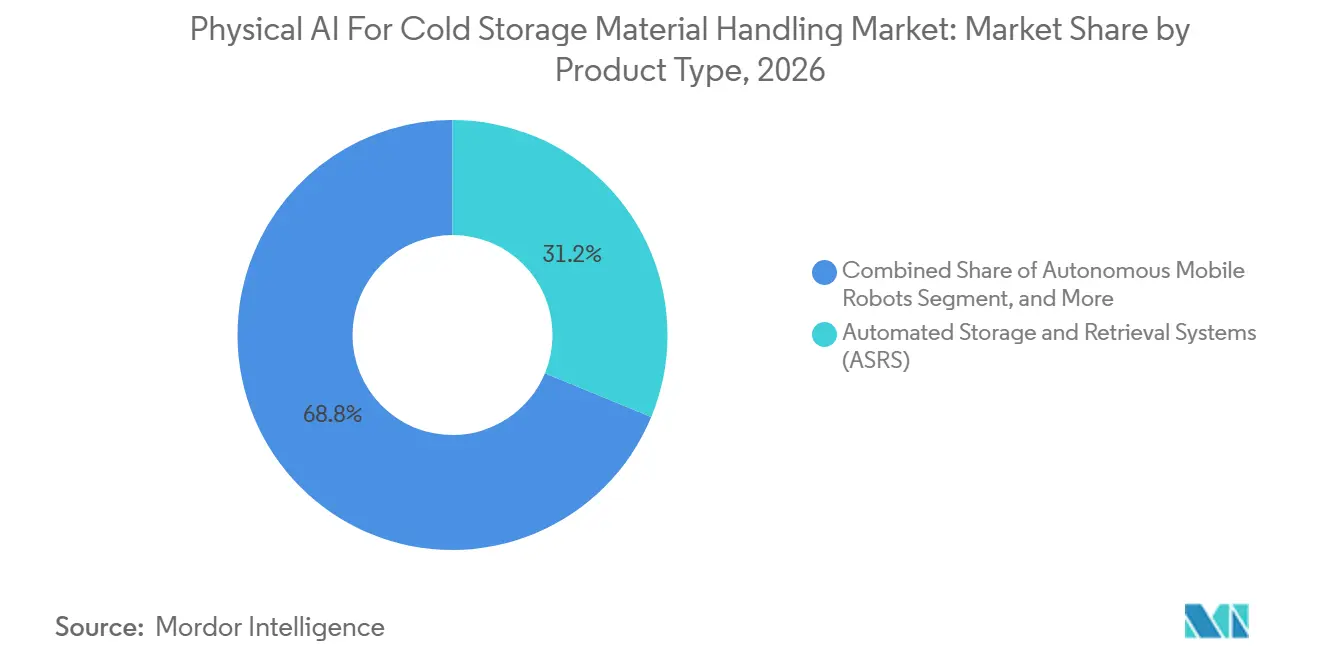
Automated storage and retrieval systems (ASRS) are projected to hold a 31.2% share of the physical AI for cold storage material handling market in 2026. Their leadership reflects the need to maximize vertical capacity in high-bay freezer facilities without expanding refrigerated floor space. In May 2026, Magnavale Bristol is expected to select Swisslog for a facility planned to accommodate 90,000 pallet locations at -28°C. The system is expected to include 10 Vectura cranes and nearly 1,500 meters of ProMove conveyor. Such installations combine high storage density, repeatable pallet handling, and reduced reliance on manual labor in freezer aisles.
Autonomous mobile robots (AMRs) are forecast to grow at a 21.4% CAGR through 2032, making them the fastest-growing product type in the physical AI for cold storage material handling market. Their modular design supports phased upgrades in existing cold rooms that cannot accommodate major structural modifications. Automated guided vehicles (AGVs) remain suitable for stable, repetitive transport routes, while robotic pallet shuttles support high-density racking configurations. In February 2026, Corvus Robotics is expected to introduce Corvus One for Cold Chain, a solution for continuous freezer inventory operations at -20°F without Wi-Fi, localization markers, or specialized barcodes. These product categories enable operators to align automation investments with building geometry, pallet flows, and flexibility requirements.

By Component: Hardware Anchors Spend, Software Redefines Value
Hardware is projected to account for a 46.8% share of the physical AI for cold storage material handling market in 2026, as cold-rated actuators, batteries, sensors, and enclosures require specialized designs. Batteries often require heated protection and control logic to maintain usable capacity at temperatures below -15°C. Equipment frames and electrical housings also require protection against moisture and repeated thermal cycling. Consequently, hardware remains a major component of initial project budgets, particularly for greenfield facilities that incorporate high-bay racks, cranes, conveyors, and robotic pallet-handling systems.
Software is forecast to grow at a CAGR of 21.5% through 2032 as operators seek to optimize the use of increasingly complex equipment fleets. The software component of the physical AI for cold storage material handling market coordinates task assignments, route selection, traffic rules, and maintenance alerts across multiple machine types. Symbotic’s expected acquisition of ARMS Innovations highlights the growing importance of real-time operational intelligence. Services will also expand alongside installed fleets, as commissioning, integration, subscription support, and cold-environment maintenance require specialized capabilities. Value is shifting toward systems that convert equipment data into coordinated daily operations.
By End User: Food Drives Volume, Pharma Sets the Growth Pace
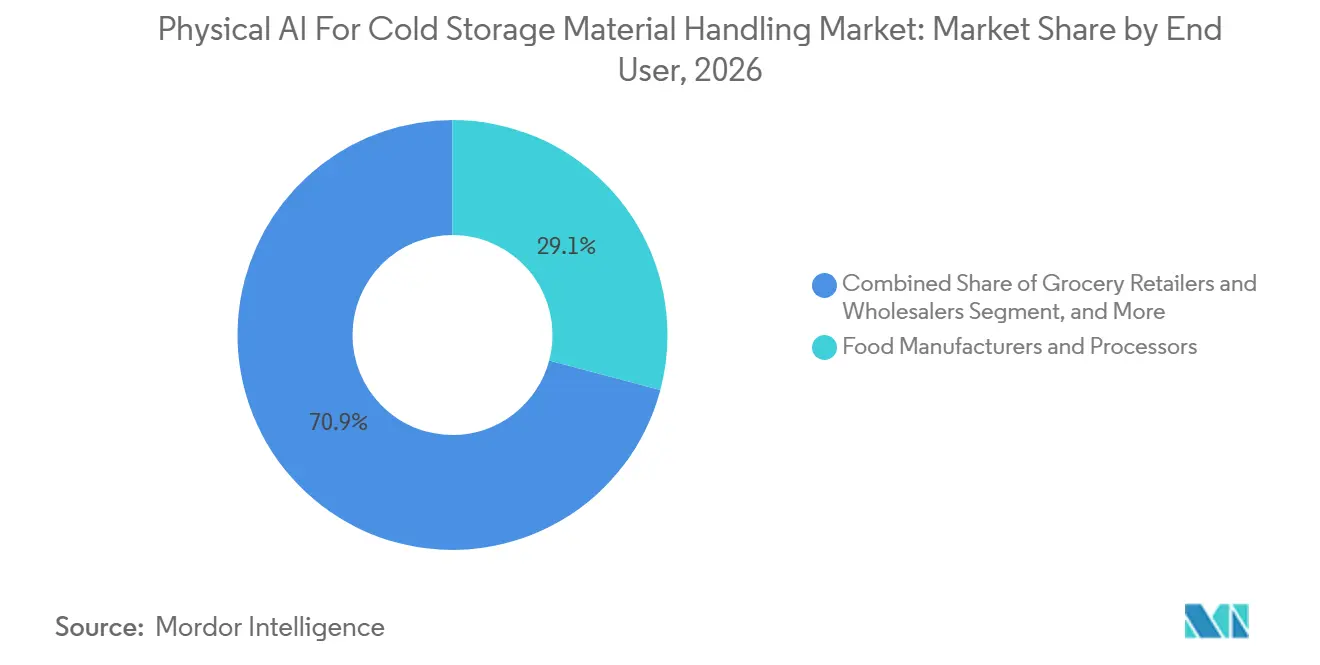
Food manufacturers and processors are projected to account for 29.1% of demand in 2026, making them the largest end-user group. Frozen and chilled food facilities require predictable material flows, inventory accuracy, and effective first-in, first-out management to reduce spoilage risks. Their throughput requirements support the deployment of automated storage systems, shuttles, and mobile robots across receiving, storage, and picking operations. Grocery retailers and wholesalers also use chilled fulfillment systems as product assortments expand. The food end-user segment will continue to provide the primary volume base for the physical AI for cold storage material handling market.
Pharmaceutical manufacturers are forecast to grow at a CAGR of 22.9% through 2032, the fastest rate among end-user groups. Their facilities require traceable temperature records, chain-of-custody documentation, and supporting systems that continuously capture handling data. UPS identified growing demand from biologics, mRNA platforms, and GLP-1 injectables when it announced its planned 2026 investment in a temperature-controlled cross-dock facility. Healthcare distributors are also upgrading their handling networks as pharmaceutical temperature-control requirements become more stringent. The segment’s growth is driven by compliance requirements, labor considerations, and storage-density economics.
By Deployment Model: Greenfield Leads, RaaS Grows Fastest
Greenfield automated cold stores are projected to account for 27.7% of demand in 2026. New facilities allow operators to specify floor flatness, structural tolerances, thermal envelopes, equipment locations, and software connections as part of an integrated operating system. In June 2026, Lineage is expected to select TGW Logistics to automate a 56,000-square-meter temperature-controlled distribution center in Texas designed to operate at -30°C. The planned facility will use shuttle storage, conveying, automated palletizing, and depalletizing systems, with operations targeted to begin by the end of 2027.
Robots-as-a-Service (RaaS) is forecast to grow at a CAGR of 22.3% through 2032 because it converts a substantial upfront capital investment into recurring operating expenses. This deployment model can make automation more accessible to mid-sized operators that lack the capital required for a full greenfield development. Locus Robotics deployed its Robots-as-a-Service model at a HelloFresh chilled facility. Brownfield retrofits will also remain important, as many existing cold stores were built before current automation standards were established. Operators choose among retrofit, semi-automated, and fully autonomous configurations based on building constraints, throughput requirements, and available capital.
Geography Analysis
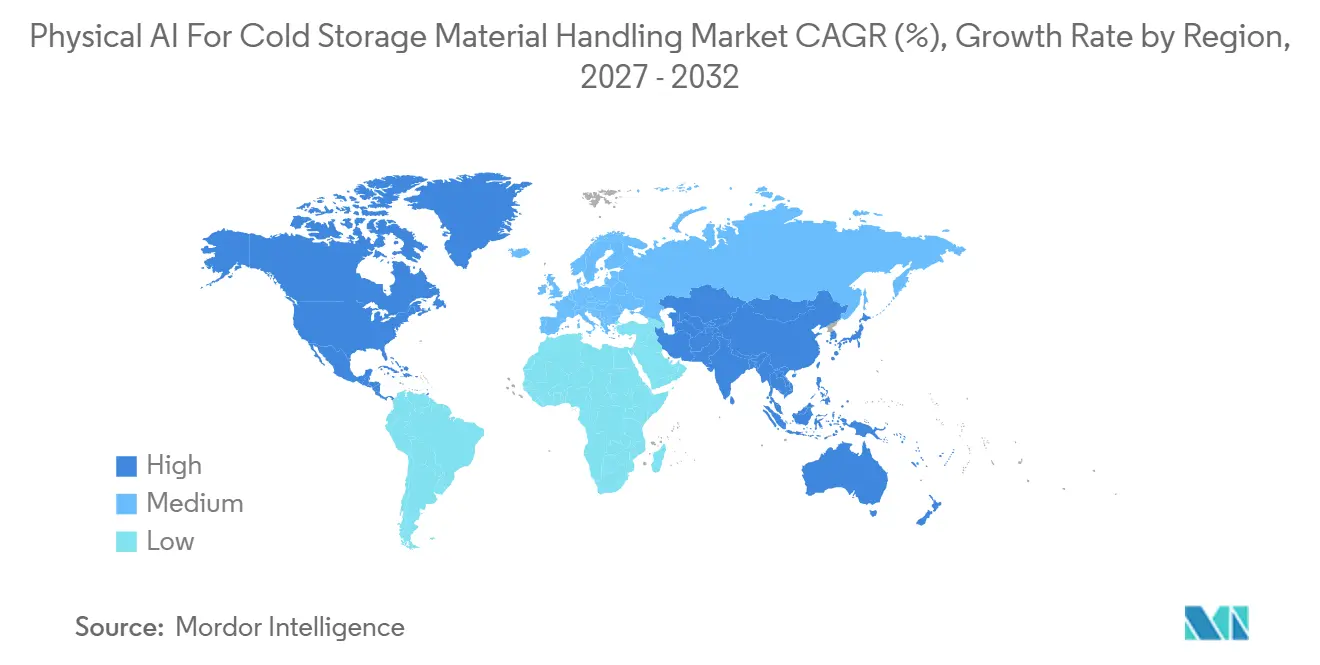
Asia-Pacific is projected to account for 27.0% of the physical AI for cold storage material handling market in 2026, making it the largest regional segment. Demand is supported by China’s cold-chain expansion, Japan’s labor-constrained food logistics sector, and India’s developing organized cold-storage network. In China, policy support for cold-chain capacity and investments by e-commerce platforms is increasing the need for temperature-controlled logistics infrastructure. Japan combines a dense food-processing base with labor constraints, driving interest in equipment that can operate in existing freezer facilities. In 2025, Geekplus is expected to deploy a multi-zone SkyCube system for JJCL across frozen and chilled areas. The project is expected to improve storage capacity, picking efficiency, and inventory accuracy.
North America is forecast to grow at a CAGR of 22.6% through 2032, the fastest rate among regions. In May 2026, Americold and EQT are expected to form a joint venture covering 12 cold-storage facilities in the United States, representing more than 400,000 pallet positions. The joint venture is expected to have a gross asset value exceeding USD 1.3 billion at inception. Separately, ColdPort has announced a USD 500 million joint venture to develop four automated high-bay facilities in the United States' gateway markets. These large-scale projects are expected to support demand for systems that provide high storage density, controlled material movement, and improved documentation.
Europe remains a major market for physical AI for cold storage material handling, with the United Kingdom, Germany, and Scandinavia supporting adoption. SSI SCHAEFER supported Coop’s 77,000-square-meter automated distribution center in Eskilstuna, Sweden, where 95% of picking is automated for a network of more than 800 stores. South America is witnessing rising demand in Brazil and Argentina, although financing limitations and power infrastructure constraints restrict deployment speed. The Middle East is investing in food security and pharmaceutical cold chains, with the United Arab Emirates and Saudi Arabia serving as leading markets. Africa is experiencing early demand in South Africa and Nigeria; however, cost, power reliability, and maintenance capabilities remain significant constraints. Consequently, the physical AI for cold storage material handling market is developing at varying rates based on local building investment, labor availability, and technical support.
Competitive Landscape
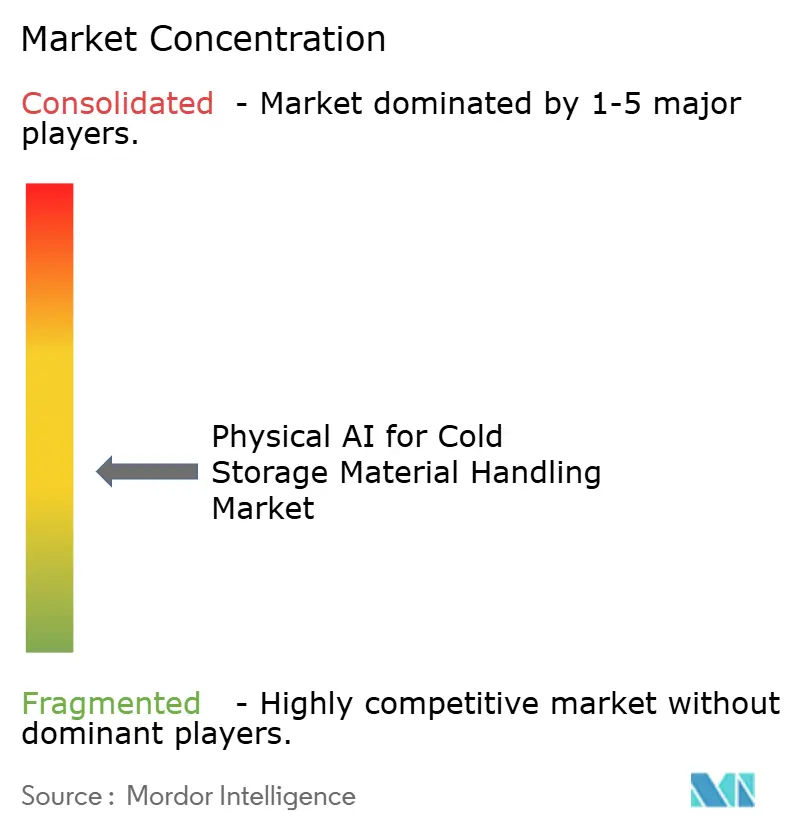
The physical AI for cold storage material handling market is moderately fragmented, with large intralogistics companies and specialized robotics providers serving different parts of the value chain. KION Group, Daifuku, Dematic, SSI SCHAEFER, and Swisslog offer broad portfolios that combine equipment, software, and integration services. Providers specializing in mobile robots, shuttles, inventory drones, and artificial intelligence software compete through targeted technical capabilities. Buyers increasingly evaluate software intelligence as closely as hardware cold ratings, reflecting the need to manage complex operations involving mobile equipment, fixed automation, and multiple temperature zones.
Symbotic is projected to report a USD 22.7 billion contracted backlog in 2026 and is expected to acquire ARMS Innovations to expand its capabilities in warehouse operations optimization. KION is expected to acquire a 70% stake in Colruyt’s Smart Innovation NV and invest in ZIKOO Robotics to strengthen its autonomous pallet-handling and pallet-storage robotics capabilities. In March 2026, Swisslog is expected to launch the AgileStore four-way shuttle for flexible, high-density pallet storage at temperatures as low as-30°C. These developments demonstrate continued investment in both software coordination and cold-capable equipment. Competitive success depends on demonstrated reliability, integration depth, and service capacity.
Specialized suppliers also compete in applications where conventional equipment has limitations. Corvus Robotics focuses on freezer inventory visibility through drones designed for sub-zero operations. Movu Robotics has established references for its Atlas shuttle in deep-freeze environments, including the Coldo installation in Belgium. Operators increasingly seek evidence that equipment can withstand thermal cycling, condensation, and frost throughout its operational life. ISO 9001 quality management and IEC 60068 environmental testing are therefore relevant criteria in vendor qualification. As the available evidence does not provide combined market shares for leading companies, it does not support a numerical market concentration score.
Physical AI For Cold Storage Material Handling Industry Leaders
-
Dematic GmbH
-
KION Group AG
-
KUKA AG
-
ABB Ltd.
-
Daifuku Co., Ltd.
- *Disclaimer: Major Players sorted in no particular order
Recent Industry Developments
- September 2026: Movianto, part of Yusen Logistics, opened one of Europe's largest pharmaceutical cold stores in Wiesloch, Germany, with approximately 30,000 m² of temperature-controlled warehouse space featuring 10,000 pallet positions at 2°C-8°C, 2,400 positions at -20°C and -26°C, and future ultra-low temperature capability to -80°C; the facility more than doubles Movianto's pharmaceutical cold-storage capacity in Germany.
- July 2026: Symbotic acquired ARMS Innovations Ltd., a UK-based real-time operational intelligence software company, to advance Warehouse Operations Optimization, a category broader than traditional WMS or WES, enabling end-to-end visibility and dynamic coordination of people, robots, and workflows in complex automated warehouse environments, including food and beverage distribution.
- July 2026: Dematic unveiled its nearly USD 50 million Solutions Center at its Americas headquarters in Grand Rapids, Michigan, the first integrated warehouse automation showcase of its kind in North America, enabling customers to evaluate full ASRS and robotics integration before committing capital to large-scale deployments.
- June 2026: UPS announced a USD 48 million investment in 27 IATA CEIV Pharma-certified temperature-controlled freight cross-dock facilities across the United States and key international markets in Europe, Asia, and the Americas, strengthening its global cold-chain network for biologics, mRNA platforms, and GLP-1 injectables.
Global Physical AI For Cold Storage Material Handling Market Report Scope
The Physical AI for Cold Storage Material Handling Report is Segmented by Product Type (Autonomous Mobile Robots, Automated Guided Vehicles, Robotic Pallet Shuttles, and Automated Storage and Retrieval Systems), Component (Hardware, Software, and Services), End User (Food Manufacturers and Processors, Grocery Retailers and Wholesalers, Third-Party Cold-Storage Providers, Pharmaceutical Manufacturers, and Healthcare Distributors), Deployment Model (Greenfield Automated Cold Stores, Brownfield Retrofit Projects, Semi-Automated Facilities, Fully Autonomous Facilities, and Robots-as-a-Service Deployments), and Geography (North America, South America, Europe, Asia-Pacific, and the Middle East and Africa). The Market Forecasts are Provided in Value (USD).
| Autonomous Mobile Robots |
| Automated Guided Vehicles |
| Robotic Pallet Shuttles |
| Automated Storage and Retrieval Systems |
| Other Product Types |
| Hardware |
| Software |
| Services |
| Food Manufacturers and Processors |
| Grocery Retailers and Wholesalers |
| Third-Party Cold-Storage Providers |
| Pharmaceutical Manufacturers |
| Healthcare Distributors |
| Other End Users |
| Greenfield Automated Cold Stores |
| Brownfield Retrofit Projects |
| Semi-Automated Facilities |
| Fully Autonomous Facilities |
| Robots-as-a-Service Deployments |
| North America | United States |
| Canada | |
| Mexico | |
| South America | Brazil |
| Argentina | |
| Chile | |
| Rest of South America | |
| Europe | Germany |
| United Kingdom | |
| France | |
| Italy | |
| Spain | |
| Rest of Europe | |
| Asia-Pacific | China |
| Japan | |
| India | |
| South Korea | |
| Rest of Asia-Pacific | |
| Middle East | Saudi Arabia |
| United Arab Emirates | |
| Rest of Middle East | |
| Africa | South Africa |
| Nigeria | |
| Rest of Africa |
| By Product Type | Autonomous Mobile Robots | |
| Automated Guided Vehicles | ||
| Robotic Pallet Shuttles | ||
| Automated Storage and Retrieval Systems | ||
| Other Product Types | ||
| By Component | Hardware | |
| Software | ||
| Services | ||
| By End User | Food Manufacturers and Processors | |
| Grocery Retailers and Wholesalers | ||
| Third-Party Cold-Storage Providers | ||
| Pharmaceutical Manufacturers | ||
| Healthcare Distributors | ||
| Other End Users | ||
| By Deployment Model | Greenfield Automated Cold Stores | |
| Brownfield Retrofit Projects | ||
| Semi-Automated Facilities | ||
| Fully Autonomous Facilities | ||
| Robots-as-a-Service Deployments | ||
| By Geography | North America | United States |
| Canada | ||
| Mexico | ||
| South America | Brazil | |
| Argentina | ||
| Chile | ||
| Rest of South America | ||
| Europe | Germany | |
| United Kingdom | ||
| France | ||
| Italy | ||
| Spain | ||
| Rest of Europe | ||
| Asia-Pacific | China | |
| Japan | ||
| India | ||
| South Korea | ||
| Rest of Asia-Pacific | ||
| Middle East | Saudi Arabia | |
| United Arab Emirates | ||
| Rest of Middle East | ||
| Africa | South Africa | |
| Nigeria | ||
| Rest of Africa | ||
Key Questions Answered in the Report
What is the projected size of the physical AI for cold storage material handling market by 2032?
The sector is forecast to reach USD 2.84 billion by 2032, rising at a 20.9% CAGR from 2027 to 2032.
Which product type drives cold storage material-handling automation?
Automated storage and retrieval systems lead with a 31.2% share in 2026, owing to their support for high-density vertical storage.
Why are autonomous mobile robots gaining use in freezer facilities?
They can support phased retrofits, reduce worker exposure to freezer conditions, and are forecast to grow at a 21.4% CAGR through 2032.
Which end users are expanding automation spending fastest?
Pharmaceutical manufacturers are the fastest-growing end-user group, with a 22.9% CAGR through 2032, because temperature and chain-of-custody records are critical.
Which region is expected to grow fastest through 2032?
North America is projected to expand at a 22.6% CAGR, supported by large-scale automated cold storage investments.
What limits the wider adoption of physical AI in cold storage?
High initial investment, long payback periods, and reliability risks from condensation, frost, and thermal cycling remain major barriers.