
Market Overview
| Study Period | 2021 - 2031 |
|---|---|
| Forecast Data Period | 2026 - 2031 |
| Historical Data Period | 2021 - 2024 |
| Growth Rate | 15.39 % |
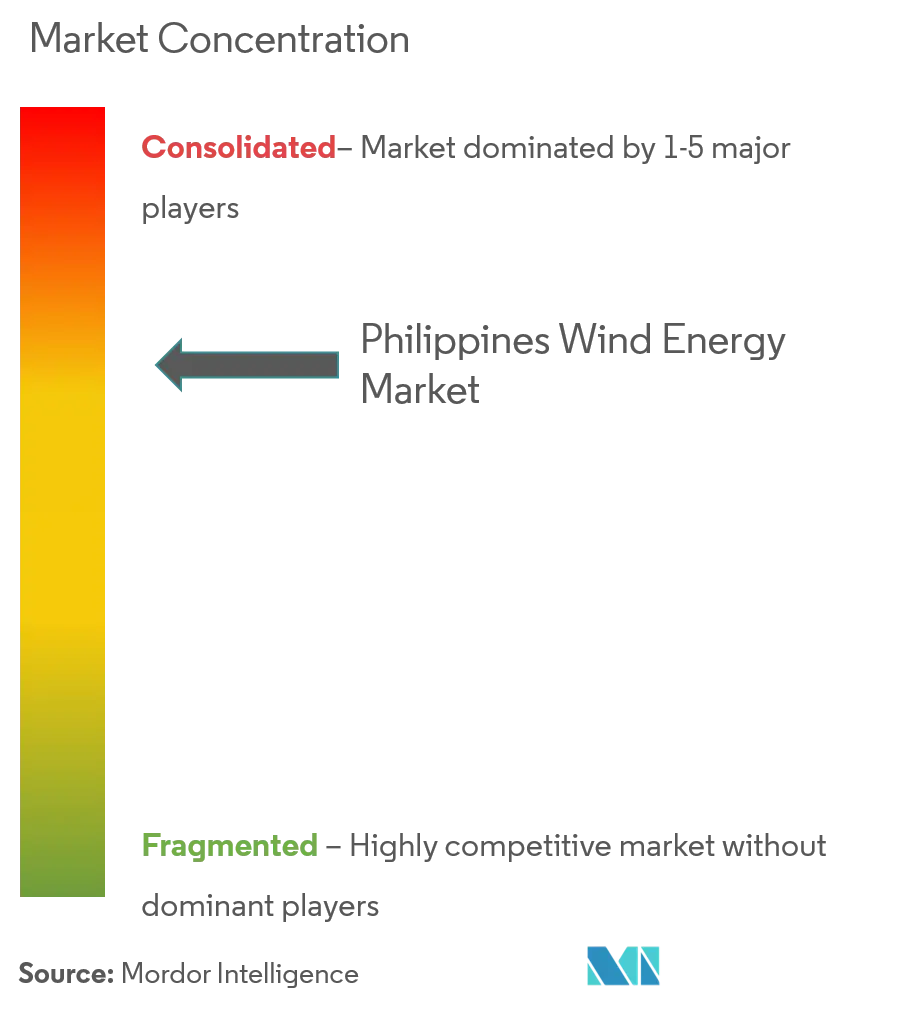
| Market Concentration | Medium |
Major Players *Disclaimer: Major Players sorted in no particular order Image © Mordor Intelligence. Reuse requires attribution under CC BY 4.0. | |
Philippines Wind Energy Market Analysis by Mordor Intelligence
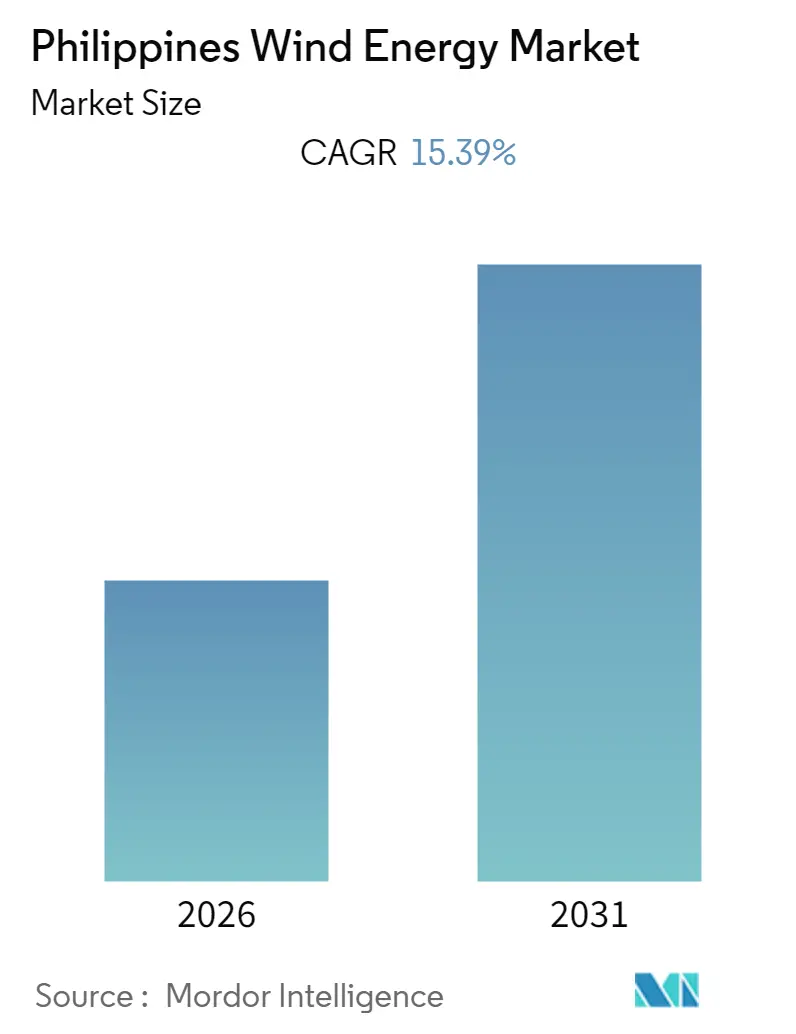
The Philippines Wind Energy Market size is expected to register a CAGR of 15.39% during the forecast period.
- Over the medium period, increased demand for renewable energy, favorable government policies, and the reduced wind power tariff is expected to drive the wind energy market in the Philippines. The Philippines has extensive wind potential among Southeast Asian countries, expected to drive the market's growth during the forecast period.
- On the other hand, the increasing adoption of alternate clean power sources such as solar and biomass and the availability of fossil fuels are likely to restrain the growth of the wind energy market in the coming years.
- Nevertheless, the integration of artificial intelligence (AI), Internet of Things(IoT), robotics, and data analytics in wind turbines will enable advanced condition monitoring and predictive maintenance, resulting in increased efficiency and reduced operational and maintenance costs, which is likely to provide the opportunity for growth in the deployment of wind turbines in coming future.
Note: Market size and forecast figures in this report are generated using Mordor Intelligence’s proprietary estimation framework, updated with the latest available data and insights as of 2026.
Market Trends and Insights
Onshore Wind Energy Segment is Expected to Dominate the Market
- As energy demand rises, wind turbines are helping the Philippines diversify its energy sources beyond fossil fuels and generating power.
- According to the National Renewable Energy Plan, the Philippines has set the goal of adopting an additional 1,548MW of renewable energy by 2030. A breakdown reveals that wind power is expected to account for the most significant share at 38% (593MW).
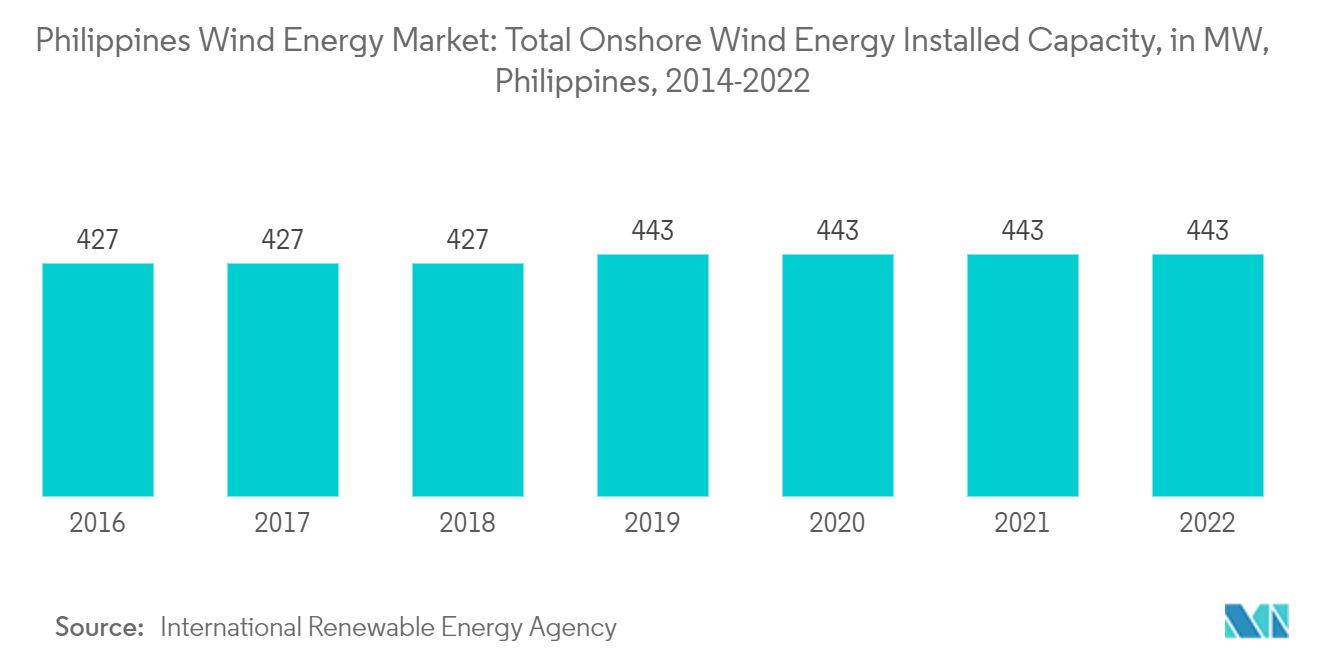
- Additionally, according to International Renewable Energy Agency, as of 2022, the Philippines' total onshore wind energy capacity accounted for 443 MW. With the country's wind energy potential and companies investing in onshore wind energy, the installed capacity is expected to increase in the forecast period.
- Moreover, in May 2023, MingYang Smart Energy agreed to supply more than 300MW of wind turbines for two wind farms developed in the Philippines by Singaporean developers Vena Energy. Vena Energy had purchased 49 MySE 6.25-172 turbines for both wind farms. Installation is scheduled for 2024 at both Talim and Sembrano. These wind projects are expected to drive the onshore wind energy market during the forecast period.
- Thus, owing to the above points onshore wind energy segment is expected to dominate the market.
Wind Potential is Expected to Drive the Market
- The greatest wind resources of the Philippines are in northern and central areas, such as Batanes and Babuyan, and the north and central Luzon areas. Because of the high potential of wind energy in the country, wind energy developers are interested in commercializing wind energy in the Philippines.
- The Philippines has 11,055 km2 of windy land estimated to have good-to-excellent wind resource potential. Wind speeds at these sites range from 6.4 meters per second (m/s) to 10.1 m/s, with wind-power-density values of 300-1,250 Watts per square meter (W/m2 ). Using conservative assumptions of about 7 MW/km2, these areas will support more than 77,000 MW of potential installed capacity, providing more than 195 billion kWh per year.
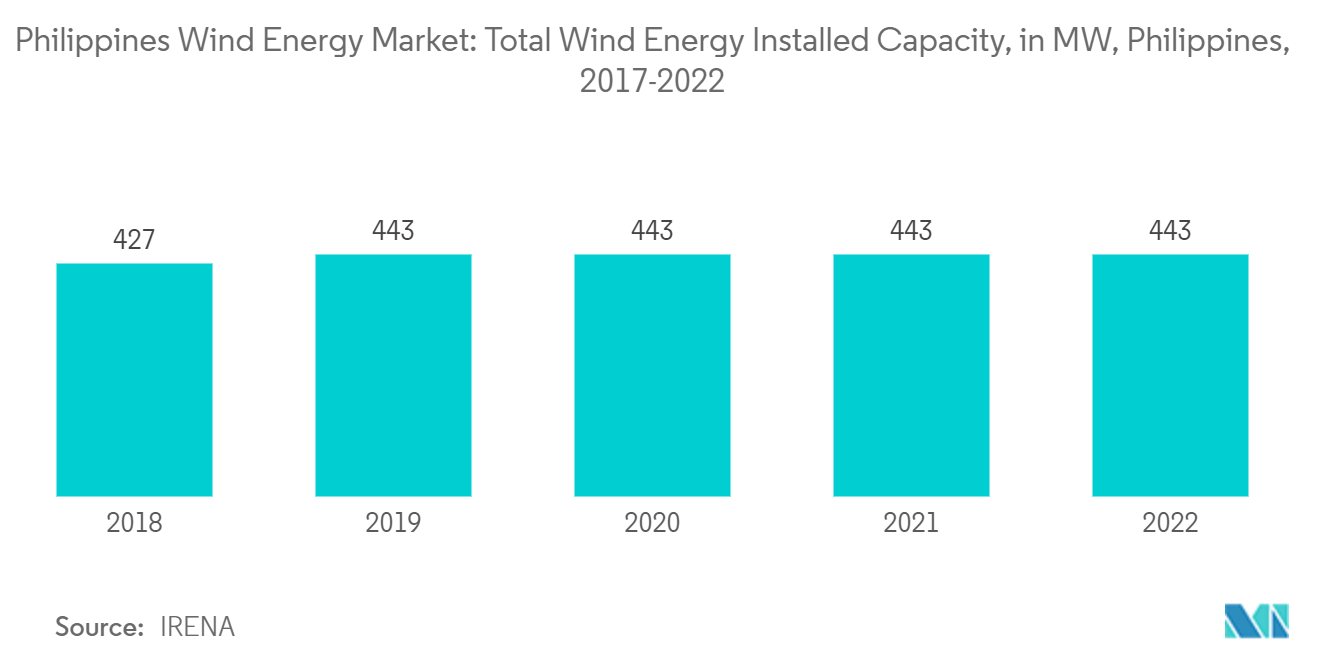
- According to International Renewable Energy Agency, as of 2022, the Philippines' total wind energy capacity accounted for 443 MW. Additionally, the government aims to expand significantly the country's wind capacity in the coming years and targets 35% of energy generation from renewables by 2035 and 40% by 2040.
- Moreover, in January 2022, Iderbola SA signed an agreement with Triconti ECC Renewables to construct five offshore wind projects with up to 3.5 GW capacity in the upcoming years. This project helps the Philippines promote its National Renewable Energy Program (NREP) for 2020-2040, which has set a target of a 35% share of renewable energy in the power generation mix by 2030 and a 50% share by 2040.
- Therefore factors such as huge wind energy potential and increasing investments in the country's renewable energy sector are expected to drive the market studied in the coming years.
Regulatory Landscape
Wind energy development in the Philippines is governed by the Department of Energy (DOE) and the Energy Regulatory Commission (ERC), with fiscal incentives anchored on Republic Act No. 9513 (Renewable Energy Act of 2008). For offshore wind, Executive Order No. 21 (s. 2023) set the policy and administrative framework, supported by DOE implementing guidelines via Department Circular DC2023-06-0020 to align permitting steps across agencies.
Permitting and compliance requirements remain a central regulatory gate. DOE issues a Compendium or guidebook that maps a multi-agency process involving over 80 permits across around 25 agencies and links workflows to the Energy Virtual One-Stop Shop (EVOSS). Environmental approvals for offshore wind tightened further through DENR Administrative Order 2024-02, which sets interim guidelines for Environmental Compliance Certificates (ECC) and requires full Environmental Impact Assessment studies. On pricing, the ERC approved a Green Energy Auction Reserve (GEAR) price of PHP 11.00/kWh for offshore wind under GEA-5 in February 2026, and policy discussions include indexation mechanisms referenced to DOE Circular DC2025-06-0009 to manage cost changes between award and commercial operation.
Value Chain Analysis
The Philippines wind energy value chain covers project origination and permitting (DOE service contracts, EVOSS processing), site studies and development (wind resource assessment, geotechnical, and marine surveys for offshore), equipment supply (turbines, towers, foundations, cables, substations), logistics (ports, heavy lift, and transport), construction and installation (civil works, electrical works, commissioning), grid interconnection and offtake (transmission tie-in, auction-based contracts), and long-term operations and maintenance (spares, monitoring, and service teams). The offshore wind policy framework under Executive Order No. 21 and the DOE permitting guidebook also reflect how development, consenting, and grid-ready execution depend on coordinating approvals across the value chain, not only hardware procurement.
Execution bottlenecks center on multi-agency permitting complexity and transmission availability, while local industrial participation is emerging around steel, shipbuilding, and specialized services referenced by industry bodies such as the Global Wind Energy Council (GWEC). Recent project actions also highlight downstream readiness needs: Alternergy energized the 500 kV substation and transmission facilities for its 128 MW Tanay Wind Project in July 2026, and Vivant Energy completed a 100% acquisition of a 200 MW Samar wind development in June 2026, consolidating development control and aligning EPC, grid interconnection, and O&M planning decisions.
Competitive Landscape
The Philippine wind energy market is moderately consolidated. Some of the key players in this market (in no particular order) include Vestas Wind Systems AS, Alternergy Ltd, AC Energy Inc., PetroEnergy Resources Corporation, and General Electric Company.
Philippines Wind Energy Industry Leaders
-
Alternergy Ltd
-
AC Energy Inc.
-
General Electric Company
-
PetroEnergy Resources Corporation
-
Vestas Wind Systems A/S
- *Disclaimer: Major Players sorted in no particular order
Philippines Wind Energy Market Companies Covered in this Report
- Vestas Wind Systems AS
- Alternergy Ltd
- AC Energy Inc.
- PetroEnergy Resources Corporation
- General Electric Company
Market Opportunities and Future Outlook
In Philippine wind, the opportunity set is being shaped by auction-based offtake and clearer offshore wind governance, alongside an active pipeline that is being filtered for readiness. The DOE has used certificates of authority covering over 29 GW of wind and geothermal projects (as of October 2025) as a signal of scale, while also tightening discipline through service contract enforcement, including revocations in 2025 tied to non-compliance with work programs. On the offshore side, the policy framework under Executive Order No. 21 and the ERC reserve price of PHP 11.00/kWh for offshore wind under GEA-5 provide more concrete commercial and procedural reference points for developers and lenders.
Near-term whitespace is visible in grid-ready, financeable onshore builds and in enabling infrastructure for offshore wind (ports, vessels, and specialized fabrication), supported by specific project milestones and investments. Alternergy energizing transmission facilities for the 128 MW Tanay Wind Project (July 2026), Acciona Energia installing the first turbine for the 101 MW Kalayaan 2 Wind Farm in Laguna (March 2026), and Bago Negros Energy Corp. breaking ground on a 150 MW wind project in Negros Occidental backed by Sermsang Power Corp. (June 2026, project cost cited at PHP 9.78 billion) point to ongoing focus on delivering into grid and execution constraints. New project entries continue to surface through permitting and scoping, such as AboitizPower advancing a 132.8 MW proposal in Bangui, Ilocos Norte (with public scoping scheduled in July 2026), which underscores developer interest in mature wind corridors and reinforces demand for transmission access, construction capability, and turbine supply tailored to Philippine site conditions.
Recent Industry Developments in Philippines Wind Energy Market
- July 2026: Alternergy Holdings Corp. energized the 500 kV substation and transmission facilities for its 128 MW Tanay Wind Project. The milestone advances grid interconnection readiness and supports conversion of awarded capacity under the Green Energy Auction Program II into deliverable generation.
- June 2026: Vivant Energy Corp. completed the 100% acquisition of Samar Philippines Renewable Corporation from Envision Energy Philippines, taking control of a 200 MW wind project in the central Philippines. The transaction consolidates project decision-making for development, procurement, and eventual offtake alignment.
- September 2024: The Philippines wind project pipeline signaled continued reliance on large-turbine OEM participation as developers pursued new builds and equipment installations with international suppliers. This reinforced the importance of logistics, port handling, and local contracting capacity for transporting and erecting larger turbines across island geographies.
Philippines Wind Energy Market Report Scope and Research Methodology
Market Definition and Coverage
For this methodology, the Philippines wind energy market is defined as grid-connected wind power development in the country, sized using installed wind capacity (MW) from operating projects and expected additions over the forecast window.
Scope exclusions: We exclude small behind-the-meter turbines and purely mechanical wind applications that do not supply electricity to the grid.
Segments Covered in This Report
- Location of Deployment
- Onshore
- Offshore
Data Sources, Market Sizing, and Validation
Desk Research
Desk work starts with building a clean list of operating wind farms and announced or permitted projects, and then aligning them with policy and grid planning signals. We mainly use public sources such as releases from the Philippines Department of Energy, Energy Regulatory Commission filings, and NGCP transmission development plans to confirm project status and grid readiness.
To keep numbers grounded, we also cross-check PSA energy statistics, IRENA country statistics, and annual data from the International Energy Agency as sanity checks for capacity and generation direction. On top of that, we review developer disclosures, public consultations, reputable news, and investor presentations to validate commissioning dates and capacity revisions, and we use paid subscriptions focused on company financials and intelligence plus patent databases when technology activity needs context. The sources mentioned are illustrative, and many other public and paid references were also used to collect data, validate assumptions, and clarify gaps.
Primary Interviews and Surveys
Primary discussions help confirm what is actually moving from announcement to construction, and what is delayed, canceled, or resized. We speak with developers, EPC and O&M participants, grid and permitting informed advisors, and large power buyers, and then their inputs are used to tighten timing assumptions across the Philippines.
Distribution of primary research fieldwork respondents
| Company type | Respondent position |
|---|---|
| Top tier: 31% | CXOs: 19% |
| Mid tier: 50% | Functional/Unit leaders: 32% |
| Smaller Players: 19% | Managers: 49% |
Market-Sizing & Forecasting
Sizing is built using a top-down and bottom-up flow, where national wind capacity additions are reconstructed from the operating base, committed projects, and grid connection timelines, and then adjusted for realistic commissioning slippage. The totals are then corroborated with selective bottom-up approximations from sampled project MW, typical turbine ratings, and channel checks on construction progress, which helps keep the numbers practical.
Key inputs include published installed capacity by year, project pipeline status (awarded, permitted, under construction), expected commercial operation dates, typical capacity factor ranges for local wind sites, and curtailment or grid constraint signals that influence effective buildout. For forecasting, scenario analysis is used, since policy shifts, auction outcomes, and transmission readiness can change timing even when projects look firm. When a project has incomplete public detail, the gap is handled by using comparable project sizing and then revisiting the assumption during primary follow-ups.
Data Validation & Update Cycle
Outputs are cross-checked against independent signals such as grid plans, auction results, and year-on-year capacity additions, and then any large jumps are reviewed again before sign-off. We also compare implied annual additions against what the permitting pace and construction cycle can realistically support, and anomalies trigger re-checks through fresh documents or follow-up calls.
Reports are refreshed annually, and interim updates are done when material events occur, such as a major policy change or a meaningful pipeline re-rating. Before delivery, an analyst runs a final pass so clients receive the latest updated view aligned to the most recent public announcements.
Mordor Intelligence's Philippines Wind Energy Market Size Measured Against Other Published Estimates
Published market sizes for Philippines wind energy do not always line up because different studies mix units and time windows, and they also vary on whether they size capacity, generation output, or revenue flows. Differences also appear when project pipelines are counted at the announcement stage versus only after permits and grid connection clarity.
Some external figures are stated in USD or in electricity generation (TWh), and those approaches can fold in power price assumptions, capacity factor views, and broader renewable activity. Those items sit outside the scope here, and the count is limited to installed wind capacity in MW with project timing checked against grid connection readiness, a scope filter applied by Mordor Intelligence.
Benchmark comparison
| Source | Market Size | Gaps in Research Methodology |
|---|---|---|
| Mordor Intelligence | USD 0.00 B (2024) | |
| Global Consultancy A | USD 2.10 B (2024) | Reported in USD, which typically embeds power price and cost assumptions and may include broader value-chain items beyond installed capacity, making it not directly comparable to a MW-based scope. |
| Industry Publisher B | USD 0.00 B (2025) | Stated in TWh (generation), which depends heavily on capacity factor and curtailment assumptions, and reports output rather than the physical installed MW base. |
Across the sources, the spread mainly comes from using different units and the extra assumptions needed to convert between MW, TWh, and USD. By keeping the model tied to project capacity and verified commissioning timing, results stay traceable to inputs that can be rechecked as the pipeline updates.
Key Questions Answered in the Report
What is the current Philippines Wind Energy Market size?
The Philippines Wind Energy Market is projected to register a CAGR of 15.39% during the forecast period (2026-2031)
Who are the key players in Philippines Wind Energy Market?
Alternergy Ltd, AC Energy Inc., General Electric Company, PetroEnergy Resources Corporation and Vestas Wind Systems A/S are the major companies operating in the Philippines Wind Energy Market.
What years does this Philippines Wind Energy Market cover?
The report covers the Philippines Wind Energy Market historical market size for years: 2020, 2021, 2022, 2023 and 2024. The report also forecasts the Philippines Wind Energy Market size for years: 2026, 2027, 2028, 2029, 2030 and 2031.