
PCR Content, Recyclability And Carbon Verification Services Market Size and Share
Market Overview
| Study Period | 2020 - 2031 |
|---|---|
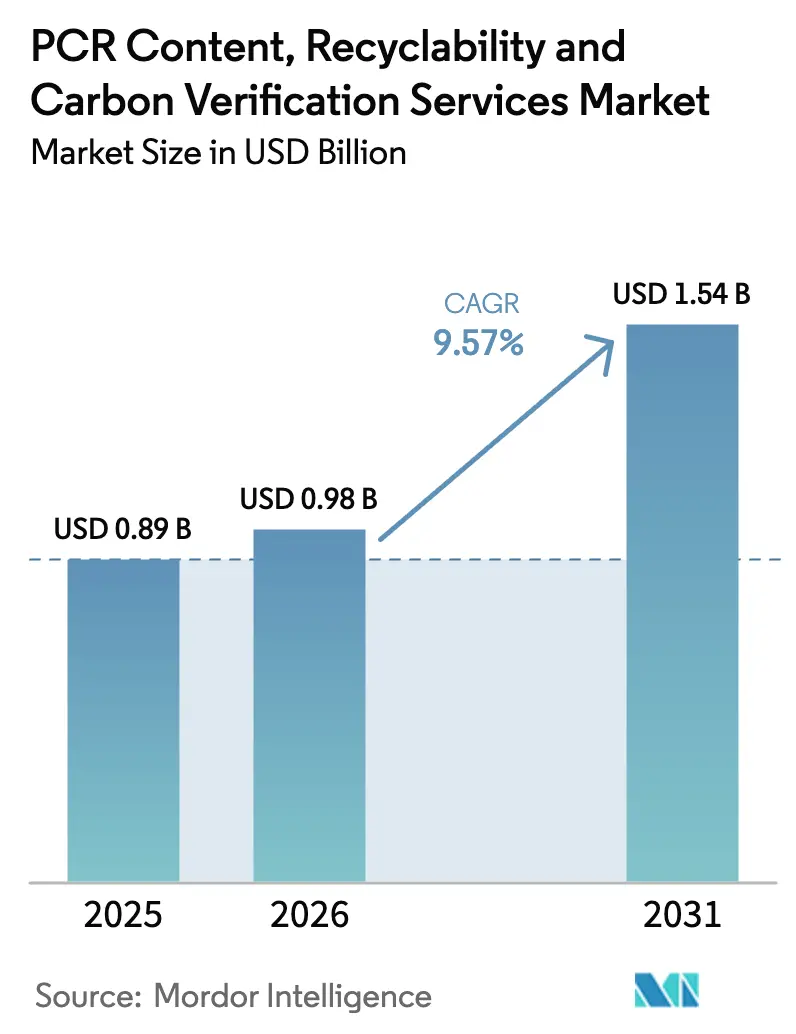
| Market Size (2026) | USD 0.98 Billion |
| Market Size (2031) | USD 1.54 Billion |
| Growth Rate (2026 - 2031) | 9.57 % |
| Fastest Growing Market | Asia Pacific |
| Largest Market | Europe |
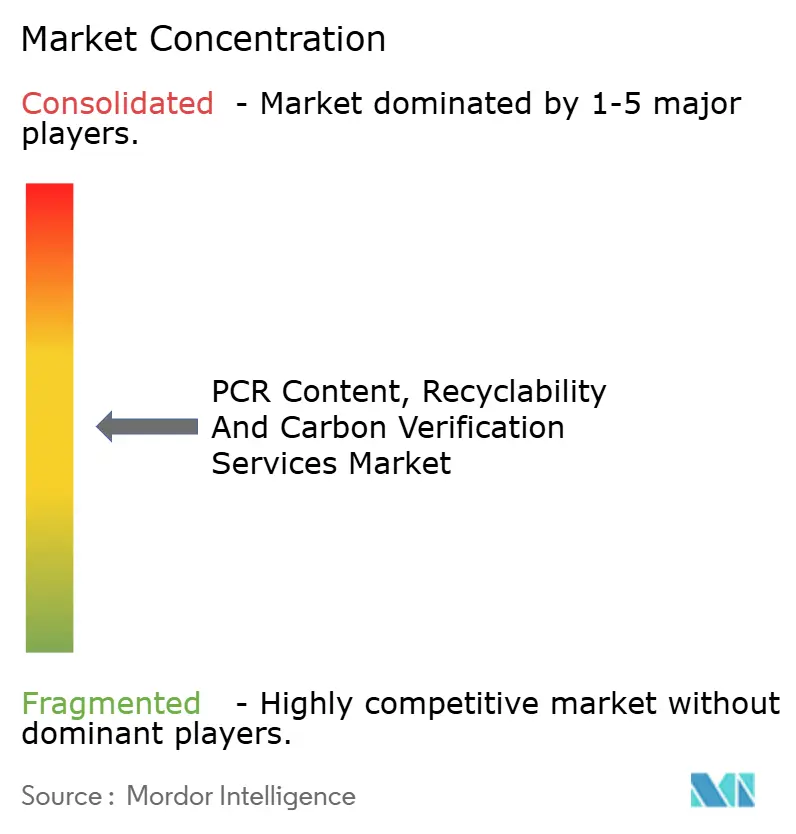
| Market Concentration | Medium |
Major Players *Disclaimer: Major Players sorted in no particular order Image © Mordor Intelligence. Reuse requires attribution under CC BY 4.0. | |
PCR Content, Recyclability And Carbon Verification Services Market Analysis by Mordor Intelligence
PCR Content, Recyclability and Carbon Verification Services market size in 2026 is estimated at USD 0.98 billion, growing from 2025 value of USD 0.89 billion with 2031 projections showing USD 1.54 billion, growing at 9.57% CAGR over 2026-2031. Users across the packaging, electronics, textiles, and automotive industries are increasingly requiring independent validation of recycled content, recyclability, and product carbon footprints, thereby transforming verification from an optional service into a core compliance activity. Digital product passports, retailer score-card programs, and premium pricing for verified recycled inputs add further impetus, creating financial benefits that outweigh audit expenditures. Incumbent testing majors are bundling recycled content, recyclability, and carbon audits into single engagements, while AI-enabled traceability continues to lower cost-to-serve, broadening access for small and medium manufacturers and propelling the PCR Content, Recyclability, and Carbon Verification Services market into its next growth phase.
Key Report Takeaways
- By service type, PCR content verification captured 37.52% of the PCR Content, Recyclability and Carbon Verification Services market share in 2025.
- By certification type, PCR Content, Recyclability and Carbon Verification Services Market size for International Sustainability and Carbon Certification (ISCC PLUS) is projected to grow at 12.08% CAGR between 2026-2031.
- By verification mode, on-site auditing captured 71.62% of the PCR Content, Recyclability and Carbon Verification Services market share in 2025.
- By end-user industry, PCR Content, Recyclability and Carbon Verification Services Market size for consumer electronics is projected to grow at 11.28% CAGR between 2026-2031.
- By geography, Europe captured 33.62% of the PCR Content, Recyclability and Carbon Verification Services market share in 2025.
Note: Market size and forecast figures in this report are generated using Mordor Intelligence’s proprietary estimation framework, updated with the latest available data and insights as of 2026.
Market Trends and Insights
Drivers Impact Analysis of PCR Content, Recyclability And Carbon Verification Services Market*
| Driver | (~) % Impact on CAGR Forecast | Geographic Relevance | Impact Timeline |
|---|---|---|---|
| Brand-Owner Decarbonization Mandates | +2.1% | Global, with early adoption in North America and the EU | Medium term (2-4 years) |
| EU Green Claims and PPWR Compliance Deadlines | +2.8% | Europe is primary, spillover to global supply chains | Short term (≤ 2 years) |
| Extended Producer Responsibility (EPR) Fee Differentials | +1.9% | Europe, APAC core markets, expanding to the Americas | Medium term (2-4 years) |
| Retailer Score-Card Procurement Rules | +1.4% | North America and the EU, with selective APAC adoption | Short term (≤ 2 years) |
| AI-Enabled Traceability Lowering Audit Cost | +1.2% | Global, with technology hubs leading implementation | Long term (≥ 4 years) |
| Premium Pricing for Verified Recycled Content in B2B Bids | +0.7% | Global, concentrated in developed markets | Medium term (2-4 years) |
| Source: Mordor Intelligence | |||
EU Green Claims and PPWR compliance deadlines
Implementation of the Packaging and Packaging Waste Regulation in 2025 obliges companies to validate 30% recycled content in plastic bottles and 10% in plastic packaging, stimulating urgent demand for third-party certifiers. Digital product passport rules require blockchain-verified chain-of-custody documentation, placing European auditors with ISO 14021 expertise at the forefront of service delivery. Suppliers outside the region that sell into the European market must also align with these rules, amplifying global verification volumes and favoring firms that already operate across multiple EU states.
Brand-owner decarbonization mandates
Multinational retailers now condition procurement on verified recycled content and Scope 3 carbon data, transforming audits into a routine cost of doing business.[1]Walmart, “Walmart Announces New Supplier Sustainability Requirements,” corporate.walmart.com Walmart and Unilever suppliers must present attested content percentages by 2025, thereby locking in recurring work for certifiers and reducing the risk of client churn. Investor pressure intensifies the need for defensible ESG disclosures, particularly following several high-profile greenwashing lawsuits that have highlighted the legal risks associated with unverified claims.
Extended Producer Responsibility fee differentials
Thirty-two national EPR programs now offer fee discounts of 20-50% for packaging containing verified recycled inputs. France’s CITEO scheme, for example, grants a EUR 0.15 (USD 0.16) per kilogram rebate for packages certified to have a 30% PCR content, shifting verification from a compliance expense to a net cost saver. Such economics accelerate adoption among cost-sensitive converters and create predictable revenue for certification bodies.
AI-enabled traceability lowering audit cost
IoT sensors, coupled with blockchain, enable continuous material-flow monitoring, reducing on-site visits by up to 60% and lowering audit budgets, particularly for routine renewals. SGS, Intertek, and TÜV Rheinland deploy AI analytics that flag anomalies in real-time, enabling auditors to focus on high-risk nodes rather than conducting entire plant walkthroughs. Lower entry costs open the PCR Content, Recyclability, and Carbon Verification Services market to small producers, fueling volume growth while raising data-science talent requirements for certifiers.
Restraints Impact Analysis of PCR Content, Recyclability And Carbon Verification Services Market*
| Restraint | (~) % Impact on CAGR Forecast | Geographic Relevance | Impact Timeline |
|---|---|---|---|
| Absence of Harmonized PCR Accounting Standards | -1.8% | Global, particularly affecting cross-border trade | Long term (≥ 4 years) |
| Limited Auditor Capacity in Emerging Markets | -1.3% | Asia-Pacific, Middle East, Africa, South America | Medium term (2-4 years) |
| Data-Privacy Concerns Around Supply-Chain Disclosure | -0.9% | Global, heightened in the EU under the GDPR framework | Short term (≤ 2 years) |
| Potential Greenwashing Litigation Risk for Certifiers | -0.6% | North America and the EU, emerging in APAC | Medium term (2-4 years) |
| Source: Mordor Intelligence | |||
Absence of harmonized PCR accounting standards
Divergent regional rules on mass balance, contamination thresholds, and attribution methods complicate cross-border verifications, forcing certifiers to maintain overlapping audit protocols. ISO 14021 provides general principles but lacks prescriptive guidance for complex, multi-material products, resulting in higher audit costs and delayed project timelines.
Limited auditor capacity in emerging markets
Verifier headcount has not kept pace with the triple-digit demand growth in the Asia-Pacific and Latin America regions. SGS hired 150 new specialists across India and Southeast Asia in 2025, yet coverage still falls short of projected needs, placing upward pressure on fees and limiting service availability for small enterprises.
*Our forecasts treat driver/restraint impacts as directional, not additive. The impact forecasts reflect baseline growth, mix effects, and variable interactions.
PCR Content, Recyclability And Carbon Verification Services Market Segment Analysis
By Service Type:
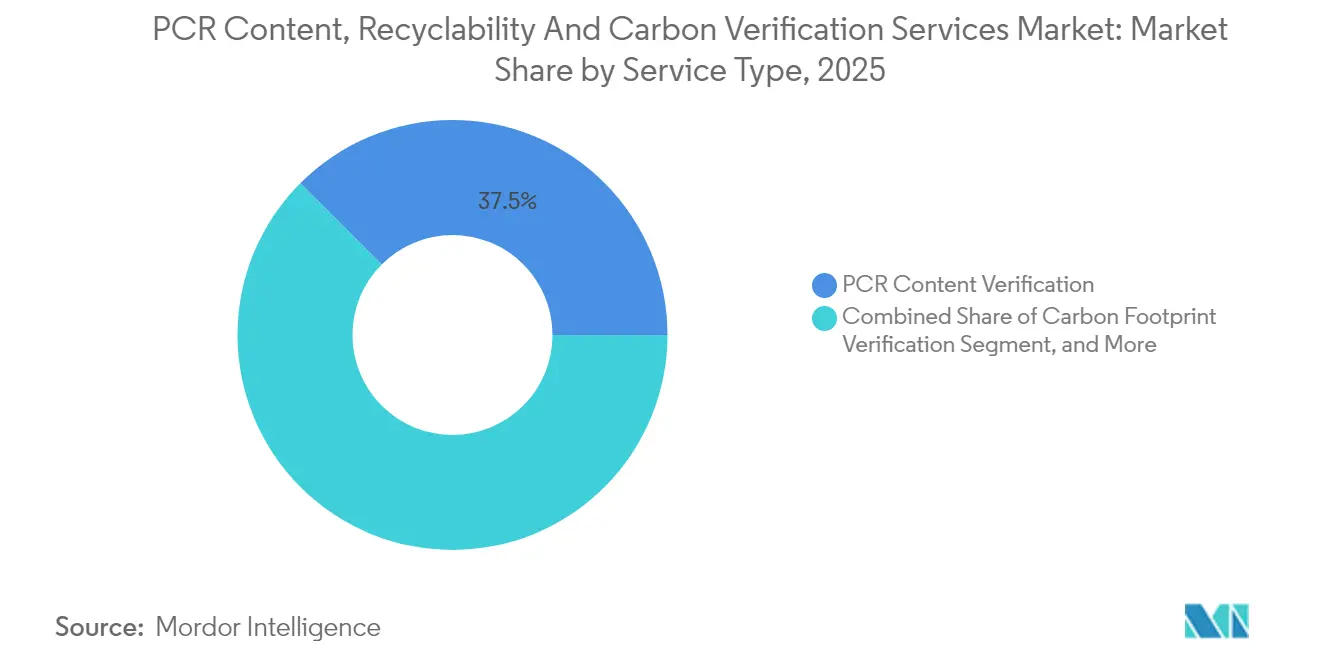
Integrated offerings drive premium growthPCR content verification held a 37.52% revenue share in 2025, underpinned by statutory recycled-content thresholds in packaging, textiles, and electronics. Standardized test methods lower per-engagement costs and broaden client uptake, cementing its lead within the PCR Content, Recyclability, and Carbon Verification Services market. Demand is further supported by EPR fee incentives and retailer procurement rules that make verified PCR percentages a purchasing prerequisite. Combined PCR-carbon certification, however, is outpacing all other categories at an 11.56% CAGR, as corporate ESG teams seek one-stop audits that cover circularity and decarbonization goals in a single site visit.
This bundling improves time-to-report and supports premium billing rates that are roughly 15-20% higher than those for stand-alone PCR or carbon audits, thereby bolstering revenue per auditor and raising switching barriers for clients. Recyclability assessment and carbon footprint verification serve narrower but strategically important niches. Recyclability audits are gaining traction in response to the EU PPWR design-for-recycling criteria, which require independent confirmation of sortability and material recovery yields. Chain-of-custody auditing remains the most technically complex service line, commanding 30-55% higher pricing because it leverages blockchain and IoT data streams to substantiate feedstock origins across diverse jurisdictions and regulatory environments.



By Certification Type:
ISCC PLUS gains momentum in integrated marketsThe Global Recycled Standard captured 41.10% of 2025 revenue, retaining leadership due to its brand recognition in textiles and its comprehensive social and environmental criteria that align with retailer scorecard requirements. Fashion labels value the consumer-facing logo, making GRS a marketing asset that reinforces recycled content disclosures at the point of sale. Conversely, ISCC PLUS is growing at a 12.08% CAGR because of its cross-industry applicability and built-in carbon accounting.
Its mass-balance methodology suits petrochemical and packaging firms that operate mixed-feedstock sites, enabling verified PCR outputs without production segregation. The Recycled Claim Standard fills a cost-sensitive niche, often adopted by suppliers in early-stage compliance markets that require lower PCR thresholds. SCS Recycled Content caters to North America, where alignment with the Federal Trade Commission's Green Guides lends it regulatory credibility.
By Verification Mode:
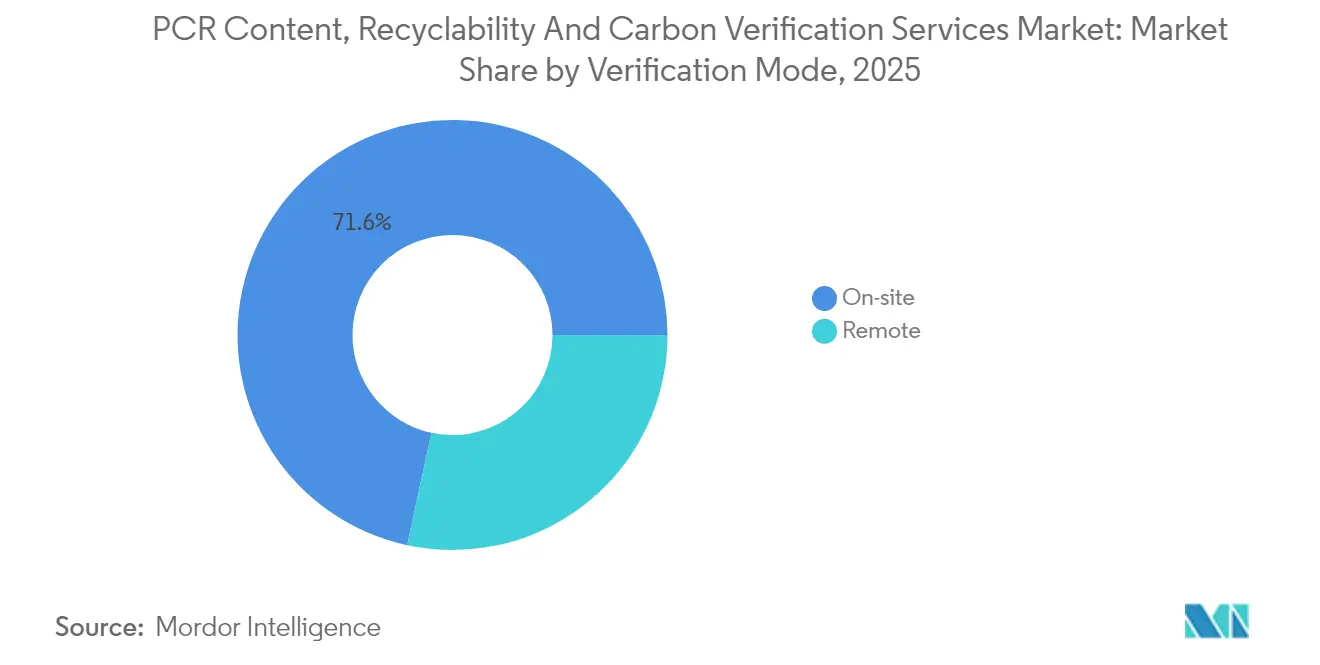
Remote auditing transforms cost structureOn-site auditing accounts for 71.62% of 2025 revenue, as regulators still require physical sampling for complex processes such as polymer melt filtration or multi-layer extrusion. Automotive and electronics clients rely on laboratory material identification to confirm safety compliance and contamination standards, cementing on-site demand. Yet remote auditing is accelerating at an 11.74% CAGR, driven by digital product passport rollouts that supply continuous machine data, high-resolution images, and geo-tagged sensor logs.
Hybrid models that combine real-time dashboards and targeted site visits reduce the average verification cost by 40-60%, making them particularly appealing to small manufacturers and those with geographically dispersed supply chains. Pandemic-era travel restrictions served as a proof of concept, and many clients now prefer digital-first engagements that shorten audit cycles and minimize plant disruption.
By End-user Industry:
Electronics surge reflects circular economy mandatesPackaging maintained 46.58% of 2025 revenue, reflecting the earliest and most prescriptive regulation set. Verification needs span PET, HDPE, PP, and paper substrates and often involve mass-balance allocation rules. The PCR Content, Recyclability, and Carbon Verification Services market size for packaging is forecast to reach USD 0.8 billion by 2031 as PPWR and global EPR schemes mature. Consumer electronics are expected to show the highest 11.28% CAGR due to impending digital product passport rules and company-specific circular commitments.
Apple and Samsung now specify 40-75% verified PCR thresholds for casings and internal components, pushing audit demand deeper into mineral and metal recovery streams. Textiles, building materials, and automotive segments also expand steadily, each presenting unique verification challenges ranging from fiber-level traceability to durability testing of recycled aggregates and compliance checks for recycled polymers used in crash-relevant components.
Geography Analysis
Europe PCR Content, Recyclability and Carbon Verification Services Market
Europe claimed 33.62% of global revenue in 2025, functioning as the regulatory nucleus that exports its compliance frameworks worldwide. Germany, France, and Italy alone accounted for over half of the regional market, leveraging advanced EPR mechanisms and sizable manufacturing bases. Harmonized EU regulations enable certifiers to replicate audit protocols across member states, enhancing scale economics and reinforcing Europe as the largest single regional market opportunity for PCR Content, Recyclability, and Carbon Verification Services.
APAC PCR Content, Recyclability and Carbon Verification Services Market
Asia-Pacific is the fastest-growing geography with an 11.42% CAGR. China’s EPR law for packaging and electronics, India’s Plastic Waste Management Rules, and Japan’s expanding sustainability reporting mandates collectively drive high volumes of verification engagements. [2]Ministry of Environment, Forest and Climate Change, “Plastic Waste Management Rules,” moef.gov.in . Singapore and Hong Kong serve as service hubs, supporting audits in Southeast Asia, while Australia’s mandatory climate disclosures sustain demand for combined PCR-carbon certifications. The PCR Content, Recyclability, and Carbon Verification Services market size in the Asia-Pacific is projected to surpass that of Europe by 2031, provided that regulatory enforcement remains consistent.
The Americas and MEA PCR Content, Recyclability and Carbon Verification Services Market
North America delivers steady mid-single-digit growth as state-level EPR statutes in California, New York and Washington intersect with Federal Trade Commission enforcement on environmental claims. Although federal regulations are less cohesive than European directives, higher litigation risk propels companies to secure robust third-party verifications. South America and the Middle East and Africa are nascent, but multinational buyers increasingly ask regional suppliers for certified recycled content and carbon data, encouraging capacity build-out among global certifiers and local specialists.


Competitive Landscape
The competitive field is moderately concentrated, with the top four players accounting for roughly 38% of 2024 revenue. Intertek, SGS, TÜV SÜD, and Bureau Veritas leverage their expansive laboratory networks and multi-industry domain expertise to deliver integrated verification bundles encompassing recycled content, recyclability, and carbon metrics. Recent acquisitions have solidified these advantages: SGS acquired Aster Global and RTI Labs to enhance its PCR polymer analytics, and Intertek added Envirolab to expand its carbon services in the Asia-Pacific region.[3]SGS Group, “SGS Acquires RTI Labs California,” sgs.com
TÜV Rheinland introduced blockchain-enabled digital product passport audits, while Bureau Veritas launched a USD 15 million sustainability verification center in Singapore to enhance its focus on electronics and packaging clients. Niche specialists emphasize speed and sector focus to win share, especially where large multinationals struggle with auditor availability.
AI-enabled platforms, such as Kiwa’s remote verification service, reduce audit budgets by 45% and attract small and medium-sized enterprises. UL Solutions, LRQA, and Eurofins also scale sustainability practices, aiming to capture clients that seek unified safety and sustainability audits. As demand rises, further consolidation is likely, especially where emerging-market capacity gaps create entry barriers for smaller firms.
PCR Content, Recyclability And Carbon Verification Services Industry Leaders
Intertek Group plc
SGS SA
TÜV SÜD AG
Bureau Veritas SA
UL Solutions Inc.
- *Disclaimer: Major Players sorted in no particular order
PCR Content, Recyclability And Carbon Verification Services Market Companies Covered in this Report
- Intertek Group plc
- SGS SA
- TÜV SÜD AG
- Bureau Veritas SA
- UL Solutions Inc.
- Dekra SE
- LRQA Ltd.
- Kiwa N.V.
- NSF International
- Eurofins Scientific SE
- Toxikon Corporation
- ClimatePartner GmbH
- Carbon Trust Advisory Ltd.
- South Pole Group
- Ecocert SA
- Eco Label Consult AS
- Preferred By Nature F.M.B.A.
- Flustix GmbH
- GreenCircle Certified LLC
- Earthhood Services Pvt Ltd

Recent Industry Developments in PCR Content, Recyclability And Carbon Verification Services Market
- March 2025: Bureau Veritas invested USD 15 million to open a sustainability verification center in Singapore, adding 50 specialized auditors.
- February 2025: TÜV Rheinland launched a digital product passport verification service with VeChain that cuts on-site inspection time by up to 60%.
- January 2025: Intertek Group acquired Envirolab Services for AUD 45 million (USD 30.2 million) to enhance carbon verification capabilities across Asia-Pacific.
- January 2025: SGS SA completed the acquisition of Aster Global Environmental Solutions, expanding recycled content testing and chain-of-custody auditing capacity in North America.


Global PCR Content, Recyclability And Carbon Verification Services Market Report Scope
| PCR Content Verification |
| Recyclability Assessment |
| Carbon Footprint Verification |
| Combined PCR-Carbon Certification |
| Chain-of-Custody Auditing |
| Global Recycled Standard (GRS) |
| Recycled Claim Standard (RCS) |
| International Sustainability and Carbon Certification (ISCC PLUS) |
| SCS Recycled Content |
| Other Certification Type |
| On-site |
| Remote |
| Packaging |
| Textiles and Apparel |
| Consumer Electronics |
| Automotive |
| Building and Construction Materials |
| Other End-user Industries |
| North America | United States | |
| Canada | ||
| Mexico | ||
| South America | Brazil | |
| Argentina | ||
| Chile | ||
| Rest of South America | ||
| Europe | United Kingdom | |
| Germany | ||
| France | ||
| Italy | ||
| Spain | ||
| Russia | ||
| Rest of Europe | ||
| Asia-Pacific | China | |
| India | ||
| Japan | ||
| South Korea | ||
| Australia | ||
| Rest of Asia-Pacific | ||
| Middle East and Africa | Middle East | Saudi Arabia |
| United Arab Emirates | ||
| Turkey | ||
| Rest of Middle East | ||
| Africa | South Africa | |
| Nigeria | ||
| Rest of Africa | ||
| By Service Type | PCR Content Verification | ||
| Recyclability Assessment | |||
| Carbon Footprint Verification | |||
| Combined PCR-Carbon Certification | |||
| Chain-of-Custody Auditing | |||
| By Certification Type | Global Recycled Standard (GRS) | ||
| Recycled Claim Standard (RCS) | |||
| International Sustainability and Carbon Certification (ISCC PLUS) | |||
| SCS Recycled Content | |||
| Other Certification Type | |||
| By Verification Mode | On-site | ||
| Remote | |||
| By End-user Industry | Packaging | ||
| Textiles and Apparel | |||
| Consumer Electronics | |||
| Automotive | |||
| Building and Construction Materials | |||
| Other End-user Industries | |||
| By Geography | North America | United States | |
| Canada | |||
| Mexico | |||
| South America | Brazil | ||
| Argentina | |||
| Chile | |||
| Rest of South America | |||
| Europe | United Kingdom | ||
| Germany | |||
| France | |||
| Italy | |||
| Spain | |||
| Russia | |||
| Rest of Europe | |||
| Asia-Pacific | China | ||
| India | |||
| Japan | |||
| South Korea | |||
| Australia | |||
| Rest of Asia-Pacific | |||
| Middle East and Africa | Middle East | Saudi Arabia | |
| United Arab Emirates | |||
| Turkey | |||
| Rest of Middle East | |||
| Africa | South Africa | ||
| Nigeria | |||
| Rest of Africa | |||


Key Questions Answered in the Report
How large is the PCR Content, Recyclability and Carbon Verification Services market in 2026?
It stands at USD 0.98 billion and is projected to reach USD 1.54 billion by 2031.
Which region currently leads to demand for verification services?
Europe accounts for 33.62% of global revenue, driven by the enforcement of PPWR and the Green Claims Directive.
What service type is growing the fastest?
Combined PCR-carbon certification is growing at an 11.56% CAGR because clients prefer integrated audits.
Why is consumer electronics an attractive end-user segment?
Digital product passports and corporate circularity targets drive demand for verification, resulting in an 11.28% CAGR outlook.
How do digital technologies affect audit costs?
AI-enabled traceability and remote monitoring can cut on-site visit expenses by up to 60%.
What is the main barrier to faster market growth?
A lack of harmonized global PCR accounting rules adds complexity and increases verification costs.
Page last updated on:





