
Patient Portal Market Size and Share
Market Overview
| Study Period | 2020 - 2031 |
|---|---|
| Market Size (2026) | USD 7.77 Billion |
| Market Size (2031) | USD 18.10 Billion |
| Growth Rate (2026 - 2031) | 18.43 % |
| Fastest Growing Market | Asia-Pacific |
| Largest Market | North America |
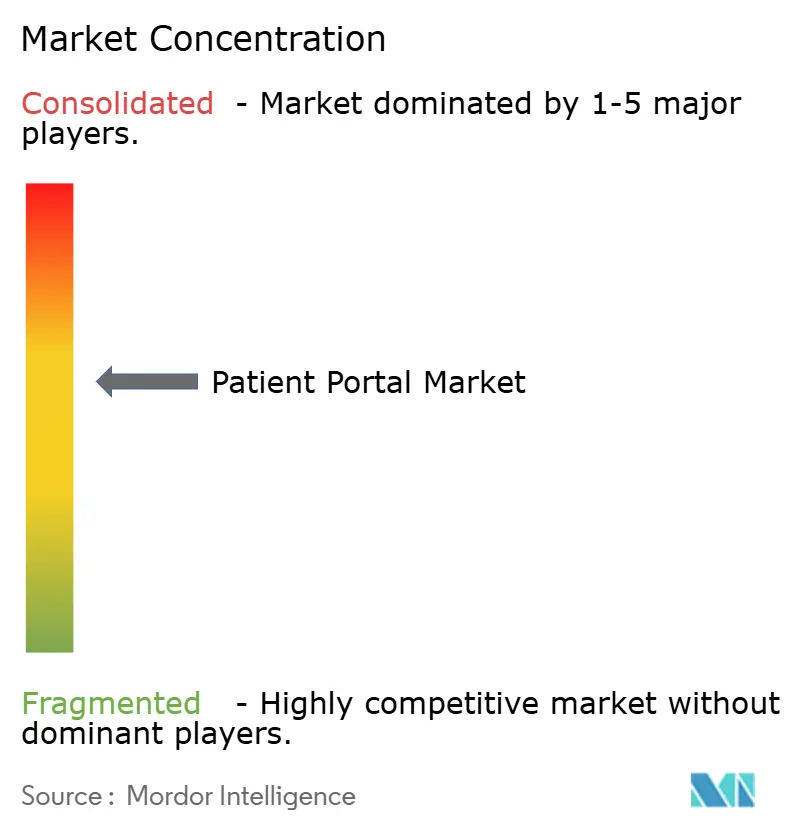
| Market Concentration | Medium |
Major Players *Disclaimer: Major Players sorted in no particular order Image © Mordor Intelligence. Reuse requires attribution under CC BY 4.0. | |
Patient Portal Market Analysis by Mordor Intelligence
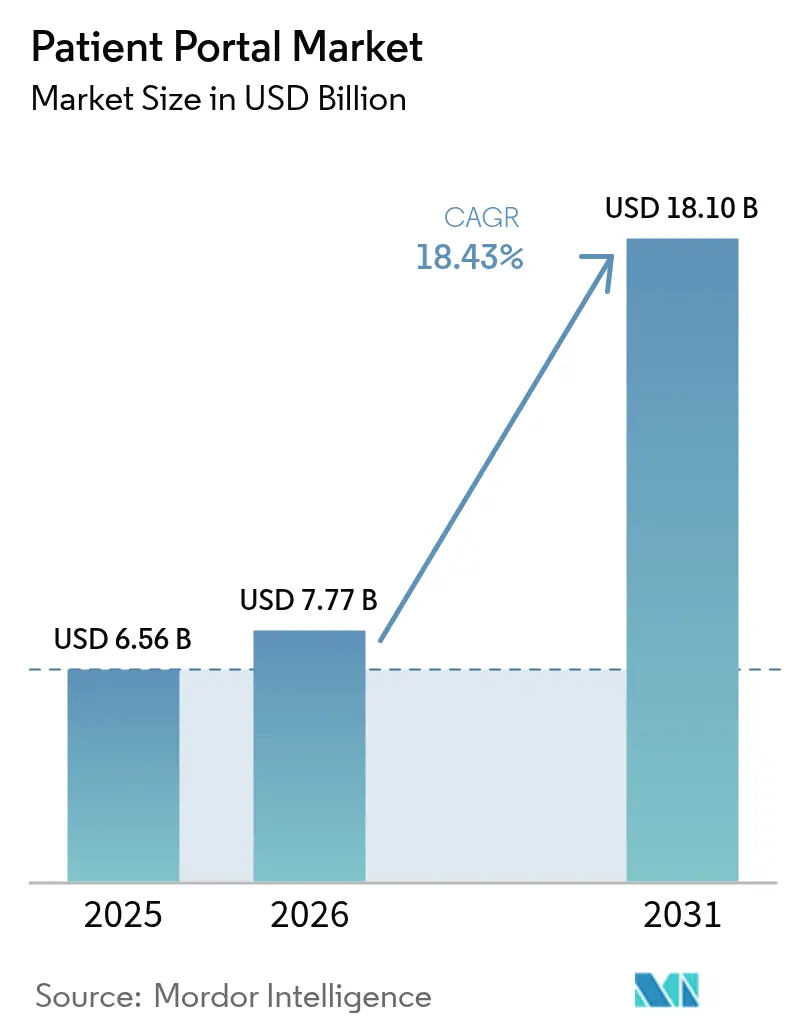
The Patient Portal Market size is projected to expand from USD 6.56 billion in 2025 and USD 7.77 billion in 2026 to USD 18.10 billion by 2031, registering a CAGR of 18.43% between 2026 to 2031.
Driven by stricter federal and international interoperability mandates, payer requirements for documented digital engagement, and growing consumer demand for on-demand health access, health portals are transitioning from optional features to critical infrastructure. Integrated platforms continue to dominate enterprise health systems due to bundled licensing that reduces switching costs. However, standalone solutions are scaling rapidly as ambulatory centers and retail clinics adopt modular deployments to avoid costly and extensive EHR overhauls. Concurrently, cloud migration is reshaping cost structures. Hyperscale vendors now offer HIPAA-compliant reference architectures, providing elastic computing, audited security controls, and a lower five-year total cost of ownership than on-premises systems. The competitive landscape exhibits moderate rivalry. Established EHR vendors protect their market share through network effects, while venture-backed specialists gain traction by embedding payment solutions, streamlining intake processes, and leveraging AI-driven triage to optimize administrative workflows.
Key Report Takeaways
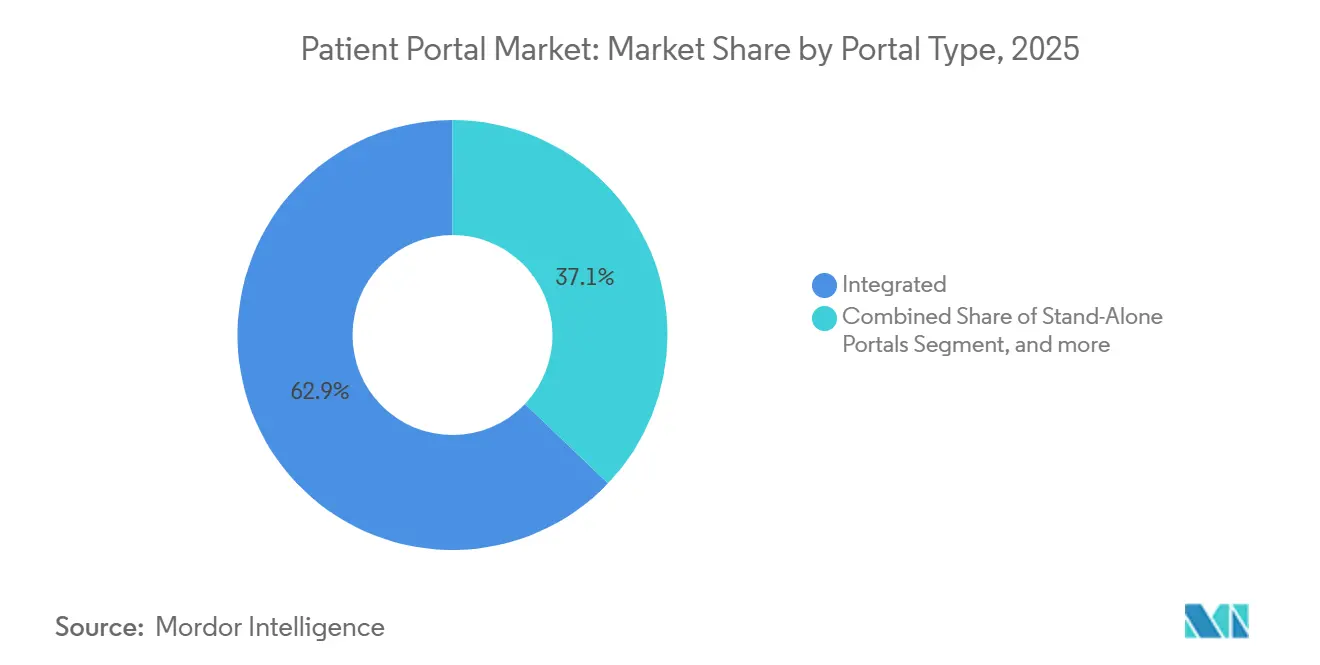
- By portal type, integrated platforms led with 62.88% revenue share in 2025, while standalone portals are advancing at a 20.54% CAGR through 2031.
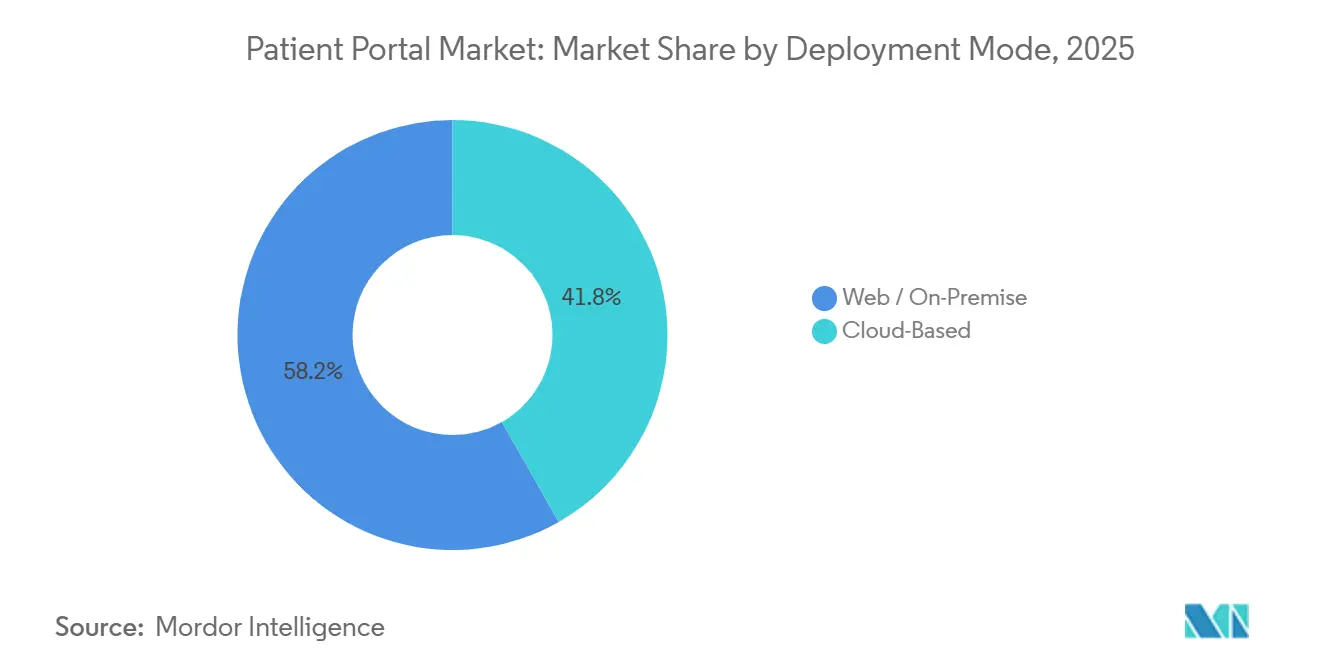
- By deployment mode, web/on-premise systems accounted for 58.23% of the patient portal market share in 2025, yet cloud-based portals are forecast to expand at a 20.78% CAGR through 2031.
- By end user, providers held 72.65% of the patient portal market size in 2025, and payers are growing at a 21.32% CAGR to 2031.
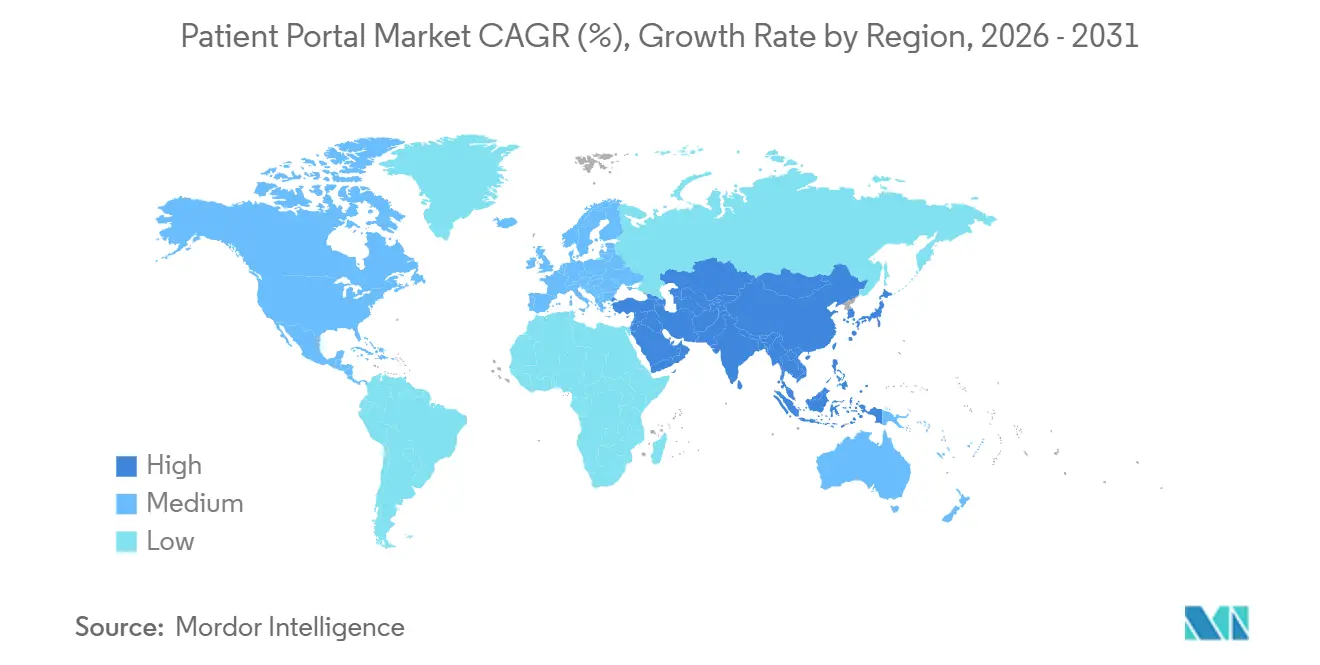
- By geography, North America accounted for 44.32% of revenue in 2025, whereas Asia-Pacific is projected to grow at a 19.65% CAGR through 2031.
Note: Market size and forecast figures in this report are generated using Mordor Intelligence’s proprietary estimation framework, updated with the latest available data and insights as of 2026.
Market Trends and Insights
Drivers Impact Analysis of Patient Portal Market*
| Driver | (~) % Impact on CAGR Forecast | Geographic Relevance | Impact Timeline |
|---|---|---|---|
| Federal interoperability & Meaningful-Use mandates | +4.2% | North America & EU | Medium term (2-4 years) |
| Rising consumer demand for digital front-door access | +3.8% | Global | Short term (≤ 2 years) |
| Rapid shift to cloud-hosted EHR ecosystems | +3.1% | Global, with early gains in North America, APAC | Medium term (2-4 years) |
| Reimbursement incentives for value-based care models | +2.9% | North America core, spill-over to EU | Long term (≥ 4 years) |
| AI-driven hyper-personalized education modules | +2.4% | North America & APAC core | Medium term (2-4 years) |
| FHIR-enabled "plug-in" app marketplace momentum | +1.8% | Global | Long term (≥ 4 years) |
| Source: Mordor Intelligence | |||
Government Interoperability Regulations
Nationwide frameworks such as the Trusted Exchange Framework and Common Agreement in the United States and the European Health Data Space in the EU require certified EHRs to publish standardized APIs that expose clinical data without special effort. Vendors now face commoditized data access and must differentiate on analytics or user experience. Smaller suppliers lacking API capacity are exiting or merging, whereas Epic Systems and Oracle Health leverage existing FHIR infrastructure to upsell advanced analytics modules. Payers increasingly exploit transparent data flows; one leading U.S. insurer realized USD 340 million in administrative savings after automating prior authorizations through open APIs[1]Office of the National Coordinator for Health IT, “Trusted Exchange Framework and Common Agreement,” healthit.gov.
Consumer Demand for Digital Healthcare Access
Smartphone-centric behavior is setting new service benchmarks. A 2025 Pew survey confirmed that 68% of U.S. adults under 50 expect same-day appointment booking and real-time prescription refills via mobile apps[2]Pew Research Center, “Public Expectations for Digital Health Services,” pewresearch.org. India’s Ayushman Bharat Digital Mission has 450 million registered users who access portals tied to a national health identifier, illustrating how government mandates align with consumer expectations. Retail pharmacy chains respond by embedding full-service portals that boosted digital engagement 19% year over year, eroding patient loyalty to traditional practices.
Cloud Adoption in Healthcare IT Systems
A Deloitte analysis found 23% five-year cost savings when EHR workloads move to hyperscale cloud platforms, mainly by retiring on-site data centers. All three major cloud providers hold HITRUST certification and publish HIPAA reference blueprints, mitigating historical compliance objections. Oracle Health’s cloud-native Cerner Millennium now loads 95% of patient transactions in under one second after migrating from local servers. Community hospitals take advantage of per-transaction SaaS pricing that eliminates capital budgets and accelerates deployment.
Shift Toward Value-Based Reimbursement Models
Medicare’s Merit-based Incentive Payment System now awards bonuses for “digital access,” incentivizing providers to raise portal activation and message response rates within 72 hours. Private payers mirror the trend: one major insurer ties 8% of reimbursement to engagement scores. Cleveland Clinic lifted portal registration from 54% to 71% through multilingual outreach, securing an extra USD 12 million in quality payments, proving that digital engagement now carries direct revenue implications.
Restraints Impact Analysis of Patient Portal Market*
| Restraint | (~) % Impact on CAGR Forecast | Geographic Relevance | Impact Timeline |
|---|---|---|---|
| Cyber-security & privacy breaches | -2.8% | Global | Short term (≤ 2 years) |
| Low digital/health literacy in elderly cohorts | -1.9% | Global, with higher impact in rural areas | Long term (≥ 4 years) |
| Clinician message-overload burnout | -1.4% | North America & EU | Medium term (2-4 years) |
| Misaligned reimbursement for asynchronous visits | -1.1% | North America core | Medium term (2-4 years) |
| Source: Mordor Intelligence | |||
Data Security and Privacy Concerns
The U.S. Department of Health and Human Services logged 725 large-scale breaches in 2024, with portals implicated in 18% due to credential stuffing and session hijacking[3]U.S. Department of Health and Human Services, “Breach Portal Annual Report 2024,” hhs.gov. Europe’s NIS2 Directive requires 24-hour incident reporting and imposes fines up to 2% of global revenue, increasing vendor compliance costs. FaceID authentication, introduced by Epic in late 2025, reduces account takeovers by 34% but increases development complexity for smaller providers. A 2025 Kaiser survey indicates that 41% of adults avoid portals due to privacy concerns, slowing adoption among key demographics.
Digital Divide Among Elderly and Rural Populations
The FCC reports 19% of rural Americans still lack 25 Mbps broadband, undermining video consult reliability. Portal registration among adults 65+ lags the average by 22 percentage points. Clinical impact is tangible; lower portal use correlates with higher preventable hospitalization rates. Governments and health systems pilot kiosks and telephone navigators, yet these measures raise administrative overhead without closing infrastructure gaps.
*Our forecasts treat driver/restraint impacts as directional, not additive. The impact forecasts reflect baseline growth, mix effects, and variable interactions.
Patient Portal Market Segment Analysis
By Portal Type:
Integrated Platforms Dominate Through EHR Lock-InIntegrated offerings commanded 62.88% of the patient portal market in 2025 as enterprise health systems accept bundled portals within EHR license fees. The patient portal market size for integrated solutions is forecast to maintain high absolute revenue, even as it cedes relative share to nimble standalone entrants. Standalone portals, projected to deliver a 20.54% CAGR, benefit from FHIR-based data exchange, which removes historical barriers to vendor swaps. Ambulatory surgery centers, specialty clinics, and retail chains increasingly adopt modular portals that prioritize billing clarity, real-time eligibility checks, and rapid go-live cycles. As a result, the competitive landscape bifurcates: large integrated delivery networks extend bundled contracts, whereas smaller organizations adopt best-of-breed apps.
Standalone suppliers validate demand for specialization. Cedar shortens payment cycles by embedding transparent estimates and flexible plans, while Phreesia automates check-in and intake to lift front-desk throughput 18%. These focused wins attract investors and expand total addressable opportunities, even in hospitals that retain integrated portals for clinical charts but overlay standalone applications for revenue-cycle or intake workflows. Regulatory insistence on open APIs erodes proprietary data moats, ensuring ongoing contest between breadth and specialization inside the patient portal market.



By Deployment Mode:
Cloud Economics Reshape Infrastructure DecisionsWeb/on-premise deployments held 58.23% of the patient portal market share in 2025, but cloud portals are expected to post the fastest growth at a 20.78% CAGR. Health systems pursuing cloud platforms cite automatic scaling, baked-in disaster recovery, and audited security controls as decisive advantages. The patient portal market size tied to cloud implementations rises steadily as mid-tier hospitals shift to SaaS subscriptions, converting capital expenditures into operating expenses. Cloud launches now include per-user or per-transaction pricing, appealing to budget-constrained community sites that previously delayed portal upgrades.
Yet on-premises solutions persist where data-science teams need immediate local access to imaging repositories or where government accreditation rules require FedRAMP High authorizations. Academic medical centers sometimes absorb higher maintenance costs to avoid outbound data fees on research-grade datasets. Hybrid architectures are emerging: transactional traffic resides in the cloud, while de-identified research copies stay on campus clusters, giving institutions flexibility without full forklift migrations.
By End User:
Provider Dominance Faces Payer Segment DisruptionIn 2025, providers accounted for 72.65% of the patient portal market, driven by compliance with meaningful-use requirements and the critical role of EHR connectivity in daily clinical operations. However, payer portals are experiencing significant growth, with a 19.65% CAGR, as insurers increasingly implement features such as self-service cost estimators and medication-adherence alerts. Additionally, retail pharmacies and grocery-based clinics are using loyalty programs to drive customers to their branded portals, further diversifying market demand. These trends indicate a gradual decline in provider dominance, enabling payers to gain greater influence over feature development and market standards.
Hospitals typically enter into multi-year contracts that require stringent uptime guarantees, while payers prefer flexible, API-driven portals that integrate claims data with wellness incentives. This divergence in priorities is driving intensified competition among platform vendors, each striving to differentiate their offerings and capture market share.
Geography Analysis
North America Patient Portal Market
North America generated 44.32% of global revenue in 2025 as Medicare and commercial insurers embed digital access metrics into reimbursement contracts, transforming portal activation into a revenue lever. Practices achieving top-quartile engagement receive USD 48,000 more in quality bonuses each year than bottom-quartile peers. Canada pilots similar incentives, while Mexico’s public insurer enrolled 18 million users within its first year but struggles with rural adoption.
APAC Patient Portal Market
Asia-Pacific is set to be the fastest expanding region at 19.65% CAGR through 2031. India’s national mission compels every empaneled hospital to maintain a portal connected to a universal health identifier, driving large-scale, cloud-native implementations. China integrates portals with social-credit and reimbursement systems, reducing claim cycles from 30 days to 3 days. Australia operates a government backbone that supports 24 million citizens, although a 2024 breach dampened new registrations. South Korea sets a 2026 deadline for tertiary hospitals to adopt FHIR-compliant portals, reflecting regional commitment to standards.
Europe, GCC and South America Patient Portal Market
Europe faces moderate momentum because GDPR compliance elevates development expense and health systems remain fragmented. The European Health Data Space standardizes cross-border access, but disparate reimbursement structures slow nationwide deployments. Outside Europe, Gulf Cooperation Council states weave portals into smart-city agendas, while Brazil’s national system enrolls 150 million users yet contends with data-quality variability.

Regulatory Landscape
In the United States, interoperability and certification rules continue to tighten the technical baseline for patient portals through mandated standardized APIs and workflow transactions. The Assistant Secretary for Technology Policy/Office of the National Coordinator for Health IT (ASTP/ONC) finalized the HTI-4 rule with an effective date of October 1, 2025, adding and updating certification criteria relevant to API functionality and transactions such as electronic prior authorization and real-time prescription benefit. As a result, portal vendors and EHR developers have to maintain compliant patient-facing data access and medication experiences.
In Europe, Regulation (EU) 2025/327 establishing the European Health Data Space entered into force on March 26, 2025, requiring Member States to stand up electronic health data access services (including online patient portals) for access to personal electronic health data. Member States must also meet governance requirements, including designating digital health authorities and national contact points by March 26, 2027. Operationally, ASTP/ONC also used enforcement discretion to extend the HTI-1 developer update deadline to March 1, 2026, and published the 2026 Standards Version Advancement Process (SVAP) fact sheet enabling voluntary adoption of newer standard versions in certified Health IT Modules beginning August 29, 2026, reinforcing a rolling upgrade cycle for portal-linked API and security capabilities.
Value Chain Analysis
The patient portal value chain starts with standards and platform inputs (FHIR-based APIs, identity and access management, cybersecurity controls, and cloud reference architectures) and then moves into solution development by EHR vendors and specialist portal providers, followed by systems integration, implementation services, and ongoing managed support. Epic, Oracle Health, and athenahealth anchor many integrated deployments, while standalone vendors tend to differentiate on payments, intake, and engagement features. Hyperscale cloud providers also supply elastic infrastructure and compliance tooling that increasingly support SaaS delivery models.
Downstream value creation centers on deployment and adoption. Providers, payers, and retail health operators configure portals to meet interoperability and digital-access requirements, integrate scheduling, messaging, and billing workflows, and drive enrollment through patient outreach. Policy and standards bodies influence upgrade cadence and integration priorities, including the example that ASTP/ONC withdrew remaining non-finalized proposals from the HTI-2 proposed rule in December 2025. That shift moved attention back to executing against existing certification and interoperability requirements rather than preparing for additional near-term federal expansions.
Competitive Landscape
Epic Systems and Oracle Health together control about 55% of integrated deployments, yielding network advantages that increase switching costs. Epic’s 305 million global MyChart accounts allow a single login across any Epic facility, reinforcing user stickiness. Oracle Health patents context-aware notification engines that reduce alert noise, signaling investments in usability enhancements. The patient portal market, therefore, shows moderate concentration yet growing fragmentation in ancillary segments.
Challengers compete on depth rather than breadth. Cedar compresses patient payment timelines by 30%, Phreesia automates intake across 3,500 practices, and Luma Health personalizes outreach to raise appointment adherence. Consumer-tech aggregators such as Apple and Google capture the longitudinal record layer, forcing traditional vendors to prioritize experience over exclusivity. Vendors increasingly differentiate through analytics, payment automation, and AI-enabled triage rather than on possession of core clinical data alone, shifting the competitive battlegrounds within the patient portal market.
Patient Portal Industry Leaders
Allscripts Healthcare Solutions Inc.
McKesson Corporation
CureMD Healthcare
Athenahealth, Inc.
Oracle (Cerner Corporation)
- *Disclaimer: Major Players sorted in no particular order
Patient Portal Market Companies Covered in this Report
- Allscripts Healthcare Solutions (Altera)
- Athenahealth
- Cedar
- eClinicalWorks
- Epic Systems Corp.
- GE Healthcare
- GetWellNetwork
- Greenway Health
- InteliChart
- Luma Health
- McKesson Corp.
- Meditech
- MyHealthONE (HCA Healthcare)
- NextGen Healthcare
- Omada Health
- Oracle Health (Cerner)
- Phreesia
- Koninklijke Philips
- Teladoc Health
- Weave Communications

Market Opportunities and Future Outlook
Regulatory operationalization is creating actionable whitespace around transactions and measurable digital engagement, beyond view-and-download access. In the United States, CMS-0057-F requires payers to implement FHIR-based APIs spanning patient access, provider access, payer-to-payer exchange, and prior authorization, with full operationalization tied to a January 1, 2027 deadline. Parts of the prior authorization provisions became mandatory in January 2026, which pulls portal strategies toward integrated member and patient experiences that combine clinical data access with benefits, prior authorization status visibility, and cost transparency. This aligns with the report context indicating faster growth in payer-led adoption.
A second opportunity area is standards-driven modernization and usability differentiation as basic data access becomes more commoditized. ASTP/ONC began Year 1 data collection for the Health IT Certification Program Insights Condition in 2026, increasing scrutiny on real-world performance and encouraging vendors to invest in user experience, accessibility, and workflow-safe messaging. Given documented disparities in standards-based capability adoption between inpatient and outpatient settings and by hospital resources, vendors that package turnkey, lower-burden implementations for smaller, rural, and community providers can address deployment gaps while staying aligned to TEFCA- and FHIR-oriented interoperability requirements already reflected in the market scope.
Recent Industry Developments in Patient Portal Market
- July 2026: athenahealth selected iScribeHealth as a Preferred Partner for ambient clinical documentation, enabling integration into the athenaOne workflow and expanding its Ambient Notes options. The update broadens athenahealth's ecosystem approach and supports portals and patient access workflows by reducing documentation friction in ambulatory settings, which can improve downstream responsiveness to patient messages and digital engagement measures.
- March 2026: CureMD launched 11x, an AI-native healthcare operating system with 16 production-grade AI models unified across clinical, operational, and financial domains. By consolidating automation across front-office, clinical, and revenue-cycle functions, the release strengthens the platform layer that patient portals increasingly depend on for intake, communications, and payment workflows.
- March 2024: CureMD announced Oncentric, a specialized oncology solution, expanding its footprint into complex specialty-care workflows. Specialty-oriented modules can intensify demand for portal capabilities such as structured care-plan communication, frequent scheduling, and coordinated billing, especially in practices that want modular deployments without full EHR replacement.


Patient Portal Market Report Scope and Research Methodology
Market Definition and Coverage
For this study, the patient portal market covers software and related services that let patients securely access their health information and interact with care teams through functions like viewing records, messaging, scheduling, and bill pay, delivered through web or mobile access.
Scope exclusions: We exclude general telehealth visit platforms, core EHR systems sold as standalone clinical records, and consumer wellness apps that do not provide a provider-connected portal experience.
Segments Covered in This Report
- By Portal Type
- Integrated Portals
- Stand-Alone Portals
- By Deployment Mode
- Web / On-Premise
- Cloud-Based
- By End User
- Providers (Hospitals, Clinics, IDNs)
- Payers
- Pharmacies & Retail Health
- Other End Users
- Geography
- North America
- United States
- Canada
- Mexico
- Europe
- Germany
- United Kingdom
- France
- Italy
- Spain
- Rest of Europe
- Asia-Pacific
- China
- Japan
- India
- Australia
- South Korea
- Rest of Asia-Pacific
- Middle East & Africa
- GCC
- South Africa
- Rest of Middle East & Africa
- South America
- Brazil
- Argentina
- Rest of South America
- North America
Data Sources, Market Sizing, and Validation
Desk Research
Desk research was used to set the market boundaries, build the first demand and adoption view, and validate the timing of policy and technology shifts. We relied on public and official sources such as ONC and CMS publications, CDC health IT and access indicators, OECD health statistics, and World Bank macro series to anchor digitization and healthcare spending context. We also reviewed peer reviewed literature on patient engagement and portal utilization, and scanned hospital and health system updates, product documentation, and investor materials to understand the feature bundles and deployment patterns that show up in real purchasing decisions.
On the supply side, we reviewed product positioning, implementation approaches, and integration requirements from public materials. We used paid subscriptions for company financials and intelligence, news and financials, and patent databases to cross-check innovation activity and portfolio focus. These inputs helped set adoption curves and price progression assumptions before interviews were conducted. The desk sources listed above are illustrative only, and other public references were also used for data collection, cross-checks, and clarification.
Primary Interviews and Surveys
Primary work focused on confirming what is counted as a patient portal transaction, particularly where portals are bundled with broader patient engagement suites. We spoke with healthcare IT leaders, provider operations teams, and solution delivery specialists across APAC, EMEA, and the Americas to pressure test adoption, replacement cycles, and typical pricing structures. Afterward, we adjusted assumptions where interview evidence on feature scope and deployment patterns was consistent with our initial demand model.
Distribution of primary research fieldwork respondents
| Company type | Respondent position | Region |
|---|---|---|
| Top tier: 31% | CXOs: 14% | APAC: 45% |
| Mid tier: 48% | Functional/Unit leaders: 28% | EMEA: 30% |
| Smaller Players: 21% | Managers: 58% | Americas: 25% |
Market-Sizing & Forecasting
Sizing starts with a top-down build where healthcare IT spend and digitization signals are converted into an addressable pool for patient access and engagement workflows, then filtered by portal adoption and paid deployment penetration. We used checks such as EHR adoption and interoperability progress, patient access and use indicators, provider digital front door investments, cloud migration pace, and typical portal module attach rates to keep the demand pool realistic. Since pricing can vary with scope, a practical ASP range was set using published contract language where available, then tightened based on interview feedback on implementation, training, and ongoing support expectations.
After the top-down estimate was produced, we corroborated it with selective bottom-up approximations, including sampled price per facility or per member structures multiplied by an estimated installed base. We then ran channel and partner checks to avoid double counting bundled modules. When a segment lacked clear volume indicators, we used proxy adoption ratios from similar provider cohorts and revalidated the implied spend levels with primary respondents. Forecasts were built using scenario analysis around policy support for access, provider budget cycles, and patient usage trends, with growth rates moderated where replacement cycles and saturation signals were reported.
Data Validation & Update Cycle
Outputs are validated through cross-checks against independent signals, including regional healthcare IT spend direction, known digitization milestones, and the implied spend per provider organization. Any large variance is investigated by revisiting the scope mapping, the adoption curve, and the pricing logic, then a second analyst review is completed before sign-off. We refresh the model annually, and interim updates are triggered when material events occur, such as a major regulatory change, a shift in reimbursement for patient access, or a step-change in provider IT budgets. Before final delivery, the full dataset and assumptions are reviewed again so clients receive the latest updated view.
Mordor Intelligence's Patient Portal Market Size Compared With Other Published Estimates
Published market sizes for patient portals can look different even when they describe the same end use, because each publisher draws the line differently on what counts as a portal and how bundled patient engagement software is treated. Differences also come from the base year used, the exchange rate timing, and whether the estimate reflects contracted revenue only or also includes implementation and support services.
In our work, the biggest drivers are usually whether telehealth and broader engagement modules are added into the total, how provider versus payer deployments are split, and how fast pricing is assumed to rise as portals move to cloud and add more functions like billing and scheduling. The spread in the table largely reflects these scope and ASP choices, plus how often assumptions are rechecked with provider-side users and implementation specialists before the totals are finalized, which is handled differently by Mordor Intelligence.
Benchmark comparison
| Source | Market Size | Gaps in Research Methodology |
|---|---|---|
| Mordor Intelligence | USD 7.77 B (2026) | |
| Global Consultancy A | USD 5.02 B (2024) | Uses an earlier base year and a different forecast window, and it can also compress the value pool when portal functionality is treated mainly as software licenses without consistently adding implementation and support services. |
| Industry Publisher B | USD 5.33 B (2024) | Starts from a 2024 base and may include a broader definition where adjacent patient engagement features are counted with portals, which can shift the split between standalone portal revenue and bundled suite revenue. |
Overall, the comparison suggests that year selection, bundle treatment, and service inclusion explain most of the gap. By keeping the demand pool tied to provider-connected portal workflows and then checking the implied pricing and adoption against field feedback, our estimate stays traceable to clear inputs and repeatable steps.


Key Questions Answered in the Report
What revenue will patient portal market reach by 2031?
The sector is forecast to generate USD 18.10 billion by 2031 on an 18.43% CAGR from 2026.
Which portal type grows fastest to 2031?
Standalone portals, favored by ambulatory and specialty clinics, are projected to advance at a 20.54% CAGR.
Why are cloud-based portals displacing on-premise systems?
Hospitals gain 20-25% total-cost savings, elastic scaling, and audited security by adopting hyperscale cloud platforms.
How do payers influence portal adoption?
Value-based contracts now allocate up to 8% of reimbursement to engagement metrics captured through member portals.
What is the main barrier to wider portal use among seniors?
Broadband gaps and low digital literacy leave registration rates 22 percentage points below the national average.
Which companies dominate integrated deployments?
Epic Systems and Oracle Health together control roughly 55% of integrated portal revenue.
Page last updated on:


 Your data is secure and never sold or shared.


