
Passenger Car Motor Oil Market Size and Share
Market Overview
| Study Period | 2021 - 2031 |
|---|---|
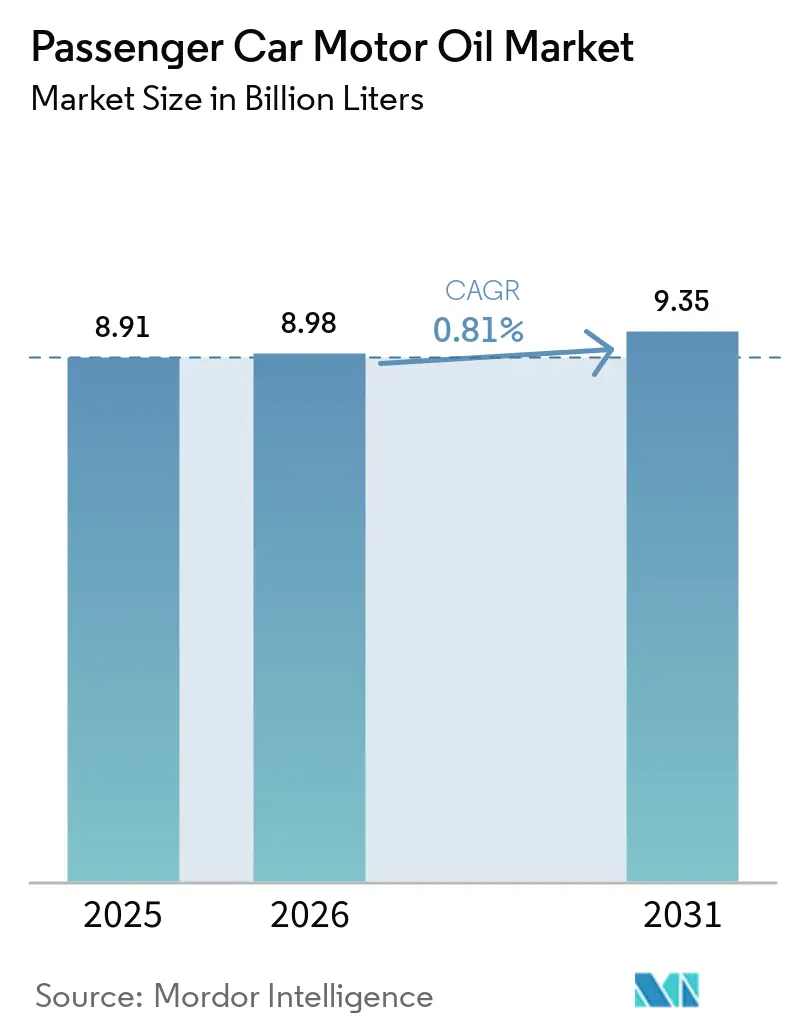
| Market Volume (2026) | 8.98 Billion liters |
| Market Volume (2031) | 9.35 Billion liters |
| Growth Rate (2026 - 2031) | 0.81 % |
| Fastest Growing Market | Asia-Pacific |
| Largest Market | Asia-Pacific |
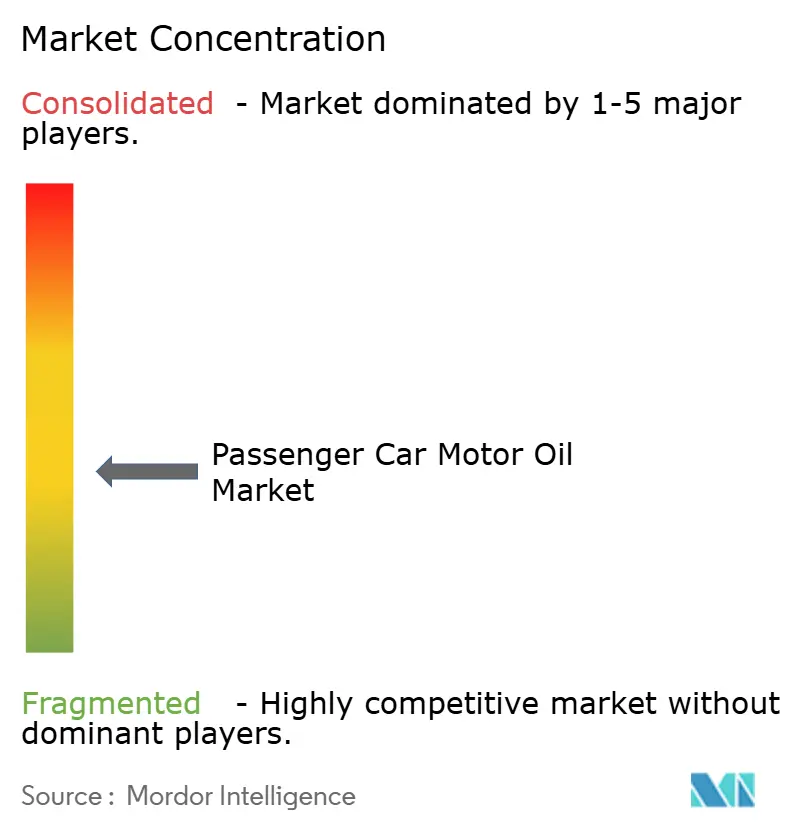
| Market Concentration | Medium |
Major Players *Disclaimer: Major Players sorted in no particular order Image © Mordor Intelligence. Reuse requires attribution under CC BY 4.0. | |
Passenger Car Motor Oil Market Analysis by Mordor Intelligence
The Passenger Car Motor Oil Market size is expected to increase from 8.91 billion liters in 2025 to 8.98 billion liters in 2026 and reach 9.35 billion liters by 2031, at a CAGR of 0.81% during the forecast period (2026-2031). Market volume growth remains below 1% annually as buyers shift from mineral-based products to synthetic and semi-synthetic oils. This shift changes the product mix but does not significantly increase overall lubricant volume demand. The International Lubricant Standardization and Approval Committee (ILSAC) GF-7 and American Petroleum Institute (API) SQ licensing standards took effect on March 31, 2025. These standards set requirements for fuel economy, low-speed pre-ignition protection, and timing-chain wear. Product upgrades are relevant for original equipment manufacturers (OEMs), formulators, workshops, and vehicle owners. The Passenger Car Motor Oil Market depends on formulation quality, OEM approvals, channel access, and volume growth.
Key Report Takeaways
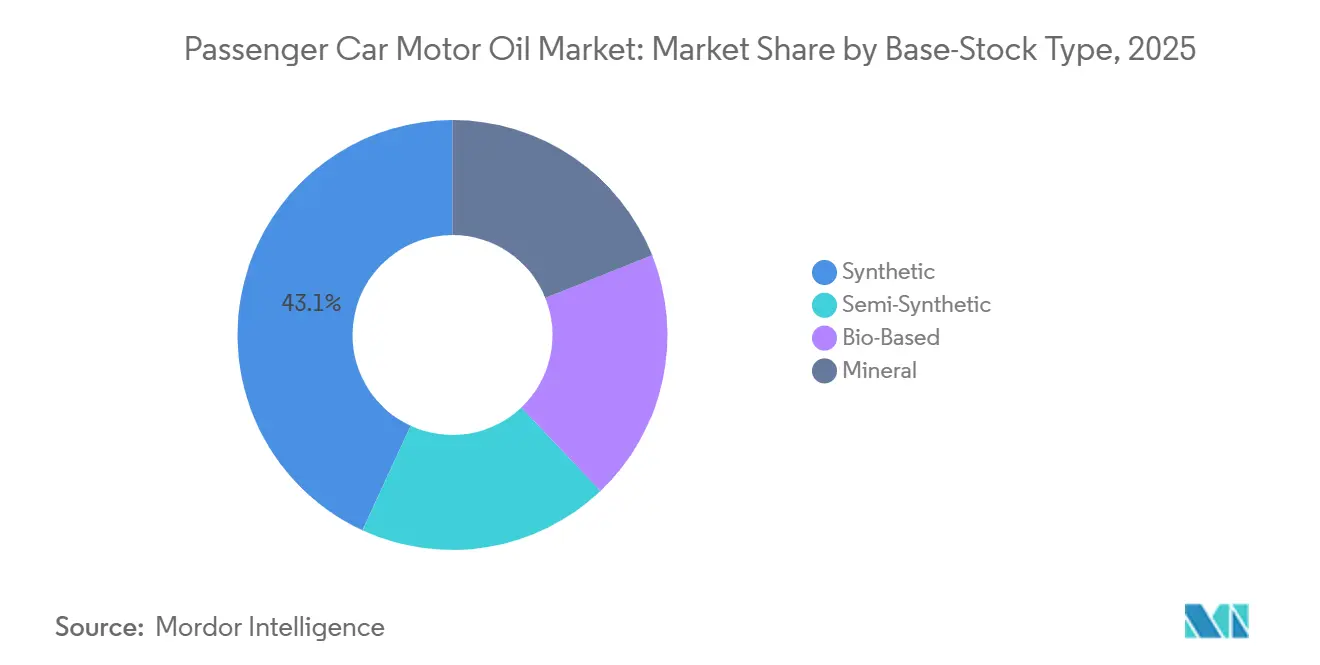
- By base-stock type, synthetic oils accounted for a 43.13% volume share in 2025, while semi-synthetic oils are forecast to grow at a CAGR of 1.32% through 2031.
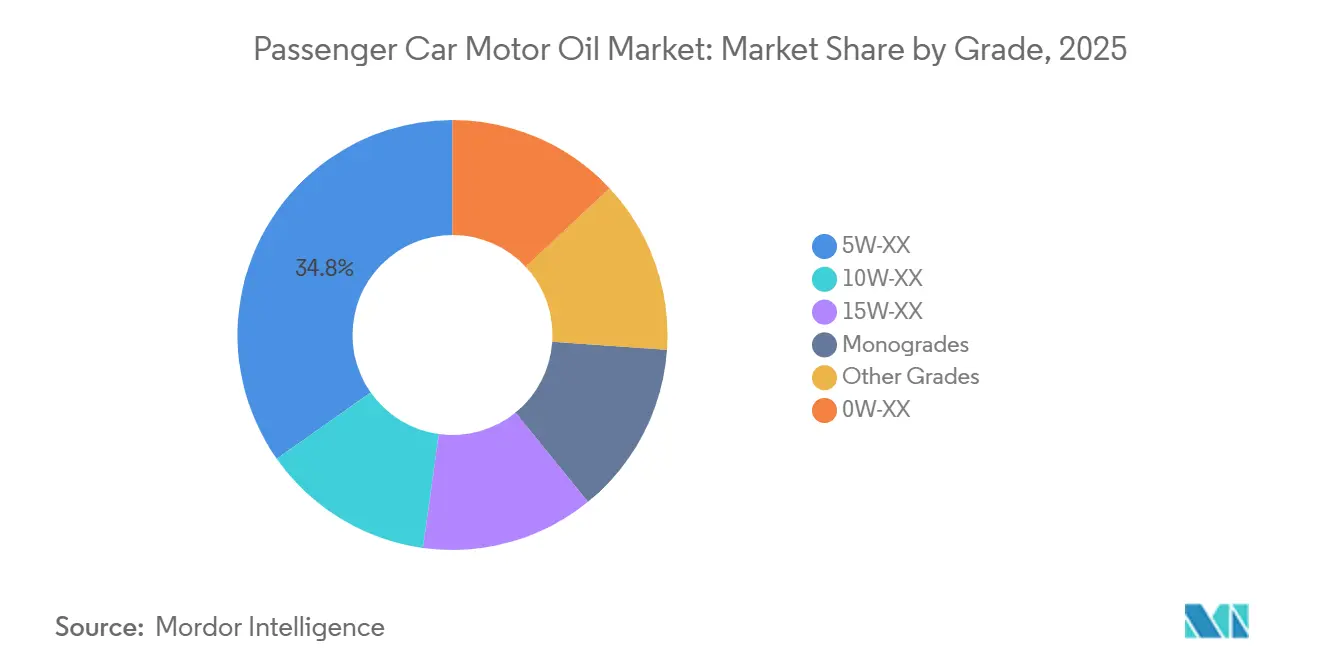
- By grade, the 5W-XX family accounted for a 34.76% volume share in 2025, while the 0W-XX family is forecast to grow at a CAGR of 1.45% through 2031.
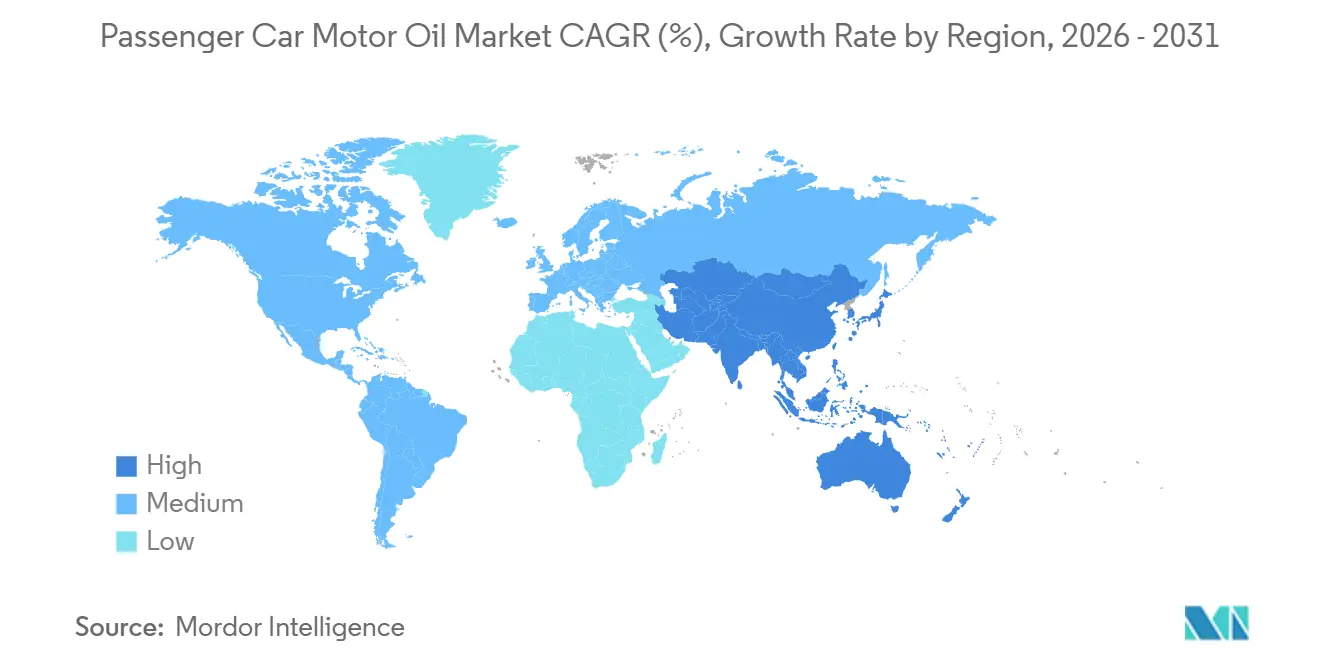
- By geography, Asia-Pacific accounted for 45.65% of volume in 2025 and is forecast to grow at a 1.27% CAGR through 2031.
Note: Market size and forecast figures in this report are generated using Mordor Intelligence’s proprietary estimation framework, updated with the latest available data and insights as of January 2026.
Global Passenger Car Motor Oil Market Trends and Insights
Drivers Impact Analysis*
| Drivers | (~) % Impact on CAGR Forecast | Geographic Relevance | Impact Timeline |
|---|---|---|---|
| Expansion of the Passenger Vehicle Parc in Emerging Economies | +1.8% | APAC core, spillover to MEA and South America | Long term (≥ 4 years) |
| Premium Synthetic and Low-Viscosity Oil Adoption | +1.6% | Global, led by North America and Europe, is spilling into APAC | Medium term (2-4 years) |
| Growth of Organized Aftermarket and Quick-Lube Networks | +0.9% | North America and APAC urban centers | Short term (≤ 2 years) |
| Increasing Hybrid Vehicle Lubricant Requirements | +0.8% | East Asia and Western Europe | Medium term (2-4 years) |
| Vehicle Identification Number (VIN)-Linked Digital Fitment and Misfill Reduction | +0.4% | Global | Short term (≤ 2 years) |
| Source: Mordor Intelligence | |||
Expansion of the Passenger Vehicle Parc in Emerging Economies
Rapid motorization in South and Southeast Asia is adding vehicles that will require regular oil changes for many years. India recorded passenger vehicle sales of 4.64 million units in FY2025-26, an increase of 7.9% from the previous year. Utility vehicles represented 68% of India's passenger vehicle sales, while SUVs grew 20.1% during Q4 FY2026. Newer Indian vehicles are moving toward multigrade synthetic products under Bharat Stage VI (BS-VI) requirements, which raises lifetime value per liter. China's passenger car stock exceeded 246 million vehicles, and the rollout of China VI-b supported demand for low-SAPS (Sulfated Ash, Phosphorus, and Sulfur) 0W-20 and 5W-30 products. Passenger vehicle growth and tighter specifications are creating demand for both more lubricant users and higher-grade formulations in the Passenger Car Motor Oil Market.
Premium Synthetic and Low-Viscosity Oil Adoption
The transition from 5W-XX products to 0W-XX grades is changing the value mix in the Passenger Car Motor Oil Market. The International Lubricant Standardization and Approval Committee (ILSAC) GF-7 was licensed on March 31, 2025, identifying 0W-20, 0W-16, and 5W-20 as key grades for current performance requirements[1]American Petroleum Institute, “API’s Motor Oil Guide,” API, api.org.. These grades support fuel economy, protection against Low Speed Pre-Ignition (LSPI), and timing-chain wear in modern engines. Volkswagen moved its TSI engine family to 0W-20 service fills in 2025, increasing workshop demand for oils that meet European Automobile Manufacturers' Association (ACEA) C5 or C6 specifications. Such products carry a 20-30% price premium over 5W-30 and 10W-40 products. Manufacturers are directing investment toward Group III, Group IV, and Group V base stocks required for low-viscosity formulations.
Growth of Organized Aftermarket and Quick-Lube Networks
Quick-lube chains are gaining business from independent repair shops through faster service and more frequent customer transactions. Valvoline's systemwide store count reached 2,456 locations by Q3 2026, reflecting 15.6% year-over-year growth. The company's quarterly systemwide sales exceeded USD 1 billion, while same-store sales grew 8% in that period. The United States light-duty aftermarket is projected to grow 5.2% in 2026 and exceed USD 500 billion by 2029. Organized service outlets can promote premium synthetic options at each oil-change visit, and their growth provides the Passenger Car Motor Oil Market with additional avenues to increase the average transaction value.
Increasing Hybrid Vehicle Lubricant Requirements
Hybrid engines face frequent cold starts, low-temperature operation, and a risk of fuel dilution. These conditions require anti-emulsification additives, copper corrosion protection, and ultra-low-viscosity products for high-temperature, high-shear (HTHS) service. Some hybrid applications use grades as low as 0W-8 or 0W-12. The American Petroleum Institute (API) indicated in 2025 that a voluntary hybrid-specific engine oil specification was planned, while GF-8 is targeted for first licensing in 2027. Hybrid-specific stock-keeping units (SKUs) are priced 15-30% above standard synthetics and face narrower approved product lists. Early original equipment manufacturer (OEM) qualifications can help lubricant suppliers establish stronger positions in this segment of the Passenger Car Motor Oil Market.
Restraints Impact Analysis*
| Restraints | (~) % Impact on CAGR Forecast | Geographic Relevance | Impact Timeline |
|---|---|---|---|
| Battery Electric Vehicle Penetration Displacing Internal Combustion Engine (ICE) Engine Oil Consumption | -1.2% | Europe, China, and North America | Long term (≥ 4 years) |
| Extended Manufacturer-Recommended Drain Intervals | -0.9% | North America and Europe | Medium term (2-4 years) |
| Counterfeit Lubricants and Product-Authentication Costs | -0.5% | Global, with APAC and MEA most exposed | Short term (≤ 2 years) |
| Source: Mordor Intelligence | |||
Battery Electric Vehicle Penetration
Battery electric vehicles (BEVs) reduce the need for engine oil, though this effect emerges gradually as the installed vehicle base changes. Global electric car sales exceeded 20 million units in 2025, representing 25% of new car sales worldwide. These sales displaced an estimated 1.2 million barrels of oil per day. China accounted for nearly 55% of new electric car sales, while Europe accounted for 28%. Hybrid and plug-in hybrid vehicles still require lubricants, which moderates the near-term decline in demand.
Extended Manufacturer-Recommended Drain Intervals
Modern synthetic products can support drain intervals of 15,000-30,000 km under European OEM programs. Longer drain intervals reduce annual lubricant use per vehicle, even when the oil used at each change carries a higher value. A vehicle operating on a 25,000 km interval requires far fewer oil changes than one on a 10,000 km interval. Low-viscosity 0W-20 and 0W-16 grades are typically associated with the longest service intervals. Oil-condition monitoring systems can extend intervals further by eliminating unnecessary changes in fleet applications. The passenger car motor oil market must offset lower change frequency through vehicle-parc expansion and a shift toward more premium products.
*Our forecasts treat driver/restraint impacts as directional, not additive. The impact forecasts reflect baseline growth, mix effects, and variable interactions.
Segment Analysis
By Base-Stock Type: Semi-Synthetic Bridges the Specification Gap
Synthetic oils held 43.13% of the Passenger Car Motor Oil Market share in 2025. The International Lubricant Standardization and Approval Committee (ILSAC) GF-7 and the Association des Constructeurs Européens d'Automobiles (ACEA) C5/C6 requirements have strengthened their role in new-vehicle factory fill and approved aftermarket applications. Synthetic formulations serve turbocharged, gasoline direct injection, and hybrid powertrains with demanding performance requirements. Their established position gives suppliers with technical approvals an advantage. Semi-synthetic oils are forecast to grow at a 1.32% CAGR through 2031, offering service centers a practical path to upgrade customers from mineral oils without requiring the full-synthetic price point.
Mineral oils remain relevant in developing-market aftermarket channels with older vehicle fleets. These vehicles often have less demanding specifications, and workshops continue to prioritize lower initial product costs. Bio-based oils remain a smaller emerging category in the Passenger Car Motor Oil Market. TotalEnergies launched an engine oil made from 100% regenerated base oils that received manufacturer approval and was co-branded with Stellantis in 2024. Group III supply constraints in 2026 added cost pressure to blends used in semi-synthetic and many full-synthetic products. The resulting cost difference from Group I mineral oils increases formulation differentiation and reinforces the need for additive chemistry and OEM approvals.



By Grade: 0W-XX Displaces Legacy Viscosities at an Accelerating Rate
The 5W-XX family held 34.76% of the Passenger Car Motor Oil Market share in 2025. Its installed base includes budget sedans, turbocharged crossovers, and many vehicles that permit 5W-30 or 5W-40. The 0W-XX family is forecast to grow at a 1.45% CAGR through 2031. ILSAC GF-7 identifies 0W-20 as a reference grade and recognizes 0W-16 for ultra-low-viscosity applications[2]Petro-Canada Lubricants, “Expert Q&A, An Introduction to ILSAC GF-7,” Petro-Canada Lubricants, petrocanadalubricants.com.. More than 70% of model-year 2025 U.S. vehicle specifications called for 0W-20 or thinner oils, and selected hybrid models use 0W-16 to support fleet-average CO2 targets.
The 10W-XX category is concentrated in older vehicles in North America and Western Europe, though it still has meaningful demand in Southeast Asia, South America, and Africa, where vehicle fleets are older. Monogrades are also declining in passenger-car use, although they remain present in some Middle Eastern and African fleet applications. The rise of 0W-XX products requires Polyalphaolefin (PAO) or high-viscosity-index Group III feedstocks, which cost more than Group I or Group II feedstocks. ExxonMobil's Baytown project targets 8,000 barrels per day of Group III capacity by 2028. Base-stock investment directed at future low-viscosity requirements supports the Passenger Car Motor Oil Market size for 0W-XX products.
Geography Analysis
Asia-Pacific held 45.65% of the Passenger Car Motor Oil market share in 2025 and is forecast to grow at a 1.27% CAGR through 2031. China's VI-b standards require low-SAPS, low-viscosity synthetic formulations across a passenger car base exceeding 246 million vehicles. India recorded 396,269 passenger vehicle registrations in August 2026, a 16% year-over-year increase. CRISIL expects India's annual passenger vehicle sales to reach 5.9 million in FY2027. Indonesia, Thailand, and Vietnam have large vehicle fleets that still use semi-synthetic and mineral grades. Regional emissions alignment and India's BIS requirements are raising product specifications and average quality.
North America has a high penetration of synthetic lubricants by volume. The region is experiencing lower lubricant sales volumes as electric vehicle adoption and longer drain intervals reduce demand for oil changes. ILSAC GF-7 products continue to account for aftermarket demand, as newer engines require approved low-viscosity oils. Mexico remains an important market for factory-fill volumes of Dexos1- and Motorcraft-approved products. Chinese suppliers are also targeting Mexico as Chinese automakers expand across Latin America.
Europe supports lubricant demand despite lower output volumes. Volkswagen transitioned its TSI engine family to 0W-20 factory-fill lubricants in 2025. In February 2026, Castrol launched EDGE Euro 0W-20 M, with approvals from BMW, Mercedes-Benz, Porsche, and Volkswagen/Audi. Brazil benefits from fleet expansion and increased participation in the formal aftermarket, while Argentina's economic conditions constrain discretionary maintenance spending. In the Middle East and Africa, counterfeit products remain an ongoing concern. Saudi Arabia's fleet modernization programs are expected to support demand for synthetic-grade products as newer vehicles enter service.

Competitive Landscape
The passenger car motor oil market is moderately fragmented. ExxonMobil, Shell, BP, Castrol, TotalEnergies, Chevron, and Sinopec Lubricant hold leading positions by global value. OEM co-approvals, quick-lube networks, and proprietary additive chemistry are the primary competitive tools. OEM contracts can place a lubricant brand in service manuals and factory-fill programs, supporting recurring demand after the original vehicle sale. Regional specialists compete most actively in emerging markets, where local distribution and price remain important factors.
In May 2026, TotalEnergies and Stellantis renewed and expanded their lubricants partnership. The companies are co-developing high-performance engine oils for Stellantis's European fleet, including oils made from 100% regenerated base oils. This development reflects the importance of OEM relationships and circularity credentials in European supply chains. In January 2026, PETRONAS Lubricants International introduced JASO GLV-2-certified 0W-16 and 0W-20 products for the Japanese market. Its early certification position demonstrates how technical approvals can support competitiveness in OEM-sensitive product categories.
Hybrid-specific products, regenerated base oils, and digital service tools are active areas of product development. In June 2026, LIQUI MOLY introduced non-copyable QR code authentication for motor oils in 150 countries. The system is designed to verify products within complex distribution networks. VIN-linked fitment and authentication tools can reduce misfills and strengthen customer confidence at the point of purchase. Brands focused primarily on mineral oils face increasing pressure as specifications shift toward synthetics. Suppliers without the capability for OEM approval may find it harder to compete as GF-7 and subsequent standards narrow product choices.
Passenger Car Motor Oil Industry Leaders
Shell plc
Exxon Mobil Corporation
BP p.l.c.
TotalEnergies
Chevron Corporation
- *Disclaimer: Major Players sorted in no particular order

Recent Industry Developments
- July 2026: Shell launched the new Shell Helix Ultra in Thailand, marking the first ASEAN market for the upgraded formula. The product meets API SQ, ACEA C6, and ILSAC GF-7 standards and uses 100% recycled plastic packaging.
- May 2026: TotalEnergies and Stellantis renewed and expanded their partnership to develop high-performance engine oils for Stellantis's European fleet. The agreement includes the co-development of products made with 100% regenerated base oils, building on more than 50 years of collaboration.


Global Passenger Car Motor Oil Market Report Scope
Passenger car motor oil (PCMO) is a specialized lubricant designed for gasoline and light-duty diesel engines used in passenger cars, SUVs, vans, and light trucks. It reduces friction between moving engine parts, dissipates heat, prevents corrosion, and removes contaminants to maintain engine performance and longevity. PCMO is available in conventional, synthetic, and semi-synthetic formulations, each catering to different engine requirements and operating conditions.
The passenger car motor oil market is segmented by base-stock type, grade, and geography. By base-stock type, the market is segmented into mineral, synthetic, semi-synthetic, and bio-based. By grade, the market is segmented into 0w-xx, 5w-xx, 10w-xx, 15w-xx, monogrades, and other grades. The report also covers market size and forecasts for passenger car motor oil across 15 countries in major regions. The market sizes and forecasts are provided in terms of volume (Liters).
| Mineral |
| Synthetic |
| Semi-Synthetic |
| Bio-Based |
| 0W-XX |
| 5W-XX |
| 10W-XX |
| 15W-XX |
| Monogrades |
| Other Grades |
| Asia-Pacific | China |
| India | |
| Japan | |
| South Korea | |
| ASEAN Countries | |
| Rest of Asia-Pacific | |
| North America | United States |
| Canada | |
| Mexico | |
| Europe | Germany |
| United Kingdom | |
| France | |
| Italy | |
| NORDIC Countries | |
| Rest of Europe | |
| South America | Brazil |
| Argentina | |
| Rest of South America | |
| Middle East and Africa | Saudi Arabia |
| South Africa | |
| Rest of Middle East and Africa |
| By Base-Stock Type | Mineral | |
| Synthetic | ||
| Semi-Synthetic | ||
| Bio-Based | ||
| By Grade | 0W-XX | |
| 5W-XX | ||
| 10W-XX | ||
| 15W-XX | ||
| Monogrades | ||
| Other Grades | ||
| By Geography | Asia-Pacific | China |
| India | ||
| Japan | ||
| South Korea | ||
| ASEAN Countries | ||
| Rest of Asia-Pacific | ||
| North America | United States | |
| Canada | ||
| Mexico | ||
| Europe | Germany | |
| United Kingdom | ||
| France | ||
| Italy | ||
| NORDIC Countries | ||
| Rest of Europe | ||
| South America | Brazil | |
| Argentina | ||
| Rest of South America | ||
| Middle East and Africa | Saudi Arabia | |
| South Africa | ||
| Rest of Middle East and Africa | ||


Key Questions Answered in the Report
What is current market size of Passenger Car Motor Oil Market?
The Passenger Car Motor Oil Market size is expected to increase from 8.91 billion liters in 2025 to 8.98 billion liters in 2026 and reach 9.35 billion liters by 2031, at a CAGR of 0.81% during the forecast period (2026-2031).
Which oil grade is growing fastest for passenger cars?
The 0W-XX family is projected to grow at a 1.45% CAGR through 2031 as low-viscosity specifications expand.
Why are synthetic motor oils becoming more important?
Newer engine specifications support fuel economy and protection need that favor synthetic and semi-synthetic formulations.
Which region leads passenger car motor oil demand?
Asia-Pacific accounted for a 45.65% volume share in 2025 and is projected to grow at a CAGR of 1.27% through 2031.
Page last updated on:





