
Partner and Merchant Digital Onboarding Platform Market Size and Share
Market Overview
| Study Period | 2021 - 2032 |
|---|---|
| Market Size (2027) | USD 1.82 Billion |
| Market Size (2032) | USD 4.08 Billion |
| Growth Rate (2027 - 2032) | 17.52 % |
| Fastest Growing Market | Asia-Pacific |
| Largest Market | North America |
| Market Concentration | Medium |
Major Players *Disclaimer: Major Players sorted in no particular order Image © Mordor Intelligence. Reuse requires attribution under CC BY 4.0. | |
Partner and Merchant Digital Onboarding Platform Market Analysis by Mordor Intelligence
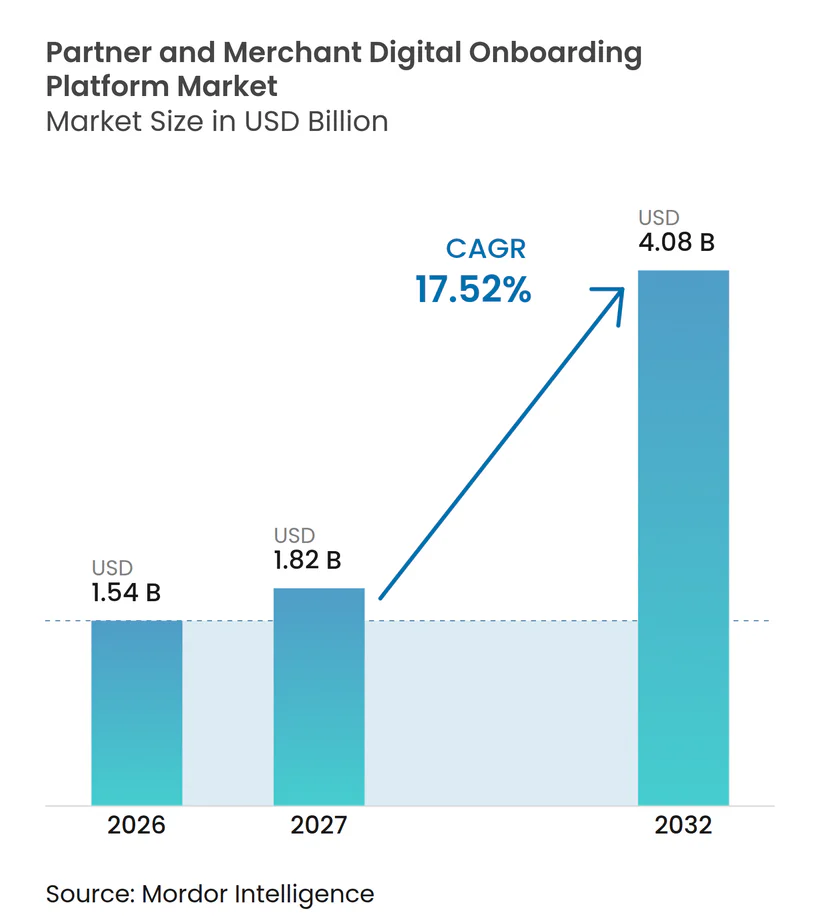
The Partner and merchant digital onboarding platform market size is projected to expand from USD 1.54 billion in 2026 and USD 1.82 billion in 2027 to USD 4.08 billion by 2032, registering a CAGR of 17.52% between 2027 to 2032. Embedded payments are moving onboarding responsibilities from acquiring banks to software platforms that accept payments for merchants and require repeatable ways to activate sub-merchants. Automated identity checks, business verification, underwriting, and anti-money-laundering screening are becoming central to merchant activation workflows and ongoing merchant records. Payment facilitators and acquirers are seeking lower operating costs without accepting more fraud exposure. Providers that combine onboarding with continuous business monitoring can address a broader part of the merchant lifecycle. Fragmented registries and local data rules favor platforms that can adapt their workflows to each jurisdiction and reliably connect to local records and payment systems.
Key Report Takeaways
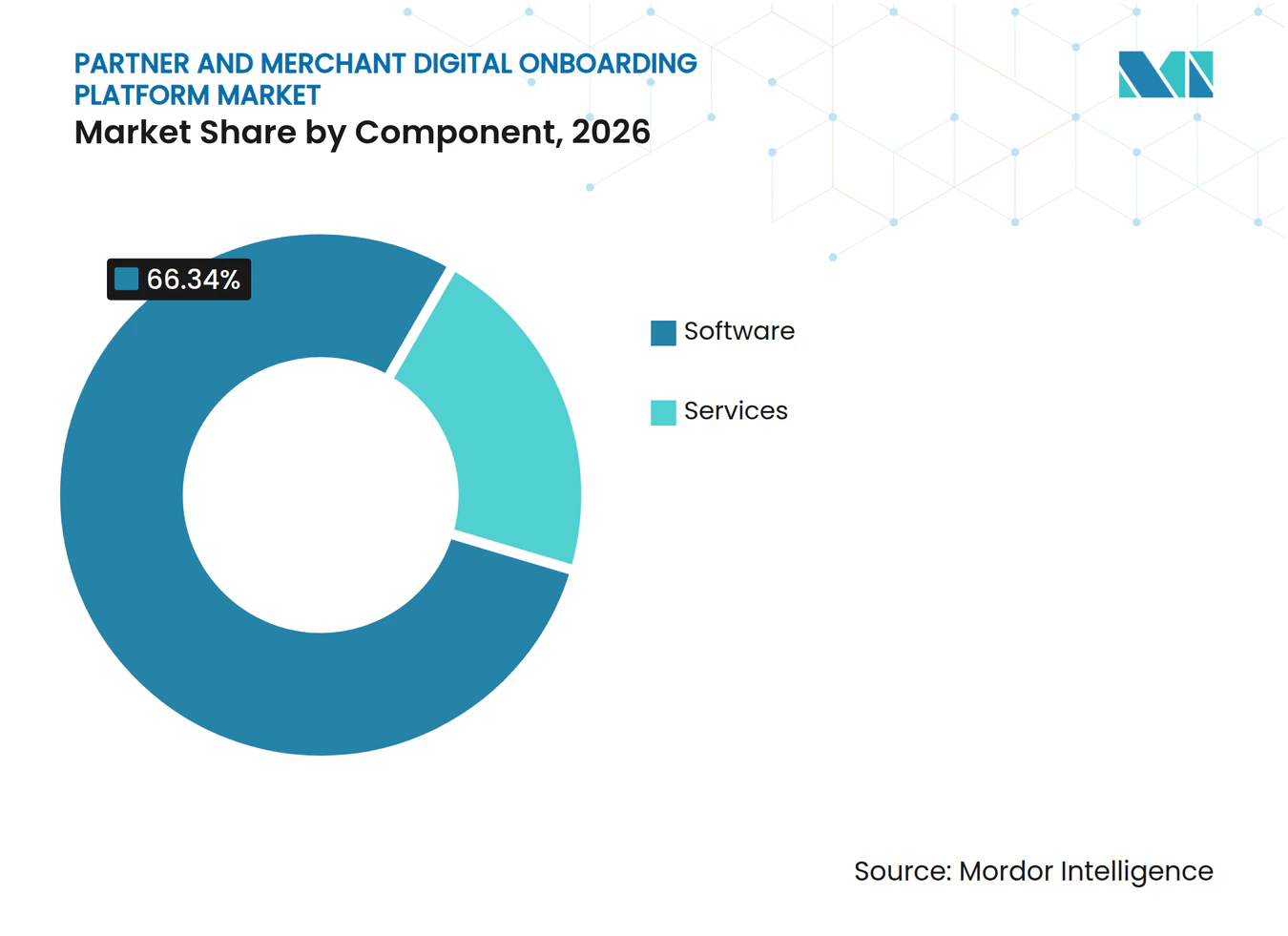
- By component, software held 66.34% of the global market in 2026, while services are projected to expand at a 17.92% CAGR through 2032.
- By deployment mode, cloud-based deployment held 71.19% share in 2026, while hybrid deployment is projected to expand at an 18.09% CAGR through 2032.
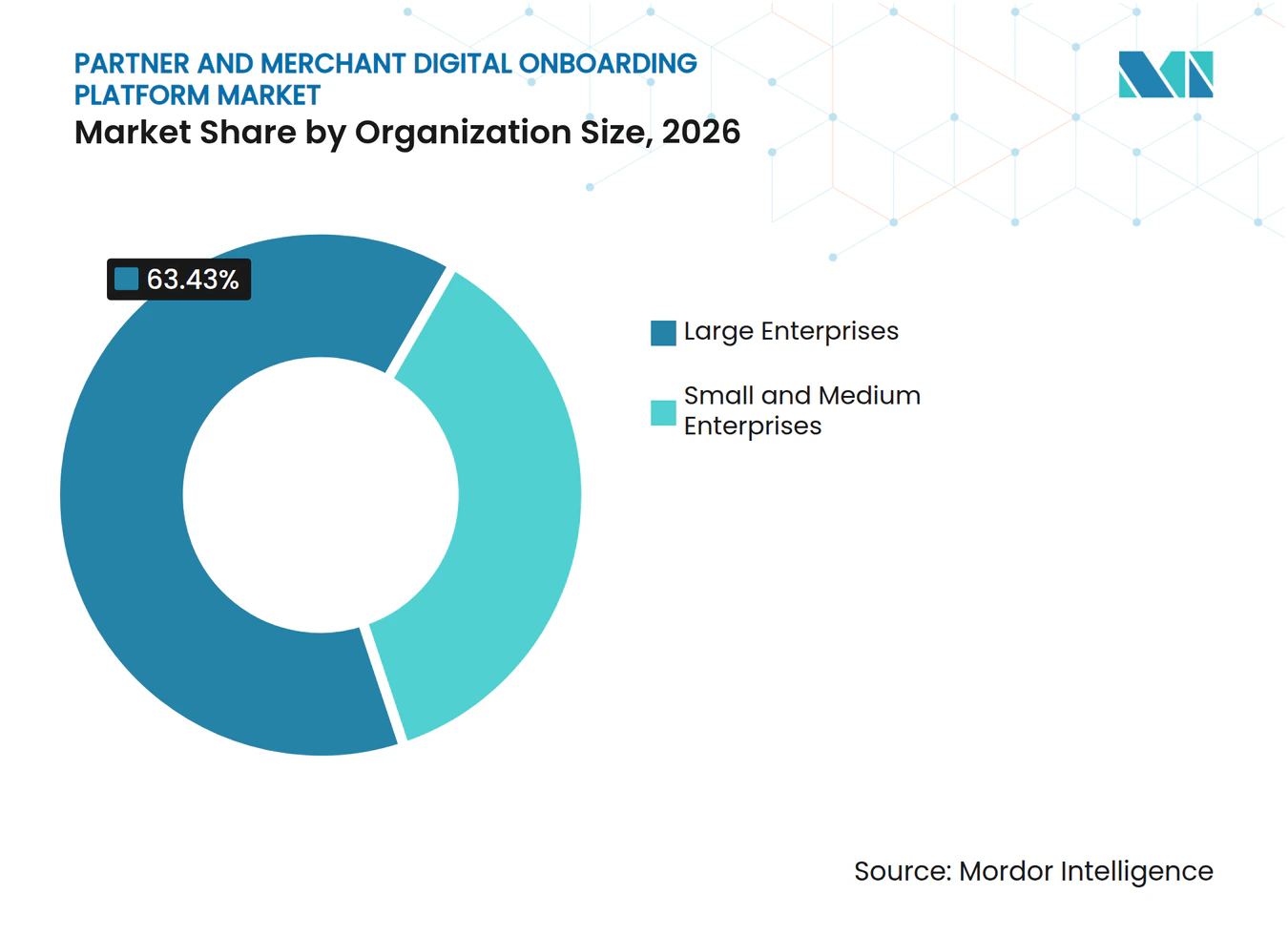
- By organization size, large enterprises held 63.43% share in 2026, while SMEs are projected to expand at a 17.88% CAGR through 2032.
- By end user, BFSI held 34.95% share in 2026, while ISVs are projected to expand at an 18.48% CAGR through 2032.
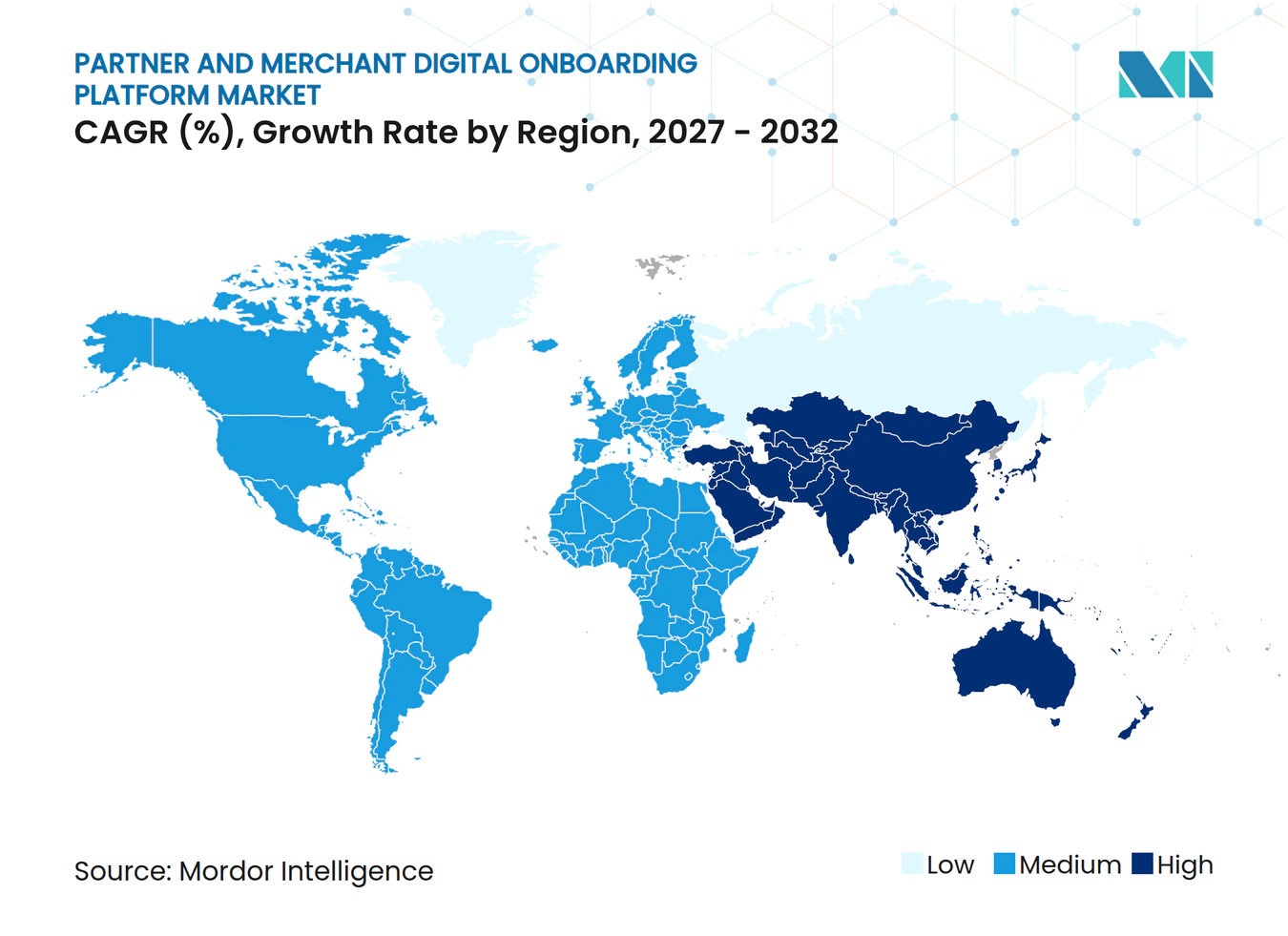
- By geography, North America held 41.11% share in 2026, while the Asia-Pacific is projected to expand at an 18.51% CAGR through 2032.
Note: Market numbers in this report are based on Mordor Intelligence's proprietary estimation framework, which combines nine months of actuals with Q4 projections for base year 2026.
Market Trends and Insights
Drivers Impact Analysis of Partner and Merchant Digital Onboarding Platform Market*
| Driver | (~) % Impact on CAGR Forecast | Geographic Relevance | Impact Timeline |
|---|---|---|---|
| Embedded Payments Adoption by Software Platforms | +4.2% | Global | Short term (≤ 2 years) |
| Stricter KYC, KYB, AML, and Beneficial Ownership Requirements | +3.8% | Global | Medium term (2-4 years) |
| Demand for Instant Merchant Activation and Lower Underwriting Cost | +3.1% | North America and Europe | Short term (≤ 2 years) |
| Acceleration of SME Digital Commerce and Omnichannel Acceptance | +2.6% | Asia-Pacific core, spillover to Middle East and Africa | Medium term (2-4 years) |
| Cross-Border Marketplace Expansion and Embedded Finance Adoption | +2.0% | Global | Long term (≥ 4 years) |
| Post-Onboarding Risk Monitoring and Continuous Business Verification | +1.4% | North America and Europe | Medium term (2-4 years) |
| Source: Mordor Intelligence | |||
Embedded Payments Adoption by Software Platforms
Embedded payments are changing the demand base for the Partner and merchant digital onboarding platform market. When an ISV adds payment acceptance to a software product, it assumes responsibility for merchant verification, underwriting, and anti-money-laundering. Mastercard and Cardstream state that a traditional payment facilitator build can cost USD 2.45 million to USD 2.9 million and take 12 to 24 months, which makes pre-integrated services important for many software platforms. The same paper reports that payments and financial technology can account for more than 50% of revenue for mature software companies using this model.[1] Onboarding, therefore, affects both payment revenue and compliance processes. The Partner and merchant digital onboarding platform market benefits when these platforms need a repeatable way to activate sub-merchants across products and regions. In the Partner and merchant digital onboarding platform market, the commercial value comes from helping software companies make payment acceptance a repeatable service while maintaining the checks required for each merchant relationship. The operating need is not limited to the first account decision. The platform must collect business information, determine ownership, evaluate risk, record the rationale for its decision, and pass approved merchants into payment processing without creating unnecessary delays for the software provider or its customers.
Stricter KYC, KYB, AML, and Beneficial Ownership Requirements
Regulatory requirements are making automated checks more important across the Partner and merchant digital onboarding platform market. The Reserve Bank of India issued its Payment Aggregator Directions in 2025, which require enhanced due diligence and contact-point verification for higher-risk merchant categories. These obligations place checks at the beginning of the merchant relationship rather than after documents have been collected. They also increase the value of records that show why a merchant was approved or referred for review. Ongoing review has become more relevant because fraud and ownership information can change after initial onboarding. Platforms that combine initial verification with continuing business checks are better aligned with this operating model. The Partner and merchant digital onboarding platform market is consequently moving toward systems that treat onboarding records as active files requiring controlled updates, rather than as one-time document collections stored after approval. They can maintain a record of the original onboarding decision and flag material changes in a merchant's ownership, activities, or risk profile. This gives compliance teams a clearer path to review exceptions without having to rebuild merchant files from separate systems.
Demand for Instant Merchant Activation and Lower Underwriting Cost
Fast activation is a direct commercial requirement for payment providers and the Partner and merchant digital onboarding platform market. A long onboarding process delays a merchant's ability to accept payments and delays the acquirer's revenue processing. Manual reviews may remain necessary for complex businesses, but they are expensive when applied across the entire merchant population. Automated workflows can route routine applications through consistent checks and reserve specialist time for cases with meaningful risk signals. This model requires connections to identity, business, sanctions, and fraud data sources. It also makes workflow design and the quality of exception handling important buying criteria for banks and payment facilitators. The Partner and merchant digital onboarding platform market depends on this operational discipline because the approval process must be fast for routine merchants yet robust enough to identify cases that require deeper scrutiny. A useful workflow must distinguish low-risk applications from cases that need further evidence. It must also present reviewers with a clear file, rather than a list of disconnected data results that takes time to interpret.
Acceleration of SME Digital Commerce and Omnichannel Acceptance
SMEs are increasing the number of businesses that need formal onboarding within the Partner and merchant digital onboarding platform market. Mastercard and Cardstream report that 62% of U.S. small businesses use or are moving toward an ISV, while SME acquiring revenue is projected to account for 57% of U.S. SMB acquiring volume by 2028, up from 42% in 2023. A merchant may accept payments through a store, a website, a QR code, and a marketplace simultaneously. Each channel can create different verification and risk requirements. Socure and Markaaz said their October 2025 partnership can automate 80% or more of verification decisions for thin-file SMBs through a combined KYB and ultimate beneficial owner workflow. Better coverage for thin-file businesses can reduce manual work and widen the merchant base that providers can serve. The Partner and merchant digital onboarding platform market can benefit when providers make these checks available through integrations that do not require smaller software companies to build their own merchant-risk programs from the ground up. This is important where merchants have recently started trading or have limited formal financial records. The same challenge becomes more difficult when businesses operate across both online and physical channels and maintain several payment relationships.
Restraints Impact Analysis of Partner and Merchant Digital Onboarding Platform Market*
| Restraint | (~) % Impact on CAGR Forecast | Geographic Relevance | Impact Timeline |
|---|---|---|---|
| Fragmented Data Availability and Uneven Registry Coverage | -1.8% | Asia-Pacific core and Middle East and Africa | Long term (≥ 4 years) |
| Data Privacy, Localization, and Consent Constraints | -1.4% | China, India, and Brazil | Long term (≥ 4 years) |
| Integration Complexity Across Legacy Acquirers and Payment APIs | -0.9% | Global | Medium term (2-4 years) |
| Fraud, Chargeback, and Liability Exposure From Faster Approvals | -0.6% | North America and Europe | Short term (≤ 2 years) |
| Source: Mordor Intelligence | |||
Fragmented Data Availability and Uneven Registry Coverage
Uneven registry coverage limits automation in the Partner and merchant digital onboarding platform market. In Nigeria, Indonesia, and Vietnam, business records can be incomplete, unavailable digitally, or available only through local-language interfaces. Providers must build local data connections or accept a higher level of manual review. Missing ownership information can make it harder to identify entities that require closer sanctions or risk review. Socure and Markaaz positioned their 2025 partnership around additional firmographic, compliance, and business health information for thin-file SMBs. The need for local data enrichment slows expansion into markets where the merchant opportunity is growing quickly. A global workflow cannot provide reliable results if the underlying records differ sharply in availability and quality. Providers must test local data sources, ownership structures, naming conventions, and document practices before they can apply automation at scale.
Data Privacy, Localization, and Consent Constraints
Data residency rules create a product design challenge for the Partner and merchant digital onboarding platform market. China, India, Brazil, and Russia have requirements that shape where resident data can be stored or processed. PCI DSS v4.0.1 became fully effective on March 31, 2025, and sets payment security requirements that providers must manage alongside local data rules.[2] Vendors may need separate infrastructure and controls across regulated jurisdictions. This can increase development work and extend delivery timelines for cross-border customers. Smaller providers can face a particular disadvantage because they have fewer resources for jurisdiction-specific deployments. The issue affects product planning and costs because a feature that works in one country may require separate storage, consent, access control, and reporting arrangements in other countries. This makes modular system design increasingly valuable for cross-border customers.
*Our forecasts treat driver/restraint impacts as directional, not additive. The impact forecasts reflect baseline growth, mix effects, and variable interactions.
Partner and Merchant Digital Onboarding Platform Market Segment Analysis
By Component:
Software Retains Leadership While Services Gain ImportanceSoftware accounted for 66.34% of the Partner and merchant digital onboarding platform market share in 2026. The position reflects the scalable nature of business verification engines, workflow logic, and risk-scoring tools. Providers can configure these systems for different merchant categories without adding staff at the same rate as customer volumes. Orchestration platforms are particularly important because they integrate external records, decision rules, and payment processor interfaces into a single workflow. This structure supports repeated onboarding for payment facilitators, marketplaces, and acquiring banks. It also gives buyers a way to set consistent evidence requirements across merchants and regions. Fenergo introduced Fen-AI in July 2026 to automate selected client lifecycle management activities for financial institutions. The release illustrates the shift from rule-based workflow management to tools that support more complex compliance decisions. Software vendors are therefore competing on coverage, workflow control, audit records, and the ability to connect to specialist data providers.
Services are projected to expand at a 17.92% CAGR through 2032 within the Partner and merchant digital onboarding platform market size. This rate reflects demand for managed compliance support among regional processors and mid-market financial institutions. These buyers may not have internal teams capable of interpreting requirements across multiple jurisdictions simultaneously. Managed services can include policy management, monitoring, case review, and audit-trail preparation, as well as software access. The arrangement can reduce the effort required to operate a new onboarding program after implementation. It can also make a vendor relationship more durable because the provider supports ongoing work rather than only supplying a license. This model matters where customers need help translating regulatory requirements into merchant rules. It does not remove the need for software, since managed teams still depend on workflow tools and connected data sources. The component split therefore supports vendors that can combine configurable technology with operational expertise. Customers may begin with a software purchase but later require help with policy updates, review queues, quality checks, and audit preparation. Providers that can support both phases can remain relevant as an onboarding program moves from implementation into everyday operation.


By Deployment Mode:
Cloud Leads While Hybrid Supports Regulated Use CasesCloud-based systems commanded 71.19% of total revenue in 2026. Cloud deployment enables rapid scaling when a payment facilitator adds merchants, enters a new market, or manages seasonal volume fluctuations. It also fits API-based verification because multiple data sources can be called through the same workflow. Centralized cloud tools can simplify release management and make changes available to customers more quickly. These advantages have made cloud systems the baseline architecture for many newer platforms. The model remains useful when customers need to connect payment, identity, business, and fraud tools in near real time. However, the leading cloud share also exposes providers to rules on personal data processing and residency. PCI DSS v4.0.1 adds security obligations that must be considered with local data controls. Providers must therefore show how their cloud configurations meet both payment security and local compliance needs.
Hybrid deployment is projected to expand at an 18.09% CAGR through 2032, the fastest rate across deployment modes. This approach lets institutions keep sensitive merchant information in on-premises or country-specific environments. They can still use cloud connections for sanctions screening, registry searches, and fraud scoring. The model responds to data localization requirements without sacrificing the flexibility of API-based workflows. It can be more expensive to build and maintain than a fully cloud-based system. Large banks and financial institutions may nevertheless select it because internal risk teams need stronger control over personal information. On-premises systems continue to serve acquirers with deeply established core technology and batch-oriented processes. Their expansion is slower because modern API connections are gradually replacing file-based processes. The Partner and merchant digital onboarding platform market, therefore, has room for multiple deployment patterns rather than a single architecture. Buyers assess their data sensitivity, internal technology, regulatory footprint, and available implementation resources before selecting a model. This creates a continuing role for providers that can offer consistent workflows across cloud, hybrid, and established on-premises environments.
By Organization Size:
Large Enterprises Provide Scale While SMEs Expand AccessLarge enterprises held 63.43% of total revenue in 2026. Their spending reflects high merchant volumes, complex system integrations, and compliance programs spanning several jurisdictions. Tier-1 acquirers and global marketplaces need integrations with core banking systems, payment processors, fraud tools, and local data providers. They also need records that support reviews of high-risk merchants and regulatory examinations. These requirements often favor platforms that can support extensive configuration and dedicated implementation work. Fenergo was selected by Ninety One in September 2026 to unify client lifecycle management and financial crime operations across South Africa, the United Kingdom, and Luxembourg. The deployment combined KYC, customer due diligence, enhanced due diligence, and transaction monitoring into a single environment. Such programs show why enterprise customers often prefer broad platforms that can manage multiple controls together. Their established budgets and large merchant or client bases continue to support the segment's leading position.
SMEs are projected to expand at a 17.88% CAGR through 2032. Payment facilitator-as-a-service models reduce the initial requirements for software platforms and smaller acquirers that want to enable payments. Mastercard and Cardstream report that a traditional payment facilitator build can require USD 2.45 million to USD 2.9 million and 12 to 24 months, while pre-integrated models can shorten implementation to 4 to 8 months. Thin-file ultimate beneficial owner records have historically increased manual review for smaller businesses. Socure and Markaaz stated that their combined workflow can automate 80% or more of verification decisions for thin-file SMBs. More automation can lower per-merchant operating costs and improve the economics of serving this customer base. Smaller merchants still require careful treatment because records, ownership structures, and payment channels can vary widely. The opportunity depends on platforms being able to manage that variability without moving every case to manual review. For smaller businesses, a practical service must accommodate incomplete histories while keeping the evidence standard appropriate for the risk. That balance helps acquirers make more decisions quickly without overlooking ownership or business-activity concerns that require escalation.

By End User:
BFSI Holds the Largest Position While ISVs Lead ExpansionBFSI accounted for 34.95% of total revenue in 2026. Acquiring banks, payment aggregators, and licensed financial institutions face extensive obligations when accepting and monitoring merchants. They need systems that cover business verification, beneficial ownership checks, risk decisions, and ongoing review. Many also operate older core systems that were not designed for API-led onboarding. Replacing these systems can take time and budget, especially for mid-tier institutions. The result is demand for platforms that can connect modern verification services to existing payment and banking infrastructure. Financial institutions also need audit records that explain decisions to internal teams and supervisors. This makes compliance workflows, evidence retention, and exception management as important as speed. The segment remains a central revenue base for the Partner and merchant digital onboarding platform market because regulatory exposure is concentrated among these buyers. Institutions also need to apply policies consistently across diverse merchant portfolios, including established businesses, online sellers, and higher-risk categories. This requirement supports spending on systems that can adapt rules while preserving a complete audit trail.
ISVs are projected to expand at an 18.48% CAGR through 2032. A software company that embeds payment acceptance becomes responsible for more than user sign-up and must verify the businesses that receive payment services. This changes its role toward that of a payment facilitator and increases the need for underwriting and continuous anti-money-laundering controls. The payment function can also become a meaningful source of commercial revenue for the software platform. Mastercard and Cardstream report that 65% of ISVs and marketplaces that do not offer a payment acceptance plan plan to add it. E-commerce platforms and marketplaces add further demand because seller verification is required under the Digital Services Act. Telecommunications operators are another relevant group where mobile-money ecosystems are formalizing merchant acceptance programs. J.P. Morgan Payments supported Mercado Libre's Global Selling expansion by providing embedded KYC and KYB capabilities for U.S. sellers entering South American marketplaces. These use cases extend demand beyond financial institutions and make integration quality important for end users.
Geography Analysis
North America Partner and Merchant Digital Onboarding Platform Market
North America held 41.11% of the Partner and merchant digital onboarding platform market share in 2026. The region has a high concentration of payment facilitators, ISVs, acquiring banks, and marketplaces. The United States accounts for much of this demand because embedded payments and merchant acquiring are well developed. Mastercard and Cardstream report that 65% of ISVs and marketplaces plan to add a payment acceptance plan. FinCEN requirements and the Bank Secrecy Act also support demand for reliable customer and business checks. Canada provides a related opportunity because its compliance requirements are closely aligned with U.S. practice. Mexico adds demand from a fintech sector that is building merchant acceptance services. These factors make the region an important testing ground for continuous KYB, fraud controls, and automated underwriting. The large installed base of technology providers and payment companies also gives vendors several routes to market. Solutions introduced in the region can later be adapted for other markets, although local data and compliance requirements still shape that process.
Europe Partner and Merchant Digital Onboarding Platform Market
Europe is shaped by PSD2, the Digital Services Act, GDPR, and the developing Anti-Money Laundering Authority framework. Germany, the United Kingdom, and France support much of the region's demand, while Benelux and Nordic markets have high compliance maturity. The Digital Services Act requires marketplace operators to verify sellers' identities, thereby extending demand for onboarding beyond traditional financial institutions. The United Kingdom has a separate post-Brexit framework, and its 2026 guidance allows certified digital verification services to meet identity-check requirements in eligible cases. This setting encourages platforms to offer configurable workflows rather than one uniform regional process. Providers need to account for local identity practices, data protection expectations, and the types of merchants served by banks and marketplaces. A flexible design can help customers use a common platform while preserving the controls required in each country.
APAC, South America and MEA Partner and Merchant Digital Onboarding Platform Market
Asia-Pacific is projected to expand at an 18.51% CAGR through 2032, the fastest regional rate in the Partner and merchant digital onboarding platform market size. India, Southeast Asia, China, and the Gulf Cooperation Council are generating demand through digital commerce, payment acceptance, and expanding marketplace activity. India's Payment Aggregator Directions require contact-point verification for merchant onboarding and enhanced due diligence for higher-risk categories.[3] China's marketplace activity generates large volumes of sub-merchants, but data localization requirements limit the use of uniform cross-border architectures. South America is gaining relevance as marketplaces expand, as shown by J.P. Morgan Payments' support for Mercado Libre's U.S.-to-South America selling program. Saudi Arabia and the UAE are advancing the digitalization of financial services through their Vision 2030 programs. Africa has substantial mobile-first potential, although registry coverage in Nigeria, Egypt, and South Africa continues to constrain automated verification. Local partnerships can help providers connect with appropriate information sources and support merchants operating through mobile-led channels. Progress will depend on better record availability as well as payment companies' ability to create workflows suited to local documentation and ownership practices.
Competitive Landscape
Market Concentration
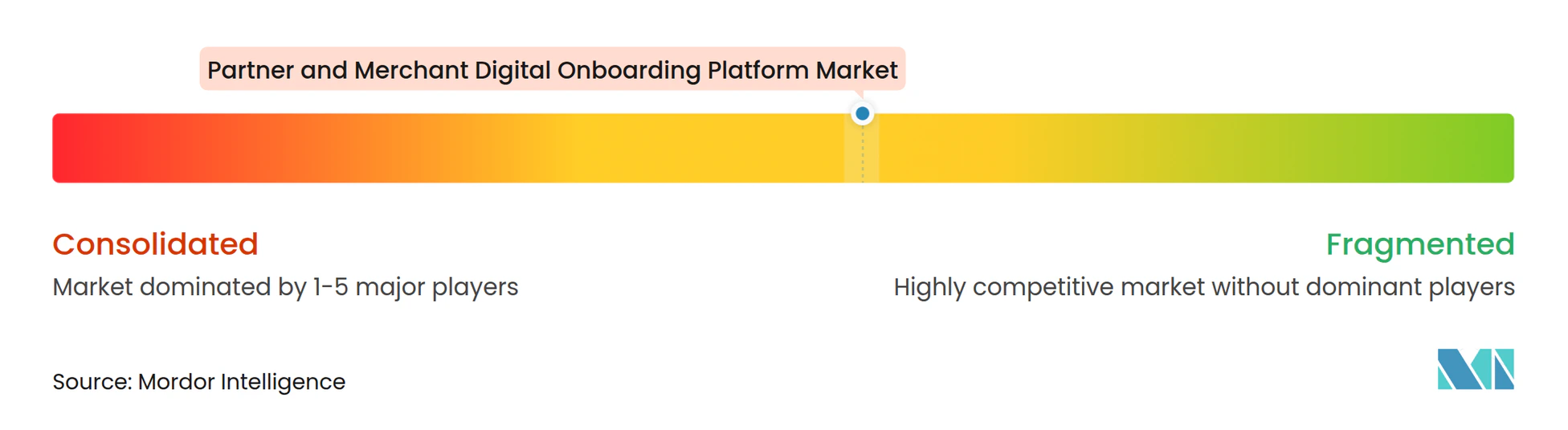
The Partner and merchant digital onboarding platform market is moderately fragmented. Competition includes orchestration platforms, merchant onboarding specialists, and identity or compliance providers. Alloy and Middesk operate at the orchestration layer, where data sources and decision rules are managed through one workflow. Finix Payments, Infinicept, and Agreement Express focus on merchant onboarding and payment-facilitator use cases. Trulioo, Socure, Fenergo, and ComplyAdvantage provide identity verification, business verification, or financial crime tools that can be used for payment and marketplace onboarding. No provider has dominant coverage across all of these functions. Commercial partnerships and application programming interface connections are therefore important routes to distribution. Vendors compete on verification coverage, workflow flexibility, integration speed, audit records, and ongoing monitoring. This structure allows customers to choose a specialist provider or combine several capabilities through an orchestration layer. The choice often depends on whether a buyer needs a broad implementation across many countries or a focused solution for a specific merchant portfolio. Integration quality is important because poor data flows can create duplicate reviews and slow the activation process.
Continuous merchant monitoring is a key area of competition in the Partner and merchant digital onboarding platform market. Ballerine launched its Trusted Agentic Commerce Governance Platform in January 2026 for payment service providers and payment facilitators that need ongoing merchant eligibility and policy monitoring. The company said the platform was certified under the Mastercard Merchant Monitoring Service Provider program. Fenergo launched Fen-AI in July 2026 to automate recurring compliance workflows for financial institutions. Socure and Markaaz partnered in October 2025 to combine KYB and ultimate beneficial owner verification for thin-file SMBs. These moves show a shift from a point-in-time onboarding task to the management of merchant risk throughout the customer lifecycle. Providers that combine business verification, adverse information, fraud signals, and case management can offer a more complete operating model. Static rule sets may face pricing pressure where automated monitoring reduces the need for repeated manual checks. Buyers will still need transparency, as decisions about high-risk merchants require clear evidence and escalation paths. Automation can improve the speed of routine decisions, but it must show which records, rules, and risk indicators supported the result. This requirement keeps governance, case management, and human review important even as more tasks become automated.
The competitive field also includes emerging approaches to sharing or reusing verified business information. Norbloc has developed blockchain-based KYC data-sharing architectures that can reduce the need for repeated verification within controlled participant networks. Such approaches can be relevant where correspondent banking relationships create overlapping verification needs. The practical value depends on participant trust, legal permissions, and the quality of underlying records. Broader platform providers continue to use partnerships when they need regional data coverage or specialized fraud intelligence. This approach can extend their reach without requiring a full acquisition. It also means customer outcomes can depend on the reliability of connected data partners. Larger providers may have an advantage in managing complex compliance deployments, while specialized vendors can differentiate through focused workflows or local coverage. The market remains open because no single company combines universal data access, payment distribution, and compliance orchestration at the same level. The Partner and merchant digital onboarding platform market, therefore, remains dependent on partnerships that add regional data, payment distribution, or specialized compliance capability to a provider's core product. This model can help customers access a wider set of functions while keeping their main onboarding workflow in one place. This leaves space for regional specialists, data providers, and workflow platforms to work with larger payment or compliance companies. The Partner and merchant digital onboarding platform market will continue to reward vendors that can make these connections reliable and usable for operational teams.
Partner and Merchant Digital Onboarding Platform Industry Leaders
-
Alloy Information Systems, Inc.
-
Fenergo Limited
-
Trulioo Information Services Inc.
-
Sum and Substance Ltd.
-
Signzy Technologies Private Limited
- *Disclaimer: Major Players sorted in no particular order
Partner and Merchant Digital Onboarding Platform Market Companies Covered in this Report
- Alloy Information Systems, Inc.
- Middesk, Inc.
- Persona Identities, Inc.
- Signzy Technologies Private Limited
- Trulioo Information Services Inc.
- Sum and Substance Ltd.
- TEEMO TECHNOLOGY LTD
- Baldor Technologies Private Limited
- norbloc AB
- Fenergo Limited
- Ballerine Labs Ltd.
- SardineAI Corp.
- Socure, Inc.
- Ondato UAB
- Finix Payments, Inc.
- Tilled, Inc.
- Centavo, Inc. (d/b/a Payabli)
- Infinicept, Inc.
- Agreement Express, Inc.
- ComplyAdvantage Ltd.
Recent Industry Developments in Partner and Merchant Digital Onboarding Platform Market
- September 2026: Fenergo was selected by Ninety One, a global asset manager overseeing more than USD 248 billion in assets, to unify client lifecycle management and financial crime operations across South Africa, the UK, and Luxembourg. The implementation combines KYC onboarding, CDD, EDD, and transaction monitoring in a single agentic AI-powered platform, replacing fragmented point solutions and disconnected systems.
- July 2026: Fenergo launched Fen-AI, its agentic AI orchestration platform for financial institutions, extending its client lifecycle management platform with AI-driven automation for repetitive compliance workflows and accelerating decision-making across KYC and AML functions. The launch signals a direction toward platforms that autonomously execute compliance tasks rather than enabling humans to perform them faster.
- May 2026: TMF Group expanded its partnership with Fenergo to deliver fully digitized investor onboarding, extending the compliance workflow across additional fund administration clients and markets.
- January 2026: Ballerine launched its Trusted Agentic Commerce Governance Platform, enabling PSPs and PayFacs to evaluate merchant eligibility, enforce policies, and continuously monitor inventory and behavioral signals for agent-driven commerce. The platform is certified under the Mastercard MMSP program, which Ballerine states can help acquirers qualify for reductions in certain Mastercard fee assessments in eligible scenarios.
Global Partner and Merchant Digital Onboarding Platform Market Report Scope
The Partner and Merchant Digital Onboarding Platform Market comprises software solutions and associated services that enable businesses to digitize, automate, and manage the onboarding of business partners, merchants, and third-party entities into their commercial ecosystems. These platforms facilitate partner and merchant registration, identity and business verification, document collection, compliance screening, risk assessment, contract management, approval workflows, and integration with payment processing systems, customer relationship management (CRM) platforms, and enterprise applications. They help organizations accelerate onboarding processes, reduce manual administration, improve data accuracy, strengthen regulatory compliance, mitigate fraud risks, and enhance partner and merchant activation.
The Partner and Merchant Digital Onboarding Platform Market Report is Segmented by Component (Software and Services), Deployment Mode (Cloud-Based, On-Premises, and Hybrid), Organization Size (Large Enterprises and Small and Medium Enterprises), End User (BFSI, E-Commerce Platforms and Marketplaces, Independent Software Vendors, Telecommunications Operators, and Large Merchants and Enterprise Platforms), and Geography (North America, South America, Europe, Asia-Pacific, Middle East, and Africa). Market Forecasts are Provided in Terms of Value (USD).
Segmentation Overview
| Software |
| Services |
| Cloud-Based |
| On-Premises |
| Hybrid |
| Large Enterprises |
| Small and Medium Enterprises |
| BFSI |
| E-Commerce Platforms and Marketplaces |
| Independent Software Vendors |
| Telecommunications Operators |
| Large Merchants and Enterprise Platforms |
| North America | United States |
| Canada | |
| Mexico | |
| South America | Brazil |
| Argentina | |
| Rest of South America | |
| Europe | Germany |
| United Kingdom | |
| France | |
| Italy | |
| Spain | |
| Benelux | |
| Nordics | |
| Rest of Europe | |
| Asia-Pacific | China |
| Japan | |
| India | |
| South Korea | |
| Australia | |
| Southeast Asia | |
| Rest of Asia-Pacific | |
| Middle East | Saudi Arabia |
| United Arab Emirates | |
| Turkey | |
| Rest of Middle East | |
| Africa | South Africa |
| Nigeria | |
| Egypt | |
| Rest of Africa |
| By Component | Software | |
| Services | ||
| By Deployment Mode | Cloud-Based | |
| On-Premises | ||
| Hybrid | ||
| By Organization Size | Large Enterprises | |
| Small and Medium Enterprises | ||
| By End User | BFSI | |
| E-Commerce Platforms and Marketplaces | ||
| Independent Software Vendors | ||
| Telecommunications Operators | ||
| Large Merchants and Enterprise Platforms | ||
| By Geography | North America | United States |
| Canada | ||
| Mexico | ||
| South America | Brazil | |
| Argentina | ||
| Rest of South America | ||
| Europe | Germany | |
| United Kingdom | ||
| France | ||
| Italy | ||
| Spain | ||
| Benelux | ||
| Nordics | ||
| Rest of Europe | ||
| Asia-Pacific | China | |
| Japan | ||
| India | ||
| South Korea | ||
| Australia | ||
| Southeast Asia | ||
| Rest of Asia-Pacific | ||
| Middle East | Saudi Arabia | |
| United Arab Emirates | ||
| Turkey | ||
| Rest of Middle East | ||
| Africa | South Africa | |
| Nigeria | ||
| Egypt | ||
| Rest of Africa | ||
Key Questions Answered in the Report
What is the size of the Partner and merchant digital onboarding platform market?
The market is projected at USD 1.54 billion in 2026, USD 1.82 billion in 2027, and USD 4.08 billion by 2032, with a 17.52% CAGR from 2027 to 2032. The forecast reflects wider use of embedded payment models and the resulting need for merchant verification and monitoring, which turns compliance operations into a more central part of payment activation across diverse merchant portfolios.
What is driving adoption of partner and merchant digital onboarding platforms?
Embedded payments, stricter KYC and KYB obligations, demand for faster activation, and expanding SME digital commerce are increasing adoption. Providers are also responding to the need for connected workflows that manage initial checks, review exceptions, and support ongoing risk controls. These workflows help operational teams apply common standards across payment channels, business types, and jurisdictions while retaining the evidence needed to explain decisions when a merchant requires further review.
Which component holds the largest share?
Software held 66.34% of revenue in 2026 because verification engines, workflow logic, and risk tools can scale across merchant types. Services are also relevant where customers require continuing help with policy management, case review, monitoring, and audit preparation.
Which deployment model is expanding fastest?
Hybrid deployment is projected to expand at an 18.09% CAGR through 2032 as institutions balance cloud workflows with local data controls. It allows sensitive merchant data to remain in controlled environments while external screening and verification services can be accessed through cloud connections.
Which end-user group is expanding fastest?
ISVs are projected to expand at an 18.48% CAGR through 2032 as embedded payment acceptance creates merchant onboarding obligations. The Partner and merchant digital onboarding platform market supports these buyers as they take on underwriting, business verification, and continuous compliance responsibilities.
Which region is expanding fastest?
Asia-Pacific is projected to expand at an 18.51% CAGR through 2032, supported by digital commerce and payment activity in India, Southeast Asia, China, and the Gulf Cooperation Council. The Partner and merchant digital onboarding platform market in the region is shaped by high merchant volumes, regulatory requirements, and data-localization constraints.