
Palm Vein Biometrics Market Size and Share
Market Overview
| Study Period | 2020 - 2031 |
|---|---|
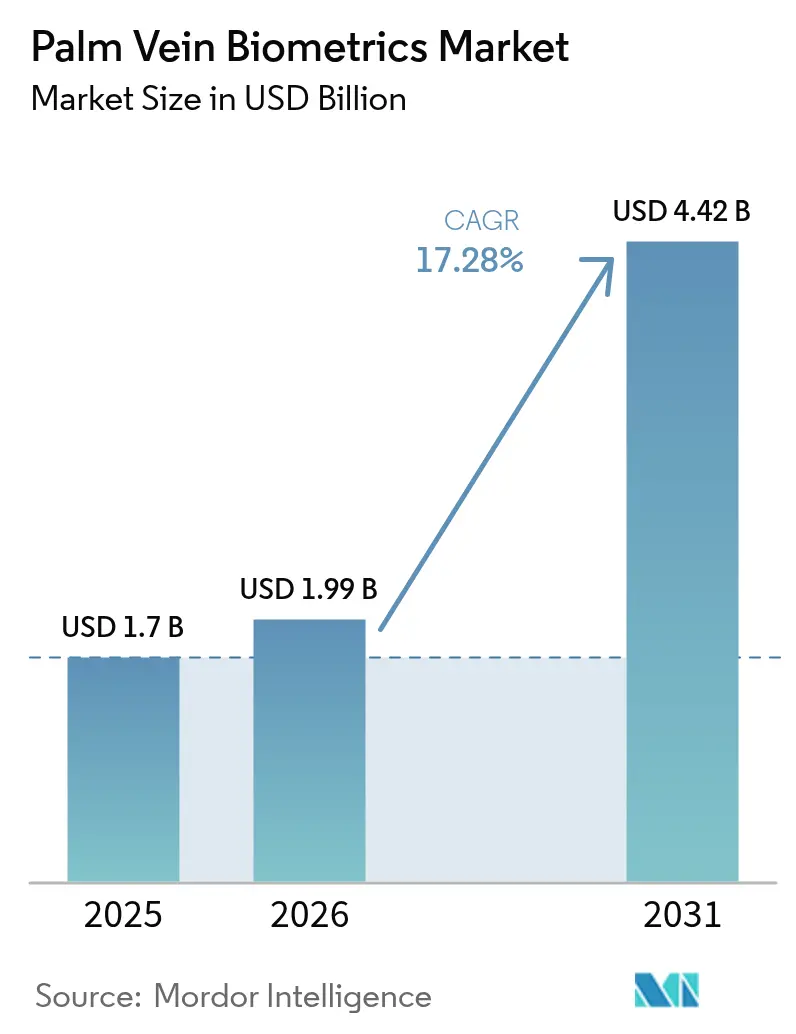
| Market Size (2026) | USD 1.99 Billion |
| Market Size (2031) | USD 4.42 Billion |
| Growth Rate (2026 - 2031) | 17.28 % |
| Fastest Growing Market | Asia Pacific |
| Largest Market | North America |
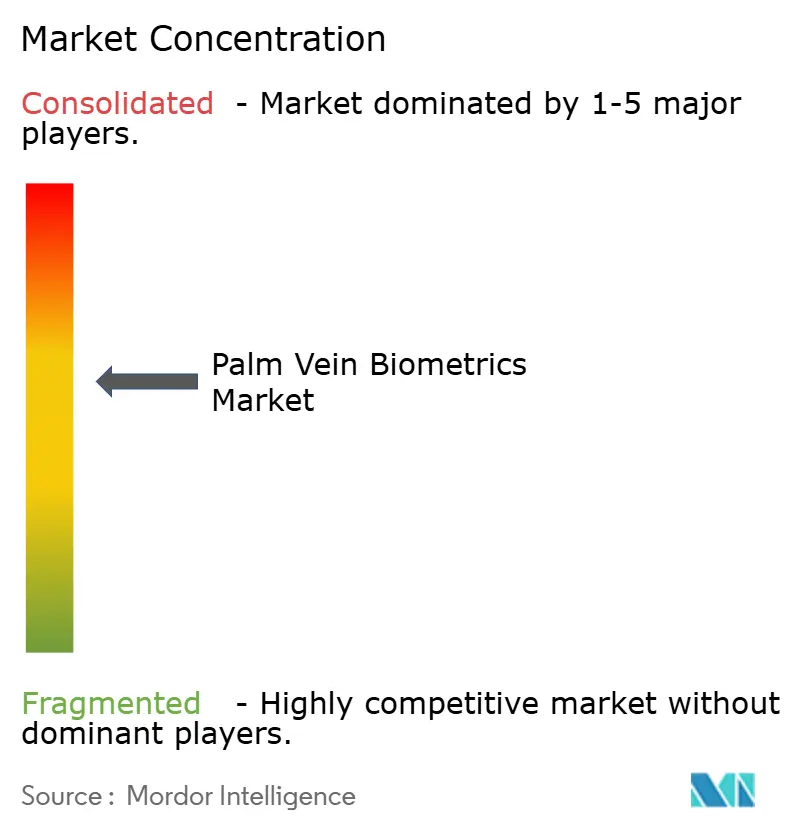
| Market Concentration | Medium |
Major Players *Disclaimer: Major Players sorted in no particular order Image © Mordor Intelligence. Reuse requires attribution under CC BY 4.0. | |
Palm Vein Biometrics Market Analysis by Mordor Intelligence
The palm vein biometrics market size is expected to grow from USD 1.7 billion in 2025 to USD 1.99 billion in 2026 and is forecast to reach USD 4.42 billion by 2031 at 17.28% CAGR over 2026-2031. Demand is accelerating as banks, hospitals, and government agencies migrate from cards and PINs to hygienic, spoof-resistant vascular imaging readers. Large retailers and quick-service restaurants now treat palm scans as loyalty enablers that link shoppers to stored payment cards and purchase histories in under one second, while healthcare systems adopt the modality to eradicate shared-surface contact and duplicate medical records. Cloud-native subscription models are bringing capital costs down for small businesses, and regulations that elevate biometric identifiers to “sensitive personal data” status are pushing enterprises to adopt template-protection architectures that favor on-device or sovereign-cloud storage.
Key Report Takeaways
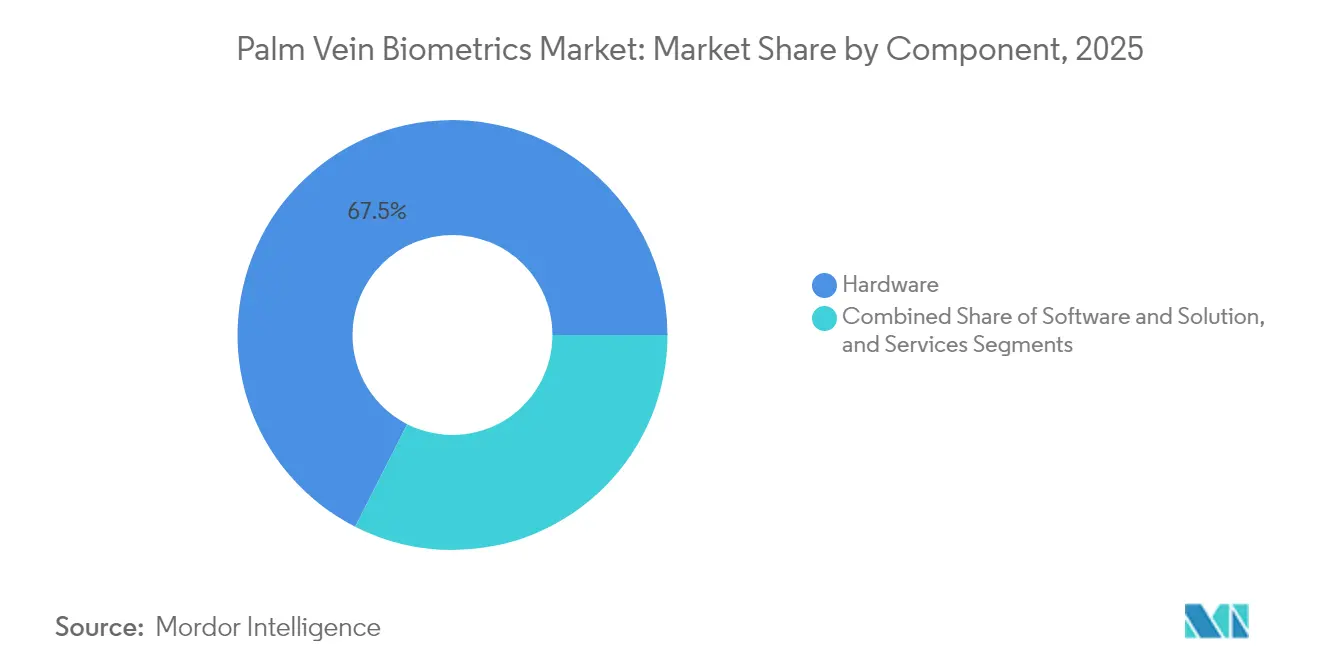
- By component, hardware commanded 67.52% revenue in 2025; services are expanding fastest at a 18.77% CAGR through 2031.
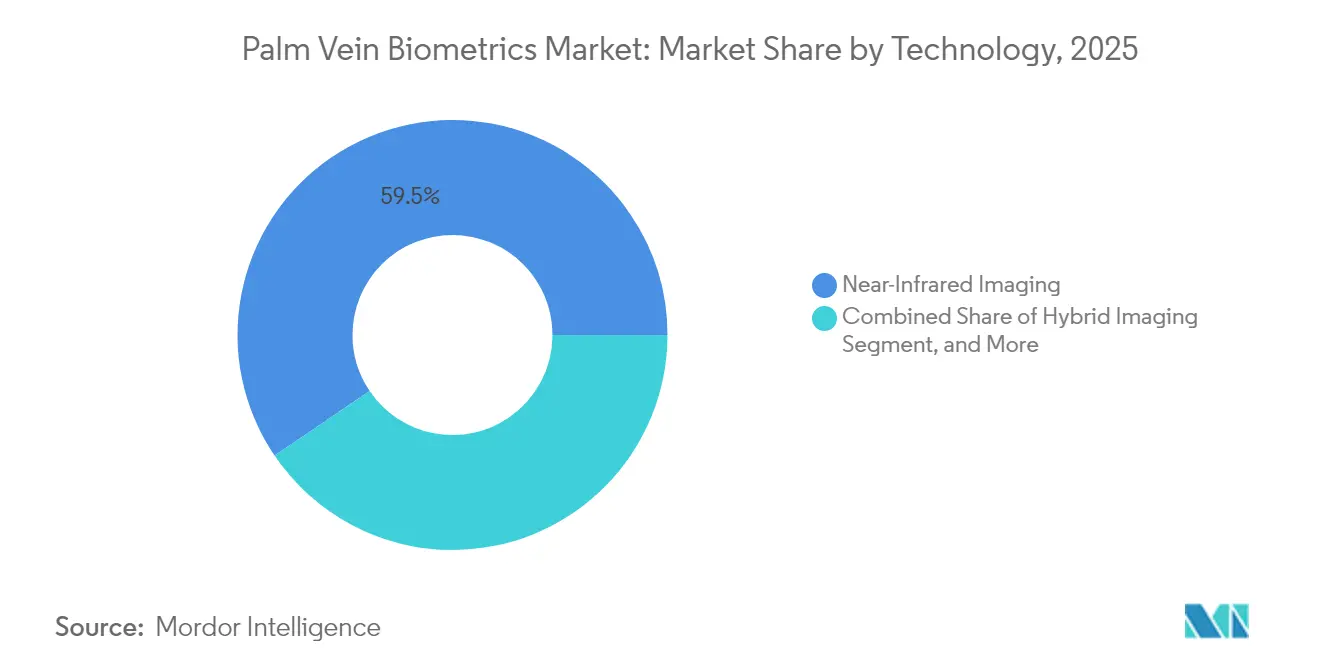
- By technology, near-infrared imaging held 59.48% market share in 2025, while hybrid imaging is forecast for an 18.31% CAGR.
- By end-user, banking institutions captured 35.12% revenue in 2025, while government agencies are expected to grow at 19.88% CAGR through 2031.
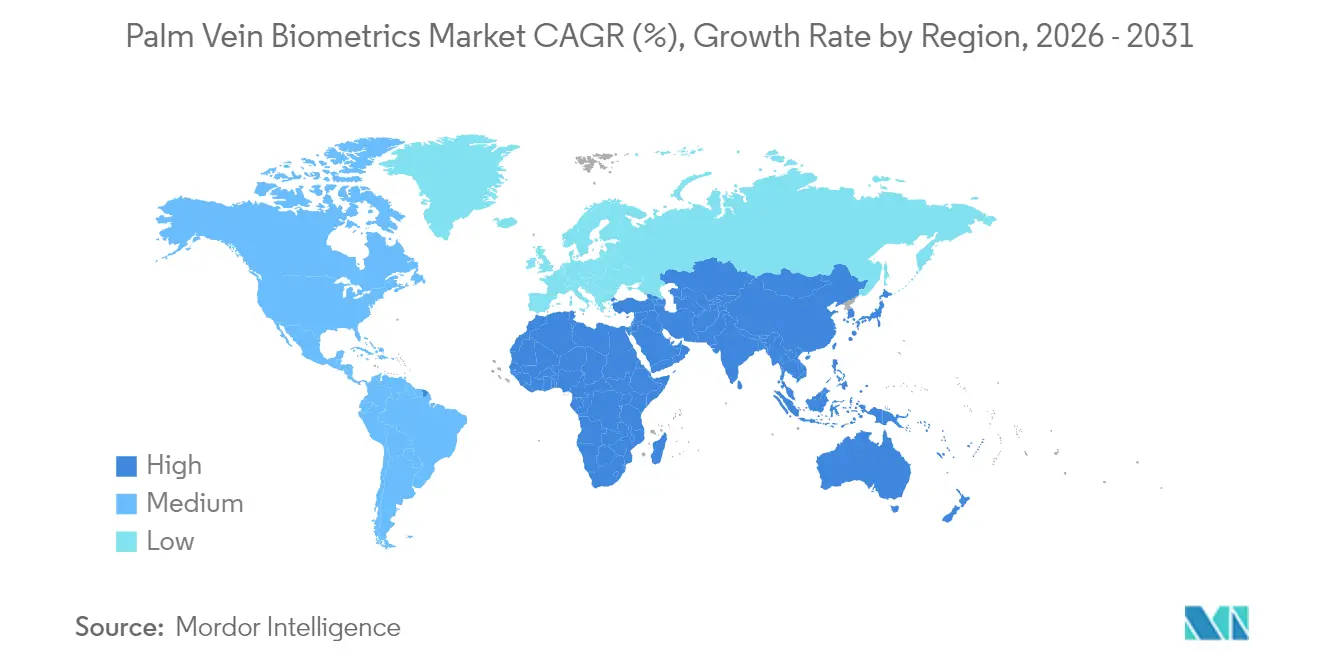
- By geography, North America led with a 39.78% palm vein biometrics market share in 2025, whereas Asia Pacific is advancing at a 17.62% CAGR to 2031.
Note: Market size and forecast figures in this report are generated using Mordor Intelligence’s proprietary estimation framework, updated with the latest available data and insights as of 2026.
Market Trends and Insights
Drivers Impact Analysis of Palm Vein Biometrics Market*
| Driver | (~) % Impact on CAGR Forecast | Geographic Relevance | Impact Timeline |
|---|---|---|---|
| Rising Adoption of Contactless Authentication in BFSI Sector | +3.50% | Global, with early traction in North America, UAE, and Japan | Medium term (2-4 years) |
| Stringent Data Privacy Regulations Mandating Biometric Upgrades | +3.00% | EU (GDPR), China (PIPL), India (DPDPA), Brazil (LGPD) | Long term (≥ 4 years) |
| Post-Pandemic Demand for Hygienic Touch-Free Patient Identification in Healthcare | +2.80% | North America and EU healthcare systems, spillover to APAC | Short term (≤ 2 years) |
| Cloud-Based Palm ID SaaS Models Shrinking Total Cost of Ownership for SMEs | +2.50% | Global, particularly SME-dense markets in Southeast Asia and Latin America | Medium term (2-4 years) |
| Smartphone-Enabled Remote Enrollment Unlocking Decentralized User Acquisition | +2.00% | North America, Western Europe, urban APAC | Short term (≤ 2 years) |
| Tariff-Driven Nearshoring of Sensor Production Lowering Supply-Chain Risk | +1.50% | North America and EU manufacturing hubs | Long term (≥ 4 years) |
| Source: Mordor Intelligence | |||
Rising Adoption of Contactless Authentication in BFSI Sector
Banks are embedding palm scans directly into point-of-sale rails to hit sub-one-second transaction times and eliminate card-present fraud. J.P. Morgan’s stadium-based pilot completed every payment in under a second during the 2024 Formula 1 Miami Grand Prix. Mastercard rolled out palm checkout in Uruguay’s Tienda Inglesa stores in June 2024, its first palm deployment in the program that had relied on facial recognition.[1]Bianca Gonzalez, “J.P. Morgan plans biometric payments rollout with PopID in 2025,” BiometricUpdate, biometricupdate.com U.S. credit-union processors PSCU and Co-op Solutions enabled 4,000 issuers to add pay-by-palm in April 2024 with eight-week implementation timelines.[2]Melissa Pollock, “PSCU/Co-op Solutions’ Integration with Amazon One Enables Pay-by-Palm for Cardholders,” creditunions.com UAE regulators aim to make Palm ID the region’s de-facto metro and ATM credential by 2026. The financial sector’s pivot frames palm authentication as a loyalty-driven personalization asset rather than a narrow fraud-control tool.
Stringent Data Privacy Regulations Mandating Biometric Upgrades
The EU’s GDPR, China’s PIPL, and India’s DPDPA classify vascular templates as sensitive data that require explicit consent, data minimization, and, where cross-border transfers occur, supplementary encryption measures. Schrems II invalidated the EU-U.S. Privacy Shield, forcing European companies to adopt local or sovereign-cloud storage. China’s PIPL mandates the Cyberspace Administration of China security assessments for transfers that involve over 1 million data subjects. ISO/IEC TS 22604:2024 now provides enterprises with a template-protection blueprint and encourages moves toward encrypted on-device matching, a model Amazon One follows by storing signatures within a secure AWS domain rather than on the reader itself. Compliance pressure, therefore, accelerates the migration from password systems to cryptographically protected biometrics.
Post-Pandemic Demand for Hygienic Touch-Free Patient Identification in Healthcare
Hospitals are ripping out shared fingerprint scanners. NYU Langone Health, BayCare Health System, and University of Tokyo Hospital have all switched to palm vein readers that authenticate through gloves and bandages, cutting duplicate records and infection risk. NEC demonstrated authentication even when one-third of a patient’s face is bandaged, a breakthrough for burn and oncology wards where contactless modalities are essential.[3]Melissa Pollock, “PSCU/Co-op Solutions’ Integration with Amazon One Enables Pay-by-Palm for Cardholders,” creditunions.com U.S. Medicare penalties tied to avoidable readmissions give financial urgency to error-free patient matching, further lifting adoption.
Cloud-Based Palm ID SaaS Models Shrinking Total Cost of Ownership for SMEs
Tencent’s PalmAI Service, Amazon One Enterprise, and TBS BIOMANAGER CLOUD deliver subscription bundles that include storage, algorithm updates, and remote maintenance. A 50-employee office can switch badge readers for under USD 200 per month instead of USD 15,000 upfront. Hitachi’s SAKULaLa platform schedules feature drops over the air adding face recognition in FY 2025 without hardware swaps. SaaS models thus democratize the technology for cost-sensitive retailers and clinics.
Restraints Impact Analysis of Palm Vein Biometrics Market*
| Restraint | (~) % Impact on CAGR Forecast | Geographic Relevance | Impact Timeline |
|---|---|---|---|
| High Upfront Hardware and Integration Costs | -2.50% | Global, particularly acute in cost-sensitive markets (Southeast Asia, Latin America, Africa) | Short term (≤ 2 years) |
| Limited Interoperability Standards Across Vendors | -2.00% | Global, most severe in government procurements requiring multi-vendor redundancy | Medium term (2-4 years) |
| Rising Scrutiny of Biometric Cloud Storage by Data Sovereignty Laws | -1.50% | China, India, EU, Russia, Brazil (markets with strict localization mandates) | Long term (≥ 4 years) |
| Scaling Latency Issues in Large-Scale Vein Template Databases | -1.20% | National-ID programs and mega-city transit systems (China, India, Indonesia) | Medium term (2-4 years) |
| Source: Mordor Intelligence | |||
High Upfront Hardware and Integration Costs
Near-infrared sensor arrays cost three-to-five times more than commodity fingerprint readers. Qualcomm and Telpo’s P105 terminal integrate dual RGB + IR cameras plus liveness optics, positioning it as a premium device that small retailers must justify through fraud savings. Integration adds USD 5,000–20,000 in professional services when legacy systems lack vascular drivers, locking out low-margin merchants in emerging markets.
Limited Interoperability Standards Across Vendors
IEEE 2410-2021 and ISO/IEC 19794-9:2011 define file formats but not algorithmic compatibility, so a user enrolled on a Fujitsu PalmSecure reader cannot authenticate on Hitachi hardware without re-enrolment. U.S. Homeland Advanced Recognition Technology has delayed palm projects because federal rules require at least two qualified suppliers. Lack of cross-vendor liveness-score harmonization also slows airport and border procurements that depend on multi-supplier redundancy.
*Our forecasts treat driver/restraint impacts as directional, not additive. The impact forecasts reflect baseline growth, mix effects, and variable interactions.
Palm Vein Biometrics Market Segment Analysis
By Component:
Hardware Dominates, Services AccelerateHardware captured 67.52% of palm vein biometrics market share in 2025 as every authentication point needs a dedicated reader. Hospitals, airports, and stadiums deploy hundreds of units, keeping hardware revenue proportional to footprint. Services, however, will log a 18.77% CAGR, reflecting template-database maintenance, algorithm retuning, and compliance audits. Digital Sense’s integration work for Mastercard’s Uruguay checkout launch demonstrates how middleware bridges palm readers to legacy POS software. Cloud platforms shift value toward recurring subscriptions, yet readers remain indispensable for high-throughput gates, ensuring hardware stays above 50% of revenue through 2031.
Software royalties are also rising. Vendors license matching engines under per-device fees, and ISO/IEC 30107-3:2023 presentation-attack-detection mandates guarantee constant firmware refreshes. Managed-service providers flourish because small retailers lack staff trained to troubleshoot false rejects or conduct privacy-impact assessments. Even with SaaS, enterprises pay monthly for log review, encryption-key rotation, and sovereign-cloud hosting where data-localization laws apply, locking in services growth.



By Technology:
Hybrid Imaging Gains ShareNear-infrared imaging held 59.48% market share in 2025 thanks to proven accuracy across skin tones and lighting, exemplified by decades-old Fujitsu PalmSecure deployments in Japanese ATMs. Hybrid imaging, which fuses IR, thermal, and optical data, is forecast for an 18.31% CAGR as regulators now expect built-in liveness checks. NEC’s November 2024 compact face-plus-iris system shows multispectral capture in a single camera, shrinking device footprints for kiosks and tablets. Thermal layers detect blood flow to foil silicone replicas, making hybrid configurations attractive for border control.
Optical imaging, while smaller, gains consumer momentum through smartphones. Amazon One’s 2024 mobile app photographs the palm under visible light, then uses generative AI to match the image with IR captures at the store. Printable IR sensors on flexible substrates, outlined in 2024 Nano Futures roadmaps, could embed palm recognition in wearables later in the decade. Hybrid imaging’s growth is therefore driven by both security mandates and emergent form factors.
By End-User Industry:
Agencies Outpace BanksBanking institutions held 35.12% revenue in 2025, but government agencies are projected to grow fastest at 19.88% CAGR. Credit-union processors have already added palm pay to 4,000 issuers, yet sovereign ID projects carry multi-million-user enrolments. The UAE’s Palm ID intends to link metro trips and ATM withdrawals by 2026, illustrating a public-infrastructure thesis where one palm template unlocks transit, payments, and e-government portals. Corporate offices, hotels, and universities adopt Amazon One Enterprise subscriptions to retire badges vulnerable to tailgating.
Geography Analysis
North America Palm Vein Biometrics Market
North America held a 39.78% palm vein biometrics market share in 2025, underpinned by Amazon One’s rollout to 500 Whole Foods stores and 150 third-party venues that have logged more than 8 million transactions with an 80% repeat rate. U.S. consumers show high biometric acceptance, with PYMNTS reporting 52% prefer biometrics over passwords. Canada pilots palm payments in grocery chains, while Mexico City explores the modality for metro fare gates. The region benefits from permissive regulations that rely on disclosure rather than explicit consent, lowering deployment friction.
APAC Palm Vein Biometrics Market
Asia Pacific is the fastest-growing geography, posting a 17.62% CAGR toward 2031. Hitachi’s SAKULaLa expanded to 100 plus venues across retail and rail, and Tencent’s PalmAI Service claims 100 million users across Beijing Airport Express, Shenzhen University, and 7-Eleven stores. China’s PIPL complicates cross-border data flows, yet domestic volumes dwarf Western markets. India’s new data law allows cross-border transfers unless on a blacklist, creating opportunity for cloud SaaS vendors, although sectoral regulators may issue tighter rules for finance or health. South Korea, Australia, and Singapore run pilots in banks and hospitals, while Indonesia studies palm scans for its 270 million-citizen national ID upgrade.
Europe and Middle East Palm Vein Biometrics Market
Europe trails due to GDPR constraints; biometric data sits under Article 9’s special-category protections requiring explicit consent. Visa and Feedzai found 40% of UK consumers willing to use biometrics for banking, but Schrems II forces U.S. cloud vendors to adopt EU data centers, inflating costs. France, Germany, and Italy test palm readers in hospitals and airports but keep template storage local. The Middle East emerges as a bright spot: the UAE targets nationwide palm infrastructure by 2026, and Dubai-based AstraTech launched Palm Pay in 2024 for hover-to-pay retail checkouts. Saudi Arabia explores border-control pilots, signalling Gulf-wide momentum.
South America and Africa Palm Vein Biometrics Market
Africa and South America remain nascent. Brazil’s LGPD classifies biometrics as sensitive and requires standard contractual clauses for transfers, while South Africa studies palm vein for refugee identity. Funding gaps and hardware costs restrain volume, though Mastercard’s Uruguay pilot may seed regional interest.

Regulatory Landscape
Palm vein templates are regulated as sensitive biometric data, shaping system design and deployment models. In Europe, Regulation (EU) 2016/679 (GDPR) treats biometrics used for unique identification as special-category data, pushing explicit consent, data minimization, and Data Protection Impact Assessments (DPIAs) for deployments in banking, healthcare, and government. The United Kingdom updated its data protection framework with the Data Use and Access Act 2025, receiving Royal Assent on 19 June 2025, requiring alignment with UK GDPR obligations for biometric recognition.
On the technical side, interoperability and template handling are anchored by ISO/IEC standards for vascular data. ISO/IEC 39794-9:2021 defines extensible biometric data interchange formats for vascular image data (including palm vein) and is used as a migration path from earlier ISO/IEC 19794-9:2011 formats, especially where multi-vendor interchange or long-term archival is required. For US public-sector procurement, NIST's recommended biometric standards and PIV specifications influence capture and interchange requirements, making standards alignment a practical gate for vendors competing in federal identity programs.
Value Chain Analysis
The palm vein biometrics value chain begins with specialized components, near-infrared illumination and optics, and CMOS image sensors optimized for vascular capture, then moves into device manufacturing and firmware, matching algorithms and template-protection layers, and middleware that integrates with IAM, POS, EHR, and access-control systems. Value is increasingly captured by vendors and integrators that package end-to-end offerings (readers, SDKs/APIs, enrollment, and identity management) and by cloud operators that deliver subscription services for storage, monitoring, and remote maintenance, as seen in platforms such as Amazon One Enterprise, Tencent PalmAI Service, and Hitachi's SAKULaLa.
Downstream, channel partners span system integrators, POS/terminal OEMs, and enterprise resellers serving BFSI, healthcare, government, and commercial access control. Supply-chain risk concentrates around a narrow base of deep-tissue sensor module suppliers and specialized optics, while tariff-driven logistics and component requalification pressures have pushed some players toward higher safety stocks and more regionalized assembly. Standards and conformity requirements also sit inside the value chain: ISO/IEC 39794-9:2021 underpins vascular data interchange, and China issued GB/T 44864-2024 (released 26 October 2024) for general specifications of hand vascular recognition terminals, adding an additional compliance layer for vendors serving Chinese deployments.
Competitive Landscape
Market concentration is moderate. Japanese incumbents Fujitsu, Hitachi, and NEC anchor legacy footprints in APAC banks and government agencies. Fujitsu licenses PalmSecure to Ingenico and Fulcrum for Mastercard’s Latin American deployments, monetizing intellectual property without direct hardware sales. Hitachi’s SAKULaLa strategy aggregates cross-industry use cases so a single enrolment pays, travels, and accrues loyalty points across 100 plus venues, cementing ecosystem lock-in. NEC pushes multimodal fusion, condensing face and iris capture into one camera that fits POS terminals.
Cloud-first challengers Amazon, Tencent, and Keyo leverage consumer apps to bypass enterprise sales cycles. Amazon One claims 99.9999% accuracy, though independent NIST validation is pending. Keyo raised USD 3.3 million in 2024 to tailor palm pay for quick-service restaurants. Competitive vectors center on sub-second speed, false-accept rates under 0.01%, and sovereign-cloud options that satisfy localization rules.
White-space opportunities lie in healthcare controlled-substance cabinets, pharmaceutical supply-chain authentication, and luxury retail where high average transaction values warrant premium hardware. Interoperability gaps persist despite IEEE 2410-2021 and ISO/IEC 19794-9:2011, allowing each vendor to wield proprietary template structures as moats. The race therefore pivots on who can offer open APIs without sacrificing algorithmic secrecy.
Palm Vein Biometrics Industry Leaders
Fujitsu Limited
BioEnable Technologies Pvt Ltd
M2SYS Technology - KernellÓ Inc.
Mantra Softech Pvt Ltd
BioSec Group Ltd
- *Disclaimer: Major Players sorted in no particular order
Palm Vein Biometrics Market Companies Covered in this Report
- Fujitsu Limited
- Hitachi Ltd.
- NEC Corporation
- M2SYS Technology LLC
- BioSec Group Ltd.
- BioEnable Technologies Private Limited
- Imprivata Inc.
- Mantra Softech (India) Private Limited
- IdentyTech Solutions Ltd.
- Matrix Comsec Private Limited
- Keyo Inc.
- Tencent Cloud Computing (Beijing) Company Limited
- Amazon Web Services, Inc.
- ZKTECO Co., Ltd.
- Idemia France SAS
- Recogtech B.V.
- Shenzhen Huifan Technology Co., Ltd.
- Hikvision Digital Technology Co., Ltd.
- Thales Group
- Mofiria Corporation

Market Opportunities and Future Outlook
Enterprise adoption is expanding into high-assurance digital workflows where persistent identity and non-repudiation matter. In January 2026, Pearson announced a partnership with Redrock Biometrics to integrate PalmID palm authentication into professional certification and licensure exams globally, creating a repeatable template for test-center operators and remote proctoring ecosystems.
Public-sector and financial-services deployments are advancing through policy momentum and programmatic deployments. In April 2026, the National Bank of Kazakhstan and the Agency for Regulation and Development of the Financial Market approved rules that include palm-vein authentication for certain remote banking and high-risk transactions, effective 12 July 2026; in Sarawak, Malaysia, SOCOE Holdings launched WaveJak palm-recognition AI integrated with the Kenyalang Gold Card for elderly identity verification in April 2026, illustrating a route from pilots to programmatic issuance tied to benefits. On the product side, Precise Biometrics reported in June 2026 that its contactless palm recognition achieved a false-accept rate better than 1 in 100 million and linked that capability to its Palm Access Pro system, strengthening its case for replacing badges and PINs in sensitive facilities.
Recent Industry Developments in Palm Vein Biometrics Market
- June 2026: Precise Biometrics expanded Palm Access Pro deployments across multiple sites, reporting a false-accept rate better than 1 in 100 million. The broader rollout strengthens palm recognition for high-security access and supports enterprise-scale deployments. This advancement positions palm biometrics as a credible substitute for badges and PINs in sensitive facilities.
- July 2026: Boom ID integrated Innovatrics palm biometrics into its mobile enterprise authorization platform for contactless approval of transactions and workforce verification. The move links palm-based identity proofing to mobile-first enterprise workflows, extending palm biometrics beyond fixed readers into distributed authorization use cases. Early pilots target field services and remote workforces in BFSI and government sectors.
- November 2024: NEC unveiled a compact face-plus-iris system that captures both modalities in a single camera for payment terminals, with availability targeted for 2026. The smaller form factor supports multimodal deployments at checkout and kiosks, enabling stronger anti-spoofing configurations without expanding device footprints. The solution expands multimodal options for retailers adopting biometric payment authentication.


Palm Vein Biometrics Market Report Scope and Research Methodology
Market Definition and Coverage
This market covers solutions that authenticate people using palm vein patterns, including the main hardware, imaging software, matching algorithms, and supporting services that are sold for identity verification and access control use cases.
Scope exclusions: It does not count broader biometrics modalities that do not use palm vein patterns, and it excludes general IT security spending that is not directly tied to palm vein capture, matching, or deployment.
Segments Covered in This Report
- By Component
- Hardware
- Software and Solution
- Services
- By Technology
- Near-Infrared Imaging
- Optical Imaging
- Thermal Imaging
- Hybrid Imaging
- By End-User Industry
- Banking and Financial Institutions
- Healthcare Providers
- Government Agencies
- Commercial and Industrial Enterprises
- By Geography
- North America
- United States
- Canada
- Mexico
- Europe
- United Kingdom
- Germany
- France
- Italy
- Rest of Europe
- Asia-Pacific
- China
- Japan
- India
- South Korea
- Rest of Asia
- Middle East
- Israel
- Saudi Arabia
- United Arab Emirates
- Turkey
- Rest of Middle East
- Africa
- South Africa
- Egypt
- Rest of Africa
- South America
- Brazil
- Argentina
- Rest of South America
- North America
Data Sources, Market Sizing, and Validation
Desk Research
Desk research was used to set the fact base for adoption drivers and spending context before the model was built. We reviewed public sources such as NIST biometric evaluation publications, ISO and IEC standards related to biometric performance and data interchange, USPTO and WIPO patent databases for palm vein imaging and matching activity, and government procurement portals that show identity and access control tenders. For demand context, we also used central bank and financial regulator publications that track payments infrastructure and branch modernization, along with public health and hospital digitization updates where hygienic authentication is relevant.
On the supply side, we referenced company annual reports, investor presentations, product datasheets, and credible press coverage to understand product positioning and typical deployment patterns. Where available, paid company financials and intelligence subscriptions and paid patent databases were used to validate entity structures, subsidiaries, and time series signals. The sources mentioned above are illustrative, and there are many other public documents and datasets that were also referred to for data collection, validation, and research clarification.
Primary Interviews and Surveys
Primary work focused on validating how palm vein systems are priced, bought, and deployed across key application areas such as BFSI, healthcare, government, and commercial security. We spoke with a mix of device and solution providers, system integrators, and enterprise buyers across APAC, EMEA, and the Americas, then used follow-up questions to confirm assumptions around refresh cycles, attach rates for software and services, and the pace of migration from legacy access methods.
Distribution of primary research fieldwork respondents
| Company type | Respondent position | Region |
|---|---|---|
| Top tier: 37% | CXOs: 12% | APAC: 51% |
| Mid tier: 49% | Functional/Unit leaders: 35% | EMEA: 29% |
| Smaller Players: 14% | Managers: 53% | Americas: 20% |
Market-Sizing & Forecasting
Sizing was built using a top-down and bottom-up mix, with the top-down side anchoring demand pools and the bottom-up side used for targeted checks. We start by reconstructing addressable installations across priority settings (for example, bank branches and kiosks, hospitals and clinics, and government or enterprise access points), then apply penetration and replacement patterns to estimate deployed units and spending by year.
To keep outputs grounded, totals are corroborated with selective bottom-up approximations such as sampled average selling prices by device class, typical software license or subscription levels, and service revenue ratios that are visible in deployments. Key model inputs include rollout pace of contactless and hygienic authentication programs, refresh cycles of access control endpoints, the split between new installs versus replacements, regional IT and security spending direction, and changes in solution packaging (standalone readers versus integrated kiosks). Forecasting relies mainly on scenario analysis, where adoption speed and pricing progression are stress-tested with expert views and then narrowed to one central case. When bottom-up signals are missing for smaller countries or niche applications, we fill gaps using proxy indicators like install base, GDP and enterprise spending intensity, followed by a sanity check against regional totals.
Data Validation & Update Cycle
Validation is done in steps so the final numbers stay traceable to real-world signals. We compare model outputs with independent indicators such as tender activity, patent momentum, and the pace of deployments seen in high-adoption end users, then review any sharp jumps that do not match adoption logic or pricing realities. When variances are material, assumptions are revisited and respondents are re-contacted to confirm whether the change is driven by scope, timing, or a true market shift.
Before sign-off, the dataset and calculations go through analyst peer review, followed by a final consistency pass across regions and end-use settings. Reports refresh annually, with interim updates for material events that can change the near-term outlook, and then a fresh pre-delivery scan is completed so clients receive the latest updated view.
Mordor Intelligence's Palm Vein Biometrics Market Size Measured Against Other Published Estimates
Published market sizes for palm vein biometrics often diverge because firms pick different start years, bundle different revenue pieces, and apply different adoption and pricing assumptions across end users. Even when the technology definition looks similar, totals can move if one estimate leans toward device shipments and another includes software, deployment, and ongoing services.
The main gap comes from what is counted as palm vein biometrics revenue, where Mordor Intelligence includes hardware plus the associated software or solution stack and services, and then ties growth to install-base build-up, refresh cycles, and region-specific price steps.
Benchmark comparison
| Source | Market Size | Gaps in Research Methodology |
|---|---|---|
| Mordor Intelligence | USD 1.70 B (2025) | |
| Industry Research Publisher A | USD 1.25 B (2024) | Uses a 2024 base year and a higher headline CAGR over 2025-2032, and its scope description may treat software and services more selectively across applications, which can compress the starting value versus an all-in spending view. |
| Industry Research Publisher B | USD 1.40 B (2024) | Anchors on 2024 and extends the horizon to 2035, which can amplify compounding, and it appears to rely more on broad end-user share splits rather than explicit install-base and replacement timing checks in each region. |
Overall, the spread is explained mainly by base-year choice, whether recurring services and solution software are consistently included, and how aggressively adoption is pushed into later years. Our sizing keeps steps repeatable by tying volumes to identifiable deployment pools and then validating pricing and service attachment with interviews and secondary signals.


Key Questions Answered in the Report
How fast can palm scans process a retail payment?
Pilots by J.P. Morgan and Amazon show sub-one-second transactions, matching tap-to-pay cards while removing card-present fraud.
Which regions are adopting palm biometrics the quickest?
North America currently leads in installed readers, but Asia Pacific is posting the fastest growth at a 17.62% CAGR driven by Japan and China.
Are templates stored in the cloud or on the device?
Leading solutions encrypt templates in sovereign clouds, though regulations are pushing some deployments to on-device matching for sensitive data.
What security advantage does palm vein hold over fingerprints?
Sub-dermal vein patterns are invisible to cameras and remain intact even through surface injuries, making them far harder to spoof with photos or latent prints.
Can small retailers afford palm authentication?
Cloud-based SaaS models now let a 50-employee business subscribe for roughly USD 200 per month, avoiding large upfront reader investments.
Page last updated on:





