
Market Overview
| Study Period | 2020 - 2031 |
|---|---|
| Forecast Data Period | 2026 - 2031 |
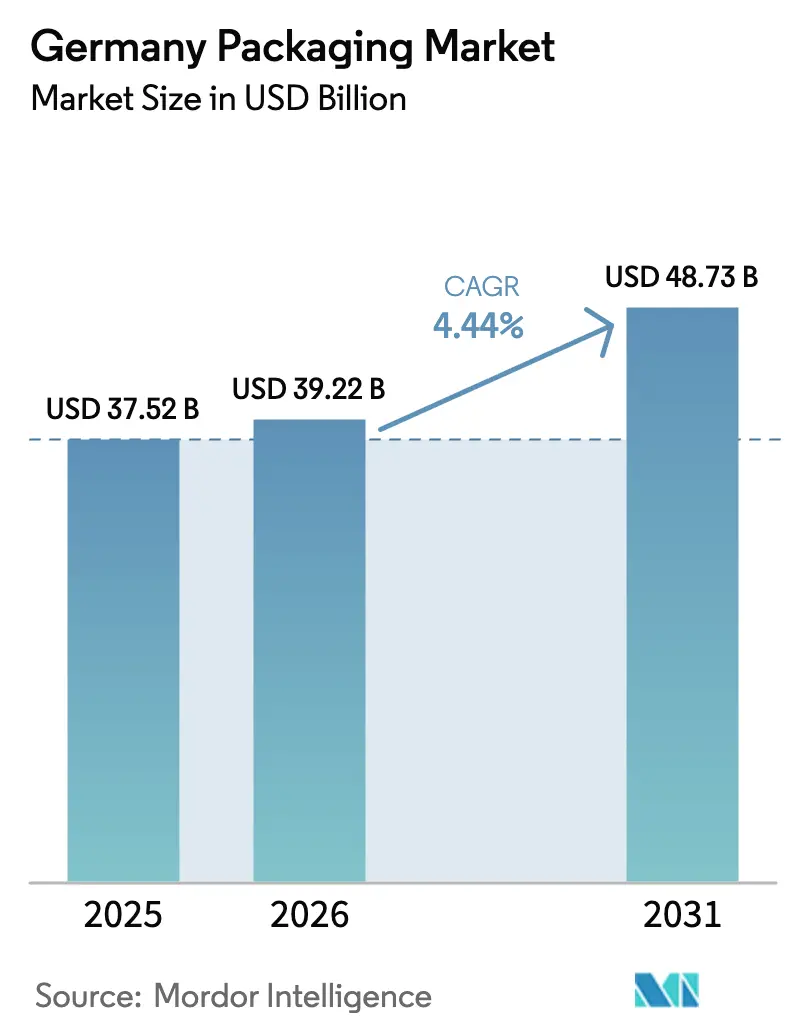
| Base Year Market Size (2025) | USD 37.52 Billion |
| Market Size (2026) | USD 39.22 Billion |
| Market Size (2031) | USD 48.73 Billion |
| Growth Rate (2026 - 2031) | 4.44 % |
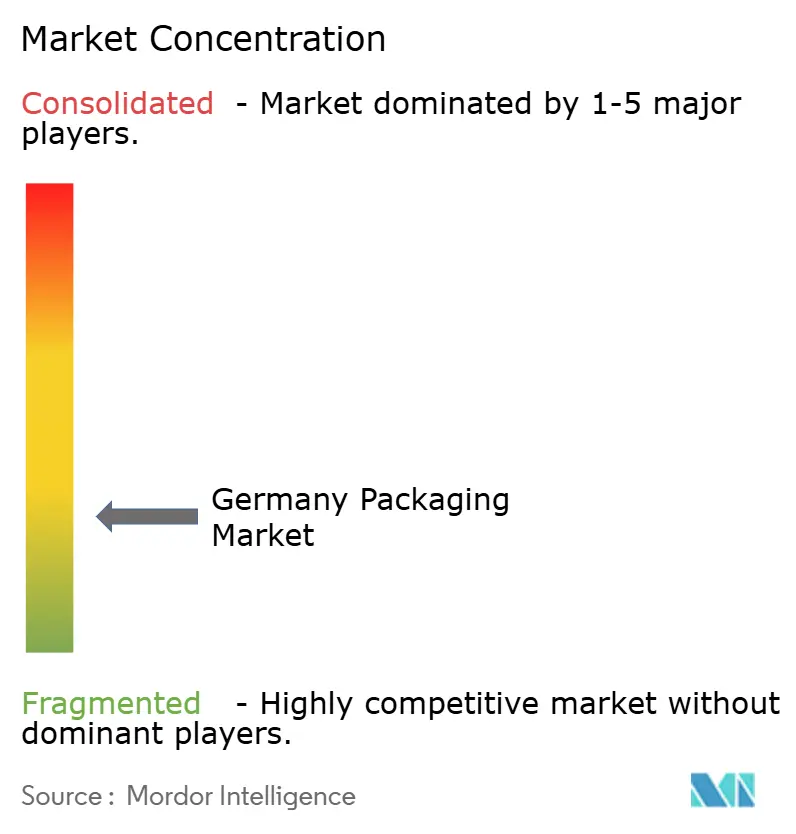
| Market Concentration | Low |
Major Players *Disclaimer: Major Players sorted in no particular order Image © Mordor Intelligence. Reuse requires attribution under CC BY 4.0. | |
Germany Packaging Market Analysis by Mordor Intelligence
The Germany packaging market size is expected to increase from USD 39.22 billion in 2026 to USD 48.73 billion by 2031, growing at a 4.44% CAGR over 2026-2031. Strong demand from Germany’s diversified manufacturing base, resilient pharmaceutical exports, and entrenched circular-economy policies underpin this expansion. Industrial production swings, however, quickly translate into packaging order patterns that favor converters with flexible capacity scheduling. The deposit return system, or Pfandsystem, processed more than 20 billion containers in 2025 and maintained a 98% material return rate, reinforcing Germany’s reputation as the benchmark for extended producer responsibility. Post-Brexit realignment of European cold-chain flows is routing additional biologics volumes through Frankfurt and Hamburg airports, accelerating investment in insulated shippers and phase-change materials. Premiumisation trends in cosmetics, automotive accessories, and watches are driving demand for high-specification folding cartons and rigid boxes, though brand owners are shifting toward mono-material structures to meet recyclability thresholds. At the same time, additive manufacturing of molds and tooling is shrinking time-to-market for limited-edition launches, sharpening competition on responsiveness.
Key Report Takeaways
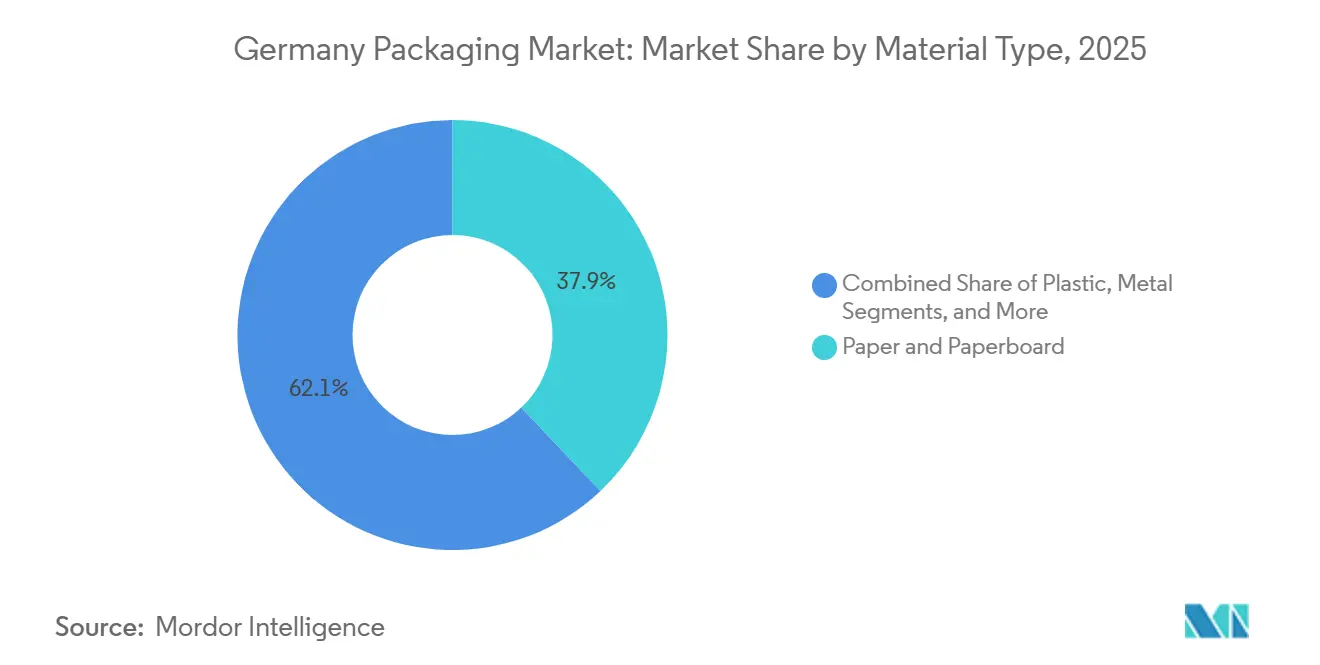
- By material type, paper and paperboard led with 37.91% of the Germany packaging market share in 2025. Biodegradable plastics are forecast to progress at a 4.83% CAGR through 2031, the fastest among all materials.
- By product type, corrugated boxes and containers accounted for 23.88% of the Germany packaging market size in 2025. Pouches are projected to expand at a 5.21% CAGR from 2026-2031, outpacing all other product formats.
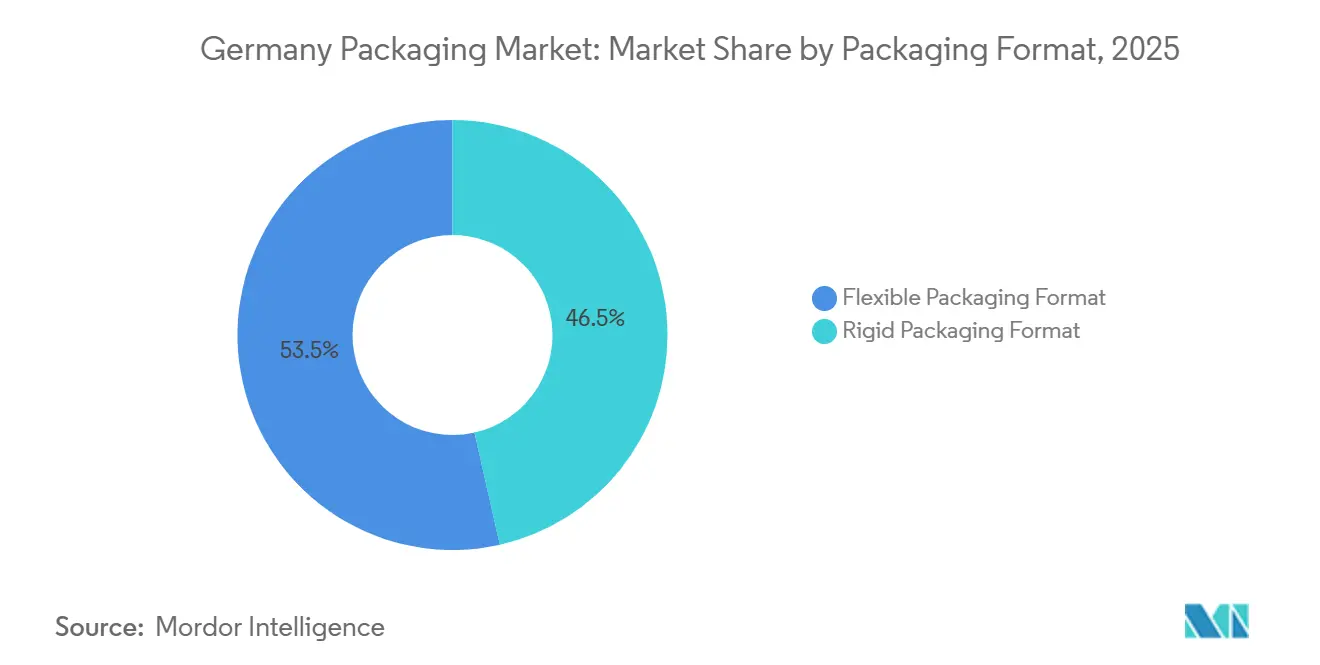
- By packaging form, flexible packaging accounted for 53.52% market share in 2025 and advanced at a 4.97% CAGR through 2031.
- By end-user, food accounted for 31.48% of the Germany packaging market size, and pharmaceutical and medical applications advanced at a 5.66% CAGR between 2026-2031, the quickest among user industries.
Note: Market size and forecast figures in this report are generated using Mordor Intelligence’s proprietary estimation framework, updated with the latest available data and insights as of January 2026.
Germany Packaging Market Trends and Insights
Drivers Impact Analysis*
| Driver | (~) % Impact on CAGR Forecast | Geographic Relevance | Impact Timeline |
|---|---|---|---|
| Pharmaceutical Cold-Chain Expansion Post-Brexit | +0.8% | Germany, with spillover to Benelux and Central Europe | Medium term (2-4 years) |
| Regulatory Push For Deposit Return System Expansion | +1.2% | Germany, national implementation with regional pilot programs | Short term (≤ 2 years) |
| Luxury Goods Export Growth Fueling Premium Packaging | +0.5% | Germany, concentrated in Bavaria and Baden-Württemberg | Long term (≥ 4 years) |
| Surge In Craft Beverage Canning Facilities | +0.7% | Germany, with early gains in Bavaria, North Rhine-Westphalia, and Thuringia | Medium term (2-4 years) |
| 3D Printing Of Packaging Tooling Reducing Lead Times | +0.4% | Germany, national adoption with concentration in industrial clusters | Medium term (2-4 years) |
| Hydrogen-Powered Delivery Fleets Lower Scope 3 Emissions | +0.3% | Germany, pilot deployments in Saxony and Bavaria | Long term (≥ 4 years) |
| Source: Mordor Intelligence | |||
Pharmaceutical Cold-Chain Expansion Post-Brexit
European biologics traffic that once consolidated in the United Kingdom is increasingly staged through Frankfurt and Hamburg, lifting demand for temperature-controlled secondary packaging and pre-qualified pallet shippers. German converters that hold ISO 15378 certification for primary containers have secured multi-year supply agreements with vaccine producers, and Gerresheimer’s investment in hermetic blister capacity (EUR 2 billion, USD 2.26 billion) positions the company to capture higher value orders.[1] Polymer syringes with integrated needle shields introduced by SCHOTT Pharma in 2024 further illustrate the migration toward break-resistant formats in automated fill-finish environments.
Regulatory Push for Deposit Return System Expansion
In 2025, Germany extended its deposit scheme to milk and juice cartons, adding an estimated 600 million additional units to reverse-logistics channels within the first year. Converters swiftly re-engineered bottles in polyethylene terephthalate to improve optical sorting efficiency, while machinery suppliers Krones and ALPLA retrofitted blow-molding lines for tethered-cap compliance. Because the EU Packaging and Packaging Waste Regulation mirrors Germany’s 90% collection benchmark, domestic producers enter the 2026-2031 horizon with a compliance head start, translating into lower contingency capital expenditure.
Luxury Goods Export Growth Fueling Premium Packaging
Luxury automotive accessories, high-end cosmetics, and horology products exported from Bavaria and Baden-Württemberg continue to favor rigid paperboard boxes with tactile varnishes. Cost-inflation in specialty pigments, however, is prompting a shift to mono-material cartonboard laminated with dispersion barriers developed by Mondi’s Steinfeld mill upgrade (EUR 50 million, USD 56.5 million).[2] These structures achieve comparable shelf impact yet qualify for existing fiber recycling streams, allowing luxury brands to meet recyclability pledges without diluting brand aesthetics.
3D Printing of Packaging Tooling Reducing Lead Times
Söhner Kunststofftechnik’s fused deposition modeling workflow produces prototype molds in a matter of days, cutting tooling lead times and costs by up to 50%. Faster iteration cycles are especially valuable for short-run promotional SKUs in fast-moving consumer goods. Heidelberger Druckmaschinen quantified a 40% reduction in time-to-market for folding cartons by combining digital presses with 3D-printed tooling, enabling brand owners to capitalize on seasonal demand spikes. Concentration of additive manufacturing capacity in Germany’s automotive clusters speeds knowledge spillover into packaging workflows.
Restraints Impact Analysis*
| Restraint | (~) % Impact on CAGR Forecast | Geographic Relevance | Impact Timeline |
|---|---|---|---|
| Skilled Labor Shortfall In High-Speed Automation | -0.9% | Germany, national with acute pressure in Bavaria and Baden-Württemberg | Short term (≤ 2 years) |
| Capital Expenditure Freeze Amid Interest Rate Volatility | -1.1% | Germany, affecting small and mid-sized converters disproportionately | Short term (≤ 2 years) |
| Fragmented Municipal Recycling Infrastructure | -0.5% | Germany, variability across 16 federal states | Medium term (2-4 years) |
| Cybersecurity Risks In Connected Packaging Lines | -0.3% | Germany, concentrated in Industry 4.0 adopters | Medium term (2-4 years) |
| Source: Mordor Intelligence | |||
Skilled Labor Shortfall in High-Speed Automation
An aging workforce and tight vocational-training pipeline leave many converters struggling to staff mechatronics and PLC programming roles needed to operate multi-lane pouch fillers and rotary blow molders. Companies are installing operator-assist interfaces and remote-diagnostics modules to partially offset the talent gap, but these solutions cannot fully replace experienced technicians. As a result, planned speed increases on existing assets are slipping, curbing near-term throughput gains.
Capital Expenditure Freeze Amid Interest Rate Volatility
Borrowing costs remain elevated, and German GDP growth was flat in 2025, leading several mid-tier converters to defer purchases of flexographic presses and aseptic fillers. The pause is most acute in biodegradable-film lines, which entail a higher technical risk and require extensive product qualification trials. By contrast, multinationals such as Amcor (EUR 1 billion, USD 1.13 billion in sustainability R&D through 2025) continue to draw on internal capital, widening the technology gap.
*Our forecasts treat driver/restraint impacts as directional, not additive. The impact forecasts reflect baseline growth, mix effects, and variable interactions.
Segment Analysis
By Material Type: Biodegradable Plastics Move From Niche to Mainstream
Paper and paperboard commanded 37.91% of the Germany packaging market size in 2025 due to corrugated demand from e-commerce shipments. Nevertheless, biodegradable plastics are expanding at a 4.83% CAGR and are on track to double European bioplastic capacity to 4.69 million tons by 2030, with Germany contributing the largest share.[3] Federal grants from the Ministry of Food and Agriculture accelerate R&D in bio-based polymers, encouraging converters to retrofit extrusion lines to run polylactic acid and polybutylene succinate blends.
Converters view bio-resins as a hedge against volatility in fossil-based polymers and looming recycled-content mandates. Stora Enso’s Maxau mill upgrade (EUR 120 million, USD 135.6 million) adds specialty barrier paperboard that enables dry food and frozen applications to displace polyethylene terephthalate laminates. Metal packaging, led by aluminum cans, benefits from the 98% return infrastructure, while container glass retains niche positions in pharmaceuticals where inertness outweighs weight penalties.

By Product Type: Pouches Capture Share Within Flexible Lines
Corrugated boxes held 23.88% share in 2025, yet pouches are forecast to expand at a 5.21% CAGR, leveraging consumer preference for resealable, lightweight formats. Mondi’s retortable pouch, commercialized in 2024, cut material use by 70% compared with steel cans while preserving shelf life, illustrating the substitution pathway for shelf-stable meals. Folding cartons continue to serve OTC pharmaceuticals and cosmetics, but order sizes are shortening as brands test seasonal graphics via digital print.
Within rigid plastics, bottle demand is stable, though closure makers are moving toward tethered designs to meet EU litter-prevention rules. Metal aerosol containers remain critical for industrial lubricants, and local beverage canners have added sleeving capability for small-batch craft drinks. Koenig and Bauer’s digital presses (EUR 1.27 billion, USD 1.44 billion in packaging machinery revenue, 2024) support rapid artwork swaps that align with micro-segmented marketing campaigns.
By Packaging Format: Flexible Leads on Carbon and Cost Metrics
Flexible formats represented 53.52% of the Germany packaging market share in 2025 and will grow at 4.97% CAGR to 2031 as brand owners emphasize transport efficiency. A typical stand-up pouch weighs up to 85% less than a comparable glass jar, lowering freight emissions and supporting corporate Net-Zero roadmaps. Amcor’s AmPrima recycle-ready polyethylene laminate, introduced in 2024, offers oxygen and moisture barrier performance comparable to older polyamide structures without compromising curbside sortability.
Rigid packaging maintains relevance where compression resistance or premium shelf presence is paramount. Beverage glass, for instance, endures in premium lagers, while molded pulp trays are displacing expanded polystyrene in fresh produce. The EU design-for-recycling deadline in 2030 is accelerating the development of mono-materials, and German research institutes are actively testing high-barrier coatings compatible with existing film-recycling lines.
By End-User: Pharmaceuticals Outpace Food and Beverage
Food applications accounted for 31.48% of the Germany packaging market size in 2025, reflecting the country’s large grocery and confectionery base. However, pharmaceutical and medical packaging is projected to log the highest CAGR of 5.66% through 2031, driven by the expansion of biologics and stricter serialization rules. Gerresheimer’s hermetic blister investment and SCHOTT Pharma’s polymer syringes illustrate the capital intensity required to meet ISO 15378 standards.
Beverage converters profit from aluminum-can momentum tied to deposit-return convenience, while personal-care brands sustain demand for high-gloss cartonboard with UV coatings. Industrial chemical drums-particularly intermediate bulk containers from Schütz, are looking at hydrogen-powered forklifts within plants, dovetailing with customer Scope 3 reduction targets. Agriculture and automotive remain smaller segments, but both benefit from Germany’s precision-engineering clusters, which favor protective dunnage solutions.
Geography Analysis
Germany’s federal structure shapes localized recycling performance, with some states operating near 100% optical-sort purity while others struggle with mixed-waste contamination. Bavaria and Baden-Württemberg generate outsized premium packaging demand because of dense luxury automotive and cosmetics ecosystems. North Rhine-Westphalia’s petrochemical heartland anchors intermediate bulk container usage, and Saxony’s Leipzig corridor- home to BMW’s hydrogen vehicle pilots- provides a proving ground for zero-emission intralogistics.
The extended deposit return system creates nationwide material loops that reduce virgin resin imports, buffering converters against polymer price spikes. Federal hydrogen funding of EUR 9 billion (USD 10.17 billion) through 2030 has so far upgraded only 100 public refueling sites, limiting over-the-road rollout but offering immediate gains on factory campuses. Frankfurt and Hamburg airports, already central to pharmaceutical exports, are courting cold-chain tenants with tax relief for ramp-side warehouses, further cementing Germany’s gateway status.
Proximity to end-use sectors is critical because just-in-time delivery norms leave little slack in supply chains. Corrugated producers in Cologne, for instance, allocate dedicated runs for next-morning shipment to adjacent e-commerce fulfillment centers. Freight bottlenecks during 2025 river-level lows on the Rhine reminded shippers of multimodal vulnerability, spurring contingency stock investments that temporarily lifted linerboard demand. As recycling harmonization progresses, southern states may lead pilot trials of digital watermarks to enable pack-level identification in material recovery facilities, a technology already under assessment by the Federal Office for Information Security.
Regulatory Landscape
Germany's packaging compliance framework is anchored in Extended Producer Responsibility (EPR) and enforcement through the Zentrale Stelle Verpackungsregister (ZSVR) and environmental authorities, with guidance and oversight roles supported by bodies such as the Umweltbundesamt (UBA) and the Federal Ministry responsible for environment (BMUV). A concrete market anchor is the Pfandsystem deposit return scheme, which processed more than 20 billion containers in 2025 and sustained a 98% material return rate. This has influenced material choices and design-for-sorting decisions across beverage and adjacent pack types.
A major regulatory transition occurs in 2026 as Germany aligns national rules with the EU Packaging and Packaging Waste Regulation (PPWR), which takes effect on August 12, 2026. In June 2026, the Bundestag passed the Packaging Act Implementation Act (VerpackDG), followed by Bundesrat approval in July 2026, finalizing the national implementation framework and introducing clearer design and labeling obligations tied to EU-wide harmonization. The implementation also embeds forward requirements such as dual-system targets reaching a 75% recycling rate for plastic waste from 2028. It accelerates shifts toward mono-material structures, tighter material restrictions including PFAS-related limitations, and right-sizing measures that reduce unnecessary packaging volume.
Value Chain Analysis
Germany's packaging value chain runs from raw materials and feedstocks (paper and board, polymers, glass, and metals) through converting (corrugated and folding carton production, extrusion and thermoforming, canmaking and glass forming), then to brand owners and industrial users, and finally into collection, sorting, and recycling loops operated under dual systems and deposit-based reverse logistics. In 2024, German packaging output was reported at about 17.1 million tons (down 2.4% year over year), while production value was about EUR 37.1 billion (down 4.1%). These swings in industrial activity and consumer demand quickly translate into converter utilization rates and purchasing patterns for substrates and packaging machinery.
Downstream, high-performance segments such as pharmaceutical and medical packaging pull from certified suppliers, including ISO 15378-aligned operations referenced in the report context. Food and beverage packaging remains tightly coupled to retail, private-label, and deposit-compatible format requirements. Collection and recycling are a core operational node: paper, cardboard, and carton (PPK) lead by volume, and industry initiatives such as AGEPA committing to a 95% material recycling rate for industrial PPK transport packaging by 2030 aim to stabilize feedstock quality and availability. With the PPWR application date of August 12, 2026 and the German implementation pathway, compliance work expands across the chain, from packaging design and labeling to documentation and reporting, increasing the day-to-day role of dual systems, auditors, and registry processes.
Competitive Landscape
The Germany packaging market features a balance of global majors and agile mid-caps. Amcor’s Kreuzlingen upgrade dedicated to AmFiber paper-based barrier lines went live in December 2024 (EUR 40 million, USD 45.2 million) and increases dry-food capacity by 80 million m² per year. Mondi followed in January 2025 by finishing a EUR 50 million (USD 56.5 million) coating line at Steinfeld that produces fully recyclable pet-food wrap, adding 30,000 tons of annual output. The Smurfit WestRock merger, which closed in September 2024, pooled more than 500 plants worldwide and around 35 German sites, giving the group an unmatched corrugated reach.
Strategic moves cluster around vertical recycling integration and mono-material innovation. Stora Enso is spending EUR 120 million (USD 135.6 million) on barrier paperboard capacity at Maxau to chase liquid food cartons migrating away from polyethylene terephthalate layers. Additive-manufacturing specialist Söhner is carving out a niche by licensing rapid-tooling know-how to converters without internal 3D printers, shortening development cycles for seasonal SKUs. Digital printing ecosystems anchored by Heidelberger Druckmaschinen and Koenig and Bauer enable converters to offer personalized runs economically, a key differentiator as e-commerce brands test micro-targeted packaging concepts.
Cybersecurity has emerged as a board-level topic; the Federal Office for Information Security issued an Industry 4.0 guidance document in 2024 urging converters to harden programmable-logic-controller gateways and adopt blockchain traceability. Firms that can certify secure-by-design production lines are beginning to advertise this capability to pharmaceutical clients that require supply-chain assurance.
Germany Packaging Industry Leaders
-
Amcor PLC
-
Mondi PLC
-
Smurfit Westrock PLC
-
Ball Corporation
-
SIG Combibloc Group
- *Disclaimer: Major Players sorted in no particular order
Market Opportunities and Future Outlook
With the PPWR application date of August 12, 2026 and the national VerpackDG implementation completing through 2026, opportunities shift toward suppliers that can deliver compliant, mono-material structures, standardized labeling readiness, and material choices that minimize restricted substances, including PFAS-related limitations. The PPWR transition is already visible in commercial activity, as SIG rolls out a 1-liter aseptic carton without aluminum in Germany for ALDI. This reflects demand for full-barrier, recyclable formats and simpler recycling pathways, consistent with PPWR-driven procurement shifts.
Converters are also targeting automation and process upgrades to manage labor constraints and cost pressure. In 2026, Mondi completed targeted upgrades at its corrugated solutions sites in Greven and Ebersdorf to raise automation and efficiency. WINTIPAK invested in a Heidelberg Boardmaster inline flexo press to lift capacity and reduce waste. Schuetz and BASF advanced an automated IBC production and storage facility at BASF's Ludwigshafen site, while Etimex Primary Packaging expanded capacity at Dietenheim, adding a new Class 7 cleanroom area. These steps strengthen local supply for regulated applications and shorten lead times for German end users.
Recent Industry Developments
- July 2026: Smurfit WestRock announced a partnership with Coca-Cola on World Cup packaging programs. The collaboration expands campaign-driven packaging execution across a major brand owner relationship and supports higher-throughput, fast-turn corrugated and paperboard requirements during demand spikes.
- May 2026: SIG began rolling out its aseptic 1-liter carton pack without an aluminum layer in Germany, used by ALDI for Rio doro grape juice. The launch provides a concrete pathway for full-barrier carton performance while simplifying material structures, aligning with recyclability-driven procurement under the PPWR transition.
- April 2026: Amcor unveiled a fiber-based packaging solution for meat and food products at Interpack in Dusseldorf, backed by a multi-party collaboration with Metsae Group and G. Mondini. The announcement signals a broader rollout across selected regional markets.
Research Methodology Framework and Report Scope
Market Definition and Coverage
This market covers the value of packaging materials and packaging containers sold in Germany that are used to protect, store, move, and present products across industries, from food and beverages to pharmaceuticals, personal care, industrial goods, and automotive.
Scope exclusions: Packaging equipment and packaging machinery revenues are not counted in this market value.
Segmentation Overview
- By Material Type
- Paper and Paperboard
- Plastic
- Polyethylene Polypropylene (PP)
- High-density Polyethylene (HDPE) and Low-density Polyethylene (LDPE)
- Polyethylene Terephthalate (PET)
- Polyvinyl Chloride (PVC)
- Polystyrene (PS)
- Other Plastics
- Metal
- Container Glass
- By Product Type
- Paper and Paperboard Product Type
- Folding Carton and Rigid Boxes
- Corrugated Boxes and Containers
- Single-use Paper Products
- Other Paper and Paperboard Product Types
- Plastic Product Type
- Rigid Plastics
- Bottles and Jars
- Caps and Closures
- Bulk-Grade Products
- Other Rigid Plastics Product Types
- Flexible Plastics
- Pouches
- Bags
- Films and Wraps
- Other Flexible Plastics Product Types
- Rigid Plastics
- Metal Product Type
- Cans
- Caps and Closures
- Aerosol Containers
- Other Metal Product Types
- Container Glass Product Type
- Bottles
- Jars
- Paper and Paperboard Product Type
- By Packaging Format
- Rigid Packaging Format
- Flexible Packaging Format
- By End-user
- Food
- Beverage
- Pharmaceutical and Medical
- Personal Care and Cosmetics
- Industrial and Chemical
- Agriculture
- Automotive
- Other End-users
Data Sources, Market Sizing, and Validation
Desk Research
Desk work was used to frame the demand drivers and the packaging mix before we finalized the model structure. Public sources were reviewed for consistent baselines, such as German Federal Statistical Office production and turnover series, Eurostat structural business statistics, UN Comtrade trade flows for key packaging materials, and environmental and waste data from the German Environment Agency. We also referred to sources such as EU packaging and packaging waste regulatory publications, along with peer-reviewed journals that track material substitution and recycling rates.
To translate these signals into a usable sizing framework, company annual reports, investor presentations, and trade association publications were checked for capacity additions, pricing commentary, and end-use trends. A paid subscription focused on company financials and intelligence was used selectively to normalize private company revenue ranges and ownership structures, and an import and export shipment-level database was referenced when trade patterns looked inconsistent with domestic production signals. These sources are illustrative rather than exhaustive, and many other public documents were also used for data collection, validation, and research clarification.
Primary Interviews and Surveys
Primary calls and short surveys were used to pressure-test the desk assumptions, especially where packaging format and material shifts were happening quickly. We spoke with packaging converters, raw material suppliers, brand owners, and downstream users so pricing moves, recycled content availability, and demand seasonality could be reflected in the final model. Inputs were validated across Germany, and the respondent mix was set to also reflect broader European supply chains because part of packaging demand is linked to cross-border production and trade.
Distribution of primary research fieldwork respondents
| Company type | Respondent position |
|---|---|
| Top tier: 36% | CXOs: 16% |
| Mid tier: 48% | Functional/Unit leaders: 35% |
| Smaller Players: 16% | Managers: 49% |
Market-Sizing & Forecasting
The core sizing starts with a top-down build where packaging demand in Germany is reconstructed from end-use output signals, material intensity patterns, and packaging format mix, and then converted into value using observed pricing and product mix. Once the demand pool is set, it is corroborated with selective bottom-up approximations, such as rolling up sampled converter revenues, checking typical price per kilogram by material, and validating volumes against production and trade indicators so the total stays realistic.
Key inputs used in the model include packaging material split across paper and paperboard, plastics, metal, and container glass, the rigid versus flexible format share, changes in recycled content and collection rates, and movements in resin, paper pulp, and aluminum related cost benchmarks that influence selling prices. We also track end-use trends like food and beverage output, pharma and medical packaging needs, and industrial activity levels, because these drive the mix and the average selling price progression differently. For forecasting, scenario analysis was applied around regulation-led material substitution and price pass-through timing, and then the final trajectory was aligned to what interviewees expected for demand recovery and material availability. Where bottom-up observations had gaps, we filled them using conservative proxy ratios from comparable end uses and then rechecked against trade and production series before accepting the values.
Data Validation & Update Cycle
Results are checked through triangulation across at least three independent views, including production and turnover signals, trade balances, and the implied value per unit of material consumed. Outliers are reviewed at the segment level first, and then at the total market level, so a single pricing spike or a one-time volume jump does not distort the full market. Before sign-off, the model is reviewed by another analyst, and any large variances trigger re-contact with a small set of respondents for clarification.
The report is refreshed annually, and interim updates are made when there are material events such as regulatory changes, major capacity expansions, or sharp feedstock price swings. Right before delivery, a final review pass is completed so clients receive the latest updated view using the most recent public data and the newest expert feedback.
Mordor Intelligence's Germany Packaging Market Size Compared With Other Published Estimates
Published market values for packaging in Germany can look far apart because each publisher chooses its own scope, time base, and conversion logic, and then applies different assumptions on pricing and cross-border flows. Differences also come from whether a study is closer to industry turnover reporting or closer to end-use packaging consumption, which can shift the number materially.
The main gap comes from whether packaging machinery and packaging services are folded into the value, where Mordor Intelligence counts only packaging materials and packaging containers and keeps machinery revenues outside the total. Some estimates also use a more aggressive price uplift path during inflationary years, or they report in euros and convert using a single average rate, which can widen the spread once translated into USD. Finally, refresh cadence matters, since recycled content rules, deposit system effects, and material substitution can change year to year and may not be reflected in older benchmarks.
Benchmark comparison
| Source | Market Size | Gaps in Research Methodology |
|---|---|---|
| Mordor Intelligence | USD 37.52 B (2025) | |
| Global Consultancy A | USD 48.76 B (2024) | Uses a different base year and a broader packaging value chain scope, which can include additional packaging layers and higher price pass-through assumptions for 2022 to 2024. |
| Industry Publication B | USD 33.27 B (2024) | Tracks industry revenue reported in euros (including domestic and export sales), so the USD value can move with exchange rate timing and with how imports are treated versus domestic production. |
The table shows that scope and measurement choice drive most of the difference, not just growth expectations. By tying totals to material and format signals and then cross-checking them with production, trade, and pricing indicators, we keep the sizing steps traceable and repeatable.
Key Questions Answered in the Report
How large is the Germany packaging market in 2026?
It stands at USD 39.22 billion and is projected to reach USD 48.73 billion by 2031.
What is the expected CAGR for packaging demand in Germany from 2026-2031?
The market is set to expand at a 4.44% compound annual growth rate.
Which material segment is growing the fastest?
Biodegradable plastics lead, advancing at a 4.83% CAGR on rising regulatory pressure for compostable formats.
Why are pouches gaining share over rigid formats?
Stand-up pouches cut material use by up to 70% and support lower freight emissions, aligning with sustainability goals.
Which end-user vertical will grow quickest through 2031?
Pharmaceutical and medical applications, supported by biologics cold-chain expansion and stringent serialization rules.
How does Germany’s deposit return system influence packaging design?
With a 98% container return rate, the system incentivizes mono-material, deposit-compatible formats that optimize automated sorting.