
Off-Highway Wheels Market Size and Share
Market Overview
| Study Period | 2019 - 2031 |
|---|---|
| Market Size (2026) | USD 2.01 Billion |
| Market Size (2031) | USD 2.68 Billion |
| Growth Rate (2026 - 2031) | 5.88 % |
| Fastest Growing Market | Asia-Pacific |
| Largest Market | Asia-Pacific |
| Market Concentration | Medium |
Major Players *Disclaimer: Major Players sorted in no particular order Image © Mordor Intelligence. Reuse requires attribution under CC BY 4.0. | |
Off-Highway Wheels Market Analysis by Mordor Intelligence
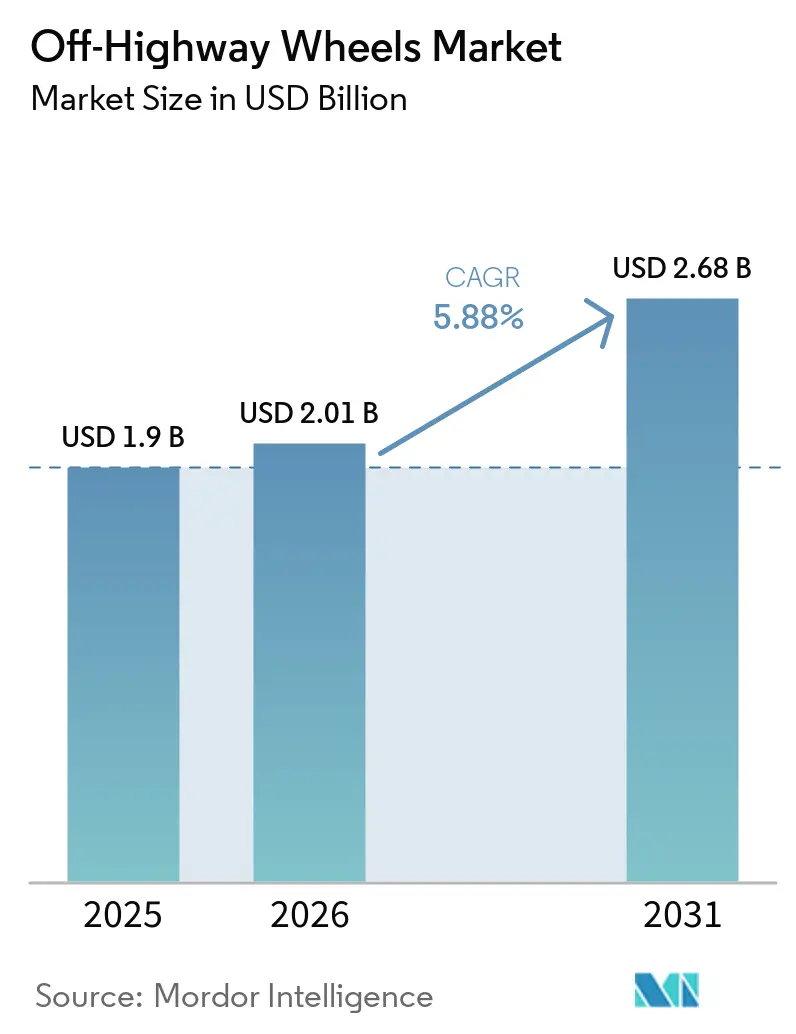
The off-highway wheels market size was valued at USD 1.90 billion in 2025 and is expected to grow from USD 2.01 billion in 2026 to reach USD 2.68 billion by 2031, at a 5.88% CAGR. The projected upswing rests on synchronized infrastructure build-outs and mechanized farming programs that are reshaping equipment preferences in high-growth economies. Mega-projects in Asia-Pacific and Africa are accelerating procurement of heavy machines that rely on robust, larger-diameter wheels, while carbon-footprint mandates are nudging OEMs toward lighter composite materials. Manufacturers also view smart sensor integration as a route to premium pricing because predictive maintenance minimizes downtime for end users. Near-shoring of production in North America and Eastern Europe further cushions supply-chain shocks by shortening lead times and lowering logistics risk.
Key Report Takeaways
- By product type, steel wheels led with 70.14% of the Off-Highway Wheels market share in 2025; composite wheels will advance at a 9.05% CAGR through 2031.
- By wheel size, the 20–30 inch segment accounted for 49.33% of the Off-Highway Wheels market size in 2025, whereas wheels above 30 inches are poised to grow at a 7.86% CAGR.
- By application, construction equipment captured 41.25% revenue share in 2025, and mining equipment is projected to accelerate at an 8.33% CAGR to 2031.
- By end use, OEM sales held a 56.03% share of the Off-Highway Wheels market size in 2025 and will expand at a 6.51% CAGR through 2031.
- By geography, Asia-Pacific controlled 44.12% of 2025 revenue and is set to climb at a 7.24% CAGR.
Note: Market size and forecast figures in this report are generated using Mordor Intelligence’s proprietary estimation framework, updated with the latest available data and insights as of January 2026.
Market Trends and Insights
Drivers Impact Analysis of Off-Highway Wheels Market*
| Driver | (~) % Impact on CAGR Forecast | Geographic Relevance | Impact Timeline |
|---|---|---|---|
| Shift to Larger Diameters | +1.2% | Global | Short term (≤ 2 years) |
| Infrastructure Megaprojects | +1.0% | Asia-Pacific, Middle East and Africa | Medium term (2-4 years) |
| Carbon-Footprint Targets | +0.9% | EU, North America | Long term (≥ 4 years) |
| Rapid Farm Mechanization | +0.8% | Asia-Pacific, Africa | Long term (≥ 4 years) |
| Smart-Sensor Wheels | +0.7% | North America, EU expanding to Asia-Pacific | Medium term (2-4 years) |
| Near-Shoring of Production | +0.6% | North America, Mexico, Eastern Europe | Medium term (2-4 years) |
| Source: Mordor Intelligence | |||
OEM Migration to Larger Wheel Diameters
Global equipment builders have already upsized standard wheel offerings by 2–4 inches, citing lower ground pressure, improved stability, and better operator comfort. Caterpillar’s next-gen excavators boast larger wheels than earlier models, while John Deere’s flagship tractors push diameter boundaries to cut compaction on soft soil. These changes invite premium wheel pricing but force suppliers to install new press lines and welding robots capable of handling wider drop-centers. Fast-follow firms lacking capex flexibility are teaming with contract fabricators, but their margins compress because OEMs stipulate PPM defect targets.
Infrastructure Megaprojects in Emerging Markets
Governments in Asia-Pacific and Africa are underwriting record-scale public works, ranging from expressways to energy corridors, that require immediate deployment of heavy machinery. India’s National Infrastructure Pipeline budgeted USD 1.4 trillion for projects by FY2024-25, while Egypt’s New Administrative Capital has already pulled in a significant number of excavators and loaders. Wheels must withstand continuous duty cycles, extreme axle loads, and abrasive terrain, steering OEMs to specify reinforced rims and deep-section designs. Because construction consortia operate under tight completion schedules, they prefer larger diameters that promise fewer tire changes and reduced downtime. Belt and Road initiatives across 65 countries amplify cross-border demand, prompting Western suppliers to form joint ventures with local assemblers to secure reliable aftermarket access.
Carbon-Footprint Targets Driving Alloy / Composite Uptake
European emissions legislation pushes OEMs to trim equipment weight, accelerating the switch from steel to aluminum and carbon-fiber composites. Construction machinery vendors are mandating lightweight wheel packages for every model in their carbon-neutral pledge, creating price premiums for qualified suppliers. Certification labs now test laminate wheels for impact toughness and fatigue at temperatures down to –40 °C, but approvals stretch 18–24 months, favoring Tier-1 manufacturers ready to fund long pilot runs. Composite wheels deliver significant weight savings, improving fuel efficiency and supporting corporate ESG metrics.
Rapid Farm Mechanization Across Asia-Pacific and Africa
Buoyed by subsidies that opened credit lines for smallholders, Thailand witnessed significant growth in its agricultural equipment market, alongside a rise in tractor imports. Farm operators switching from animal traction to mid-horsepower tractors now seek wheels that balance flotation with soil protection. Local rim fabricators in Vietnam and Nigeria have responded by offering value-priced assemblies with optimized bead seats and adaptable disc patterns. OEMs that once shipped universal wheel kits now localize specifications to regional soil profiles, raising the bar for global suppliers to maintain inventory breadth. Because mechanization is linked to food-security goals, orders flow throughout the calendar year rather than clustering around harvest, smoothing demand for wheel manufacturers.
Restraints Impact Analysis of Off-Highway Wheels Market*
| Restraint | (~) % Impact on CAGR Forecast | Geographic Relevance | Impact Timeline |
|---|---|---|---|
| Steel and Aluminum Price Volatility | -0.4% | Global, acute in Asia-Pacific | Short term (≤ 2 years) |
| Raw-Material Supply Disruptions | -0.3% | Europe, North America | Medium term (2-4 years) |
| Track-System Substitution | -0.2% | North America, EU | Long term (≥ 4 years) |
| Certification Lag for Composites | -0.1% | EU, North America | Short term (≤ 2 years) |
| Source: Mordor Intelligence | |||
Steel and Aluminum Price Volatility
In 2025, energy costs and blast-furnace outages significantly impacted steel prices, while aluminum prices experienced a notable increase year-on-year. Wheel producers locked into OEM frame contracts struggled to pass surcharges downstream, eroding margins. Smaller firms without derivatives hedges faced liquidity crunches and accelerated M&A discussions. Some shifted to scrap-based EAF supplies, but quality consistency issues limited adoption.
Raw-Material Supply-Chain Disruptions
Port congestion elongated alloy delivery times, compelling European factories to raise safety stocks and tie up working capital. Specialized epoxy resins for composite rims faced six-month lead times when East Asian plants shut down for maintenance. OEMs with vertically integrated steel mills cushioned the blow, but mid-tier suppliers scrambled for secondary sources and paid airfreight premiums, undermining cost competitiveness [1].
*Our forecasts treat driver/restraint impacts as directional, not additive. The impact forecasts reflect baseline growth, mix effects, and variable interactions.
Off-Highway Wheels Market Segment Analysis
By Product Type:
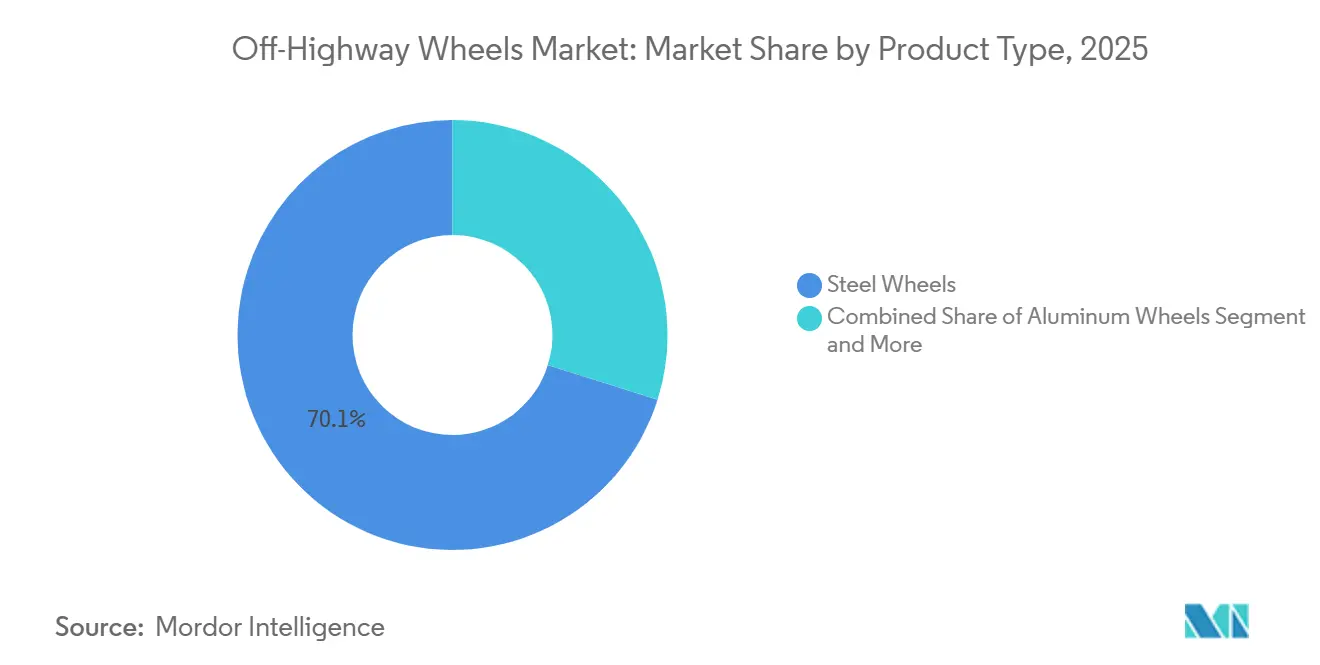
Steel Dominance Faces Composite ChallengeSteel wheels accounted for 70.14% of 2025 revenue because global supply chains deliver predictable quality at competitive cost. Composite wheels will grow fastest at a 9.05% CAGR, as OEMs chase notable weight savings that translate into lower fuel burn. Aluminum wheels serve mid-tier niches, offering corrosion resistance at modest premiums, while alloy wheels target specialty mining and marine applications. Certification lags and tooling expense slow composite penetration, but premium price points offset capital outlays, attracting both incumbents and new entrants. Steel retains strength in cost-sensitive regions where established forging and welding infrastructure favors high-volume throughput.
Composite wheels entice early adopters through sustainability credits and operator comfort gains derived from dampened vibration. OEM marketing teams position lightweight rims as productivity enhancers, citing reduced soil compaction and longer component life. Suppliers in North America and Europe highlight recycled carbon fiber content to appeal to ESG-driven buyers. Asian vendors counter with hybrid steel-composite constructions that cut costs while shrinking mass, thereby extending steel’s relevance in the Off-Highway Wheels market.

By Wheel Size:
Larger Diameters Drive Performance EvolutionWheels spanning 20–30 inches delivered 48.33% of 2025 sales, balancing maneuverability and load capacity for mainstream construction and agricultural platforms. Assemblies above 30 inches will be climbing at a 7.86% CAGR to 2031, spurred by heavier payload requirements in mining haul trucks and high-flotation tractors. Below-20-inch wheels are losing share as compact equipment shifts to rubber tracks, but remain essential for backhoes and compact telehandlers operating in confined spaces.
The move toward larger diameters supports OEM objectives to lower ground pressure and widen contact patches, thereby improving tractive efficiency and operator comfort. Suppliers must invest in larger spin-forming machines and robotic welding cells to meet run-out tolerances on oversized rims. The capital burden justifies higher selling prices, enhancing revenue per unit but also raising barriers for late entrants.
By Application:
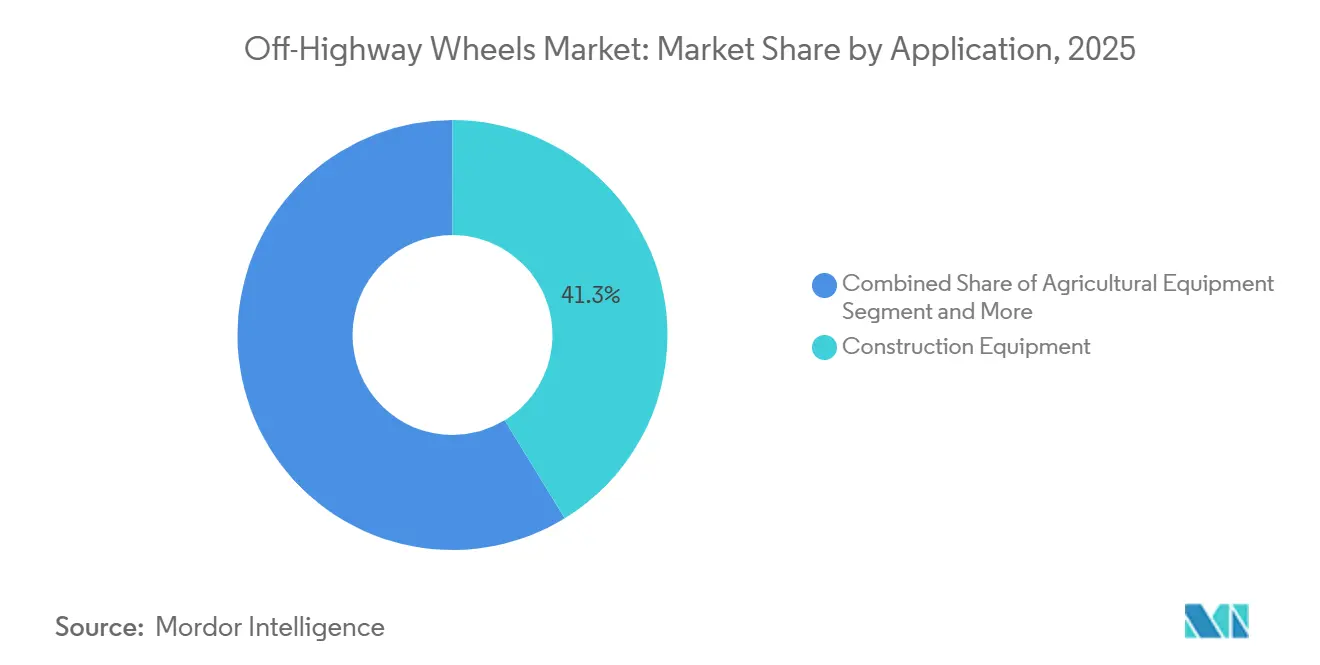
Construction Leads While Mining AcceleratesConstruction equipment absorbed 41.25% of the 2025 revenue, due to continuous residential and commercial development pipelines worldwide. Machines such as articulated dump trucks and wheel loaders require versatile wheels that juggle on-site mobility with highway transit regulations. Mining equipment wheels will advance at an 8.33% CAGR and command the highest ASPs because heat-treated discs and reinforced flanges withstand massive payloads and extreme braking cycles. Agricultural machinery displayed consistent replacement demand tied to planting and harvest calendars, while industrial vehicles filled customized roles in ports and warehouses.
In mining, wheels above 30 inches dominate due to payload growth in ultra-class trucks. Suppliers coat rim flanges with anti-corrosion treatments and integrate bead-seat wear indicators to support stringent safety audits. Construction equipment still favors steel wheels for cost reasons, but premium urban projects specify aluminum to manage environmental noise and weight limitations on elevated roadways.
By End Use:
OEM Channel Dominates Growth StrategyOEM transactions generated 56.03% of 2025 sales because integrated design cycles embed wheel specifications early in the platform roadmap. The same segment is poised for the fastest growth at a 6.51% CAGR through 2031. OEM contracts ensure predictable volumes and lock in technical intimacy, but demand round-the-clock engineering support and PPAP documentation. Aftermarket sales compensate through higher gross margins, selling replacement rims to fleets and rental companies that upgrade machinery mid-life.
OEM revenue streams rise in tandem with machine production runs fueled by infrastructure funding, whereas aftermarket volumes fluctuate with equipment utilization rates and commodity pricing. Data-enabled wheels may shift aftermarket dynamics by enabling predictive replacement scheduling, giving original suppliers an edge over independent resellers.
Geography Analysis
APAC Off-Highway Wheels Market
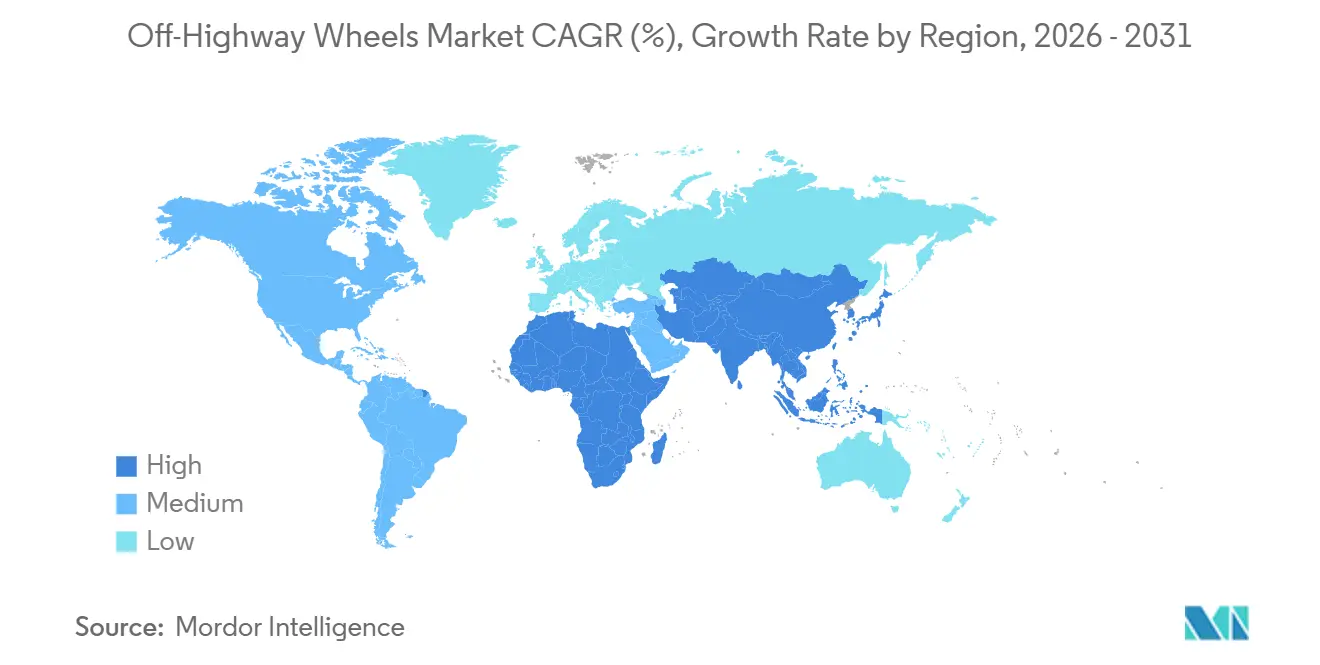
Asia-Pacific accounted for 44.12% of the Off-Highway Wheels market revenue in 2025 and will grow at a 7.24% CAGR through 2031. China’s Belt and Road Initiative pumps capital into cross-border rail and highway assets, sustaining demand for earth-moving equipment. India’s mechanization drive spurs tractor and skid-steer orders across rural cooperatives. ASEAN nations fast-track industrial park construction, boosting demand for telehandler and crane wheels. Supply-chain density in the region ensures material availability, while governmental tax rebates entice OEMs to co-locate final assembly.
North America Off-Highway Wheels Market
North America retains a sizable slice of global turnover owing to pipeline rehabilitation projects, renewable-energy installations, and corn-belt agriculture upgrades. The CHIPS Act stimulates fabrication of semiconductor plants that require specialized heavy lifters, translating into niche wheel demand. Reshoring trends draw Titan International and Maxion Wheels to expand Illinois and Ontario factories, shortening cycle times and aligning with Buy American preferences [2].
Europe Off-Highway Wheels Market
Europe foregrounds decarbonization. EU regulations that penalize emissions intensify composite wheel adoption. Germany’s quarry equipment segment opts for sensor-laden rims to comply with predictive maintenance directives that aim to eliminate catastrophic failures. Eastern European construction booms benefit from cohesion-fund allocations, and local rim makers upgrade presses to meet Western OEM tolerance requirements.
Competitive Landscape
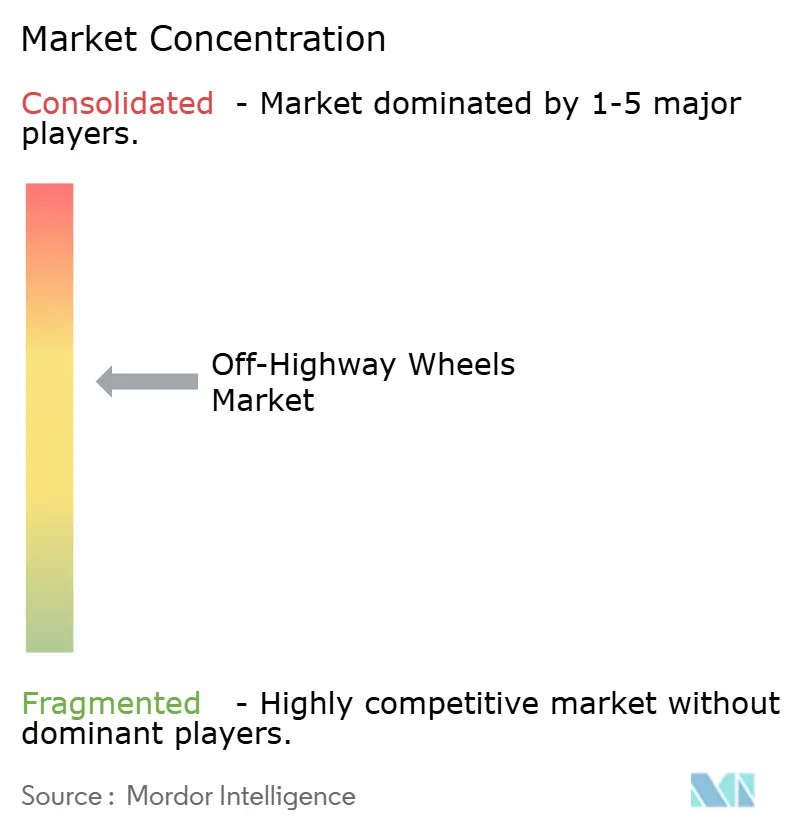
The market shows moderate concentration. Titan International, Maxion Wheels, and Accuride jointly control a significant revenue share, followed by regional contenders like Wheels India and Rodaros. Competitive thrusts focus on composite R&D, sensor integration, and strategic proximity to OEM assembly lines. Titan’s 2025 tie-up with Rodaros strengthened South American footholds, while Maxion retrofits its Czech facility for carbon-fiber spokes [3].
Patenting activity spikes around embedded electronics that monitor wheel health and feed data into cloud platforms. Tier-1 suppliers leverage deep pockets to absorb certification costs for next-gen composites, whereas smaller firms compete on localized tooling and quick-turn customization.
M&A chatter circles around sensor start-ups, suggesting that wheel makers will vertically integrate electronics to safeguard margins. Fragmentation persists in developing economies where local manufacturers tender for government infrastructure fleets with cost-advantaged steel wheels.
Off-Highway Wheels Industry Leaders
-
Titan International, Inc.
-
Maxion Wheels
-
moveero (GKN Wheels)
-
Accuride Corporation
-
Topy Industries, Ltd.
- *Disclaimer: Major Players sorted in no particular order
Off-Highway Wheels Market Companies Covered in this Report
- Titan International, Inc.
- Maxion Wheels
- moveero (GKN Wheels)
- Accuride Corporation
- Topy Industries, Ltd.
- RIMEX
- JANTSA
- Wheels India Limited
- The Carlstar Group
- Unverferth Manufacturing Co., Inc.
- Levypyörä Oy (Nokian Heavy Tyres Ltd)
- Global Wheel the Americas, LLC
- Dexstar Wheel
- Vlukon B.V.
- Zhejiang Jingu Co., Ltd.
- Trelleborg Wheel Systems (Yokohama TWS)
Recent Industry Developments in Off-Highway Wheels Market
- September 2026: OTR Engineered Solutions, headquartered in Rome, Georgia, United States, introduced OTR3DLab, a physical prototyping service designed to reduce development timelines for off-highway tires, wheels, tracks, and related components. The service enables customers to mount full-scale, 3D-printed physical tire prototypes directly onto standard steel or aluminum wheels using conventional tire-mounting equipment.
- March 2026: Following years of engineering development and large-scale field testing, Global Air Cylinder Wheels (GACW), the Phoenix-based developer of the Air Suspension Wheel (ASW), announced a key milestone in its transition from research and development to commercial deployment in 2026. The milestone followed successful extreme-condition validation trials at mining operations in Minnesota.
Global Off-Highway Wheels Market Report Scope
An off-highway wheel is a specialized type of wheel designed for vehicles that operate primarily off paved roads. These wheels are engineered to withstand the demanding conditions encountered in various off-highway environments, including agriculture, construction, mining, and industrial. They are typically built to handle rough terrain, heavy loads, and challenging weather conditions, ensuring durability, stability, and performance in extreme operating conditions.
The scope includes segmentation by product type (steel wheels, aluminum wheels, alloy wheels, and composite wheels), wheel size (below 20 inches, 20-30 inches, and above 30 inches), application (construction equipment, agricultural equipment, mining equipment, and industrial vehicles), and end use (OEM and aftermarket). The analysis also covers regional-level segmentation, including North America, South America, Europe, Asia-Pacific, and the Middle East and Africa. Market size and growth forecasts are presented by value in USD and volume in Units.
Segmentation Overview
| Steel Wheels |
| Aluminum Wheels |
| Alloy Wheels |
| Composite Wheels |
| Below 20 Inches |
| 20-30 Inches |
| Above 30 Inches |
| Construction Equipment |
| Agricultural Equipment |
| Mining Equipment |
| Industrial Vehicles |
| OEM |
| Aftermarket |
| North America | United States |
| Canada | |
| Rest of North America | |
| South America | Brazil |
| Argentina | |
| Rest of South America | |
| Europe | Germany |
| United Kingdom | |
| France | |
| Italy | |
| Spain | |
| Rest of Europe | |
| Asia-Pacific | China |
| India | |
| Japan | |
| South Korea | |
| Rest of Asia-Pacific | |
| Middle East and Africa | United Arab Emirates |
| Saudi Arabia | |
| South Africa | |
| Turkey | |
| Rest of Middle East and Africa |
| By Product Type | Steel Wheels | |
| Aluminum Wheels | ||
| Alloy Wheels | ||
| Composite Wheels | ||
| By Wheel Size | Below 20 Inches | |
| 20-30 Inches | ||
| Above 30 Inches | ||
| By Application | Construction Equipment | |
| Agricultural Equipment | ||
| Mining Equipment | ||
| Industrial Vehicles | ||
| By End Use | OEM | |
| Aftermarket | ||
| By Geography | North America | United States |
| Canada | ||
| Rest of North America | ||
| South America | Brazil | |
| Argentina | ||
| Rest of South America | ||
| Europe | Germany | |
| United Kingdom | ||
| France | ||
| Italy | ||
| Spain | ||
| Rest of Europe | ||
| Asia-Pacific | China | |
| India | ||
| Japan | ||
| South Korea | ||
| Rest of Asia-Pacific | ||
| Middle East and Africa | United Arab Emirates | |
| Saudi Arabia | ||
| South Africa | ||
| Turkey | ||
| Rest of Middle East and Africa | ||
Key Questions Answered in the Report
What factors will drive demand for larger wheel diameters through 2031?
OEMs continue upsizing wheels by 2–4 inches to improve stability, lower ground pressure, and enhance operator comfort, lifting the above-30-inch segment at a 7.86% CAGR.
How fast are composite wheels expected to grow over the forecast period?
Composite wheels will lead with a 9.05% CAGR to 2031 as weight-reduction mandates and carbon-footprint targets gain strength in Europe and North America.
Which region will post the highest CAGR and why?
Asia-Pacific is set to expand at a 7.24% CAGR due to sustained infrastructure outlays in China, India, and Southeast Asia coupled with resilient local supply chains.
Why do OEM channels command higher share than aftermarket sales?
OEM contracts bundle wheels into new-equipment builds, ensuring volume stability and technical integration, which secured a 56.03% share of 2025 revenue and a 6.51% CAGR outlook.