
Nucleating and Clarifying Agents Market Size and Share
Market Overview
| Study Period | 2021 - 2031 |
|---|---|
| Market Size (2026) | USD 443.96 Million |
| Market Size (2031) | USD 603.99 Million |
| Growth Rate (2026 - 2031) | 6.35 % |
| Fastest Growing Market | Asia-Pacific |
| Largest Market | Asia-Pacific |
| Market Concentration | Medium |
Major Players *Disclaimer: Major Players sorted in no particular order Image © Mordor Intelligence. Reuse requires attribution under CC BY 4.0. | |
Nucleating and Clarifying Agents Market Analysis by Mordor Intelligence
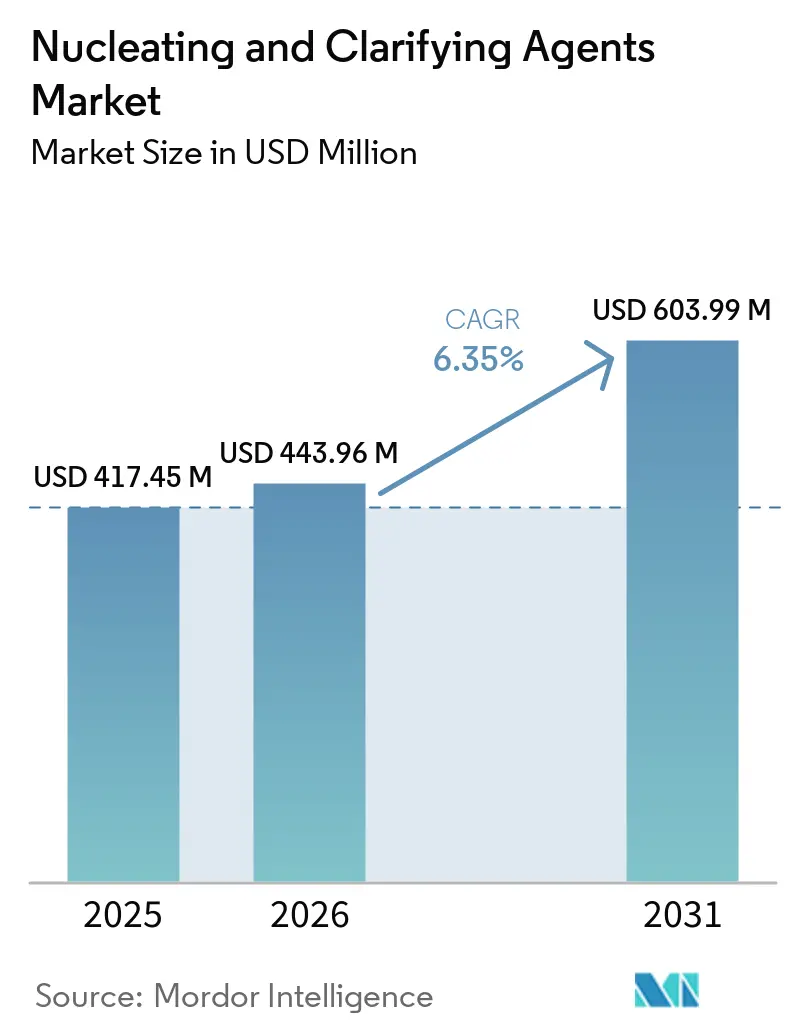
The Nucleating and Clarifying Agents Market size was valued at USD 417.45 million in 2025 and is estimated to grow from USD 443.96 million in 2026 to reach USD 603.99 million by 2031, at a CAGR of 6.35% during the forecast period (2026-2031). The nucleating and clarifying agents market is supported by processors that need faster polymer crystallization, shorter molding cycles, and better optical clarity in polypropylene (PP) products. Regulations on recycled content and packaging recyclability are shifting demand toward additives that can maintain processing performance in recycled polyethylene terephthalate (rPET) and recyclable PP formats. Packaging demand remains closely tied to clarity, stiffness, and the move away from multilayer structures that are harder to recycle. Suppliers are responding through higher-performance clarifiers, food-contact validation, and formulations that perform consistently in recycled resin streams, including variable post-consumer feedstocks used in demanding packaging and medical applications. The nucleating and clarifying agents market also faces pressure from local Chinese producers in standard grades, uneven recycled-resin quality, and restrictions on selected single-use plastic formats.
Key Report Takeaways
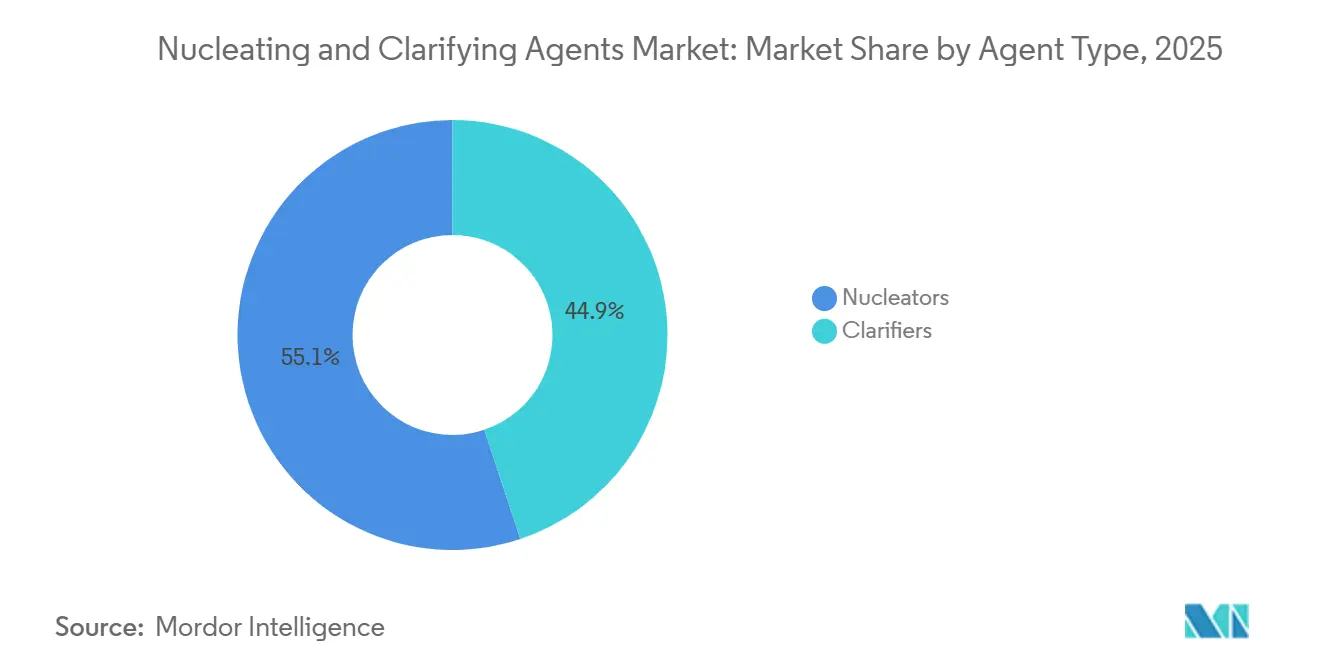
- By agent type, nucleators held 55.13% of the nucleating and clarifying agents market share in 2025, while clarifiers are projected to advance at a 6.84% CAGR through 2031.
- By form, powder held 57.72% of the nucleating and clarifying agents market share in 2025 and is projected to advance at a 6.91% CAGR through 2031.
- By polymer, polypropylene held 48.60% of the nucleating and clarifying agents market share in 2025, while polyethylene terephthalate is projected to advance at a 7.15% CAGR through 2031.
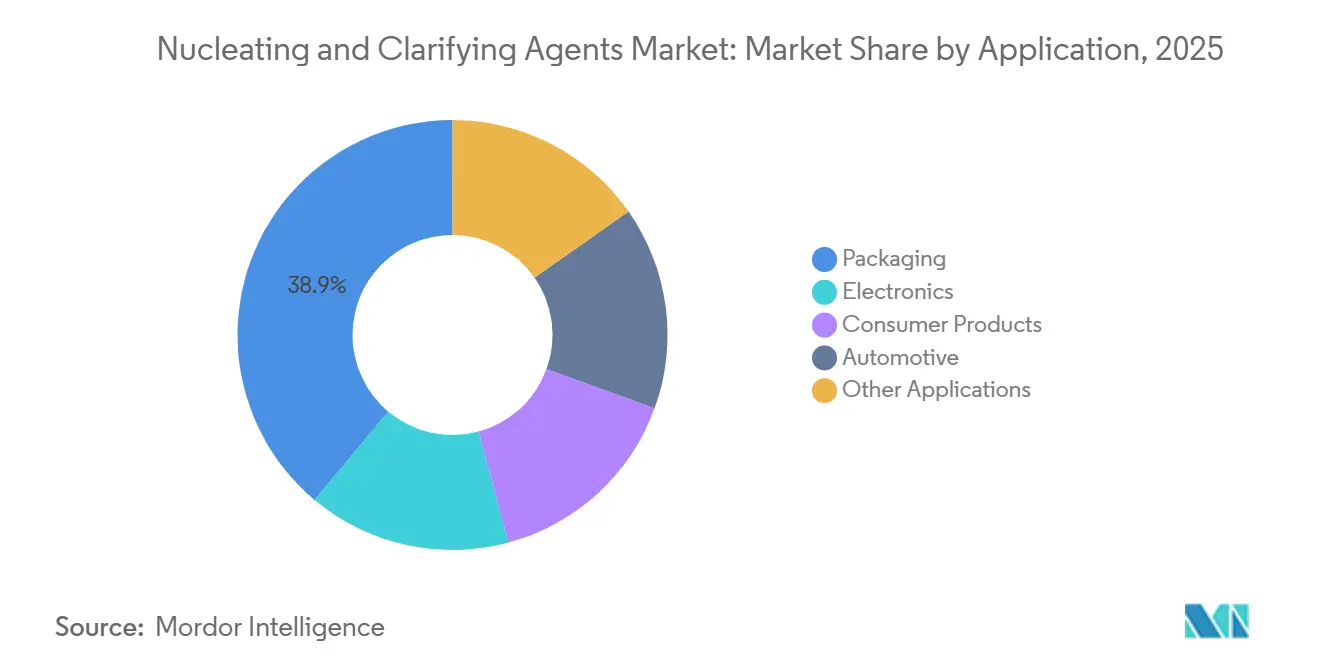
- By application, packaging held 38.91% of the nucleating and clarifying agents market share in 2025 and is projected to advance at a 7.36% CAGR through 2031.
- By geography, Asia-Pacific held 41.58% of the nucleating and clarifying agents market share in 2025 and is projected to advance at a 7.23% CAGR through 2031.
Note: Market size and forecast figures in this report are generated using Mordor Intelligence’s proprietary estimation framework, updated with the latest available data and insights as of January 2026.
Global Nucleating and Clarifying Agents Market Trends and Insights
Drivers Impact Analysis*
| Driver | (~) % Impact on CAGR Forecast | Geographic Relevance | Impact Timeline |
|---|---|---|---|
| Growth in Transparent and Lightweight Packaging | +1.8% | Global, with core concentration in Asia-Pacific and Europe | Short-term (≤ 2 years) |
| Automotive Lightweighting and Higher PP Content | +1.4% | Global, strongest in Asia-Pacific, Europe, and North America | Medium-term (2-4 years) |
| Recycled and Bio-Based Polymer Performance Requirements | +1.1% | Europe and North America primarily, with Asia-Pacific spillover | Medium-term (2-4 years) |
| Low-Dosage, Fast-Cycle Processing Economics | +0.9% | Global, strongest in Asia-Pacific and North America | Short-term (≤ 2 years) |
| Food-Contact and Medical-Grade Clarity Requirements | +0.7% | North America and Europe primarily, with ASEAN spillover | Medium-term (2-4 years) |
| Source: Mordor Intelligence | |||
Growth in Transparent and Lightweight Packaging
High-clarity PP is becoming more important in rigid food packaging, which makes clarifying agents part of a broader material substitution decision. Hyper-nucleation enables PP homopolymer containers to retain flexural modulus while delivering haze levels that were previously associated with polyethylene terephthalate (PET). This supports monomaterial formats that can use established PP sorting infrastructure. Regulation (EU) 2025/40 requires 30% recycled content in contact-sensitive packaging by 2030, increasing the need for packaging choices that can meet both material and visual requirements. Brand sustainability commitments are also making clarity a procurement requirement rather than a discretionary design feature. These conditions support the nucleating and clarifying agents market, where converters need transparent packaging without adding multilayer complexity.
Automotive Lightweighting and Higher PP Content
Automotive original equipment manufacturers are extending PP use into semi-structural and thermally demanding components. Nucleating agents improve stiffness, heat distortion temperature, and dimensional stability, which are relevant to electric vehicle battery housing covers that must balance thermal management and weight reduction. High-temperature PP composite programs demonstrate how nucleating agents are being specified in demanding automotive components. Beta-type nucleating agents are receiving attention for electric vehicle battery housings because impact absorption requirements can exceed the capability of alpha-type nucleants. The nucleating and clarifying agents market benefits when component makers specify crystallization control as part of the material design. This demand is strongest where vehicle manufacturing, PP supply, and lightweighting programs are expanding together.
Recycled and Bio-Based Polymer Performance Requirements
Mechanically recycled polymers have created demanding applications for nucleating agents, particularly in rPET. Directive 2019/904 requires PET beverage bottles to contain at least 25% recycled plastic from 2025 and 30% by 2030[1]“Directive 2019/904 on Single-Use Plastics,” Official Journal of the European Union, eur-lex.europa.eu. This requirement makes nucleant addition relevant to compliance and not only processing efficiency. A 2026 scientific study found that aromatic-amide sodium nucleating agents reduced rPET half-crystallization time from 17.6 minutes to 2.9 minutes and improved impact strength by up to 58.9%. Validated formulations for specific recycled resin profiles can create switching costs after food-contact review by the U.S. Food and Drug Administration (FDA) or the European Food Safety Authority (EFSA). The nucleating and clarifying agents market, therefore, has an opening for suppliers that can show repeatable performance in variable recycled feedstocks.
Low-Dosage, Fast-Cycle Processing Economics
Nucleating agents are generally used at low dosage, while their effect on crystallization can improve production throughput. Milliken presented Hyperform HPN 58ei for PP thermoforming with improved optical performance and isotropic shrinkage, and the product has FDA food-contact clearance. Faster cycles can be particularly valuable where molding-machine availability limits output, including parts of Southeast Asia and India. Better shrinkage control can also reduce scrap in high-speed packaging lines. The nucleating and clarifying agents market gains support when converters can add production capacity through process efficiency rather than new equipment. The economics remain relevant even when specialty chemical budgets are under pressure from input-cost inflation.
Restraints Impact Analysis*
| Restraint | (~) % Impact on CAGR Forecast | Geographic Relevance | Impact Timeline |
|---|---|---|---|
| Plastic Waste Regulation and Single-Use Plastic Restrictions | -1.2% | Europe and North America, extending progressively to Asia-Pacific | Short-term (≤ 2 years) |
| Raw Material Price Volatility and Formulation Cost Pressure | -0.9% | Global | Short-term (≤ 2 years) |
| Formulation Dosage, Migration, and Recycled-Resin Variability | -0.6% | Global, with heightened complexity in Europe and North America | Medium-term (2-4 years) |
| Source: Mordor Intelligence | |||
Plastic Waste Regulation and Single-Use Plastic Restrictions
Plastic-waste regulations can limit demand by reducing the volume of host polymers used in single-use applications. Directive 2019/904 requires reductions in beverage cup and food-container consumption by 2026 against 2022 baselines. Canada’s regulations restrict 6 categories of single-use plastic items through phased implementation that extended through December 2025. Standard clarifying grades in the nucleating and clarifying agents market face pressure in formats affected by these restrictions. At the same time, recyclability-compatible grades can benefit when converters reformulate existing products to meet new rules. CLARIANT launched AddWorks PPA 101 FG in June 2025 as a perfluoroalkyl and polyfluoroalkyl substances (PFAS)-free processing aid with food-contact approvals across several jurisdictions[2]“Clariant Launches Innovative PFAS-Free Polymer Processing Aids for More Sustainable Polyolefin Extrusion,” Clariant, clariant.com.
Raw Material Price Volatility and Formulation Cost Pressure
Sorbitol is the primary precursor to dibenzylidene sorbitol, methyl dibenzylidene sorbitol, and dimethyl dibenzylidene sorbitol clarifying agents. Its production from glucose through hydrogenation links clarifier costs to agricultural commodity cycles. Benzaldehyde, used in dibenzylidene sorbitol synthesis, adds a petrochemical input variable. Smaller regional producers such as GCH TECHNOLOGY CO.,LTD. and Shandong Rainwell New Materials Technology Co., Ltd. can be more exposed when these inputs rise together. Large suppliers can use vertical integration and long-term supply arrangements to manage these swings. Such cost pressure can reduce pricing flexibility in the nucleating and clarifying agents market and favor suppliers with broader specialty chemical operations.
*Our forecasts treat driver/restraint impacts as directional, not additive. The impact forecasts reflect baseline growth, mix effects, and variable interactions.
Segment Analysis
By Agent Type: Clarifiers Gaining Pricing Power Despite Nucleators Lead
Nucleators held 55.13% of the agent type segment in 2025. Their position reflected use in standard PP processing for packaging, automotive trim, and synthetic fiber. Inorganic nucleants, including sodium benzoate and talc, support standard stiffness requirements at lower unit cost. Organic phosphate-salt grades, including NA-11, can deliver higher crystallization temperatures for automotive and technical molding. The nucleating and clarifying agents market has a clear division between commodity inorganic products and premium organic grades. Commodity products face greater Chinese competition, while specialized products retain performance-based differentiation.
Clarifiers are projected to advance at a 6.84% CAGR through 2031. They are used in high-clarity food packaging, pharmaceutical containers, and medical devices where optical performance carries a price premium. FDA 21 Code of Federal Regulations (CFR) 178.3295 sets maximum-use concentrations for sorbitol-based clarifying agents in food-contact polymers. ADEKA CORPORATION introduced TRANSPAREX in November 2024, and it was recognized by Guinness World Records in 2025 for PP transparency. Milliken began commercial production of Millad ClearX 9000 in July 2026, increasing competition in advanced clarifier grades.


By Form: Powder Leads on Both Share and Growth
Powder accounted for 57.72% of the nucleating and clarifying agents market size in 2025 and is projected to advance at a 6.91% CAGR through 2031. This form is compatible with dry blending and twin-screw compounding systems used in commercial PP and PET processing. Capacity additions in China and India are generally designed for powder-compatible dosing systems. That equipment base supports continued powder use in large-volume processing. Demand in the nucleating and clarifying agents market is especially linked to compounding investment across the Asia-Pacific. This form remains practical for converters that prioritize throughput and established material-handling methods.
Granule-form agents have a stable role because they reduce dusting and simplify handling for processors that address Registration, Evaluation, Authorisation and Restriction of Chemicals (REACH) requirements. Liquid clarifiers remain smaller in use but can improve dispersion uniformity through melt-stream injection. This is valuable in thin-wall injection molding, where haze can expose uneven additive distribution. Avient Corporation states that Hiformer Clearview liquid clarifiers control crystallization uniformly through the polymer melt. Medical-device and pharmaceutical packaging applications can justify liquid systems where visible agglomerates result in product rejection. Specialized injection equipment limits wider adoption, which keeps liquid formats focused on applications that can support the performance premium.
By Polymer: PP Anchors Commercial Scale While PET Emerges as the Fastest-Growing Substrate
PP commanded 48.60% of the polymer segment in 2025. It is a major semi-crystalline thermoplastic in packaging, automotive, and consumer goods. Inorganic nucleants are used where standard clarity and cost control are important. Organic alpha-type phosphate-salt and sorbitol-derived agents can achieve higher crystallization temperatures for more demanding processing. Beta-type nucleants can improve impact resistance in automotive applications where toughness is a key material requirement. The nucleating and clarifying agents market continues to rely on PP because multiple nucleant chemistries can be matched to different processing and performance needs.
PET is projected to advance at a 7.15% CAGR through 2031. The requirement for recycled content in PET beverage bottles makes crystallization control more important in rPET processing. Supplier grades that are validated for particular recycled resin profiles and cleared for food contact can be difficult for converters to replace. This qualification work creates an opening in the nucleating and clarifying agents market. Polyethylene has a role in high-density polyethylene pipe compounds and low-density polyethylene films, where crystallization control supports mechanical performance. Polylactic acid and bio-based polyesters remain earlier-stage materials for additive development under programs intended to reduce fossil-based plastic use.
By Application: Packaging Leads on Revenue and Growth as Automotive Integration Deepens
Packaging held 38.91% of the application segment in 2025 and is projected to advance at a 7.36% CAGR through 2031. Consumer clarity preferences, recyclable monomaterial mandates, and e-commerce logistics support demand for stiff and clear containers. Rigid food containers, clear lids, and thermoformed trays are central applications for nucleated and clarified PP. Hyper-nucleation can provide stiffness and clarity without the multilayer structure that complicates mechanical recycling. Consumer products such as PP housewares, personal-care packaging, and cosmetic bottles also use clarifiers for visual presentation. Electronics packaging and device housings are another use case where nucleated PP can replace more expensive engineering plastics.
Automotive use is extending beyond interior appearance to parts that require thermal stability and dimensional control. High-temperature PP composite programs use nucleating-agent approaches for demanding automotive components. Electric vehicle battery tray programs require PP materials that combine low density, dimensional precision, and thermal stability. Beta-type nucleating agents are relevant where battery enclosures must absorb impact energy. Agricultural film and industrial containers add demand where processing efficiency matters more than optical performance. These application needs widen the nucleating and clarifying agents market beyond clear packaging while preserving packaging as the largest area of use.

Geography Analysis
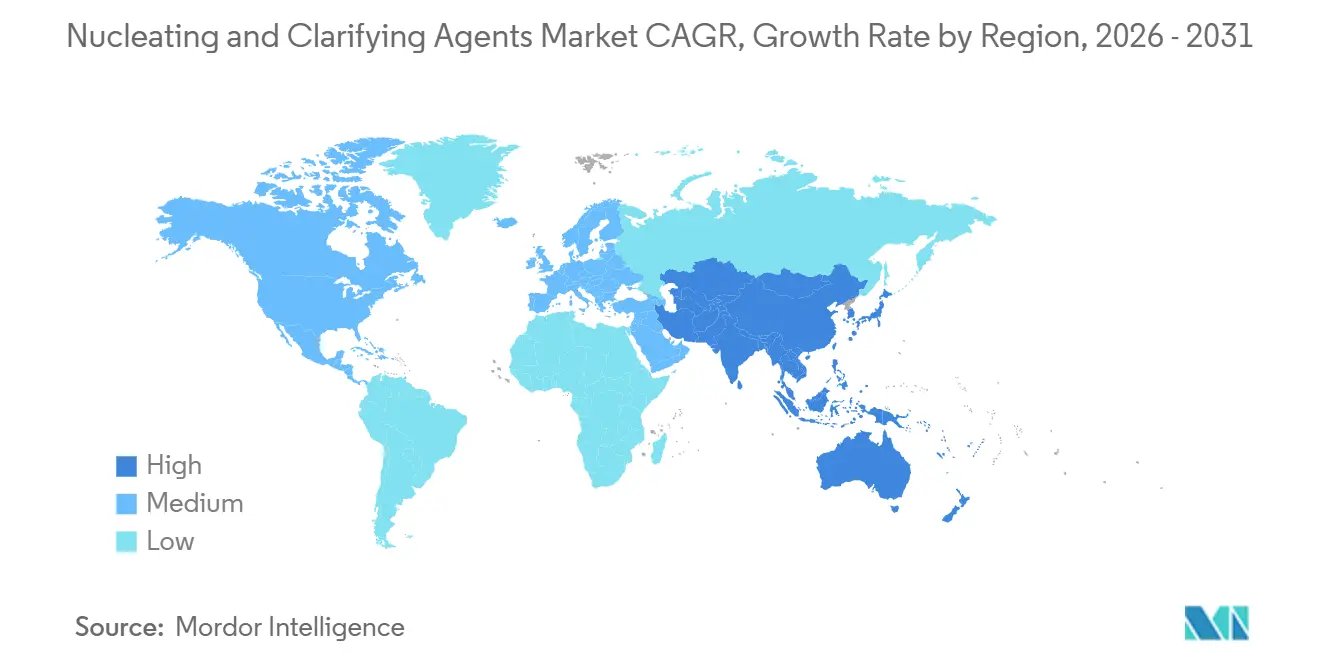
Asia-Pacific held 41.58% of the regional segment in 2026 and is projected to advance at a 7.23% CAGR through 2031. China’s PP production capacity increased from 28.82 million metric tons in 2020 to 49.17 million metric tons in 2025, creating a broad base for additive demand. This shift expanded local supply while increasing price pressure in standard grades. India is growing through polymer-processing capacity investment under the Production Linked Incentive (PLI) scheme and an expanding organized retail sector. The nucleating and clarifying agents market benefits in this region from large PP supply chains and rising demand for clear packaging.
North America and Europe form a technically demanding demand cluster within the nucleating and clarifying agents market. FDA food-contact clearance under 21 CFR 178.3295 is an access requirement for sorbitol and nonitol-derivative clarifying agents used in the United States and Canada. Mexico adds demand through its automotive manufacturing links with North American original equipment manufacturers. Europe’s regulatory requirements support demand for rPET nucleants and recyclability-compatible PP clarifiers. Germany combines automotive PP component production with the presence of ALTANA AG. The Nordic countries also provide compliance-led reformulation demand. These conditions favor suppliers with validated products and regulatory support.
South America and the Middle East and Africa are smaller regional segments with growing polymer-processing activity. Brazil leads South American demand through food and agricultural packaging production. Saudi Arabia’s expanding downstream petrochemical sector is increasing demand for specialty additives as domestic PP uses diversify. Argentina, ASEAN countries, and the rest of the Middle East and Africa add demand through organized retail development and pharmaceutical packaging growth. ADEKA CORPORATION announced a JPY 6.5 billion investment (approximately USD 43.3 million) in a TRANSPAREX manufacturing plant in South Korea, with commercial operations targeted for November 2028. The investment indicates the strategic role of Asia-Pacific in the global supply chain.

Competitive Landscape
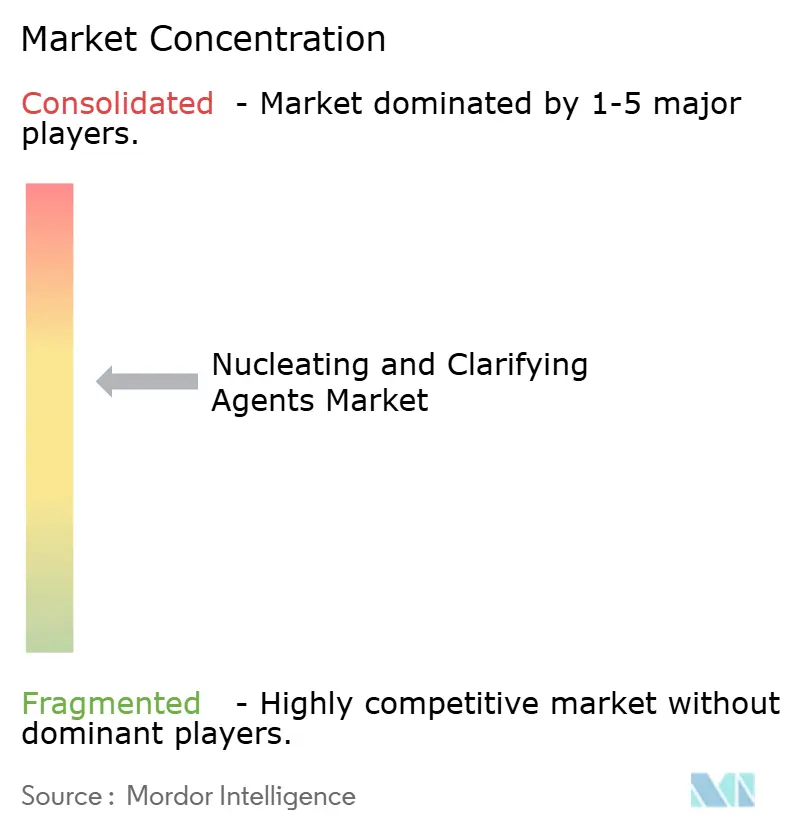
The nucleating and clarifying agents market is moderately concentrated, with the top five players including Milliken, ADEKA CORPORATION, BASF, Avient Corporation, and CLARIANT. New Japan Chemical Group, HPL Additives Limited, GCH TECHNOLOGY CO.,LTD., and regional masterbatch specialists compete in commodity nucleating grades. Milliken began dedicated commercial production capacity for Millad ClearX 9000 in India in July 2026. This move increases access to fifth-generation clarifier supply for packaging and consumer-goods customers. It also raises the standard for optical performance and supply proximity in the Asia-Pacific.
ADEKA CORPORATION announced a new South Korean TRANSPAREX manufacturing plant in September 2026. The JPY 6.5 billion investment (approximately USD 43.3 million) is the company’s first resin-additives capacity investment in 9 years and has a November 2028 commercial target. CLARIANT launched AddWorks PPA 101 FG in June 2025 with food-contact approvals in the United States, Europe, Mercosur, China, and Japan. These actions show a focus on capacity, regulatory qualification, and products designed for evolving processing requirements. The nucleating and clarifying agents market is becoming more dependent on proven compliance support. Chinese suppliers continue to gain share in commodity grades through cost competition. Global suppliers are responding by focusing on protected, compliance-validated, and premium formulations.
Openings remain in rPET-focused nucleating grades that have been validated for specific mechanically recycled resin profiles. Bio-based nucleating alternatives also align with efforts to reduce fossil-based plastics. Evonik Industries AG has a niche in high-purity specialty nucleants for medical-device polymers, where safety and traceability requirements are strict. Plastiblends and Polyvel Inc. use masterbatch distribution to reach smaller converters. ALTANA AG and Imerys provide specialty additive and mineral-nucleant portfolios for automotive and technical molding applications. The nucleating and clarifying agents market remains divided between price-driven standard grades and differentiated formulations with qualification barriers.
Nucleating and Clarifying Agents Industry Leaders
Milliken
ADEKA CORPORATION
BASF
Avient Corporation
CLARIANT
- *Disclaimer: Major Players sorted in no particular order

Recent Industry Developments
- July 2026: Milliken began commercial production of Millad ClearX 9000, a next-generation clarifier for polypropylene designed to improve transparency and processing efficiency. The dedicated capacity supports growing demand for clarifying agents in food packaging, consumer products, medical, and industrial PP applications.
- June 2025: CLARIANT launched AddWorks PPA 101 FG, a PFAS-free polymer processing aid for polyolefin extrusion. The development supports the nucleating and clarifying agents market by expanding additive solutions that improve polyolefin processing efficiency and surface quality while addressing the shift toward PFAS-free formulations.


Global Nucleating and Clarifying Agents Market Report Scope
Nucleating and clarifying agents are additives used to modify the crystallization behavior and optical properties of polymers. They help control crystal formation, improve material clarity, and enhance processing and performance characteristics.
The Nucleating and Clarifying Agents Market is segmented by agent type, form, polymer, application, and geography. By agent type, the market is segmented into nucleators and clarifiers. By form, the market is segmented into powder, granules, and liquid. By polymer, the market is segmented into polypropylene (PP), polyethylene (PE), polyethylene terephthalate (PET), and other polymers. By application, the market is segmented into packaging, consumer products, automotive, electronics, and other applications. The report also covers the market size and forecasts for nucleating and clarifying agents in 15 countries across major regions. For each segment, the market sizing and forecasts have been done on the basis of value (USD).
| Nucleators |
| Clarifiers |
| Powder |
| Granules |
| Liquid |
| Polypropylene (PP) |
| Polyethylene (PE) |
| Polyethylene Terephthalate (PET) |
| Other Polymers |
| Packaging |
| Consumer Products |
| Automotive |
| Electronics |
| Other Applications |
| Asia-Pacific | China |
| India | |
| Japan | |
| South Korea | |
| ASEAN Countries | |
| Rest of Asia-Pacific | |
| North America | United States |
| Canada | |
| Mexico | |
| Europe | Germany |
| United Kingdom | |
| France | |
| Italy | |
| NORDIC Countries | |
| Rest of Europe | |
| South America | Brazil |
| Argentina | |
| Rest of South America | |
| Middle East and Africa | Saudi Arabia |
| South Africa | |
| Rest of Middle East and Africa |
| By Agent Type | Nucleators | |
| Clarifiers | ||
| By Form | Powder | |
| Granules | ||
| Liquid | ||
| By Polymer | Polypropylene (PP) | |
| Polyethylene (PE) | ||
| Polyethylene Terephthalate (PET) | ||
| Other Polymers | ||
| By Application | Packaging | |
| Consumer Products | ||
| Automotive | ||
| Electronics | ||
| Other Applications | ||
| By Geography | Asia-Pacific | China |
| India | ||
| Japan | ||
| South Korea | ||
| ASEAN Countries | ||
| Rest of Asia-Pacific | ||
| North America | United States | |
| Canada | ||
| Mexico | ||
| Europe | Germany | |
| United Kingdom | ||
| France | ||
| Italy | ||
| NORDIC Countries | ||
| Rest of Europe | ||
| South America | Brazil | |
| Argentina | ||
| Rest of South America | ||
| Middle East and Africa | Saudi Arabia | |
| South Africa | ||
| Rest of Middle East and Africa | ||


Key Questions Answered in the Report
What is the size of the nucleating and clarifying agents market?
The nucleating and clarifying agents market stands at USD 443.96 million in 2026 and is projected to reach USD 603.99 million by 2031.
What is driving demand for nucleating and clarifying agents?
Clear and recyclable PP packaging, recycled PET processing needs, and faster molding cycles are supporting demand.
Which agent type is projected to advance fastest through 2031?
Clarifiers are projected to advance at a 6.84% CAGR through 2031, supported by food packaging, pharmaceutical containers, and medical devices.
Which polymer is projected to advance fastest through 2031?
PET is projected to advance at a 7.15% CAGR through 2031 as recycled-content requirements increase the need for crystallization control.
Page last updated on:


 Your data is secure and never sold or shared.


