
Transparent Plastics Market Size and Share
Market Overview
| Study Period | 2021 - 2031 |
|---|---|
| Market Size (2026) | USD 162.74 Billion |
| Market Size (2031) | USD 219.12 Billion |
| Growth Rate (2026 - 2031) | 6.13 % |
| Fastest Growing Market | Asia-Pacific |
| Largest Market | Asia-Pacific |
| Market Concentration | Medium |
Major Players *Disclaimer: Major Players sorted in no particular order Image © Mordor Intelligence. Reuse requires attribution under CC BY 4.0. | |
Transparent Plastics Market Analysis by Mordor Intelligence
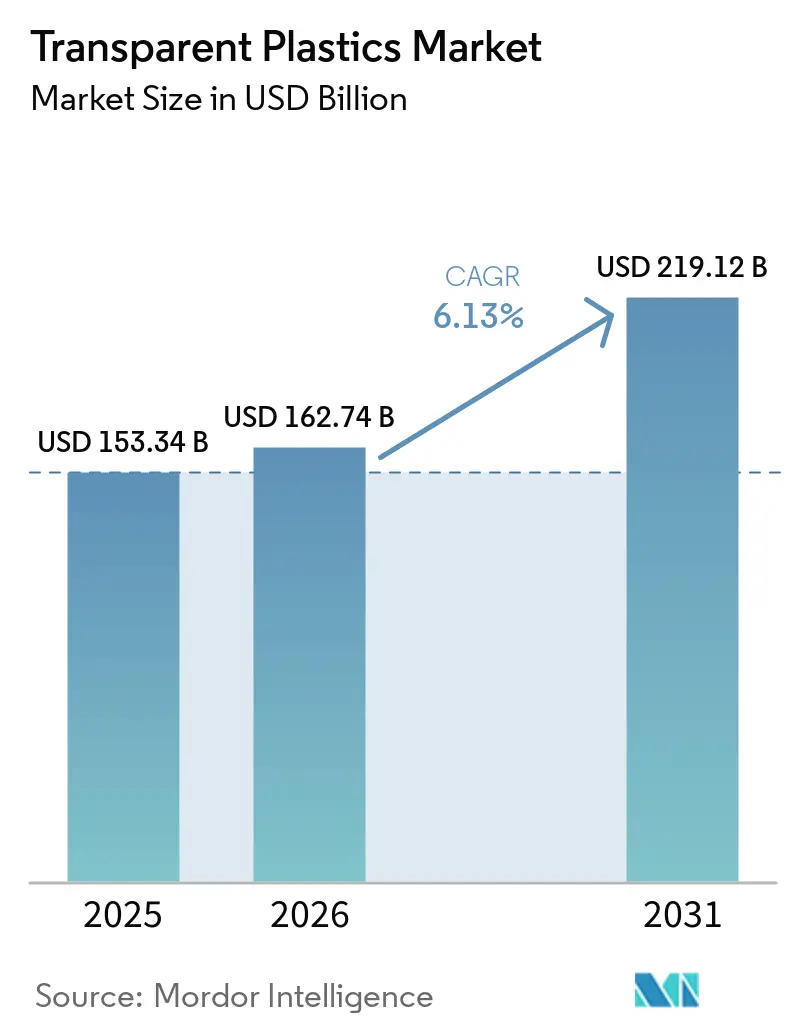
The Transparent Plastics Market size was valued at USD 153.34 billion in 2025 and is estimated to grow from USD 162.74 billion in 2026 to reach USD 219.12 billion by 2031, at a CAGR of 6.13% during the forecast period (2026-2031). The transparent plastics market is supported by packaging upgrades, vehicle lightweighting, healthcare requirements, and demand for clear materials in electronics and buildings, which together create requirements for materials with different processing and performance profiles. Producers are responding with recycled-content, bio-based, and higher-performance grades that can meet optical, safety, and processing requirements while responding to customer requests for clearer environmental documentation. The transparent plastics market also benefits where plastic replaces glass or metal because lower component weight can improve handling, reduce structural load, and enable functional integration in vehicle glazing or building systems. Feedstock costs and limited supplies of high-quality clear recyclate remain material constraints for suppliers and converters, especially where food-contact, medical, or high-clarity specifications restrict the available material choices and increase the importance of dependable material qualification. The transparent plastics market, therefore, depends on companies balancing cost control with investments in circular materials and application development, while keeping supply reliable for high-volume packaging and specialized engineering applications.
Key Report Takeaways
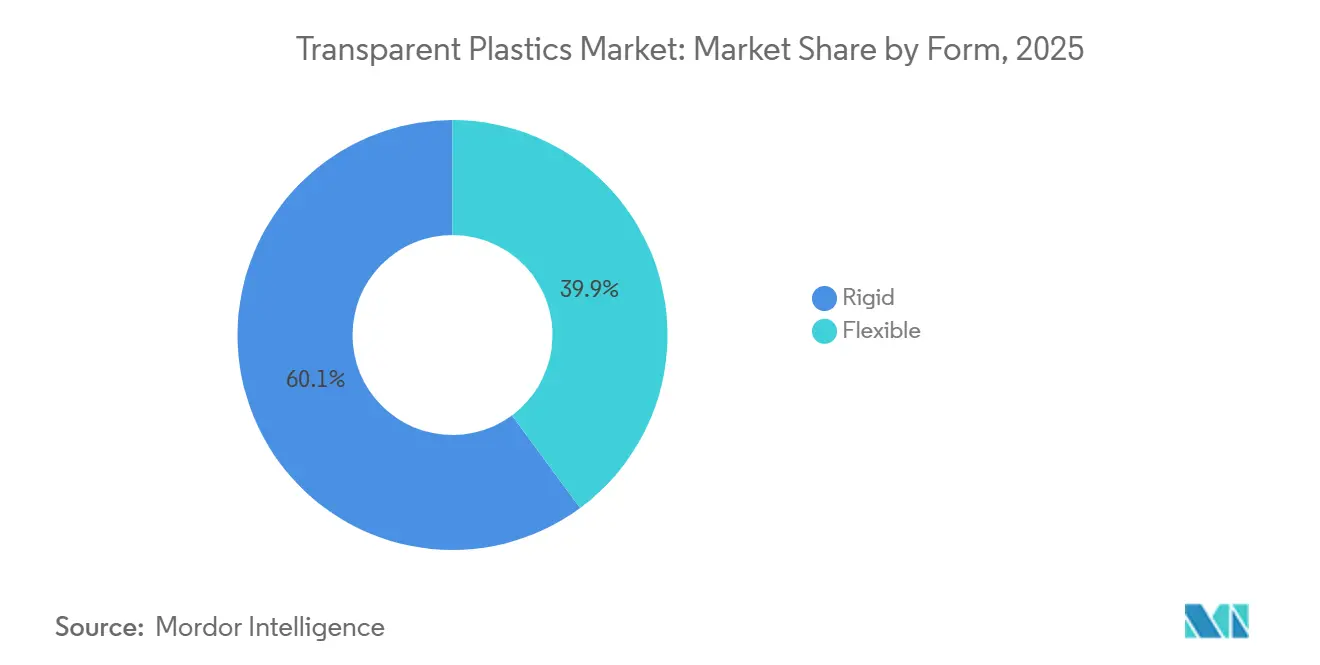
- By form, rigid held 60.13% of the transparent plastics market share in 2025, while flexible is projected to advance at a 6.87% CAGR through 2031.
- By polymer type, polyethylene terephthalate (PET) held 31.26% of the transparent plastics market share in 2025, while polycarbonate (PC) is projected to advance at a 6.93% CAGR through 2031.
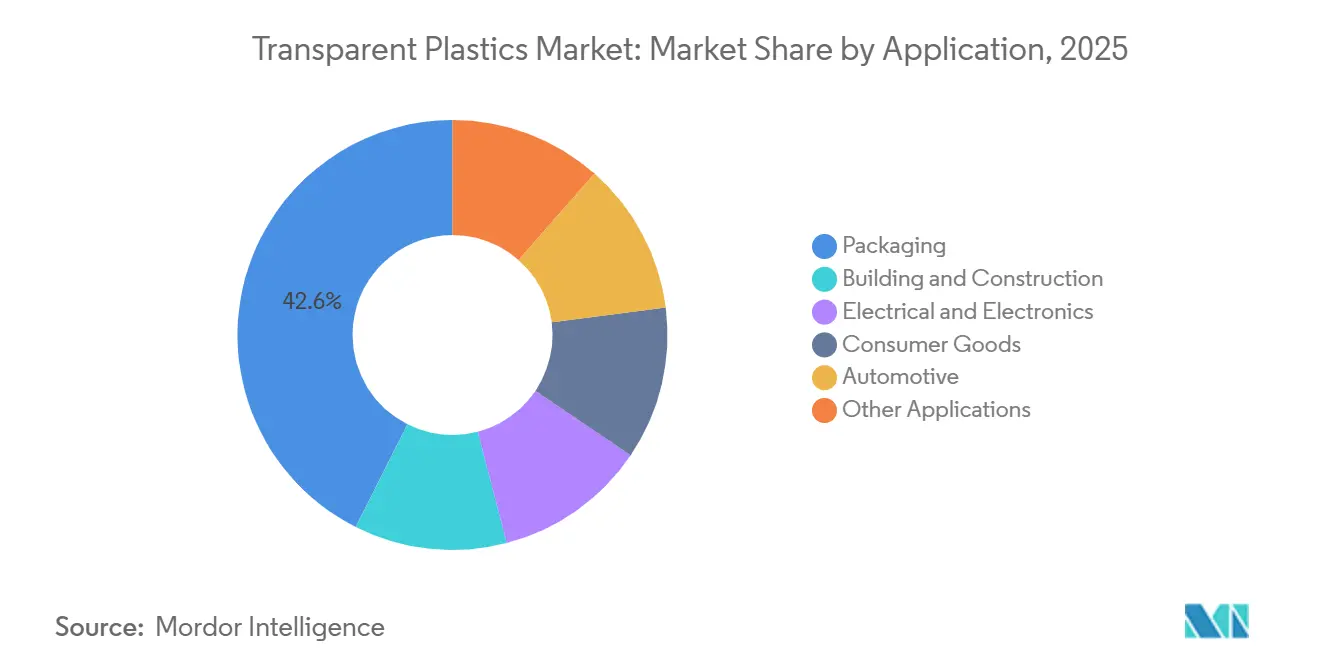
- By application, packaging held 42.57% of the transparent plastics market size in 2025, while automotive is projected to advance at a 7.15% CAGR through 2031.
- By geography, Asia-Pacific held 43.09% of the transparent plastics market share in 2025 and is projected to advance at a 7.04% CAGR through 2031.
Note: Market size and forecast figures in this report are generated using Mordor Intelligence’s proprietary estimation framework, updated with the latest available data and insights as of January 2026.
Global Transparent Plastics Market Trends and Insights
Drivers Impact Analysis*
| Driver | (~) % Impact on CAGR Forecast | Geographic Relevance | Impact Timeline |
|---|---|---|---|
| E-commerce and Premium Packaging Adoption | +1.8% | Global; highest intensity in APAC and North America | Short term (≤ 2 years) |
| Lightweighting and Glass Replacement in Automotive Applications | +1.5% | Global; APAC core, spillover to Europe and North America | Medium term (2–4 years) |
| Growth of Medical, Diagnostic, and Pharmaceutical Packaging | +1.1% | Global; anchor markets in North America, Europe, and APAC | Medium term (2–4 years) |
| Transparent Materials for Energy-Efficient Buildings and Electronics | +0.8% | Europe and North America; early gains in APAC urban centers | Long term (≥ 4 years) |
| Demand for Recyclable and Bio-Based Transparent Polymers | +0.7% | Europe and North America; expanding to APAC regulatory fronts | Medium term (2–4 years) |
| Source: Mordor Intelligence | |||
E-commerce and Premium Packaging Adoption
E-commerce has changed packaging requirements for the transparent plastics market across fast-moving distribution networks. Clear packaging now supports product visibility, tamper evidence, and physical protection during repeated handling, rather than serving only shelf-display needs. Demand is especially strong for high-clarity PET and copolyester formats that withstand multistep logistics while maintaining a clear view of the product. Retailers also use clear packaging to support private-label products that need a premium appearance and a closer visual match to branded goods. This requirement raises the minimum clarity standard even in packaging formats that were previously treated as commodity products. Eastman Chemical Company and PepsiCo have a multiyear arrangement for molecularly recycled PET in Gatorade bottles available in 2026. This example shows that recycled content and the optical quality expected in branded packaging can be pursued together.
Lightweighting and Glass Replacement in Automotive Applications
Automotive programs are expanding the use of PC beyond lamp lenses into structural glazing, panoramic roofs, and sensor housings. PC glazing can reduce window weight by up to 50% compared with glass of equivalent thickness. The material can reduce vehicle mass and support electric vehicle range and efficiency objectives. PCQ Technologies stated that full PC glazing could save 40 kg in a typical passenger vehicle as the technology moves toward series-produced electric vehicles. Functional glazing can also incorporate color-changing surfaces, photovoltaic layers, and head-up display films, changing glazing from a passive surface into an integrated vehicle component. Covestro AG and Anko Optics signed a September 2025 cooperation memorandum to develop functional automotive transparent plastic glazing. Hard-coated PC systems have demonstrated abrasion and weathering performance in testing, although movable side windows remain an important commercial qualification step.
Demand for Recyclable and Bio-Based Transparent Polymers
Regulatory requirements are making recyclable and bio-based grades more important within the transparent plastics market. The European Union Packaging and Packaging Waste Regulation entered into force in 2025 and sets packaging recycled-content requirements from 2030. These requirements create a clearer demand signal for high-quality, clear recyclate and bio-based resins across European supply chains. Arkema began operating a Rilsan Clear transparent polyamide unit in Singapore in January 2026. The USD 20 million investment tripled global capacity for the material and targeted eyewear, electronics, healthcare, and home-appliance uses. The transparent plastics market has an opportunity to replace conventional materials when bio-based grades satisfy clarity, sterilization, and performance requirements. Producers must still manage the cost and availability challenges that affect adoption across high-volume packaging applications.
Growth of Medical, Diagnostic, and Pharmaceutical Packaging
Medical and pharmaceutical packaging requires clear plastics that meet strict sterility, chemical-resistance, and dimensional requirements. This demand supports premium materials rather than standard commodity packaging grades because the requirements cannot be met by many standard grades. Amcor launched its AmSecure APET-based thermoformed medical packaging solution in October 2025, emphasizing clarity and sterilization compatibility. The wider use of biosimilars, glucagon-like peptide-1 medicines, and point-of-care diagnostics supports demand for high-value transparent containers. Regulatory guidance for polymer alternatives to primary containers can also make material substitution more practical. This demand base gives the transparent plastics market consistent requirements across medical trays, vials, and prefillable syringes.
Restraints Impact Analysis*
| Restraint | (~) % Impact on CAGR Forecast | Geographic Relevance | Impact Timeline |
|---|---|---|---|
| Crude Oil-Linked Feedstock Price Volatility | -1.4% | Global; most acute in APAC (naphtha-dependent) and Middle East | Short term (≤ 2 years) |
| Plastic Waste, Collection Gaps, and Low Recycling Yields | -1.0% | Global; most structurally significant in Europe and APAC | Long term (≥ 4 years) |
| Clarity Loss and Contamination in Recycled Transparent Resins | -0.7% | Global; particularly critical for food-contact and pharma packaging | Medium term (2–4 years) |
| Source: Mordor Intelligence | |||
Plastic Waste, Collection Gaps, and Low Recycling Yields
Collection systems do not yet provide enough high-quality, clear recyclate for regulated packaging uses. Circular plastics production in Europe grew 1.2% in 2024, while more than 70% of collected plastic waste was directed to incineration or landfill[1]Plastics Europe, “Circular Economy for Plastics 2026: Dramatic Slowdown in Europe’s Transition to a Circular Plastics System,” Plastics Europe, plasticseurope.org. Europe also relies on trade flows where collected material is recycled outside the region, and converter demand is met through imports. The available material can lose clarity through contamination, which limits food-contact and pharmaceutical applications. Brand owners face recycled-content requirements while converters need material that preserves the optical properties of clear packaging. These gaps slow the transition of the transparent plastics market toward more circular product portfolios.
Crude Oil-Linked Feedstock Price Volatility
Feedstock volatility remained a constraint for the transparent plastics market in 2026. Disruptions to petrochemical flows through the Strait of Hormuz raised polymer input costs across polyethylene, polypropylene, PET, and PC categories. PET producers face pressure from both purified terephthalic acid and monoethylene glycol inputs, which compound pricing pressure in the leading transparent polymer chain. PC costs are also exposed where regional production depends on naphtha-based cracking. Integrated producers can absorb cost changes more effectively than independent converters with limited feedstock access, which can favor vertically integrated suppliers. High-clarity grades offer less flexibility for lower-cost substitutions because optical specifications must be maintained. This difference makes cost volatility more difficult to manage for clear materials than for less demanding polymer formats.
*Our forecasts treat driver/restraint impacts as directional, not additive. The impact forecasts reflect baseline growth, mix effects, and variable interactions.
Segment Analysis
By Form: Rigid Anchors Revenue as Flexible Outgrows the Market
Rigid held 60.13% of the market revenue in 2025. Rigid formats serve pharmaceutical containers, beverage bottles, automotive lenses, and building glazing panels. These applications require dimensional stability, barrier performance, and optical clarity through production, distribution, and end use. PET, PC, Polymethyl Methacrylate (PMMA), and high-clarity polypropylene grades support the rigid format category. Food and beverage packaging uses this format because bottles, trays, and containers require consistent shapes and product visibility. Tooling investment and qualification cycles make switching established rigid packages difficult for both material suppliers and converters. Consumer acceptance testing also extends the time needed for a format change when packaging is visible to the buyer. Existing filling lines and downstream collection systems further support continued use of established rigid formats. These conditions preserve the role of rigid products in the transparent plastics industry. Their position also reflects the need for dependable barrier and structural performance in applications where failures can affect product safety or quality.
Flexible is projected to grow at a 6.87% CAGR through 2031. Its expansion reflects e-commerce packaging, agricultural films, and flexible electronics substrates. Multilayer structures with transparent PET and PMMA layers are used for fresh food, dairy products, and pharmaceutical blister packs. Anti-fog performance and product visibility can support their use in premium packaging, where product appearance remains part of the purchase decision. Transparent conductive PET films are also used as substrate layers in foldable smartphones and wearable devices. This creates demand beyond conventional packaging uses and links flexible materials with changing consumer-electronics designs. Flexible structures can meet different product needs through the selection and arrangement of barrier, sealant, and surface layers. High-clarity mono-PET and mono-polypropylene structures are being developed to improve end-of-life recyclability. These design requirements direct research activity toward flexible materials in the transparent plastics market. The segment must still protect products and maintain clarity while meeting increasingly important recycling requirements.


By Polymer Type: PET Dominates While Polycarbonate Scales in High-Value Applications
PET held 31.26% of the transparent plastics market size in 2025. It combines transparency, food-contact compliance, processing efficiency, and an established mechanical recycling infrastructure. Beverage, food, and personal care packaging use PET across global supply chains because resin processing and collection systems are well established. PET supports bottles, trays, and other clear formats where producers need a practical balance between clarity, throughput, and cost. Polyvinyl Chloride (PVC) remains relevant in medical tubing, blister films, and flexible packaging. PVC faces substitution pressure as restrictions on certain plasticizers become tighter in Europe and North America. High-clarity polypropylene grades are gaining use in rigid food packaging across the Asia-Pacific, supported by distributed regional processing infrastructure. Polystyrene (PS) continues in food service and point-of-purchase display applications. Its single-use profile has increased regulatory scrutiny in several countries. The transparent plastics industry continues to use each resin where its processing and performance characteristics match the application.
PC is projected to grow at a 6.93% CAGR through 2031. Automotive glazing, Advanced Driver Assistance Systems (ADAS) sensor lenses, and medical housings are central uses. PC provides impact resistance and 88% to 90% light transmittance in these applications. These characteristics support uses where a transparent component must also withstand mechanical stress, demanding temperatures, or repeated handling. SABIC introduced optical thermoplastic Extem RH1017UCL resin for sensor lenses and gesture-control systems at Plastics in Automotive Engineering (PIAE) 2026. PMMA remains important in glazing, lighting, and medical diagnostics, where its optical properties and processing options remain useful. Other materials include cyclic olefin copolymers and specialty transparent polyamides for applications requiring sterilization or high clarity. Suppliers can use these specialty polymers where standard resins cannot satisfy a specific optical or chemical-resistance requirement. The resulting polymer mix allows manufacturers to select materials according to the functional needs of each component.
By Application: Packaging Anchors Demand While Automotive Sets the Growth Pace
Packaging accounted for 42.57% of the transparent plastics market size in 2025. Product visibility supports its use across food, beverages, personal care, pharmaceuticals, and e-commerce. PET bottles, APET trays, and multilayer films consume a large share of output because they combine visibility with familiar production processes. Commodity clear packaging faces margin pressure from PET overcapacity in the Asia-Pacific. Healthcare and e-commerce packaging instead require differentiated copolyesters and optically engineered PMMA when performance requirements justify higher-value materials. Building, electronics, and consumer goods also require transparent materials for defined product functions. Packaging suppliers must also consider tamper evidence, product protection, and the appearance of the product after distribution. These uses maintain broad demand across the transparent plastics market. The scale of packaging makes material availability and recycling performance important considerations across the wider value chain.
Automotive is projected to advance at a 7.15% CAGR through 2031. Electric vehicles increase the value placed on lower-weight glazing, lamp housings, and interior trim. Each kilogram removed can support driving-range objectives, which gives material selection a direct role in vehicle design. Hard-coated PC systems have improved the practical case for wider automotive glazing adoption. Automakers also need materials that can support sensor integration and meet safety requirements for exterior components. Building applications use PMMA and PC systems in skylights and canopies where reduced structural load and thermal-management needs are important. Product-level environmental documentation can also influence architectural procurement decisions for transparent systems. Agricultural films and optical components add smaller demand pools linked to precision agriculture and augmented-reality devices. Together, these uses broaden the application base beyond packaging while retaining a need for application-specific material grades.

Geography Analysis
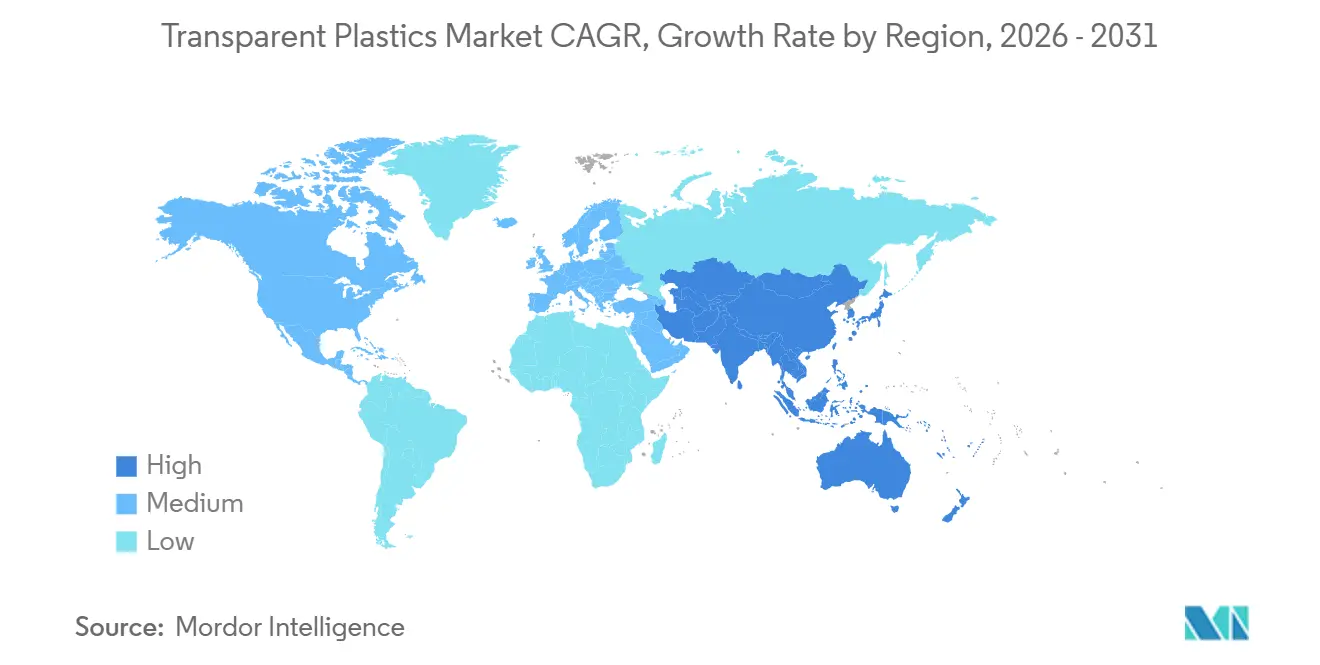
Asia-Pacific held 43.09% of the transparent plastics market share in 2025 and is projected to grow at a 7.04% CAGR through 2031. China supports regional demand through large packaging, consumer electronics, and automotive production networks, while circular-economy policies support requirements for recycled-content PET and polypropylene grades across regional supply chains. India has growing requirements for pharmaceutical packaging, transparent food-processing containers, and medical conversion capacity near pharmaceutical clusters. Japan and South Korea use optical-grade PC, PMMA lighting materials, and specialty PET films in technology-intensive applications, while ASEAN countries remain import-reliant for high-clarity PC and PMMA grades.
North America has demand from pharmaceutical packaging, premium food and beverage containers, and automotive lightweighting programs. The United States has substantial requirements for recycled-content PET and high-clarity copolyesters, while Mexico supports additional demand through consumer goods and automotive manufacturing for regional and export supply. Europe is shaped by quality and sustainability requirements under the Packaging and Packaging Waste Regulation, which creates a defined demand signal for circular clear resins and encourages the use of documented environmental performance. Eastman Chemical Company expanded Saflex LiteCarbon Clear PVB interlayer availability across Europe in January 2026. The product offers up to 37% lower embodied carbon than standard Saflex Clear, based on Environmental Product Declarations, while Germany and the UK remain important locations for automotive and packaging research and development.
South America centers on Brazil and Argentina for food, beverage, and transparent packaging demand, with Brazil using clear PET bottles, APET trays, and flexible packaging across its food-processing and organized retail sectors. Argentina has domestic PS and polypropylene capacity but relies on imports for some high-performance PC and PMMA grades, creating exposure to exchange-rate and global resin-price movements. Saudi Arabia and the United Arab Emirates are expanding packaging capacity through industrial diversification programs, while GCC cities are using transparent polymers in bus shelters, light-emitting diode fixtures, and smart-city structures. Recycling gaps and fragmented regulation remain constraints across the Middle East and Africa.

Competitive Landscape
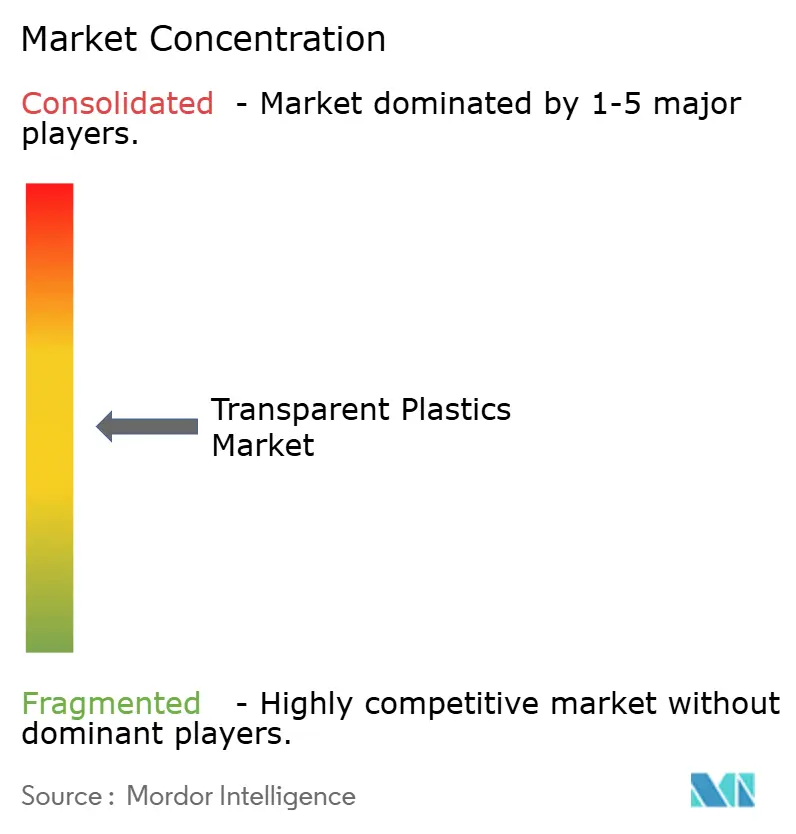
The transparent plastics market is moderately concentrated, with the top five players including SABIC, BASF, Covestro AG, Dow, and LyondellBasell Industries Holdings B.V. These companies compete on raw material efficiency, development speed, and sustainability credentials, including the ability to offer reliable materials for demanding end uses. Their strategies combine mechanical and chemical recycling with higher-performance grades for automotive and electronics. This approach aims to deliver recycled-content materials that still meet food-contact, medical, and optical requirements.
Covestro AG began expanding differentiated PC compounding capacity at Hebron, Ohio, in 2025, with operations scheduled to begin by the end of 2026[2]Covestro AG, “Additional Capacity for Differentiated Polycarbonates,” Covestro Press Release, covestro.com. BASF inaugurated its world-scale Verbund site in Zhanjiang, China, in March 2026, including engineering-plastics production in an integrated value chain. These investments reflect the importance of Asia-Pacific demand and differentiated polymer grades. Environmental Product Declarations and life-cycle assessments have become important qualification materials for key customers in Europe and North America.
Companies see opportunities in clear PET and PS recycling for food-contact uses, particularly where high-quality material can meet demanding packaging specifications. Functional transparent materials for ADAS, lidar, and autonomous vehicle systems are another area of competition. SABIC developed LNP Elcrin DC0051RC1 PC compound with 75% post-consumer-recycled content for consumer electronics housings. Transparent insulation and functional glazing suppliers compete through documented energy performance, product design, and direct engagement with building or vehicle customers. Digital material qualification and closer connections with automotive procurement teams can shorten development cycles and support application-specific supply arrangements. The transparent plastics market continues to reward producers that combine reliable supply with proven application performance.
Transparent Plastics Industry Leaders
SABIC
BASF
Covestro AG
Dow
LyondellBasell Industries Holdings B.V.
- *Disclaimer: Major Players sorted in no particular order

Recent Industry Developments
- April 2026: POLYVANTIS introduced PLEXIGLAS PMMA in India alongside its LEXAN polycarbonate film and sheet portfolio, expanding access to transparent thermoplastic solutions for roofing, skylights, façades, safety glazing, and other applications. The portfolio expansion supports broader adoption of transparent plastics as lightweight and durable alternatives to glass in construction and architectural applications.
- September 2025: Covestro AG signed a strategic cooperation memorandum with China’s Anko Optics to develop transparent engineering plastics for electric vehicles and future flying cars, including color-changing, photovoltaic-integrated, and display-embedded glazing. The collaboration supports the development of advanced polycarbonate glazing with lower weight, impact resistance, design flexibility, and functional integration, expanding the application scope of transparent plastics in mobility.


Global Transparent Plastics Market Report Scope
Transparent plastics are polymer materials that allow light to pass through with varying levels of clarity and transparency. They combine optical properties with characteristics such as lightweight construction, durability, and design flexibility for use in manufactured products.
The Transparent Plastics Market is segmented by form, polymer type, application, and geography. By form, the market is segmented into rigid and flexible. By polymer type, the market is segmented into polyethylene terephthalate (PET), polyvinyl chloride (PVC), polypropylene (PP), polystyrene (PS), polycarbonate (PC), polymethyl methacrylate (PMMA), and other polymer types. By application, the market is segmented into packaging, building and construction, electrical and electronics, automotive, consumer goods, and other applications. The report also covers the market size and forecasts for transparent plastics in 15 countries across major regions. For each segment, the market sizing and forecasts have been done on the basis of value (USD).
| Rigid |
| Flexible |
| Polyethylene Terephthalate (PET) |
| Polyvinyl Chloride (PVC) |
| Polypropylene (PP) |
| Polystyrene (PS) |
| Polycarbonate (PC) |
| Polymethyl Methacrylate (PMMA) |
| Other Polymer Types |
| Packaging |
| Building and Construction |
| Electrical and Electronics |
| Automotive |
| Consumer Goods |
| Other Applications |
| Asia-Pacific | China |
| India | |
| Japan | |
| South Korea | |
| ASEAN Countries | |
| Rest of Asia-Pacific | |
| North America | United States |
| Canada | |
| Mexico | |
| Europe | Germany |
| United Kingdom | |
| France | |
| Italy | |
| NORDIC Countries | |
| Rest of Europe | |
| South America | Brazil |
| Argentina | |
| Rest of South America | |
| Middle East and Africa | Saudi Arabia |
| South Africa | |
| Rest of Middle East and Africa |
| By Form | Rigid | |
| Flexible | ||
| By Polymer Type | Polyethylene Terephthalate (PET) | |
| Polyvinyl Chloride (PVC) | ||
| Polypropylene (PP) | ||
| Polystyrene (PS) | ||
| Polycarbonate (PC) | ||
| Polymethyl Methacrylate (PMMA) | ||
| Other Polymer Types | ||
| By Application | Packaging | |
| Building and Construction | ||
| Electrical and Electronics | ||
| Automotive | ||
| Consumer Goods | ||
| Other Applications | ||
| By Geography | Asia-Pacific | China |
| India | ||
| Japan | ||
| South Korea | ||
| ASEAN Countries | ||
| Rest of Asia-Pacific | ||
| North America | United States | |
| Canada | ||
| Mexico | ||
| Europe | Germany | |
| United Kingdom | ||
| France | ||
| Italy | ||
| NORDIC Countries | ||
| Rest of Europe | ||
| South America | Brazil | |
| Argentina | ||
| Rest of South America | ||
| Middle East and Africa | Saudi Arabia | |
| South Africa | ||
| Rest of Middle East and Africa | ||


Key Questions Answered in the Report
What is the size of the transparent plastics market?
The transparent plastics market stands at USD 162.74 billion in 2026 and is projected to reach USD 219.12 billion by 2031.
What is driving demand for transparent plastics?
Packaging upgrades, automotive lightweighting, medical packaging, electronics, and building applications support demand.
Which form led the market share in 2025?
Rigid held 60.13% of the market share in 2025, supported by packaging, healthcare, automotive, and glazing uses.
Which polymer type is projected to grow fastest through 2031?
Polycarbonate (PC) is projected to advance at a 6.93% CAGR through 2031, supported by glazing, sensor lenses, and medical device housings.
Page last updated on:





