
Market Overview
| Study Period | 2019 - 2030 |
|---|---|
| Forecast Data Period | 2025 - 2030 |
| Historical Data Period | 2019 - 2023 |
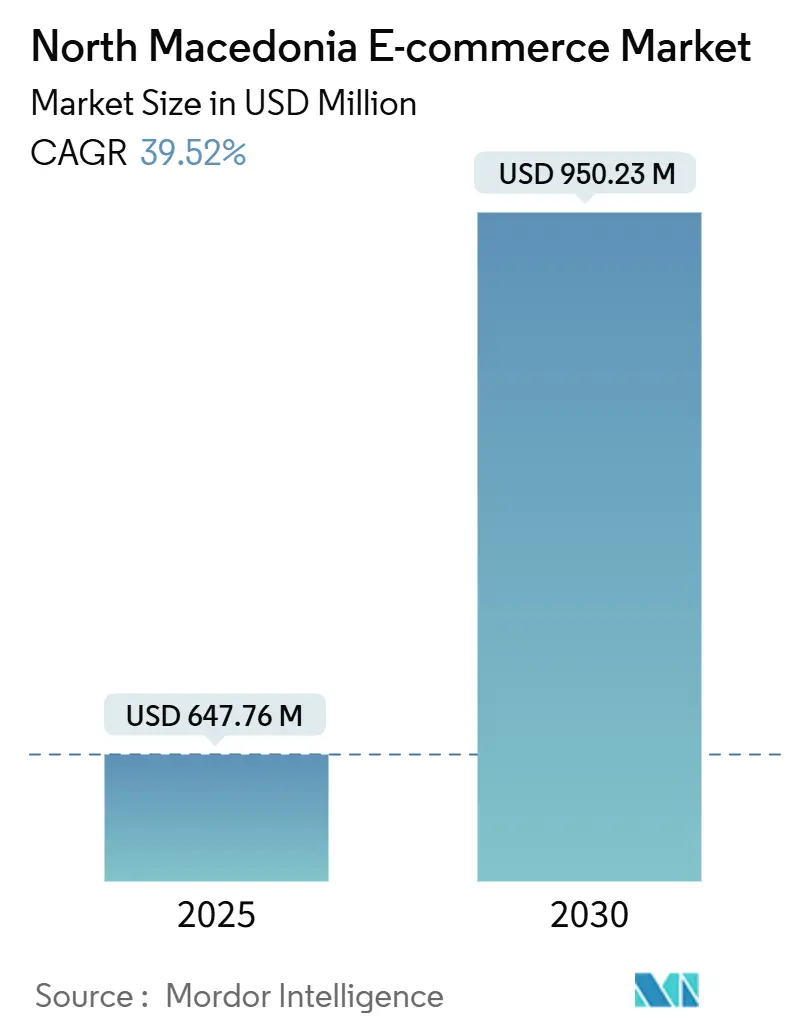
| Market Size (2025) | USD 647.76 Million |
| Market Size (2030) | USD 950.23 Million |
| Growth Rate (2025 - 2030) | 39.52 % |
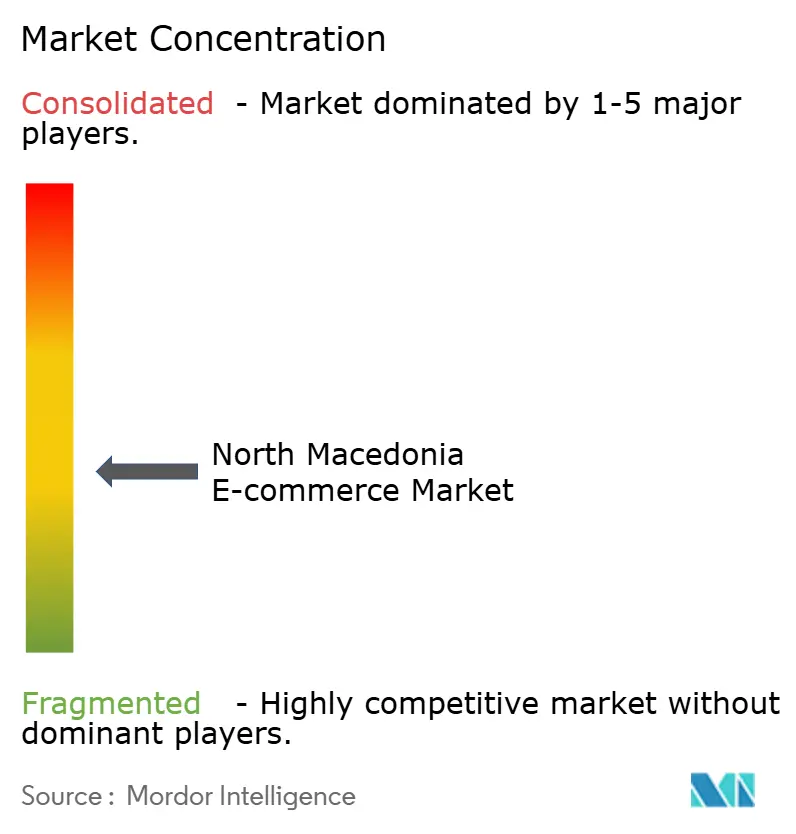
| Market Concentration | Medium |
Major Players *Disclaimer: Major Players sorted in no particular order Image © Mordor Intelligence. Reuse requires attribution under CC BY 4.0. | |
North Macedonia E-commerce Market Analysis by Mordor Intelligence
The North Macedonia e-commerce market is valued at USD 647.76 million in 2025 and is projected to reach USD 950.23 million by 2030, reflecting a robust 39.52% CAGR and underscoring the country’s emergence as one of the Western Balkans’ fastest-growing digital commerce hubs. Rapid smartphone adoption, the government’s Smart Society 2025 agenda, and deeper cross-border marketplace integration are expanding the addressable consumer base and accelerating the shift from traditional retail to online channels. Although only 27.6% of individuals aged 16-74 purchased goods or services online in 2022—well below the EU average—the gap signals ample room for growth as digital literacy rises and payment security improves.[1]Eurostat, “Digital Economy and Society Statistics,” ec.europa.eu International platforms such as AliExpress and Amazon are sharpening competition, while local players leverage mobile optimization and same-day delivery to protect share. Government funding of EUR 41.3 million (USD 44.9 million) for digitalization projects is catalyzing SME adoption of e-commerce technologies.[2]Development Bank of North Macedonia, “Digitalisation Support Programs,” dbnm.mk
Key Report Takeaways
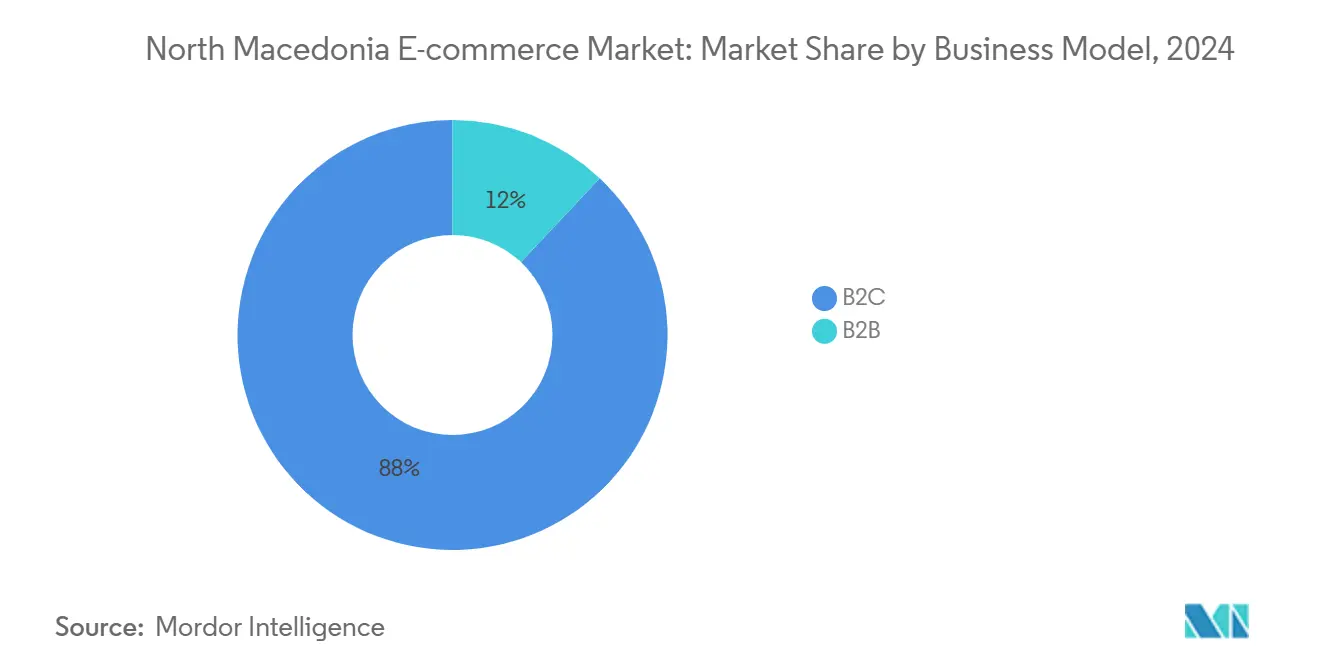
- By business model, the B2C segment held 88% of the North Macedonia e-commerce market share in 2024, whereas B2B posts the highest projected CAGR at 42.1% through 2030.
- By device, smartphones accounted for 71% of traffic and revenue in 2024; mobile commerce is set to expand at a 41.4% CAGR to 2030.
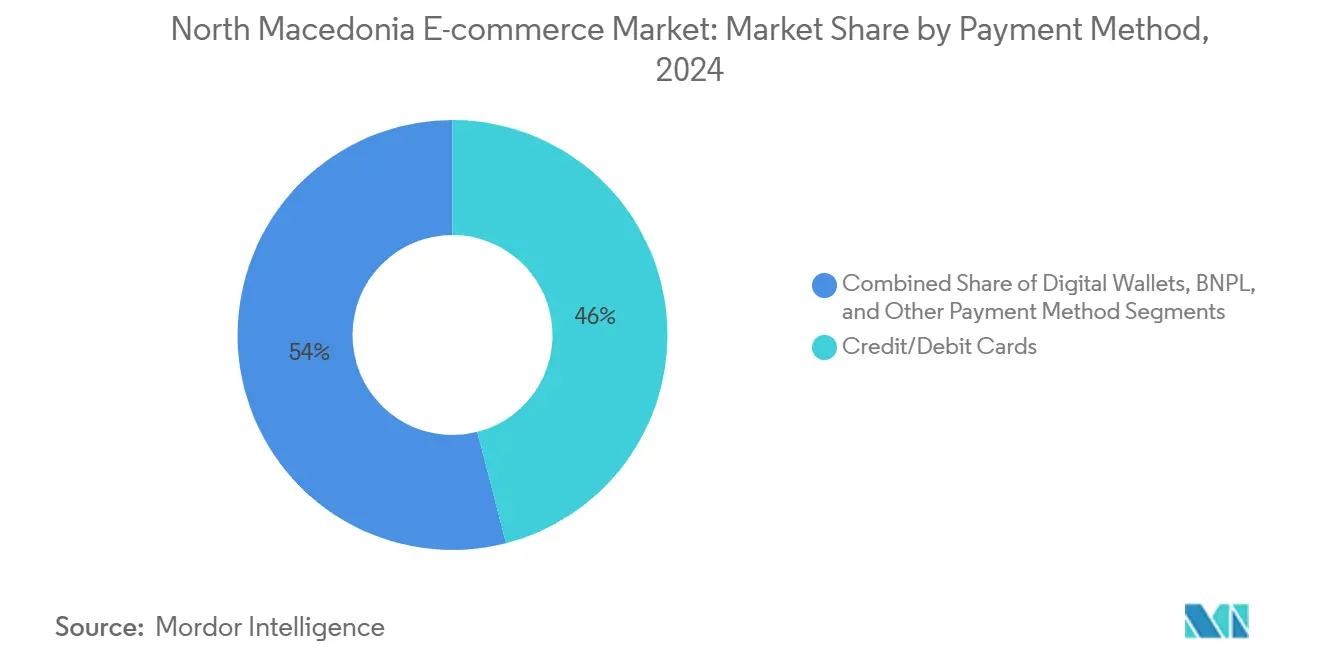
- By payment method, credit and debit cards led with 46% share in 2024, while digital wallets are forecast to grow at a 44.7% CAGR through 2030.
- By B2C product category, consumer electronics contributed 28% of the North Macedonia e-commerce market size in 2024; food and beverages is advancing at a 45.3% CAGR through 2030.
Note: Market size and forecast figures in this report are generated using Mordor Intelligence’s proprietary estimation framework, updated with the latest available data and insights as of January 2026.
North Macedonia E-commerce Market Trends and Insights
Drivers Impact Analysis*
| Driver | (~) % Impact on CAGR Forecast | Geographic Relevance | Impact Timeline |
|---|---|---|---|
| Smartphone-first Consumer Behaviour Accelerating M-commerce Adoption | +12.5% | National, with concentration in Skopje and urban centers | Short term (≤ 2 years) |
| Government "Smart Society 2025" Digital Agenda Incentivising Online Retail | +8.2% | National, with early implementation in administrative centers | Medium term (2-4 years) |
| Expansion of Same-day Parcel Networks by Post of North Macedonia and Cargo Express | +6.8% | National, prioritizing Skopje-Bitola-Ohrid corridor | Short term (≤ 2 years) |
| Growth in Cross-border Listings via Regional Marketplaces | +7.1% | Regional focus on Serbia, Bulgaria, Turkey trade corridors | Medium term (2-4 years) |
| Source: Mordor Intelligence | |||
Smartphone-first Consumer Behaviour Accelerating M-commerce Adoption
Smartphones generated 71% of all e-commerce transactions in 2024 as improved 4G/5G coverage and advanced mobile banking apps encouraged consumers to shop on the go.[3]Komercijalna Banka, “Mobile Banking Platform Release,” kb.mk Daily internet usage now reaches 80.5% of the population, and consumers aged 16-34 demonstrate higher basket sizes when purchasing via native apps. Local platforms eKupi.mk and Vendor.com.mk revamped their mobile interfaces in 2024, boosting conversion rates among younger demographics. With handset penetration at 86.4%, merchants that fail to optimize mobile experiences risk losing relevance in the North Macedonia e-commerce market.
Government “Smart Society 2025” Digital Agenda Incentivising Online Retail
The Smart Society 2025 program funds digital infrastructure and introduced a national e-identity system in 2024, streamlining online verification and reducing cart abandonment. Of the EUR 41.3 million (USD 44.9 million) disbursed by the Development Bank, 47% supported equipment upgrades and 6% targeted digital transformation, directly enhancing merchant readiness. Complementary legislation covering data exchange and online payments positions the North Macedonia e-commerce market for steady institutional support.
Expansion of Same-day Parcel Networks by Post of North Macedonia and Cargo Express
Post of North Macedonia scaled to more than 300 postal units in 2024 and integrated international tracking, allowing real-time monitoring of shipments from global platforms. Private operators such as Mex.mk provide same-day delivery in Skopje, reducing delivery lead times—a critical factor for repeat purchases. Network extensions into rural zones improve accessibility and unlock latent demand, though fragmented addressing still impedes last-mile efficiency.
Growth in Cross-border Listings via Regional Marketplaces
Regional marketplaces like KupujemProdajem broadened seller reach into Serbia, Bulgaria, and Turkey in 2024, aided by simplified customs processes under the Open Balkan initiative. Local merchants capitalise on price arbitrage in electronics and fashion, while consumers enjoy expanded assortments. Skopje’s role as a transport hub makes cross-border fulfilment attractive, yet harmonising regulatory frameworks remains a medium-term prerequisite for unlimited scale.
Restraints Impact Analysis*
| Restraint | (~) % Impact on CAGR Forecast | Geographic Relevance | Impact Timeline |
|---|---|---|---|
| Limited Roll-out of 3-D Secure and Tokenisation among Local Banks | -4.3% | National, affecting all digital payment channels | Short term (≤ 2 years) |
| High Cash-on-Delivery Returns Rate Raising Last-Mile Costs | -3.7% | National, with higher impact in rural regions | Medium term (2-4 years) |
| Low Basket Affordability Outside Skopje Region | -2.8% | Regional, primarily affecting rural and secondary urban areas | Long term (≥ 4 years) |
| Fragmented Address System Hindering Rural Deliveries | -2.2% | Rural regions, particularly mountainous and remote areas | Medium term (2-4 years) |
| Source: Mordor Intelligence | |||
Limited Roll-out of 3-D Secure and Tokenisation among Local Banks
Patchy adoption of modern security protocols constrains higher-value online transactions. While Komercijalna Banka and Sparkasse Bank introduced tokenised payments in 2024, smaller lenders lag, prompting consumer reluctance toward card payments. As Mastercard intends to end manual card entry in Europe by 2030, banks must accelerate compliance or risk sidelining the North Macedonia e-commerce market from global payment ecosystems.
High Cash-on-Delivery Returns Rate Raising Last-Mile Costs
COD remains prevalent outside urban centres, but return rates exceed prepaid transactions by 15-20%, inflating logistics expenses for Post of North Macedonia and private couriers. Inventory cycles lengthen, cash handling costs rise, and merchants struggle with liquidity swings. A coordinated push for digital wallets and consumer education is essential to unlock operational efficiencies.
*Our forecasts treat driver/restraint impacts as directional, not additive. The impact forecasts reflect baseline growth, mix effects, and variable interactions.
Segment Analysis
By Business Model: B2C Dominance Drives Market Expansion
The B2C segment captured 88% of the North Macedonia e-commerce market share in 2024, underpinned by over 596,620 active listings on Pazar3.mk. Smartphone-centric interfaces and social commerce integrations continue to strengthen consumer engagement. Simultaneously, B2B revenue remains smaller but is forecast to grow at 42.1% CAGR to 2030 as SMEs migrate procurement online, supported by EUR 41.3 million (USD 44.9 million) in digitalisation funding. Manufacturing suppliers increasingly trial e-catalogues, signalling the evolution of the North Macedonia e-commerce industry toward enterprise usage.
As B2B platforms integrate with ERP systems, transaction complexity rises, favouring vendors offering API connectivity and automated invoicing. Market entrants targeting industrial components, wholesale groceries, or office supplies can exploit white-space created by limited domestic options. Cross-border procurement enabled by Open Balkan policy further accelerates B2B momentum.


By Device Type: Mobile Commerce Transformation
Smartphones accounted for 71% of sales in 2024, supported by nationwide 4G coverage and growing 5G roll-outs. Mobile commerce is projected at a 41.4% CAGR to 2030, confirming its centrality to the North Macedonia e-commerce market. Desktop usage persists for complex comparisons and high-ticket B2B orders, but its share is shrinking annually. The ascendancy of mobile also drives demand for lighter page loads and one-click checkouts to curb bounce rates.
Retailers that optimise for accelerated mobile pages and biometric login see lower abandonment and higher repeat rates. Meanwhile, tablets and smart TVs represent niche but expanding channels as households adopt multiple connected devices. Retail media advertising on these screens presents incremental monetisation avenues for leading platforms.
By Payment Method: Digital Wallet Acceleration
Credit and debit cards led payments with 46% share in 2024, yet digital wallets demonstrate a 44.7% CAGR to 2030 as tokenisation roll-outs gain traction. High COD dependence persists, particularly in rural zones, though merchants incentivise pre-payment via discounts and loyalty points. Banks are partnering with Apple Pay and Google Wallet to familiarise users with secure tap-to-pay methods, gradually narrowing the trust deficit.
Regulatory clarity on buy-now-pay-later products remains pending, but early pilots indicate demand among millennials. Once enacted, BNPL could divert transaction volume from COD and cards, provided credit-risk frameworks mature in tandem. Real-time account-to-account payments also have potential, contingent on banking sector interoperability.

By B2C Product Category: Electronics Lead, Food Accelerates
Consumer electronics generated 28% of 2024 GMV thanks to cross-border sourcing that keeps pricing competitive. The North Macedonia e-commerce market size for electronics is forecast to expand as 5G handsets and home-office equipment remain popular. Food and beverages deliver the fastest 45.3% CAGR, anchored by expanded cold-chain capacity and consumer preference for convenience. Grocery platforms like Hrana.mk offer 90-minute delivery in Skopje, tapping into time-pressed urban lifestyles.
Fashion follows electronics as a major category, propelled by influencer marketing and hassle-free return policies. Furniture and home décor sales grow steadily as augmented-reality previews alleviate size and style uncertainties. Beauty, toys, and DIY niches thrive on subscription models and content-driven engagement that deepens customer loyalty.
Geography Analysis
Skopje and its metropolitan area accounted for roughly 60% of e-commerce turnover in 2024, reflecting higher broadband penetration and disposable income. Same-day logistics coverage enhances customer satisfaction in the capital, making it the bellwether for consumer expectations. Secondary cities Bitola, Ohrid, and Kumanovo are recording double-digit annual growth as network infrastructure upgrades reduce delivery times.
Rural participation is rising from a low base due to extended postal networks and the government’s rural connectivity programs under Smart Society 2025. However, fragmented address databases still hamper precise geolocation, prompting logistics providers to invest in GIS mapping and community collection points. The Open Balkan initiative opens broader regional demand pools; merchants in Skopje now fulfil Serbian and Bulgarian orders within two days, reinforcing the country’s role as a regional node.
Tourism corridors such as Lake Ohrid amplify cross-border spending on souvenirs and local products ordered online post-visit. Foreign direct investment in warehousing and fulfilment centres near Skopje International Airport is increasing capacity to manage rising parcel volumes. Over the forecast period, a balanced spread of infrastructure projects is expected to narrow urban-rural disparities and deepen national market penetration.
Competitive Landscape
The market is moderately fragmented, with local, regional, and global players co-existing. Pazar3.mk dominates classifieds, while Setec.mk and Anhoch.mk lead category-specific verticals such as electronics. International giants AliExpress and eBay partner with Post of North Macedonia for preferential rates, shortening delivery lead times and challenging domestic pricing advantages.
Mobile-first UX, AI-driven recommendations, and integrated payment gateways constitute the primary competitive levers. Leading merchants deploy chatbots and live-commerce sessions to boost engagement, while smaller retailers join multi-seller marketplaces to mitigate technology costs. Investment flows prioritise last-mile capacity and warehouse automation, as speed becomes a key differentiator.
White-space opportunities include B2B procurement platforms, rural logistics specialists, and fintech solutions that underwrite instalment purchases. Strategic alliances between banks and retailers aim to bundle payment, credit, and loyalty features. Regulatory backing for digital identity amplifies these moves by standardising KYC processes.
North Macedonia E-commerce Industry Leaders
Setec.mk
Anhoch.mk
Neptun.mk
AliExpress (Alibaba Group)
Grouper.mk
- *Disclaimer: Major Players sorted in no particular order

Recent Industry Developments
- January 2025: The UK and North Macedonia signed a GBP 5 billion (USD 6.2 billion) partnership that channels export-finance support into technology and digital commerce infrastructure, offering domestic merchants access to UK innovation and supply chains .
- June 2024: The Ministry of Internal Affairs launched a national electronic identity system, enabling seamless online customer verification and lowering onboarding friction for merchants.
- June 2024: Komercijalna Banka released a modern mobile banking application, integrating in-app e-commerce payments and real-time credit approvals that enhance checkout convenience.
- March 2024: The Ministry of Information Society and Administration rolled out the Open Government Partnership Action Plan 2024-2026 to improve transparency and digital services adoption, creating a fertile environment for the North Macedonia e-commerce market


North Macedonia E-commerce Market Report Scope
Conducting an e-commerce business means fostering relationships and selling information, services, and goods over computer communication networks. E-commerce usually refers to trading goods and services over the internet, which means broader economic activity. E-commerce consists of B2B and B2C and internal organizational transactions that support these activities.
The study also tracks the key market parameters, underlying growth influencers, and major vendors operating in the industry, which supports the market estimations and growth rates over the forecast period in North Macedonia. The study further analyzes the overall impact of Covid-19 on the ecosystem. The scope of the report encompasses market sizing and forecast for segmentation by B2B and B2C, in which the B2C channel is further segmented by application.
By Business Model
| B2C |
| B2B |
By Device Type
| Smartphone / Mobile |
| Desktop and Laptop |
| Other Device Types |
By Payment Method
| Credit / Debit Cards |
| Digital Wallets |
| BNPL |
| Other Payment Method |
By B2C Product Category
| Beauty and Personal Care |
| Consumer Electronics |
| Fashion and Apparel |
| Food and Beverages |
| Furniture and Home |
| Toys, DIY and Media |
| Other Product Categories |
| By Business Model | B2C |
| B2B | |
| By Device Type | Smartphone / Mobile |
| Desktop and Laptop | |
| Other Device Types | |
| By Payment Method | Credit / Debit Cards |
| Digital Wallets | |
| BNPL | |
| Other Payment Method | |
| By B2C Product Category | Beauty and Personal Care |
| Consumer Electronics | |
| Fashion and Apparel | |
| Food and Beverages | |
| Furniture and Home | |
| Toys, DIY and Media | |
| Other Product Categories |


Key Questions Answered in the Report
What is the current value of the North Macedonia e-commerce market?
The market is valued at USD 647.76 million in 2025 and is on track to reach USD 950.23 million by 2030.
How fast is mobile commerce growing in North Macedonia?
Smartphone-based transactions are forecast to expand at a 41.4% CAGR between 2025 and 2030, driven by wider 4G/5G coverage and improved mobile banking apps.
Which product category generates the most online revenue?
Consumer electronics leads with 28% share in 2024, while food and beverages is the fastest-growing category at a 45.3% CAGR.
Why is cash-on-delivery still popular?
Limited rollout of advanced payment security features and consumer trust issues keep COD prevalent, particularly in rural regions, despite higher logistics costs.
How does the Smart Society 2025 agenda support e-commerce?
The program funds digital infrastructure, introduced a national e-identity system, and streamlines regulations, collectively reducing friction for online transactions.
What opportunities exist for new entrants?
High-growth niches include B2B procurement platforms, rural last-mile logistics services, and fintech solutions that facilitate secure digital payments.
Page last updated on:





