
North America Roofing Market Size and Share
Market Overview
| Study Period | 2020 - 2031 |
|---|---|
| Forecast Data Period | 2026 - 2031 |
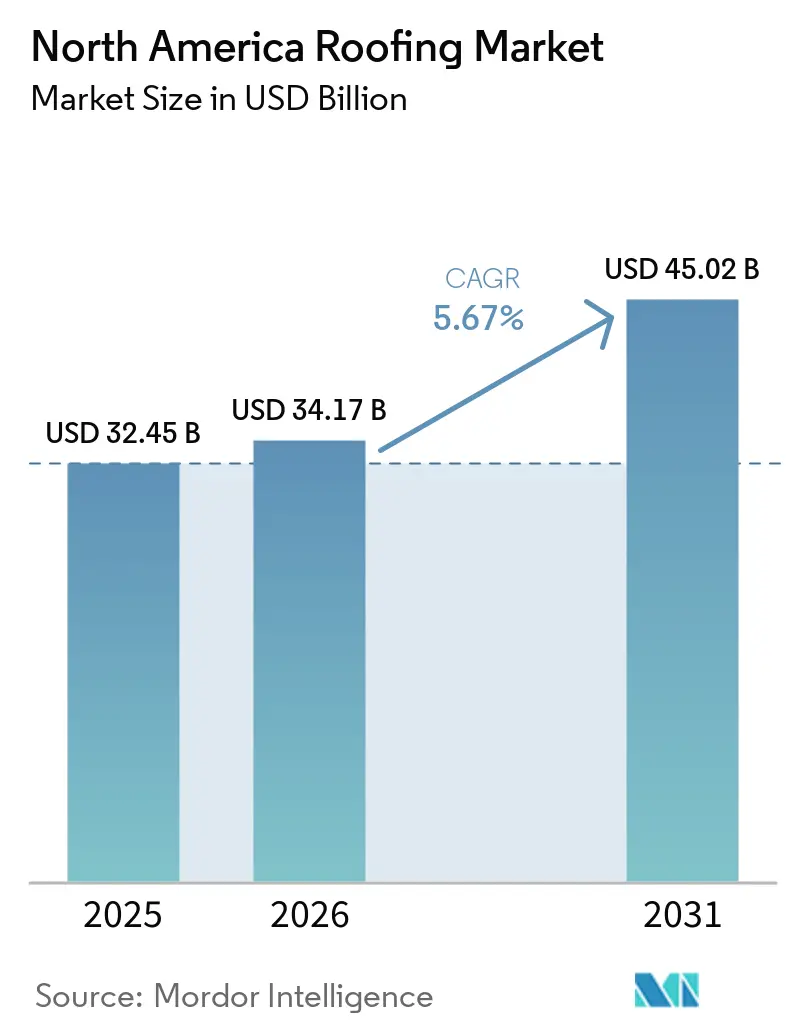
| Base Year Market Size (2025) | USD 32.45 Billion |
| Market Size (2026) | USD 34.17 Billion |
| Market Size (2031) | USD 45.02 Billion |
| Growth Rate (2026 - 2031) | 5.67 % |
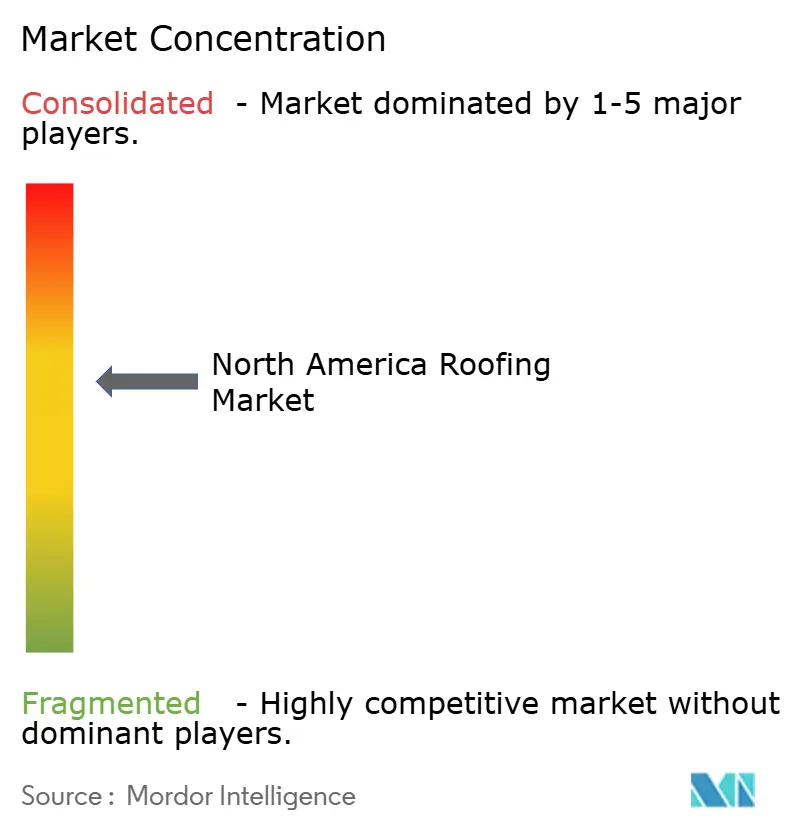
| Market Concentration | Medium |
Major Players *Disclaimer: Major Players sorted in no particular order Image © Mordor Intelligence. Reuse requires attribution under CC BY 4.0. | |
North America Roofing Market Analysis by Mordor Intelligence
The North America Roofing Market size was valued at USD 32.45 billion in 2025 and is estimated to grow from USD 34.17 billion in 2026 to reach USD 45.02 billion by 2031, at a CAGR of 5.67% during the forecast period (2026-2031). The market remains resilient because a very large installed base of aging residential and commercial roofs continues to move into replacement years, supporting demand even as new construction slows. Severe weather losses are also changing purchase behavior, as homeowners, insurers, and building owners increasingly favor systems that improve hail, wind, and impact performance. That shift is making resilience a routine specification factor rather than a niche upgrade. Energy rules are also lifting specification standards, especially for cool-roof and reflective systems in warmer regions, which supports higher average selling prices across reroofing and new-build projects. On the non-residential side, data centers, logistics warehouses, and industrial facilities are creating a strong pipeline for low-slope systems, which broadens the market beyond the residential replacement cycle. Material inflation and labor shortages still create execution pressure, but they are delaying work more often than eliminating it, which keeps deferred demand in place for later conversion.
Key Report Takeaways
By material type, asphalt shingles led with 58.6% revenue share in 2025, while single-ply membranes are forecast to expand at a 7.26% CAGR through 2031.
By construction type, reroofing and replacement held 63.5% of the North America roofing market size in 2025, while new construction is forecast to grow at a 6.58% CAGR through 2031.
By application, residential accounted for 56.5% of the North America roofing market size in 2025, while industrial is projected to advance at a 7.60% CAGR through 2031.
By geography, the United States held 84% of the North America roofing market share in 2025, while Mexico is forecast to record the highest CAGR at 6.86% through 2031.
Note: Market size and forecast figures in this report are generated using Mordor Intelligence’s proprietary estimation framework, updated with the latest available data and insights as of January 2026.
North America Roofing Market Trends and Insights
Drivers Impact Analysis*
| Drivers | (~) % IMPACT ON CAGR FORECAST | Geographic Relevance | Impact Timeline |
|---|---|---|---|
| Aging roof stock and sustained reroofing intensity | +1.8% | National, concentrated in the Northeast, Midwest, and Southeast | Long term (≥ 4 years) |
| Severe-weather and hail resilience upgrades | +1.5% | Southeast, Midwest, Texas, and Mountain West | Short term (≤ 2 years) |
| Cool-roof and energy-code compliance mandates | +1.0% | Southwest, West Coast, Southeast, and expanding nationally under IECC 2024 | Medium term (2-4 years) |
| Warehouse, data center, and public infrastructure buildouts | +0.8% | Southwest, Southeast, Midwest, and emerging in Mexico's Bajío industrial corridor | Medium term (2-4 years) |
| Insurer-backed FORTIFIED and Class-4 adoption | +0.5% | Southeast, Gulf Coast, Carolinas, Oklahoma, and expanding to the Midwest | Medium term (2-4 years) |
| Artificial intelligence and drone claims workflows are shortening replacement cycles | +0.3% | National, concentrated in catastrophe-prone states with high claims volume. | Short term (≤ 2 years) |
| Source: Mordor Intelligence | |||
Aging Roof Stock and Sustained Reroofing Intensity
The North America roofing market continues to benefit from the large wave of roofs installed during the housing expansion of the 1990s and early 2000s, many of which are now deep into replacement years. That demand is less tied to consumer sentiment than many building products categories because roof failure or visible deterioration usually forces action within a limited time window. The labor outlook supports this view, as the US Bureau of Labor Statistics expects roofer employment to grow by 6% from 2024 to 2034 and to see 12,700 openings per year over the decade[1]. Commercial demand shows the same pattern, with Carlisle noting that reroofing accounted for nearly 70% of its commercial roofing business in late 2025[2]. This makes the North America roofing market more stable than categories that depend mostly on new building starts.
Severe-Weather and Hail Resilience Upgrades
The North America roofing market is also being boosted by a clear shift toward products that reduce storm-related losses and insurance claims. The Insurance Institute for Business & Home Safety, or IBHS, reported that the FORTIFIED program passed 100,000 designations in May 2026, and more than half of those designations were achieved in the last 3 years[3]. That pace shows that resilience has moved from an optional premium feature to a standard consideration in many storm-prone areas. Carriers have reinforced the trend by offering meaningful discounts for qualifying roofs, which makes the upgrade case easier for homeowners and property managers. As a result, the North America roofing market is seeing faster adoption of impact-resistant shingles, better fastening methods, and higher-specification replacement systems.
Cool-Roof and Energy-Code Compliance
The North America roofing market is also gaining support from code changes that make reflective, energy-efficient systems more common in reroofing and new construction. California's 2025 Building Energy Efficiency Standards require low-slope roofs across all 16 climate zones to meet minimum aged solar reflectance and thermal emittance levels, or a Solar Reflectance Index, or SRI, threshold of 75. The 2024 International Energy Conservation Code, or IECC, extends cool-roof compliance language across warm climate zones, which raises the share of projects that need higher-performance roof assemblies. These rules matter because replacement work is often governed by the code in force at the time of installation, not by the standard used when the original roof was built. That means the North America roofing market is getting a structural lift from regulation as older roofs move into mandatory replacement.
Warehouse, Data-Center, and Public-Infrastructure Buildouts
The North America roofing market is not relying solely on residential demand, as industrial and institutional projects are expanding the addressable base for membranes and other low-slope systems. ConstructConnect reported USD 77.7 billion in data center construction starts in 2025, which represented a 190% year-over-year increase. Large data centers and logistics facilities require extensive roof areas, stringent system performance requirements, and long warranty terms, so they favor better-specified membrane assemblies. Public projects and industrial parks are adding to that mix, especially in the United States and Mexico, where infrastructure and factory investment remain active. This gives the North America roofing market a broader growth foundation than a residential-only cycle would.
Restraints Impact Analysis*
| Restraints | (~) % Impact on CAGR Forecast | Geographic Relevance | Impact Timeline |
|---|---|---|---|
| Asphalt, metal, and installed-cost inflation | -1.2% | National, amplified in tariff-sensitive markets (Canada, Mexico border regions) | Short term (≤ 2 years) |
| Skilled-labor shortages and installation bottlenecks | -0.8% | National, most acute in high-growth Sun Belt, Plains, and Pacific Coast regions | Long term (≥ 4 years) |
| Limited tear-off recycling infrastructure and landfill pressure | -0.3% | National, with regulatory pressure concentrated in California, the Northeast, and Canada | Medium term (2-4 years) |
| Insurance documentation and code-compliance burden | -0.2% | National, highest in jurisdictions with mandatory IBHS, IECC 2024, or state energy-code enforcement | Medium term (2-4 years) |
| Source: Mordor Intelligence | |||
Asphalt, Metal, and Installed-Cost Inflation
The North America roofing market still faces margin pressure from raw material and installed-cost inflation, especially in price-sensitive residential work. The Producer Price Index for Asphalt Paving and Roofing Materials Manufacturing rose to 377.7 in January 2026 from 365.2 in December 2025, which shows how quickly petroleum-linked costs can move through the supply chain. Contractors often face a difficult timing issue because materials can reset faster than customer budgets or insurance allowances. Installed pricing also remains elevated when crews are scarce, suggesting labor inflation can persist even as commodity costs soften. This does not remove demand from the North America roofing market, but it can delay project starts and compress contractor profitability.
Skilled-Labor Shortages and Installation Bottlenecks
The North America roofing market also faces a lasting capacity problem because labor supply is not keeping pace with project demand. NRCA estimates that workforce shortages cost the US roofing sector between USD 9.5 billion and USD 19 billion in lost annual economic growth. Associated Builders and Contractors, or ABC, said the construction industry needed 439,000 net new workers in 2025 and 499,000 in 2026 to balance supply and demand, while wages continued to rise faster than the broader economy. At the same time, AGC and the National Center for Construction Education and Research, or NCCER, reported broad difficulty in hiring qualified craft labor across construction. This keeps the North America roofing market in a position where demand is present, but execution speed remains constrained.
*Our forecasts treat driver/restraint impacts as directional, not additive. The impact forecasts reflect baseline growth, mix effects, and variable interactions.
Segment Analysis
By Material Type: Asphalt Dominance Amid Membrane Momentum
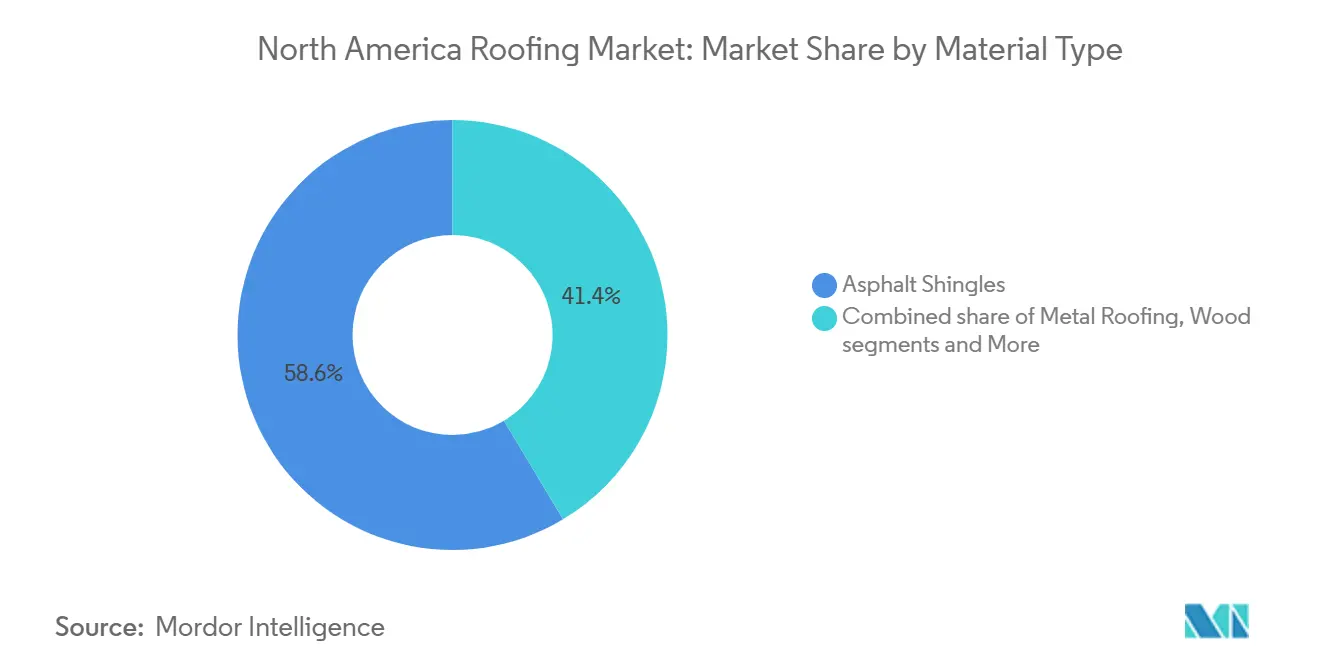
Asphalt shingles accounted for 58.6% of revenue in 2025, keeping them the defining material category in the North America roofing market. That lead reflects a long-established fit with detached housing, broad installer familiarity, and a lower upfront cost than many alternative systems. The category is also moving up in value, not just in volume, because resilience standards and insurer preferences are pushing more buyers toward premium architectural and impact-resistant lines. In February 2026, GAF expanded national availability of Timberline Ultra High Definition shingles with a Class 4 impact rating under Underwriters Laboratories 2218, and TAMKO introduced HailGuard with a hail warranty in the same month. These launches show how the North America roofing market is raising the performance floor inside its largest material segment.
Single-ply membranes are forecast to grow at a 7.26% CAGR through 2031, making them the fastest-moving material group in the North America roofing market. Demand is being supported by data centers, logistics facilities, and other low-slope projects where speed of installation, seam quality, and long-term energy performance matter. Thermoplastic Polyolefin, or TPO, Ethylene Propylene Diene Monomer, or EPDM, and Polyvinyl Chloride, or PVC, remain the key products in this group. Modified bitumen stays relevant in demanding climates, while metal roofing continues to gain acceptance where durability and insurance economics justify the higher initial cost. The broader North America roofing industry is therefore seeing a shift toward a mix, where asphalt maintains the largest base while membranes and metal capture more of the premium and commercial opportunities.

By Construction Type: Reroofing Resilience and New-Build Momentum
Reroofing and replacement accounted for 63.5% of demand in 2025, underscoring the North America roofing market's reliance on the installed base already in service. This segment is resilient because most replacement decisions are driven by age, leaks, storm loss, or insurance pressure, not by discretionary spending alone. Carlisle reinforced this pattern when it said that reroofing accounted for nearly 70% of its commercial roofing business in late 2025. That installed-base orientation gives the market a steadier revenue floor than categories tied mostly to new starts. It also raises the average value because many owners use replacement cycles to move to higher-grade systems rather than repeating a basic like-for-like specification.
New construction is forecast to expand at a 6.58% CAGR through 2031, keeping it the fastest-growing construction type in the North America roofing market. The growth is being driven more by non-residential work than by single-family housing, especially in data centers, industrial plants, cold storage, and public projects. ConstructConnect said the forward data center pipeline for 2026 exceeded USD 88 billion in projects expected to break ground within 6 months. IKO also broke ground on a USD 120 million granule facility in Missouri in June 2025, which signaled confidence in sustained demand for premium shingle production. Within the North America roofing industry, this means new-build demand is becoming more specialized and more weighted toward higher-performance assemblies.
By Application: Residential Foundation, Industrial Growth Engine
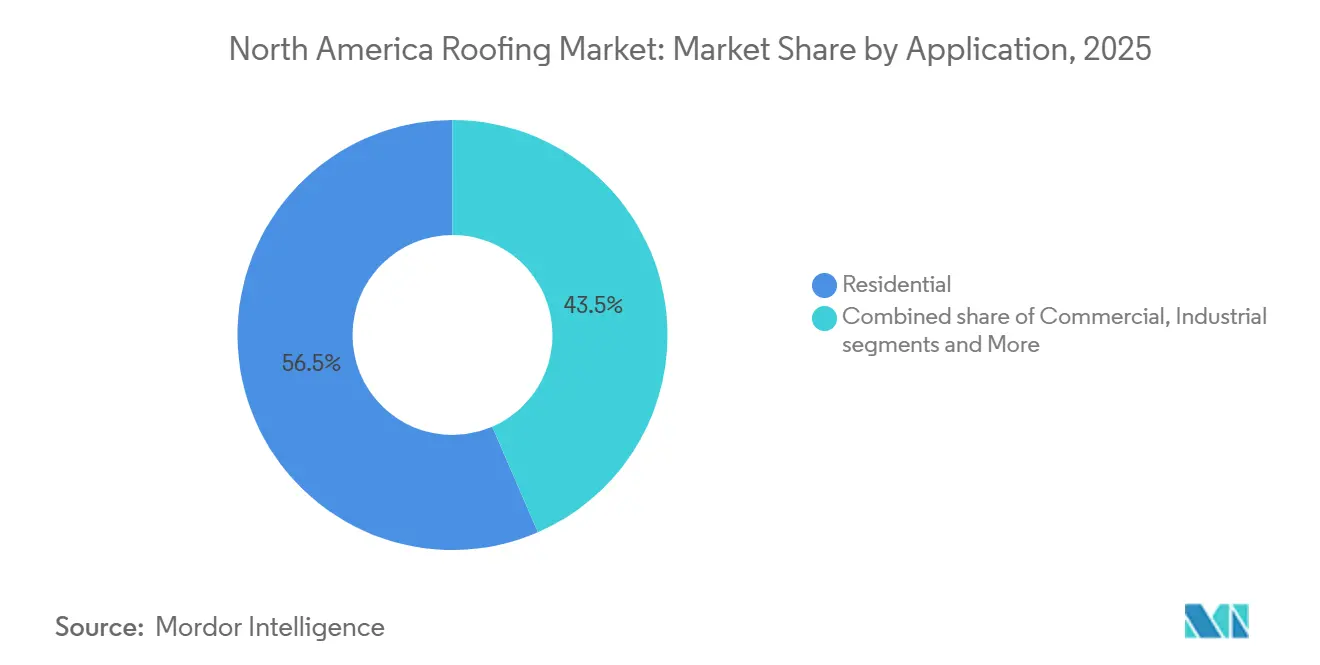
Residential applications accounted for 56.5% of revenue in 2025, giving it the largest share in the North America roofing market. That scale comes from the region's large single-family housing base and the age profile of roofs installed during prior housing cycles. Residential reroofing is also becoming more value-accretive because policyholders can often justify upgrades when insurers recognize impact and wind resistance. IBHS has shown that qualifying roofs can achieve meaningful premium savings, strengthening the case for higher-grade materials and better installation details. As a result, the North America roofing market continues to rely on residential work as its core volume engine.
Industrial applications are forecast to grow at 7.60% through 2031, making it the fastest-growing end-use segment in the North America roofing market. Nearshoring activity in Mexico and logistics development across the United States are expanding the need for large-span systems with strong thermal and weather performance. Data center construction is also shifting the demand mix, with purpose-built technology facilities now taking a larger share of non-residential roofing spend. Institutional projects remain supportive as public buildings pursue energy upgrades and durability targets. This leaves the North America roofing market with a broad application base, where residential provides scale, and industrial provides the fastest momentum.
Geography Analysis
The United States held 84% of the North America roofing market share in 2025, making it the clear anchor of regional demand. The market there is supported by a large suburban housing stock entering peak replacement years for roofs installed in the late 1990s and early 2000s. Storm activity across the Southeast, Midwest, and Texas also keeps insurance-funded reroofing elevated, which strengthens volumes even when interest-rate conditions weigh on new housing. IBHS reported 100,000 cumulative FORTIFIED designations nationwide in May 2026, with rapid adoption in states that have strong insurer and grant support. The North America roofing market in the United States also benefits from stronger non-residential demand, especially from data centers and logistics facilities that require large low-slope roof systems.
Canada maintained a stable role in the North America roofing market, supported by recurring reroofing activity in major urban corridors and by demand for impact-resistant products in hail-prone Prairie provinces. The country is also important from a circularity standpoint because commercial-scale shingle recovery is beginning to take shape. Northstar's Empower Calgary facility began receiving waste asphalt shingles in April 2026 and can process up to 80,000 tonnes per year, improving disposal options for tear-off work. Canada also supports demand for cool-roof and high-performance membrane systems as energy efficiency standards tighten across building types.
Mexico is forecast to be the fastest-growing country in the region, with a 6.86% CAGR through 2031, giving it the highest growth rate in the North America roofing market. The main driver is nearshoring-led industrial construction, especially in Nuevo León, Guanajuato, and the Bajío corridor, where factories, logistics parks, and supporting infrastructure continue to expand. That pipeline favors insulated panels, reflective membranes, and durable assemblies that can control energy use and support long operating cycles. The North America roofing market in Mexico is also being supported by improving public infrastructure activity and a more stable residential backdrop in 2026. This combination of industrial expansion, code awareness, and improving project visibility makes Mexico the region's most dynamic growth pocket.
Competitive Landscape
The North America roofing market is moderately consolidated in asphalt shingle manufacturing, but remains far more fragmented in membranes, contracting, and local installation. GAF Materials Corporation, Owens Corning, and CertainTeed LLC hold the strongest positions in the asphalt shingle market. At the same time, Carlisle Construction Materials, SOPREMA Inc., Sika Corporation, and Johns Manville compete more actively across commercial systems. This means competitive advantage is rarely based solely on price. Warranty strength, contractor certification networks, product breadth, and resilience credentials now carry more weight in specification decisions. In the North America roofing market, suppliers that can pair materials with training, accessories, and distribution support usually gain the strongest pull-through.
Strategic moves by large players show how quickly the North America roofing market is shifting toward integrated system ownership and scale. Carlisle acquired MTL Holdings in 2024 for USD 410 million, thereby expanding its position in edge metal and strengthening its building envelope offering. GAF began construction on a new shingle plant in Newton, Kansas, in June 2025, while Owens Corning announced a new shingle facility in the Southeastern United States and then completed the sale of its glass reinforcements business in April 2026 to focus more tightly on roofing and insulation growth. QXO also completed the acquisition of Beacon Roofing Supply in 2025 and then signed an agreement to acquire TopBuild in 2026, which deepens its reach across building products distribution. These moves show that the North America roofing market is rewarding vertical reach, capacity additions, and tighter control over channels.
Technology is becoming another point of separation in the North America roofing market. Nearmap's Roof Age Gen2 gives carriers and contractors a faster way to estimate replacement timing, improving underwriting, claims triage, and sales targeting. Product innovation is also accelerating, with GAF and TAMKO expanding Class 4 offerings and Atlas improving solar reflectance across cool-color shingles in 2026. The North America roofing market, therefore, remains competitive, but it is becoming more structured around resilience, code compliance, and system-level service rather than simple commodity supply.
North America Roofing Industry Leaders
-
GAF Materials Corporation
-
Owens Corning
-
CertainTeed LLC
-
Holcim Building Envelope
-
Elevate Commercial Roofing Systems
- *Disclaimer: Major Players sorted in no particular order
Recent Industry Developments
- May 2026: The IBHS FORTIFIED program surpassed 100,000 designations nationwide, marking the milestone that over half of all designations were achieved in the last 3 years, reflecting the growing alignment of insurers, manufacturers, and state grant programs around the science-based reroofing standard.
- April 2026: QXO, Inc. announced a definitive agreement to acquire TopBuild Corp. for USD 17 billion, expected to close in Q3 2026. The combined entity will hold the No. 2 position in roofing distribution and No. 1 in insulation and waterproofing distribution across North America.
- April 2026: Owens Corning completed the sale of its glass reinforcements business to Praana Group for an enterprise value of USD 645 million, with cash proceeds of USD 280 million to fund roofing and insulation organic growth initiatives, completing the company's strategic pivot to a focused North America building products leader.
- February 2026: GAF Materials Corporation announced nationwide availability of Timberline Ultra High Definition shingles with UltraMat technology, carrying a Class 4 impact-resistance rating under Underwriters Laboratories 2218, expanding the impact-resistant segment into mainstream national distribution.
North America Roofing Market Report Scope
| Asphalt Shingles |
| Clay & Concrete Tiles |
| Metal Roofing |
| Bituminous / Modified Bitumen Membranes |
| Single-Ply Membranes (TPO, EPDM, and PVC) |
| Wood |
| Others |
| New Construction |
| Reroofing and Replacement |
| Residential |
| Commercial |
| Industrial |
| Institutional |
| Others |
| United States |
| Canada |
| Mexico |
| By Material Type | Asphalt Shingles |
| Clay & Concrete Tiles | |
| Metal Roofing | |
| Bituminous / Modified Bitumen Membranes | |
| Single-Ply Membranes (TPO, EPDM, and PVC) | |
| Wood | |
| Others | |
| By Construction Type | New Construction |
| Reroofing and Replacement | |
| By Application | Residential |
| Commercial | |
| Industrial | |
| Institutional | |
| Others | |
| By Country | United States |
| Canada | |
| Mexico |
Key Questions Answered in the Report
What is the 2026 value of the North America roofing market?
The North America roofing market is estimated at USD 34.17 billion in 2026 and is forecast to reach USD 45.02 billion by 2031, with a 5.67% CAGR.
Which material category leads roofing demand in North America?
Asphalt shingles lead the region with 58.6% of 2025 revenue because they remain closely tied to the large residential reroofing base.
Which roofing material is growing the fastest in North America?
Single-ply membranes are the fastest-growing material segment, with a projected 7.26% CAGR through 2031, supported by data centers, warehouses, and industrial buildings.
Why does reroofing matter more than new construction in this space?
Reroofing and replacement held 63.5% of demand in 2025, showing that aging roof stock and storm damage create a more stable revenue base than new starts alone.
Which country is growing the fastest in the region?
Mexico is expected to post the highest growth rate at 6.86% through 2031, driven by nearshoring, industrial parks, and broader construction activity.
What are the main risks affecting suppliers and contractors?
The main risks are inflation in installed costs, labor shortages, pressure to dispose of tear-off waste, and heavier insurance and code documentation requirements.