
North America Roads and Highways Infrastructure Construction Market Size and Share
Market Overview
| Study Period | 2020 - 2031 |
|---|---|
| Forecast Data Period | 2026 - 2031 |
| Base Year Market Size (2025) | USD 512.46 Billion |
| Market Size (2026) | USD 545.71 Billion |
| Market Size (2031) | USD 721.5 Billion |
| Growth Rate (2026 - 2031) | 5.74 % |
| Market Concentration | Medium |
Major Players *Disclaimer: Major Players sorted in no particular order Image © Mordor Intelligence. Reuse requires attribution under CC BY 4.0. | |
North America Roads and Highways Infrastructure Construction Market Analysis by Mordor Intelligence
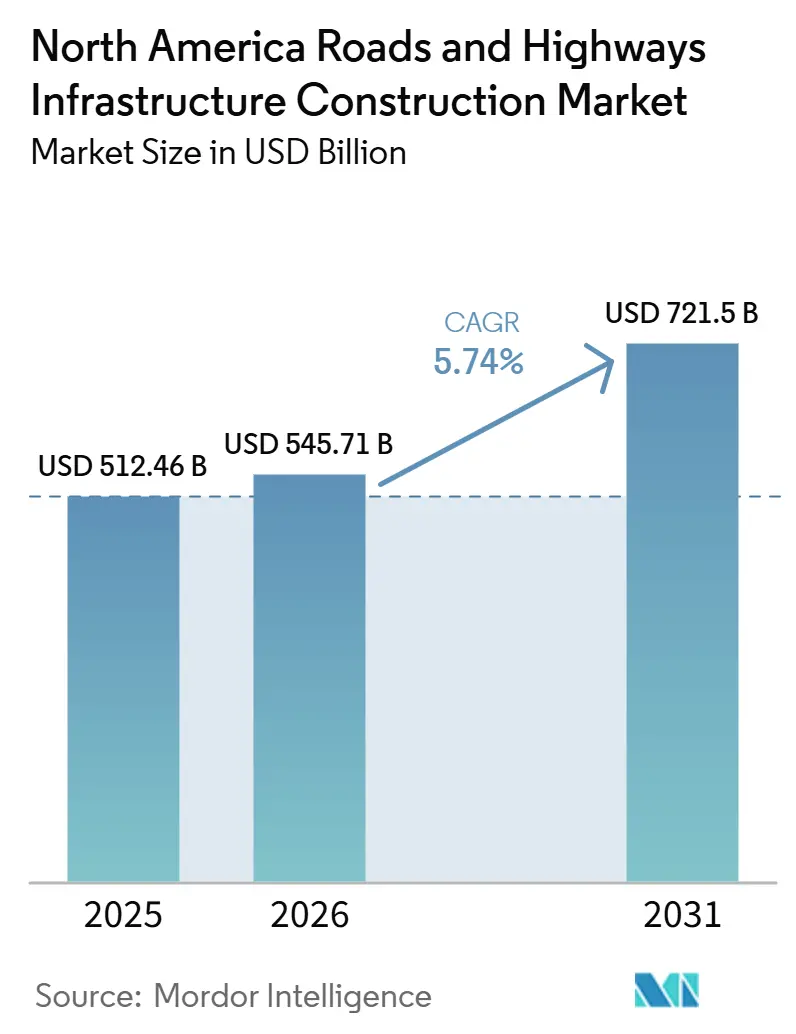
The North America Roads And Highways Infrastructure Construction Market size is expected to grow from USD 512.46 billion in 2025 to USD 545.71 billion in 2026 and is forecast to reach USD 721.5 billion by 2031 at 5.74% CAGR over 2026-2031.
The North America roads and highways infrastructure construction market is supported by the federal funding cycle, freight corridor development, and extensive rehabilitation needs across existing road assets. United States highway construction spending was running at a seasonally adjusted annual rate of USD 150.6 billion in May 2026, keeping activity near recent highs as the current federal authorization nears its September 2026 expiry[1]U.S. Census Bureau, “Monthly Construction Spending, May 2026,” U.S. Census Bureau, census.gov. Investment is shifting toward rehabilitation as agencies manage aging pavements and bridges while maintaining capacity programs to accommodate growing freight and commuter traffic. Contractors are also placing greater weight on joint ventures, design-build delivery, and construction manager/general contractor procurement for large projects. The outlook remains dependent on the federal reauthorization outcome, while higher input costs and limited labor availability could affect project schedules and contractor margins.
Key Report Takeaways
- By component, roads held 67.80% of the North America roads and highways infrastructure construction market share in 2025, while bridges/overpass are forecast to grow at a 6.40% CAGR through 2031.
- By construction type, new construction accounted for 61.50% of the North America roads and highways infrastructure construction market size in 2025, while renovation is projected to expand at a 6.20% CAGR through 2031.
- By investment source, public funding held 73.40% of the North America roads and highways infrastructure construction market share in 2025, while public-private partnerships are forecast to advance at a 6.80% CAGR through 2031.
- By type, national roads held 49.80% of the North America roads and highways infrastructure construction market size in 2025, while state highways are forecast to grow at a 6.10% CAGR through 2031.
- By geography, the United States held 84.60% of revenue in 2025, while Mexico is forecast to grow at a 7.10% CAGR through 2031.
Note: Market size and forecast figures in this report are generated using Mordor Intelligence’s proprietary estimation framework, updated with the latest available data and insights as of January 2026.
Market Trends and Insights
Drivers Impact Analysis of North America Roads and Highways Infrastructure Construction Market*
| Drivers | (~) % Impact on CAGR Forecast | Geographic Relevance | Impact Timeline |
|---|---|---|---|
| Federal Funding for Road and Bridge Construction | +1.8% | United States, with spillover to Canada through trade corridor investment | Short term (≤ 2 years) |
| Aging Assets Drive Rehabilitation and Replacement | +0.9% | United States and Canada, especially rural bridge stock | Medium term (2-4 years) |
| Freight Corridor Expansion | +0.7% | U.S. Sun Belt, Midwest freight corridors, and U.S.-Mexico border states | Medium term (2-4 years) |
| Accelerated Bridge Construction Methods | +0.5% | Broad regional relevance, with strong use by U.S. state departments of transportation | Long term (≥ 4 years) |
| Climate-Resilient Road Upgrades | +0.4% | Coastal U.S. states, the Pacific Northwest, Gulf Coast, and northern Canadian corridors | Long term (≥ 4 years) |
| EV Charging Corridor Expansion | +0.3% | U.S. alternative fuel corridors and Canadian interprovincial highways | Medium term (2-4 years) |
| Source: Mordor Intelligence | |||
Federal Funding for Road and Bridge Construction
The North America roads and highways infrastructure construction market continues to benefit from the Infrastructure Investment and Jobs Act, which committed USD 350 billion to federal highway programs for fiscal years 2022 through 2026. Fiscal year 2026 apportionments reached USD 56.8 billion, the highest annual authorization in the program’s history. States had committed USD 270 billion to more than 119,000 highway and bridge projects through March 2026. The law also supported 19,000 bridge upgrades during its first 4 fiscal years, exceeding the total delivered during the prior 5-year period. Competitive programs, including the Bridge Investment Program, National Highway Freight Program, and PROTECT funding, direct capital toward strategic assets alongside formula funding. The September 2026 expiry creates a transition point because a projected USD 166 billion shortfall after expiry could limit the state programs with the largest maintenance backlogs[2]Congressional Research Service, “Funding and Financing Highways and Public Transportation,” Congressional Research Service, congress.gov.
Aging Assets Drive Rehabilitation and Replacement
The North America roads and highways infrastructure construction market has a large rehabilitation pipeline because the United States had 220,295 bridge spans requiring repair in 2025. This total included 74,472 spans requiring full replacement, and the American Road & Transportation Builders Association (ARTBA) estimated the total repair cost at USD 467 billion. The American Society of Civil Engineers estimated USD 191 billion in bridge rehabilitation needs, even after allowing for USD 40 billion in dedicated IIJA bridge funding. Rural areas accounted for 80% of the 42,000 bridges that remained in poor condition in June 2025. These structures often support agricultural and energy freight routes with limited alternate access. Highway investment continues to prioritize system preservation, requiring agencies to balance maintaining existing infrastructure with expanding transportation capacity.
Freight Corridor Expansion
The North America roads and highways infrastructure construction market is being shaped by freight routes that connect manufacturing areas, border crossings, and port facilities. The USD 4.05 billion Brent Spence Bridge Corridor broke ground in May 2026 and reinforced the I-75 and I-71 corridor, which carries more than USD 26 billion in annual cross-river trade. Georgia opened the USD 126 million Brampton Road Connector in Savannah in July 2026, separating 15,000 daily truck movements from local traffic and improving access to I-16. Supply-chain realignment has increased the need for coordinated investment in highways, customs facilities, and multimodal hubs across the United States, Canada, and Mexico. States and provinces are therefore competing more actively for discretionary funding, with freight benefits becoming more important in project selection. This pattern supports projects that improve reliability on routes serving industrial relocation and cross-border trade.
Accelerated Bridge Construction Methods
The North America roads and highways infrastructure construction market is adopting accelerated bridge construction methods to reduce traffic disruption and shorten field work. Research on ultra-high-performance concrete found that prefabricated bridge connections can reduce development lengths by up to 70% compared with conventional reinforced concrete joints. Self-propelled modular transporters can allow full bridge replacement within 48 hours, reducing user delay and work-zone exposure. The Federal Highway Administration reported that prefabricated bridge element systems were deployed in 40 states, the District of Columbia, and Puerto Rico, with more than 600 bridges designed or built through the program. A review of 9 replacement projects found USD 30 million in savings from prefabricated bridge element systems. Contractors with internal fabrication capacity or reliable access to specialized transport equipment can better manage the cost and timing requirements of these projects.
Restraints Impact Analysis of North America Roads and Highways Infrastructure Construction Market*
| Restraints | (~) % Impact on CAGR Forecast | Geographic Relevance | Impact Timeline |
|---|---|---|---|
| Skilled Labor Shortages in Heavy Civil Construction | -0.8% | Regionwide, with the strongest effects in rural and Sun Belt markets | Short term (≤ 2 years) |
| Volatile Asphalt, Steel, Cement, and Aggregate Costs | -0.7% | Regionwide, with cross-border cement exposure in some U.S. markets | Short term (≤ 2 years) |
| Permitting and Utility Relocation Delays | -0.5% | United States, especially states without NEPA Assignment | Medium term (2-4 years) |
| State and Municipal Funding Gaps | -0.4% | United States, especially fiscally constrained northeastern and midwestern states | Long term (≥ 4 years) |
| Source: Mordor Intelligence | |||
Skilled Labor Shortages Constrain Heavy Civil Construction Projects
The North America roads and highways infrastructure construction market faces staffing constraints as construction employers require 499,000 additional workers in 2026 to meet demand. In a 2025 contractor survey, 92% of respondents reported difficulty filling positions, and 45% identified labor shortages as a direct cause of delays. Heavy civil construction faces a particular challenge in securing experienced field managers. The 2026 civil infrastructure construction index reported that 59% of respondents had difficulty attracting field leadership. The workforce is also aging, with 20% expected to retire during the next 10 years. Hiring plans remain active, but immigration enforcement concerns could further limit the labor pool available for highway work
Volatile Asphalt, Steel, Cement, and Aggregate Costs
The North America roads and highways infrastructure construction market is exposed to material escalation, as construction input costs rose 7.6% year over year in June 2026. Higher energy prices affected asphalt feedstock, while tariffs affected steel and rebar costs on several projects. Portland cement was priced at USD 469.2 per ton in 2026, up 3.3% from the prior year. Proposed tariffs on Canadian and Mexican cement imports could create supply pressure in areas that rely on cross-border deliveries. Input prices also rose faster than bid prices in May 2026, widening the gap between contractor estimates and owner budgets. Projects with long design-to-construction schedules face greater exposure because public highway contracts do not commonly include broad escalation provisions.
*Our forecasts treat driver/restraint impacts as directional, not additive. The impact forecasts reflect baseline growth, mix effects, and variable interactions.
North America Roads and Highways Infrastructure Construction Market Segment Analysis
By Component:
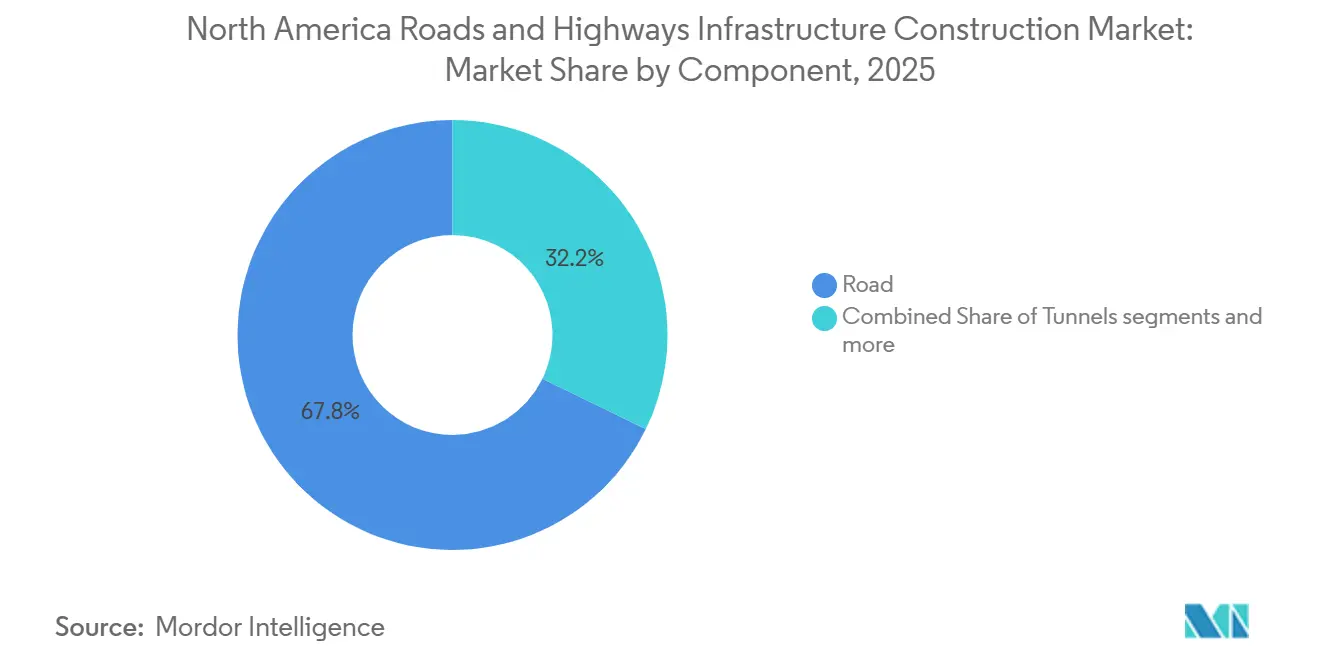
Roads Remain the Largest Category While Bridges/Overpass Activity Grows FasterRoads retained a 67.80% share in 2025 and remained the largest component of the North America roads and highways infrastructure construction market. Their position reflects ongoing spending on resurfacing, lane additions, widening, and capacity improvement across interstate and arterial networks. Federal formula programs direct a large share of highway funding toward pavement-related work. The National Highway Performance Program and Surface Transportation Block Grant support this recurring project base. Tunnels and other assets, including rest areas, retaining walls, and drainage systems, made up the remaining spending. Tunnel projects are fewer in number but can carry high values, including the Eisenhower Tunnel rehabilitation in Colorado and proposed I-405 tunneled alternatives in Los Angeles.
Bridges/overpass are forecast to grow at a 6.40% CAGR through 2031, ahead of the wider North America roads and highways infrastructure construction market. Fiscal year 2026 Bridge Formula Program funding reached USD 5.5 billion for bridge replacement, rehabilitation, preservation, and construction. The large repair backlog also maintains demand for bridge contractors and specialist suppliers. The Brent Spence Bridge Corridor shows how multi-year bridge programs can anchor demand for steel, ultra-high-performance concrete, and specialized transport equipment. Its design-build team includes the Walsh Kokosing joint venture, with AECOM and Jacobs providing design services. State departments of transportation are also using geosynthetic reinforced soil abutments and ultra-high-performance concrete deck panels to reduce closures on high-traffic freight routes.



By Construction Type:
New Construction Holds the Largest Position While Renovation ExpandsNew construction accounted for 61.5% of the North America roads and highways infrastructure construction market in 2025. The category is supported by capacity programs in the Sun Belt and southern border states where population growth and freight movements exceed existing lane capacity. Texas, Florida, and Arizona have a substantial share of new lane and interchange work. Texas Department of Transportation maintains one of the largest active highway building programs in the region. Private funding and public-private partnerships are more likely to support new-capacity projects where toll revenues can support finance structures. This approach is expanding beyond established toll markets in Texas and Florida to states such as Indiana and Colorado.
Renovation is forecast to grow at a 6.20% CAGR through 2031 in the North America roads and highways infrastructure construction market. Much of the interstate system was built between 1956 and 1990, leaving major sections near or beyond their original design lives. ARTBA data for 2022 through 2026 showed that 44% of IIJA projects were repair or reconstruction projects, compared with 6% for new roads and bridges. Agencies are using seismic retrofits, deck replacements, and cable re-tensioning to reduce the need for full replacement when sound substructures are present. Thirty-three states are expected to have National Highway System road and bridge funding gaps during the next decade. Nineteen states projected bridge maintenance shortfalls totaling USD 37.8 billion, supporting demand for contractors with long-term maintenance agreements.
By Investment Source:
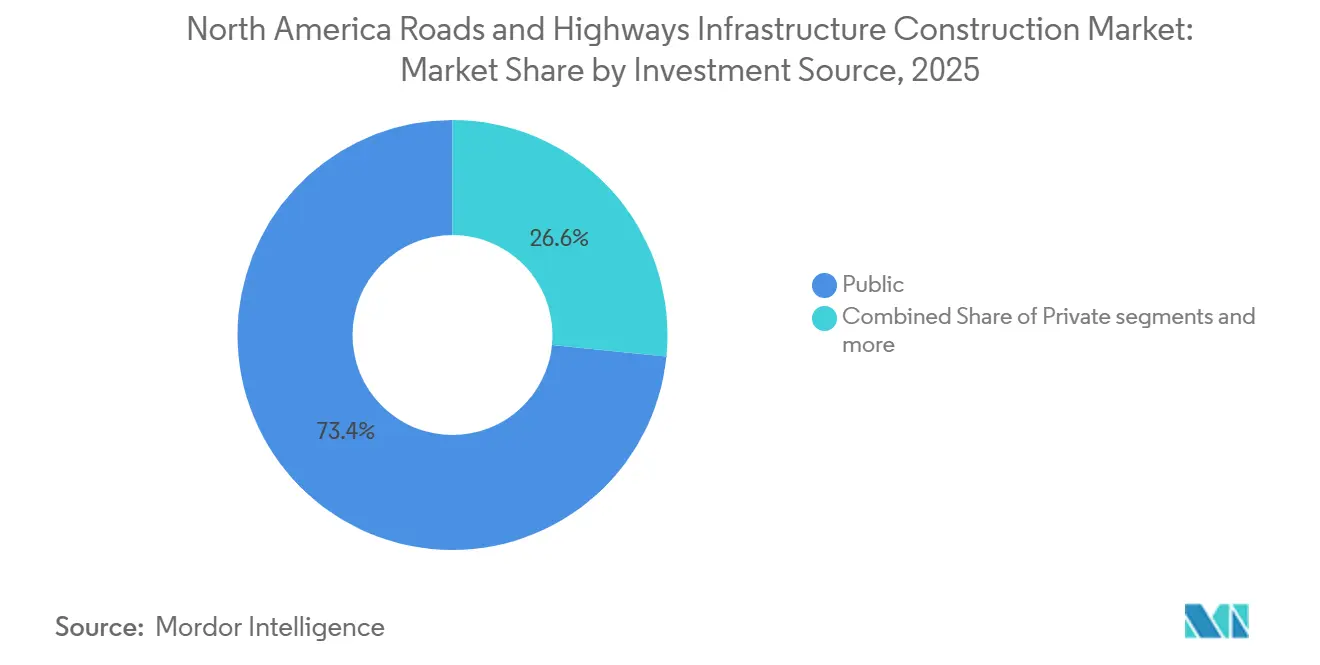
Public Funding Provides the Base While Public-Private Partnerships Gain UsePublic funding retained 73.40% of the North America roads and highways infrastructure construction market in 2025. Most highways are non-tolled public assets, which limits the scope for direct user-fee recovery. Federal trust fund apportionments, state fuel taxes, and general fund appropriations support most road investment. Federal contributions accounted for more than 50% of state highway and bridge capital outlays during the past decade.
Private funding remains relevant for managed lanes and express toll roads in Texas, Florida, Virginia, and Colorado. Commercial users can support these projects where reliable travel time has a clear operating value. Public-private partnerships are forecast to grow at a 6.80% CAGR through 2031 in the North America roads and highways infrastructure construction market. States facing fiscal constraints and possible post-IIJA funding gaps are considering availability-payment and concession structures for major projects. Several states are using enabling legislation, indexed fuel taxes, and electric vehicle registration fees to support long-term highway revenue. These structures supplement public funding rather than replace it. Large partnership projects usually combine federal grants, state bond proceeds, and private equity or infrastructure debt. Contractors with experience in availability-payment procurement and lifecycle cost analysis are better placed to participate in this work.
By Type:
National Roads Lead While State Highway Programs AccelerateNational roads held a 49.80% share in 2025 and represented the largest type within the North America roads and highways infrastructure construction market. National Highway Performance Program funding supports the 163,000-mile National Highway System. The system accounts for 55% of United States vehicle miles traveled while representing less than 5% of road mileage. This density makes the network a priority for capital planning. The standard federal-aid match is generally 80% federal and 20% state. This structure makes National Highway System projects attractive because state funding can leverage a larger total program value.
State highways are forecast to grow at a 6.10% CAGR through 2031 in the North America roads and highways infrastructure construction market. State programs supplement federal allocations, especially in California, Texas, and Florida. California, Texas, and Florida have large capital programs that continue to support corridor and interchange work. Granite Construction won a USD 114 million Highway 101 Segment 4E North contract in California in April 2026. It also secured a USD 116.9 million State Route 177 extension in Utah in 2026. Local roads depend more heavily on block grant allocations, county resources, and municipal bonds, while accessibility requirements also support steady retrofit activity within highway rights-of-way.
Geography Analysis
United States Roads and Highways Infrastructure Construction Market
The United States accounted for 84.60% of regional revenue in 2025, making it the main contributor to the North American highway construction market. Its position reflects the scale of the road network, the current IIJA funding cycle, and strong vehicle travel demand. Federal apportionments to states totaled USD 56.8 billion in fiscal year 2026. The Bridge Formula Program provided USD 5.5 billion during fiscal year 2026 for replacement, rehabilitation, preservation, and construction. Texas has a statewide program that supports a large volume of highway work. Fluor began the USD 671 million reconstruction of State Highway 6 in Bryan and College Station in November 2025. A continuing resolution at current IIJA funding levels would preserve project pipelines, while a return to pre-2021 authorization levels would reduce annual federal highway spending by USD 20 billion.
Canada and Mexico Roads and Highways Infrastructure Construction Market
Canada remains the second-largest contributor to the North America roads and highways infrastructure construction market. The federal government committed CAD 115 billion (USD 83 billion) to major infrastructure over 5 years. Ontario announced a CAD 210 billion (USD 152 billion) capital plan over 10 years, with highways, transit, and community infrastructure among the primary areas of spending. Its 2026-27 budget allocated CAD 37 billion (USD 26.6 billion). Major work on the 16.3 km Bradford Bypass began in 2026 as part of Ontario’s CAD 31 billion (USD 22.5 billion) highway investment program. The project is expected to support 2,200 jobs each year. The federal Major Projects Office also placed nearly CAD 120 billion (USD 86.3 billion) of projects under review during its first 3 months, indicating a focus on shortening approval timelines. Mexico is forecast to grow at a 7.10% CAGR through 2031, the fastest rate in the North America roads and highways infrastructure construction market. The 2025-2030 national road program allocates MXN 144,384 million (USD 7.9 billion) for the construction and modernization of 2,313 km of federal toll-free highways. The 2026 road conservation program directs MXN 69,299 million (USD 4 billion) to maintain 18,000 km of the federal network. The program operates 20 new paving trains, with 11 more expected to deploy by the end of 2026. Mexico’s infrastructure ministry reported MXN 224,875 million (USD 12.3 billion) in total investment for highway modernization in 2026. Manufacturing relocation to northern Mexico is increasing pressure on freight corridors between Monterrey, Nuevo León, and Chihuahua and the United States border crossings.
Competitive Landscape
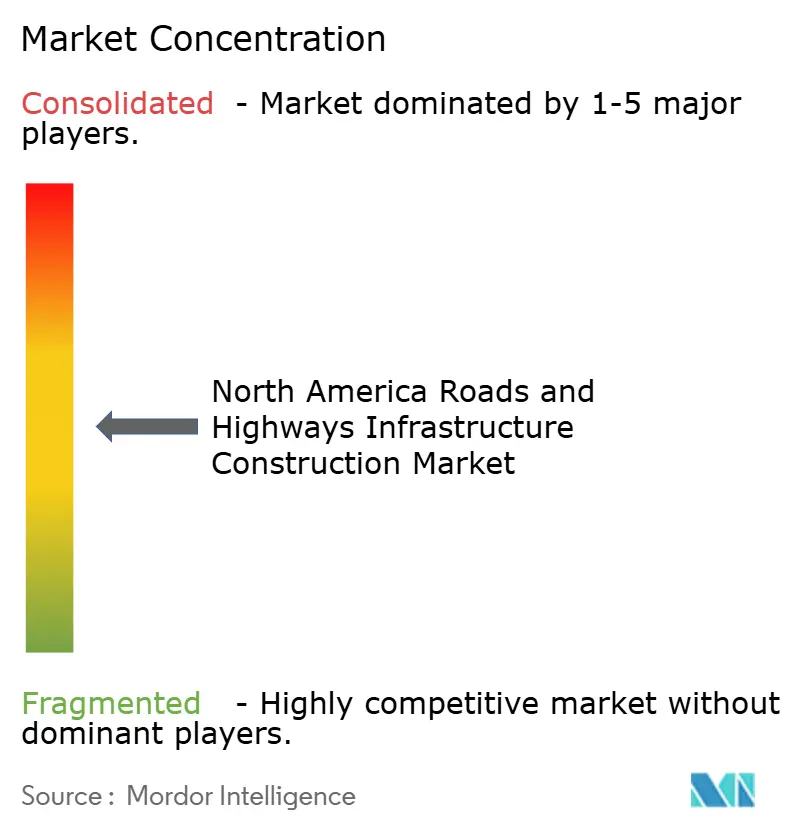
The North America roads and highways infrastructure construction market has a moderately concentrated upper tier, with Fluor Corporation, Walsh Group, AECOM, Acciona S.A., Bechtel, Skanska, and Parsons Corporation competing for large-scale transportation contracts. Regional contractors and specialty civil engineering firms remain active in state and municipal highway programs, particularly on rehabilitation, resurfacing, and bridge replacement projects. Joint ventures remain the preferred delivery model for mega projects, enabling contractors to combine financial capacity, engineering expertise, and specialized construction capabilities. The Brent Spence Bridge Corridor remains a prominent example, with the Walsh Kokosing Joint Venture leading construction. At the same time, AECOM, Jacobs, and Parsons provide design and engineering services for the USD 4.05 billion program.
Alternative delivery methods, including design-build (DB) and construction manager/general contractor (CM/GC), continue to gain traction for highway projects because they accelerate project delivery and improve risk allocation. During 2026, Granite Construction secured the approximately USD 114 million Highway 101 Segment 4E North CM/GC contract in California, reinforcing its position in complex corridor modernization programs. Fluor continues work on the USD 671 million State Highway 6 expansion project in Texas, widening the corridor from four to six lanes while improving interchanges and multimodal connectivity. These awards highlight the growing preference among transportation agencies for contractors with integrated engineering, preconstruction, and project management capabilities.
Technology is becoming an increasingly important differentiator in contractor selection across the North America roads and highways infrastructure construction market. Building information modeling (BIM), digital project controls, drone-based site monitoring, intelligent compaction, and automated earthmoving improve productivity and schedule certainty on large corridor programs. Contractors are also investing in ultra-high-performance concrete (UHPC), modular bridge components, and specialized transport systems to support accelerated bridge construction (ABC) projects, reducing traffic disruptions and shortening construction schedules. Environmental compliance remains a critical project risk, although the NEPA Assignment Program continues to expand, enabling participating state departments of transportation to assume greater environmental review authority and streamline project approvals in states such as Nebraska, Maine, and Texas.
North America Roads and Highways Infrastructure Construction Industry Leaders
AECOM
Acciona S.A.
ACS, Actividades de Construcción y Servicios, S.A.
Bechtel Corporation
FlatironDragados
- *Disclaimer: Major Players sorted in no particular order
North America Roads and Highways Infrastructure Construction Market Companies Covered in this Report
- AECOM
- Acciona S.A.
- ACS, Actividades de Construcción y Servicios, S.A.
- Aecon Group Inc.
- Bechtel Corporation
- FlatironDragados
- EllisDon Corporation
- Ferrovial S.E.
- Fluor Corporation
- Granite Construction Incorporated
- Graham Group
- Grupo Indi, S.A. de C.V.
- Kiewit Corporation
- Kokosing, Inc.
- Ledcor Group of Companies
- Michels Corporation
- Skanska AB
- The Walsh Group
- Tutor Perini Corporation
- Zachry Construction Corporation

Recent Industry Developments in North America Roads and Highways Infrastructure Construction Market
- April 2026: Granite Construction was awarded a USD 114 million contract by Caltrans to deliver the Highway 101 Segment 4E North project between Carpinteria and Santa Barbara, California, under the CM/GC delivery model. The project is scheduled for completion by December 2028, marking the final phase of the 11-mile corridor improvement program.
- February 2026: Nevada DOT selected Granite Construction to deliver preconstruction services for the USD 475 million I-80 East Widening Project in Washoe County, backed by USD 275 million from the USDOT INFRA Grant program. Construction is expected to begin in Q3 2027.
- November 2025: Fluor Corporation broke ground on the USD 671 million reconstruction and widening of State Highway 6 in Bryan and College Station, Texas, for TxDOT. The 12-mile corridor will expand from 2 to 3 lanes in each direction as part of the Texas Triangle freight network, with completion expected by the end of 2030.


North America Roads and Highways Infrastructure Construction Market Report Scope
The North America Roads and Highways Infrastructure Construction Market Report is Segmented by Component (Road, Bridges/Overpass, Tunnels, and Others), Construction Type (New Construction and Renovation), Investment Source (Public, Private, and Public-Private Partnership), Type (National, State, and Local), and Geography (United States, Canada, Mexico). The Market Forecasts are Provided in Terms of Value (USD).
| Road |
| Bridges/Overpass |
| Tunnels |
| Others |
| New Construction |
| Renovation |
| Public |
| Private |
| Public-Private Partnership |
| National |
| State |
| Local |
| United States |
| Canada |
| Mexico |
| By Component | Road |
| Bridges/Overpass | |
| Tunnels | |
| Others | |
| By Construction Type | New Construction |
| Renovation | |
| By Investment Source | Public |
| Private | |
| Public-Private Partnership | |
| By Type | National |
| State | |
| Local | |
| By Country | United States |
| Canada | |
| Mexico |


Key Questions Answered in the Report
What is the 2026 value of the North America roads and highways infrastructure construction market?
The sector is estimated at USD 545.71 billion in 2026 and is forecast to reach USD 721.50 billion by 2031.
What growth rate is forecast through 2031?
The North America roads and highways infrastructure construction market is projected to grow at a CAGR of 5.7% during the 2026–2031 forecast period.
Which highway construction component has the largest share?
Roads led the component mix with a 67.80% share in 2025, supported by resurfacing, widening, and capacity programs.
Which construction activity is expanding fastest?
Renovation is forecast to grow at a 6.20% CAGR through 2031 as agencies address aging interstate and bridge assets.
Why are public-private partnerships becoming more important?
Public-private partnerships are forecast to grow at a CAGR of 6.80% as government agencies increasingly adopt availability-payment and concession models for large-scale infrastructure projects.
Which country is expected to grow fastest in North America?
Mexico is forecast to grow at a 7.10% CAGR through 2031, supported by road modernization and freight corridor demand.
Page last updated on:





