
North America Packaged Chia Seeds Market Size and Share
Market Overview
| Study Period | 2021 - 2031 |
|---|---|
| Forecast Data Period | 2026 - 2031 |
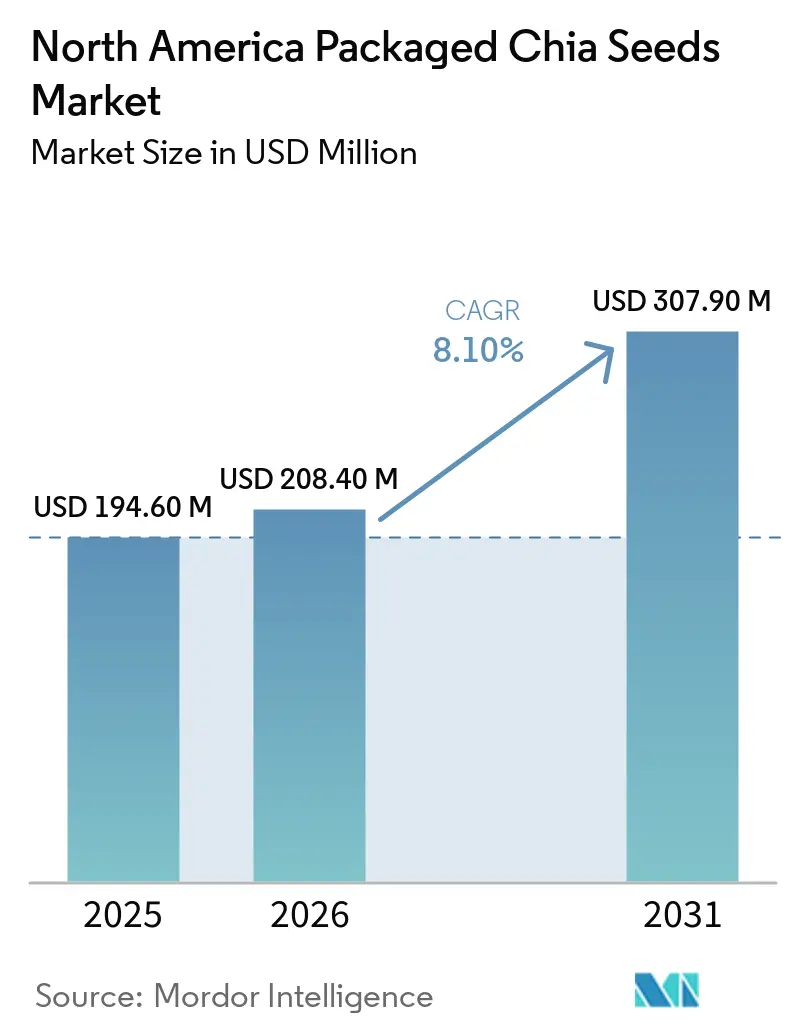
| Base Year Market Size (2025) | USD 194.60 Million |
| Market Size (2026) | USD 208.40 Million |
| Market Size (2031) | USD 307.90 Million |
| Growth Rate (2026 - 2031) | 8.10 % |
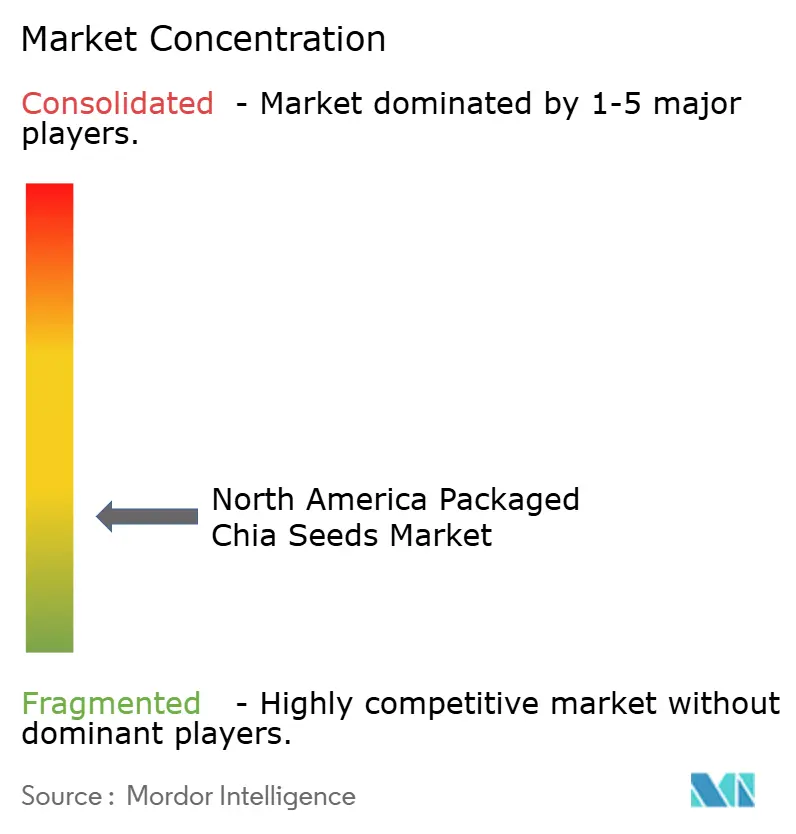
| Market Concentration | Low |
Major Players *Disclaimer: Major Players sorted in no particular order Image © Mordor Intelligence. Reuse requires attribution under CC BY 4.0. | |
North America Packaged Chia Seeds Market Analysis by Mordor Intelligence
The North America packaged chia seeds market size was valued at USD 194.6 million in 2025 and is estimated to grow from USD 208.4 million in 2026 to reach USD 307.9 million by 2031, at a CAGR of 8.1% during the forecast period (2026-2031). The category is moving beyond its earlier health-food positioning as more households use chia in routine meals and packaged foods. Clear nutrition labeling has increased attention on fiber and added sugar, which supports interest in ingredients with a simple nutritional profile. Private-label growth is also changing competition because retailers can offer familiar seed products at lower prices. Brands therefore need to combine dependable sourcing, practical packaging, and clearer product benefits to protect their position in the North America packaged chia seeds market.
Key Report Takeaways
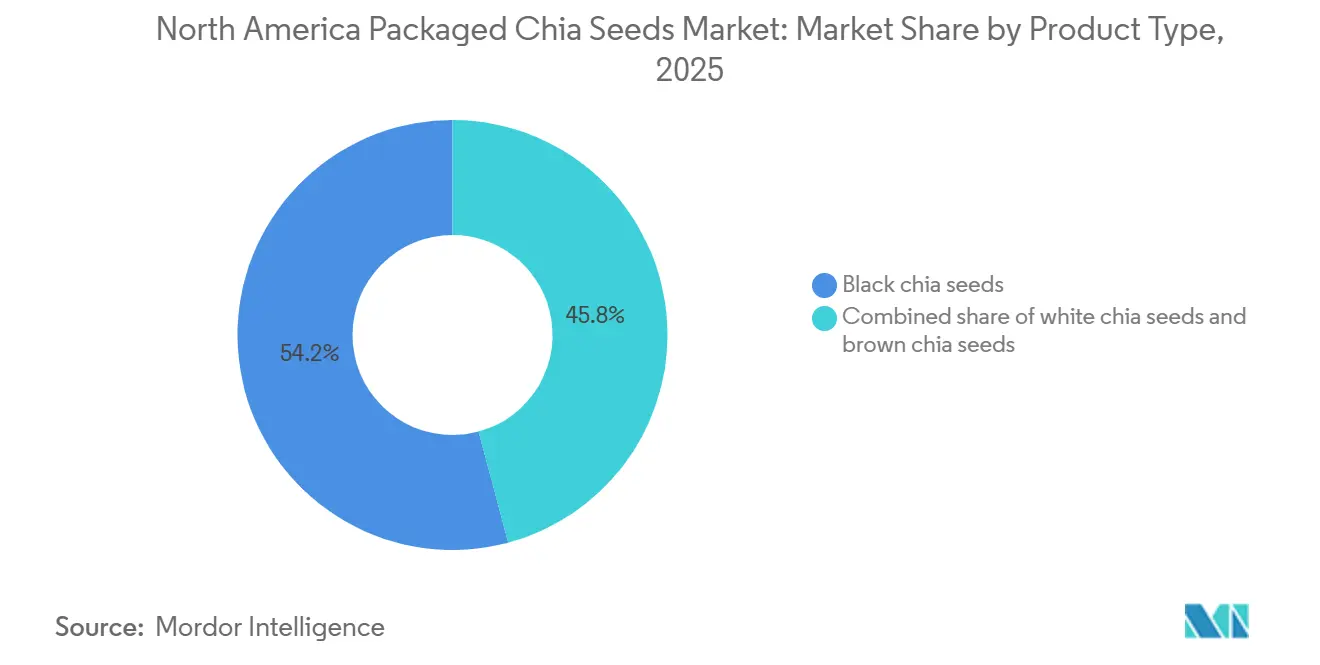
- By product type, black chia seeds held 54.2% of revenue in 2025, while white chia seeds are forecast to grow at an 8.7% CAGR through 2031.
- By nature, conventional chia seeds held 79.3% of revenue in 2025, while organic chia seeds are forecast to grow at a 10.1% CAGR through 2031.
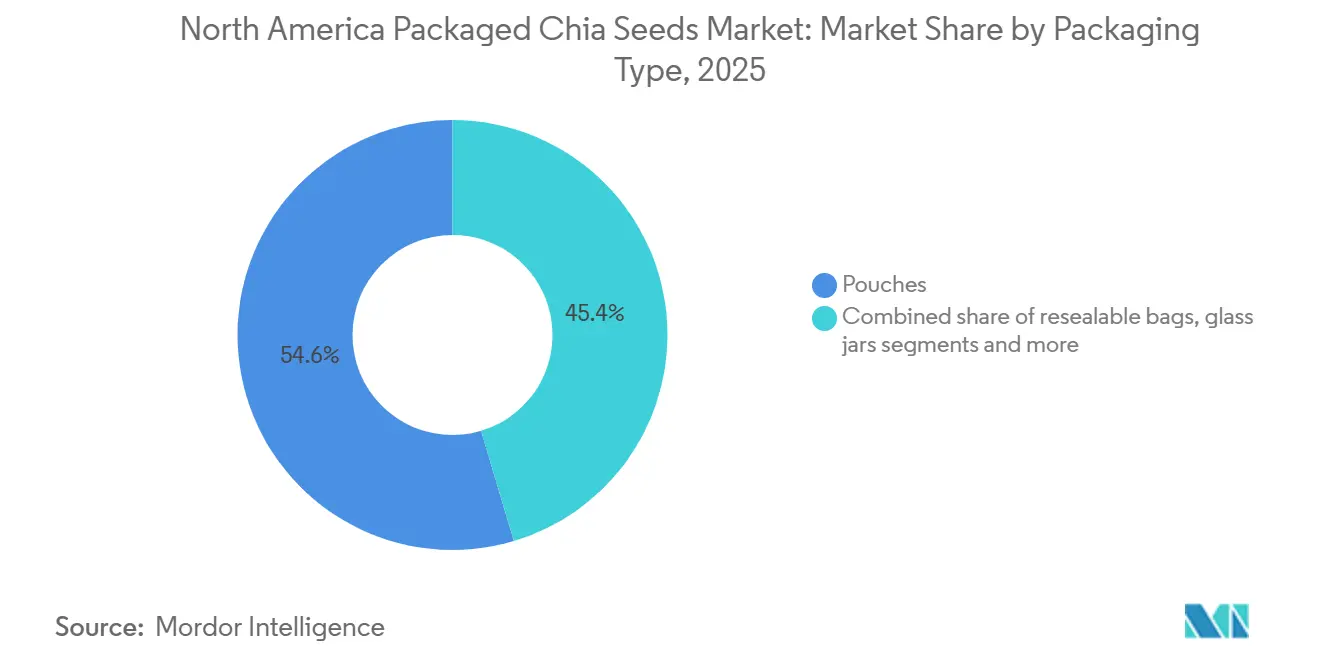
- By packaging type, pouches held 54.6% of revenue in 2025, while resealable bags are forecast to grow at a 9.1% CAGR through 2031.
- By distribution channel, supermarkets and hypermarkets held 45.7% of revenue in 2025, while online retail stores are forecast to grow at a 10.3% CAGR through 2031.
- By geography, the United States held 73.5% of revenue in 2025, while Mexico is forecast to grow at a 9.4% CAGR through 2031.
Note: Market size and forecast figures in this report are generated using Mordor Intelligence’s proprietary estimation framework, updated with the latest available data and insights as of January 2026.
North America Packaged Chia Seeds Market Trends and Insights
Drivers Impact Analysis*
| Drivers | (~) % Impact on CAGR Forecast | Geographic Relevance | Impact Timeline |
|---|---|---|---|
| Mainstream Chia Use in Everyday Grocery | +2.5% | United States and Canada | Short term (≤ 2 years) |
| Flavored and Fortified Chia Product Innovation | +1.8% | United States, with early gains in Canada | Medium term (2-4 years) |
| Chia Use in Clean-Label Formulations | +1.5% | United States, with spillover to Canada and Mexico | Medium term (2-4 years) |
| Transparent Sourcing and Sustainability Credentials | +1.2% | United States and Canada, with spillover to Mexico | Long term (≥ 4 years) |
| Private-Label and Mass-Retail Availability | +1.0% | United States and Canada | Short term (≤ 2 years) |
| E-Commerce and Direct-to-Consumer Expansion | +1.3% | United States, with fast uptake in Mexico | Medium term (2-4 years) |
| Source: Mordor Intelligence | |||
Mainstreaming of Chia from Specialty Food to Everyday Grocery
Chia's transition from a premium health-food aisle niche into center-store grocery is the single strongest structural driver of this market. Annual Amazon US chia seed searches reached 562,915 queries in July 2026 alone, with monthly unit sales of 315,400 units across the top 50 ASINs, up 18.0% from August 2025, and cumulative 12-month revenues of USD 33.3 million, figures that reflect a consumer base replenishing a pantry staple rather than discovering a trend. Club-store channel behavior reinforces this: Costco's switch from Nutiva to Monda Foods Organic as its chia seed supplier by 2026 illustrates how cost-efficiency now rivals brand loyalty in high-volume retail, a hallmark of category maturation. The USDA confirms that plant-based food sales in the US continued to expand through 2024, directly supporting mainstream chia demand trajectories. The strategic implication for incumbents: brands that invested in consumer education must now compete on private-label-proof differentiation, convenience formats, and supply chain efficiency, because the awareness gap they once exploited has closed.
Innovation in Flavored and Fortified Chia Products
Product developers are repositioning chia from a commodity seed into a functional ingredient platform, and commercial validation is materializing. Cibo Vita's Probiotic FruiChias, launched in late 2024 and co-delivering 2 billion microencapsulated probiotic cultures alongside 4 grams of dietary fiber per serving, won the Good Housekeeping 2025 Snack Award, confirming strong market appetite for multi-benefit chia formats targeting digestive health. Benexia's Seeds of Wellness Chia Milk, launched in March 2025 at select Costco locations and nationwide on Amazon, delivers 740 mg of plant-based omega-3 per 8 oz serving, 4x the fiber of leading almond or oat milks and 3x the protein of leading rice milks, establishing a new premium-beverage beachhead for chia. The second-order pricing insight: fortified chia formats command 3–5× the per-ounce price of bulk seeds, opening margin-expansion pathways for brands that have competed primarily on commodity positioning.
Use of Chia as a Clean-Label Formulation Aid
Chia's functional versatility, gelling, emulsification, moisture retention, enables it to substitute hydrocolloids, guar gums, and egg components in packaged food formulations, making it a strategic procurement decision for CPG manufacturers, not merely a consumer-facing ingredient. Benexia's XIA FIBER, a chia-derived concentrate combining 56% soluble and insoluble fiber, 25% plant-based protein, and 5% omega-3 ALA in a single clean-label input, received novel food recognition from the European Food Safety Authority (EFSA), a regulatory influence milestone that foreshadows expanded ingredient approval and likely North American formulation uptake. The FDA's updated Nutrition Facts panel, mandating fiber and added sugar disclosures, has made fiber-dense ingredients such as chia a compliance-adjacent priority for mainstream packaged food brands seeking to meet label standards without synthetic additives. The implication that competitors often overlook: packaged chia seed brands capable of positioning their product as a B2B formulation enabler, not just a retail snack unlock access to the far larger CPG ingredient and food-service markets, bypassing the price compression endemic to retail SKU competition.
Expansion of E-Commerce and D2C Channels
Online retail stores are the fastest-growing distribution channel in this market at a projected 10.31% CAGR through 2026-2031, and the unit economics explain why: an online 2 lb chia sale generates higher gross margins for the brand, no slotting fees, no promotional allowances, while often offering consumers better per-ounce value than single-unit physical retail purchases. The 10 top-ranked chia seed ASINs on Amazon US captured 69.8% of unit volume and 64.8% of revenue in July 2026, with concentration at the top acting as a built-in barrier for new entrants. Navitas Organics, acquired by Laird Superfood in March 2026, reported a 64% online sales mix in 2024, a structural dependency that provides margin advantage but also concentration risk if algorithm-driven pricing erodes premium positioning over time[1]. The broader D2C shift rewards brands that can convey sourcing transparency and organic credentials through digital content, attributes that physical shelf facings struggle to communicate at scale.
Restraints Impact Analysis*
| Restraint | (~) % Impact on CAGR Forecast | Geographic Relevance | Impact Timeline |
|---|---|---|---|
| Allergen and sensitivity concerns | -0.8% | United States & Canada | Long term (≥ 4 years) |
| Competition from other superfoods and seeds | -1.2% | United States & Canada | Short term (≤ 2 years) |
| Shorter shelf-life of value-added chia formats | -0.5% | United States, with early signal in Canada | Medium term (2-4 years) |
| Food-safety recall and pathogen-control exposure | -0.7% | United States & Canada | Short term (≤ 2 years) |
| Source: Mordor Intelligence | |||
Competition from Other Superfoods and Seeds
Chia competes directly for shelf space and consumer spending against flaxseed, hemp seeds, and quinoa, all of which carry comparable health positioning and, in many cases, lower per-gram price points. Supermarkets and hypermarkets, which accounted for 45.72% of packaged chia distribution in 2025, apply rigorous slotting discipline, and category managers routinely rationalize superfood SKUs by velocity. Hemp seeds have expanded their clean-label and omega-3 positioning aggressively, while flaxseed benefits from longer consumer familiarity and deeply established supply chains. Private label retailer brands captured approximately 18.5% of supermarket chia seed volumes by 2025, often priced 15–25% below branded equivalents, compressing the addressable margin for mid-tier branded players caught between premium organic brands and value private-label alternatives. It is likely that this competitive compression will accelerate SKU rationalization in mass retail, while simultaneously creating white space in functional-format and D2C channels where category incumbents have not yet established dominance.
Food-Safety Recall and Pathogen-Control Exposure
Pathogen contamination remains a structurally recurring risk in raw seed categories, and chia is not exempt from exposure. In May 2024, Natural Sourcing International initiated a voluntary recall of Great Value Organic Black Chia Seeds due to potential Salmonella contamination; the FDA elevated this to a Class I recall in June 2024, the highest risk classification, reserved for products with a reasonable probability of causing serious adverse health consequences or death. Navitas Organics issued a separate voluntary recall of select 8 oz organic chia seed lots that same year, distributed at Whole Foods Market, Target, Amazon, and iHerb, triggered by supplier-level contamination[2]. A prior international Salmonella outbreak linked to sprouted chia seed powder in 2013–2014 affected 94 persons across 16 US states and 4 Canadian provinces, establishing an episodic pattern. Each recall event inflicts disproportionate brand damage on organic-certified products in premium channels because the implied quality promise is highest there an asymmetric risk that brands with diversified distribution can absorb more readily than single-channel specialists.
*Our forecasts treat driver/restraint impacts as directional, not additive. The impact forecasts reflect baseline growth, mix effects, and variable interactions.
Segment Analysis
By Product Type: Black Seeds Anchor Volume, White Seeds Attract Formulation Demand
Black chia seeds held 54.2% of the North America packaged chia seeds market share in 2025. The format benefits from established sourcing, familiar use, and broad acceptance in mass retail. It is the common choice for club-store packs, supermarket private labels, and bulk purchases. Its dark color is acceptable in many consumer uses, including smoothies, oatmeal, and baked goods. Large retailers can use black chia in value-oriented programs because it supports consistent pack formats. The broad product base gives suppliers a stable volume platform. It also increases the importance of dependable sourcing and straightforward quality standards. The North America packaged chia seeds industry relies on this segment to maintain accessible retail price points.
White chia seeds are forecast to grow at an 8.7% CAGR through 2031. Their lighter appearance suits yogurt, beverages, rice-paper snacks, and protein bars where visible black specks may be undesirable. Food manufacturers can use the lighter color to keep a finished product’s appearance consistent. Seeds of Wellness used whole chia seeds in its 2025 Chia Milk launch, which illustrated an application beyond standard dry seed packs. White chia can therefore appeal to manufacturers that need a neutral visual profile in prepared foods. The segment does not replace black chia’s volume role. Instead, it provides an option for specialized food and beverage applications. This distinction supports product development without requiring a major change in how consumers use chia.

By Nature: Conventional Holds the Volume Base, Organic Captures Growth
Conventional chia seeds held 79.3% of regional revenue in 2025. Their leading position reflects a lower sourcing cost and a retail price that can suit a wider group of shoppers. These products meet demand from consumers who value chia’s nutritional profile but do not require organic certification. Conventional supply is also well suited to private-label programs that prioritize value and broad distribution. Large retail programs can use conventional products to offer a recognizable category at competitive prices. This supports their role in supermarkets, club stores, and online value packs. The segment’s volume base is therefore likely to remain important even as certified products expand. Affordability will continue to influence the North America packaged chia seeds market.
Organic chia seeds are forecast to grow at a 10.1% CAGR through 2031. Some buyers treat organic certification as a basic quality requirement rather than a premium feature. Documentation under the Canada Organic Regime and compliance with the USDA National Organic Program can reinforce confidence in certified products. These requirements can make verification more important for cross-border supply. Navitas Organics built a business around organic superfoods and had a 64% online sales mix in 2024. Organic products can be better positioned for consumers seeking traceable sourcing and digital product detail. The segment may maintain a price premium where certification is supported by credible documentation. Its growth reflects a preference for verified product claims as well as nutritional benefits.
By Packaging Type: Pouches Dominate on Economics, Resealable Bags Drive Growth
Pouches held 54.6% of revenue in 2025. Their low unit cost makes them suitable for branded and retailer-owned products. They also support a range of fill weights, from smaller trial packs to larger value formats. Lightweight packs can lower shipping costs, which helps online sellers. Printed pouches give suppliers a simple way to present label claims, preparation ideas, and certification marks. These benefits make the format difficult to displace in high-volume channels. Glass jars and plastic containers still serve premium and specialty stores where presentation can matter more. Pouches remain central to the North America packaged chia seeds market because their economics work across retail formats.
Resealable bags are forecast to grow at a 9.1% CAGR through 2031. This growth is consistent with repeat use in breakfasts, smoothies, overnight oats, and baking. Consumers who buy larger packs need a package that can be closed after opening. Resealable formats can help protect product quality during household use. This is relevant because chia contains polyunsaturated fatty acids that can be affected by oxidation after a package is opened. The format gives brands a practical product benefit that is easy to communicate. It can also encourage a larger purchase than a single-use or small trial pack. Resealable bags therefore support household use patterns that are becoming more routine.
By Distribution Channel: Supermarkets Anchor Volume, Online Channels Define Growth
Supermarkets and hypermarkets held 45.7% of revenue in 2025. These stores provide visibility, frequent replenishment, and access to shoppers who buy pantry staples during regular grocery trips. Their scale also supports private-label offerings and promotional activity. Physical retail remains important for consumers who compare pack sizes and prices directly at the shelf. Convenience and grocery stores complement this channel with smaller and more immediate purchase occasions. Other channels include food-service and institutional buyers that may favor bulk formats. Competition in these stores can be intense because category managers review product velocity and shelf productivity. This makes physical distribution essential but demanding for brands in the North America packaged chia seeds market.
Online retail stores are forecast to grow at a 10.3% CAGR through 2031. The channel can serve consumers who want larger sizes, subscription-style replenishment, or organic products that may not be stocked nearby. It allows companies to provide detailed information on origin, certification, nutrition, and use. Direct sales can avoid some of the fees and shelf constraints associated with store placement. However, brands must still manage visible pricing, reviews, and delivery performance. Digital channels also make it easier for small suppliers to reach customers without securing nationwide shelf space. This can support entry while making comparison shopping more immediate. Online growth will remain an important source of opportunity and price pressure for the North America packaged chia seeds industry.
Geography Analysis
The United States held 73.5% of the North America packaged chia seeds market share in 2025. Its leading role reflects deep retail infrastructure across club stores, natural grocery banners, and mass-market chains. Many of the region’s established chia brands operate in the United States or depend on its retail and digital channels. The country also has a large consumer base that recognizes functional foods and uses chia in routine meals. Private-label availability supports broader access because it brings chia into store-owned health and pantry ranges. The United States therefore provides the largest platform for brands that can supply quality products at several price points.
Canada is an important consumption and trade market for packaged chia products. Canada exported 6,713 tonnes of chia seeds valued at USD 55.4 million in 2024, according to the supplied trade data. The country’s food safety and organic import requirements raise the standard for documented supply chains. This can favor suppliers that can demonstrate traceability and consistent certification records. Canadian demand is supported by organized health-food retail and consumers who show interest in organic products. These conditions make quality assurance and regulatory documentation important elements of regional competition.
Mexico is projected to grow at a 9.4% CAGR through 2031. The country combines a long cultural relationship with chia and an expanding modern retail base. Its domestic output was estimated at 4,771 tonnes in 2025, but rising packaged demand also requires imported supply. Mexico’s chia imports reached USD 39.6 million in 2024, compared with USD 18.7 million in 2023 in the supplied trade data. Organized retail in secondary cities can extend packaged products beyond premium outlets in Mexico City. The North America packaged chia seeds market can benefit as familiar agricultural heritage translates into more branded and packaged purchases. The Rest of North America remains a smaller revenue base, although improving logistics and retail penetration may widen future distribution opportunities.
Competitive Landscape
The North America packaged chia seeds market is fragmented, with specialty superfood brands, private-label suppliers, health food companies, and bulk import resellers competing through similar channels. The supplied material does not identify any company with a significant share of regional revenue. Companies compete on price, organic certification, convenient packaging, and reliable sourcing. Private-label products pressure brands selling plain chia seeds with limited differentiation. Branded suppliers can respond with verified quality, ready-to-use formats, and direct consumer engagement. The market is broad and not dominated by a few large players.
Laird Superfood is expected to acquire Navitas LLC for USD 38.5 million in March 2026. The deal will combine Navitas Organics’ retail and online distribution network with Laird Superfood’s plant-based functional food platform. Laird Superfood will fund the acquisition through a concurrent USD 50 million preferred stock placement. The acquisition will expand its presence across premium organic, club-store, and online channels. In 2025, NOW Health Group is expected to work with LeafWorks to improve botanical identity testing through DNA analysis and next-generation sequencing. These investments may strengthen supplier verification, compliance, and brand differentiation.
Companies also compete through product innovation and brand visibility. Mamma Chia’s Squeeze pouches are expected to appear on Good Morning America in May 2026, increasing awareness of its fiber-focused format. In 2025, Navitas Organics is expected to support Fairtrade farmers in Honduras through its Grow Ahead partnership and an online-sales-linked pledge. These efforts strengthen brand identity through sourcing and product formats. Smaller companies can attract consumers through specialized products and digital communication, while larger companies can build their position through acquisitions, quality systems, and wider distribution. The market is likely to remain open to differentiated brands, as the available evidence does not indicate dominance by a few players.
North America Packaged Chia Seeds Industry Leaders
-
Nutiva Inc.
-
BetterBody Foods
-
Bob’s Red Mill Natural Foods, Inc.
-
Navitas Organics
-
Mamma Chia LLC
- *Disclaimer: Major Players sorted in no particular order
Recent Industry Developments
- March 2026: Laird Superfood, Inc. completed the acquisition of Navitas LLC, parent of Navitas Organics, for USD 38.5 million, funded through a concurrent USD 50 million Series A preferred stock placement with Nexus Capital Management LP, following stockholder approval on March 11, 2026. The deal combines Navitas Organics’ premium organic superfood distribution, including Whole Foods Market, Costco, and Amazon.
- May 2026: Mamma Chia’s Squeeze pouches were featured on ABC’s Good Morning America, spotlighting the product’s prebiotic fiber content amid growing U.S. consumer interest in fiber-dense foods. The national broadcast placement expanded brand visibility among mainstream U.S. consumers well beyond the brand’s core natural-food audience.
- March 2025: Navitas Organics announced a partnership with Grow Ahead to support Fairtrade farmers in Honduras during Earth Month, pledging 5% of all April 2025 online sales toward shade-growing agricultural practices designed to increase crop yields and reduce carbon emissions.
North America Packaged Chia Seeds Market Report Scope
Chia seeds are derived from the Salvia hispanica plant and are small, nutrient-dense seeds containing dietary fiber, plant-based protein, omega-3 fatty acids, minerals, and other nutritional components. The North America packaged chia seeds market covers chia seeds sold in consumer-ready packaged formats for household consumption and is segmented by product type, nature, packaging type, distribution channel, and geography. Based on product type, the market is segmented into white chia seeds, black chia seeds, and brown chia seeds. Based on nature, the market is segmented into organic chia seeds and conventional chia seeds. Based on packaging type, the market is segmented into pouches, resealable bags, glass jars, plastic containers/bottles, and others. Based on distribution channel, the market is segmented into supermarkets/hypermarkets, convenience and grocery stores, online retail stores, and other distribution channels. Based on geography, the market is segmented into the United States, Canada, Mexico, and the rest of North America. For each segment, the market sizing and forecast have been done based on value (in USD million).
| White chia seeds |
| Black chia seeds |
| Brown chia seeds |
| Organic chia seeds |
| Conventional chia seeds |
| Pouches |
| Resealable bags |
| Glass jars |
| Plastic containers/bottles |
| Others |
| Supermarkets/Hypermarkets |
| Convenience and Grocery Stores |
| Online Retail Stores |
| Other Distribution Channels |
| United States |
| Canada |
| Mexico |
| Rest of North America |
| By Product Type | White chia seeds |
| Black chia seeds | |
| Brown chia seeds | |
| By Nature | Organic chia seeds |
| Conventional chia seeds | |
| By Packaging Type | Pouches |
| Resealable bags | |
| Glass jars | |
| Plastic containers/bottles | |
| Others | |
| By Distribution Channel | Supermarkets/Hypermarkets |
| Convenience and Grocery Stores | |
| Online Retail Stores | |
| Other Distribution Channels | |
| By Geography | United States |
| Canada | |
| Mexico | |
| Rest of North America |
Key Questions Answered in the Report
What is the forecast growth rate for packaged chia seeds in North America?
The category is forecast to grow at an 8.1% CAGR from 2026 to 2031, rising from USD 208.4 million in 2026 to USD 307.9 million by 2031.
Which type of chia seed has the largest regional sales base?
Black chia seeds led product demand with a 54.2% revenue share in 2025, supported by established supply and broad retail use.
Why are organic chia seeds growing faster than conventional products?
Organic chia seeds are forecast to grow at a 10.1% CAGR through 2031 as certification and traceable sourcing matter to a growing group of consumers.
Which sales channel is expanding fastest for packaged chia products?
Online retail stores are forecast to grow at a 10.3% CAGR through 2031, supported by larger pack sales and detailed digital product information.