
North America Industrial Asset Inspection Services Market Size and Share
Market Overview
| Study Period | 2021 - 2032 |
|---|---|
| Forecast Data Period | 2027 - 2032 |
| Base Year Market Size (2026) | USD 10.71 Billion |
| Market Size (2027) | USD 11.46 Billion |
| Market Size (2032) | USD 16.45 Billion |
| Growth Rate (2027 - 2032) | 7.50 % |
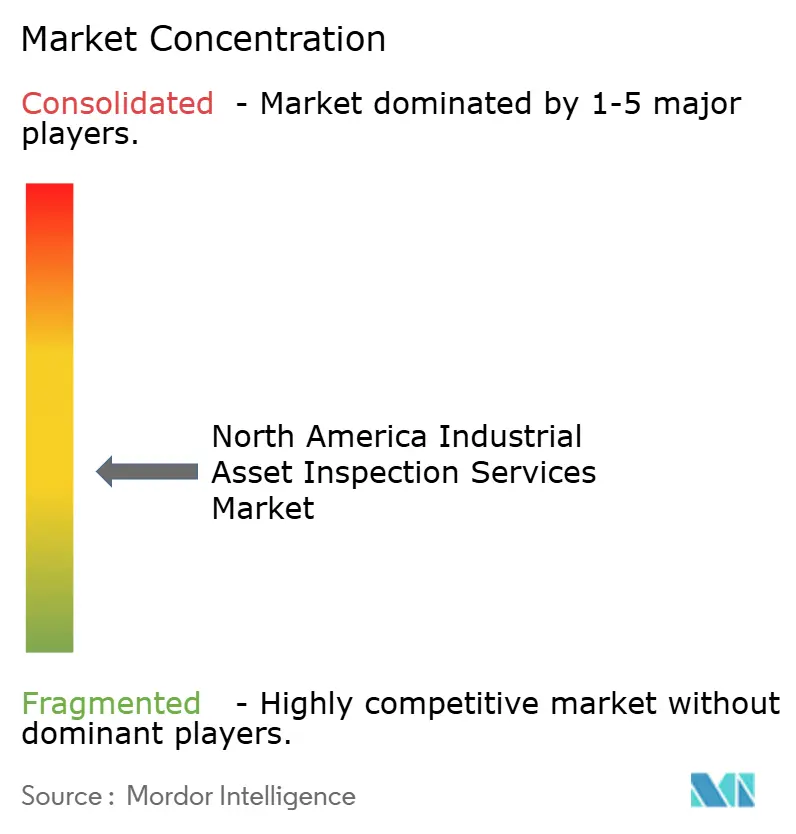
| Market Concentration | Medium |
Major Players *Disclaimer: Major Players sorted in no particular order Image © Mordor Intelligence. Reuse requires attribution under CC BY 4.0. | |
North America Industrial Asset Inspection Services Market Analysis by Mordor Intelligence
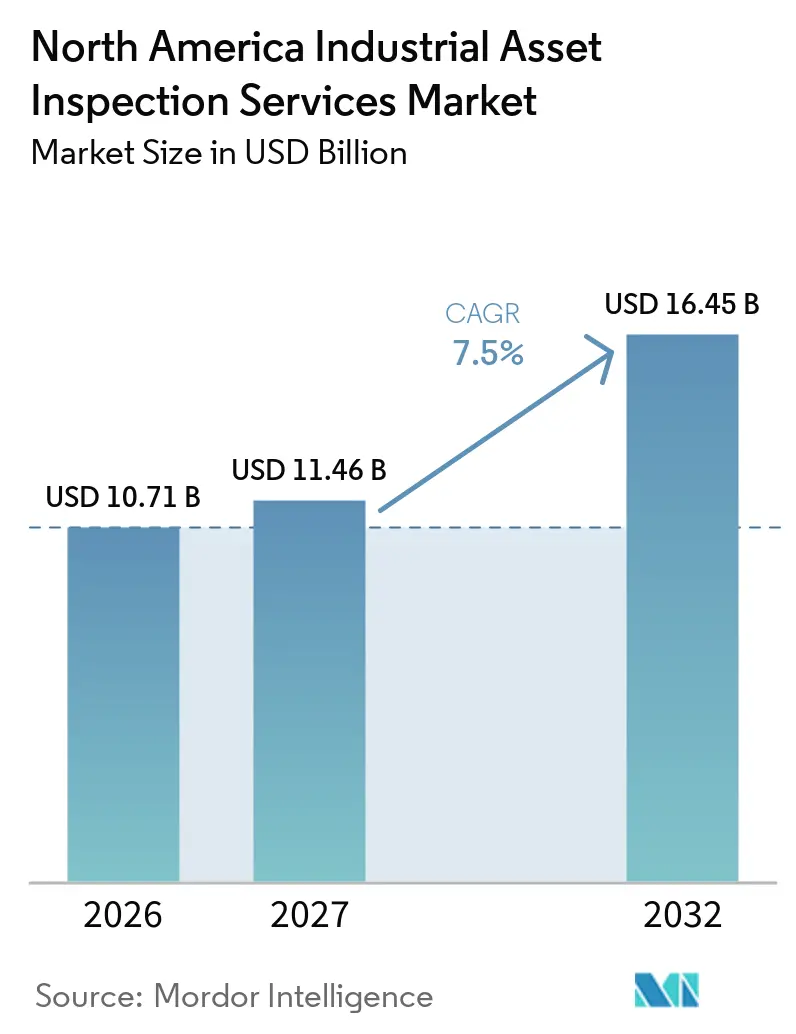
The North America Industrial Asset Inspection Services Market size is expected to increase from USD 10.71 billion in 2026 to USD 11.46 billion in 2027 and reach USD 16.45 billion by 2032, growing at a CAGR of 7.5% over 2027-2032.
The North America industrial asset inspection services market is supported by a large installed base of pipelines, pressure equipment, power networks, and industrial facilities that require periodic condition assessment. Aging electricity equipment and transmission lines add to this need, as 70% of United States power transformers and 70% of transmission lines are at least 25 years old. Federal safety rules, infrastructure rehabilitation, and longer operating lives are sustaining service demand even when capital spending varies. Digital inspection methods are also changing how providers compete because asset owners increasingly expect field findings to connect with maintenance and asset-management systems. This creates opportunities for firms that combine qualified technicians, data handling, and repeatable inspection programs.
Key Report Takeaways
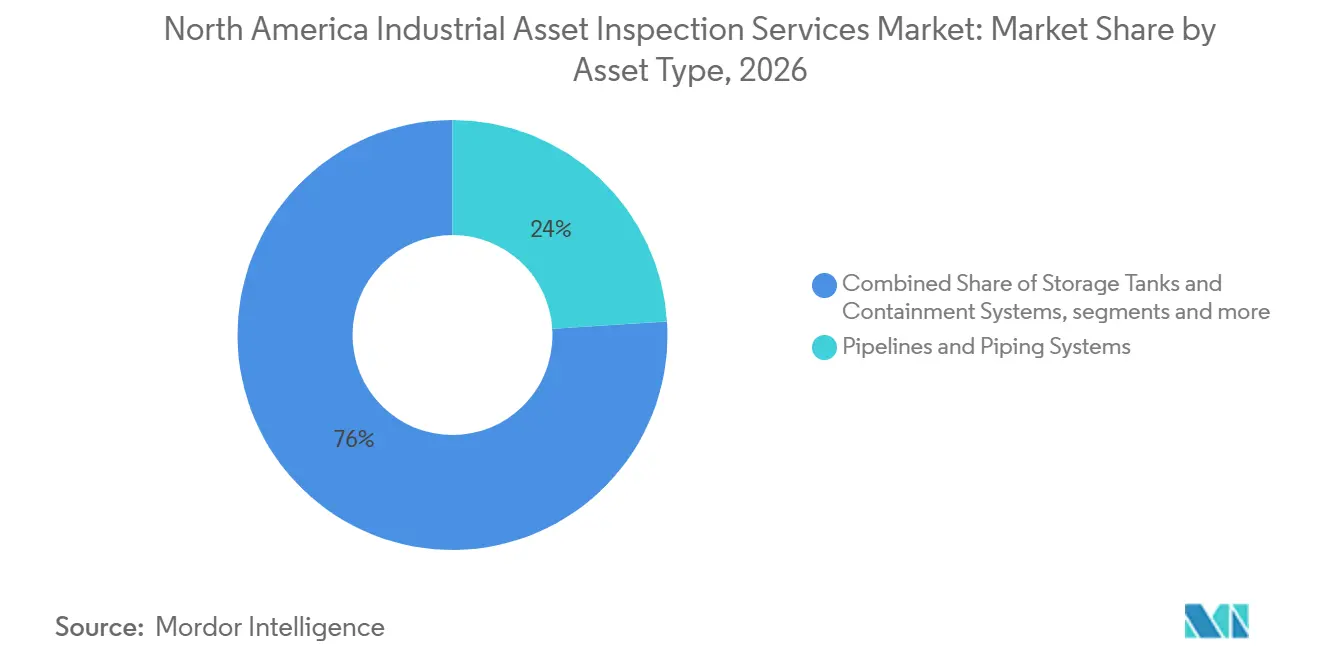
- By asset type, pipelines and piping systems held 24.0% of the North America industrial asset inspection services market share in 2026, while electrical and power equipment is projected to grow at a 9.0% CAGR through 2032.
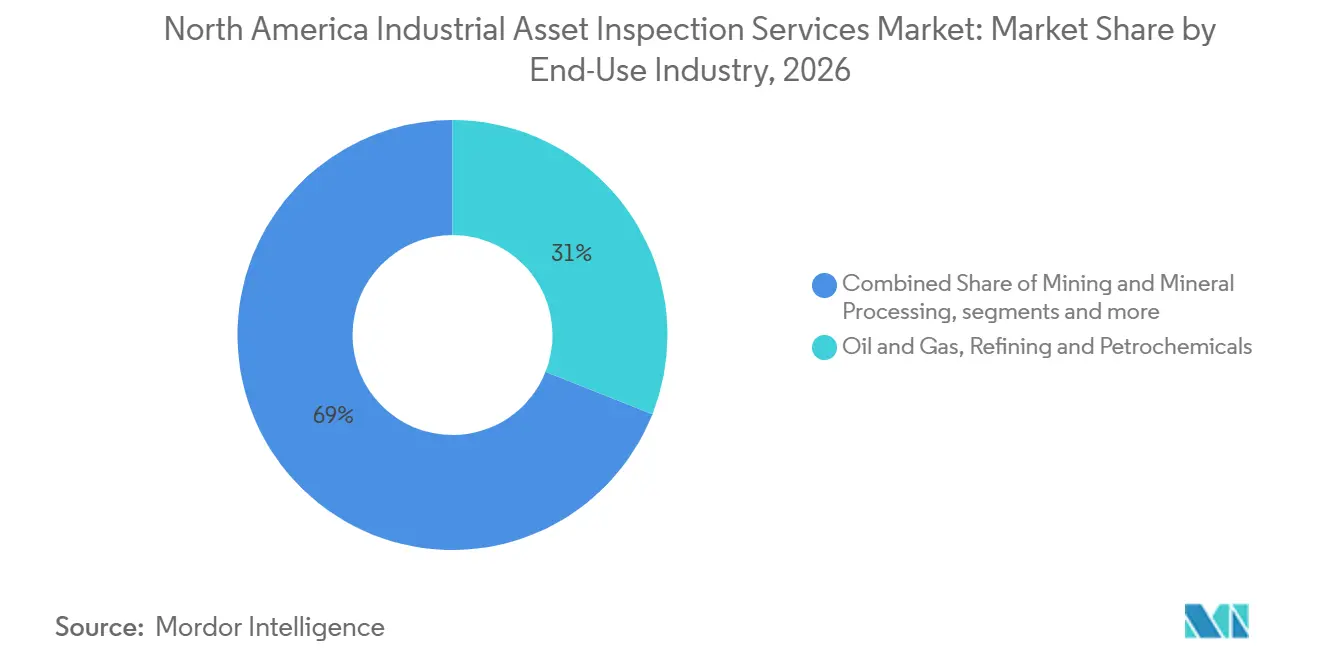
- By end-use industry, oil and gas, refining, and petrochemicals accounted for 31.0% of the North America industrial asset inspection services market size in 2026, while power generation, renewable energy, and electrical utilities are forecast to expand at a 9.2% CAGR through 2032.
- By geography, the United States held 76.0% of the North America industrial asset inspection services market share in 2026, while Mexico is forecast to grow at an 8.5% CAGR through 2032.
Note: Market numbers in this report are based on Mordor Intelligence's proprietary estimation framework, which combines nine months of actuals with Q4 projections for base year 2026.
North America Industrial Asset Inspection Services Market Trends and Insights
Drivers Impact Analysis*
| Driver | (~) % Impact on CAGR Forecast | Geographic Relevance | Impact Timeline |
|---|---|---|---|
| Aging Pipelines, Bridges, Power Assets, and Industrial Plants | +2.1% | United States dominant, with material spillover to Canada | Long term (≥ 4 years) |
| OSHA, PHMSA, FAA, Transport Canada, and Provincial Compliance Requirements | +1.6% | United States federal and state requirements, plus Canadian federal requirements | Medium term (2-4 years) |
| Shift Toward Risk-Based and Condition-Based Inspection | +1.0% | North America-wide, with earlier adoption in the United States and Canada | Medium term (2-4 years) |
| Aircraft Fleet Expansion and Longer Asset Service Lives | +0.6% | United States dominant, including maintenance hubs in Texas, Georgia, and Washington | Long term (≥ 4 years) |
| Mexico Manufacturing, Energy, and Transportation Modernization | +0.5% | Mexico, with spillover to United States border facilities | Medium term (2-4 years) |
| Remote Inspection, NDT 4.0, and Digital Reporting Adoption | +0.5% | North America wide, led by technology adopters in the United States | Short term (≤ 2 years) |
| Source: Mordor Intelligence | |||
Aging Pipelines, Bridges, Power Assets, and Industrial Plants
As fixed industrial assets age, deferred renewals are turning into required inspections across the North America industrial asset inspection services market. The 2025 ASCE report found that 70% of power transformers were at least 25 years old, 60% of circuit breakers were at least 30 years old, and 70% of transmission lines were at least 25 years old. ASCE assigned the United States energy sector a D+ grade in 2025, compared with a C- grade in 2021.[1] The same assessment placed bridge rehabilitation needs at USD 191.3 billion, and replacement needs for structurally poor bridges at USD 69.7 billion. Assets rated in fair condition are particularly important because assessment can help identify deterioration before replacement becomes necessary. This supports ongoing contracts in the North America industrial asset inspection services market for infrastructure operators and industrial owners.
OSHA, PHMSA, FAA, Transport Canada, and Provincial Compliance Requirements
Regulatory requirements give the North America industrial asset inspection services market a base level of work that is less exposed to commodity price changes. OSHA requires covered facilities to inspect and test process equipment under recognized and generally accepted good engineering practices.[2] This framework applies to mechanical integrity programs for pressure vessels, piping, storage tanks, and related equipment. PHMSA introduced a final rule on gas pipeline leak detection and repair in January 2025, including performance-based programs, leak grading criteria, and repair deadlines. PHMSA also incorporated 19 revised technical standards into pipeline safety regulations through its 2025 Periodic Standards Update II. In Canada, the regulator’s 2025 audit of Enbridge Pipelines illustrates continuing oversight of facility integrity management.[3] These rules support renewal-oriented service agreements in the North America industrial asset inspection services market because operators must document compliance over time.
Shift Toward Risk-Based and Condition-Based Inspection, Remote Inspection, NDT 4.0, and Digital Reporting Adoption
Risk-based inspection is moving service delivery away from uniform inspection intervals and toward the probability and consequence of equipment failure. API Recommended Practice 580 provides the core framework for applying risk-based inspection to process industry equipment. This approach directs attention to equipment that presents the highest integrity risk, while reducing lower-value work on items with lower risk. The North America industrial asset inspection services market is also adopting sensors, digital records, remote methods, and data links with maintenance systems. Those capabilities allow operators to connect field findings with maintenance planning and asset-performance decisions. Providers in the North America industrial asset inspection services market that support this integration can pursue longer contracts, while firms limited to manual reporting face greater pressure on contract retention.
Aircraft Fleet Expansion, Longer Asset Service Lives, and Mexico Modernization
Aircraft expansion and industrial modernization broaden the customer base for the North America industrial asset inspection services market. The FAA’s 2025 forecast points to continued expansion in the United States commercial aircraft fleet over the long term. Aircraft that remain in service longer require continued nondestructive testing and structural inspection. FAA airworthiness directives issued in 2025 required specific inspections for Boeing 787 forward pressure bulkheads and repeated high-frequency eddy-current inspections for Boeing 737 frame cracks. In Mexico, PEMEX’s 2025 to 2030 plan includes 1,300 major equipment repairs and refinery overhaul work. This combination increases demand across the North America industrial asset inspection services market in aviation, refining, power, manufacturing, and transportation.
Restraints Impact Analysis*
| Restraint | (~) % Impact on CAGR Forecast | Geographic Relevance | Impact Timeline |
|---|---|---|---|
| Shortage and Retirement of Certified NDT Personnel | -1.2% | North America wide, with greater pressure at remote and offshore sites | Long term (≥ 4 years) |
| High Cost of Advanced Equipment, Calibration, and Software | -0.9% | North America wide, with greater pressure on mid-tier providers | Medium term (2-4 years) |
| Cybersecurity and Data-Integration Concerns | -0.5% | United States dominant, including cross-border data flows | Medium term (2-4 years) |
| Complex Composite and Alloy Inspection Requirements | -0.4% | United States aerospace and chemical sites, plus Canadian oil sands metallurgy | Long term (≥ 4 years) |
| Source: Mordor Intelligence | |||
Shortage and Retirement of Certified NDT Personnel
The supply of certified personnel remains a structural limitation for the North America industrial asset inspection services market. ASNT reported that 30% of certified nondestructive testing professionals worldwide were over 55 years old. The organization also identified fewer than 1,200 senior Level III trainers supporting an estimated 150,000 certified professionals globally. This training structure takes time to expand because certification depends on supervised experience and qualified instruction. Staffing shortages are more difficult at remote, offshore, and turnaround sites where scheduling is less flexible. North America industrial asset inspection services market providers may therefore limit project selection when technician availability cannot match client timing. Different certification requirements across jurisdictions can further limit the movement of qualified workers during periods of high demand.
High Cost of Advanced Equipment, Calibration, and Software
Advanced inspection hardware and software can create a high upfront cost for regional and mid-sized providers. Phased-array ultrasonic systems, drone payloads, defect-recognition software, calibration equipment, and secure reporting systems require steady contract utilization. This spending can favor larger North America industrial asset inspection services market providers with broader customer portfolios and established service networks. CISA issued guidance in December 2025 on securely integrating artificial intelligence into operational technology environments. Providers using connected inspection tools must address data security and integration expectations alongside field-service requirements. Complex composites and specialized alloys also require methods and technician skills that are not equally available across every location.
*Our forecasts treat driver/restraint impacts as directional, not additive. The impact forecasts reflect baseline growth, mix effects, and variable interactions.
Segment Analysis
By Asset Type: Pipeline Infrastructure Anchors Revenue, Power Assets Drive Future Growth
Pipelines and piping systems held 24.0% of the North America industrial asset inspection services market share in 2026. Their position reflects the inspection requirements surrounding oil, gas, chemical, and industrial transmission corridors. Federal pipeline integrity requirements support recurring assessment work in high-consequence areas. Inline inspection, cathodic protection assessment, and fitness-for-service work remain important under this framework. Pressure vessels, boilers, and heat exchangers form another large service base because process facilities require mechanical-integrity programs. Storage tanks also require continuing attention as operators assess corrosion, containment, and operating conditions. Together, these categories support regular work that is linked to inspection cycles, shutdowns, and documented compliance.
Electrical and power equipment is forecast to expand at a 9.0% CAGR through 2032. This North America industrial asset inspection services market size for electrical equipment is supported by grid rehabilitation and commissioning of new energy assets. FirstEnergy completed aerial infrared and ultraviolet patrols across nearly 5,000 miles of high-voltage lines in 2025. The program shows how utilities can make inspection a planned operating activity rather than a response to failure. Rotating equipment and industrial structures provide steadier demand across manufacturing and process sites. Rope access and robotic methods are gaining use in these categories because they can reduce confined-space exposure and disruption to operations. OSHA documentation requirements maintain a broad inspection base across equipment categories at the facilities covered.

By End-Use Industry: Oil and Gas Concentration Persists While Energy Transition Creates New Demand Centers
Oil and gas, refining, and petrochemicals accounted for 31.0% of the North America industrial asset inspection services market size in 2026. The segment is supported by OSHA mechanical-integrity obligations, hazardous-liquid pipeline requirements, and refinery turnaround schedules. These sites use pressure equipment, piping, tanks, and process units that require documented inspection and testing. PEMEX’s 2025 to 2030 work plan includes refinery overhaul activity and major repairs across production assets. Such work requires inspection support before, during, and after equipment maintenance. The scale of these facilities can create concentrated periods of demand during planned shutdowns. Their ongoing maintenance needs provide a stable base for specialized service providers.
Power generation, renewable energy, and electrical utilities are projected to grow at a 9.2% CAGR through 2032. The segment benefits from work on solar, wind, battery storage, combined-cycle, and legacy thermal assets. Mexico’s electricity expansion plan reinforces the need for commissioning checks and condition monitoring across new power assets. New assets require commissioning checks, while existing assets require continuing condition monitoring. Chemical manufacturing, metals, mining, water, food, pharmaceuticals, transport, and ports create a diversified secondary demand base. This diversification can reduce the effect of lower hydrocarbon capital spending on the North America industrial asset inspection services market. It also gives large service providers opportunities to use similar inspection skills across several customer sectors.
Geography Analysis
The United States held 76.0% of the North America industrial asset inspection services market share in 2026. Its position reflects a large industrial asset base, broad federal oversight, and established procurement practices. Infrastructure rehabilitation continues to support commissioning assessments and periodic monitoring needs. The FAA also accepted an autonomous drone-based general visual inspection program for Delta Air Lines in 2025. This indicates a growing role for automated methods at major aviation maintenance locations.
Canada has a stable place in the regional service base because of pipeline oversight, qualification frameworks, oil sands activity, and energy development. The Canadian Energy Regulator uses compliance verification that considers facility type, company history, and technical risk. This process supports regular integrity-management work for operators and their service partners. Alberta’s oil sands and the British Columbia LNG corridor are important concentrations of demand. Acuren invested in four Bronto Skylift platforms in January 2025 to increase wind-turbine inspection capacity. This investment reflects the relevance of renewable energy inspection alongside conventional energy assets. Canada therefore offers a steady mix of pipeline, industrial, and renewable inspection work.
Mexico is projected to advance at an 8.5% CAGR through 2032. PEMEX plans include work at six refineries and 1,300 major equipment repairs across production assets. The North America industrial asset inspection services market size in Mexico is also supported by investment in transmission and distribution upgrades. Electricity expansion and distribution modernization are broadening the addressable base beyond hydrocarbons. Inspection demand extends beyond hydrocarbons as manufacturing expands in Nuevo León, Jalisco, and Coahuila. These facilities add demand for pressure equipment, structural inspection, and commissioning support. The country’s growth outlook is therefore tied to rehabilitation, utility investment, and a larger manufacturing asset base.
Competitive Landscape
The North America industrial asset inspection services market exhibits a medium level of market concentration. SGS, Bureau Veritas, Baker Hughes through Waygate Technologies, Intertek, and Applus+ operate alongside MISTRAS Group, Acuren, TEAM Inc., and IRISNDT. Acuren completed its combination with NV5 Global in August 2025, creating a testing, inspection, certification, and engineering platform with more than USD 2 billion in revenue, over 11,000 employees, and more than 230 locations. The transaction expanded the company’s engineering and field-service reach across North America. It also demonstrates the value that providers place on broader technical coverage and geographic scale.
SGS signed an agreement in July 2025 to acquire Applied Technical Services for USD 1,325 million in enterprise value. ATS had 2,100 employees, 85 United States facilities, and projected 2026 sales of USD 460 million according to SGS. This transaction reflects demand for service platforms that combine inspection, testing, and related engineering capabilities. Wabtec completed its acquisition of Evident’s Inspection Technologies division in July 2025. The acquisition added nondestructive testing, remote visual inspection, and analytical instruments that support the North America industrial asset inspection services market to Wabtec’s infrastructure portfolio. These moves can raise the capability threshold for firms seeking major multi-site contracts. Regional specialists can still compete where they hold specific expertise, local access, or established customer relationships.
Technology is becoming a more important consideration in major inspection contracts. Baker Hughes announced in November 2025 that Antea’s mechanical-integrity and risk-based inspection capabilities would be integrated into its Cordant asset-performance management software. The planned integration links inspection findings with broader asset strategy and maintenance decisions. TEAM Inc. reported 15.2% revenue growth in its Inspection and Heat Treating segment during the second quarter of 2025. Its Canadian operations recorded 31.4% growth during that quarter. The results show that specialized providers can benefit from enforcement activity and demand for field services. Providers that can protect inspection data and integrate it with customer systems are likely to be better positioned for longer-term contracts.
North America Industrial Asset Inspection Services Industry Leaders
-
SGS SA
-
Bureau Veritas SA
-
Baker Hughes Company
-
Applus+
-
MISTRAS Group, Inc.
- *Disclaimer: Major Players sorted in no particular order
Recent Industry Developments
- April 2026: Industrial Thermal Services (ITS) acquired NDE Incorporated, a provider of nondestructive testing (NDT) services, to expand its industrial inspection and quality assurance capabilities. The acquisition strengthened ITS’s service portfolio by integrating NDT services with heat treatment and specialty mechanical services. This enhanced the company’s ability to serve industrial customers across the energy, petrochemical, manufacturing, and infrastructure industries.
- July 2025: SGS signed a definitive agreement to acquire Applied Technical Services, a 2,100-professional North American inspection and testing firm with USD 460 million in projected 2026 sales and 85 United States facilities, for a USD 1,325 million enterprise value.
- July 2025: Wabtec Corporation completed its acquisition of Evident’s Inspection Technologies division, a provider of nondestructive testing, remote visual inspection, and analytical instruments.
- November 2025: Baker Hughes announced the planned integration of Antea’s mechanical integrity and risk-based inspection software into its Cordant asset-performance management platform.
North America Industrial Asset Inspection Services Market Report Scope
The North America Industrial Asset Inspection Services Market Report is Segmented by Asset Type (Pipelines and Piping Systems, Pressure Vessels, Boilers and Heat Exchangers, and More), by End-Use Industry (Oil and Gas, Refining and Petrochemicals, Mining and Mineral Processing, Water and Wastewater Utilities, and More), and by Geography (United States, Canada, Mexico). The Market Forecasts are Provided in Terms of Value (USD).
| Pipelines and Piping Systems | Oil, Gas and Industrial Transmission Pipelines |
| Process Piping and Industrial Utility Piping | |
| Offshore Pipelines, Risers and Flowlines | |
| Pressure Vessels, Boilers and Heat Exchangers | Pressure Vessels and Process Reactors |
| Industrial Boilers and Steam Systems | |
| Heat Exchangers and Pressurized Thermal Equipment | |
| Storage Tanks and Containment Systems | Aboveground and Underground Industrial Storage Tanks |
| Industrial Containment and Bulk Storage Systems | |
| Rotating and Mechanical Equipment | Pumps, Compressors and Industrial Turbines |
| Conveyors, Drives and Fixed Production Machinery | |
| Other Installed Mechanical Equipment | |
| Electrical and Power Equipment | Transformers, Switchgear and Power Distribution Equipment |
| Generators and Electrical Installations | |
| Power Transmission and Electrical Utility Assets | |
| Industrial Structures and Fixed Installations | Industrial Structural Steel and Equipment Supports |
| Offshore Platforms and Fixed Energy Installations | |
| Industrial Towers, Stacks and Supporting Structures | |
| Other Fixed Industrial Assets | Process Furnaces and Refractory Systems |
| Industrial Instrumentation and Control Installations | |
| Other Specialized Installed Industrial Assets |
| Oil and Gas, Refining and Petrochemicals |
| Power Generation, Renewable Energy and Electrical Utilities |
| Chemical Manufacturing (Excluding Petrochemicals) |
| Metals and Other Industrial Manufacturing |
| Mining and Mineral Processing |
| Water and Wastewater Utilities |
| Food and Beverage Processing |
| Pharmaceuticals and Bioprocessing |
| Transportation, Logistics and Port Operations |
| Other Industrial End Users |
| United States |
| Canada |
| Mexico |
| By Asset Type | Pipelines and Piping Systems | Oil, Gas and Industrial Transmission Pipelines |
| Process Piping and Industrial Utility Piping | ||
| Offshore Pipelines, Risers and Flowlines | ||
| Pressure Vessels, Boilers and Heat Exchangers | Pressure Vessels and Process Reactors | |
| Industrial Boilers and Steam Systems | ||
| Heat Exchangers and Pressurized Thermal Equipment | ||
| Storage Tanks and Containment Systems | Aboveground and Underground Industrial Storage Tanks | |
| Industrial Containment and Bulk Storage Systems | ||
| Rotating and Mechanical Equipment | Pumps, Compressors and Industrial Turbines | |
| Conveyors, Drives and Fixed Production Machinery | ||
| Other Installed Mechanical Equipment | ||
| Electrical and Power Equipment | Transformers, Switchgear and Power Distribution Equipment | |
| Generators and Electrical Installations | ||
| Power Transmission and Electrical Utility Assets | ||
| Industrial Structures and Fixed Installations | Industrial Structural Steel and Equipment Supports | |
| Offshore Platforms and Fixed Energy Installations | ||
| Industrial Towers, Stacks and Supporting Structures | ||
| Other Fixed Industrial Assets | Process Furnaces and Refractory Systems | |
| Industrial Instrumentation and Control Installations | ||
| Other Specialized Installed Industrial Assets | ||
| By End-Use Industry | Oil and Gas, Refining and Petrochemicals | |
| Power Generation, Renewable Energy and Electrical Utilities | ||
| Chemical Manufacturing (Excluding Petrochemicals) | ||
| Metals and Other Industrial Manufacturing | ||
| Mining and Mineral Processing | ||
| Water and Wastewater Utilities | ||
| Food and Beverage Processing | ||
| Pharmaceuticals and Bioprocessing | ||
| Transportation, Logistics and Port Operations | ||
| Other Industrial End Users | ||
| By Geography | United States | |
| Canada | ||
| Mexico | ||
Key Questions Answered in the Report
What is the projected value of North America industrial asset inspection services by 2032?
The North America industrial asset inspection services market is forecast to reach USD 16.5 billion by 2032, from USD 10.7 billion in 2026, at a 7.5% CAGR.
Which asset category leads North America industrial asset inspection services?
Pipelines and piping systems lead with a 24.0% share in 2026, supported by recurring integrity management and compliance work.
Which end-use sector is growing fastest in industrial inspection services?
Power generation, renewable energy, and electrical utilities are forecast to grow at a 9.2% CAGR through 2032.
Why is Mexico growing faster than other North American countries for inspection services?
Mexico is forecast to grow at an 8.5% CAGR through 2032, supported by refinery repairs, electricity investment, and manufacturing expansion.
What is the main challenge for nondestructive testing service providers?
Qualified personnel shortages are a major constraint because training and certification depend on limited senior instruction capacity.
How are digital tools changing inspection service contracts?
Risk-based inspection, remote methods, and data integration favor providers that can connect field results with maintenance and asset-management systems.