
North America Electric Vehicle Charging Equipment Market Size and Share
| Study Period | 2019 - 2030 |
| Forecast Data Period | 2025 - 2030 |
| Historical Data Period | 2019 - 2023 |
| Market Volume (2025) | 271.54 Thousand units |
| Market Volume (2030) | 939.57 Thousand units |
| CAGR (2025 - 2030) | 28.18% |
| Market Concentration | Low |
Major Players *Disclaimer: Major Players sorted in no particular order |
North America Electric Vehicle Charging Equipment Market Analysis by Mordor Intelligence
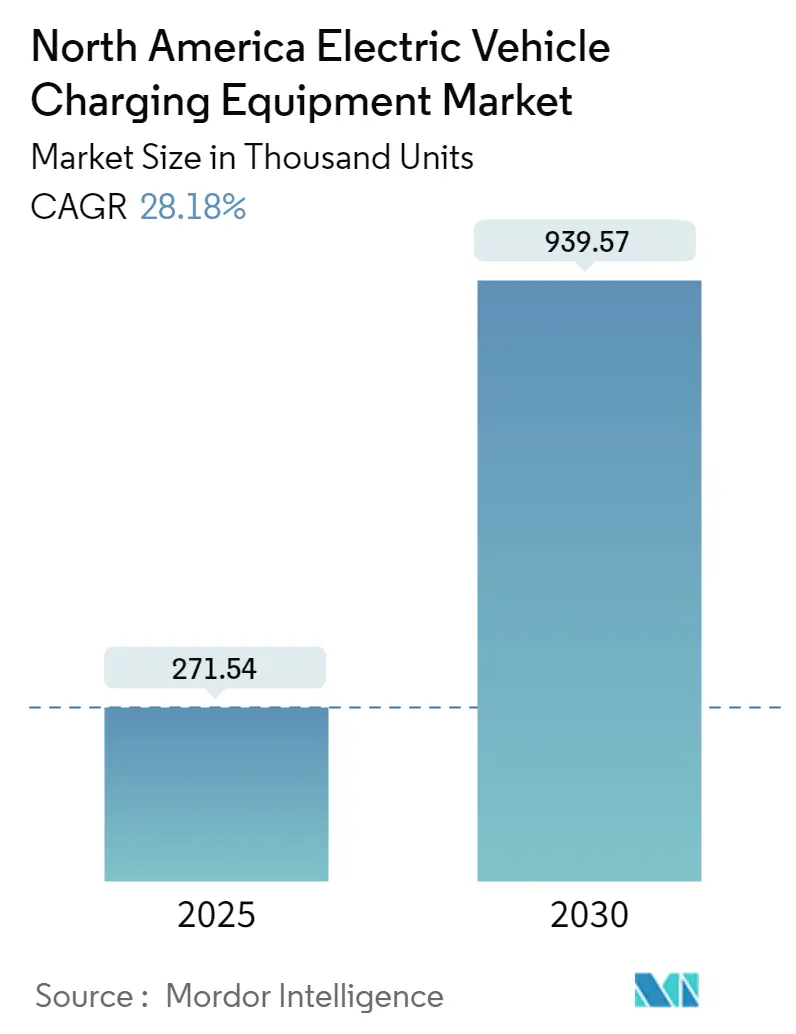
The North America Electric Vehicle Charging Equipment Market size is estimated at 271.54 thousand units in 2025, and is expected to reach 939.57 thousand units by 2030, at a CAGR of 28.18% during the forecast period (2025-2030).
- Over the medium term, factors like the growing adoption of electric vehicles and supportive government policies and initiatives are expected to drive the EV charging equipment market during the forecast period.
- On the other hand, high installation costs associated with setting up charging stations and maintenance costs are expected to hinder the market's growth during the forecast period.
- Nevertheless, increasing investments in EVs and technological advancements in EV charging Equipment are expected to provide significant opportunities for the North America electric vehicle (EV) charging equipment market during the forecast period.
Worldwide, activity is shaped by contributions from multiple regions, with North america representing one of the more structurally developed among them. The global report on electric vehicle charging equipment market by Mordor Intelligence reflects how these regional layers combine into a single system.
North America Electric Vehicle Charging Equipment Market Trends and Insights
Battery Electric Vehicles Segment to Dominate the market
- Battery electric vehicles (BEVs), often simply called electric vehicles, utilize a large traction battery pack to power their electric motor. To recharge, these vehicles must connect to a wall outlet or specialized charging equipment known as electric vehicle supply equipment (EVSE).
- BEVs, being entirely electric, typically lack an internal combustion engine (ICE), fuel tank, or exhaust pipe. They derive their energy from a battery pack, which is replenished from the grid. As zero-emission vehicles, BEVs do not produce the harmful tailpipe emissions associated with traditional gasoline-powered cars, thus mitigating air pollution.
- North America is witnessing a transformation in its automotive landscape, with battery electric vehicles (BEVs) gaining significant traction. Driven by technological advancements, governmental backing, and heightened environmental awareness, BEVs are emerging as a viable solution to combat climate change and lessen dependence on fossil fuels.
- In recent years, North America has seen a marked uptick in the adoption of battery-electric vehicles. Breakthroughs in battery technology, longer driving ranges, and an expansion of charging infrastructure have smoothed the path for BEVs. Key automakers, including Tesla, Chevrolet, Nissan, and Ford, have been instrumental in popularizing BEVs, introducing models that cater to a diverse consumer base.
- The United States stands as the leading market for BEVs in North America. For instance, the International Energy Agency (IEA) reported that United States sales of battery electric vehicles reached approximately 1.1 million units in 2023, marking a 37% surge from the previous year. In comparison, Canada and Mexico recorded BEV sales of about 130,000 and 13,000 units, respectively.
- To further boost BEV adoption, North American countries are rolling out a range of initiatives and incentives. In the United States, federal tax credits, state rebates, and subsidies have made EVs more financially accessible. Moreover, several states are ambitiously targeting a complete phase-out of internal combustion engine (ICE) vehicles, underscoring their commitment to electric cars. Given this momentum, the rising adoption of BEVs is set to spur demand for EV charging equipment and infrastructure.
- With technological advancements on the horizon, the future of BEVs in North America appears bright. Both automakers and governments are channeling substantial investments into research and development, aiming to boost battery efficiency, cut costs, and elevate vehicle performance. Notably, the United States is emerging as a global magnet for investments in electric vehicle and battery manufacturing. While global vehicle manufacturers and battery producers plan a whopping USD 860 billion investment by 2030 for the EV transition, the United States is set to claim a lion's share of USD 210 billion, outpacing all other nations. This investment surge is poised to bolster the BEV manufacturing sector, subsequently amplifying the demand for a robust EV charging infrastructure.
- Initially, concerns loomed over the adequacy of charging infrastructure for BEVs. Yet, strides are being made to address this. Public charging stations are proliferating, thanks to investments from both governmental and private sectors in establishing a comprehensive charging network nationwide. According to the IEA, as of 2023, the United States boasts around 140,000 slow charging and 43,000 fast charging public points. Canada follows with approximately 22,000 slow and 4,800 fast charging points, while Mexico has around 2,000 fast and 76 slow charging points.
- The increasing share of fast charging points, coupled with advancements that have shortened charging durations, underscores the growing infrastructure's capability to meet the rising demand from BEVs.
- Given these dynamics, the BEV segment is poised to lead the North American EV charging equipment market in the coming years.


United States is Expected to Dominate the Market
- In recent years, the United States has significantly expanded its electric vehicle (EV) equipment and infrastructure, mirroring the nation's increasing embrace of the EV industry. For instance, the International Energy Agency (IEA) reported that by the close of 2023, the United States boasted approximately 43,000 publicly available fast EV chargers, with an addition of around 15,000 chargers installed that same year.
- Moreover, as of May 8, 2024, data from the United States Department of Energy highlighted California as the leader in EV charging stations and outlets. Following California, New York and Florida secured the second and third spots, respectively. California's dominance is evident, with over 52,834 charging ports spread across 16,928 station locations. In contrast, New York offers about 12,749 ports at 4,234 locations, while Florida has over 10,776 ports distributed across 3,661 stations.
- The surge in the United States EV charging infrastructure can be attributed to the rising adoption of EVs, significant investments from major automobile players, plans to phase out fossil-fuel vehicles, and supportive government policies and targets. These trends are poised to continue, further propelling the growth of EV charging infrastructure.
- For instance, in early 2022, the United States Department of Transportation and Energy unveiled a commitment of nearly USD 5 billion under the National Electric Vehicle Infrastructure (NEVI) Formula Program. Established by the Bipartisan Infrastructure Law, this initiative aims to create a national EV charging network, ensuring accessibility for all Americans. Over five years, the program's funding will assist states in establishing EV charging stations along designated Alternative Fuel Corridors, especially on the Interstate Highway System. This initiative envisions a network of highways with EV charging stations positioned every 50 miles, a move expected to significantly boost the demand for EV charging equipment.
- In February 2023, the Biden administration rolled out initiatives to establish a reliable, American-made EV charging network, aiming to electrify American road trips. This effort aligns with the United States' ambitious climate goals, targeting a national network of 500,000 EV chargers and ensuring EVs constitute at least 50% of new car sales by 2030.
- Beyond governmental initiatives, major players in the United States are making substantial investments in EVs and related infrastructure, coupled with plans to phase out fossil fuel vehicles. For instance, General Motors (GM) declared in early 2021 its commitment to transition entirely to zero tailpipe emission vehicles by 2035, as part of a broader strategy to achieve carbon neutrality by 2040.
- Moreover, GM is set to integrate Tesla's technology for charging its vehicles. In June 2023, GM, following Ford's lead, adopted Tesla's North American charging plug standard, granting its electric vehicle buyers access to the Tesla Supercharger network. This alignment signifies a consensus among three leading EV sellers in North America on a unified charging hardware standard.
- British energy giant BP, in February 2023, unveiled plans to invest USD 1 billion by 2030 in EV charge points across the United States. A cornerstone of this investment is a collaboration with Hertz, aiming to introduce fast charging infrastructure at Hertz locations in major cities, including Atlanta, Boston, Chicago, and San Francisco.
- Several fast-charging installations in the United States will feature Giga hub locations, like the one at Los Angeles International Airport (LAX), a collaboration between BP and Hertz. This hub is designed to cater to rideshare and taxi drivers, car rental customers, and the general public, especially in high-demand areas like airports.
- In March 2023, Blink Charging secured an indefinite-delivery/indefinite-quantity (IDIQ) contract with the United States Postal Service (USPS) to supply up to 41,500 EV chargers, facilitating USPS's transition to an electric delivery fleet. Blink's Series 7 dual-port charger, capable of delivering 80 amps (19.2 kW) from each port, will be the primary offering for USPS.
- Besides Blink, USPS is also procuring equipment from Rexel Energy Solutions and Siemens, with a combined contract value of USD 260 million. This procurement follows USPS's announcement of a shift to electric vehicles post-2026 and a doubling of its order for electric delivery trucks from Oshkosh Defense, totaling 50,000 units at a cost of USD 2.98 billion.
- Given these developments, the United States EV charging equipment market is poised for significant growth, aligning with the nation's increasing adoption of EVs and supportive governmental policies.


Mordor Intelligence provides coverage of the electric vehicle charging equipment market across other key regional markets, including South America, Asia, and South East Asia, each with their regulatory frameworks and demand patterns. Detailed country-level analysis extends to Australia, South Korea, Germany, Denmark, Netherlands, and Belgium incorporating local coverage and market participation, as required.
Competitive Landscape
The North America electric vehicle (EV) charging equipment market is semi-fragmented. Some of the key players in the market (not in any particular order) include ABB Ltd, Robert Bosch GmbH, Delta Electronics Inc., Siemens AG, and Tesla Inc.
North America Electric Vehicle Charging Equipment Industry Leaders
Siemens AG
Tesla Inc.
Robert Bosch GmbH
Delta Electronics Inc.
ABB Ltd
- *Disclaimer: Major Players sorted in no particular order


Recent Industry Developments
- February 2024: United States Connected car service provider Parkopedia collaborated with ChargeHub, the largest North American electric vehicle roaming hub operator. It is to enhance the charging experience for millions of North American electric vehicle drivers. ChargeHub’s 80,000-strong network of charging stations across the United States and Canada will be integrated into Parkopedia’s Payment Platform.
- January 2024: The United States Transportation Department awarded USD 148.8 million to repair or replace nearly 4,500 existing electric vehicle charging ports in 20 different states. The investment would support the EV Chargers that are out of service. The fund is a part of the USD 5 billion National Electric Vehicle Infrastructure (NEVI) program funded by a USD 1 trillion 2021 infrastructure law.
- November 2023: The Canada Infrastructure Bank (CIB) announced a financing agreement with Parkland Corporation (Parkland), Canada’s largest fuel distributor and retailer. The CAD 210 million financing agreement helps Parkland strategically expand its EV charging network in communities across Canada. The agreement paves the way for the installation of up to 2,000 new charging ports at up to 400 sites. It represents the CIB’s second investment under its Charging and Hydrogen Refuelling Infrastructure (CHRI) initiative.


North America Electric Vehicle Charging Equipment Market Report Scope
- Electric vehicle (EV) charging equipment refers to the equipment and infrastructure used to charge electric vehicles at home or in commercial and public spaces. The EV charging equipment plays a crucial role in the widespread adoption of electric vehicles in North America. The availability of robust EV charging infrastructure is essential for overcoming range anxiety, a primary concern for potential EV buyers. It helps in reducing carbon emissions and improving air quality.
- The North America electric vehicle (EV) charging equipment market is segmented into Vehicle Type, Application, Charging Type, and Geography. By Vehicle type, the market is segmented into battery electric vehicles (BEV) and plug-in hybrid electric vehicles (PHEV). By application, the market is segmented into home charging, workplace charging, and public charging. By charging type, the market is segmented into AC charging (level 1 and level 2) and DC charging. The report also covers the market size and forecasts for the North America electric vehicle (EV) charging equipment market across major countries. The report offers the market size and forecasts for the market in units for all the above segments.
| Battery Electric Vehicle (BEV) |
| Plug-in Hybrid Electric Vehicle (PHEV) |
| Home Charging |
| Workplace Charging |
| Public Charging |
| AC Charging (Level 1 and Level 2) |
| DC Charging |
| United States |
| Canada |
| Rest of North America |
| Vehicle Type | Battery Electric Vehicle (BEV) |
| Plug-in Hybrid Electric Vehicle (PHEV) | |
| Application | Home Charging |
| Workplace Charging | |
| Public Charging | |
| Charging Type | AC Charging (Level 1 and Level 2) |
| DC Charging | |
| Geography | United States |
| Canada | |
| Rest of North America |


Key Questions Answered in the Report
How big is the North America Electric Vehicle Charging Equipment Market?
The North America Electric Vehicle Charging Equipment Market size is expected to reach 271.54 thousand units in 2025 and grow at a CAGR of 28.18% to reach 939.57 thousand units by 2030.
What is the current North America Electric Vehicle Charging Equipment Market size?
In 2025, the North America Electric Vehicle Charging Equipment Market size is expected to reach 271.54 thousand units.
Who are the key players in North America Electric Vehicle Charging Equipment Market?
Siemens AG, Tesla Inc., Robert Bosch GmbH, Delta Electronics Inc. and ABB Ltd are the major companies operating in the North America Electric Vehicle Charging Equipment Market.
What years does this North America Electric Vehicle Charging Equipment Market cover, and what was the market size in 2024?
In 2024, the North America Electric Vehicle Charging Equipment Market size was estimated at 195.02 thousand units. The report covers the North America Electric Vehicle Charging Equipment Market historical market size for years: 2019, 2020, 2021, 2022, 2023 and 2024. The report also forecasts the North America Electric Vehicle Charging Equipment Market size for years: 2025, 2026, 2027, 2028, 2029 and 2030.
Page last updated on:
North America Electric Vehicle Charging Equipment Market Report
Statistics for the 2025 North America Electric Vehicle Charging Equipment market share, size and revenue growth rate, created by Mordor Intelligence™ Industry Reports. North America Electric Vehicle Charging Equipment analysis includes a market forecast outlook for 2025 to 2030 and historical overview. Get a sample of this industry analysis as a free report PDF download.





