
North America Data Center Real Estate Market Size and Share
Market Overview
| Study Period | 2020 - 2031 |
|---|---|
| Forecast Data Period | 2026 - 2031 |
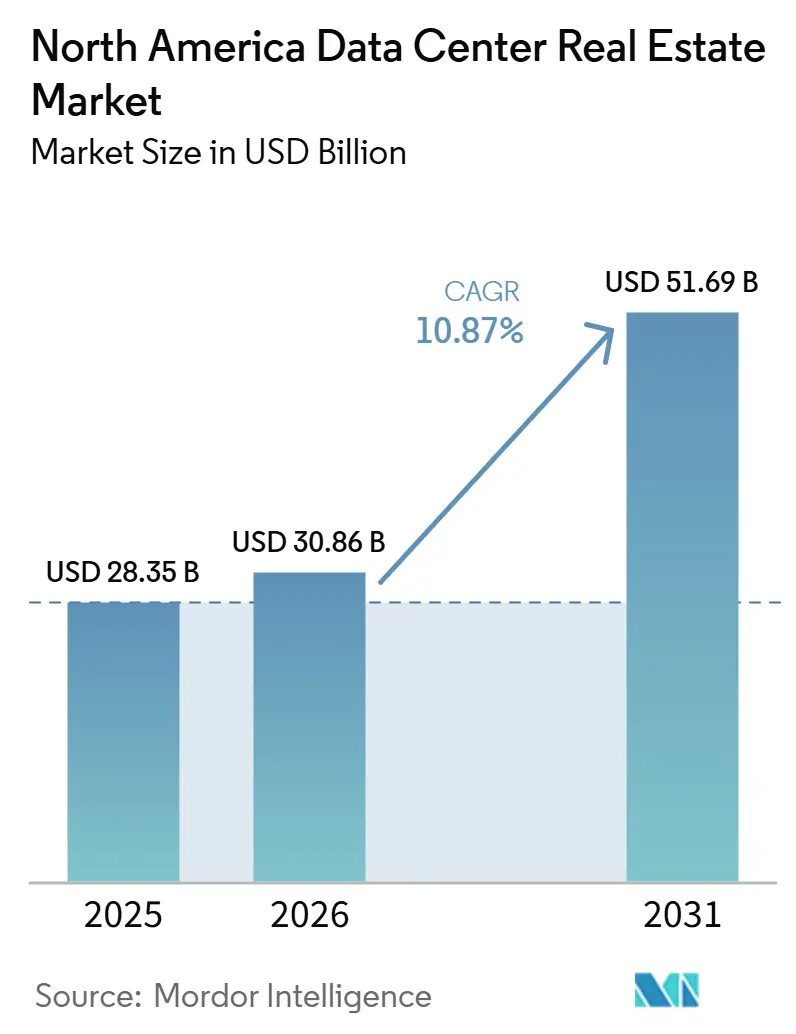
| Base Year Market Size (2025) | USD 28.35 Billion |
| Market Size (2026) | USD 30.86 Billion |
| Market Size (2031) | USD 51.69 Billion |
| Growth Rate (2026 - 2031) | 10.87 % |
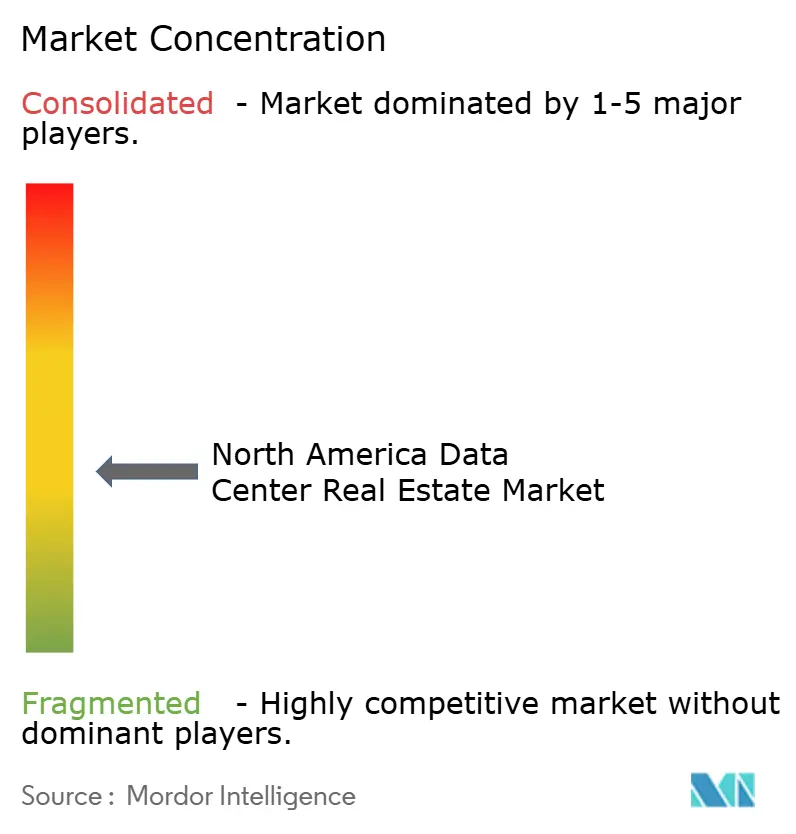
| Market Concentration | Medium |
Major Players *Disclaimer: Major Players sorted in no particular order Image © Mordor Intelligence. Reuse requires attribution under CC BY 4.0. | |
North America Data Center Real Estate Market Analysis by Mordor Intelligence
The North America Data Center Real Estate Market size is expected to grow from USD 28.35 billion in 2025 to USD 30.86 billion in 2026 and is forecast to reach USD 51.69 billion by 2031 at 10.87% CAGR over 2026-2031.
The North America data center real estate market is being shaped by persistent demand for AI training and inference workloads that require continuous computing, higher rack density, and dependable power delivery. Power access now influences site selection more than traditional location preferences, which is pushing developers toward markets that can support large-load connections and phased campus growth. Long-duration leases, strong tenant credit, and inflation-linked rental structures continue to attract institutional capital into the North America data center real estate market. Canada and Mexico are also gaining strategic relevance as operators seek access to clean energy, new cable connectivity, and space for large future clusters. Supply chain delays for electrical equipment and utility connection bottlenecks still slow delivery, but they also reinforce the value of operators that already control land, power pathways, and financing in the North America data center real estate market.
Key Report Takeaways
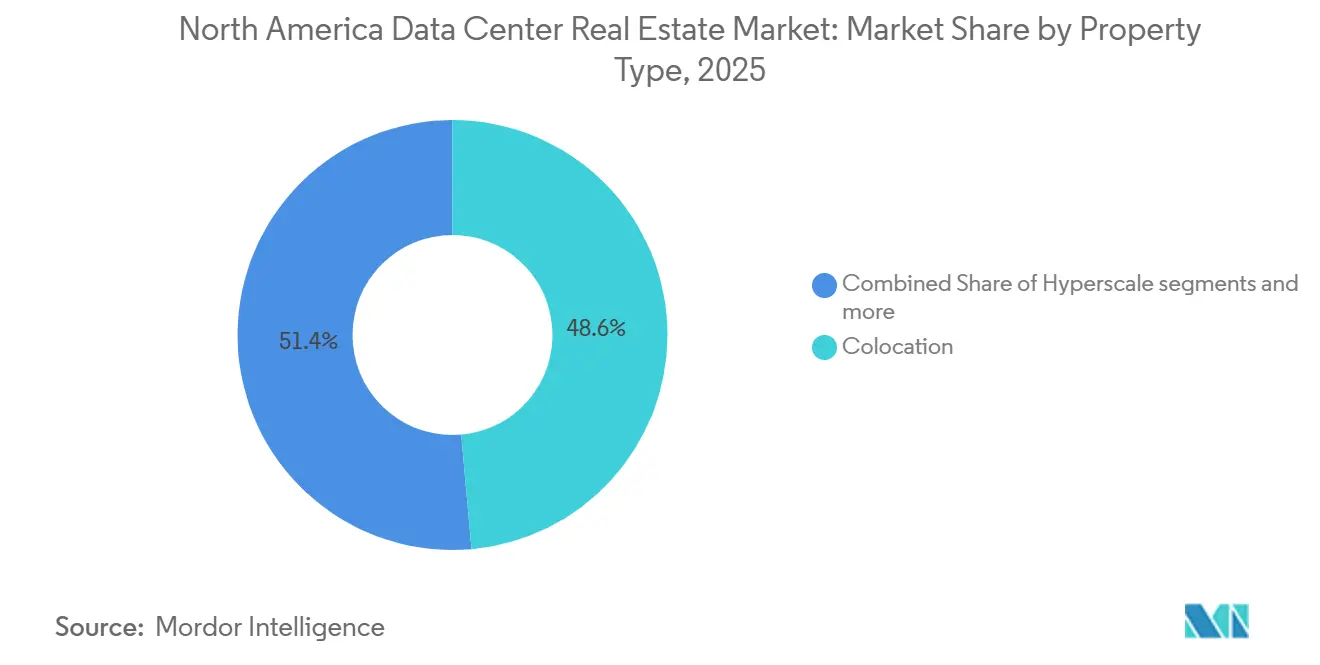
- By property type, colocation held 48.60% of the North America data center real estate market share in 2025, while edge data center properties are projected to grow at a 14.20% CAGR through 2031.
- By ownership, leased assets accounted for 81.50% share of the North America data center real estate market size in 2025, while the leased segment is also forecast to expand at an 11.40% CAGR through 2031.
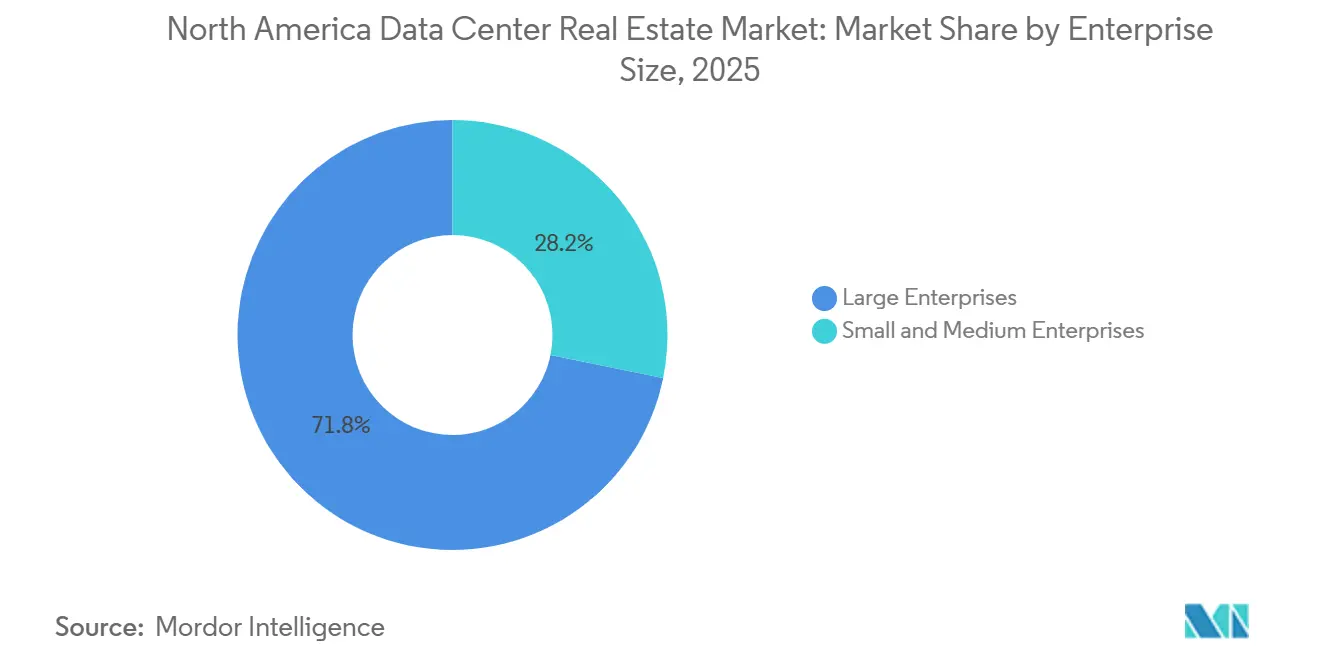
- By enterprise size, large enterprises led with 71.80% revenue share in 2025, while small and medium enterprises are projected to record the highest CAGR at 12.60% through 2031.
- By end-users, information technology and telecom accounted for 47.30% share of the North America data center real estate market size in 2025, while healthcare is expected to advance at a 13.10% CAGR through 2031.
- By geography, the United States held 88.4% share of the North America data center real estate market size in 2025, while Canada is forecast to grow at the fastest CAGR of 12.80% through 2031.
Note: Market size and forecast figures in this report are generated using Mordor Intelligence’s proprietary estimation framework, updated with the latest available data and insights as of January 2026.
Market Trends and Insights
Drivers Impact Analysis of North America Data Center Real Estate Market*
| Drivers | (~) % Impact on CAGR Forecast | Geographic Relevance | Impact Timeline |
|---|---|---|---|
| AI and Generative AI Demand Accelerates Colocation Expansion | +3.5% | Global, with a concentration in the United States frontier markets and major hubs | Long term (≥ 4 years) |
| Record-Low Vacancy Supports Strong Preleasing Activity | +1.8% | North America core markets, including Northern Virginia, Dallas-Fort Worth, and Atlanta | Short term (≤ 2 years) |
| Power Availability Drives Data Center Site Selection | +1.5% | United States Sun Belt and Midwest, Canada, and deregulated markets | Medium term (2-4 years) |
| Frontier Markets Attract Data Center Development Investment | +1.2% | United States frontier markets, including Texas, Tennessee, Wisconsin, Ohio, and Louisiana | Long term (≥ 4 years) |
| On-Site Power Generation Enhances Energy Reliability | +0.9% | United States deregulated markets, Canada, and Mexico | Medium term (2-4 years) |
| Subsea Cable and Interconnection Expansion Strengthens Connectivity | +0.6% | United States East Coast, Gulf Coast, Canada, and Mexico | Long term (≥ 4 years) |
| Source: Mordor Intelligence | |||
AI and Generative AI Demand Accelerates Colocation Expansion
AI training and inference workloads are changing the demand profile of the North America data center real estate market. These workloads run for longer periods and require denser power and cooling environments than many legacy enterprise applications. This makes specialized facilities more valuable because tenants need dependable capacity without long delays in internal build programs. The demand also extends beyond hyperscalers because neocloud providers, model-serving firms, and GPU-focused platforms now compete for the same real estate pipeline. That competition raises the strategic value of sites that can scale in stages without disrupting live operations. The North America data center real estate market, therefore, benefits from a broader AI customer base rather than from a single class of tenant.
Record-Low Vacancy Supports Strong Preleasing Activity
Tight vacancy conditions continue to shorten the leasing cycle across the North America data center real estate market. Tenants are increasingly willing to commit earlier because available high-quality capacity in major hubs remains limited. That behavior improves landlords' revenue visibility and gives lenders greater confidence in projects before delivery. It also supports larger development programs because owners can underwrite future cash flow with greater certainty. Early commitments from strong counterparties reduce lease-up risk and shift more attention toward execution risk. The North America data center real estate market is therefore attracting capital not only because demand is high, but also because contracted demand is visible earlier.
Power Availability Drives Data Center Site Selection
Power availability has become one of the clearest growth filters in the North America data center real estate market. Developers can no longer assume that a strong network location alone is enough to secure a viable campus. Site control now matters most when it comes with a realistic path to utility connection, substation support, and long-term energy procurement. Recent hyperscale commitments in Alberta and Saskatchewan show that power-backed locations are gaining share in project pipelines[1]Bell Canada, “Bell AI Fabric Expands National Network with 300 MW Data Centre in Saskatchewan,” Nasdaq Press Release, nasdaq.com . This is pushing landlords, utilities, and capital partners to work together earlier in the project cycle. As a result, the North America data center real estate market increasingly rewards operators that secure power before they market land.
Frontier Markets Attract Data Center Development Investment
The geographic center of expansion in the North America data center real estate market is moving beyond a narrow set of legacy hubs. Developers are showing greater interest in interior and secondary locations where land assembly is easier and future expansion is more practical. These markets are attractive when they offer scalable power, state support, and room for campus-style development. Meta's new Alberta project and Bell's Saskatchewan project both reinforce the shift toward locations that were previously outside the main regional development map. The shift does not reduce the importance of established hubs, but it does lower the share of new growth they can capture. This broadening footprint gives the North America data center real estate market a larger long-term land and power runway.
Restraints Impact Analysis of North America Data Center Real Estate Market*
| Restraints | (~) % Impact on CAGR Forecast | Geographic Relevance | Impact Timeline |
|---|---|---|---|
| Utility Interconnection Delays Slow Data Center Development | -1.8% | National, with acute pressure in Northern Virginia, Texas, and Ontario | Long term (≥ 4 years) |
| Transformer and Substation Equipment Shortages Delay Project Delivery | -1.5% | North America-wide, linked to global manufacturing bottlenecks | Medium term (2-4 years) |
| Water Availability and Cooling Constraints Limit New Developments | -0.9% | U.S. Southwest, Mid-Atlantic, and drought-risk areas in western Canada | Long term (≥ 4 years) |
| Rising Power Costs and Grid Curtailment Increase Operating Risks | -0.7% | Texas, the Mid-Atlantic, Ontario, and Alberta | Medium term (2-4 years) |
| Source: Mordor Intelligence | |||
Utility Interconnection Delays Slow Data Center Development
Utility interconnection delays remain a structural constraint on the North America data center real estate market. Large projects need more than building permits because they depend on transmission readiness, substation work, and utility scheduling. These steps often stretch project timelines even when land and financing are already in place. Developers are responding by treating future power-delivery slots as a core part of site control rather than a later execution task. That change favors operators with established utility relationships and repeat development experience. The North America data center real estate market, therefore, remains capacity hungry, but not every announced project can move on the same timeline.
Transformer and Substation Equipment Shortages Delay Project Delivery
Transformer and substation equipment shortages continue to affect delivery schedules across the North America data center real estate market. Even well-capitalized developers cannot accelerate a project when critical electrical equipment is not available in time. This bottleneck shifts project risk away from land acquisition and toward procurement and supplier access. Larger operators often have an advantage because they can place orders earlier and negotiate across wider portfolios. Some developers are exploring on-site generation and modular approaches, but these options do not remove the need for core grid equipment. The North America data center real estate market, therefore, faces a supply response that is constrained by industrial lead times as much as by finance.
*Our forecasts treat driver/restraint impacts as directional, not additive. The impact forecasts reflect baseline growth, mix effects, and variable interactions.
North America Data Center Real Estate Market Segment Analysis
By Property Type:
Colocation Anchors Revenue While Edge Rewires the PeripheryColocation held 48.60% of the North America data center real estate market share in 2025, which confirms its role as the largest revenue pool in this market. The segment benefits from enterprise outsourcing, hyperscale overflow demand, and the need for fast access to ready capacity. In the North America data center real estate industry, colocation also offers a flexible path for tenants that want to scale without waiting for full self-build delivery. Hyperscale properties remain the second-largest category and continue to attract long lease structures with strong counterparties. Modular formats are gaining relevance where speed matters and permanent utility upgrades take longer than tenant deployment plans.
The edge segment is expected to grow at a 14.20% CAGR through 2031, making it the fastest-growing property type in the North America data center real estate market. Its growth reflects rising interest in low-latency inference, distributed content delivery, and localized processing closer to users. This property class is particularly relevant as AI serving moves from centralized model training into live enterprise and consumer applications. The Others category continues to lose relative weight because stand-alone enterprise ownership models are less efficient under current power, cooling, and compliance demands.


By Ownership:
Leased Model Dominates as Build-to-Suit Bridges the Ownership SpectrumThe leased segment accounted for 81.50% share of the North America data center real estate market size in 2025, which shows how strongly outsourced capacity still defines this market. The leased segment is projected to grow at a 11.4% CAGR through 2031, making it the fastest-growing ownership model. This outcome reflects the fact that build-to-suit leasing can deliver capacity faster than many self-build timelines. It also allows tenants to secure long-duration control without carrying the real estate asset on their own balance sheet. In the North America data center real estate industry, this model has become the clearest bridge between speed, flexibility, and scale.
Owner-occupied supply continues to matter because large technology companies still build and control major campuses directly. Even so, the line between leased and owner-directed capacity is becoming less rigid as long-term build-to-suit structures give tenants extensive operational control. That shift changes underwriting because some leased assets now behave more like infrastructure-backed net-lease properties. It also means a growing share of the North America data center real estate market is supported by customized lease structures rather than by standard multi-tenant formats.
By Enterprise Size:
Large Enterprises Lead but Small and Medium Enterprises Growth Signals Market BroadeningLarge enterprises held 71.80% of the market in 2025, which reflects the historical concentration of demand among hyperscalers, large corporates, and major regulated institutions. These users typically have the procurement scale to secure large deployments, longer terms, and more tailored service requirements. Financial services, public agencies, and major digital platforms all reinforce this concentration because they require resilience, security, and dependable latency. Large enterprise demand also supports premium facilities that can meet strict compliance and uptime standards. This keeps large customers central to near-term absorption across the North America data center real estate market.
Small and medium enterprises are forecast to expand at a 12.60% CAGR through 2031, which signals that adoption is broadening beyond the largest buyers. Smaller firms increasingly access AI-enabled services through managed providers, which lowers the barrier to using third-party data center space. Compliance burdens in healthcare-adjacent, financial, and digital services businesses also make leased infrastructure more attractive than on-premise deployment. As SME demand grows, the North America data center real estate market gains a more diverse tenant base and reduces some dependence on a narrow set of very large occupiers.

By End-Users:
Information Technology and Telecom Anchors Absorption While Healthcare Reshapes Future Capacity DemandInformation technology and telecom accounted for 47.30% share of the North America data center real estate market size in 2025, making it the leading end-user segment. This position is supported by cloud platforms, network operators, and content delivery workloads that remain the backbone of capacity absorption. Banking, financial services, and insurance also remain a major customer group because it values proximity, uptime, and strong operational security. Government demand is strengthening as agencies expand digital services and secure computing environments. These segments provide the stable base load that supports ongoing development across the North America data center real estate market.
Healthcare is projected to grow at a 13.10% CAGR through 2031, making it the fastest-growing end-user category. The segment is benefiting from secure cloud migration, digital diagnostics, data interoperability needs, and tighter compliance expectations. This favors facilities that can support controlled access, strong redundancy, and contract structures suited to regulated workloads. Healthcare growth, therefore, creates a more specialized demand layer within the North America data center real estate market, especially for operators that have already invested in compliant infrastructure.
Geography Analysis
United States Data Center Real Estate Market
The United States held an 88.40% share of the North American data center real estate market in 2025, maintaining its lead over other countries. Its lead reflects the scale of its digital economy, established carrier ecosystems, deep capital access, and broad developer base. The United States also remains the region's main location for hyperscale leasing, institutional transactions, and large campus construction. Even so, growth is spreading beyond the most mature hubs because access to power and land availability increasingly determine where new phases are feasible. The North America data center real estate market in the United States, therefore, remains dominant, but its internal map is becoming more distributed.
Canada Data Center Real Estate Market
Canada is projected to grow at a 12.80% CAGR through 2031, making it the fastest-growing country market in the region. Its appeal is tied to cleaner power profiles, sovereign infrastructure interest, and room for major campus development. Meta broke ground on its first Canadian data center in Alberta in July 2026, with more than CAD 13 billion (USD 9 billion) in investment for a 1-GW AI-optimized facility. Bell Canada also announced a CAD 1.7 billion (USD 1.25 billion) investment for a 300-MW AI data center in Saskatchewan in March 2026, and CPP Investments committed USD 1.75 billion to EQT's EdgeConneX strategy in July 2026.
Mexico Data Center Real Estate Market
Mexico remains the smallest country market, but its strategic position is improving within the North America data center real estate market. Its proximity to the United States demand corridors and its role in cross-border connectivity create a practical opening for future cluster growth. Querétaro remains the best-known center, while other locations gain interest as network depth improves. The CSN-2 subsea cable project announced in May 2026 strengthens that case by linking Veracruz with Florida and Texas through a new regional data path[2] C3ntro Telecom, “Telconet & C3ntro Launch CSN-2, a New Subsea Backbone in the Gulf of Mexico,” C3ntro, c3ntro.com.
Competitive Landscape
The North America data center real estate market remains moderately concentrated at the top, with Equinix and Digital Realty holding the strongest regional footprints. Below that top tier, the field is much more fragmented, with many developers, private operators, and specialized platform builders competing for power-backed sites. This creates a market where scale matters, but where local execution still determines whether projects can actually move forward. The leading operators are distinguished by land control, utility relationships, financing depth, and their ability to support long lease structures. Those advantages are becoming more important as the North America data center real estate market shifts toward larger campuses and more customized deployments.
Private capital partnerships continue to shape competitive strategy in the North America data center real estate market. Digital Realty agreed in June 2026 to acquire Blackstone's 100% stake in three fully leased Northern Virginia data centers for USD 7.8 billion, supported by 15-year leases and 3.6% annual rent escalators[3]Blackstone, “Digital Realty Announces Purchase of Blackstone Interest in Three Northern Virginia Data Centers,” Blackstone Press Release, blackstone.com. CPP Investments also committed USD 1.75 billion to EQT's EdgeConneX strategy in July 2026, which reinforces the role of institutional capital in funding next-phase expansion. CDPQ added CAD 240 million (USD 175 million) in senior financing for Cologix's MTL8 AI-ready facility in Montreal in March 2026.
Competitive white space is strongest in healthcare-compliant colocation, edge inference environments, and power-advantaged secondary markets. Operators that can combine compliance features with managed services are better placed to serve customers outside the hyperscale core. Another visible shift is the growing importance of pre-development strategy, where power pathways and infrastructure readiness matter more than simple location premiums. The North America data center real estate market is therefore competitive not only in leasing, but also in who can convert land, power, and capital into deliverable capacity first.
North America Data Center Real Estate Industry Leaders
Equinix, Inc.
Digital Realty Trust, Inc.
Iron Mountain Incorporated
CyrusOne LLC
QTS Realty Trust, LLC
- *Disclaimer: Major Players sorted in no particular order
North America Data Center Real Estate Market Companies Covered in this Report
- Equinix, Inc.
- Digital Realty Trust, Inc.
- Iron Mountain Incorporated
- CyrusOne LLC
- QTS Realty Trust, LLC
- Vantage Data Centers LLC
- STACK Infrastructure
- NTT Global Data Centers
- CoreSite Realty Corporation
- Cologix, Inc.
- Flexential Corporation
- DataBank Holdings Ltd.
- EdgeConneX, Inc.
- Aligned Data Centers
- CloudHQ LLC
- Switch, Inc.
- Compass Datacenters
- Centersquare
- Prime Data Centers
- PowerHouse Data Centers

Recent Industry Developments in North America Data Center Real Estate Market
- July 2026: Meta broke ground on its first Canadian data center in Sturgeon County, Alberta, a 1-GW AI-optimized facility representing more than CAD 13 billion (approximately USD 9 billion) in investment and the company's largest data center outside the United States. The project uses a closed-loop, liquid-cooled system with no operational cooling water consumption and is matched 100% by clean, renewable energy, per Meta's official press release.
- July 2026: CPP Investments committed USD 1.75 billion to EQT's strategy to build AI infrastructure through global data center developer and operator EdgeConneX, which plans to develop more than 10 GW of additional data centers worldwide. This follows CPP's prior USD 15 billion joint venture with Equinix, reinforcing Canadian institutional capital as a structural source of funding for data center real estate.
- June 2026: Digital Realty agreed to acquire Blackstone's 80% interest in two 96-MW data centers in Manassas, Virginia, and a 50% interest in one 96-MW data center in Sterling, Virginia, for USD 7.8 billion at 100% share, backed by 15-year leases with an AA-blended credit rating and 3.6% annual rent escalators. Two of the three assets are expected to stabilize in H1 2027 and the third in H1 2028.
- May 2026: C3ntro Telecom and Telconet launched the CSN-2 subsea cable project, a next-generation fiber-optic network linking Veracruz, Mexico, to Apalachee Beach, Florida, with a branch to Galveston, Texas, and onward to Houston. The project integrates with C3ntro's TIKVA network, connecting Querétaro to Phoenix, creating a continuous, high-capacity data corridor across key North American infrastructure.


North America Data Center Real Estate Market Report Scope
The North America Data Center Real Estate Market Report is Segmented by Property Type (Colocation, Hyperscale, Edge, Modular, and Others), Ownership (Leased and Owner Occupied), Enterprise Size (Large Enterprises and Small and Medium Enterprises), End-Users (Information Technology and Telecom, and More), and Geography (United States, Canada, Mexico). The Market Forecasts are Provided in Terms of Value (USD).
| Colocation |
| Hyperscale |
| Edge Data Center Properties |
| Modular Data Center Properties |
| Others (Wholesale, Retail and Enterprise) |
| Leased |
| Owner Occupied |
| Large Enterprises |
| Small and Medium Enterprises |
| Information Technology and Telecom |
| Banking, Financial Services, and Insurance |
| Government and Public Sector |
| Healthcare |
| Other End Users |
| United States |
| Canada |
| Mexico |
| By Property Type | Colocation |
| Hyperscale | |
| Edge Data Center Properties | |
| Modular Data Center Properties | |
| Others (Wholesale, Retail and Enterprise) | |
| By Ownership | Leased |
| Owner Occupied | |
| By Enterprise Size | Large Enterprises |
| Small and Medium Enterprises | |
| By End-Users | Information Technology and Telecom |
| Banking, Financial Services, and Insurance | |
| Government and Public Sector | |
| Healthcare | |
| Other End Users | |
| By Country | United States |
| Canada | |
| Mexico |


Key Questions Answered in the Report
What is the 2031 outlook for North America data center real estate?
The North America data center real estate market is forecast to reach USD 51.69 billion by 2031 from USD 30.86 billion in 2026, growing at a 10.87% CAGR.
Which property type leads regional revenue?
Colocation led the market in 2025 with 48.60% share, supported by enterprise outsourcing and hyperscale overflow demand.
Which segment is growing fastest by property type?
Edge data center properties are projected to grow the fastest at a 14.20% CAGR through 2031, driven by low-latency inference and distributed processing needs.
Why is power access so important for new projects?
Power availability now affects whether a site can move from land control to actual delivery, which makes utility readiness and energy procurement central to project timing.
Page last updated on:





