
Aluminum Parts Gravity Die Casting Market Size and Share
Market Overview
| Study Period | 2019 - 2031 |
|---|---|
| Market Size (2026) | USD 7.15 Billion |
| Market Size (2031) | USD 9.09 Billion |
| Growth Rate (2026 - 2031) | 4.93 % |
| Fastest Growing Market | Asia-Pacific |
| Largest Market | Asia-Pacific |
| Market Concentration | Medium |
Major Players *Disclaimer: Major Players sorted in no particular order Image © Mordor Intelligence. Reuse requires attribution under CC BY 4.0. | |
Aluminum Parts Gravity Die Casting Market Analysis by Mordor Intelligence
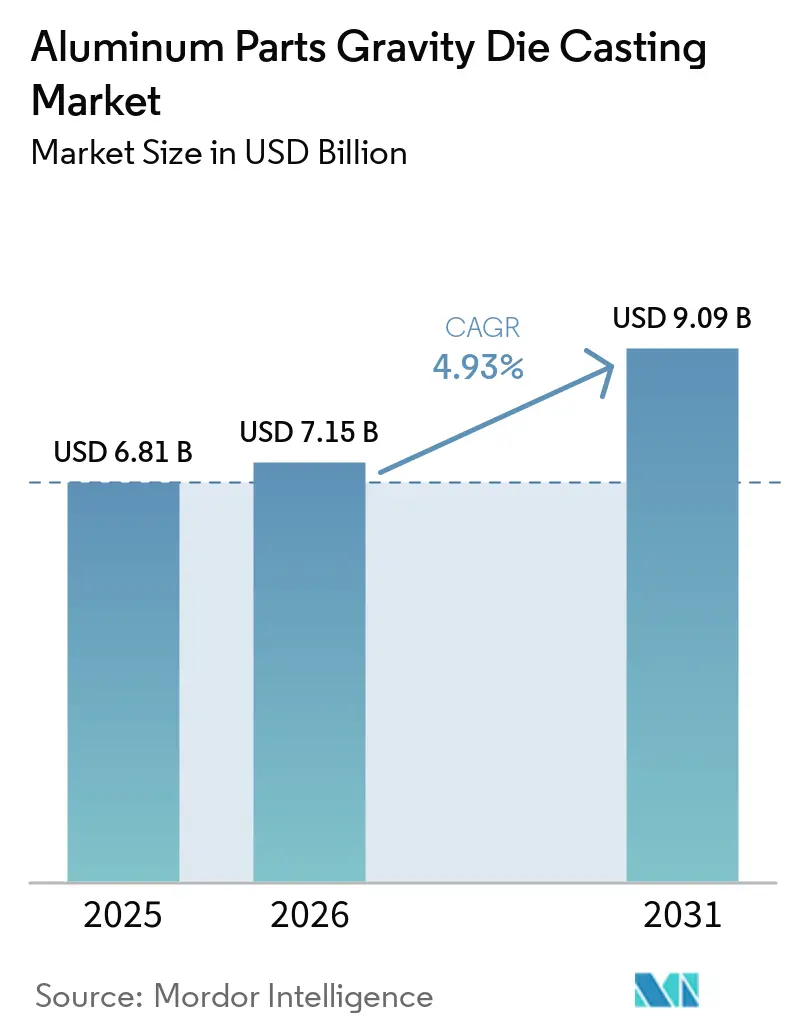
The Aluminum Parts Gravity Die Casting Market size was valued at USD 6.81 billion in 2025, and is expected to reach USD 7.15 billion in 2026, and is projected to reach USD 9.09 billion by 2031, at a CAGR of 4.93% during the forecast period (2026-2031). Legacy ICE powertrain castings are being replaced by EV battery enclosures, structural chassis elements, and thermal-management housings. These new components, with their tighter porosity tolerances, favor gravity die casting over sand casting and other permanent-mold methods. Stricter efficiency mandates, such as those requiring significant improvements in fleet fuel efficiency within a few years, are urging automakers to reduce vehicle weight wherever possible. This push gives aluminum components, such as control arms, brake calipers, and knuckles, a distinct cost-benefit advantage over steel. Europe's upcoming regulation to limit brake particulate emissions is driving up demand for aluminum brake systems, known for producing less wear debris. On the technology front, vacuum-assisted gravity die casting, paired with AI-driven die-health monitoring, is not only reducing scrap rates but also paving the way for safety-critical applications. This advancement enables tier-1 suppliers to adhere to stringent safety standards without the need for impregnation. However, fluctuations in raw-material costs on the London Metal Exchange, combined with a shortage of skilled labor, are squeezing profit margins by a noticeable percentage. Despite these challenges, integrated foundries that incorporate on-site recycling and near-shore machining are successfully expanding their capacity.
Key Report Takeaways
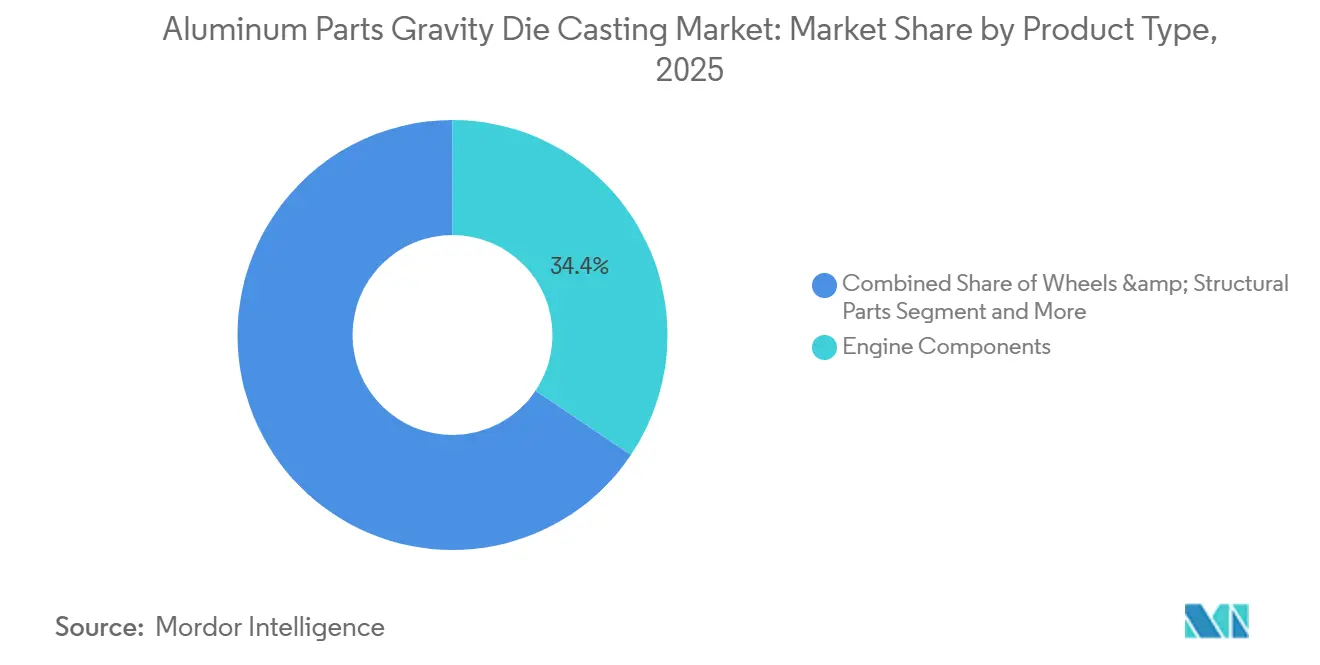
- By product type, engine components led with 34.36% revenue share in 2025; wheels & structural parts are projected to expand at a 5.95% CAGR through 2031.
- By alloy type, Al-Si alloys captured 63.21% of 2025 revenue, while Al-Cu alloys are forecast to advance at a 5.01% CAGR to 2031.
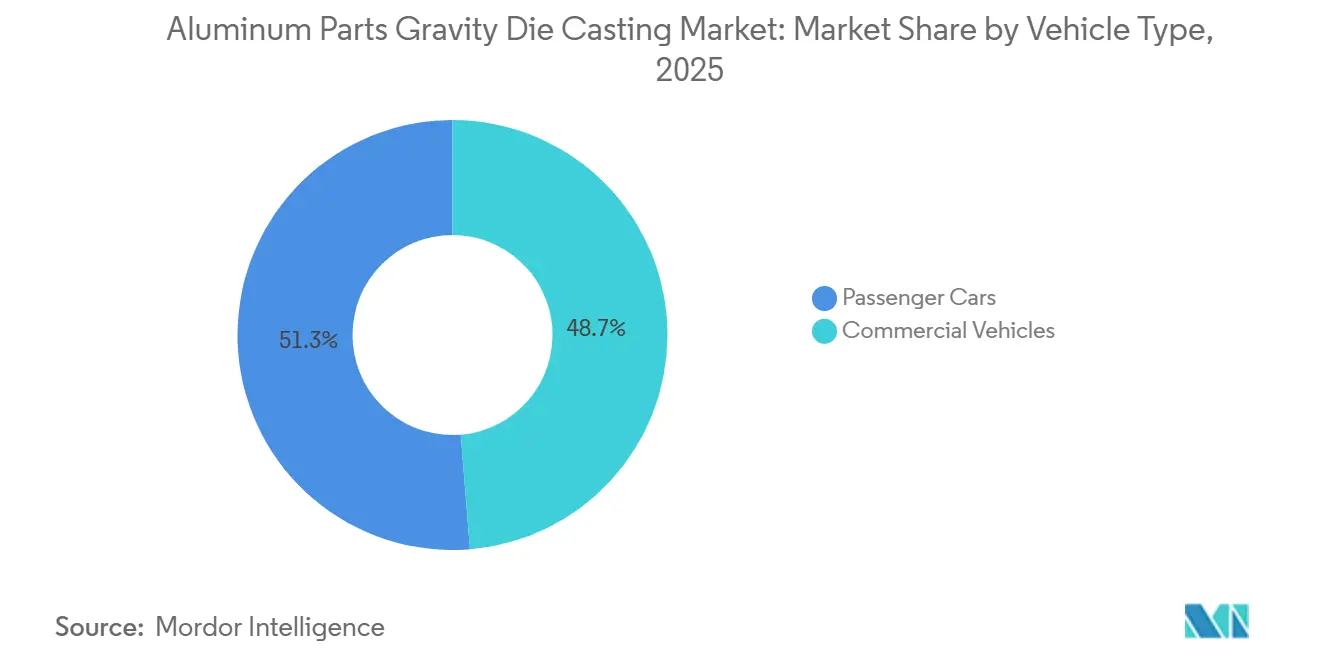
- By vehicle type, passenger cars accounted for 51.28% of 2025 volume and are set to grow at a 5.04% CAGR to 2031.
- By end-user, OEMs held 73.37% of 2025 revenue, and this segment is expected to rise at a 6.97% CAGR through 2031.
- By geography, the Asia Pacific commanded 38.73% of 2025 revenue and is progressing at a 6.98% CAGR to 2031.
Note: Market size and forecast figures in this report are generated using Mordor Intelligence’s proprietary estimation framework, updated with the latest available data and insights as of January 2026.
Global Aluminum Parts Gravity Die Casting Market Trends and Insights
Drivers Impact Analysis*
| Driver | (~) % Impact on CAGR Forecast | Geographic Relevance | Impact Timeline |
|---|---|---|---|
| EV Battery-Housing Demand Surge | +1.5% | Asia Pacific core, spill-over to North America | Short term (≤ 2 years) |
| Light-Vehicle Lightweighting Mandates | +1.2% | Global, with peak intensity in EU and China | Medium term (2-4 years) |
| ICE-To-EV Factory Retrofits | +0.8% | North America and EU | Medium term (2-4 years) |
| Regional Near-Shoring After Tariff Shifts | +0.7% | North America, with secondary gains in Mexico | Short term (≤ 2 years) |
| Vacuum-Assisted GDC Lowering Porosity | +0.5% | Global, led by premium OEMs in Germany and Japan | Long term (≥ 4 years) |
| AI-Driven Die-Health Monitoring | +0.4% | Global, early adoption in Asia Pacific and North America | Medium term (2-4 years) |
| Source: Mordor Intelligence | |||
EV Battery-Housing Demand Surge
Weighing significantly, a 75 kWh battery pack necessitates a leak-tight aluminum enclosure. Gravity die casting, with its ability to achieve a laminar metal flow, limits porosity to a minimal level. This precision is a benchmark that high-pressure die casting (HPDC) finds challenging to meet without the aid of vacuum evacuation. Renault’s Captur E-Tech, in a bid to streamline production, consolidated numerous stamped parts into its battery housing. This move significantly reduced assembly time. However, it came at a cost: an increase in the use of Al-Si-Mg alloy per vehicle. Such an increase could stretch foundry margins, especially without securing long-term production volumes [1]. Meanwhile, Tesla, facing a considerable scrap rate, is pivoting from its single-piece gigacast underbodies. This shift has led to a partial redirection of orders towards modular gravity die cast designs, which promise reduced collision-repair costs.
Light-Vehicle Lightweighting Mandates
Legislated fuel-economy and brake-particulate standards have set a new baseline, significantly increasing the aluminum content per light vehicle. These standards are steering OEMs towards prioritizing cast aluminum for control arms, calipers, and knuckles. In the U.S., stricter fuel-efficiency thresholds incentivize improvements in fuel consumption through weight reduction, leading to a notable shift from iron and steel parts [2]. Meanwhile, in Europe, failing to meet stringent CO₂ limits results in substantial financial penalties, making a stronger case for adopting permanent-mold aluminum subframes. China's ambitious fuel-efficiency targets, alongside its dual-credit NEV initiative, are driving the shift towards aluminum transmission cases in hybrid powertrains. While premium brands are leveraging vacuum-assisted gravity die casting to adhere to rigorous fatigue standards, mass-market programs are opting for conventional gravity die casting with impregnation to keep costs in check.
ICE-To-EV Factory Retrofits Spawning New Tooling Orders
Legacy engine-block plants are increasingly transitioning to the production of battery trays and motor housings as automakers expand their electric vehicle manufacturing capabilities. Ford has made substantial investments in a Michigan battery complex, installing large gravity die-casting machines to manufacture drive-unit housings. General Motors and Stellantis are also pursuing similar transitions by adapting existing manufacturing facilities to support EV component production. However, the high-silicon alloys used in EV housings significantly reduce die life compared with conventional materials. This shorter die lifespan increases tooling replacement requirements and raises amortized tooling costs for manufacturers.
Regional Near-Shoring After Tariff Shifts
The United States reinstated aluminum import tariffs, prompting foundries to expand operations across the United States and Mexico. Georg Fischer began constructing a major facility in Augusta, Georgia, which is expected to supply BMW with a substantial and consistent volume of battery housings each year, supporting the growing demand for electric vehicle components. Meanwhile, Ryobi’s expansion in Irapuato added several high-pressure die-casting lines and created new employment opportunities, strengthening General Motors’ local sourcing capabilities and regional supply chain resilience. Although rising gas prices in Europe have encouraged selective reshoring initiatives, lower-cost imports continue to undercut EU producers and limit the competitiveness of domestic production.
Restraints Impact Analysis*
| Restraint | (~) % Impact on CAGR Forecast | Geographic Relevance | Impact Timeline |
|---|---|---|---|
| Aluminum Ingot Price Volatility | -0.9% | Global, with acute exposure in spot-market-dependent foundries | Short term (≤ 2 years) |
| Competition from Giga-Casting HPDC | -0.7% | Asia Pacific and North America, led by EV-native OEMs | Medium term (2-4 years) |
| High Cap-Ex For Large-Tonnage Tilt-Pour Cells | -0.6% | North America and EU, where labor costs justify automation | Medium term (2-4 years) |
| Skilled-Labor Shortages | -0.5% | North America and Western Europe | Long term (≥ 4 years) |
| Source: Mordor Intelligence | |||
Aluminum Ingot Price Volatility
Foundries without frequent price indexation mechanisms experienced significant increases in casting costs, resulting in a considerable decline in EBITDA until contract terms could be renegotiated. Linamar’s acquisition of Aludyne strengthened its in-house recycling capabilities, which now account for a substantial share of its melt supply and provide greater protection against input-cost volatility and margin pressure. In contrast, smaller plants with limited production volumes and financial flexibility often struggle to finance similar hedging measures or invest in recycling capabilities, leaving them more exposed to fluctuations in material costs.
Competition from Giga-Casting HPDC for Mega-Structurals
Tesla's Giga Press demonstrates the efficiency of casting an entire rear body structure and helps reduce component complexity and assembly requirements. However, it faces challenges, including elevated scrap rates, limited die life, and higher collision repair costs, as damage to a large integrated casting may require extensive repairs or replacement. While Dongfeng and BYD are testing larger presses with greater clamping capacity to support more integrated vehicle structures, OEMs such as Renault and Hyundai continue to adopt modular architectures. These manufacturers rely on gravity die casting for replaceable crash structures, which can improve repairability and support more cost-effective vehicle maintenance.
*Our forecasts treat driver/restraint impacts as directional, not additive. The impact forecasts reflect baseline growth, mix effects, and variable interactions.
Segment Analysis
By Product Type: Engine Components Yield to Structural Shift
Engine components retained 34.36% of 2025 revenue, but the aluminum parts gravity die casting market sees that share eroding as automakers delete V8 blocks in favor of battery packs. Wheels & structural parts—flow-formed rims, battery trays, and shock towers—are posting a 5.95% CAGR through 2031, surpassing the overall aluminum parts gravity die casting market trajectory. Transmission housings are shifting from multi-speed internal combustion engine (ICE) units to single-speed electric vehicle (EV) reducers, significantly reducing aluminum content per vehicle. In response to Euro 7 limits on brake dust, the industry is witnessing a surge in aluminum calipers, which now achieve durability benchmarks without the weight penalties associated with cast iron. Insurance data reveals that modular gravity-cast rear subframes incur considerably lower repair costs after a moderate impact compared to single-piece gigacast underbodies. This cost disparity solidifies the position of structural parts within the gravity-casting domain of mainstream programs.
Flow-formed wheels achieve a substantial reduction in wall thickness, leading to decreased rotational inertia and an improvement in EV range. Suspension knuckles and control arms, crafted through vacuum-assisted gravity die casting, benefit from a reduced unsprung mass while adhering to ISO 26262 standards. While HPDC gigacasting is making waves in the media, the aluminum parts gravity die casting market continues to dominate essential safety-critical niches. These are areas where high-pressure processes face challenges, often requiring additional vacuum and heat-treat steps to compete.

By Alloy Type: Al-Cu Gains on Thermal Demands
Al-Si alloys owned 63.21% of the 2025 volume and continue to dominate thin-wall castings due to their eutectic fluidity. Still, Al-Cu grades are advancing at a 5.01% CAGR because EV battery trays and 800-V motor housings need better heat dissipation. Premium OEMs are willing to pay a premium on raw materials to achieve significant weight reduction per vehicle, even as the market share for Al-Cu in aluminum parts gravity die casting remains modest.
Speed of adoption is contingent on navigating EU end-of-life regulations, which impose strict limits on lead content. This constraint pushes the industry to replace lead with alternative elements like bismuth or tin in free-cutting alloys. While heat-treating steps like the T6 temper can significantly enhance structural performance, many mass-market programs opt to skip this additional furnace cycle. Due to vacuum-assisted gravity die casting, A356 Al-Si-Mg castings can achieve high tensile strength without the need for hot isostatic pressing, solidifying Al-Si's dominance in the aluminum parts gravity die casting arena.
By Vehicle Type: Passenger Cars Lead, Commercial Vehicles Electrify
Passenger cars commanded 51.28% of 2025 revenue and are rising at a 5.04% CAGR on the back of sport-utility and crossover demand. Battery-electric models average 220–250 kg of aluminum, compared with 180–200 kilograms of comparable ICE versions. Class 8 trucks require battery enclosures weighing up to 2t. Yet, gravity die cast trays, hinge reinforcements, and cooling plates lower unit tooling cost by two-fifths relative to HPDC, making them attractive for depot-based delivery fleets.
Light commercial vans, such as the Ford Transit and Mercedes Sprinter, employ gravity-cast hinge blocks and door modules to recoup payload lost due to 300-kg battery packs. As duty cycles shift toward urban routes, the growth of the commercial segment in the aluminum parts gravity die casting market may soon outpace that of passenger cars, even though the latter currently commands a larger revenue share.
By End-User: OEM Dominance, Aftermarket Quality Gaps
OEM contracts represented 73.37% of 2025 revenue. Also, they registered a robust CAGR of 6.97% through 2031, with tier-0.5 suppliers co-designing castings early in vehicle-architecture cycles to secure seven-year volume commitments that justify a massive die set. Aftermarket castings show elevated dimensional failure rates in independent lab audits, highlighting a persistent quality divide.
Counterfeit brake calipers and suspension knuckles make up a significant portion of the global replacement volume—especially in fast-growing emerging markets—posing safety and liability risks. Consolidation intensified as Nemak completed its acquisition of Georg Fischer's automotive casting unit in February 2026 and Linamar absorbed Aludyne’s North American operations, further tilting bargaining power toward integrated OEM suppliers in the aluminum parts gravity die casting industry.
Geography Analysis
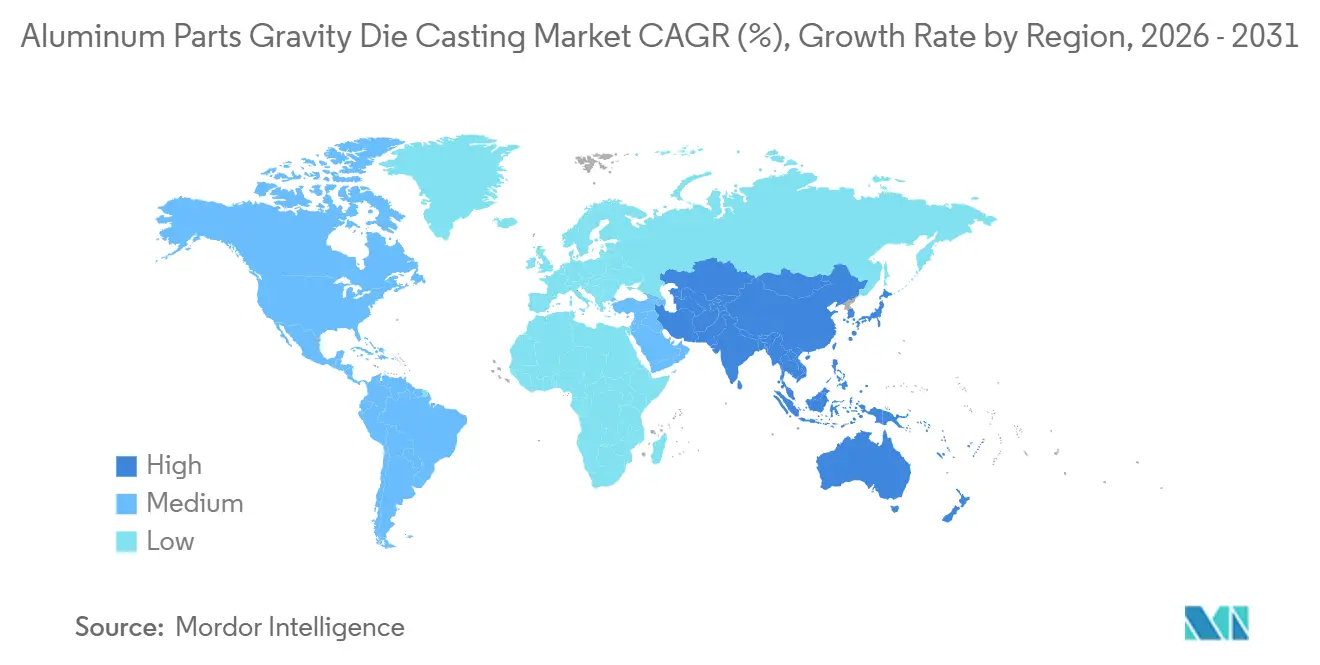
The Asia Pacific, with 38.73% of 2025 revenue, is expected to report robust growth of 6.98% by 2031, seamlessly merging gigacasting and modular gravity casting. At Dongfeng Motor’s expansive complex in Wuhan, the integration of high-capacity HPDC presses with gravity die casting cells has resulted in a significant reduction in internal logistics. In an important move for India’s automotive landscape, both Uno Minda and Jaya Hind have made substantial investments in installing the subcontinent’s first large-scale HPDC machine, aligning with Maruti Suzuki’s ambitions for electric vehicles. Japan showcases a split approach: Ryobi is channeling considerable resources into gigapresses, while Ahresty pivots from ICE blocks to concentrate on motor housings. Meanwhile, in South Korea, Hyundai Mobis has achieved a milestone, now supplying a majority of aluminum parts internally to Hyundai-Kia, underscoring the advantages of vertical integration in the aluminum parts gravity die casting arena.
North America, accounting for a significant portion of global revenue, benefits from tariff-driven near-shoring initiatives. In a testament to the region's growth, Georg Fischer is set to inaugurate its Augusta, Georgia, plant in the near future, creating hundreds of jobs. Concurrently, Ryobi is bolstering its presence in Mexico, adding multiple HPDC lines specifically to cater to GM. The importance of aluminum is underscored by CAFE regulations, especially for pickups and SUVs, where weight reduction translates to notable fuel savings. Highlighting regional growth, Ontario's cluster in Canada, buoyed by Linamar’s Welland giga-casting center, recorded a notable increase in activity in 2024.
Europe, holding a significant share, grapples with margin pressures. Linamar faced a setback, registering a substantial goodwill impairment in late 2024, following deferrals of EV launches by German OEMs due to charging challenges. Yet, amidst these challenges, the Euro 7 brake-dust limits have spotlighted aluminum calipers as a lucrative opportunity. Additionally, GF’s sale of its Leipzig facility to Nemak underscores the ongoing consolidation trends in the region. Meanwhile, South America and the combined regions of the Middle East & Africa, accounting for a smaller share, find leadership in Brazil’s bustling São Paulo corridor and Turkey’s casting houses, which are increasingly oriented towards exports.
Competitive Landscape
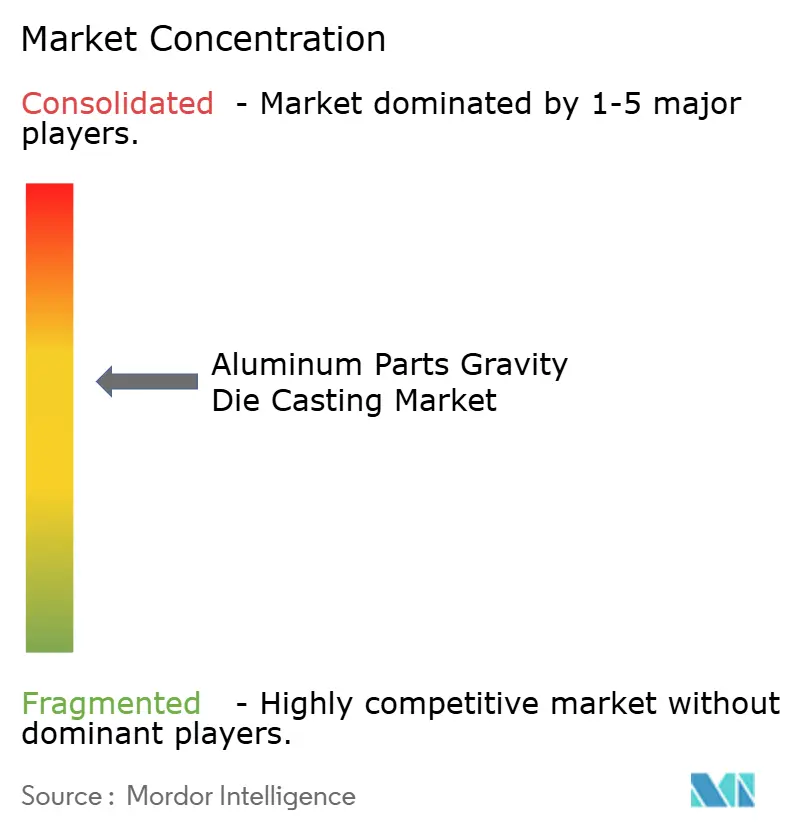
In the aluminum parts gravity die casting market, moderate fragmentation is evident. The top five players command a significant share of the market. In a strategic move, Nemak acquired Georg Fischer’s automotive casting unit, gaining control of numerous factories and securing a supply with a high percentage of recycled content [3].
Linamar strengthened its position as a Tier 0.5 partner for automotive giants Ford and GM through its acquisition of Aludyne, significantly expanding its production capacity. Meanwhile, technological differentiators, such as vacuum-assisted casting and AI-driven die monitoring, require substantial investment, creating barriers for smaller aftermarket shops.
In the current market, sustainability credentials carry significant weight. Aluminum Stewardship Initiative certifications and commitments to closed-loop recycling are becoming prerequisites for OEM contracts, particularly for OEMs seeking to reduce Scope 3 emissions. Furthermore, disruptive players from India and Southeast Asia are leveraging advantages such as lower landed costs and just-in-time delivery models to significantly reduce supply chain inventory.
Aluminum Parts Gravity Die Casting Industry Leaders
-
Endurance Technologies
-
Minda Corporation Limited
-
Sundaram Clayton Limited
-
Rockman Industries
-
CIE Automotive
- *Disclaimer: Major Players sorted in no particular order
Recent Industry Developments
- July 2026: Thrust Capital Partners acquired Alphacasting, a specialized manufacturer of complex aluminum and titanium castings, in a significant consolidation move. The acquisition targets demand for high-integrity gravity and precision castings in the aerospace and specialized transportation systems sectors.
- March 2026: Form Technologies, Dynacast’s parent company, officially announced the acquisition of Tijuana-based Platinadora Baja. The acquisition expands Dynacast’s North American footprint by adding aluminum and zinc die-casting capabilities and specialized downstream finishing services.
- February 2026: Nemak finalized its acquisition of GF Casting Solutions’ automotive business, a division of Swiss industrial group Georg Fischer, for an enterprise value of USD 336 million. The acquisition added nine production facilities and an R&D center, strengthening Nemak’s capabilities in structural and electric vehicle components.
Global Aluminum Parts Gravity Die Casting Market Report Scope
The scope of the report includes Product Type (Engine Components and More), Alloy Type (Al-Si Alloys and More), Vehicle Type (Passenger Cars and Commercial Vehicles), End-User (OEMs and Aftermarket Suppliers), and Geography. The Market Forecasts are Provided in Terms of Value (USD).
| Engine Components |
| Transmission Parts |
| Brake Components |
| Suspension Parts |
| Wheels & Structural Parts |
| Al-Si Alloys |
| Al-Cu Alloys |
| Other Specialized Alloys |
| Passenger Cars |
| Commercial Vehicles |
| OEMs |
| Aftermarket Suppliers |
| North America | United States |
| Canada | |
| Rest of North America | |
| South America | Brazil |
| Argentina | |
| Rest of South America | |
| Europe | Germany |
| United Kingdom | |
| France | |
| Italy | |
| Spain | |
| Rest of Europe | |
| Asia Pacific | China |
| India | |
| Japan | |
| South Korea | |
| Rest of Asia Pacific | |
| Middle East and Africa | United Arab Emirates |
| Saudi Arabia | |
| South Africa | |
| Turkey | |
| Rest of Middle East and Africa |
| By Product Type | Engine Components | |
| Transmission Parts | ||
| Brake Components | ||
| Suspension Parts | ||
| Wheels & Structural Parts | ||
| By Alloy Type | Al-Si Alloys | |
| Al-Cu Alloys | ||
| Other Specialized Alloys | ||
| By Vehicle Type | Passenger Cars | |
| Commercial Vehicles | ||
| By End-User | OEMs | |
| Aftermarket Suppliers | ||
| By Geography | North America | United States |
| Canada | ||
| Rest of North America | ||
| South America | Brazil | |
| Argentina | ||
| Rest of South America | ||
| Europe | Germany | |
| United Kingdom | ||
| France | ||
| Italy | ||
| Spain | ||
| Rest of Europe | ||
| Asia Pacific | China | |
| India | ||
| Japan | ||
| South Korea | ||
| Rest of Asia Pacific | ||
| Middle East and Africa | United Arab Emirates | |
| Saudi Arabia | ||
| South Africa | ||
| Turkey | ||
| Rest of Middle East and Africa | ||
Key Questions Answered in the Report
What was the aluminum parts gravity die casting market worth in 2025?
The aluminum parts gravity die casting market size stands at USD 6.81 billion in 2025 and is projected to reach USD 9.09 billion by 2031.
Which product group is expanding fastest in gravity die casting?
Wheels & structural parts show the highest growth, advancing at a 5.95% CAGR through 2031.
How large is Asia Pacific’s share of global gravity die-cast aluminum parts?
Asia Pacific accounts for 38.73% of global revenue and is growing at a 6.98% CAGR.
Which alloy is gaining share in EV battery trays?
Al-Cu alloys are rising fastest at a 5.01% CAGR owing to their superior thermal conductivity.
Why are vacuum-assisted cells gaining favor among premium OEMs?
Evacuated dies cut porosity by as much as 80%, enabling ISO 26262-compliant safety parts without impregnation and reducing scrap rates.
What factor most threatens foundry profitability in the next two years?
Aluminum ingot price volatility, with 12.5% swings on the LME, can compress EBITDA by up to 300 basis points for spot-dependent foundries.