
Market Overview
| Study Period | 2020 - 2031 |
|---|---|
| Forecast Data Period | 2026 - 2031 |
| Base Year Market Size (2025) | USD 15.36 Billion |
| Market Size (2026) | USD 16.67 Billion |
| Market Size (2031) | USD 25.14 Billion |
| Growth Rate (2026 - 2031) | 8.55 % |
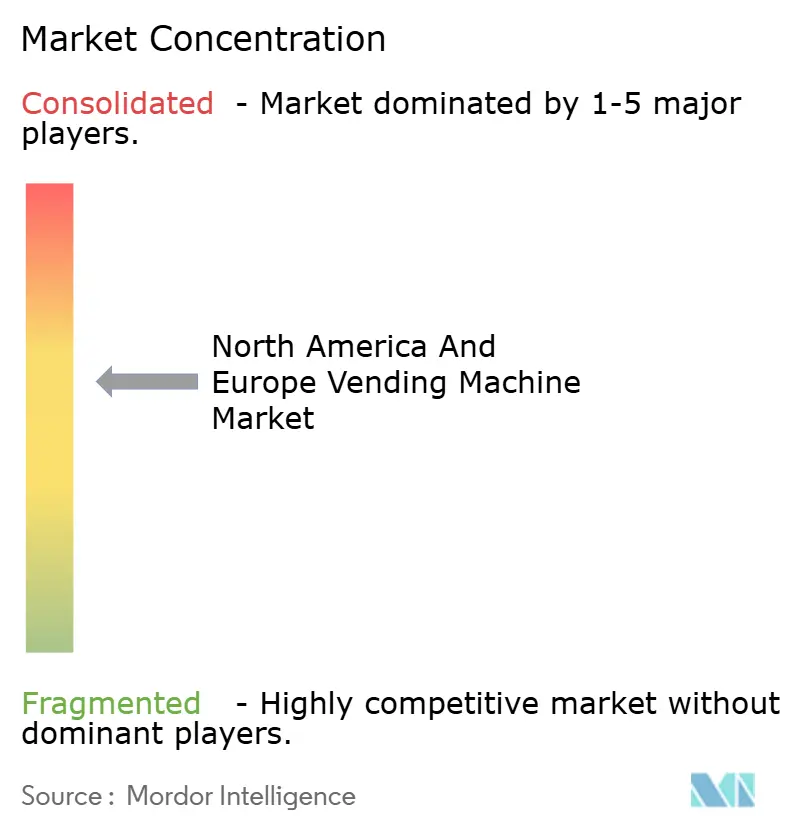
| Market Concentration | Medium |
Major Players *Disclaimer: Major Players sorted in no particular order Image © Mordor Intelligence. Reuse requires attribution under CC BY 4.0. | |
North America And Europe Vending Machine Market Analysis by Mordor Intelligence
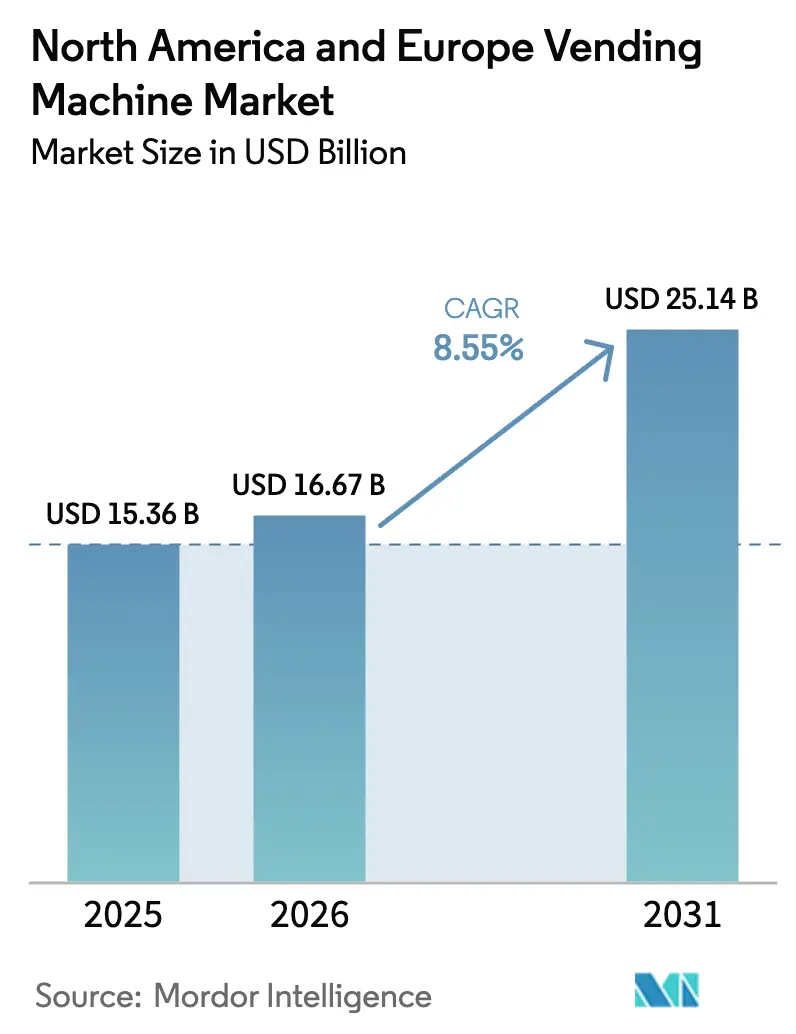
The North America and Europe vending machine market size is expected to grow from USD 15.36 billion in 2025 to USD 16.67 billion in 2026 and is forecast to reach USD 25.14 billion by 2031 at 8.55% CAGR over 2026-2031. Accelerated adoption of cashless payments, growth in fresh-food merchandising, and real-time telemetry are reshaping the vending ecosystem into a data-rich retail channel. Beverage machines retained revenue leadership with 46.12% share in 2024, yet food and snack units are expanding faster, supported by cold-chain upgrades and AI-guided planograms. Offices remain the densest installation cluster, but transit hubs are gaining priority as airports and metros seek contact-free retail that serves commuters quickly. Cash usage is receding, falling to 58.32% of 2024 transactions, while mobile wallets and QR codes climb on the back of declining cash circulation in Germany and EU policy pressure for digital micro-payments. Operators continue to weigh retrofit costs against telemetry gains; nonetheless, smart machines are forecast to outpace the broader North America and Europe vending machine market through 2030.
Key Report Takeaways
- By product type, beverage machines led with 45.78% revenue share in 2025; food and snacks are projected to post a 9.02% CAGR to 2031.
- By location, office and commercial buildings accounted for 36.72% of installations in 2025, while transportation facilities are poised to expand at an 8.31% CAGR through 2031.
- By payment mode, cash retained 57.89% share in 2025, yet mobile wallet and QR-code transactions will rise at a 12.78% CAGR to 2031.
- By technology, non-smart units comprised 60.94% of the installed base in 2025, whereas smart or IoT-enabled machines will advance at a 15.26% CAGR.
- By end-use industry, corporate workspaces held 30.12% revenue share in 2025; healthcare is set to grow at a 10.57% CAGR through 2031.
Note: Market size and forecast figures in this report are generated using Mordor Intelligence’s proprietary estimation framework, updated with the latest available data and insights as of 2026.
Market Trends and Insights
Drivers Impact Analysis of North America And Europe Vending Machine Market*
| Driver | (~) % Impact on CAGR Forecast | Geographic Relevance | Impact Timeline |
|---|---|---|---|
| Cashless Micro-Payments Integration Accelerating Unit Economics | +1.8% | Germany, United Kingdom, Nordics | Short term (≤ 2 years) |
| Rising Demand for Contact-Free Retail Experiences | +1.5% | North America and EU transit hubs | Medium term (2-4 years) |
| Expansion of Fresh-Food Vending in Transport Hubs | +1.3% | United States airports, EU rail terminals | Medium term (2-4 years) |
| AI-Powered Planogram Optimisation and Dynamic Pricing | +1.2% | North America corporate campuses, EU smart cities | Long term (≥ 4 years) |
| Workplace Well-Being Initiatives Driving Healthy-Snack Offerings | +0.9% | North America and Western Europe | Medium term (2-4 years) |
| Government Incentives for Energy-Efficient Refrigeration | +0.7% | EU and United States | Long term (≥ 4 years) |
| Source: Mordor Intelligence | |||
Cashless Micro-Payments Integration Accelerating Unit Economics
Vending operators that fitted contactless readers and mobile-wallet acceptance achieved a 77% cashless share in 2024, reducing coin-handling costs and enabling dynamic pricing that lifted average ticket values by up to 18%. Germany illustrates the economics: SECO and BDTA began retrofitting 200,000 tobacco units with girocard terminals, eliminating cash-collection routes that previously absorbed 25% of operating costs.
Rising Demand for Contact-Free Retail Experiences
Touchless interfaces introduced during the pandemic are now standard in busy venues. QR-code ordering and voice-activated modules reduce surface-contact complaints and align with hygiene protocols in healthcare and food-service settings.
Expansion of Fresh-Food Vending in Transport Hubs
Farmer’s Fridge surpassed 1,000 airport and transit locations by mid-2024, demonstrating that chef-prepared salads priced at USD 8–12 can triple annual sales per machine versus legacy snack units. Cold-chain compliance and spoilage control remain the primary constraints.
AI-Powered Planogram Optimisation and Dynamic Pricing
Selecta’s 2024 pilot in Swiss offices used machine-learning to rotate SKUs and raised sales per machine by 19%. Dynamic pricing faces regulatory scrutiny in France but is gaining acceptance where demand elasticity supports it.
Restraints Impact Analysis of North America And Europe Vending Machine Market*
| Restraint | (~) % Impact on CAGR Forecast | Geographic Relevance | Impact Timeline |
|---|---|---|---|
| Escalating Cyber-security and Data-Privacy Threats | -1.1% | EU (GDPR, Cyber Resilience Act), North America (state-level breach laws) | Short term (≤ 2 years) |
| High Capital Cost of Retrofit for Connectivity | -0.9% | North America and Europe, particularly legacy fleets in rural areas | Medium term (2-4 years) |
| Stringent EU Waste-Reduction Regulations on Single-Use Packaging | -0.6% | European Union member states, with pilot enforcement in France, Germany | Long term (≥ 4 years) |
| Persistent Vandalism and Physical Theft Risks | -0.5% | Urban centers in United States, Southern Europe | Short term (≤ 2 years) |
| Source: Mordor Intelligence | |||
Escalating Cyber-Security and Data-Privacy Threats
The EU Cyber Resilience Act obliges vending operators to patch vulnerabilities within 14 days or face fines up to 2.5% of global revenue, raising compliance outlays by USD 800–1,200 per legacy unit.[1]
High Capital Cost of Retrofit for Connectivity
Converting a mechanical machine into an IoT node typically costs USD 1,500–2,500, pushing fleet-wide upgrades for mid-size operators into the USD 7–12 million range and delaying full telemetry rollouts.
*Our forecasts treat driver/restraint impacts as directional, not additive. The impact forecasts reflect baseline growth, mix effects, and variable interactions.
North America And Europe Vending Machine Market Segment Analysis
By Type:
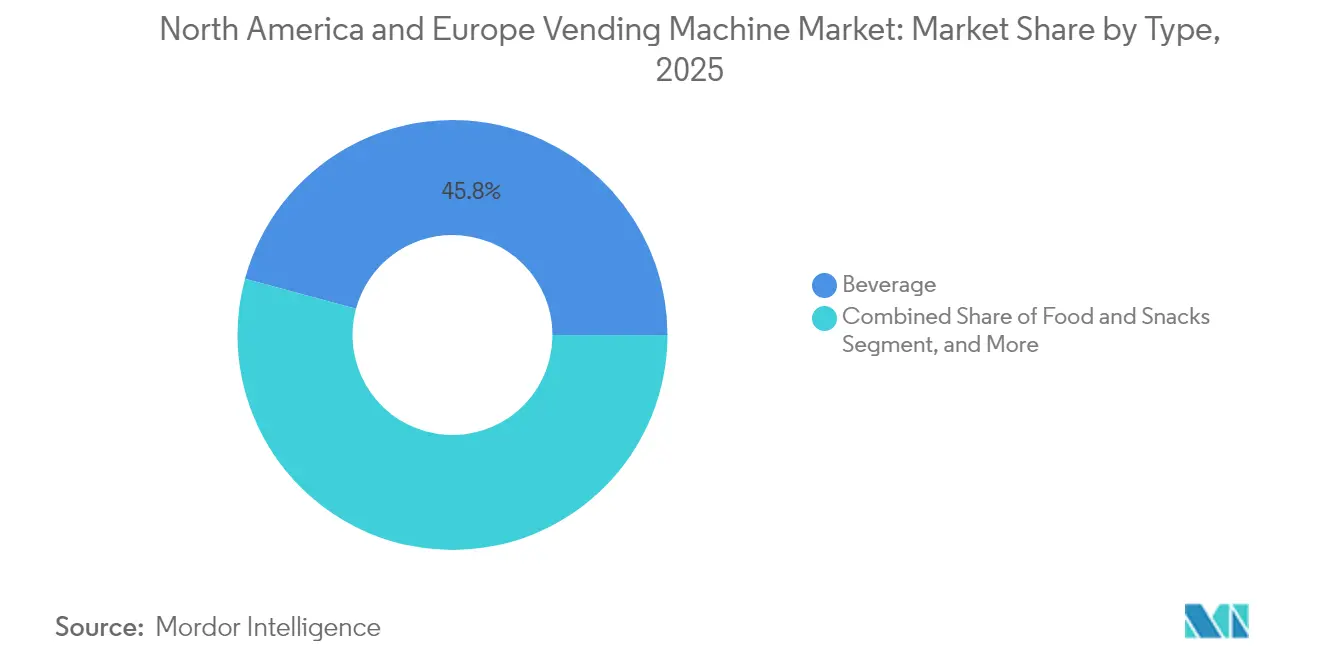
Fresh Meals Challenge Beverage DominanceSales of beverage machines still anchor the North America and Europe vending machine market, holding 45.78% revenue share in 2025. However, food and snack machines are forecast to grow 9.02% annually, reflecting the superior gross margins of chef-prepared meals. A single Farmer’s Fridge unit at Chicago O’Hare generated USD 120,000 in 2024 triple the take of a standard snack vendor. Cold-chain investments are therefore rising, spurred by FDA temperature-logging mandates and EU refrigerant rules that favor energy-efficient propane systems.
Natural-refrigerant compressors add 30–40% to equipment cost yet reduce electricity use by 20%, enabling price premiums on perishable SKUs. Beverage vending continues to benefit from supplier-funded placements and tolerant temperature bands, enabling incumbents to defend share through exclusive pour rights and promotional pricing. Personal-care merchandising remains below 5% but is gaining traction in hospitals and dormitories, where round-the-clock access to hygiene items offsets emergency-supply trips.

By Location:
Transit Hubs Gain as Offices PlateauOffices delivered 36.72% of 2025 installations, but hybrid work diminished weekday footfall and pressured per-machine turnover. In contrast, airports and metro stations are projected to grow at an annual rate of 8.31%, aided by municipal efforts to diversify non-fare revenue. Metro de Madrid’s EUR 7.7 million contract for 145 combo ticket-and-snack units underscores the commercial potential, each machine occupies only 4 sq ft and is expected to earn USD 35,000 yearly, split evenly with the transit authority.
Institutional venues such as schools and hospitals provide stable demand but impose nutritional or hygiene restrictions that lengthen assortment cycles. Leisure settings exhibit high per-event revenue yet volatile throughput, compelling operators to balance machine density with route efficiency. Closed-campus systems simplify settlement but tie operators into exclusive contracts, limiting SKU experimentation.
By Payment Mode:
Mobile Wallets Erode Cash HegemonyCash still represented 57.89% of 2025 transactions, but the share is sliding as smartphone wallets win favor. Apple Pay and Google Pay adoption exceeded 50% among U.S. and U.K. smartphone users by mid-2024, propelling a 12.78% CAGR for mobile wallets through 2031. Cantaloupe micro-markets achieved 96% cashless penetration in 2024, showcasing how digitally literate environments can bypass notes and coins altogether. The forthcoming digital euro may accelerate this shift by offering instant settlement with negligible interchange fees.
Closed-loop stored-value systems captured 8.00% of 2025 volume but remain confined to campuses and large employers. PSD3 proposals to cap interchange on sub-EUR 5 transactions will further squeeze processor margins and encourage QR-based schemes that skirt card rails.
By Technology:
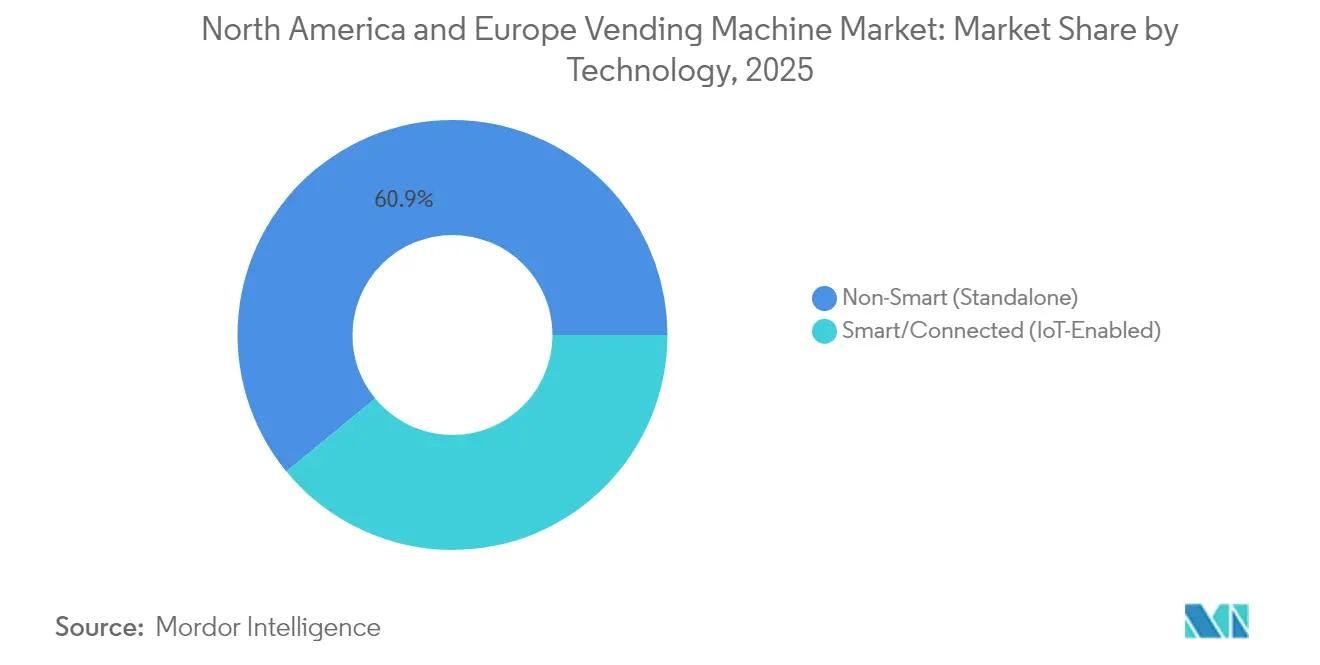
IoT Retrofit Economics Slow Smart-Machine AdoptionSmart machines are forecast to grow at a rate of 15.26% annually, the fastest of any segment; yet, non-smart units still dominate, accounting for 60.94% of 2025 installations. Operators weigh USD 1,500–2,500 retrofit costs against telemetry benefits, as connected machines cut out-of-stocks by 40% and shrink truck rolls by 25%. However, connectivity fees and cybersecurity compliance dilute returns in low-traffic zones. PCI DSS 4.0 now requires multi-factor authentication for remote device access, adding USD 50,000–100,000 in annual spend for mid-size fleets.
Operators are experimenting with modular upgrade kits that bolt cellular modems, optical sensors, and cashless readers onto legacy cabinets, reducing retrofit costs to USD 1,000–1,200 while still unlocking telemetry that reduces truck rolls by 20–30% and cuts unplanned downtime by 25%. Yet reliability gaps persist in basement corridors and rural fuel stops where SIM authentication fails or metal enclosures weaken signals, forcing some fleets to revert to store-and-forward data dumps during scheduled service visits.
By End-Use Industry:
Healthcare Vending Gains from PPE DemandCorporate campuses led 2025 revenue at 30.12%, yet healthcare is projected to climb 10.57% annually as hospitals automate PPE and OTC drug dispensing. Medical vending reached USD 428 million in 2025, with North America supplying roughly 40% of installations. Hospitals value traceability and 24-hour availability, while PPE machines ease front-desk congestion and increase infection-control compliance.
Education adheres to the USDA’s Smart Snacks standards, limiting SKU variety and slowing growth. Travel and hospitality sites command premium prices but pay revenue-share fees of up to 20%. Manufacturing plants leverage vending and micro-markets to retain shift workers, though OSHA placement rules require careful site selection.
Geography Analysis
North America Vending Machine Market
The United States captured 53.85% of 2025 revenue, supported by 7 million installed machines and a 77% cashless transaction rate. Energy-efficient refrigeration adoption is accelerating under the SNAP program, trimming operating costs by 20% despite USD 3,000–5,000 upfront outlays per unit. Canada benefits from the adoption of universal debit and bilingual labeling, which discourages cross-border imports, while fresh-food vending continues its gradual expansion in high-traffic urban centers.
Europe Vending Machine Market
Germany is the fastest-growing major market at 8.74% CAGR to 2031, buoyed by girocard ubiquity and the SECO-BDTA plan to retrofit 200,000 tobacco machines with cashless modules. Cash transactions dropped from 82.5% in 2008 to 51% in 2023, hastening the shift to digital payments. The U.K., France, and Italy each command 8–12% of European sales but face rising packaging waste compliance costs, particularly under France’s AGEC law, which mandates 50% reusable or compostable containers by 2027. Spain leverages tourism; airport and rail machines can yield USD 40,000–60,000 annually, twice the office average. Russia remains limited by import restrictions on Western telemetry gear, keeping smart-machine penetration below 10%. Across the EU, implementation of the Cyber Resilience Act and Packaging Directive will create scale advantages for large operators capable of spreading compliance costs across extensive fleets.
Regulatory Landscape
In the United States, vending operators face federal nutrition-disclosure obligations under FDA vending-machine labeling rules, including 21 CFR 101.8 requirements that apply to businesses owning or operating 20 or more vending machines. They also operate under a fragmented set of state and local public-health permits and sanitation requirements for food handling, temperature control, and storage, with plan review and licensing handled by state and local health authorities such as Oregon. State-level rules also apply in jurisdictions such as North Dakota and Kentucky, where requirements are published and enforced at the state level. These requirements are particularly consequential for fresh-food and healthcare placements, where temperature logging, allergen visibility, and hygiene controls can be checked through routine inspections.
In Europe, food vending is governed by the EU food-hygiene framework, including Regulation (EC) No 852/2004. It sets general hygiene requirements and HACCP-based procedures for food business operators, extending to automated retail formats. For connected machines, data-handling and product-security compliance adds another layer: the EU Cyber Resilience Act, which entered into force in March 2024, elevates patching and vulnerability-management obligations for connected vending machines operating as products with digital elements, increasing compliance requirements for telemetry-enabled fleets and their software suppliers.
Value Chain Analysis
The vending-machine value chain in North America and Europe begins with component inputs, including sheet metal and plastics, refrigeration systems, secure payment readers, telemetry modules, and embedded controllers. After that, OEM design and assembly lead to local customization, distribution, and installation. Service and operations sit in the profit-critical middle of the chain, driven by site acquisition and contracting (often with revenue share), merchandising and warehousing, route logistics, cash collection where applicable, and field maintenance. As payment mixes shift away from cash and smart or connected footprints expand, the software layer, including device management, planograms, pricing, and telemetry analytics, together with payment processing partnerships, increasingly influences total cost of ownership and operator differentiation.
Downstream, operators and convenience-services providers handle replenishment and compliance across venues such as offices, healthcare, and transportation facilities, where contractual terms and technical specifications differ. The chain is sensitive to retrofit economics because many fleets remain non-smart. Upgrades require coordinated procurement of readers, modems, and sensors, plus certification and cybersecurity controls for remote access, along with ongoing connectivity fees. Industry activity has also emphasized interoperability and integration, including the European Vending and Coffee Service Association (EVA) presenting its SmartLink interoperability architecture at Venditalia 2026 to standardize communication between unattended retail hardware, payments, and software ecosystems.
Competitive Landscape
The North America and Europe vending machine market remains moderately concentrated; the top Scale affords them superior route density, exclusive site contracts, and bargaining power with payment processors. Cantaloupe’s connected endpoints rose 12% year-over-year to 2.1 million in fiscal 2024, cutting service calls 22% and boosting average transaction value 9%.
Disruptors such as Farmer’s Fridge command 60% gross margins on fresh meals by leveraging cold-chain logistics and chef-prepared branding. Micro-market kiosks bypass coin mechanisms entirely and achieved 96% cashless penetration in 2024, pressuring legacy vending machines to upgrade their interfaces. Compliance with ETSI TS 103 701 constrains over-profiling but still permits aggregate demand analysis, which is critical to SKU optimization. Consolidation is likely as mid-tier operators lacking telemetry scale struggle to meet cybersecurity and packaging mandates.
North America And Europe Vending Machine Industry Leaders
-
American Vending Machines Inc.
-
Fuji Electric Co., Ltd.
-
Azkoyen Vending Systems, S.A.
-
Aramark Corporation
-
Jofemar Corporation
- *Disclaimer: Major Players sorted in no particular order
North America And Europe Vending Machine Market Companies Covered in this Report
- American Vending Machines Inc.
- Fuji Electric Co., Ltd.
- Azkoyen Vending Systems, S.A.
- Aramark Corporation
- Jofemar Corporation
- Compass Group PLC
- Evoca Group S.p.A.
- Crane Merchandising Systems Inc.
- Automated Merchandising Systems Inc.
- Sanden Holdings Corporation
- Selecta Group B.V.
- Bulk Vending Systems Ltd.
- Continental Vending Inc.
- FAS International S.p.A.
- N&W Global Vending S.p.A.
- Westomatic Vending Services Ltd.
- Azkoyen Group S.A.
- Bianchi Vending Group S.p.A.
- Vengo Labs Inc.
- Bianchi Industry S.p.A.
- FAS International S.p.A.
Read Analysis of North America And Europe Vending Machine Companies
Market Opportunities and Future Outlook
A near-term whitespace is in upgrading legacy fleets toward cashless-first, connected configurations that suit higher-velocity venues such as airports, metros, and rail terminals, while supporting fresh-food merchandising. The market already provides proof points in transport and travel placements, including Farmer's Fridge surpassing 1,000 airport and transit locations by mid-2024, and in transit authorities using vending as non-fare retail, illustrated by Metro de Madrid's contract for 145 ticket-and-snack units. For operators, these placements strengthen the business case for cold-chain investments, remote monitoring, and more frequent planogram refresh cycles versus traditional snack-and-beverage vending.
Another opportunity is reducing integration and operating friction through standardization and hybrid AI architectures that lower per-site deployment complexity across mixed equipment types, including traditional vending, smart coolers, and micro-markets. In Europe, EVA's May 2026 SmartLink initiative, and in North America, the 2026 NAMA Show highlighting edge-and-cloud AI approaches, point to ongoing work on interoperability, computer-vision retail, and automated compliance workflows. These efforts align with current restraints such as cybersecurity and privacy requirements for connected machines, supporting demand for secure-by-design hardware, faster patch management, and payment and telemetry platforms that can roll out across multi-country fleets without bespoke integration for each site.
Recent Industry Developments in North America And Europe Vending Machine Market
- June 2026: Azkoyen Group reported record 2025 net revenue of more than EUR 211 million and approved a dividend payment scheduled for July 24, 2026. The results and shareholder return reinforced its ability to fund product development and commercial expansion across its vending systems and payment technologies portfolio.
- October 2025: Azkoyen formally created Azkoyen Vending & Payment Solutions, S.L. (VPS) to concentrate its Coffee & Vending Systems and Payment Technologies industrial and commercial activities. The consolidation strengthens execution focus in unattended retail by aligning hardware and payment capabilities under a dedicated operating structure.
- September 2024: Cantaloupe acquired SB Software to expand its European telemetry footprint and add optimization algorithms aimed at lowering out-of-stocks and reducing route fuel consumption. The deal tightened the link between connected endpoints and route intelligence, raising competitive pressure on operators and OEMs that rely on standalone machines without advanced monitoring.
North America And Europe Vending Machine Market Report Scope and Research Methodology
Market Definition and Coverage
For this report, the market is the revenue generated from vending machines deployed across North America and Europe that automatically dispense consumer products in unattended settings. It includes both traditional machines and smart connected units, regardless of payment method.
Scope exclusions: We exclude staffed retail counters and manual kiosks that do not dispense products through a vending mechanism.
Segments Covered in This Report
- By Type
- Beverage
- Food and Snacks
- Personal-Care and Hygiene
- Other Type
- By Location
- Office and Commercial Buildings
- Institutional Settings
- Transportation Facilities
- Leisure and Entertainment Venues
- By Payment Mode
- Cash
- Cashless - Card
- Cashless - Mobile Wallet / QR
- Closed-Loop Systems (Campus/Stored-Value)
- By Technology
- Smart/Connected (IoT-Enabled)
- Non-Smart (Standalone)
- By End-Use Industry
- Corporate Workspaces
- Education
- Healthcare
- Travel and Hospitality
- Manufacturing and Distribution Centres
- By Geography
- North America
- United States
- Canada
- Europe
- United Kingdom
- Germany
- France
- Italy
- Spain
- Russia
- Rest of Europe
- North America
Data Sources, Market Sizing, and Validation
Desk Research
Desk work was used to define the market boundaries, map the operating environment, and build a clean starting dataset before numbers were modeled. We reviewed public sources such as the US Bureau of Labor Statistics, Eurostat, and national statistical offices for indicators that relate to location footprints and consumer spending patterns that influence vending demand.
We also relied on materials from industry bodies such as the European Vending and Coffee Service Association, plus comparable regional groups, to understand machine deployments, product mix shifts, and payment adoption trends. In parallel, we used company filings, investor presentations, and reputable press coverage to cross-check expansion plans and pricing commentary. Where needed, our analysts referenced paid subscriptions for company financials and intelligence, news and financials, and patent databases to confirm technology direction and reduce gaps in publicly available disclosures. These examples are not exhaustive, and we also used other public sources for data collection, validation, and clarification.
Primary Interviews and Surveys
Primary work was used to pressure-test desk assumptions and to fill gaps around installed base, replacement cycles, and typical pricing by machine type and location. We spoke with machine operators, equipment suppliers, location owners, and payment and telemetry ecosystem participants across North America and Europe, then reconciled differences across viewpoints before finalizing the model.
Distribution of primary research fieldwork respondents
| Company type | Respondent position |
|---|---|
| Top tier: 30% | CXOs: 16% |
| Mid tier: 54% | Functional/Unit leaders: 29% |
| Smaller Players: 16% | Managers: 55% |
Market-Sizing & Forecasting
Sizing was built using a top-down and bottom-up approach, where location-led demand pools were reconstructed first and then tested with supplier and operator sense-checks. On the top-down side, we used market-specific signals such as workplace and institutional location counts, footfall-heavy venue growth, cashless payment penetration, and consumer snack and beverage spending direction. These inputs were then translated into expected vending placements and throughput.
To keep totals realistic, selective bottom-up approximations were used as checkpoints, including sampled machine counts by major location type, typical vend frequency, and average selling price ranges by product mix (snacks, beverages, and higher value categories). When an input was missing for a smaller country group, we used proxy ratios from the closest comparable markets, then adjusted assumptions after operator feedback. Forecasts were projected using scenario analysis supported by variable-level expectations from interviewees, particularly around smart machine adoption, telemetry rollout, and payment mix shifts that can change sales per machine over time.
Data Validation & Update Cycle
Validation was performed through multiple checks so the final number remains aligned with observed market behavior. We compared outputs against independent signals such as equipment shipment commentary, location expansion cues, and changes in cashless usage, then investigated outliers before totals were locked.
A second analyst review was used to re-check calculations, unit consistency, and currency treatment, followed by targeted re-contact when a key assumption showed high sensitivity. Reports are refreshed annually, with interim updates when material events shift pricing, regulation, or deployment trends. Before delivery, the model is re-run with the latest available inputs so clients receive an updated view.
Mordor Intelligence's North America and Europe Vending Machine Market Size Compared With Other Published Estimates
Published market sizes for vending machines in North America and Europe can differ because published studies do not always count the same machine scope, the same revenue streams, or the same year timing for currency and inflation. Differences also arise when one estimate leans on shipment activity while another leans on operator revenue, which can move in different directions within a given year.
Key gap drivers are usually in what gets included as vending revenue, for example whether service and software fees are counted with the machine economy. Differences also show up in how smart machines are treated versus traditional units, and whether fresh food and specialty categories are expanded beyond core snack and beverage assumptions. By tracking payment-mode mix, installed base replacement cycles, and average sales-per-machine by location type, Mordor Intelligence keeps the 2026 total tied to observable deployment and consumption signals rather than broad retail spending proxies.
Benchmark comparison
| Source | Market Size | Gaps in Research Methodology |
|---|---|---|
| Mordor Intelligence | USD 16.67 B (2026) | |
| Industry Association A | USD 15.20 B (2026) | Uses a narrower definition that emphasizes traditional snack and beverage vending, and it tends to exclude smart machine software, telemetry, and certain premium product formats, which lowers the revenue total. |
| Global Consultancy B | USD 18.40 B (2026) | Applies broader retail automation assumptions that can blend adjacent self-service formats into vending, and it often relies on higher throughput and faster ASP escalation without consistent operator-level cross-checks. |
The spread in the table mainly comes down to scope boundaries and how sales-per-machine is built for high-traffic locations and smart deployments. Our approach stays traceable because the final value is connected back to placements, payment mix, and realistic vend economics, and then confirmed through interview-based checks before forecasts are extended.
Key Questions Answered in the Report
How large will cashless payments become in North American and European vending by 2031?
Mobile wallet and QR-code transactions are projected to rise at a 12.78% CAGR, cutting the cash share well below one-third of all purchases by 2031.
Which product category is expanding fastest in regional vending?
Food and snack machines are set to grow 9.02% per year, outpacing beverages due to higher margins on fresh meals.
Why are transit hubs attractive for new machine placements?
Airports and metro systems target non-fare revenue, and machines in these venues can earn USD 35,00060,000 annually while fulfilling contact-free shopping expectations.
What is driving smart-machine adoption despite retrofit expenses?
Connected units slash out-of-stocks 40% and trim truck rolls by about 25%, delivering route efficiencies that offset monthly connectivity fees.
How will EU regulations influence vending-machine operations?
The Cyber Resilience Act and updated Packaging Directive impose new security-patch and recycling duties, favoring well-capitalized operators able to spread compliance costs.