
Market Overview
| Study Period | 2020 - 2031 |
|---|---|
| Forecast Data Period | 2026 - 2031 |
| Base Year Market Size (2025) | USD 9.68 Billion |
| Market Size (2026) | USD 10.22 Billion |
| Market Size (2031) | USD 13.39 Billion |
| Growth Rate (2026 - 2031) | 5.53 % |
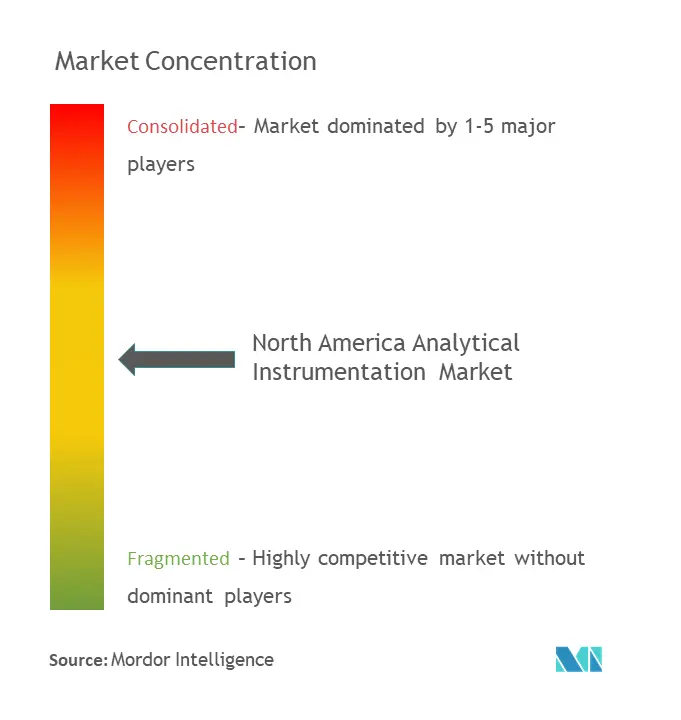
| Market Concentration | Medium |
Major Players *Disclaimer: Major Players sorted in no particular order Image © Mordor Intelligence. Reuse requires attribution under CC BY 4.0. | |
North America Analytical Instrumentation Market Analysis by Mordor Intelligence
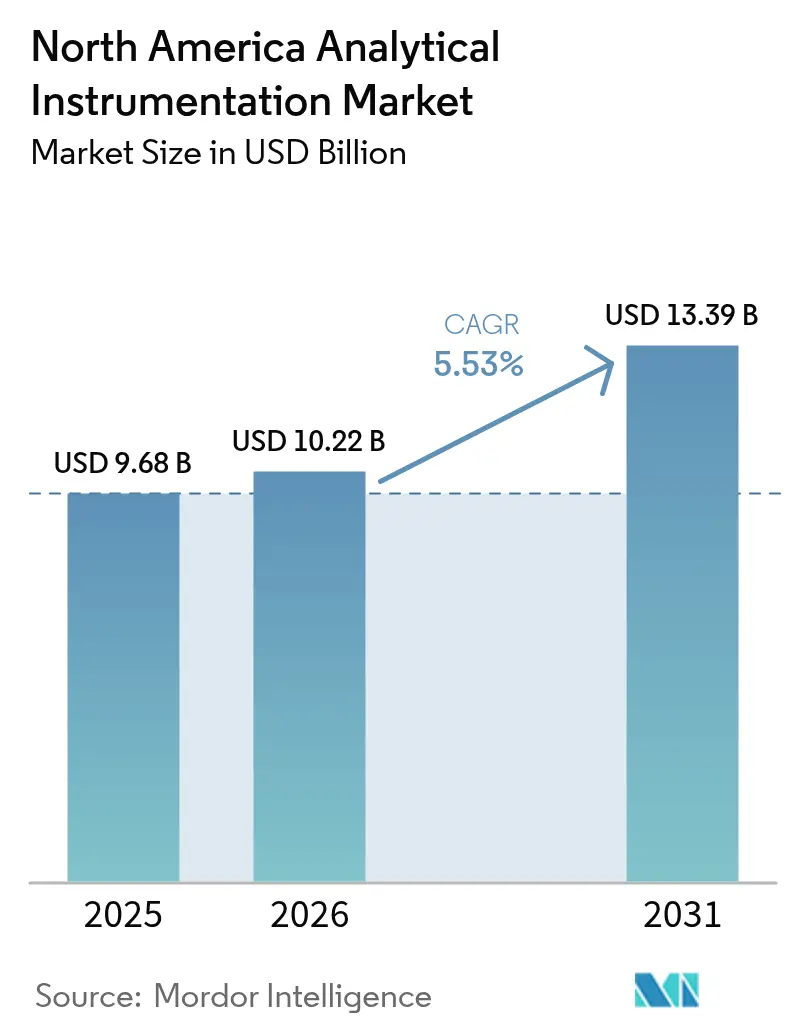
The North America Analytical Instrumentation Market size was valued at USD 9.68 billion in 2025 and estimated to grow from USD 10.22 billion in 2026 to reach USD 13.39 billion by 2031, at a CAGR of 5.53% during the forecast period (2026-2031).
The analytical instrumentation industry is experiencing significant transformation driven by increasing demands for quality control and regulatory compliance across multiple sectors. Automation across end-user industries, particularly in material handling and pharmaceutical applications, has fueled the development of sophisticated analytical equipment in North America. The integration of advanced technologies has enabled companies to enhance testing capabilities, with electron microscopy technologies now capable of analyzing structures at the atomic scale. This technological evolution has been particularly evident in the battery development sector, where companies are leveraging analytical instruments to improve energy storage solutions for electric vehicles and mobile devices.
The industry has witnessed substantial advancement in mass spectrometry and chromatography applications, particularly in environmental and food safety testing. Elemental analysis spectrometers are finding expanded applications across environmental, petrochemical, food safety, metallurgical, geochemical, and clinical research applications. In January 2024, Fujifilm expanded its North Carolina facility by adding 89,000 sq. ft. of laboratory space, featuring state-of-the-art analytical instrumentation and high-throughput bioprocessing equipment, demonstrating the growing investment in analytical capabilities.
Strategic collaborations and technological innovations are reshaping the competitive landscape. In August 2023, HORIBA Scientific partnered with Covalent Metrology to expand engineering and scientific access to chemical analysis instruments, positioning both companies to accelerate research and development work in the semiconductor and electronics industries. The industry is also witnessing a shift toward digital and cloud-based solutions, with major vendors investing in enhanced software capabilities to provide comprehensive analytical technology solutions.
The market is experiencing significant developments in mass spectrometry applications, particularly in the field of materials analysis and quality control. Companies are increasingly focusing on developing integrated solutions that combine multiple analytical techniques. For instance, in July 2023, Waters Corporation launched new mass spectrometry instruments that enable biopharmaceutical laboratories to implement multi-attribute methods for complex analysis. This trend toward integrated solutions is particularly evident in the pharmaceutical and biotechnology sectors, where analytical instruments are crucial for ensuring product quality and regulatory compliance.
Note: Market size and forecast figures in this report are generated using Mordor Intelligence’s proprietary estimation framework, updated with the latest available data and insights as of 2026.
North America Analytical Instrumentation Market Trends and Insights
Development of Precision Medicines
The emergence of precision medicine represents a transformative shift in healthcare delivery, driving significant demand for advanced analytical instrumentation. Precision medicine, also known as personalized medicine, integrates genomics, big data analytics, and population health to create targeted therapeutic approaches based on individual clinical, molecular, and lifestyle information. The fundamental aspects of human biology in precision medicine rely heavily on analytical chemistry instruments, particularly in genetics and genomics applications that require DNA analyzers with exceptional sensitivity, reproducibility, and reliability. This sophisticated approach has led pharmaceutical companies to increase their investments in analytical instrumentation that can comply with stringent drug safety regulations while enabling more precise and personalized therapeutic development.
The growing emphasis on precision medicine has catalyzed innovations in analytical instrumentation technology, particularly in mass spectrometry and chromatography applications. For instance, in July 2021, Sciex introduced the groundbreaking ZenoTOF 7600 System, featuring both Zeno trap and electron activated dissociation (EAD) fragmentation capabilities, enabling comprehensive characterization of individual lipids from single spectra for cancer and inflammatory disease research. The FDA's approval of targeted therapeutics like Lynparza and Blincyto demonstrates the increasing acceptance of precision medicine approaches, further driving the demand for sophisticated analytical instruments. This trend is reinforced by the flourishing Next Generation Sequencing (NGS) technology, which has expanded beyond basic research into the biomedical domain, creating substantial opportunities for analytical measurement solutions in both public and private sector applications.
Additionally, the integration of process analytical technology in laboratory settings has enhanced the precision and efficiency of drug development processes. The demand for advanced laboratory equipment continues to rise as precision medicine becomes more prevalent, underlining the critical role of mass spectrometry in advancing healthcare solutions.
Understand The Key Trends Shaping This Market
Download Sample
Segment Analysis
Analytical Microscopes Segment in North America Analytical Instrumentation Market
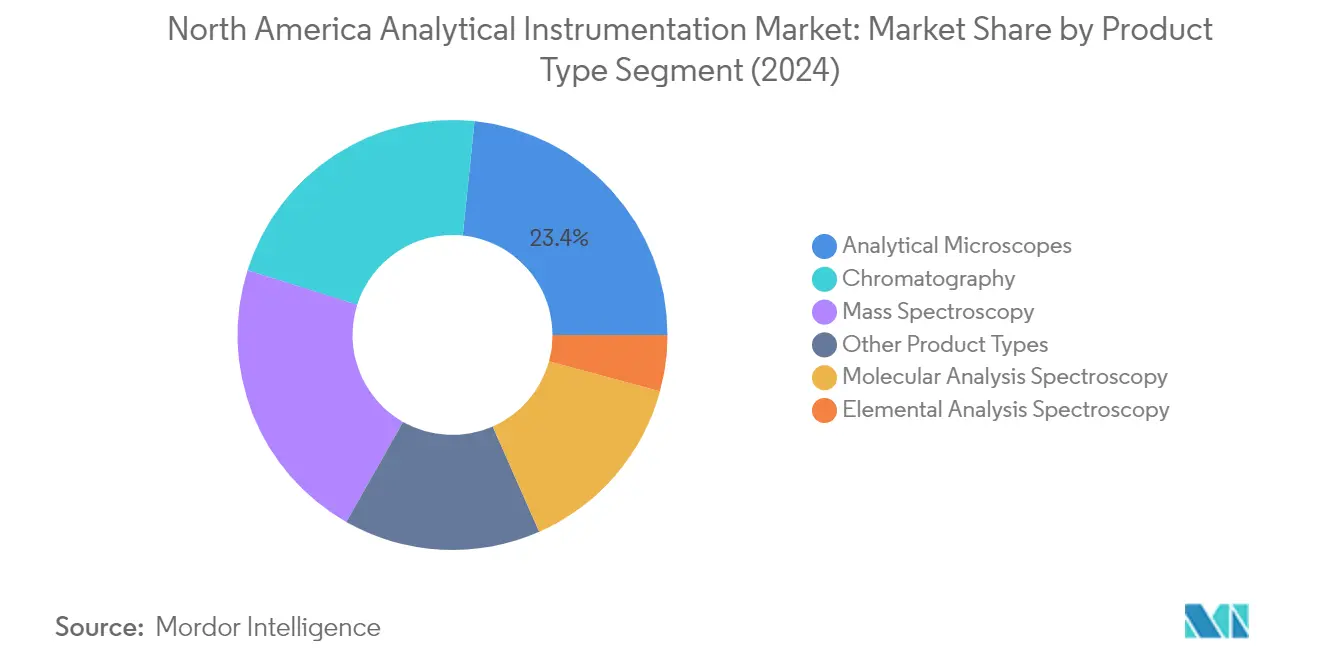
Analytical microscopes dominate the North American analytical instrumentation market, commanding approximately 22.65% market share in 2025. This segment's prominence is driven by its crucial role in providing structural, compositional, and bonding information about samples probed by electron beams, particularly inside transmission electron microscopes. The segment's leadership position is reinforced by the increasing adoption of analytical electron microscopy techniques, especially for energy-dispersive X-ray spectroscopy, microanalysis, and electron energy-loss spectroscopy. The segment is experiencing the fastest growth rate of around 8.42% through 2026-2031, propelled by the rising demand for sophisticated microscopes that can produce high spatial resolution images of physical structures and enable qualitative and quantitative measurements in micro-size observation areas. The growth is further supported by the segment's expanding applications in advanced scientific research and material development fields, where these instruments are becoming crucial tools for observing nano-scale structures and capturing information on the interaction between specimen atoms and incident electrons.
Remaining Segments in Product Type
The other significant segments in the market include chromatography instruments, mass spectrometry, molecular analysis spectroscopy, elemental analysis spectroscopy, and other product types. Chromatography instruments play a vital role in analyzing complex sample matrices in both gas and liquid forms, finding extensive applications in food safety testing and environmental sample screening. Mass spectrometry instruments are crucial for analyzing chemical compounds in complex mixtures, while molecular analysis spectroscopy serves various applications in food testing and quality control. Elemental analysis spectroscopy is essential for environmental, petrochemical, and clinical research applications, while other product types, including atomic spectroscopy and analytical X-ray instrumentation, contribute to the market's diverse analytical capabilities. Each of these segments continues to evolve with technological advancements, meeting the growing demands of various end-user industries.
Segment Analysis: End-User Industry
Life Sciences Segment in North America Analytical Instrumentation Market
The life sciences instrumentation segment dominates the North American analytical instrumentation market, commanding approximately 41% market share in 2024, while also maintaining the highest growth trajectory. This segment's prominence is driven by the increasing demand for analytical tools in pharmaceutical research, bioprocessing, and clinical diagnostics. The segment's growth is particularly fueled by the rising emphasis on precision medicine development, increased access to clinical trials, and the expanding applications in genomics technology. The integration of advanced analytical instruments in biomedical research and drug development processes has become crucial, especially with the growing focus on personalized medicine and therapeutic development. Additionally, the segment's robust performance is supported by substantial investments in pharmaceutical R&D and the stringent regulatory requirements for drug safety compliance in North America.
Chemical and Petrochemical Segment in North America Analytical Instrumentation Market
The Chemical and Petrochemical segment represents the second-largest share in the market, with significant growth potential driven by increasing applications and substantial growth in production activities. This sector's expansion is particularly notable in developed economies due to continuous growth in production volume. The segment's growth is supported by the rising demand for testing and analysis equipment for regulatory compliance and quality control in chemical manufacturing processes. Advanced analytical laboratory instruments and instrumentations are increasingly being deployed for successful chemical testing, particularly in the fabrication of products for daily use, food-related chemicals, and health improvement products. The integration of centralized software systems and advanced chromatography solutions has further enhanced the segment's technological capabilities, enabling more efficient and accurate analysis of chemical compounds and materials.
Remaining Segments in End-User Industry
The remaining segments, including Material Sciences, Food Testing, Oil and Gas, Research and Academia, and Other End-Users, collectively contribute to the market's diverse application landscape. The Material Sciences segment focuses on structural properties and chemical composition analysis, while Food Testing emphasizes quality control and safety compliance. The Oil and Gas sector utilizes analytical instruments for exploration, development, and processing applications, particularly in downstream operations. The Research and Academia segment benefits from the ongoing digital revolution and scientific innovations, while Other End-Users, including water analysis and manufacturing sectors, contribute to the market's breadth through specialized applications. Each of these segments brings unique requirements and applications, driving innovation and technological advancement in the analytical instrumentation market.
Value Chain Analysis
The North American analytical instrumentation value chain starts with upstream component and subsystem suppliers, including precision optics, vacuum systems, detectors, motion control, electronics, and software. Instrument OEMs then design and assemble platforms such as chromatography systems, mass spectrometers, spectrometers, and analytical microscopes.
Specialized participants also support semiconductor and electronics metrology and monitoring, including MKS Instruments for process control and instrumentation, Teledyne Analytical Instruments for analytical and monitoring solutions, and niche metrology providers such as JP Analytical for thin film and materials characterization. Downstream, OEMs sell directly to large pharma and biotech companies, semiconductor manufacturers, and government or academic labs, while channel partners, integrators, and contract testing or metrology service providers broaden access to advanced tools. Aftermarket services, including installation qualification, calibration, method development support, software updates, consumables such as columns and reagents, and long-term maintenance contracts, capture ongoing value and shape replacement cycles. In 2025, procurement and lead-time planning became more central to the value chain as tariffs on imported components and finished equipment increased cost and sourcing complexity for laboratories and manufacturers relying on global supply networks.
Competitive Landscape
Top Companies in North America Analytical Instrumentation Market
The North American analytical instrumentation market is dominated by established players like Agilent Technologies, Bruker Corporation, PerkinElmer, Thermo Fisher Scientific, and Waters Corporation, who have built strong market positions through continuous innovation and strategic expansion. These companies are actively investing in research and development to launch advanced analytical technology tools, particularly in the mass spectrometry, chromatography, and spectroscopy segments. The market leaders are increasingly focusing on digital integration and cloud-based solutions to enhance their product offerings and provide comprehensive analytical solutions. Strategic collaborations with academic institutions, research organizations, and industry partners have become a key trend, enabling companies to expand their technological capabilities and market reach. Companies are also emphasizing the development of automated, high-throughput systems with improved accuracy and efficiency, while simultaneously expanding their service and support networks across the region.
Consolidated Market with Strong Growth Potential
The analytical instrumentation market exhibits a moderately consolidated structure, with global conglomerates holding significant market share through their extensive product portfolios and strong distribution networks. These major players have established themselves through decades of expertise, substantial R&D investments, and strategic acquisitions of smaller, specialized companies with innovative technologies. The market has witnessed numerous strategic mergers and acquisitions, particularly focused on expanding capabilities in emerging technologies like mass spectrometry and molecular analysis, while also strengthening geographical presence across North America.
The competitive landscape is characterized by high entry barriers due to substantial capital requirements, technical expertise needs, and the importance of established brand reputation in the industry. Local players and specialists typically focus on niche segments or specific regional markets, often collaborating with larger companies for distribution or technology sharing. The market has seen increased partnership activities between established players and technology startups, particularly in areas like artificial intelligence integration and automated analytical solutions, indicating a trend toward collaborative innovation rather than direct competition.
Innovation and Customer Focus Drive Success
Success in the scientific instrumentation market increasingly depends on companies' ability to provide integrated solutions that combine advanced hardware with sophisticated software capabilities. Market leaders are focusing on developing user-friendly interfaces, automated systems, and comprehensive data analysis tools to address the growing demand for efficient laboratory operations. Companies are also investing in building strong customer relationships through enhanced service offerings, technical support, and customized solutions, while simultaneously expanding their presence in high-growth application areas like life sciences, environmental testing, and food safety.
For new entrants and smaller players, success lies in identifying and focusing on specialized market segments where they can offer unique value propositions. The market shows moderate buyer concentration, with large pharmaceutical companies, research institutions, and government laboratories being key customers, necessitating strong relationship management capabilities. While substitution risk remains low due to the specialized nature of research instrumentation, regulatory compliance, particularly in pharmaceutical and environmental applications, continues to shape product development strategies. Companies are increasingly focusing on developing products that meet evolving regulatory standards while providing improved analytical capabilities and operational efficiency.
North America Analytical Instrumentation Industry Leaders
Agilent Technologies, Inc
PerkinElmer Inc.
Shimadzu Corporation
Thermo Fisher Scientific Inc.
Malvern Panalytical Ltd (Spectris company)
- *Disclaimer: Major Players sorted in no particular order


Market Opportunities and Future Outlook
Semiconductor and electronics manufacturing provides a demand anchor for analytical instrumentation linked to metrology intensity and domestic capacity build-outs, creating room for suppliers delivering thin film characterization, critical dimension metrology, and contamination monitoring across gases, chemicals, and ultrapure water streams. The US CHIPS and Science Act-driven focus on expanding domestic fabrication capacity supports multi-site procurement programs for process analytical sensors and characterization tools, while device scaling raises the need for more frequent measurement and control steps within manufacturing and R&D workflows.
In life sciences, biopharmaceutical development and quality control continue to draw through integrated, higher-throughput analytical workflows, particularly LC/HRMS-based methods and automation-ready systems that reduce manual interpretation. Product activity in 2026, including Agilent releasing a multi-attribute method (MAM) solution for biopharma QC and Thermo Fisher launching integrated platforms for biologics development and cell therapy manufacturing, points to ongoing vendor investment in end-to-end solutions combining instruments, consumables, and software. Across end users, tariffs and supply-chain volatility visible in 2025 also create opportunities for localized manufacturing, service footprint expansion, and inventory strategies aimed at protecting uptime for regulated and high-utilization labs.
Recent Industry Developments
- July 2026: Shimadzu Corporation completed the acquisition of TESCAN GROUP, a.s., adding electron microscopy capabilities to its analytical portfolio. The deal broadens Shimadzu's ability to offer more complete characterization workflows across materials and life science applications, increasing competitive intensity in high-value microscopy-led solutions.
- June 2026: Agilent Technologies completed its acquisition of Biocare Medical, expanding Agilent's capabilities in pathology. The transaction strengthens Agilent's position in clinical and translational lab workflows that depend on robust analytical tools, software, and consumables for standardized testing and interpretation.
- January 2024: Fujifilm expanded its North Carolina facility by adding 89,000 sq. ft. of laboratory space equipped with state-of-the-art analytical instrumentation and high-throughput bioprocessing equipment. The expansion increased in-region analytical capacity supporting bioprocess development and quality activities that drive demand for chromatography, mass spectrometry, and related lab systems.


Research Methodology Framework and Report Scope
Market Definition and Coverage
For this study, the North America analytical instrumentation market is defined as revenues from analytical instruments used to identify, measure, and characterize chemical, biological, and material samples across industrial and laboratory settings in the region.
Scope exclusions: We exclude routine lab consumables and general-purpose lab equipment that are not analytical instruments (such as glassware and basic storage items).
Segmentation Overview
- By Product Type
- Chromatography
- Molecular Analysis Spectroscopy
- Elemental Analysis Spectroscopy
- Mass Spectroscopy
- Analytical Microscopes
- Other Product Types
- By End-user Industry
- Life Sciences
- Chemical and Petrochemical
- Material Sciences
- Food Testing
- Oil and Gas
- Research and Academia
- Other End-Users
Data Sources, Market Sizing, and Validation
Desk Research
Desk work started with mapping where demand is created and where instruments are installed in North America, then tying those sites to measurable signals. Public sources such as US Census Bureau manufacturing data, US International Trade Commission trade statistics, Statistics Canada, and the US Geological Survey were used to understand production activity and materials testing needs. We also reviewed technical and regulatory reference points that affect purchasing and replacement cycles, including FDA, EPA, and OSHA publications, plus standards updates from bodies such as ASTM and ISO.
To keep assumptions grounded, we cross-checked public company filings, investor presentations, and credible press coverage for shipment commentary and pricing direction. A few paid subscriptions were used in a limited way for company financial intelligence, patent databases, and shipment-level import and export checks, where classification was clear enough for analytical instruments. The desk sources listed here are not exhaustive, and many other references were used for data collection, validation, and research clarification.
Primary Interviews and Surveys
Primary work was used to verify what gets bought, how often equipment is replaced, and which applications are expanding faster across North America. We spoke with a mix of instrument makers, distributors, lab managers, and end users in life sciences, chemicals, food testing, oil and gas, and research settings, so gaps from desk findings could be closed and assumptions could be stress-tested across countries.
Distribution of primary research fieldwork respondents
| Company type | Respondent position |
|---|---|
| Top tier: 35% | CXOs: 14% |
| Mid tier: 44% | Functional/Unit leaders: 27% |
| Smaller Players: 21% | Managers: 59% |
Market-Sizing & Forecasting
Sizing was built with a top-down approach where lab and industrial testing demand is reconstructed from end-user activity, then translated into instrument spending using adoption and replacement patterns. We used this to set the overall demand pool, and then corroborated totals with selective bottom-up checks, such as sampled average selling price ranges by instrument class multiplied by estimated unit volumes, followed by distributor and channel feedback to adjust outliers.
Key inputs used in the model include reported R&D intensity and lab spending direction in life sciences, environmental testing and compliance activity, petrochemical and materials testing throughput, and the installed base renewal cycle for core platforms, since calibration, uptime, and obsolescence drive replacement timing. Trade flows and manufacturing output were also used as sanity checks when they aligned with instrument categories. For forecasting, we relied on scenario analysis supported by simple trend models, including exponential smoothing, so growth paths stayed consistent with interviewed expectations on budgets, replacement timing, and pricing progression. When bottom-up approximations had gaps, we filled them through conservative penetration assumptions that were later revisited during validation calls.
Data Validation & Update Cycle
Outputs were checked through multiple passes so a single data series did not overly influence the result. We compared modeled totals against independent signals such as import trends, reported capital spending direction in key end-user industries, and typical replacement cycles discussed by lab operators. If a segment showed unusual jumps, the assumptions were re-opened, and respondents were re-contacted to confirm whether it was a real shift or a modeling artifact.
Before sign-off, the work goes through analyst review steps that look for unit consistency, currency timing consistency, and variance against the prior edition where applicable. The report is refreshed annually, and interim updates are made when material events change demand, pricing, or supply conditions. Before delivery, the latest public releases are re-checked so clients receive an updated view.
Mordor Intelligence's North America Analytical Instrumentation Market Estimate Compared With Other Published Estimates
Published market values for analytical instrumentation in North America often vary because the scope line is drawn differently and the year used for pricing and currency timing is not always the same. The table helps show how even small differences in what is counted, and when it is counted, can move the reported number.
The benchmark table shows a tighter range when only analytical instruments are counted, and in Mordor Intelligence's model the totals follow the product types on the study page, which avoids folding in services, software bundles, or broad lab equipment that can inflate the value.
Benchmark comparison
| Source | Market Size | Gaps in Research Methodology |
|---|---|---|
| Mordor Intelligence | USD 9.68 B (2025) | |
| Regional Consultancy A | USD 11.20 B (2025) | Often includes related service contracts and software revenue under analytical instrumentation, and may also blend in adjacent life science instrumentation that sits outside pure analytical instrument scope. |
| Trade Journal B | USD 8.90 B (2024) | Uses an earlier base year and may apply conservative replacement assumptions, with limited adjustment for recent pricing changes and new capacity additions in testing-heavy end users. |
Overall, the spread mainly comes from scope choices, base-year timing, and how pricing and replacement cycles are treated. By tying the market value to clear instrument categories and repeatable demand signals, the estimate stays traceable to practical inputs that can be rechecked during updates.


Key Questions Answered in the Report
How big is the North America Analytical Instrumentation Market?
The North America Analytical Instrumentation Market size is expected to reach USD 10.22 billion in 2026 and grow at a CAGR of 5.53% to reach USD 13.39 billion by 2031.
What is the current North America Analytical Instrumentation Market size?
In 2026, the North America Analytical Instrumentation Market size is expected to reach USD 10.22 billion.
Who are the key players in North America Analytical Instrumentation Market?
Agilent Technologies, Inc, PerkinElmer Inc., Shimadzu Corporation, Thermo Fisher Scientific Inc. and Malvern Panalytical Ltd (Spectris company) are the major companies operating in the North America Analytical Instrumentation Market.
What years does this North America Analytical Instrumentation Market cover, and what was the market size in 2025?
In 2025, the North America Analytical Instrumentation Market size was estimated at USD 10.22 billion. The report covers the North America Analytical Instrumentation Market historical market size for years: 2019, 2020, 2021, 2022, 2023 and 2024. The report also forecasts the North America Analytical Instrumentation Market size for years: 2026, 2027, 2028, 2029, 2030 and 2031.
Page last updated on:


 Your data is secure and never sold or shared.


