
Nigeria Data Center Networking Market Size and Share
Market Overview
| Study Period | 2020 - 2031 |
|---|---|
| Forecast Data Period | 2026 - 2031 |
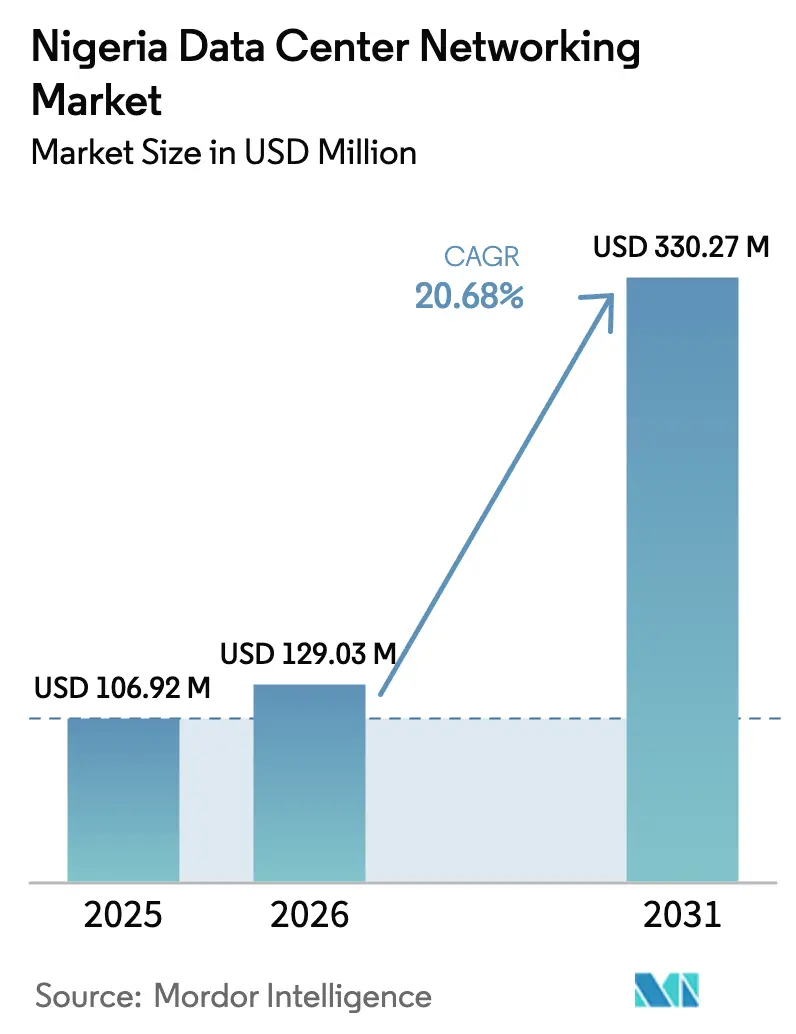
| Base Year Market Size (2025) | USD 106.92 Million |
| Market Size (2026) | USD 129.03 Million |
| Market Size (2031) | USD 330.27 Million |
| Growth Rate (2026 - 2031) | 20.68 % |
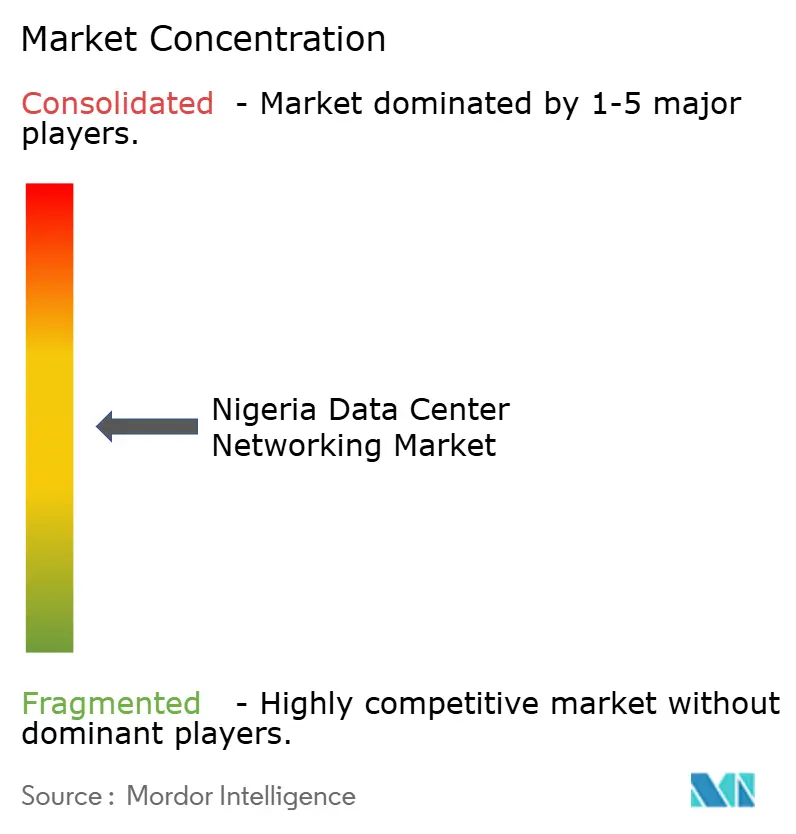
| Market Concentration | Medium |
Major Players *Disclaimer: Major Players sorted in no particular order Image © Mordor Intelligence. Reuse requires attribution under CC BY 4.0. | |
Nigeria Data Center Networking Market Analysis by Mordor Intelligence
Nigeria data center networking market size in 2026 is estimated at USD 129.03 million, growing from 2025 value of USD 106.92 million with 2031 projections showing USD 330.27 million, growing at 20.68% CAGR over 2026-2031. Momentum is fueled by cloud migration, 5G roll-outs, and data-sovereignty mandates that require critical workloads to remain inside national borders. Lagos and Abuja anchor most build-outs, yet secondary cities are steadily adding edge capacity as fintech, media streaming, and e-commerce traffic spreads inland. Spending continues to flow toward leaf-spine topologies, 400G/800G optics, and software-defined tools that tame multi-vendor environments. Vendors that marry high-performance hardware with managed services gain an edge because operators face both power-grid volatility and a shortage of certified network engineers. International capital commitments crossing USD 630 million underscore long-term confidence, even as operators wrestle with elevated OPEX linked to diesel generation and import tariffs on optical gear.
Key Report Takeaways
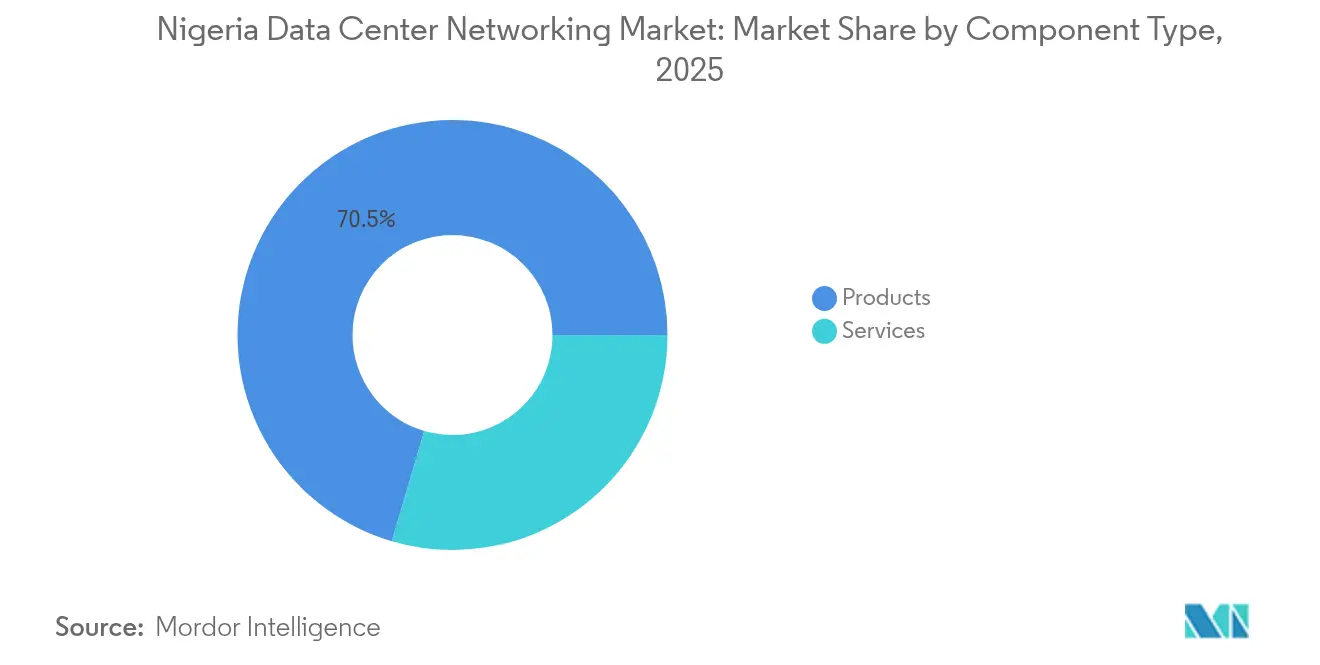
- By component, products led with 70.45% of Nigeria data center networking market share in 2025; services post the fastest 23.35% CAGR through 2031.
- By end-user, IT & telecommunications commanded 37.85% revenue share in 2025, while healthcare & life sciences expand at a 24.55% CAGR to 2031.
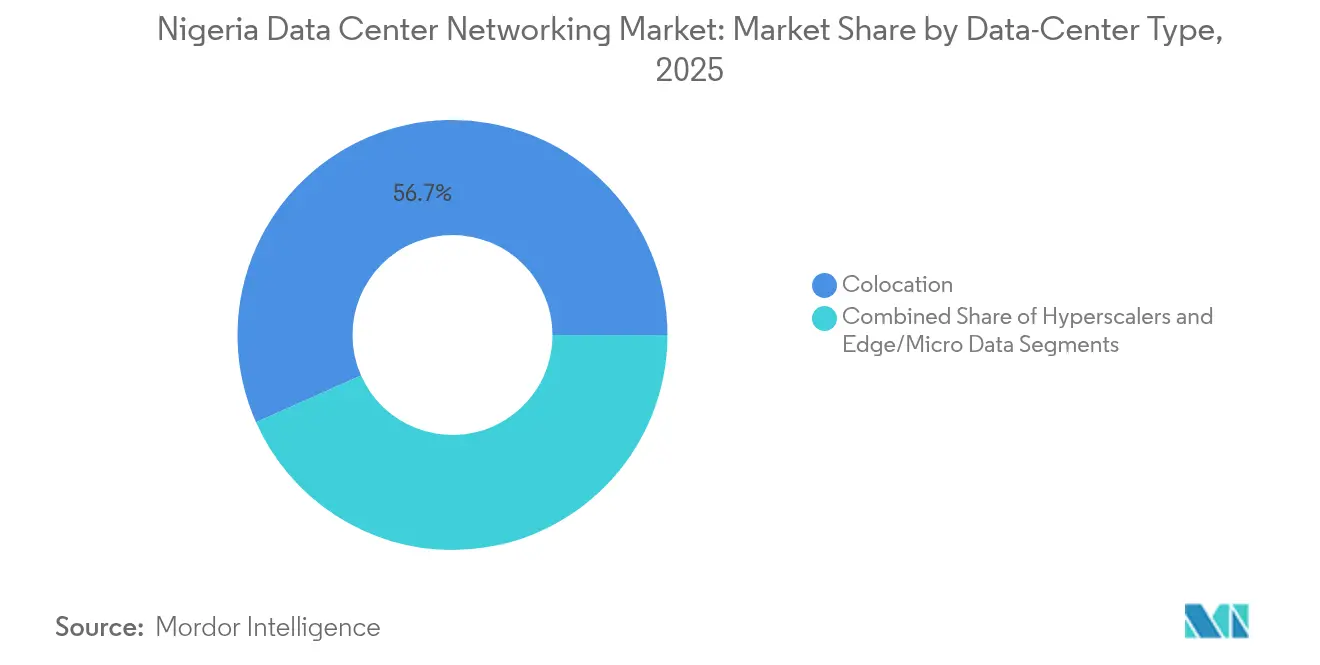
- By data-center type, colocation captured 56.65% of the Nigeria data center networking market size in 2025; hyperscalers grow at a 25.1% CAGR to 2031.
- By bandwidth, 50-100 GbE links held 33.65% revenue share in 2025; >100 GbE upgrades progress at a 22.2% CAGR through 2031.
Note: Market size and forecast figures in this report are generated using Mordor Intelligence’s proprietary estimation framework, updated with the latest available data and insights as of 2026.
Nigeria Data Center Networking Market Trends and Insights
Drivers Impact Analysis*
| Driver | % Impact on CAGR Forecast | Geographic Relevance | Impact Timeline |
|---|---|---|---|
| Surge in cloud service adoption and local data sovereignty push | +4.2% | National, with concentration in Lagos, Abuja | Medium term (2-4 years) |
| 5G-driven low-latency demand elevating networking capacity | +3.8% | National, with early deployment in Lagos, Port Harcourt | Medium term (2-4 years) |
| Hyperscale and colocation capital inflows | +3.1% | Lagos, Abuja, with spillover to Port Harcourt | Short term (≤ 2 years) |
| Government incentives via National Broadband Plan 2025 | +2.9% | National, prioritizing underserved regions | Long term (≥ 4 years) |
| Rapid adoption of liquid and immersion cooling enabling 400G fabrics | +2.4% | Lagos, Abuja data center clusters | Medium term (2-4 years) |
| AI workloads requiring 800G leaf-spine architectures in fintech clusters | +1.8% | Lagos financial district, emerging fintech hubs | Long term (≥ 4 years) |
| Source: Mordor Intelligence | |||
Surge in cloud service adoption & data-sovereignty push
Mandated domestic hosting of financial, health, and citizen data compels enterprises to shift workloads to local clouds, sparking immediate upgrades to carrier-neutral facilities that can deliver sub-millisecond latency. Banks in Lagos now specify redundant spine-leaf fabrics for real-time clearing systems, while domestic cloud start-ups tout compliance as a competitive moat. The regulatory stance keeps traffic onshore, driving fresh purchases of high-port-density switches and application delivery controllers. Operators that bundle managed security with ultra-low-latency connectivity become preferred partners for highly regulated sectors.
5G-driven low-latency demand elevating networking capacity
The regulator awarded 3.5 GHz spectrum and declared the backbone 97% ready for nationwide launch. Mobile operators respond with micro-data centers near towers so that IoT and AR/VR sessions avoid long round-trip times.[1]Nigerian Communications Commission, “NCC Announces Nigeria’s 5G Readiness Status,” ncc.gov.ng These edge nodes feed metro facilities by 400G wave-division links, which in turn push backbone requirements beyond 800 G. MTN Nigeria’s 1,400-rack Tier 4 build illustrates the scale required to backhaul 5G traffic peaks. Optical vendors that can integrate coherent pluggables into existing routing shelves gain a pricing advantage.
Hyperscale & colocation capital inflows
Equinix’s USD 320 million MainOne acquisition and IFC’s USD 100 million investment in Raxio validate Nigeria’s location as West Africa’s cloud gateway.[2]Equinix Inc., “Equinix Completes Acquisition of MainOne,” equinix.com Each project demands high-density switches, automated fabric management, and direct-to-cloud exchange points. Operators aim to lift revenue per rack by weaving 400G leaf uplinks with liquid cooling so tenants can host AI accelerators without thermal risk. Fast-tracked deployments shorten payback periods but intensify the scramble for skilled installers.
Government incentives via National Broadband Plan 2025
The plan targets 70% internet penetration and 120,000 km of new fibre, unlocking fiscal perks and zero right-of-way charges for carriers that extend routes into underserved zones. The framework catalyzes metro aggregation builds that link rural POPs to Lagos cores through resilient ring topologies.[3]Office of the Minister of Communications, Innovation and Digital Economy, “National Broadband Plan 2025 Update,” fmcide.gov.ng Vendors able to ruggedise 100 Gbps optics for tropical conditions see early uptake in northern corridors.
Restraints Impact Analysis*
| Restraint | % Impact on CAGR Forecast | Geographic Relevance | Impact Timeline |
|---|---|---|---|
| Unreliable power grid inflating OPEX | -2.8% | National, acute in northern regions | Short term (≤ 2 years) |
| Shortage of certified data-center network engineers | -1.9% | National, concentrated in Lagos, Abuja | Medium term (2-4 years) |
| Delays in metropolitan fiber right-of-way permits | -1.4% | Lagos, Abuja, Port Harcourt metropolitan areas | Short term (≤ 2 years) |
| High import tariffs on greater than100G optics and NICs | -1.1% | National, affecting all data center operators | Medium term (2-4 years) |
| Source: Mordor Intelligence | |||
Unreliable power grid inflating OPEX
Grid output frequently slips below 5,000 MW, forcing data centers to run diesel generators that add significant cost per kilowatt-hour. Power volatility also complicates the adoption of high-density 800G switches, which draw more amperage and demand tighter thermal envelopes. Operators increasingly pivot to immersion cooling and on-site gas turbines to tame utility disruptions, yet capital outlays stretch project timelines.
Shortage of certified data-center network engineers
The “Japa” talent exodus drains mid-career professionals skilled in 400G optics, SDN, and fabric automation. Local curricula lag behind hyperscale design practices, leaving integrators to import contractors at a premium. Wages climb, deployment schedules stretch, and managed-service vendors with regional training pipelines clinch multi-year contracts.
*Our forecasts treat driver/restraint impacts as directional, not additive. The impact forecasts reflect baseline growth, mix effects, and variable interactions.
Segment Analysis
By Component: Services Scale on Skills Gaps
Products still command 70.45% revenue in 2025 as operators acquire leaf-spine switches, routers, and coherent optics to migrate from legacy 10 GbE. Services, however, sprint at a 23.35% CAGR, lifted by complexity that forces enterprises to outsource design, integration, and day-two operations. Managed network services capture workloads from fintechs that must run 24/7 yet lack in-house engineers. Consulting and training engagements rise as operators prepare for liquid cooling and 800G road maps. Consequently, suppliers that wrap lifecycle services around hardware record stickier revenues in the Nigeria data center networking market.
A parallel trend is the pivot to software-defined overlays that abstract vendor heterogeneity. Controllers optimize traffic flows across both 100 GbE and 400 GbE links while exposing north-bound APIs for DevOps teams. This transition underpins demand for high-availability professional services, keeping the Nigeria data center networking market on an upward trajectory despite macro headwinds.



By End-User: Healthcare Picks Up Pace
IT & telecom retains 37.85% spending in 2025, but digital-health initiatives push healthcare to a 24.55% CAGR through 2031. Tele-ICU platforms move clinical data among hospitals, cloud AI engines, and insurers, requiring secure L2-L3 fabrics plus application firewalls. Fintechs that handle 42% of continental deal flow remain voracious network buyers for high-frequency trading and instant payment settlement. The government modernises tax and identity systems, adopting private-cloud stacks inside classified facilities. Media outlets deploy content-delivery nodes to keep streaming latency below 50 ms during live sports. All together, these verticals sustain equipment refresh cycles, keeping the Nigeria data center networking market expanding even as economic volatility lingers.
Healthcare’s momentum is most visible in teaching hospitals that now back-haul radiology images to Lagos AI clusters for diagnostics, leaning on 50-100 GbE uplinks and redundant BGP routes. Compliance with new patient-data laws accelerates encryption appliance demand. These upgrades underscore how vertical diversification shields the Nigeria data center networking industry from sector-specific shocks.
By Data-Center Type: Hyperscale Growth Outpaces Colocation
Colocation retains 56.65% share in 2025 because enterprises prize carrier-neutral facilities such as Rack Centre for multi-cloud interconnection. Still, hyperscale campuses post a 25.1% CAGR as Microsoft and Google deploy availability zones to satisfy data-sovereignty clauses. Project pipelines nearing 60 MW in aggregate will swell the Nigeria data center networking market size for hyperscale builds at least through 2031.
Operators blur lines by launching hybrid offers that let tenants mix shared MMR space with reserved suites. These models need high-port-count leaf switches and micro-segmentation firewalls. Edge and micro-data centers emerge along 5G corridors, using modular containers with ruggedised 25 GbE TOR switches to keep back-haul efficient. Such diversification ensures that investment cycles overlap rather than peak simultaneously, smoothing capex volatility in the Nigeria data center networking market.
By Bandwidth: 400G-Plus Moves Mainstream
The lion’s share of 2025 revenue stays with 50-100 GbE because many enterprise workloads remain VM-centric. Yet >100 GbE links grow 22.2% annually as AI clusters, online trading engines, and streaming transcoders exceed 30 Gbps per server. Early 800G pilots in Lagos fintech racks rely on immersion-cooled chassis that offset 35 W per optical module. Vendors supplying low-power DSPs capture orders as clients chase lower PUE.
Conversely, ≤10 GbE uplinks decline, surviving only in branch offices. Secondary cities adopt 25-40 GbE for edge compute nodes that aggregate IoT sensor feeds. These shifts collectively elevate average port speeds, pushing the Nigeria data center networking market toward higher ASPs even as unit volumes level off.
Geography Analysis
Lagos anchors nearly every hyperscale launch thanks to proximity to subsea cables, Nigeria Stock Exchange, and the fintech corridor. The metro’s carrier hotels already land traffic from more than 40 regional ISPs, uplifting cross-connect volumes and boosting Nigeria data center networking market demand for 400G optical backbones. Abuja forms the governmental compute enclave, driven by e-governance applications and National Broadband Plan incentives that subsidise fibre laterals into underserved districts. Port Harcourt now attracts edge nodes that serve oil-and-gas telemetry and 5G small-cell aggregation. Northern states lag on utility stability, yet recent solar-farm PPAs could unlock captive micro-grid data centers. Across all regions, new fibre commitments of 90,000 km aim to raise household internet penetration from 42% to 70% by 2025, laying fresh conduits for high-capacity inter-data-center routes.
Cross-border connectivity improves as new subsea systems land in Lagos, cutting latencies to Europe to below 90 ms and positioning Nigeria as a regional handoff point. Traffic from Ghana and Côte d’Ivoire increasingly hairpins through Lagos exchange points, further enlarging the Nigeria data center networking market. With right-of-way fees lifted in multiple states, metro loops proliferate, yet permitting delays still cause schedule overruns in congested urban zones.
Regulatory Landscape
Nigeria's data center networking demand is shaped by data localization and cloud governance rules. The Nigeria Data Protection Commission (NDPC) regulates personal data processing under the Nigeria Data Protection Act (NDPA) 2023, with requirements that bring major data controllers and processors into formal compliance and oversight. For cloud services, the National Information Technology Development Agency (NITDA) issued the National Cloud Policy 2025 (October 2025), which provides a unified framework for public-sector cloud adoption and aligns cloud use with the NDPA, reinforcing local hosting requirements for sensitive and classified datasets.
Telecom and sector regulators also influence facility design, interconnection, and security architecture. The Nigerian Communications Commission (NCC) governs licensing and operational rules that affect carrier connectivity into data centers and the rollout of 5G and metro fiber. Sector bodies such as the Central Bank of Nigeria (CBN) set data governance expectations for regulated financial institutions. In practice, these frameworks drive demand for audited controls (including registration, data classification, and security assurance), supporting adoption of network security appliances, segmentation, and resilient leaf-spine fabrics inside Nigerian facilities.
Value Chain Analysis
The Nigeria data center networking value chain begins with global OEMs supplying switches, routers, optical interconnects, and security appliances. Hardware then moves through local distributors and systems integrators that manage importation, customs clearing, and on-site deployment. Colocation and carrier-neutral operators in Lagos and Abuja typically anchor demand, buying high-port-density Ethernet and coherent optics, and pairing hardware with services such as installation, integration, and managed operations to mitigate the shortage of certified network engineers.
Upstream dependencies also affect cost and lead times, particularly power infrastructure and connectivity. With grid volatility, operators increasingly incorporate an energy-to-digital model, such as gas-based generation or IPP-style onsite supply, which influences networking design via higher-density, power-aware fabrics and out-of-band management. Downstream, subsea cable landings, metro fiber builds, and local Internet Exchange Points (IXPs) determine where interconnection-rich data centers cluster. Public programs such as FMCIDE's Project BRIDGE (national backbone expansion via an SPV) reinforce the backbone layer that feeds data center interconnect and edge or micro deployments.
Competitive Landscape
Global OEMs such as Cisco, Huawei, and Dell maintain brand pull, bolstered by end-to-end portfolios and channel financing. Juniper and Arista specialise in high-density leaf-spine fabrics, securing AI and HFT projects that require deterministic latency. Ciena’s WaveLogic 6 Nano pluggables push coherent 800G onto compact chassis, winning metro back-haul slots. Local integrators fill a critical gap by offering compliance alignment, customs clearing, and on-site support, which international vendors sometimes deliver only remotely.
Technology differentiation increasingly revolves around software-defined orchestration tied to AI-driven telemetry that predicts congestion and power anomalies. Vendors that bundle network-aware liquid cooling carve out margin because customers want a single throat to choke. Edge deployments in secondary cities open a white-space market for ruggedised switches rated for high humidity and temperature swings. Over the forecast period, competitive intensity should remain moderate as capacity additions stay ahead of demand, keeping pricing stable but rewarding service-rich offers.
Nigeria Data Center Networking Industry Leaders
Cisco Systems Inc.
Huawei Technologies Co. Ltd.
Dell Technologies Inc.
Oracle Corporation
Juniper Networks Inc.
- *Disclaimer: Major Players sorted in no particular order

Market Opportunities and Future Outlook
A near-term opportunity is new backbone and metro build-outs, which translate into more inter-data-center connectivity and higher-capacity routing and optical requirements. FMCIDE's Project BRIDGE targets a 90,000 km national fiber backbone via a Special Purpose Vehicle, creating whitespace for metro aggregation, DCI links, and exchange-connected designs that support demand for 100 GbE and greater-than-100 GbE optics, high-scale routing, and automated network operations.
Capacity additions and more energy-resilient builds also expand the market for switching, optical interconnects, and security stacks inside new facilities. In November 2025, Equinix announced a USD 22 million investment for its LG3 data center in Lagos, and in March 2026, Tetracore Energy Group, Huawei, and Inspirive Technologies announced a USD 400 million, 20 MW Tier III data center project in Ogun State with a 100 MW onsite power plant. These announcements point to the growing role of integrated power and facility expansion in enabling network upgrades. As Open Access Data Centres evaluate gas-based power generation for uptime, network vendors and integrators have clearer entry points to package high-density fabrics with managed services, security-by-design, and energy-aware operations for regulated industries and latency-sensitive workloads.
Recent Industry Developments
- June 2026: Airtel Nigeria announced a $120 million investment for a 38MW data center in Eko Atlantic, Lagos, to support AI and enterprise workloads. The investment expands Lagos capacity for AI workloads and reinforces a telco-datacenter model in fintech hub.
- April 2026: Digital Realty/IXPN activated a new internet exchange point at the Ibeju-Lekki data center, a landing site for the 2Africa subsea cable. The move positions Nigeria as a regional IX hub and expands cross-border data routing capabilities.
- March 2026: Tetracore Energy Group/Huawei/Inspirive Technologies announced a $400 million, 20MW Tier III data center project in Atakobo, Ogun State, powered by a 100MW onsite independent power plant. The project enhances domestic capacity and energy resilience for data-center backbone.


Research Methodology Framework and Report Scope
Market Definition and Coverage
This market covers networking hardware, software, and related services that are purchased to connect and run data center networks inside Nigeria, including switching, routing, security, and interconnect functions that support on-premises and colocation facilities.
Scope exclusions: We exclude consumer connectivity equipment, pure telecom carrier transport networks, and networking assets that are installed and billed outside Nigeria.
Segmentation Overview
- By Component
- Products
- Ethernet Switches
- Routers
- Storage Area Network (SAN)
- Application Delivery Controllers (ADC)
- Network Security Appliances
- Software-Defined Networking (SDN) Controllers
- Optical Interconnects
- Services
- Installation and Integration
- Training and Consulting
- Support and Maintenance
- Managed Network Services
- Products
- By End-User
- IT and Telecommunications
- Banking, Financial Services and Insurance (BFSI)
- Government and Defense
- Media and Entertainment
- Healthcare and Life Sciences
- Manufacturing and Industrial
- Other End-Users
- By Data-Center Type
- Colocation
- Hyperscalers/Cloud Service Providers
- Edge/Micro Data Centers
- By Bandwidth
- LessThan equals to 10 GbE
- 25–40 GbE
- 50–100 GbE
- Greater Than 100 GbE
Data Sources, Market Sizing, and Validation
Desk Research
We start by building a basic fact base on Nigeria data center and digital infrastructure activity so later assumptions are not made in isolation. Public sources such as the Nigerian Communications Commission (NCC), the National Bureau of Statistics (NBS), the Central Bank of Nigeria (CBN), Nigeria Customs trade statistics, and ITU indicators are used to understand connectivity build-out, import exposure, and macro signals that can affect network spending.
Next, company filings, investor presentations, association websites, and reputable press coverage are used to map data center expansions, and to track practical timing constraints around power and logistics that can influence network equipment refresh decisions. Where needed, we also reference paid subscriptions for company financials and intelligence, patent databases, and shipment-level trade views to cross-check directionality. These desk research sources are illustrative only, and many other references were also used for data collection, validation, and clarification.
Primary Interviews and Surveys
We interview and survey network architects, data center operators, distributors, integrators, and enterprise technology leaders in Nigeria. Their responses help quantify equipment mix, rack additions, channel margins, replacement timing, local pricing, and project pipelines, especially where public records do not show networking spend separately. We compare conflicting answers with secondary indicators before final triangulation.
Distribution of primary research fieldwork respondents
| Company type | Respondent position |
|---|---|
| Top tier: 30% | CXOs: 15% |
| Mid tier: 45% | Functional/Unit leaders: 30% |
| Smaller Players: 25% | Managers: 55% |
Market-Sizing & Forecasting
Sizing starts with a top-down reconstruction of Nigeria data center networking spend, where data center capacity additions and utilization signals are translated into network port and fabric needs over the year. That view is then corroborated using selective bottom-up checks, such as sampled equipment pricing by class, channel feedback on order timing, and service revenue attach rates, which helps correct for gaps when public disclosures are limited.
The model is anchored on practical inputs that can be re-checked, including data center build activity, refresh cycles for switches and routers, adoption of higher-speed Ethernet and optical interconnect, the mix of colocation versus enterprise facilities, and the share of projects that include security and software-defined controls. For forecasting, we mainly use scenario analysis, where these drivers are projected under a base case and then stress-tested for currency movement, import lead times, and power-cost sensitivity that can delay deployments. When an input cannot be observed directly, we document the proxy used and validate it through interviews so the final totals stay explainable and repeatable.
Data Validation & Update Cycle
Before sign-off, we run multiple checks so the final market values do not rely on any single assumption. Model outputs are compared against independent signals such as known facility expansions, equipment import patterns where relevant, and typical project sizing shared by practitioners, and then anomalies are investigated until the variance is understood.
A second analyst reviews key inputs, calculation logic, and year-on-year movements, followed by re-contacts when a major variable shifts or a large deal changes timing. Reports are refreshed annually, with interim updates when material events occur, and a final pre-delivery review is performed so clients receive the latest updated view.
Mordor Intelligence's Nigeria Data Center Networking Market Estimate Compared With Other Published Estimates
Published market sizes for Nigeria data center networking often differ because the boundaries are not always aligned, even when the topic label looks similar. Differences usually come from what is counted as data center networking versus telecom transport, whether services are included, and how pricing is handled in a market where currency and import costs can move quickly.
By tracking equipment class level pricing and refresh cadence, and then checking inclusion rules for in-country revenue recognition, Mordor Intelligence keeps the estimate focused on networking solutions deployed for Nigeria data center environments rather than adjacent connectivity spending. Some estimates also widen the scope into broader IT infrastructure, or they apply aggressive uptake assumptions for higher-speed ports without validating installation timing with local project cycles.
Benchmark comparison
| Source | Market Size | Gaps in Research Methodology |
|---|---|---|
| Mordor Intelligence | USD 106.92 M (2025) | |
| Industry Association A | USD 118.40 M (2025) | Uses a broader infrastructure lens that can pull in non-data center networking spend, and it often treats carrier-side networking and enterprise campus upgrades as part of the same pool. |
| Trade Journal B | USD 92.10 M (2025) | Leans on a conservative shipment proxy that can miss service revenue and late-year project completions, and it typically applies limited adjustment for price uplift on imported networking gear. |
The spread is largely explained by scope discipline and how pricing and timing are treated in a fast-changing local build-out cycle. When inclusions, pricing logic, and the demand signals are stated clearly, decision-makers can trace the total back to real deployment activity and update the assumptions as conditions change.


Key Questions Answered in the Report
What is the current size of the Nigeria data center networking market?
The market is valued at USD 129.03 million in 2026 and is on track to hit USD 330.27 million by 2031.
Which segment grows fastest in the Nigeria data center networking market?
Services expand at a 23.35% CAGR as enterprises outsource complex network design, integration, and operations.
How will 5G affect the Nigeria data center networking industry?
5G roll-outs trigger edge-data-center builds and require 400G/800G back-haul links to handle low-latency traffic.
What is the biggest restraint for operators?
Unreliable power infrastructure forces heavy reliance on diesel generators, inflating operating costs and complicating high-density equipment deployments
Why are hyperscale investments accelerating?
Data-sovereignty rules, rising cloud adoption, and new subsea cables make Nigeria a strategic hub, prompting global players to commit multi-hundred-million-dollar campuses.
Page last updated on:
- Artificial Intelligence (AI) Data Center Market AI facilities across all regions, split by facility type, component and tier.
- Data Center Cooling Market Global cooling demand, split by cooling technology, cooling component and facility type.
- Data Center Server Market Servers worldwide, split by tier, facility size and facility type.
- Nigeria Data Center Physical Security Market Nigeria's physical security, split by solution type and service type.
- Mexico Data Center Cooling Market Cooling demand across Mexico, covering cooling technology, type and end-user industry.
- United Arab Emirates Data Center Cooling Market The UAE cooling, split by facility type, tier and cooling technology.





