
Global Nerve Monitoring System Market Size and Share
Market Overview
| Study Period | 2020 - 2031 |
|---|---|
| Forecast Data Period | 2026 - 2031 |
| Market Size (2026) | USD 1.57 Billion |
| Market Size (2031) | USD 2.05 Billion |
| Growth Rate (2026 - 2031) | 5.45 % |
| Fastest Growing Market | Asia-Pacific |
| Largest Market | North America |
Major Players *Disclaimer: Major Players sorted in no particular order Image © Mordor Intelligence. Reuse requires attribution under CC BY 4.0. | |
Global Nerve Monitoring System Market Analysis by Mordor Intelligence
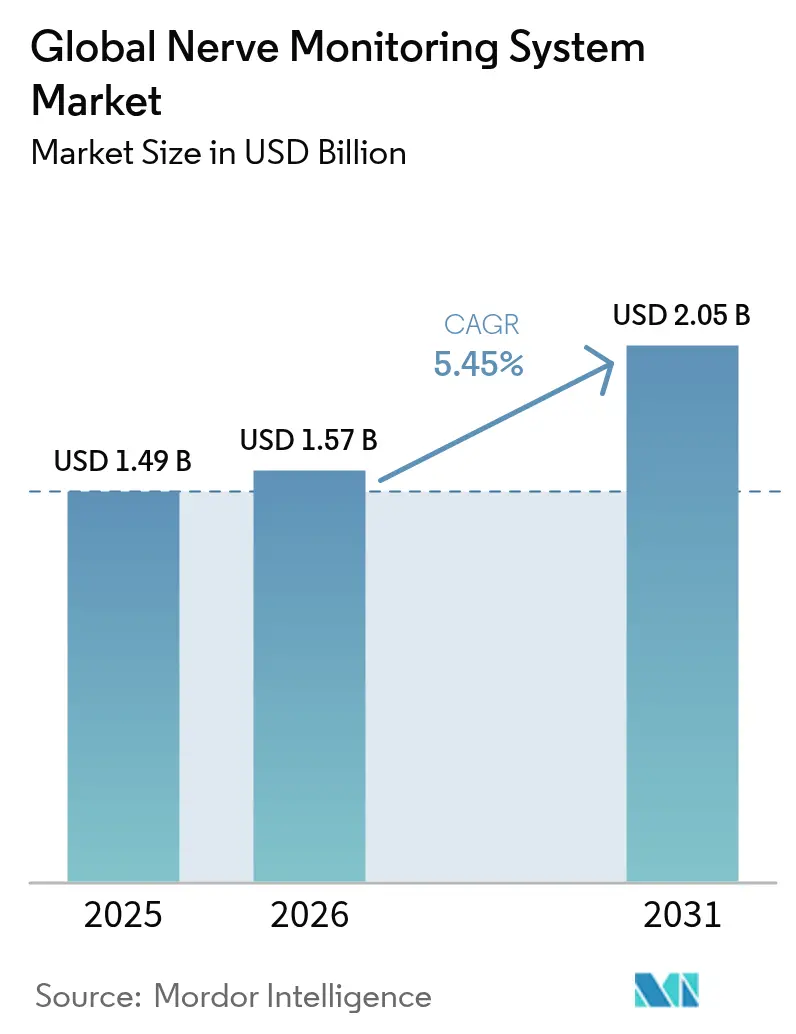
The nerve monitoring systems market size is expected to grow from USD 1.49 billion in 2025 to USD 1.57 billion in 2026 and is forecast to reach USD 2.05 billion by 2031 at 5.45% CAGR over 2026-2031. Rising surgical complexity, mandatory patient-safety regulations, and the convergence of artificial intelligence with real-time neurophysiological monitoring are central to this expansion. Hospitals are embedding intraoperative nerve monitoring into spinal, neurosurgical, and ENT protocols to improve outcomes and limit liability exposure. Vendors are shifting toward consumable-driven revenue models that capitalize on electrodes and probes used in every procedure. Simultaneously, cloud-based remote monitoring services and AI-assisted analytics are widening access for facilities lacking full-time neurophysiologists. Consolidation among health systems is intensifying price negotiations but also unlocking large bundled contracts for suppliers able to provide end-to-end solutions.
Key Report Takeaways
- By product category, nerve monitors led with 45.32% of the nerve monitoring systems market share in 2025; nerve stimulation electrodes and probes are projected to expand at a 6.55% CAGR to 2031.
- By technology, electromyography commanded 38.92% share of the nerve monitoring systems market size in 2025 and is advancing at a 6.95% CAGR through 2031.
- By application, neurosurgery accounted for 30.74% share of the nerve monitoring systems market in 2025, while spine surgery is set to grow fastest at 7.29% CAGR through 2031.
- By end user, hospitals and surgical centers held 64.41% of the nerve monitoring systems market in 2025, yet ambulatory surgical centers are expanding at 7.63% CAGR to 2031.
- By geography, North America maintained 41.38% revenue in 2025; Asia-Pacific is the fastest-growing region at 8.02% CAGR through 2031.
Note: Market size and forecast figures in this report are generated using Mordor Intelligence’s proprietary estimation framework, updated with the latest available data and insights as of 2026.
Market Trends and Insights
Drivers Impact Analysis of Global Nerve Monitoring System Market*
| Driver | (~) % Impact on CAGR Forecast | Geographic Relevance | Impact Timeline |
|---|---|---|---|
| Rapid uptake of intraoperative EMG in spinal & neurosurgery | +1.2% | Global, with concentration in North America & Europe | Medium term (2-4 years) |
| Increasing reimbursed ENT nerve-monitoring procedures | +0.8% | North America & Europe, expanding to APAC | Short term (≤ 2 years) |
| Growth in complex oncology resections requiring IONM | +0.9% | Global, led by developed markets | Long term (≥ 4 years) |
| Hospital consolidation driving bundled device purchases | +0.7% | North America primarily, spreading to Europe | Medium term (2-4 years) |
| AI-assisted real-time signal-quality analytics | +0.6% | Global, early adoption in tech-forward markets | Long term (≥ 4 years) |
| Growth of cloud-based remote IONM service providers | +0.5% | North America & Europe, regulatory-dependent expansion | Medium term (2-4 years) |
| Source: Mordor Intelligence | |||
Rapid Uptake of Intraoperative EMG in Spinal & Neurosurgery
Electromyography has become standard in complex spine and cranial procedures, driven by 2020 Korean guidelines that list EMG as essential for motor-pathway preservation and raise adoption above 85% in spinal deformity cases. Multimodal protocols that combine EMG with somatosensory and motor-evoked potentials have reduced false-negative rates below 2%, which lowers malpractice risk for surgeons and institutions. Robotic platforms increasingly rely on EMG data for autonomous trajectory correction, embedding the technology deeper into surgical workflows. Predictable demand for electrodes and probes stabilizes consumable revenue and encourages suppliers to refine single-use designs. Ongoing clinical studies continue to show better neurological outcomes when EMG is employed, reinforcing hospital purchasing decisions and strengthening the nerve monitoring systems market.
Increasing Reimbursed ENT Nerve-Monitoring Procedures
Enhanced CPT codes released by the American Academy of Otolaryngology simplified billing for intraoperative neurophysiology in endocrine and airway surgeries. Continuous monitoring now receives higher payment than intermittent approaches, allowing providers to upgrade equipment without eroding margins. Specialized endotracheal tubes embedded with electrodes shorten setup time and improve signal stability, expanding surgeon acceptance. Thyroid procedures adopting continuous monitoring have shown lower rates of recurrent laryngeal nerve injury, which translates into measurable cost savings for insurers. The reimbursement momentum is pulling new suppliers into the ENT segment and intensifying competition for procedure-specific consumables within the nerve monitoring systems market.
Growth in Complex Oncology Resections Requiring IONM
Pelvic intraoperative neuromonitoring lowered postoperative urinary dysfunction from 19% to 8% in the NEUROS multicenter trial. Evidence-based protocols are now mandated by top oncology centers for rectal, prostate, and head-and-neck cancers. Brachial plexus tumor resections using multimodal monitoring preserved neurological function in 94% of cases across 36-patient cohorts. These success metrics justify premium pricing for high-channel monitors and disposable electrodes. Integrating monitoring data with intraoperative navigation and fluorescence imaging enlarges procedural complexity and cements the nerve monitoring systems market as a cornerstone of modern oncologic surgery.
Hospital Consolidation Driving Bundled Device Purchases
Integrated delivery networks negotiate multiyear contracts covering capital systems, electrodes, and service agreements, creating volume commitments that favor full-portfolio vendors. USMON’s workflow platform manages more than 3 million patient records and USD 6 billion in claims annually, illustrating the scale that consolidated entities can command. Bundled purchasing lowers per-unit electrode pricing but locks suppliers into exclusive long-term relationships. Vendors able to demonstrate outcome gains and compliance support gain preferred-supplier status, reinforcing the competitiveness of the nerve monitoring systems market among the largest health systems.
Restraints Impact Analysis of Global Nerve Monitoring System Market*
| Restraint | (~) % Impact on CAGR Forecast | Geographic Relevance | Impact Timeline |
|---|---|---|---|
| High capital cost & disposable electrode pricing | -0.9% | Global, particularly acute in emerging markets | Short term (≤ 2 years) |
| Shortage of certified neurophysiologists | -1.1% | North America & Europe primarily | Medium term (2-4 years) |
| Signal-latency risks in remote monitoring | -0.4% | Global, concentrated in regions adopting telemedicine | Medium term (2-4 years) |
| Cyber-security vulnerabilities in connected OR suites | -0.6% | Global, with heightened concern in North America & Europe | Short term (≤ 2 years) |
| Source: Mordor Intelligence | |||
High Capital Cost and Disposable Electrode Pricing
Comprehensive monitoring consoles range from USD 150,000 to USD 300,000, a hurdle that smaller ambulatory centers and emerging-market hospitals struggle to clear. Single-use electrodes add USD 200-500 for each surgery, pressuring margins in cost-sensitive settings. Although 2024 coding changes increased reimbursement for some neuromodulation procedures, gaps persist across many indications[1]Source: ASRA Pain Medicine, “Changes in Coding and Payment for Neuromodulation Procedures in 2024,” asra.com . Leasing models and pay-per-use contracts are gaining favor among budget-constrained providers, yet up-front costs remain a primary adoption barrier that tempers expansion of the nerve monitoring systems market, especially outside high-income economies.
Shortage of Certified Neurophysiologists
Training programs produce fewer than 200 certified neurophysiologists annually in North America, well below demand projections. Surveys show 70% of surgeons favor supervision by a neurologist or neurophysiologist over technologists, but staffing shortfalls push facilities to rely on less-qualified personnel. Universities are scaling certificate curricula and online modules that promise salaries of USD 70,000-99,000 for new entrants. Still, the specialty’s lengthy apprenticeship requirements delay workforce expansion. Staffing gaps restrict procedure volumes and slow the nerve monitoring systems market in regions where remote solutions or AI decision support are not yet fully deployed.
*Our forecasts treat driver/restraint impacts as directional, not additive. The impact forecasts reflect baseline growth, mix effects, and variable interactions.
Global Nerve Monitoring System Market Segment Analysis
By Product Type:
Monitors Lead While Consumables AccelerateThe nerve monitoring systems market recorded 45.32% revenue from nerve monitors in 2025, underscoring their role as foundational capital investments for hospitals. However, nerve stimulation electrodes and probes are growing at 6.55% CAGR, a signal that recurring consumable sales will contribute an increasing share of overall profit pools. Accessories and other consumables show the fastest velocity as single-use policies help eliminate sterilization costs and cross-contamination risk. The product mix is evolving toward a razor-and-blade model that stabilizes vendor cash flow and incentivizes continuous innovation in electrode design.
Consumable-centric strategies also mitigate the liability exposure associated with capital devices, highlighted by the 2024 recall of a major monitoring system linked to patient injuries. Premium electrodes that deliver higher signal-to-noise ratios and integrate RFID tracking command prices above USD 500 per case, offsetting lower device margins. As health systems centralize purchasing, suppliers offering flexible service contracts and automatic replenishment gain an advantage. These developments reinforce the position of consumables as critical growth drivers within the nerve monitoring systems market.




By Technology:
EMG Dominance Drives InnovationElectromyography contributed 38.92% revenue in 2025 and is expanding at 6.95% CAGR, reflecting its versatility across spine, cranial, and ENT applications. EMG’s compatibility with AI platforms accelerates its adoption further because machine learning improves artifact rejection and speeds alerting. Electroencephalography and evoked-potential monitoring remain essential in awake craniotomies and complex scoliosis corrections, though they occupy smaller revenue brackets. Electrocorticography persists as a niche used mainly in epilepsy surgery but commands premium pricing due to highly specialized demand.
Integration of multimodal monitoring is rising among Japanese spine surgeons who combine EMG, SSEPs, and MEPs to enhance surgical confidence. Vendors now position their consoles as open platforms that accept multiple signal modalities and third-party software, future-proofing customer investment. Robotic surgery solutions require millisecond-level feedback loops, pushing technology providers to refine latency and data-fusion capabilities. These requirements sustain high R&D spending and keep the nerve monitoring systems market on a steady trajectory of incremental technical improvement.
By Application:
Spine Surgery Momentum Challenges Neurosurgery LeadershipNeurosurgery held 30.74% of revenue in 2025, yet spine surgery is on track for the fastest expansion at 7.29% CAGR as aging populations increase demand for deformity and fusion procedures acn.kr. Standardized guidelines have made spinal monitoring routine, which in turn elevates electrode consumption volume. ENT procedures benefit from favorable reimbursement, particularly for thyroid and parathyroid operations where continuous monitoring prevents recurrent laryngeal nerve injury. Oncology resections in the pelvis and brachial plexus continue to stimulate usage of high-channel systems that support nuanced functional mapping.
Application diversification spreads revenue risk and creates multiple entry points for new suppliers specializing in procedure-specific accessories. Robotic-assisted surgeries across spine, orthopedics, and soft-tissue fields require plug-and-play monitoring integration, further entwining monitoring with next-generation surgical platforms. As evidence linking IONM to reduced complication rates grows, payers and hospitals incorporate monitoring into quality metrics, increasing the baseline demand across every surgical vertical of the nerve monitoring systems market.

By End User:
Ambulatory Centers Challenge Hospital DominanceHospitals and large surgical centers commanded 64.41% revenue in 2025 thanks to their infrastructure readiness and ability to manage complex surgeries. Ambulatory surgical centers are expanding at 7.63% CAGR as outpatient spine and ENT procedures migrate to lower-cost settings. Specialty clinics focused on pain management and minimally invasive surgery are also adopting compact monitoring systems that fit procedure-specific rooms.
Remote neurophysiology oversight levels the playing field by giving smaller facilities access to expert interpretation without hiring full-time staff. Portable consoles designed for quick setup and touchscreen workflows cater to teams with limited technical training. Group purchasing organizations extend hospital standards into affiliated ambulatory sites, driving uniformity in equipment choice. These shifts create fresh demand pockets while balancing the customer base within the nerve monitoring systems market.
Geography Analysis
North America Nerve Monitoring System Market
North America retained 41.38% revenue in 2025, propelled by robust reimbursement and the presence of leading equipment makers. High surgical volumes in spine and ENT specialties underpin stable electrode consumption. Regulatory scrutiny of cybersecurity in operating-room devices spurred some hospitals to pivot toward domestic suppliers, a trend that reshapes vendor share. Workforce shortages encourage rapid uptake of remote monitoring networks and AI decision support, sustaining technology churn across the region’s nerve monitoring systems market.
APAC Nerve Monitoring System Market
Asia-Pacific is projected to post an 8.02% CAGR through 2031, the fastest globally, as countries invest in surgical infrastructure and adopt Western procedural protocols. China’s National Medical Products Administration streamlined device approvals in 2024, facilitating quicker import of monitoring platforms english.nmpa.gov.cn. India’s medical device sector, forecast to hit USD 50 billion by 2030, remains largely import-dependent, offering multinational vendors substantial runway Japan demonstrates sophisticated multimodal monitoring adoption, integrating AI analytics and robotics into routine spine surgery.
Europe, South America and Middle East Nerve Monitoring System Market
Europe shows steady expansion anchored by harmonized safety regulations and cross-border care initiatives. Hospital consolidation encourages bundled equipment contracts similar to North America. Meanwhile, South America and the Middle East register rising but uneven adoption as cost constraints persist. Tele-monitoring mitigates local staffing shortages, allowing smaller hospitals to participate in advanced procedures. Each of these regional dynamics contributes to the diversified growth profile of the nerve monitoring systems market worldwide.


Regulatory Landscape
In the United States, nerve monitoring and related intraoperative neurophysiology devices are commonly regulated by the FDA as Class II devices, frequently cleared via the 510(k) pathway under neurological diagnostic and surgical nerve stimulation classifications (for example, 21 CFR 882.1870 and 21 CFR 874.1820 with associated product codes used for predicate-based clearances). This framework supports iterative upgrades of consoles, stimulators, and EMG-centric monitoring features, while keeping attention on labeling, electrical safety, EMC, and software controls.
In Europe, access is governed by Regulation (EU) 2017/745 (MDR), which raises expectations for technical documentation, conformity assessment, and post-market surveillance supported by Notified Bodies and national competent authorities. International standards remain central to cross-market compliance, including IEC 80601-2-26:2019 plus its AMD1:2024 amendment for relevant neuro-monitoring equipment, alongside the broader IEC 60601 series requirements for medical electrical safety and performance.
Value Chain Analysis
The value chain starts with electronics and sensor inputs such as amplifiers, printed circuit boards, connectors, and electrode materials that enable high-fidelity acquisition of EMG and related signals. It then moves through OEM design, system integration, verification/validation, and regulatory documentation aligned to IEC 60601-series safety, software life-cycle expectations, and regional approval routes (FDA Class II/510(k) and EU MDR). Manufacturing covers both capital equipment (consoles, acquisition modules, and stimulators) and high-velocity consumables (electrodes, probes, and cables), with the consumable stream structurally tied to procedure volumes and single-use policies.
Downstream, large vendors and specialists sell through direct hospital or tertiary-center teams and distributors that broaden coverage into ambulatory surgical centers, while service partners extend reach via remote monitoring workflows. Recent supply-chain pressure points include qualification lead times for components and suppliers under MDR, plus cost and logistics volatility associated with tariff and trade-policy uncertainty emerging in 2025, which increases the importance of dual sourcing, regionalized production, and predictable replenishment programs for electrodes and probes.
Competitive Landscape
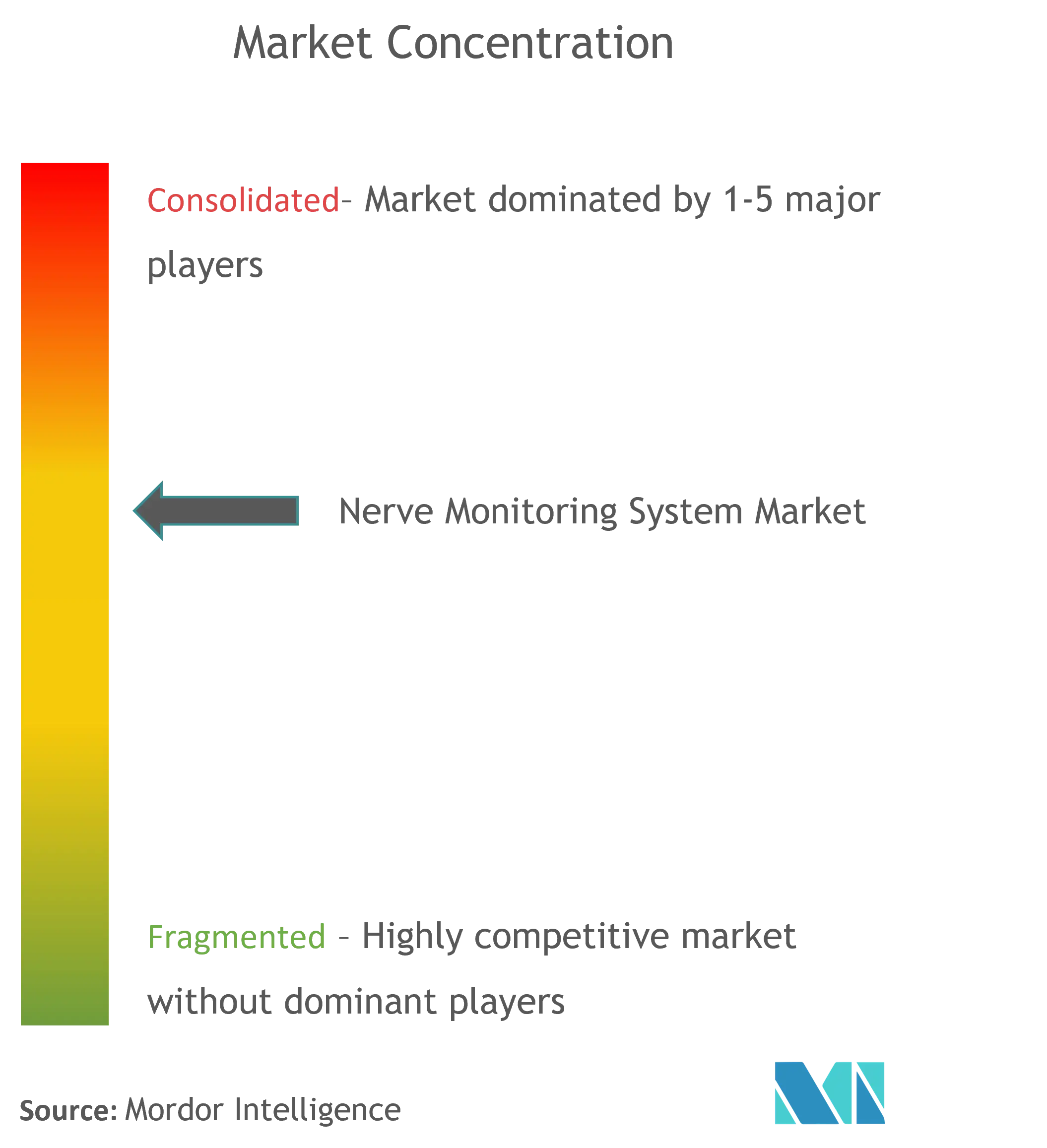
The nerve monitoring systems market is moderately concentrated, with leading manufacturers leveraging broad patent portfolios, regulatory experience, and clinical-evidence pipelines to protect share. Established companies such as Medtronic and Nihon Kohden pair equipment with proprietary electrodes and long-term service contracts that bind customers. Mid-tier suppliers compete through specialization, focusing on niche applications like intracranial electrodes or pediatric spine systems. Service providers that offer remote neurophysiology already partner with hardware vendors to deliver bundled outcomes guarantees, satisfying health-system demands for accountability and cost control.
Scale advantages are prompting mergers and acquisitions. Globus Medical’s USD 250 million purchase of Nevro in February 2025 broadened its neuromodulation footprint and offered cross-selling potential into monitoring customers. Nihon Kohden acquired a majority stake in NeuroAdvanced to deepen its electrode portfolio and solidify North American distribution[2]Source: Nihon Kohden Corporation, “Notice Regarding Acquisition of NeuroAdvanced,” nihonkohden.com . Such deals reflect a race to own differentiated consumables and advanced signal-analysis software, both critical to sustaining margin in an environment where basic hardware is increasingly commoditized.
Technology leadership now hinges on integrating AI algorithms, cybersecurity safeguards, and interoperability with robotic surgery platforms. Vendors unable to demonstrate measurable outcome gains risk contract exclusion by group purchasing organizations seeking standardized, data-driven value. Conversely, companies that embed cloud analytics and remote service capabilities position themselves at the forefront of the nerve monitoring systems market’s evolution toward connected, outcome-based healthcare delivery.
Global Nerve Monitoring System Industry Leaders
Medtronic
NuVasive, Inc.
Nihon Koden
Natus Medical
Checkpoint Surgical Inc.
- *Disclaimer: Major Players sorted in no particular order
Global Nerve Monitoring System Market Companies Covered in this Report
- Medtronic
- NuVasive
- Nihon Kohden
- Natus Medical
- inomed Medizintechnik GmbH
- Dr Langer Medical GmbH
- Cadwell
- Magstim (Neurosign)
- Checkpoint Surgical
- Neurovision Medical Products
- Alpha Omega Engineering
- Impulse Monitoring Inc.
- Biotronic NeuroNetwork LLC
- Moberg ICU Solutions
- Synapse Biomedical
- Compumedics
- AxoGen Inc.
- Soterix Medical
- Brain Lab
- Medline Industries
- Zimmer Biomet (NeuroCare)

Market Opportunities and Future Outlook
A primary whitespace is expanding access to intraoperative neurophysiology when certified neurophysiologist availability limits case throughput, especially outside large academic centers. Remote monitoring workflows and software-driven signal-quality automation address this constraint, and they also fit with hospitals shifting procurement toward bundled service agreements and recurring consumable utilization. This is consistent with the market mix moving toward procedure-driven electrodes and probes, which represent the larger portion of product demand and link vendor growth to standardized surgical protocols in spine, neurosurgery, and ENT.
Technology opportunity centers on software-defined platforms that reduce setup time, improve artifact rejection, and provide actionable alerts at the point of care. This is reflected in software and analytics directions pursued by emerging AI-focused vendors, including Nervio, which builds systems that translate raw monitoring data into real-time guidance. On the regulatory and evidence side, differentiation can come from aligning development to internationally recognized standards (IEC 60601 family and related software expectations) and supporting protocol-based evidence in high-risk populations, such as degenerative cervical myelopathy cohorts emphasized in recent clinical literature, which can resonate with health systems tying monitoring adoption to quality and safety metrics.
Recent Industry Developments in Global Nerve Monitoring System Market
- May 2026: Medtronic announced its intent to acquire SPR Therapeutics, Inc., expanding its peripheral nerve stimulation portfolio for chronic pain. The acquisition extends Medtronic's nerve-focused offering set for procedural ecosystems and can support cross-selling into hospital accounts that purchase adjacent neuromonitoring and neurosurgical technologies.
- May 2026: Cadwell launched the Cadwell Guardian intraoperative neuromonitoring (IONM) system in the United States, pairing a pod-based architecture with Cascade Surgical Studio 4.0 software. The emphasis on modularity and workflow software targets faster OR setup and reinforces the shift from console-only differentiation toward integrated, upgradeable software and service experiences.
- February 2025: Globus Medical announced the acquisition of Nevro Corp for USD 250 million, broadening its neuromodulation footprint. While neuromodulation and intraoperative monitoring are distinct, the deal signals continued consolidation in adjacent neuro-technology categories that share surgeon call points and health-system contracting mechanisms.


Global Nerve Monitoring System Market Report Scope and Research Methodology
Market Definition and Coverage
For this study, the nerve monitoring system market covers the revenue earned from intraoperative neuromonitoring equipment and related accessories that help clinicians detect and protect nerve function during surgeries, reported in USD and consolidated across major regions.
Scope exclusions: We exclude general diagnostic neurology tests done outside the operating room, rehabilitation devices, and stand-alone imaging systems that do not perform nerve monitoring.
Segments Covered in This Report
- By Product Type
- Nerve Monitors
- Nerve Stimulation Electrodes & Probes
- Accessories & Consumables
- By Technology
- Electromyography (EMG)
- Electroencephalography (EEG)
- Evoked Potentials (EP)
- Electrocorticography (ECoG)
- By Application
- Neurosurgery
- Spine Surgery
- ENT Surgery
- Cardiovascular & Other Surgeries
- By End User
- Hospitals & Surgical Centers
- Ambulatory Surgical Centers
- Specialty Clinics
- By Geography
- North America
- United States
- Canada
- Mexico
- Europe
- Germany
- United Kingdom
- France
- Italy
- Spain
- Rest of Europe
- Asia-Pacific
- China
- India
- Japan
- South Korea
- Australia
- Rest of Asia-Pacific
- South America
- Brazil
- Argentina
- Rest of South America
- Middle East and Africa
- GCC
- South Africa
- Rest of Middle East and Africa
- North America
Data Sources, Market Sizing, and Validation
Desk Research
Desk work started with building a clean universe of procedure areas where nerve monitoring is routinely used, and then linking this to device adoption signals and typical system pricing ranges. We relied on public sources such as the US FDA device databases (clearances and recalls), the US Centers for Medicare and Medicaid Services (procedure and reimbursement references), the OECD and World Bank (health spending and macro indicators), and the WHO (workforce and system capacity context).
To keep assumptions realistic, we also reviewed hospital and society guidance posted on association websites, peer reviewed clinical literature on neuromonitoring utilization, and publicly available company filings and investor decks that discuss revenue mix and product rollouts. In addition, we used paid database subscriptions for company financials and intelligence, patent tracking, and shipment level import export checks where relevant to validate supply signals. These desk sources are illustrative, and many other public materials were also consulted to collect data points, validate assumptions, and clarify uncertainties.
Primary Interviews and Surveys
Primary interviews and surveys were used to pressure test the demand pool and pricing logic by speaking with a mix of surgeons, neurophysiology teams, biomedical procurement staff, distributors, and device side product and commercial leaders. Since surgical volumes and reimbursement environments vary by geography, we balanced inputs across the Americas, EMEA, and APAC so gaps from desk research could be closed and final assumptions could be triangulated more confidently.
Distribution of primary research fieldwork respondents
| Company type | Respondent position | Region |
|---|---|---|
| Top tier: 36% | CXOs: 15% | APAC: 49% |
| Mid tier: 48% | Functional/Unit leaders: 27% | EMEA: 31% |
| Smaller Players: 16% | Managers: 58% | Americas: 20% |
Market-Sizing & Forecasting
The model begins with a top-down build that reconstructs demand from surgery volumes in core procedures (such as spine, neurosurgery, and ENT), adjusted for the share of cases that typically use intraoperative nerve monitoring, and then translated into USD using utilization rates and average selling price bands. Once that demand pool was formed, we corroborated totals with selective bottom-up checks, where supplier revenue disclosures, distributor channel checks, and sampled ASP multiplied by estimated units were used to validate direction and correct outliers.
Key inputs included annual surgical volumes by procedure group, adoption rates of monitoring by facility type, installed base replacement cycles, disposable and accessory attachment rates, and regional pricing differences driven by tendering and reimbursement. Where direct unit visibility was limited, gaps were handled by using conservative ranges from interviews, and then narrowing those ranges using observable signals like product launches, regulatory approvals, and changes in hospital capital budgets.
For forecasting, we used scenario analysis supported by multivariate regression on leading indicators that primary experts consistently pointed to, including elective surgery recovery trends, hospital capital spending outlook, clinician staffing availability, and the pace of technology upgrades (for example multimodal monitoring demand). The final forecast was reviewed to ensure the implied penetration and pricing paths stayed plausible for each region.
Data Validation & Update Cycle
Validation was done in multiple steps so that unusual jumps or region skews were caught early, and then revisited with additional checks. We compared model outputs against independent signals such as procedure growth trends, reimbursement and guideline changes, and company level commentary on demand and backlog, and then flagged variances for rework.
Before sign-off, the work moves through analyst reviews where assumptions, math logic, and unit economics are checked again, and interview notes are rechecked when a number looks off. Reports are refreshed annually, with interim updates when material events occur, and a final pre-delivery pass is completed so clients receive the latest updated view.
Mordor Intelligence's Nerve Monitoring System Market Size Versus Other Published Estimates
Published market values for nerve monitoring systems can look far apart, even when the topic sounds the same, because the cut lines around what counts as revenue are not always aligned. The timing of currency conversion, how pricing is averaged across tenders and list prices, and how fast assumptions get refreshed after a change in surgical volumes are also common sources of spread.
In this category, the biggest gaps usually come from whether services and intraoperative monitoring fees are blended into the device market, how disposable attachment rates are treated, and whether the base year is anchored to observed procedure activity or to a forward-leaning scenario. By running variance checks on implied units per procedure and updating FX timing and ASP bands during review cycles, the 2025 value in Mordor Intelligence is kept closer to repeatable demand signals instead of one-time pricing points.
Benchmark comparison
| Source | Market Size | Gaps in Research Methodology |
|---|---|---|
| Mordor Intelligence | USD 1.49 B (2025) | |
| Trade Journal A | USD 0.70 B (2024) | Uses a narrower device-only view that appears to undercount recurring disposables and accessories, and it likely applies a single global ASP without normalizing for tender-driven regional price spreads. |
| Industry Association B | USD 2.30 B (2025) | Seems to include broader intraoperative neuromonitoring revenues (including service or fee components) and uses an optimistic adoption ramp that raises the implied monitoring rate per eligible surgery. |
Looking across the three figures, the spread is mainly explained by scope boundaries and by how pricing and utilization are averaged across regions and facility types. Our approach stays traceable to procedure led demand, realistic attachment rates, and pricing bands that are refreshed and rechecked when new signals appear, which helps keep the estimate practical for planning and benchmarking.


Key Questions Answered in the Report
How big is the Global Nerve Monitoring System Market?
The Global Nerve Monitoring System Market size is expected to reach USD 1.57 billion in 2026 and grow at a CAGR of 5.45% to reach USD 2.05 billion by 2031.
Which product segment generates the highest revenue?
Nerve monitors hold 45.32% revenue, making them the leading product category.
Why is Asia-Pacific the fastest-growing region?
Expanded surgical infrastructure, streamlined regulatory pathways, and rising procedure volumes drive an 8.02% CAGR in the region.
How are AI technologies influencing intraoperative monitoring?
AI platforms improve signal-quality analytics with over 95% accuracy, reduce false alerts, and enable cloud-based predictive maintenance.
What limits the wider adoption of nerve monitoring systems?
High capital costs, expensive disposable electrodes, and a shortage of certified neurophysiologists remain the primary barriers.
Page last updated on:





