
Mutual Funds Market Size and Share
Market Overview
| Study Period | 2021 - 2032 |
|---|---|
| Market Size (2027) | USD 78.20 Trillion |
| Market Size (2032) | USD 103.60 Trillion |
| Growth Rate (2027 - 2032) | 5.80 % |
| Fastest Growing Market | Asia-Pacific |
| Largest Market | North America |
| Market Concentration | High |
Major Players *Disclaimer: Major Players sorted in no particular order Image © Mordor Intelligence. Reuse requires attribution under CC BY 4.0. | |
Mutual Funds Market Analysis by Mordor Intelligence
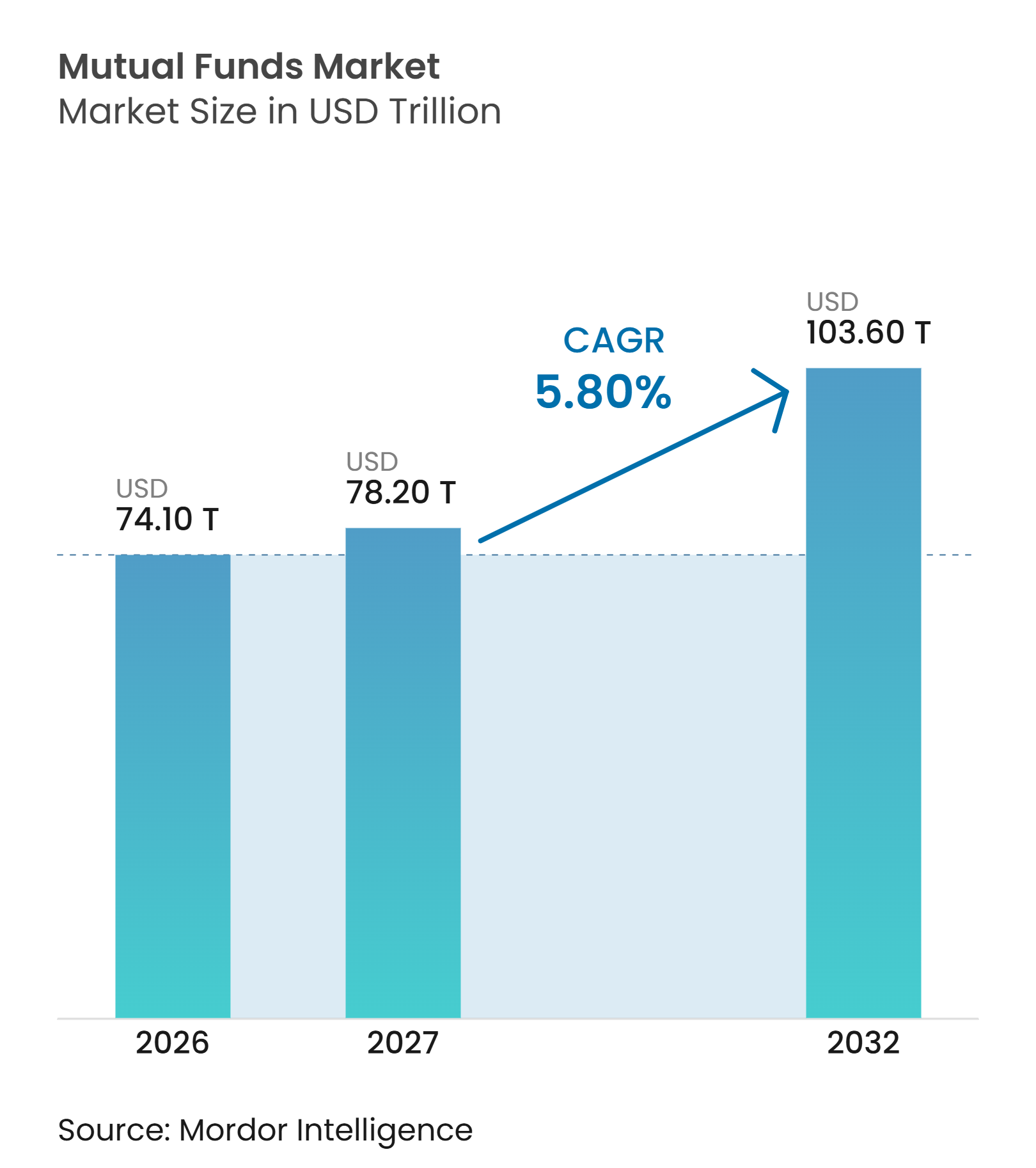
The Mutual Funds Market size was valued at USD 74.10 trillion in 2026 and is estimated to grow from USD 78.20 trillion in 2027 to reach USD 103.60 trillion by 2032, at a CAGR of 5.80% during the forecast period (2027-2032).
Retirement plans remained a durable source of investment because payroll contributions and tax-advantaged accounts directed household savings into managed portfolios. Digital account opening, lower minimum investments, and investor education widened access, particularly in Asia-Pacific. Fund providers responded by building low-cost index options, target-date portfolios, money market products, and digital distribution relationships. The competitive environment favored managers that combined scale, product breadth, compliance resources, and direct access to investors, while ETF flows and lower fees continued to pressure traditional fund economics.
Key Report Takeaways
- By fund type, equity mutual funds captured 47.5% of the mutual funds market share in 2026, while other mutual funds were projected to grow at a 7.4% CAGR through 2032.
- By investor type, retail investors held 61.7% of the mutual fund market share in 2026, while institutional investors were forecast to expand at a 6.8% CAGR through 2032.
- By management style, active management held 91.8% of the mutual funds market share in 2026, while passive and index mutual funds were projected to grow at a 9.6% CAGR through 2032.
- By distribution channel, banks and bank-affiliated distributors captured 33.8% of the mutual fund market share in 2026, while online platforms, direct-to-consumer channels, and robo-advisors were forecast to grow at an 11.2% CAGR through 2032.
- By geography, North America captured 46.1% of the mutual funds market share in 2026, while Asia-Pacific was projected to grow at an 8.6% CAGR through 2032.
Note: Market numbers in this report are based on Mordor Intelligence's proprietary estimation framework, which combines nine months of actuals with Q4 projections for base year 2026.
Market Trends and Insights
Drivers Impact Analysis of Mutual Funds Market*
| Driver | % Impact on CAGR Forecast | Geographic Relevance | Impact Timeline |
|---|---|---|---|
| Retirement Savings Contributions and Employer-Sponsored Investment Plans | 1.5% | North America, Europe (core); expanding into Asia-Pacific | Long term (≥ 4 years) |
| Growing Demand for Low-Cost Index Mutual Funds | 1.3% | Global, led by North America and India | Medium term (2–4 years) |
| Digital Fund Distribution and Greater Retail Investor Accessibility | 1.0% | Asia-Pacific Core, spillover to MEA and LATAM | Medium term (2–4 years) |
| Money Market Fund Demand Driven by Short-Term Interest Rates and Cash Management Needs | 0.9% | North America, Europe | Short term (≤ 2 years) |
| Rising Retail Investment Participation in Emerging Markets | 0.7% | India, China, Southeast Asia, LATAM | Long term (≥ 4 years) |
| Increasing Demand for Diversified Investment Portfolios and Professional Fund Management | 0.6% | Global | Medium term (2–4 years) |
| Source: Mordor Intelligence | |||
Retirement Savings Contributions and Employer-Sponsored Investment Plans
Tax-advantaged retirement accounts gave the mutual funds market a recurring source of long-term savings. The 401(k) elective deferral limit increased to USD 24,500 in 2026 from USD 23,500 in 2025, and the combined employer and employee contribution limit was USD 72,000[1]. Mutual funds held USD 14.7 trillion of defined-contribution plan and individual retirement account assets at the end of 2025, while 74% of United States households held tax-advantaged retirement savings. These plans made regular investment contributions less dependent on short-term market sentiment. They also supported managers with established target-date portfolios, retirement-plan relationships, and administrative capabilities. T. Rowe Price reported more than USD 560 billion in target-date assets under management at the end of 2025, which illustrated the scale available to managers with broad retirement offerings.
Growing Demand for Low-Cost Index Mutual Funds
Cost-sensitive investors increased their use of index mutual funds, changing the product mix in the mutual funds market. Equity mutual fund expense ratios averaged 0.40% in 2025, compared with 0.14% for index equity ETFs. The difference kept pressure on active fund providers to explain their fees and performance. In India, passive mutual fund assets reached INR 14.63 lakh crore (USD 175 billion), or 18% of total assets of INR 79.20 lakh crore (USD 946 billion), at the end of fiscal year 2026[2]. Index fund assets in India reached INR 3.07 lakh crore (USD 36.7 billion) after a 74.1% five-year CAGR through March 2026, indicating strong adoption among investors who may not have used exchange-traded funds. Managers therefore adjusted product design, distribution, and pricing as passive choices gained visibility.
Digital Fund Distribution and Greater Retail Investor Accessibility
Digital distribution reduced friction for retail investors entering the mutual fund industry. Model portfolios managed through financial advisors held USD 7.7 trillion in the first quarter of 2025, and registered investment advisor model portfolios grew by 5.5% during that quarter[3]. In South Korea, robo-advisor assets exceeded KRW 1.06 trillion (USD 780 million) in August 2025. Digital wealth services were also established in Singapore, where 85% of investors used them during the prior two years, 59% used robo-advisors, and 27% used artificial intelligence-based guidance tools. Lower account-opening barriers and smaller investment thresholds could extend mutual fund access beyond high-income households. This shift increased the value of simple mobile journeys, reliable advice tools, and distributor partnerships.
Money Market Fund Demand Driven by Short-Term Interest Rates and Cash Management Needs
Money market funds benefited from demand for liquid investments that offered competitive short-term returns. United States money market fund assets reached USD 7.03 trillion in March 2025 and rose to USD 7.94 trillion by October 2026. Their role extended beyond retail cash holdings because institutions used them for balance-sheet liquidity management. Canadian money market mutual fund assets increased by 180% from 2019, exceeding the growth of pension funds and other mutual fund categories[4]. The mutual fund industry therefore benefited when investors placed greater value on liquidity and yield. However, managers needed strong liquidity controls because rapid flows could amplify stress during market volatility.
Restraints Impact Analysis of Mutual Funds Market*
| Restraint | % Impact on CAGR Forecast | Geographic Relevance | Impact Timeline |
|---|---|---|---|
| Competition from ETFs and Other Investment Vehicles | -1.8% | North America & EU (primary); growing in Asia-Pacific | Short term (≤ 2 years) |
| Fee Compression and Pressure on Mutual Fund Profitability | -1.2% | Global | Medium term (2–4 years) |
| Market Volatility and Investor Redemptions | -0.8% | Global | Short term (≤ 2 years) |
| Regulatory Compliance and Operational Resilience Costs | -0.5% | EU, North America | Medium term (2–4 years) |
| Source: Mordor Intelligence | |||
Competition from ETFs and Other Investment Vehicles
ETFs continued to challenge the mutual funds market through their intraday trading, tax features, and growing breadth of strategies. Mutual fund providers had increasingly used ETF structures to retain clients who wanted these features. The United States Securities and Exchange Commission issued more than 30 exemptive orders through mid-2026 that enabled ETF share classes within existing mutual fund structures. This approach could allow managers to offer an ETF option without closing a long-standing mutual fund. It also narrowed the distinction between the two product forms and raised the importance of operational readiness. Fund groups needed to determine where a mutual fund remained the better structure for retirement plans, recurring contributions, and investors who did not require exchange trading.
Fee Compression and Pressure on Mutual Fund Profitability
Lower fees reshaped the economics of the mutual funds market, particularly for broad equity and bond strategies. Average expense ratios fell 62% for equity mutual funds and 57% for bond mutual funds from 1996 through 2025. In 2025, average expense ratios were 0.40% for equity mutual funds and 0.36% for bond mutual funds. Lower revenue per asset reduced the resources available for investment teams, technology, and distribution. The pressure was most acute for managers that lacked either low-cost scale or a clearly differentiated active strategy. Firms consequently focused on targeted products, automated processes, and broader client relationships to protect profitability.
*Our forecasts treat driver/restraint impacts as directional, not additive. The impact forecasts reflect baseline growth, mix effects, and variable interactions.
Mutual Funds Market Segment Analysis
By Fund Type:
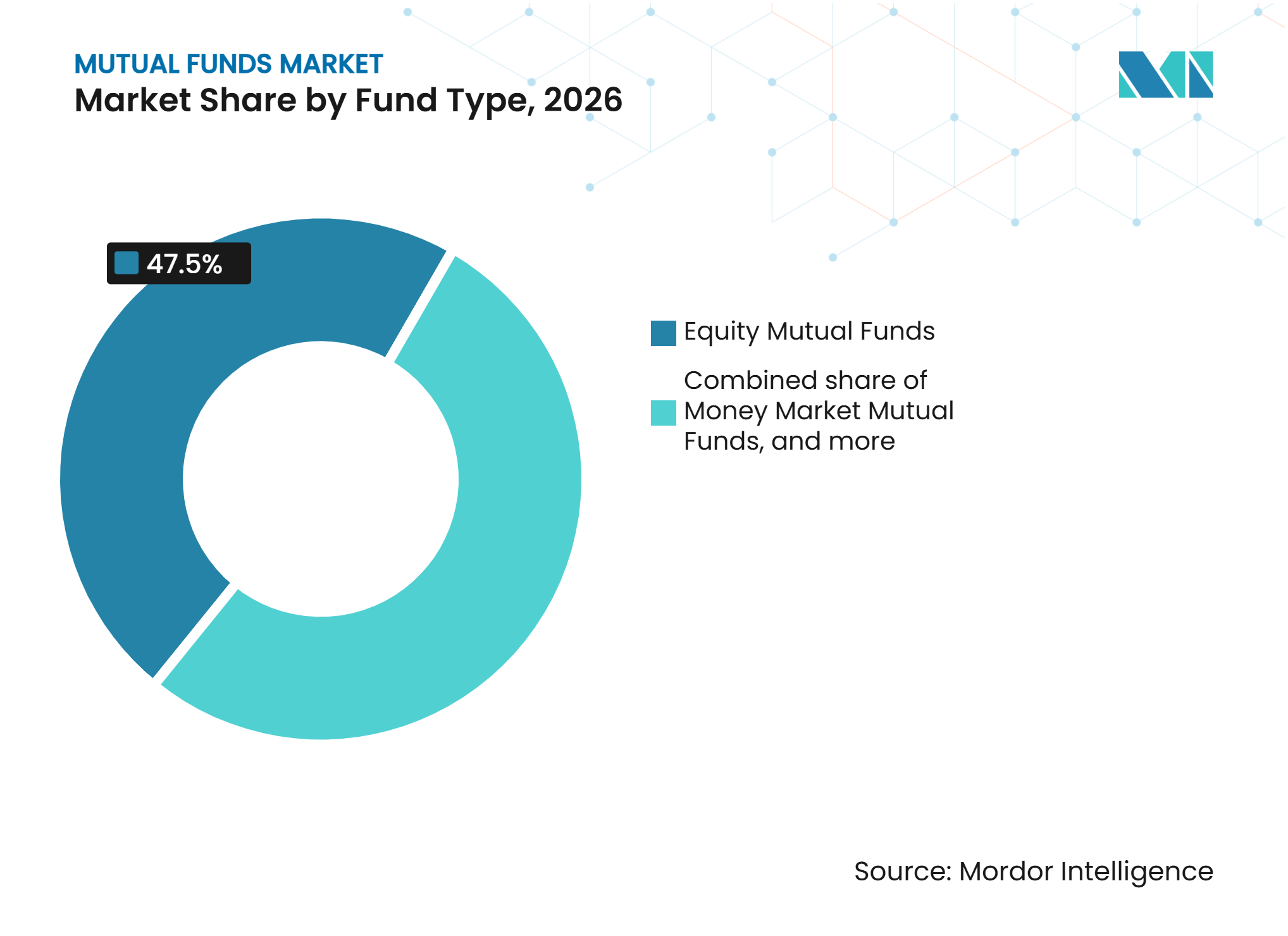
Equity Funds Anchor Assets While Other Strategies Lead GrowthEquity mutual funds captured 47.5% of global mutual fund assets in 2026, supported by their central role in retirement allocations and long-term wealth creation. In the United States, equity funds represented 52% of mutual fund net assets at the end of 2025. United States domestic equity mutual fund assets reached USD 13.55 trillion in August 2026. Bond funds remained important for investors seeking income, duration management, and lower equity exposure. Their role was especially relevant for insurers, pension plans, and investors with planned withdrawals. Money market funds were the second-largest United States fund category, with 25% of fund net assets, and their short-term appeal had risen with higher cash yields.
Other mutual funds were projected to grow at a 7.4% CAGR through 2032, the fastest rate among fund types in the mutual funds market. This group included real estate, commodity, alternative, and guaranteed or protected strategies. Investors used these products to seek return sources that were less closely linked to traditional equity and bond holdings. Regulated fund structures could also make private credit, infrastructure, and real estate strategies more accessible to retail investors. Target-date and multi-asset portfolios continued to combine these building blocks through automatic rebalancing. T. Rowe Price’s USD 560 billion target-date asset base indicated the continuing value of managed portfolios for retirement savers.


By Investor Type:
Retail Participation Provides Scale While Institutions Drive Specialized DemandRetail investors held 61.7% of global mutual fund assets in 2026. Their participation reflected access through employer plans, individual retirement accounts, bank networks, and digital investment platforms. The United States had 128.7 million mutual fund investors at the end of 2025. A total of 76 million United States households invested through employer plans, individual retirement accounts, or direct purchases. Regular payroll contributions and reinvested distributions provided a comparatively stable base of retail flows. The retail segment also gave fund providers an incentive to simplify disclosures, improve digital support, and provide products with smaller initial investments.
Institutional investors were projected to grow at a 6.8% CAGR through 2032. At the end of 2025, institutional investors held USD 3.9 trillion in United States mutual fund assets. Money market funds accounted for 62% of those institutional assets, showing that liquidity management was a major use case. This mix meant that institutional growth could be concentrated in rate-sensitive and lower-fee portfolios. Managers could deepen these relationships by offering multi-asset, fixed-income, and alternative solutions where appropriate. Large organizations also tended to favor providers with audited controls, broad product ranges, and established regulatory processes.
By Management Style:
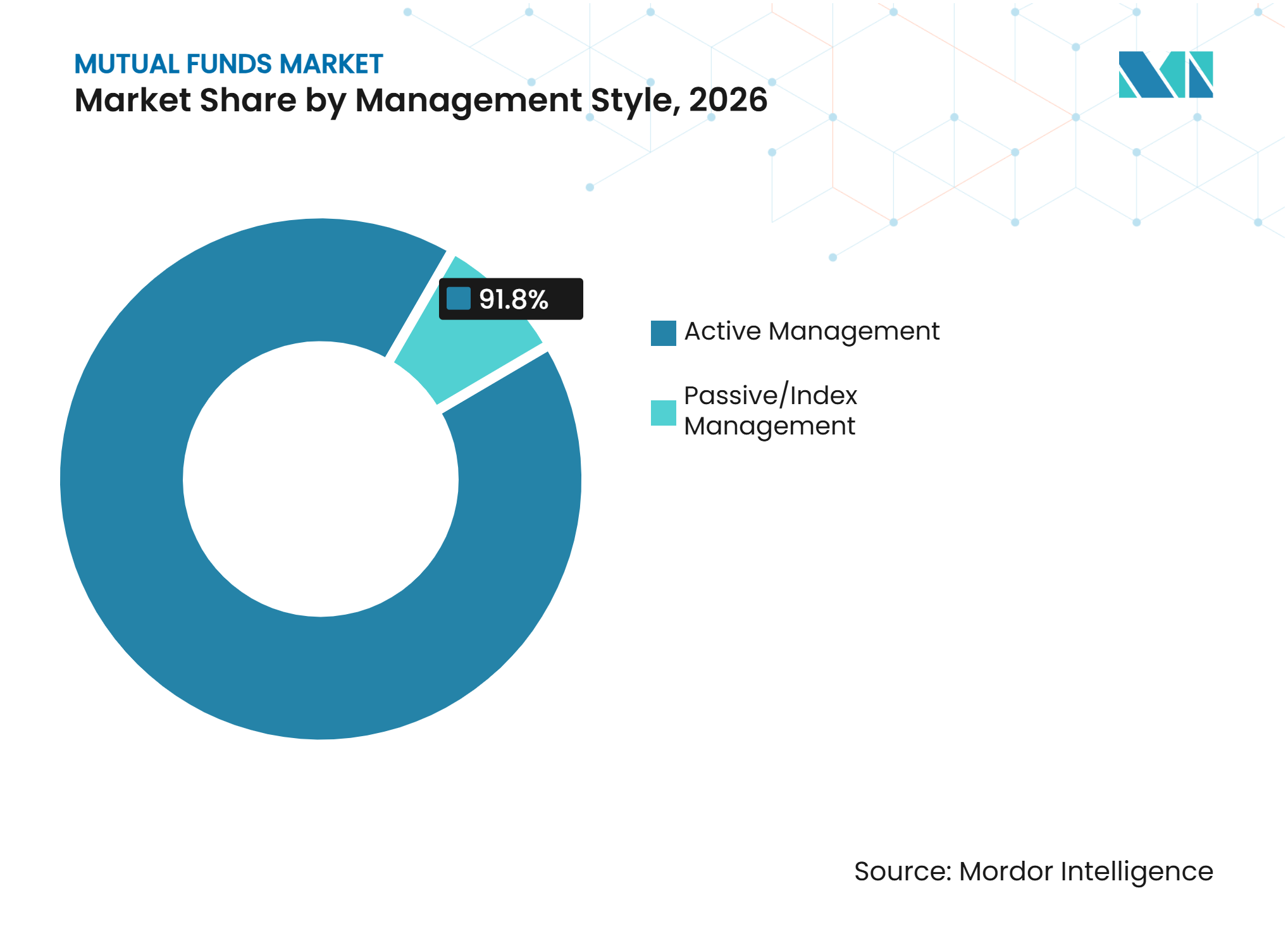
Active Funds Retain Scale While Passive Products Build MomentumActive management held 91.8% of the mutual funds market size in 2026. Its position reflected established advisor and bank distribution networks, as well as investor demand for professional security selection. The model remained especially prominent where investors used funds for retirement allocations and expected manager oversight during market changes. T. Rowe Price reported that 72% of its fund assets outperformed peer groups on a 3-year basis as of the fourth quarter of 2025. Such performance could support active products when it was consistent and understandable to clients. However, active mutual funds had to continue demonstrating value after fees as low-cost alternatives became more widely available.
Passive and index mutual funds were forecast to grow at a 9.6% CAGR through 2032. Their appeal came from lower expenses, transparent index exposure, and simple portfolio construction. In India, passive mutual fund assets reached INR 14.63 lakh crore (USD 175 billion) and represented 18% of total fund assets at the end of fiscal year 2026. Index fund assets reached INR 3.07 lakh crore (USD 36.7 billion) after growing at a 74.1% five-year CAGR through March 2026. The rise of these products pushed active managers to strengthen product differentiation and clarify the purpose of active decisions. It also created room for fund platforms that could offer both passive core holdings and specialist active strategies.

By Distribution Channel:
Bank Networks Lead While Digital Access Changes Investor ReachBanks and bank-affiliated distributors captured 33.8% of the global mutual fund assets in 2026. Their position was supported by existing customer relationships and their ability to discuss savings, credit, and investments together. Bank channels could also place a wide set of affiliated and third-party funds across established branch and advisory networks. In Europe, bank-based distribution remained important in countries such as Italy, Spain, and France. Investor protection rules could raise documentation requirements, which could favor large distributors with established compliance teams. This channel remained relevant for clients who wanted in-person support or received investment guidance through their primary bank.
Online platforms, direct-to-consumer services, and robo-advisors were projected to grow at an 11.2% CAGR through 2032. The mutual funds industry used these channels to reach investors with lower balances and more self-directed preferences. In Singapore, 59% of investors used robo-advisors, and 27% used artificial intelligence-based guidance tools during the prior 2 years. Digital channels could reduce onboarding costs and make recurring investments easier to set up. They also increased price transparency and made it easier for consumers to compare funds. Fund managers needed effective digital service, clear risk communication, and dependable platform relationships to benefit from this shift.
Geography Analysis
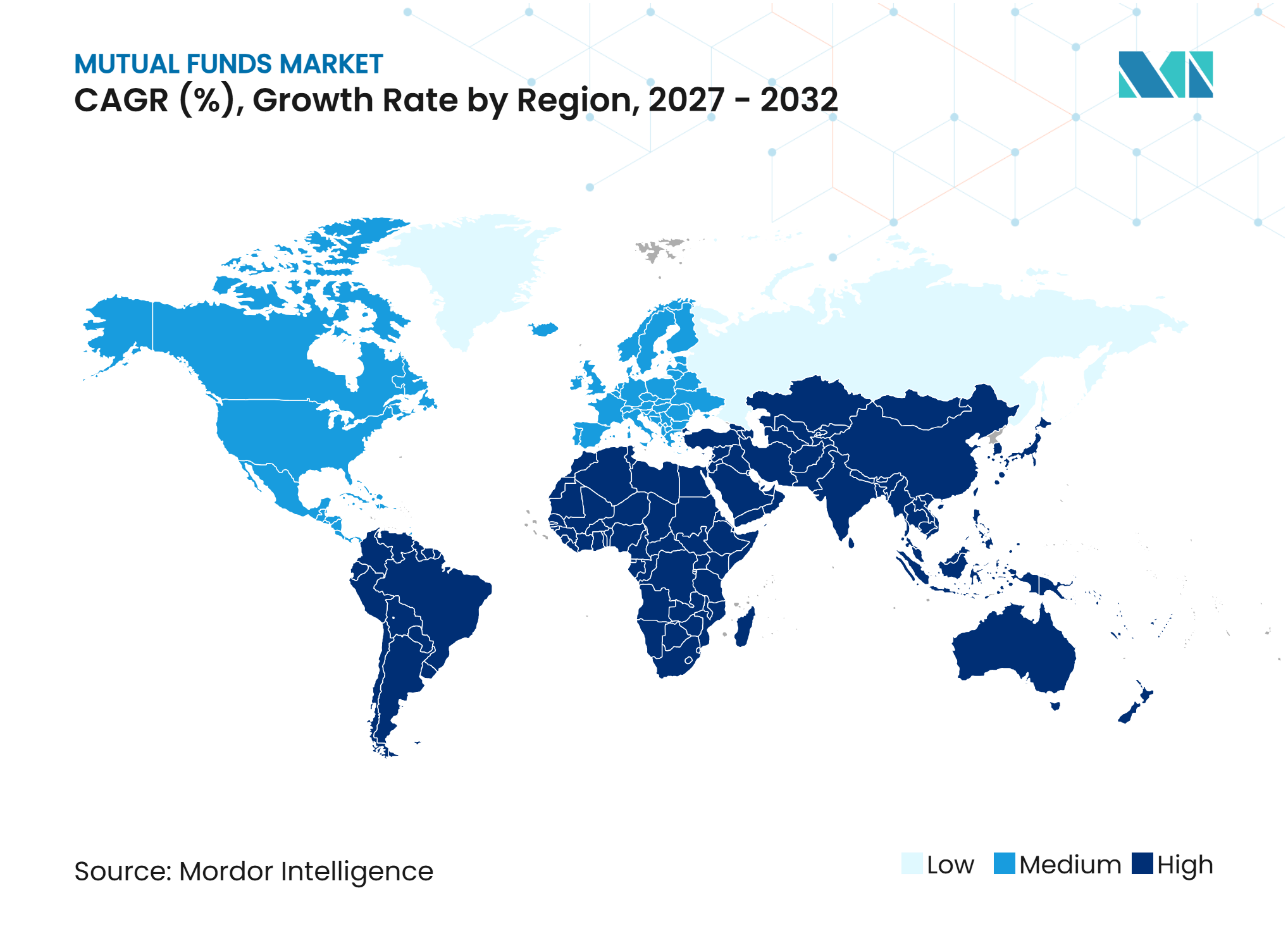
North America captured 46.1% of global mutual fund assets in 2026. The United States supported this position through deep capital markets, employer-sponsored retirement plans, large asset managers, and the widespread use of investment advice. United States mutual fund assets reached USD 33.29 trillion in August 2026. Retail investors held 87% of United States mutual fund assets, while institutional investors held around USD 3.9 trillion. Canada also experienced greater use of money market funds, with assets in this category increasing by 180% since 2019.
Asia-Pacific is projected to grow at an 8.6% CAGR through 2032, making it the fastest-growing region in the mutual funds market. India combined rising household wealth with systematic investment plans and a growing distributor base. Indian mutual fund assets increased from INR 9 trillion (USD 150 billion) in 2014 to INR 81 trillion (USD 840 billion) in April 2026. China’s fund assets exceeded CNY 34.9 trillion (USD 5 trillion) at the end of November 2025. Singapore’s strong adoption of digital wealth tools also demonstrated how the region could transition rapidly from basic access to digital advice and managed portfolios.
Europe remained a major fund center, with regulated open-end fund assets of USD 27.9 trillion at the end of 2025. The European Union updated sustainability and liquidity requirements, increasing the need for clear product disclosures and resilient fund operations. The European Securities and Markets Authority identified liquidity management and fund suspension powers as supervisory priorities for 2026. South America, the Middle East, and Africa remained smaller but developing regions, where broader financial access and institutional mandates could support future fund adoption.
Competitive Landscape
Market Concentration
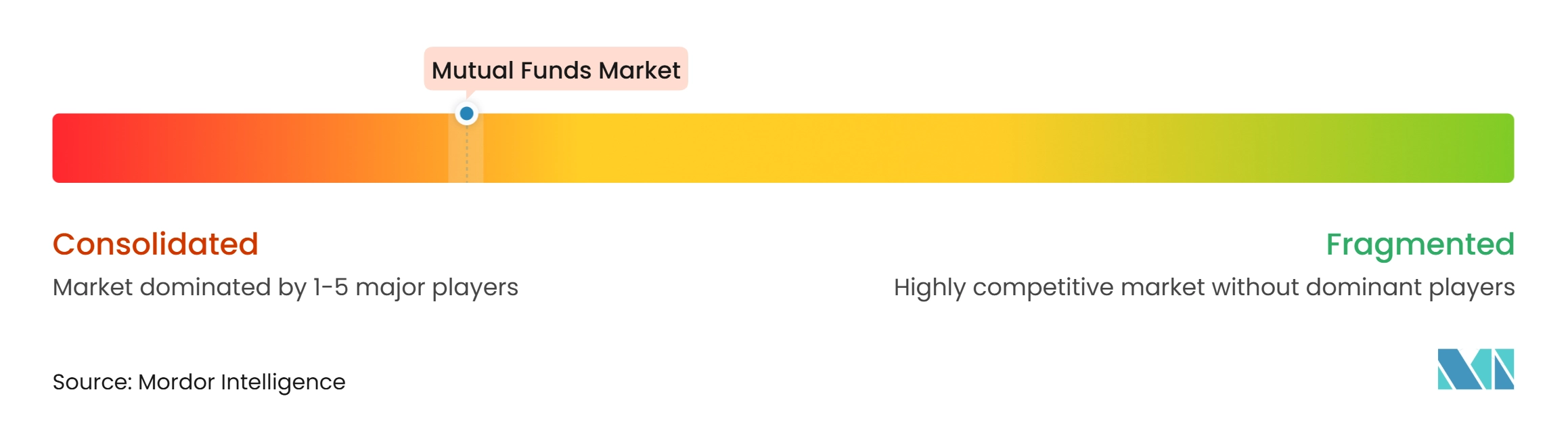
The mutual funds market was concentrated among the largest global managers, although it remained competitive across many specialist strategies. BlackRock reported USD 14.0 trillion in assets under management as of December 31, 2025. Scale allowed large providers to spread technology, compliance, and distribution costs across extensive product ranges. Vanguard, Fidelity, BlackRock, and other large managers also benefited from direct investor relationships, advisor platforms, and retirement-plan coverage. Smaller managers usually competed through specialist investment capabilities, focused client service, or distinct product design. The mutual funds market therefore had significant entry barriers in broad passive products, while selected active and alternative categories remained open to differentiated providers.
Consolidation was a practical response to these economic pressures. BNP Paribas combined AXA Investment Managers, BNP Paribas Real Estate Investment Management, and BNP Paribas Asset Management into a single legal entity by December 31, 2025, creating a platform with around USD 1.7 trillion in combined assets. Franklin Templeton completed its acquisition of Apera Asset Management in October 2025, adding more than EUR 5 billion (USD 5.4 billion) in assets under management to its private credit presence and taking alternative credit assets above USD 90 billion. Goldman Sachs Asset Management and T. Rowe Price also launched co-branded model portfolios in December 2025 as part of their strategic collaboration. These moves showed that companies used acquisitions and partnerships to add distribution reach, alternative capabilities, and portfolio construction tools.
Product innovation created another area of competition. BlackRock completed its acquisition of HPS Investment Partners on July 1, 2025, and announced the acquisition of ElmTree Funds on July 7, 2025, to expand private financing and real estate capabilities. The launch of joint model portfolios by Goldman Sachs Asset Management and T. Rowe Price combined mutual funds, ETFs, separately managed accounts, direct indexing, and alternative strategies for wealth clients. These developments indicated that companies responded to investor demand for broader portfolio choices within more integrated distribution systems. Managers who could adapt product structures while maintaining simple communication and reliable operations were likely to strengthen their positions.
Mutual Funds Industry Leaders
-
BlackRock, Inc.
-
The Vanguard Group, Inc.
-
Fidelity Investments
-
State Street Global Advisors
-
J.P. Morgan Asset Management
- *Disclaimer: Major Players sorted in no particular order
Mutual Funds Market Companies Covered in this Report
- BlackRock, Inc.
- The Vanguard Group, Inc.
- Fidelity Investments
- State Street Investment Management
- J.P. Morgan Asset Management
- Capital Group
- Amundi
- UBS Asset Management
- DWS Group
- Invesco Ltd.
- Franklin Templeton
- Goldman Sachs Asset Management
- PIMCO
- T. Rowe Price Group, Inc.
- Morgan Stanley Investment Management
- BNP Paribas Asset Management
- Northern Trust Asset Management
- Legal & General Asset Management
- Allianz Global Investors
- Schroders plc
Recent Industry Developments in Mutual Funds Market
- October 2026: ASK Investment Managers agreed to acquire SageOne Investment Managers, bringing together ASK's distribution network and institutional scale with SageOne's research-driven equity investment capabilities. Backed by Blackstone, the combined platform is expected to strengthen ASK's portfolio management services and alternative investment fund business. The transaction remains subject to regulatory approvals and other customary closing conditions.
- October 2026: Janus Henderson announced an agreement to acquire four mutual funds managed by Nicholas Company, adding approximately USD 5.7 billion in assets and around 28,000 individual clients. The transaction is intended to strengthen Janus Henderson's United States self-directed investor business and broaden its actively managed equity fund offering. Completion remains subject to shareholder approval and customary conditions.
- August 2026: Victory Capital agreed to acquire First Eagle Investments, with the combined business expected to manage approximately USD 571 billion in assets across global multi-asset, equity, fixed-income, and alternative credit strategies. The transaction is intended to expand investment capabilities and distribution reach while creating a larger diversified asset management platform.
- August 2026: Goldman Sachs Asset Management announced an agreement to acquire NEOS Investments, a specialist in options-based income ETFs with USD 30 billion in assets as of June 30, 2026. The transaction is intended to expand Goldman Sachs' active ETF and derivative-income investment capabilities. The deal, valued at up to USD 2.25 billion in cash and equity, is expected to close in the first quarter of 2027, subject to approvals.
Global Mutual Funds Market Report Scope
Segmentation Overview
| Equity Mutual Funds |
| Bond / Fixed-Income Mutual Funds |
| Money Market Mutual Funds |
| Hybrid and Multi-Asset Mutual Funds |
| Other Mutual Funds (Real Estate, Commodity, Alternative, Guaranteed/Protected, etc.) |
| Retail Investors |
| Institutional Investors |
| Active Management |
| Passive / Index Management |
| Banks and Bank-Affiliated Distributors |
| Financial Advisors, Wealth Managers and Independent Intermediaries |
| Securities Firms and Broker-Dealers |
| Online Platforms, Direct-to-Consumer and Robo-Advisors |
| Direct-to-Investor Sales |
| Other / Unclassified Channels |
| North America | United States |
| Canada | |
| Mexico | |
| South America | Brazil |
| Argentina | |
| Rest of South America | |
| Europe | United Kingdom |
| Germany | |
| France | |
| Italy | |
| Spain | |
| Rest of Europe | |
| Asia-Pacific | China |
| Japan | |
| India | |
| South Korea | |
| Australia | |
| Indonesia | |
| Thailand | |
| Malaysia | |
| Singapore | |
| Vietnam | |
| Rest of Asia-Pacific | |
| Middle East and Africa | Saudi Arabia |
| United Arab Emirates | |
| Turkey | |
| South Africa | |
| Egypt | |
| Rest of Middle East and Africa |
| By Fund Type | Equity Mutual Funds | |
| Bond / Fixed-Income Mutual Funds | ||
| Money Market Mutual Funds | ||
| Hybrid and Multi-Asset Mutual Funds | ||
| Other Mutual Funds (Real Estate, Commodity, Alternative, Guaranteed/Protected, etc.) | ||
| By Investor Type | Retail Investors | |
| Institutional Investors | ||
| By Management Style | Active Management | |
| Passive / Index Management | ||
| By Distribution Channel | Banks and Bank-Affiliated Distributors | |
| Financial Advisors, Wealth Managers and Independent Intermediaries | ||
| Securities Firms and Broker-Dealers | ||
| Online Platforms, Direct-to-Consumer and Robo-Advisors | ||
| Direct-to-Investor Sales | ||
| Other / Unclassified Channels | ||
| By Geography | North America | United States |
| Canada | ||
| Mexico | ||
| South America | Brazil | |
| Argentina | ||
| Rest of South America | ||
| Europe | United Kingdom | |
| Germany | ||
| France | ||
| Italy | ||
| Spain | ||
| Rest of Europe | ||
| Asia-Pacific | China | |
| Japan | ||
| India | ||
| South Korea | ||
| Australia | ||
| Indonesia | ||
| Thailand | ||
| Malaysia | ||
| Singapore | ||
| Vietnam | ||
| Rest of Asia-Pacific | ||
| Middle East and Africa | Saudi Arabia | |
| United Arab Emirates | ||
| Turkey | ||
| South Africa | ||
| Egypt | ||
| Rest of Middle East and Africa | ||
Key Questions Answered in the Report
What is the projected size of mutual fund assets by 2032?
The mutual funds market is projected to reach USD 103.6 trillion by 2032, expanding at a 5.8% CAGR from 2027.
Which fund category holds the largest share?
Equity mutual funds hold the largest share at 47.5% in 2026, supported by retirement allocations and long-term investment demand.
Which mutual fund category is growing fastest?
Other mutual funds, including real estate, commodity, alternative, and protected strategies, are projected to expand at a 7.4% CAGR through 2032.
Why are passive mutual funds gaining attention?
Passive and index mutual funds are projected to grow at a 9.6% CAGR through 2032 because investors value transparent index exposure and lower costs.
Which region is expected to grow fastest?
Asia-Pacific is forecast to grow at an 8.6% CAGR through 2032, supported by household wealth growth, digital platforms, and financial inclusion.
How are digital channels changing fund investing?
Online platforms, direct-to-consumer services, and robo-advisors are projected to grow at an 11.2% CAGR through 2032, expanding access for retail investors.