
Multi-Stage Centrifugal Pumps Market Size and Share
Market Overview
| Study Period | 2020 - 2031 |
|---|---|
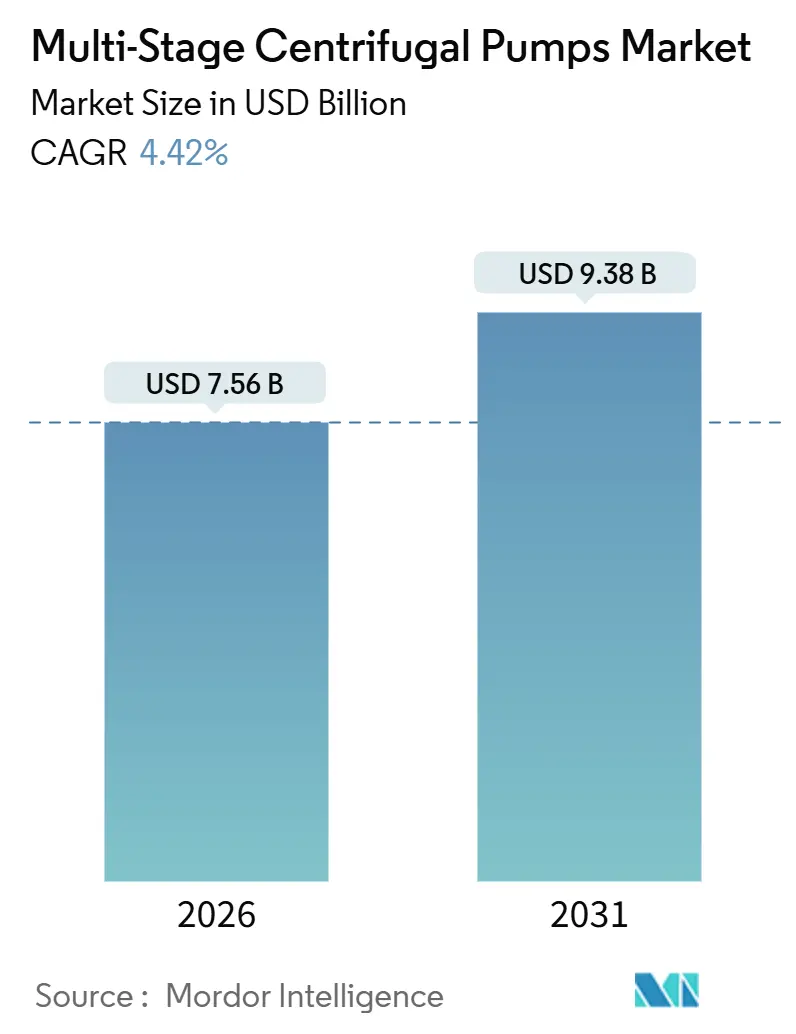
| Market Size (2026) | USD 7.56 Billion |
| Market Size (2031) | USD 9.38 Billion |
| Growth Rate (2026 - 2031) | 4.42 % |
| Fastest Growing Market | Middle East |
| Largest Market | Asia Pacific |
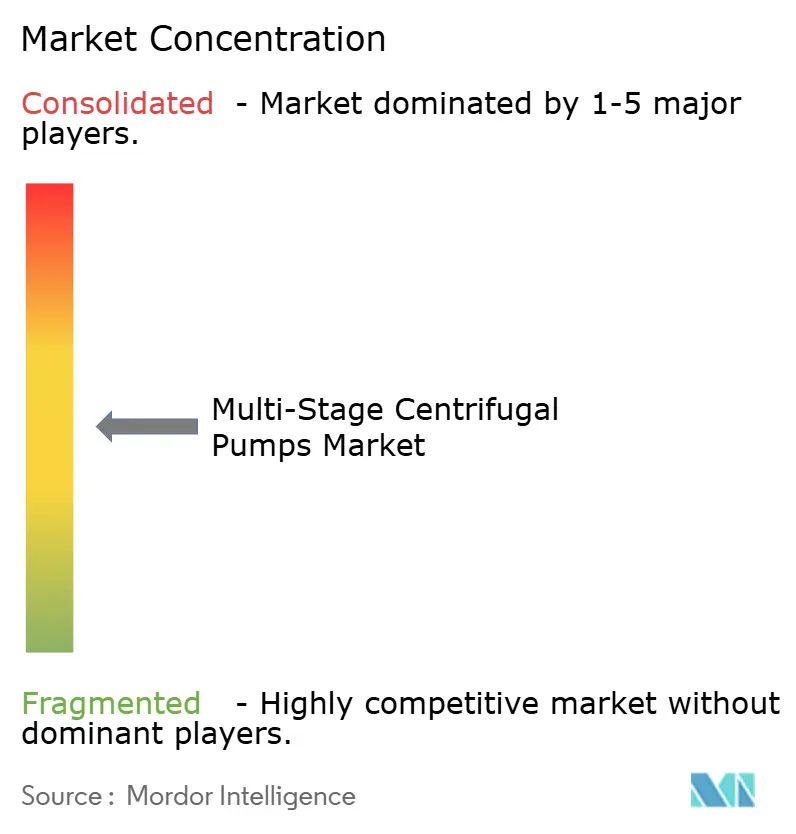
| Market Concentration | Medium |
Major Players *Disclaimer: Major Players sorted in no particular order Image © Mordor Intelligence. Reuse requires attribution under CC BY 4.0. | |
Multi-Stage Centrifugal Pumps Market Analysis by Mordor Intelligence
The multi-stage centrifugal pumps market size reached USD 7.56 billion in 2026 and is projected to climb to USD 9.38 billion by 2031, translating into a 4.42% CAGR through the forecast period. Rising investment in water infrastructure, the build-out of large-scale desalination capacity, and rapidly tightening energy-efficiency codes are the core growth catalysts. Demand is further reinforced by deep-well oilfield activity that favors high-head pumping along with government incentives that underwrite solar-powered irrigation systems. Suppliers are simultaneously reshaping product portfolios around duplex steels and IIoT-enabled service models, moves that temper margin pressure from raw-material volatility and price-led Asian competition. As these themes converge, the multi-stage centrifugal pumps market is likely to maintain a balanced mix of replacement and green-field demand across public utilities, energy, and process industries.
Key Report Takeaways
- By type, horizontal pumps held 61.0% of the multi-stage centrifugal pumps market share in 2025, whereas vertical pumps are forecast to record the fastest 5.45% CAGR through 2031.
- By stage count, the 2-5 stage category commanded 45.2% share of the multi-stage centrifugal pumps market size in 2025 while above-10-stage units are set to expand at 5.21% CAGR between 2026-2031.
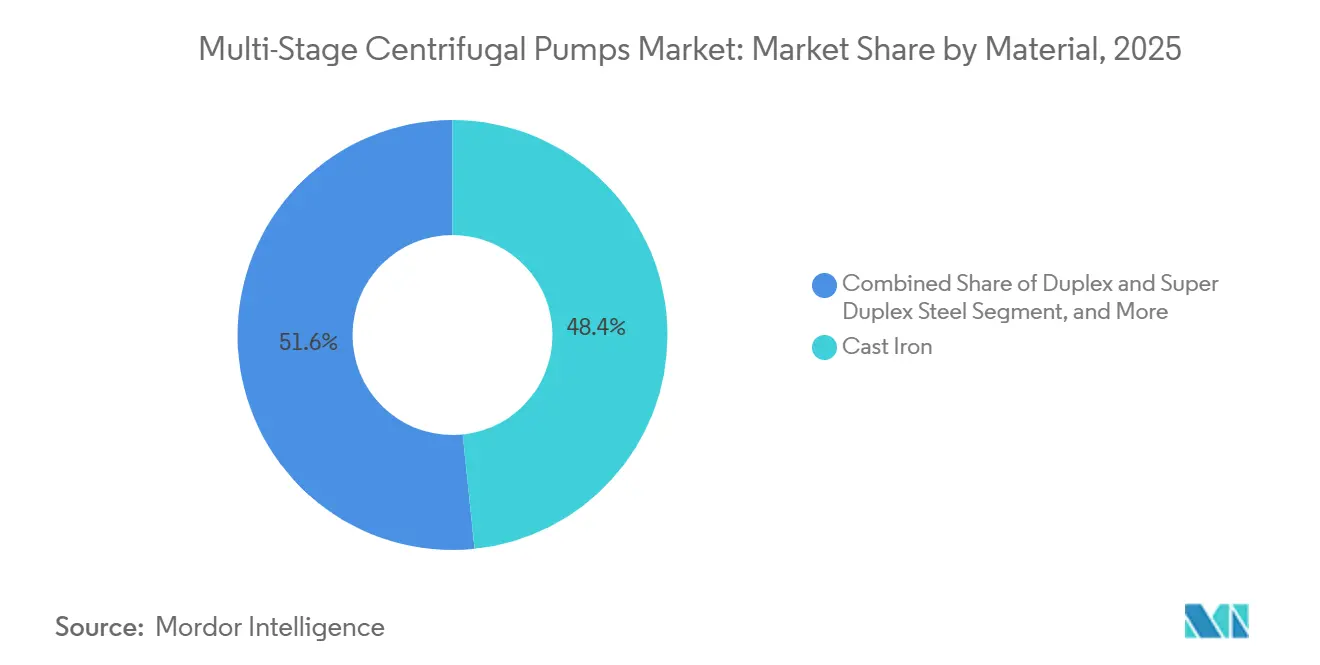
- By material, cast iron captured 48.3% share in 2025 but duplex and super duplex steels will post the highest 5.89% CAGR across 2026-2031.
- By end-user, water and wastewater systems contributed 32.4% revenue in 2025, whereas desalination plants are projected to advance at a 4.99% CAGR to 2031.
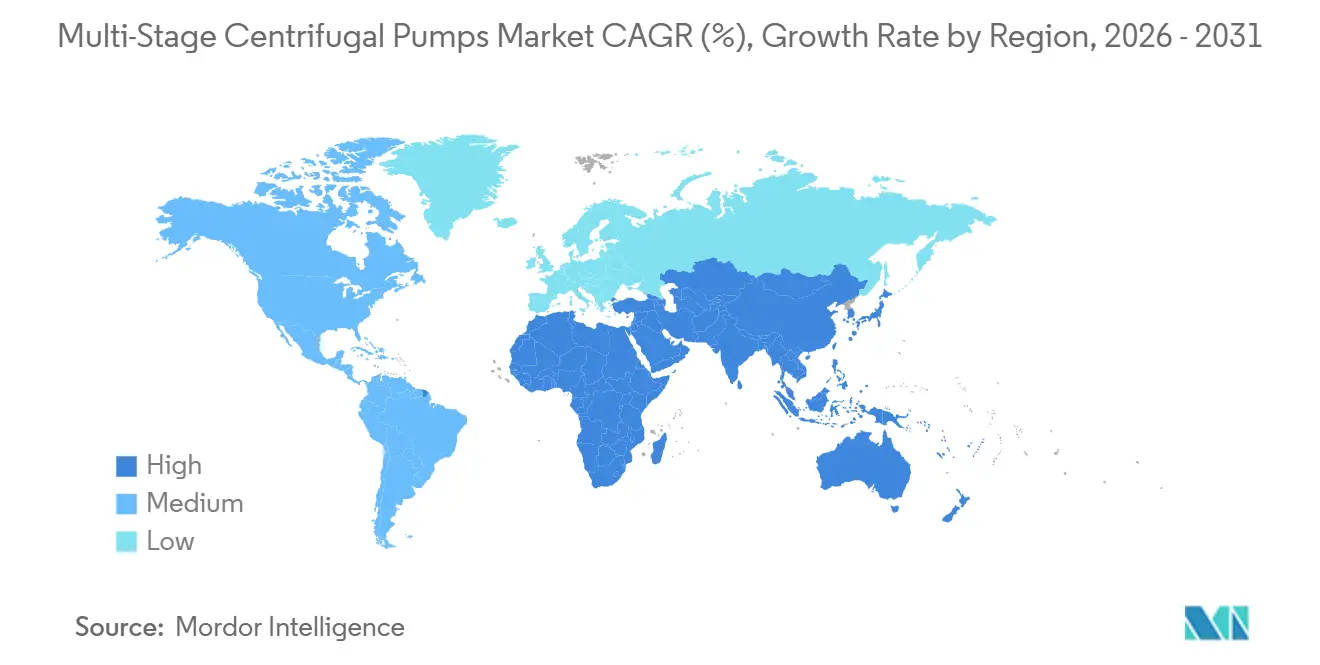
- By geography, Asia Pacific led with 36.7% share in 2025 and the Middle East is expected to grow the quickest at 5.62% CAGR over the forecast horizon.
Note: Market size and forecast figures in this report are generated using Mordor Intelligence’s proprietary estimation framework, updated with the latest available data and insights as of January 2026.
Market Trends and Insights
Drivers Impact Analysis of Multi-Stage Centrifugal Pumps Market*
| Driver | (~) % Impact on CAGR Forecast | Geographic Relevance | Impact Timeline |
|---|---|---|---|
| Surging Water and Wastewater Infrastructure Spending in North America and Europe | +0.70% | North America and Europe, with spillover to Latin America | Medium term (2-4 years) |
| Expansion of Desalination Projects in Water-Scarce Economies | +0.80% | Middle East core, North Africa, and Australia | Long term (≥ 4 years) |
| Increasing Deep-Well Oilfield Projects Requiring High-Head Pumping | +0.50% | Middle East, North America (shale basins), Russia | Medium term (2-4 years) |
| Shift Toward Energy-Efficient Pump Designs Driven by ESG Targets | +0.60% | Global, with early adoption in Europe and North America | Short term (≤ 2 years) |
| Integration of IIoT-Enabled Predictive Maintenance Platforms | +0.40% | Global, led by Europe and North America industrial clusters | Short term (≤ 2 years) |
| Growing Government Subsidies for Rural Irrigation in Asia Pacific | +0.50% | Asia Pacific core (India, China, Southeast Asia) | Long term (≥ 4 years) |
| Source: Mordor Intelligence | |||
Surging Water and Wastewater Infrastructure Spending
Public funding for pipe replacement and treatment upgrades is translating directly into demand for pressure-boosting multi-stage units. The United States Bipartisan Infrastructure Law earmarked USD 55 billion for water networks, and over 40% of municipal pumps in the country have surpassed 30-year service life. Similar momentum in Europe is led by Germany’s EUR 2.5 billion (USD 2.67 billion) municipal program and supportive financing from the European Investment Bank.[1] Compliance with new U.S. Department of Energy energy-index thresholds that took effect in 2025 is accelerating the swap-out of inefficient single-stage equipment. Together, these dynamics underpin the largest installed-base refresh ever seen in the segment, favoring horizontal configurations that simplify maintenance procedures.
Expansion of Desalination Projects in Water-Scarce Economies
Committed capital topping USD 100 billion across the Gulf Cooperation Council has catalyzed a wave of orders for high-pressure multi-stage pumps capable of operating at 60-80 bar.[2] Flagship sites such as Yanbu 4 and Shuaibah 3 in Saudi Arabia each specify more than a dozen 14-stage duplex-steel models. Outside the Gulf, Egypt’s Abu Qir plant and the United Arab Emirates’ Hassyan project are adopting energy-recovery devices that cut pump power draw by a third. The material mix is shifting accordingly, with duplex and super duplex steels displacing 316L stainless steel as chloride-induced corrosion limits rise.
Increasing Deep-Well Oilfield Projects Requiring High-Head Pumping
Saudi Aramco’s Marjan and Berri expansions, the Vostok Oil megaproject in Siberia, and a rebound in shale completions across the Permian Basin are lifting shipments of above-10-stage pumps rated beyond 4,000 psi.[3] Enhanced oil recovery schemes, such as polymer flooding and CO₂ injection, demand corrosion-resistant metallurgy certified to API 610 11th edition, allowing suppliers such as ANDRITZ to gain share with duplex-steel offerings. Upstream capital outlays directed to artificial-lift systems reached USD 115 billion in 2026 and remain on an upward curve.
Shift Toward Energy-Efficient Pump Designs Driven by ESG Targets
Regulatory pressure, exemplified by Europe’s Ecodesign Directive 2025 motor mandate, is forcing end users to adopt variable-speed drives and permanent-magnet motors. Sulzer’s Energy Optimization Service trims operating power by up to 25% and pays back in under 18 months. Xylem’s e-Series multi-stage line achieves 89% wire-to-water efficiency, and corporate purchasers link such upgrades to corporate Scope 3 commitments. Energy savings translate into a lower lifetime cost of ownership, sustaining the multi-stage centrifugal pumps market even where project capital is constrained.
Restraints Impact Analysis of Multi-Stage Centrifugal Pumps Market*
| Restraint | (~) % Impact on CAGR Forecast | Geographic Relevance | Impact Timeline |
|---|---|---|---|
| Volatility in Raw Material Prices Raising Capex for OEMs | -0.60% | Global, with acute pressure in Asia Pacific manufacturing hubs | Short term (≤ 2 years) |
| Intensifying Competition from Low-Cost Regional Manufacturers | -0.50% | Asia Pacific and Middle East, with spillover to Africa | Medium term (2-4 years) |
| Lengthy Certification Cycles in Nuclear and Power Applications | -0.30% | North America, Europe, China (nuclear-expansion markets) | Long term (≥ 4 years) |
| Rising Adoption of Alternative Positive-Displacement Pump Technologies | -0.40% | Global, concentrated in chemical and food-processing sectors | Medium term (2-4 years) |
| Source: Mordor Intelligence | |||
Volatility in Raw-Material Prices Raising Capex for OEMs
Nickel and chromium price spikes in 2025 lifted duplex-steel input costs by double digits, squeezing gross margins at suppliers locked into multi-year municipal contracts. Flowserve cited a 220-basis-point margin contraction in 2025 as it struggled to pass through higher alloy surcharges. Currency swings exacerbate planning risk, especially for European OEMs purchasing Asian forgings in U.S. dollars. Some manufacturers now hedge by bulk-buying stainless-steel castings and diversifying supplier bases, yet sustained volatility still weighs on near-term profitability.
Intensifying Competition from Low-Cost Regional Manufacturers
Chinese and Indian producers have captured 12% of Southeast Asian sales by underpricing established brands 20-25% on standard cast-iron units. Quality differentials are narrowing; ISO 9906 Grade 2B pumps from new entrants posted failure rates within 8% of European equivalents in a 5-year field study. Incumbents answer with local assembly plants and extended warranty schemes, but such moves pare back premium pricing, placing a ceiling on average selling prices within the multi-stage centrifugal pumps market.
*Our forecasts treat driver/restraint impacts as directional, not additive. The impact forecasts reflect baseline growth, mix effects, and variable interactions.
Multi-Stage Centrifugal Pumps Market Segment Analysis
By Type - Vertical Pumps Gain Ground in Space-Constrained Installations
The vertical subsegment is projected to grow at 5.45% CAGR, a pace that outstrips the overall multi-stage centrifugal pumps market by more than 100 basis points. Horizontal models maintain a 61.0% multi-stage centrifugal pumps market share on the strength of lower installation expense in water treatment and industrial cooling duty. However, high-rise construction and offshore platform projects prioritize compact footprints, tipping procurement toward vertical stacks equipped with integrated drives. Wilo’s Helix EXCEL line, introduced in 2025, saves 40% floor space relative to comparable horizontals, a decisive advantage in premium urban basements. Offshore wells reinforce the same preference; modular vertical assemblies fit 9-inch casings and can descend beyond 3,500 meters to lift fluids in Saudi Aramco’s Marjan field. As end users shift to predictive maintenance, vibration sensors mounted on vertical axes offer cleaner data streams, supporting analytics platforms without costly retrofits.
Horizontal units will continue to dominate power-generation cooling circuits where inline layouts simplify turbine-driven back-up arrangements. Many public utilities own existing spare parts inventories geared toward horizontal pumps, tempering the conversion rate. Nevertheless, the steady rollout of high-density commercial towers in Asia and the Middle East will ensure that vertical solutions steadily erode horizontal share, particularly where building regulations cap mechanical-room footprints. Suppliers that deliver plug-and-play vertical skids with IE4 motors and cloud-ready controllers are positioned to outpace the broader multi-stage centrifugal pumps market.

By Stage - Ultra-High-Head Projects Boost Above-10-Stage Demand
Units carrying 2-5 impellers represented 45.2% of the multi-stage centrifugal pumps market size in 2025, but above-10-stage machines will advance at a 5.21% CAGR through 2031 as desalination, carbon-capture, and deep-reservoir oil lifts proliferate. Saudi Arabia’s Yanbu 4 plant employs 14-stage pumps rated at 75 bar to offset the osmotic pressure of 45,000 ppm seawater, illustrating how multi-stage counts rise in tandem with salinity and head height. Similarly, Norway’s Northern Lights carbon-capture system compresses liquefied CO₂ to 150 bar using 16-stage compressors, a template for future sequestration hubs.
Mid-range 6-10 stage pumps remain workhorses in boiler feedwater and chemical processing, where balanced capital and operating costs matter more than peak discharge pressure. Yet each additional impeller adds mechanical complexity, so OEMs deploy ceramic-coated wear rings and thrust-balancing designs to sustain mean time between overhaul. Digital twins created during computational-fluid-dynamics simulations now predict internal recirculation patterns, enabling OEMs to fine-tune stage counts before casting billets, an emerging efficiency lever within the multi-stage centrifugal pumps market.
By Material - Duplex Steels Capture Share in Offshore and Desalination Duty
Cast iron continues to dominate on unit volume, holding 48.3% share in 2025 thanks to a cost basis near USD 1,200 per metric ton. In contrast, duplex and super duplex steels, running USD 4,500-6,000 per ton, are gaining at a 5.89% CAGR wherever chloride-rich brines or sour hydrocarbons accelerate corrosion. Middle East operators cite 25-year life cycles for duplex-steel pumps certified to NORSOK M-001, a decisive economic argument for offshore platforms that face million-dollar day rates should pumps fail.
Stainless 316L maintains relevance in food, beverage, and pharmaceutical lines that must meet 3-A and ASME BPE-2024 hygienic criteria. Here, electropolished internals and sub-0.8 µm surface roughness are mandatory, and suppliers lead with documentation packages suited for validation audits. Titanium remains a niche solution in coastal power-plant condensers, and nickel alloys appear in acid-handling service, but both lag duplex steels on cost effectiveness. Lifecycle studies published in 2025 affirm that duplex units deliver 40% lower total cost of ownership than 316L in high-salinity duty, evidence that will likely accelerate further material migration across the multi-stage centrifugal pumps market.

By End-User Industry - Desalination Sets the Growth Pace
Municipal water and wastewater treatment contributed 32.4% of revenue in 2025, anchored by funding lines in the United States and Europe that prioritize replacement of aged equipment. Desalination, however, represents the fastest climb, projected at 4.99% CAGR into 2031. The Gulf pipeline alone amounts to USD 100 billion in projects at varying stages of execution, each specifying dozens of high-pressure pumps operating above 60 bar. Outside the Middle East, Egypt, Iraq, and Australia are lining up megaprojects that replicate this capital pattern.
Oil and gas remains structurally important, stimulated by 14% year-on-year growth in electric submersible pump shipments during 2025. Chemical and pharmaceutical processing favor hygienic stainless-steel constructions, while food and beverage lines reward clean-in-place designs that slash sanitation downtime. Power generation’s shift toward flexible turbine load-following, prompted by renewable integration, is catalyzing orders for variable-speed multi-stage feeder pumps. Metals and mining outfits value abrasion-resistant white-iron internals, adopting pumps that extend run-time in tailings and dewatering loops. Collectively, these patterns diversify revenue streams and moderate cyclicality within the multi-stage centrifugal pumps market.
Geography Analysis
APAC Multi-Stage Centrifugal Pumps Market
Asia Pacific accounted for 36.7% of global revenue in 2025, buoyed by China’s CNY 5.4 trillion (USD 740 billion) rural water program and India’s Jal Jeevan Mission that linked 148 million homes to piped networks by December 2025. Government subsidies under India’s PM-KUSUM scheme funded 180,000 solar-powered agricultural pumps, spotlighting a sizeable off-grid niche. Japan’s Ministry of Health, Labour and Welfare earmarked JPY 1.2 trillion (USD 8.1 billion) to replace aging mains, implying elevated demand for small and mid-size units through 2028. Southeast Asian irrigation projects in Vietnam and Indonesia round out the region’s near-term pipeline. Local manufacturers enjoy cost advantages, yet global brands preserve share in high-specification builds that require third-party certification.
Middle East and Turkey Multi-Stage Centrifugal Pumps Market
The Middle East is forecast to register the fastest 5.62% CAGR across 2026-2031 as desalination and nuclear power construction drive high-pressure pump procurement. Saudi Arabia’s Yanbu 4 and Shuaibah 3 plants, Qatar’s Facility E, and the UAE’s Hassyan project headline a dense order book for duplex-steel multistage units. Turkey’s Akkuyu nuclear complex adds another 96 primary and secondary cooling pumps to regional demand. Financing from sovereign wealth funds and development banks mitigates commodity-price volatility, ensuring a steady tender cadence.
North America, Europe, LATAM and Africa Multi-Stage Centrifugal Pumps Market
North America and Europe together represented 38% of 2025 turnovers, with sales propelled by lifecycle-driven replacements mandated by new energy-efficiency standards. The U.S. Department of Energy rules effective January 2025 and Europe’s IE4 motor stipulations effective 2027 advance variable-speed multi-stage adoption. Latin America’s expansion concentrates in Brazil and Argentina where irrigation and mining hold sway, whereas Africa’s outlook is shaped by South Africa’s Lesotho Highlands Water Project Phase II and Kenya’s solar-pump irrigation program. Despite divergent baselines, all regions converge on a common requirement for higher efficiency and lower unplanned downtime, hallmarks of modern multi-stage centrifugal pumps market offerings.
Regulatory Landscape
Procurement and compliance requirements for multi-stage centrifugal pumps are increasingly shaped by energy-efficiency rules and industry specifications for critical-service applications. In the United States, U.S. Department of Energy energy-index thresholds that took effect in January 2025 have accelerated replacement activity in municipal and industrial duty, while Europe is moving through tighter motor efficiency requirements tied to its Ecodesign framework, which is pushing wider adoption of variable-speed drives and higher-efficiency motor-pump packages.
For oil, gas, and petrochemical service, project tenders frequently reference API 610 and related supply-chain quality controls. IOGP S-615v2025-12 is used as a supplementary technical specification to API 610 procurement, and IOGP S-615Q reinforces quality-management expectations across the centrifugal pump supply chain by referencing ISO 9001 and API Q1 concepts. In China, GB/T 3215-2025 for centrifugal pumps serving oil, petrochemical, and natural gas industries took effect on April 1, 2026, adding another compliance anchor for OEMs and local manufacturers supplying in-country projects.
Competitive Landscape
The multi-stage centrifugal pumps market displays moderate concentration. The top five brands control an estimated 35% of revenue, leaving substantial latitude for regional challengers. Global leaders deepen resilience by shifting toward service-recurring business models. Grundfos Machine Health, launched in 2025, bundles vibration analytics and edge gateways on a subscription, delivering 30% downtime cuts for early adopters. Sulzer’s Energy Optimization Service and Xylem’s cloud collaboration with Amazon Web Services similarly convert one-time hardware sales into annuity cash flows.
Localization remains a second pillar. Grundfos’ USD 60 million plant in Coimbatore leverages domestic castings and motors to trim landed costs by 15%. Flowserve opened a pump-overhaul center in Saudi Arabia’s Jubail industrial zone, positioning for nitrogen, hydrogen, and desalination retrofits. Mergers augment aftermarket reach; Sulzer’s Denmark acquisition added 120 technicians and a northern European fleet of service vans.
Disruption is evident at the low end of the price curve. Leo Group and Shimge push cast-iron multi-stage units into Southeast Asia at discounts topping 20%. Kirloskar Brothers and Shakti Pumps target Africa with solar-powered solutions that bypass weak grids, carving out niches beyond the economic reach of Western incumbents. Technology differentiation narrows as Chinese firms file impeller and wear-ring patents and certify to ISO 9906 Grade 2B tolerances. In response, incumbents emphasize nuclear-qualified and API 610-compliant lines where certification hurdles remain high, sustaining their price premium in critical-service applications.
Multi-Stage Centrifugal Pumps Industry Leaders
-
Kirloskar Brothers Limited
-
Baker Hughes Company
-
Circor International Inc.
-
Ebara Corporation
-
The Weir Group
- *Disclaimer: Major Players sorted in no particular order
Multi-Stage Centrifugal Pumps Market Companies Covered in this Report
- Kirloskar Brothers Limited
- Baker Hughes Company
- Circor International Inc.
- Ebara Corporation
- The Weir Group plc
- Grundfos Holding A/S
- Pentair plc
- Sulzer Ltd
- Tsurumi Manufacturing Co. Ltd
- Wilo SE
- Xylem Inc.
- KSB SE & Co. KGaA
- Flowserve Corporation
- Ruhrpumpen Group
- ANDRITZ AG
- SPX FLOW Inc.
- ITT Inc. (Goulds Pumps)
- Dab Pumps S.p.A.
- Shakti Pumps (India) Ltd
- Flowrox Oy
Market Opportunities and Future Outlook
Tightened energy-efficiency requirements and a broader operating-cost focus in utilities and process industries are expanding whitespace for packaged, measurable efficiency upgrades. Multi-stage units paired with variable-speed drives, higher-efficiency motors, and sensor-enabled service can shift sales from pump-only specifications toward monitored uptime and documented energy reductions.
A second opportunity is the push into specialized, higher-value applications where metallurgy, sealing, and qualification standards raise the barrier to entry, including large desalination trains (60-80 bar duty cited in Gulf projects) and hydrogen value-chain equipment. In April 2026, Ebara Elliott Energy received an order from Kawasaki Heavy Industries to supply liquid hydrogen booster pumps for a liquefied hydrogen supply-chain demonstration, indicating demand for advanced multi-stage and cryogenic-adjacent rotating equipment capabilities within OEM portfolios. There is also continued geographic whitespace where procurement emphasizes local availability and service response, supported by localization actions such as Grundfos series production at its Coimbatore facility in late 2025 and Ebara’s expansion of South American pump solutions through its March 2026 acquisition of Germek.
Recent Industry Developments in Multi-Stage Centrifugal Pumps Market
- June 2026: Guangzhou Xinheng Pump Manufacturing Co., Ltd. signed a cooperation agreement with Prudent Equipment Trading at the UAE International Investment Summit in Guangzhou, integrating into ADNOC's supply chain. The collaboration strengthens ADNOC pump supply ecosystem and may generate multi-year retrofit and maintenance demand for high pressure centrifugal pumps.
- December 2025: Grundfos started series production at its USD 60 million Coimbatore, India facility, lifting annual capacity. The expansion strengthens regional manufacturing footprint and could reduce costs, reinforcing supply security in APAC.
- September 2025: Sulzer Qatar Facility E desalination plant commenced operations using 48 Sulzer high pressure pumps. The move enhances exposure to large scale water infrastructure projects in the Middle East.
Multi-Stage Centrifugal Pumps Market Report Scope and Research Methodology
Market Definition and Coverage
This market covers multi-stage centrifugal pumps sold for moving liquids at higher heads by using two or more impellers in series. The sizing is based on factory-gate revenue across major end-use industries and regions.
Scope exclusions: we exclude installation, civil works, long-term operation and maintenance contracts, spare parts-only shipments, and standalone motors or drives sold separately from the pump.
Segments Covered in This Report
- By Type
- Horizontal Pumps
- Vertical Pumps
- By Stage
- 2-5 Stage
- 6-10 Stage
- Above 10 Stage
- By Material
- Cast Iron
- Stainless Steel
- Duplex and Super Duplex Steel
- Other Materials
- By End-User Industry
- Oil and Gas
- Chemicals
- Food and Beverage
- Water and Wastewater
- Power Generation
- Pharmaceuticals
- Metals and Mining
- Other End-User Industries
- By Geography
- North America
- United States
- Canada
- Mexico
- South America
- Brazil
- Argentina
- Rest of South America
- Europe
- Germany
- France
- United Kingdom
- Italy
- Russia
- Rest of Europe
- Asia Pacific
- China
- India
- Japan
- South Korea
- Rest of Asia Pacific
- Middle East
- Saudi Arabia
- United Arab Emirates
- Turkey
- Rest of Middle East
- Africa
- South Africa
- Nigeria
- Egypt
- Rest of Africa
- North America
Data Sources, Market Sizing, and Validation
Desk Research
Desk research was used to set the market boundaries and to anchor the model with repeatable demand signals tied to high-head pumping requirements. We mainly rely on public sources such as the US Energy Information Administration, the International Energy Agency, UN Comtrade, World Bank water and infrastructure indicators, and standards bodies such as ISO, plus national energy-efficiency programs, which help frame where multi-stage designs are typically specified.
We also review manufacturer annual reports, investor presentations, product catalogs, and credible trade and engineering publications to map typical applications such as boiler feed, reverse osmosis, high-rise boosting, and oilfield injection. Where public filings are limited, we supplement with paid subscriptions for company financials and news, patent databases to track design shifts, and shipment-level import and export databases to sanity-check cross-border equipment flows. These references are not exhaustive, and additional public and subscription sources were used during data collection, validation, and clarification.
Primary Interviews and Surveys
Primary work was used to confirm how demand behaves by application and to pressure-test pricing and replacement cycles that are not clear in public datasets. We spoke with pump OEMs and channel participants, EPC and project engineering stakeholders, and end-user maintenance and procurement teams across APAC, EMEA, and the Americas. The discussions were used to refine utilization, specification ranges, and realistic adoption timing by project type.
Distribution of primary research fieldwork respondents
| Company type | Respondent position | Region |
|---|---|---|
| Top tier: 25% | CXOs: 15% | APAC: 39% |
| Mid tier: 59% | Functional/Unit leaders: 25% | EMEA: 34% |
| Smaller Players: 16% | Managers: 60% | Americas: 27% |
Market-Sizing & Forecasting
Sizing starts with a top-down build that reconstructs the demand pool from application signals where multi-stage pumps are routinely specified. We then convert those signals into annual pump value using validated ranges for duty conditions and typical configuration mix.
Inputs include new water and wastewater capacity additions, desalination project pipelines, refinery and petrochemical capacity changes, thermal power boiler-feed requirements, and oil and gas injection and lifting activity. These are translated into likely unit demand and average selling price bands.
The totals are corroborated with selective bottom-up approximations using sampled supplier revenues, channel checks, and volume times price calculations for common pump classes, which helps correct for over-counting during weaker capex cycles. When gaps appear, we tighten assumptions using interview feedback on lead times, replacement share versus greenfield share, and the spread between horizontal and vertical configurations. For forecasting, we run scenario analysis supported by short trend models, where capex and industrial output outlooks, energy-efficiency upgrade timing, and steel and alloy price expectations shape the price and volume paths.
Data Validation & Update Cycle
Validation is done through several checks so the model outputs do not drift away from procurement behavior. We compare results against independent indicators such as pump export trends, major project award timing, and end-user maintenance spending patterns. Any large variance is reviewed again before sign-off.
The draft is then reviewed in steps by another analyst, followed by targeted re-contacts when pricing, application mix, or a regional growth driver looks inconsistent with field feedback. Reports refresh annually, with interim updates when material events occur, and a final pass is completed before delivery so clients receive the latest updated view.
Mordor Intelligence's Multi Stage Centrifugal Pumps Market Size Versus Other Published Estimates
Published market values for multi-stage centrifugal pumps can differ across sources even when the topic name is similar. The differences usually come from what is counted as revenue, how pricing is handled across pump classes, and whether the forecast is tied to project timing or broader industrial growth proxies.
A common gap driver is whether aftermarket and service revenues are bundled into the total. Mordor Intelligence counts pump equipment revenue at the point of sale and keeps spares and long-term service outside the core total, which can pull the number lower than studies that bundle lifecycle value. Variance also shows up when some publishers assume a single global price curve, while others adjust ASPs by metallurgy, pressure class, and application (for example, boiler feed versus boosting), and then apply different currency conversion timing. Finally, refresh cadence matters because large desalination and power orders can shift a year quickly when award dates move.
Benchmark comparison
| Source | Market Size | Gaps in Research Methodology |
|---|---|---|
| Mordor Intelligence | USD 7.56 B (2026) | |
| Global Consultancy A | USD 8.40 B (2026) | Likely includes aftermarket spares and service bundles alongside new pump sales, and may use broader pump pricing averages that lift ASPs for standard boosting duties. |
| Industry Association B | USD 6.90 B (2026) | May restrict scope to industrial process sectors and exclude municipal water and building services demand, and may apply conservative project realization rates that defer orders into later years. |
The spread across the table is mainly explained by what is counted in revenue and how application mix is translated into price and volume. By keeping the scope tied to equipment shipments and by using application-led demand indicators that can be cross-checked, the estimate stays traceable to clear inputs and can be repeated and reviewed year to year.
Key Questions Answered in the Report
What is the current value of the multi-stage centrifugal pumps market?
The market stood at USD 7.56 billion in 2026 and is projected to reach USD 9.38 billion by 2031.
Which type of pump dominates global sales?
Horizontal multi-stage pumps led with 61.0% share in 2025 due to ease of maintenance and lower installation costs.
Which region is growing the fastest?
The Middle East is set to post the quickest 5.62% CAGR on the back of large desalination and nuclear projects.
What material segment is gaining the most traction?
Duplex and super duplex steels are expanding at 5.89% CAGR as offshore and desalination operators prioritize corrosion resistance.
How are manufacturers improving pump reliability?
Leading OEMs embed IIoT sensors and predictive analytics, cutting unplanned downtime by up to 30% in pilot deployments.
What is driving the shift toward energy-efficient pumps?
Stricter U.S. Department of Energy and European Ecodesign regulations plus corporate ESG targets are pushing adoption of high-efficiency variable-speed systems.