
Market Overview
| Study Period | 2020 - 2031 |
|---|---|
| Market Size (2026) | USD 6.78 Trillion |
| Market Size (2031) | USD 10.47 Trillion |
| Growth Rate (2026 - 2031) | 9.08 % |
| Fastest Growing Market | Africa |
| Largest Market | Asia Pacific |
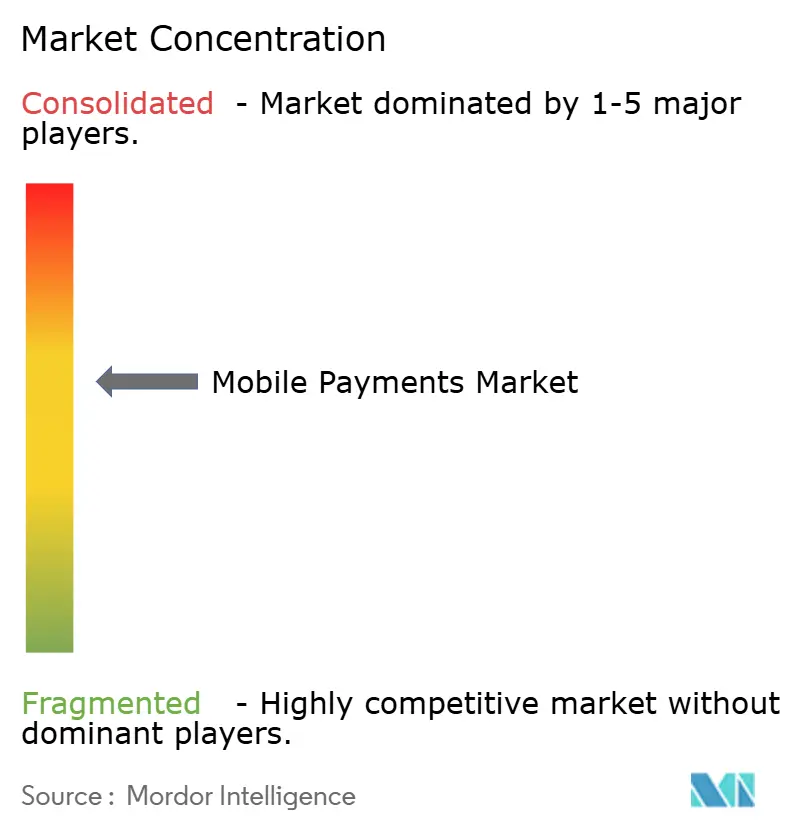
| Market Concentration | Medium |
Major Players *Disclaimer: Major Players sorted in no particular order Image © Mordor Intelligence. Reuse requires attribution under CC BY 4.0. | |
Mobile Payments Market Analysis by Mordor Intelligence
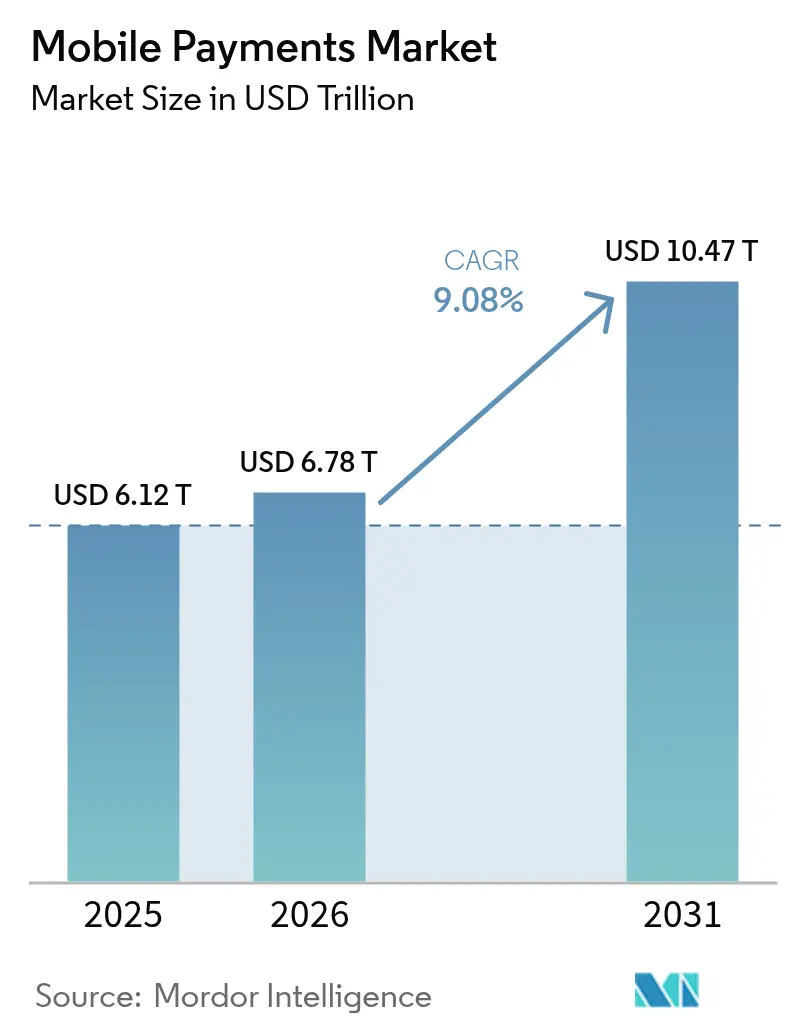
The mobile payments market size is projected to expand from USD 6.12 trillion in 2025 and USD 6.78 trillion in 2026 to USD 10.47 trillion by 2031, registering a CAGR of 9.08% between 2026 to 2031. Momentum is shifting from card-centric interchange models to zero-MDR account-to-account rails that clear funds instantly and surface richer transaction data. Real-time systems such as India’s UPI and Brazil’s Pix are proving that low-cost infrastructure can displace decades-old card networks within a few years, encouraging central banks elsewhere to replicate the blueprint. Super-apps in East and Southeast Asia are reinforcing wallet loyalty by bundling commerce, ride-hailing, insurance, and lending, while transit agencies that adopt NFC fare collection are turning the daily commute into a habit-forming tap-to-pay showcase. Competitive pressure is intensifying as regulators force platform gatekeepers to open hardware and software interfaces, allowing banks and fintechs to reclaim customer data and craft differentiated wallet propositions.
Key Report Takeaways
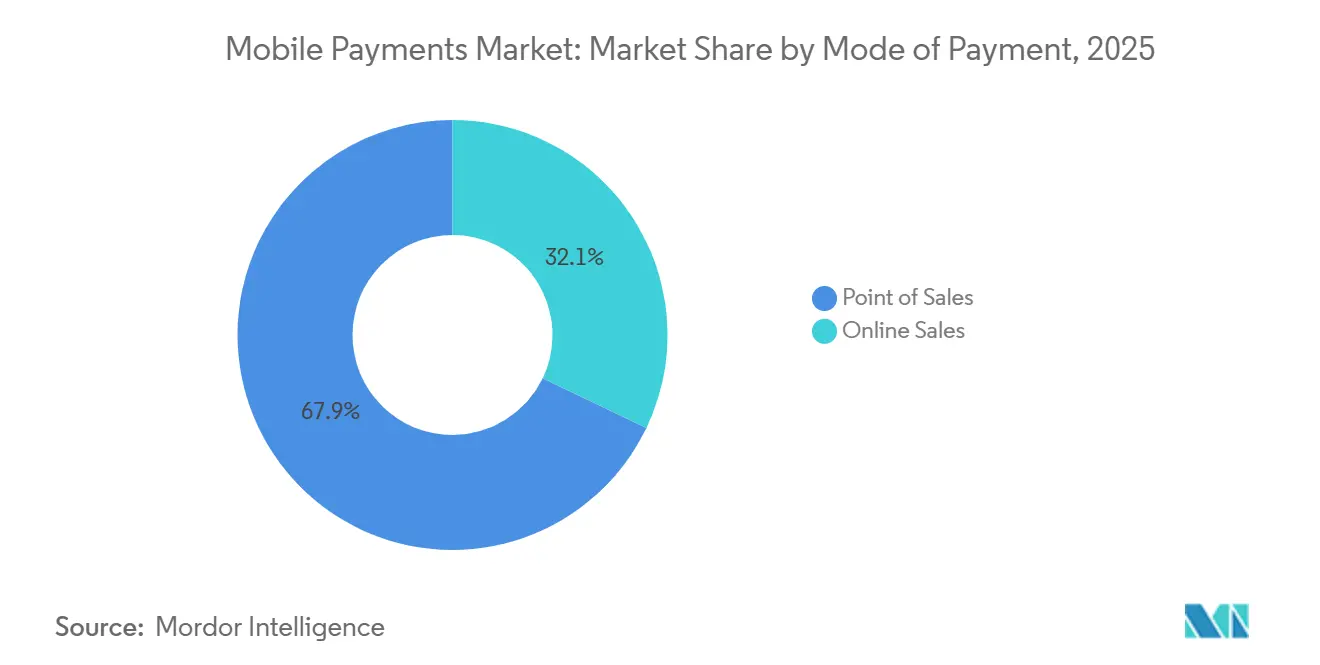
- By mode of payment, point of sales channels led with 67.89% revenue share in 2025; online channels are forecast to expand at an 11.43% CAGR through 2031.
- By payment type, other payment mechanisms, principally SMS and USSD wallets, commanded 48.67% of the mobile payments market share in 2025, while QR-based payments are projected to grow at a 12.24% CAGR between 2026 and 2031.
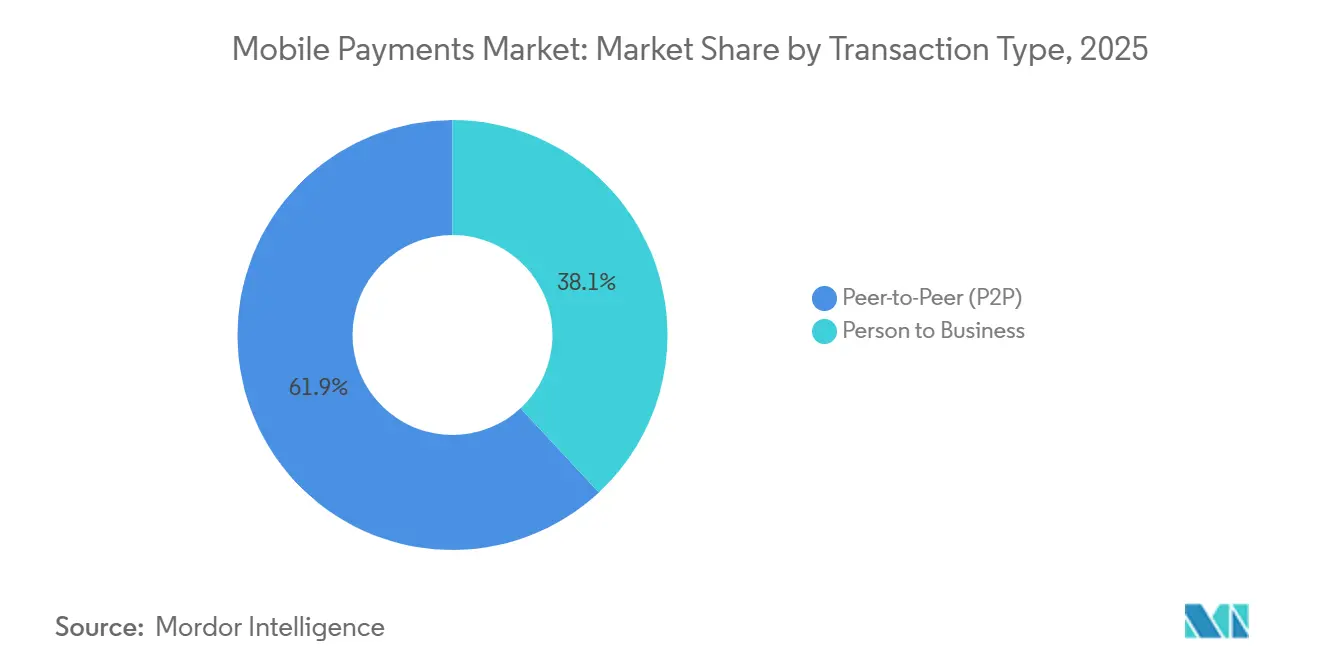
- By transaction type, peer-to-peer transfers accounted for 61.92% of volume in 2025, whereas person-to-business flows are advancing at a 13.17% CAGR over the forecast horizon.
- By application, retail and e-commerce captured 31.59% of the mobile payments market size in 2025 and transportation and logistics is pacing ahead at a 10.56% CAGR to 2031.
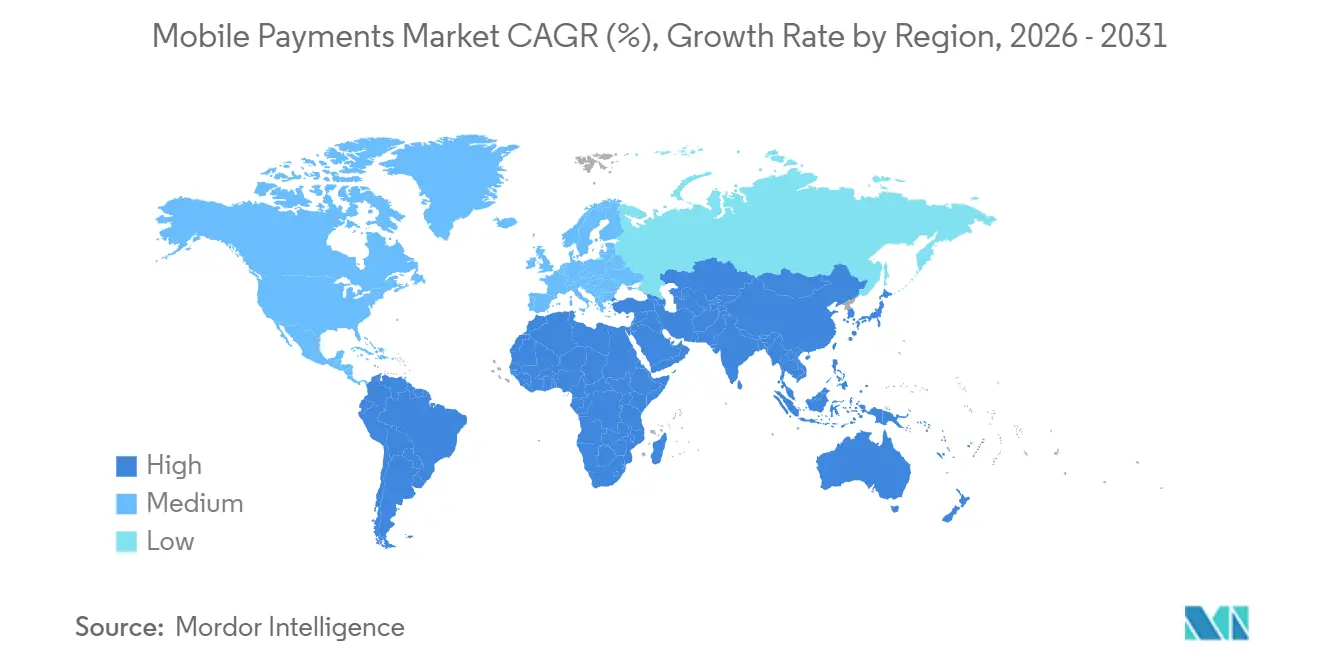
- By geography, Asia-Pacific captured 48.79% of revenue in 2025, while Africa is projected to post the highest regional growth at 19.16% CAGR during the forecast horizon.
Note: Market size and forecast figures in this report are generated using Mordor Intelligence’s proprietary estimation framework, updated with the latest available data and insights as of 2026.
Market Trends and Insights
Drivers Impact Analysis of Mobile Payments Market*
| Driver | (~) % Impact on CAGR Forecast | Geographic Relevance | Impact Timeline |
|---|---|---|---|
| Explosive UPI and Pix-Style Real-Time Rails Adoption | +2.8% | Asia-Pacific core, Latin America expansion, spillover to Middle East and Africa | Medium term (2-4 years) |
| Subsidised Merchant MDRs Fueling QR-Code Uptake | +1.9% | Global, with highest intensity in India, Southeast Asia, Latin America | Short term (≤ 2 years) |
| Super-App Ecosystem Lock-Ins in East and Southeast Asia | +1.6% | China, Indonesia, Singapore, Thailand, Vietnam, South Korea | Long term (≥ 4 years) |
| NFC-Enabled Transit Projects Boosting Urban Proximity Spend | +1.3% | North America, Europe, Asia-Pacific urban centers | Medium term (2-4 years) |
| Interchange-Free A2A Wallets Compressing Card Fees | +1.5% | Global, with early gains in Brazil, India, European Union | Medium term (2-4 years) |
| Apple iPhone Third-Party NFC Access Opening New Wallet Competition | +0.9% | European Economic Area, potential spillover to other jurisdictions | Short term (≤ 2 years) |
| Source: Mordor Intelligence | |||
Explosive UPI and Pix-Style Real-Time Rails Adoption
India’s Unified Payments Interface handled 228 billion transactions worth INR 300 trillion (USD 3.61 trillion) in 2025, equal to 83% of national retail digital volume, validating that real-time, zero-interchange rails can eclipse card usage once consumer familiarity and merchant ubiquity align. Brazil’s Pix reached 170 million adults and 20 million companies within four years, with person-to-business flows growing fastest as QR scans replace boleto slips.[1]Banco Central do Brasil, “Pix Payment System Statistics,” bcb.gov.br Instant settlement slashes working-capital strain and bolsters monetary-policy transmission, prompting Singapore, Malaysia, and the European Union to accelerate similar rollouts.
Subsidised Merchant MDRs Fueling QR-Code Uptake
Indonesia’s QRIS regime caps merchant discount rates at 0.7% for small-ticket transactions and guarantees interoperability across 30 e-wallets, expanding acceptance to 21 million points by 2024.[2]Bank Indonesia, “QRIS Statistics and Regulations,” bi.go.id Vietnam mirrored the tactic, waiving MDRs for micro-merchants and registering 892% year-on-year QR volume growth in January 2024. Governments justify the subsidies by enlarging the tax base and shrinking cash-handling costs, while wallet providers pivot to value-added services such as inventory analytics and loyalty engines.
Super-App Ecosystem Lock-Ins in East and Southeast Asia
Alipay and WeChat Pay processed more than 90% of China’s mobile payments in 2025, embedding mini-programs that bundle shopping, ride-hailing, wealth management, and insurance, which makes wallet switching onerous. GrabPay’s 40 million monthly users across Southeast Asia illustrate the model’s portability, delivering USD 9.4 billion in gross merchandise value in Q3 2024. Regulators are responding; China’s central bank ordered Alipay-WeChat interoperability in 2024, hinting at future antitrust interventions elsewhere.
Interchange-Free A2A Wallets Compressing Card Fees
The U.S. FedNow network connected 900 institutions by 2024, enabling account-pull checkouts that save merchants 1-3 percentage-points in fees. Europe’s SEPA Instant Payments mandate, effective January 2025, requires euro transfers to settle in under 10 seconds, catalyzing merchant adoption of open-banking-initiated payments. Merchants report 40-60% fee savings and zero chargeback exposure, pressuring card schemes to reposition as fraud-protection layers rather than primary rails.
Restraints Impact Analysis of Mobile Payments Market*
| Restraint | (~) % Impact on CAGR Forecast | Geographic Relevance | Impact Timeline |
|---|---|---|---|
| Fragmented Tokenisation Standards Hindering Cross-Wallet Acceptance | -0.8% | Global, with highest friction in cross-border e-commerce | Medium term (2-4 years) |
| High Chargeback Ratios in Cross-Border Wallet-Funded Transactions | -1.1% | Global, concentrated in Europe-Asia and North America-Asia corridors | Short term (≤ 2 years) |
| In-Store NFC Interoperability Gaps in US Dual-Tap Flows | -0.6% | United States, limited spillover to Canada and Mexico | Short term (≤ 2 years) |
| AML and KYC Friction Slowing Wallet On-Boarding in Tier-2 African Banks | -0.7% | Sub-Saharan Africa, with early challenges in Nigeria, Kenya, Ghana | Medium term (2-4 years) |
| Source: Mordor Intelligence | |||
High Chargeback Ratios in Cross-Border Wallet-Funded Transactions
Wallet-funded cross-border e-commerce sees chargeback rates of 1-2%, roughly quadruple domestic card levels, due to inconsistent authentication, currency disputes, and regulatory divergence.[3]Visa, “Chargeback Statistics,” visa.com Merchants often respond by geo-blocking high-risk corridors, which then constrains wallet adoption and stifles growth in the mobile payments market. Networks are investing in real-time fraud scoring, yet liability rules remain patchy, discouraging universal acceptance.
Fragmented Tokenisation Standards Hindering Cross-Wallet Acceptance
EMVCo’s token framework is interpreted differently across regions, leading to lifecycle and cryptogram mismatches that degrade authorization success for cross-border shoppers.[4]EMVCo, “Payment Token Service Provider Specifications,” emvco.com Retailers juggling multiple token vaults face higher costs and elevated cart-abandonment risk, undercutting one of the core convenience benefits that the mobile payments market promises.
*Our forecasts treat driver/restraint impacts as directional, not additive. The impact forecasts reflect baseline growth, mix effects, and variable interactions.
Mobile Payments Market Segment Analysis
By Mode of Payment:
Physical Retail Infrastructure Anchors Volume, Digital Channels Capture GrowtPoint of sales transactions delivered 67.89% of 2025 volume, underscoring the still-dominant role of NFC terminals and QR acceptance in brick-and-mortar settings. Nevertheless, online channels are forecast to grow at an 11.43% CAGR through 2031, reflecting expanding super-app ecosystems and one-click guest checkouts that remove traditional form-fill friction. Stripe’s 2024 Fastlane launch demonstrated a sub-30-second guest flow, lifting conversions markedly. While hardware refresh cycles slow point-of-sale upgrades, software distribution for e-commerce is near-instant, letting small merchants in under-banked regions tap digital wallets without card contracts. As a result, the mobile payments market is likely to see rapid share rebalancing despite the entrenched in-store base.
Evolving security requirements, notably PSD2’s strong customer authentication, initially impeded online adoption but are now largely invisible to consumers due to biometric pass-through in leading wallets. Where tap-to-ride transit systems normalize habitual phone payments, adjacent quick-service outlets are following suit, blurring the historical line between physical and digital checkout.


By Payment Type:
SMS and USSD Wallets Retain Reach, QR Codes Lead MomentumOther payment types, chiefly SMS and USSD wallets, held 48.67% share in 2025, proving indispensable where feature phones dominate and internet access is patchy. QR-based methods, however, are tracking a 12.24% CAGR as merchants appreciate zero hardware costs and governments subsidize MDRs. Indonesia’s interoperable QRIS and India’s Bharat QR exemplify how public standards ignite competition among private wallets without locking merchants into proprietary codes.
61 million users in 18 African nations move value over USSD rails, bypassing the need for smartphones. Still, as entry-level Android handsets fall below USD 50, QR acceptance is expected to leapfrog older modalities, expanding the mobile payments market size in rural locales formerly reliant on cash.
By Transaction Type:
Social Transfers Dominate Counts, Commercial Flows Drive ValuePeer-to-peer transfers represented 61.92% of 2025 transaction counts, energized by wedding gifts, informal commerce, and migrant remittances. Yet person-to-business volumes are projected to log a 13.17% CAGR as real-time rails eliminate cash-on-delivery and gig-economy payouts migrate to wallets. India’s Paytm, with 10.5 million QR merchants, exemplifies the pivot from gratuities to structured commerce.
Recurring bill frameworks such as India’s Bharat Bill Payment System are automating utilities and insurance debits, making digital wallets sticky and predictable revenue generators. Consequently, the mobile payments market share of commercial flows is set to rise even if P2P remains transaction-count heavy.
By Application:
Retail Commands Today, Transit and Logistics Accelerate TomorrowRetail and e-commerce absorbed 31.59% of 2025 mobile payments market size, reflecting grocery, apparel, and restaurant dominance. Transit and logistics, however, are expanding at a 10.56% CAGR as NFC fare gates proliferate and freight platforms embed instantaneous wallet settlements. Transport for London processed 1.7 million daily contactless taps in 2024, with 70% issued from phones, proving that the daily commute entrenches behavioral change.
Government-to-person disbursements also matter; India’s Direct Benefit Transfer funneled INR 9.4 trillion (USD 113 billion) to citizens in 2024, legitimizing wallets as official channels. Over the forecast period, public sector and healthcare payments are poised to climb as regulators digitize tax and license workflows, fortifying the mobile payments industry against cash leakage.
Geography Analysis
APAC Mobile Payments Market
Asia-Pacific remains the epicenter of the mobile payments market, anchored by Alipay and WeChat Pay capturing over 90% of China’s transactions and locking 1.33 billion users into super-app webs. India’s UPI contributed INR 300 trillion (USD 3.61 trillion) of 2025 value, equal to 83% of domestic retail digital activity. Southeast Asia is rising quickly; GrabPay’s 40 million monthly users and Indonesia’s 21 million QRIS merchants illustrate regional replication potential. Japan and South Korea continue to post high tap-to-pay penetration, with Kakao Pay processing KRW 183 trillion (USD 141 billion) in 2023.
LATAM Mobile Payments Market
Latin America is the second-fastest region as Brazil’s Pix moved BRL 26.4 trillion (USD 5.28 trillion) in 2024 and achieved 76.4% adult penetration. Mercado Pago processed USD 134 billion in total payment value in 2023 and is leveraging transaction data to underwrite consumer credit. Mexico’s CoDi and Argentina’s inflationary environment are also nudging cash users toward wallets.
Europe, North America and Middle East Mobile Payments Market
The Middle East is accelerating through policy targets, with the UAE at 95% smartphone penetration and Saudi Arabia’s Vision 2030 mandating cashless ecosystems. MTN Mobile Money’s agent-assisted onboarding offsets biometric KYC gaps, yet tier-2 banks lack infrastructure, slowing broader wallet rollout. North America and Europe show slower headline growth but benefit from transit-led NFC habit formation and impending open-banking boosters like SEPA Instant.

Regulatory Landscape
Regulation is increasingly shaping competition and interoperability in mobile payments, covering consumer protection, device access, and governance across real-time payment rails. In the European Union, the Digital Markets Act-driven opening of iPhone NFC access (implemented in July 2024) lowered platform gatekeeper barriers for banks and fintechs to deploy alternative wallets. Separately, the publication of compromise texts for PSD3 and the Payment Services Regulation on April 23, 2026 advanced a more harmonized framework for payment services, safeguarding, and open-banking access rules.
In high-growth markets, central banks continue to tighten security and operational requirements for prepaid and wallet ecosystems to reduce fraud risk and improve resilience. The Reserve Bank of India has updated and consolidated requirements across recurring payments and PPIs, including the Digital Payments E-mandate Framework, 2026 and the Master Direction on Prepaid Payment Instruments, 2026, along with 2026 changes to rules governing authorized persons for cross-border transactions. Across jurisdictions, policy themes highlighted by bodies such as the Financial Stability Board and UK regulators focus on cross-border payment transparency, fee governance, and stronger controls against scams and unauthorized payments, with compliance requirements feeding into wallet onboarding, transaction monitoring, and customer authentication design.
Value Chain Analysis
The mobile payments value chain begins with consumer devices and wallet interfaces, spanning OEM support and app-based wallets. It then runs through acceptance infrastructure, including QR codes, NFC terminals, and transit validators, before reaching merchant-facing enablement layers such as payment service providers, processors, and gateways (for example, Stripe and Adyen). Merchant acquirers and processing platforms (for example, Fiserv and Worldpay) connect transactions to issuing banks and account-to-account rails (UPI, Pix, FedNow, SEPA Instant) or to card networks, while risk, identity, and fraud controls sit across the stack to manage authentication and chargebacks in domestic and cross-border use.
Interoperability standards and regulator-driven API access increasingly influence where value is captured, especially where open-banking payments and QR regimes remove hardware and scheme-fee dependencies. Upstream enablers include standards bodies and industry coordination that shape tokenization, QR specifications, and API norms, while downstream distribution is driven by super-app ecosystems, e-commerce checkout integrations, and transit-led daily acceptance. Recent platform moves reinforce the shift toward software-defined acceptance and intelligent routing, with wallets and network infrastructure providers investing in AI-native payment capabilities and always-on settlement models that can reduce reliance on batch cycles and correspondent chains.
Competitive Landscape
The global mobile payments market features moderate concentration, with the top 10 players handling roughly 60% of transaction value. Super-apps such as Alipay, WeChat Pay, and GrabPay treat payments as gateways to higher-margin finance, whereas infrastructure firms like Visa, Mastercard, and Stripe monetize fraud analytics and cross-border settlement. Apple’s forced opening of iPhone NFC in July 2024 under the Digital Markets Act has empowered European banks to craft proprietary wallets, eroding Apple Pay’s platform moat. Card schemes are hedging via acquisitions, Mastercard purchased Recorded Future for USD 2.65 billion to embed threat intelligence into authorization flows.
White-space remains in cross-border remittances, where wallets still route through correspondent banks, and in U.S. offline acceptance, where NFC terminal coverage lags card issuance. New entrants are using FedNow connections to price merchant checkout at 0.5-1% versus the 2-3% card benchmark, shifting the cost calculus for small retailers. Technology differentiation centers on biometric authentication and AI-driven anomaly detection, with Stripe integrating facial-match vendor Okay to meet European PSD2 mandates.
Mobile Payments Industry Leaders
Alphabet (Google Pay)
Apple Inc.
Samsung Electronics (Samsung Pay)
PayPal Holdings
Amazon.com Inc. (Amazon Pay)
- *Disclaimer: Major Players sorted in no particular order
Mobile Payments Market Companies Covered in this Report
- Alphabet (Google Pay)
- Apple Inc.
- Samsung Electronics (Samsung Pay)
- PayPal Holdings Inc.
- Amazon.com Inc. (Amazon Pay)
- Visa Inc.
- American Express Company
- Mastercard Incorporated
- Stripe Inc.
- Block Inc. (Square and Cash App)
- Fidelity National Information Services Inc. (Worldpay)
- Fiserv Inc. (Clover)
- ACI Worldwide Inc.
- Adyen N.V.
- Ant Group Co., Ltd. (Alipay)
- Tencent Holdings Ltd. (WeChat Pay)
- One97 Communications Ltd. (Paytm)
- Grab Holdings Ltd. (GrabPay)
- Kakao Pay Corp.
- MercadoLibre Inc. (Mercado Pago)
- MTN Group Ltd. (MTN MoMo)
- Comviva Technologies Ltd.

Market Opportunities and Future Outlook
Interoperable payment initiation standards and rail-to-rail connectivity are creating whitespace in regions where wallets remain fragmented across closed-loop QR, proprietary NFC, and bank apps. Standardization signals already provide entry points for multi-wallet acceptance and routing layers: the South African Reserve Bank published QR+ Standard v1.2 in July 2026 to support interoperable digital payment initiation, and the U.S. Accredited Standards Committee X9 issued X9.150 for secure, merchant-presented dynamic QR codes aligned to instant and account-to-account payment use cases. With these signals, PSPs, acquirers, and wallet providers can reduce merchant complexity while improving authorization performance through shared specifications and connectivity.
Cross-network wallet interoperability and software-based acceptance models are also broadening use cases beyond domestic retail. PayPal announced PayPal World in July 2025 to connect large payment systems and digital wallets, starting with interoperability to PayPal and Venmo and linkages including Tenpay and UPI, which highlights demand for cross-border wallet reach without requiring users to move to new apps. On the acceptance side, Block announced in July 2025 that Cash App enabled Tap to Pay on iPhone for over a million sellers, reinforcing software-only acceptance as a lever for small merchants that previously avoided contactless due to terminal costs. In parallel, public-sector digitization programs such as Papua New Guinea Government E-Payment Standards (effective January 2025) and the National Bank of Ethiopia National Digital Payments Strategy (2026-2030 draft) extend the pipeline for government and everyday bill flows into mobile channels, supporting recurring payment use cases and stronger data trails.
Recent Industry Developments in Mobile Payments Market
- May 2026: Google announced a Google Wallet redesign and introduced Cross-device Payment Verification, enabling biometric confirmation on an Android phone in place of desktop SMS passcodes for certain payment flows. The change tightens authentication while keeping checkout friction low, supporting higher conversion for wallet-funded e-commerce and reducing dependence on vulnerable OTP delivery channels.
- July 2025: Block announced that Cash App enabled Tap to Pay on iPhone for over a million sellers, allowing contactless acceptance using only an iPhone without additional hardware. This lowers the entry barrier for micro and small merchants to add NFC acceptance and widens in-store wallet usage in locations where terminal deployment slowed adoption.
- July 2024: Apple opened iPhone NFC access to third-party wallets in the European Economic Area following requirements tied to the EU Digital Markets Act. The change enabled banks and fintechs to build competing tap-to-pay wallet experiences on iOS, increasing competitive intensity around token provisioning, fraud tooling, and value-added wallet features.


Mobile Payments Market Report Scope and Research Methodology
Market Definition and Coverage
For this study, the mobile payment market is defined as the value of payments initiated through a mobile device for online purchases, in-store checkout, and person-to-person transfers, using commonly used technologies like NFC and QR.
Scope exclusions: We exclude non-mobile initiated card payments and any unrelated banking services that do not directly enable a payment transaction.
Segments Covered in This Report
- By Mode of Payment
- Point of Sales
- Online Sales
- By Payment Type
- NFC
- QR-Based
- Other Payment Types
- By Transaction Type
- Peer-to-Peer (P2P)
- Person to Business
- By Application
- Retail and E-Commerce
- Transportation and Logistics
- Hospitality and Food-Service
- Government and Public Sector
- Other Applications (Education, Healthcare)
- By Geography
- North America
- United States
- Canada
- Mexico
- Europe
- United Kingdom
- Germany
- France
- Italy
- Spain
- Rest of Europe
- Asia-Pacific
- China
- India
- Japan
- South Korea
- Rest of Asia-Pacific
- South America
- Brazil
- Argentina
- Rest of South America
- Middle East
- United Arab Emirates
- Saudi Arabia
- Rest of Middle East
- Africa
- South Africa
- Nigeria
- Rest of Africa
- North America
Data Sources, Market Sizing, and Validation
Desk Research
Desk work starts with building a clean fact base on digital payments and mobile commerce adoption, so the model has sensible anchors before forecasting begins. We rely on public and official sources such as central bank and payment regulator releases, BIS and IMF macro series, World Bank financial inclusion indicators, and ITU mobile connectivity statistics to set context for smartphone reach and payment readiness.
We then add practical market signals from company annual reports and investor presentations, along with developer documentation for widely used payment rails. Where regulation or product changes were relevant, we used reputable financial press coverage to capture the timing and direction of change. In a few places, we also used paid subscriptions for company financials and news, plus patent databases, to confirm product direction and rollout timelines. The sources listed here are illustrative only, and many other public and paid references were also checked to collect data, validate assumptions, and clarify open questions.
Primary Interviews and Surveys
Primary work was used to pressure test adoption assumptions and to confirm how quickly payment mixes are shifting across online and point-of-sale flows in major regions. We spoke with a mix of payment ecosystem participants, including merchants, payment processors, wallet providers, and enabling technology teams, then cross-checked responses across APAC, EMEA, and the Americas so one geography did not over-influence the final model.
Distribution of primary research fieldwork respondents
| Company type | Respondent position | Region |
|---|---|---|
| Top tier: 26% | CXOs: 16% | APAC: 44% |
| Mid tier: 55% | Functional/Unit leaders: 30% | EMEA: 29% |
| Smaller Players: 19% | Managers: 54% | Americas: 27% |
Market-Sizing & Forecasting
Sizing starts with a top-down reconstruction of the demand pool by linking digital payment activity to mobile-specific usage, then allocating it across online and point-of-sale transaction flows. To keep the results grounded, we corroborate with selective bottom-up checks such as sampled merchant acceptance rates, mobile wallet user bases, and average transaction value times estimated transaction counts in key corridors. If these do not reconcile, we adjust the model structure and assumptions rather than forcing a fit.
A few inputs matter more than others for mobile payments, so we addressed them early and kept them consistent across regions. These include smartphone penetration and mobile broadband access, the share of retail sales happening online, contactless and QR acceptance growth at merchants, peer-to-peer transfer usage, and changes in authentication and payments regulation that can speed up or slow down adoption. For forecasting, we used scenario analysis around adoption curves and pricing or mix shifts, and we aligned the chosen trajectory with what interviewees described as realistic for rollout speed and user switching. Where bottom-up checks had gaps, we used proxy indicators, such as bank and regulator reported digital payment growth, and then revalidated the implied share with primary inputs before finalizing.
Data Validation & Update Cycle
Outputs are validated through several checks so outliers do not slip into the final view. We compare model totals against independent signals such as macro payment growth, mobile commerce trends, and reported digital transaction indicators. We also investigate any region or channel jump that does not match known adoption patterns.
Before sign-off, the build goes through multi-step analyst review, and follow-up calls are triggered when key assumptions move, or when new regulation, platform policy changes, or sudden macro shifts occur. The report is refreshed annually, and interim updates are made when a material event is likely to change the market trajectory. Right before delivery, we run a final update pass using the latest available data so the estimate reflects the most recent information.
Mordor Intelligence's Mobile Payment Market Sizing Compared With Other Published Estimates
Published mobile payment numbers often look far apart because the underlying question is not always the same, even when the title sounds identical. Differences usually come from what is counted as a mobile payment, which channels are included, and whether the estimate reflects transaction value or a narrower revenue take.
Some public estimates also bundle adjacent digital payment activity and then apply aggressive adoption assumptions that are not cross-checked against observed retail, wallet, and acceptance signals. For Mordor Intelligence, the value is counted only for payments initiated through mobile devices across point-of-sale and online flows. The estimate is then validated using adoption and usage checks gathered through interviews, which helps prevent scope from expanding without clear evidence.
Benchmark comparison
| Source | Market Size | Gaps in Research Methodology |
|---|---|---|
| Mordor Intelligence | USD 6.78 T (2026) | |
| Industry Publisher A | USD 6.46 T (2026) | Uses a broader inclusion of mobile-enabled payment methods and can mix transaction value logic with looser channel boundaries, which shifts the implied share of mobile within total digital payments. |
| Global Publisher B | USD 9.07 T (2026) | Builds a faster growth path with wider scenario assumptions and less visible reconciliation to acceptance, wallet usage, and online commerce indicators, which can push the starting year higher. |
The spread in the table is mainly explained by scope expansion and how quickly adoption is assumed to rise in the first forecast years. When the model is tied to observable mobile usage signals and consistent channel definitions, the final market value becomes easier to trace, repeat, and update as new data points arrive.


Key Questions Answered in the Report
How large is the mobile payments market expected to be by 2031?
It is projected to reach USD 10.47 trillion by 2031, expanding at a 9.08% CAGR from 2026.
Which region currently generates the most mobile wallet volume?
Asia-Pacific leads, driven by China’s Alipay and WeChat Pay and India’s UPI.
What segment is growing fastest within mobile payments?
Online channels inside the mobile payments market are forecast to grow at an 11.43% CAGR through 2031.
Why are QR codes popular with merchants in emerging economies?
They avoid terminal hardware costs, attract subsidized MDRs, and interoperate across multiple wallets.
How are regulators reshaping competition on iOS devices?
The European Union’s Digital Markets Act forced Apple to open iPhone NFC hardware to third-party wallets, letting banks bypass Apple Pay fees.
What is the main challenge hindering cross-border wallet growth?
Elevated chargeback ratios and fragmented tokenization standards drive merchant reluctance to accept overseas wallet transactions.
Page last updated on:





