
Middle East Wire and Cable Market Size and Share
Market Overview
| Study Period | 2020 - 2031 |
|---|---|
| Forecast Data Period | 2026 - 2031 |
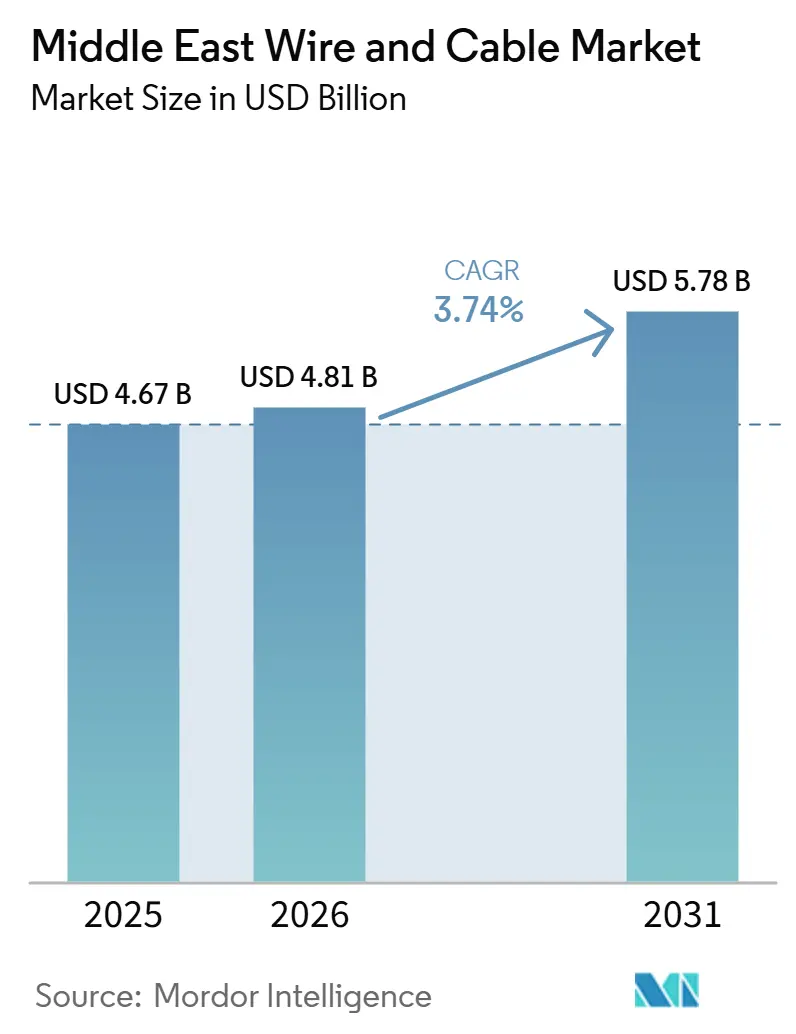
| Base Year Market Size (2025) | USD 4.67 Billion |
| Market Size (2026) | USD 4.81 Billion |
| Market Size (2031) | USD 5.78 Billion |
| Growth Rate (2026 - 2031) | 3.74 % |
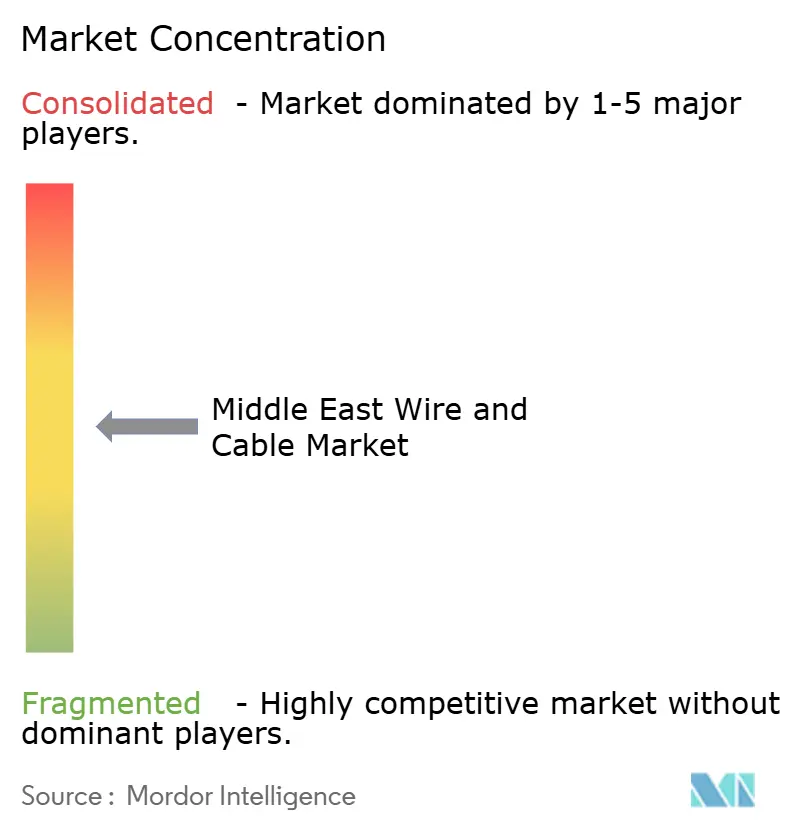
| Market Concentration | Medium |
Major Players *Disclaimer: Major Players sorted in no particular order Image © Mordor Intelligence. Reuse requires attribution under CC BY 4.0. | |
Middle East Wire and Cable Market Analysis by Mordor Intelligence
The Middle East wire and cable market size was valued at USD 4.67 billion in 2025 and estimated to grow from USD 4.81 billion in 2026 to reach USD 5.78 billion by 2031, at a CAGR of 3.74% during the forecast period (2026-2031). Grid upgrades, renewable energy connections, large construction programs, and digital infrastructure are supporting demand across the region. Saudi Arabia’s Vision 2030, the UAE’s Net Zero by 2050 strategy, and Qatar’s National Vision 2030 are driving increased demand for power, specialty, and fiber-optic cables. These programs bring grid expansion, renewable integration, and urban construction into the same investment period. Local content rules also influence supplier selection, testing investment, and factory location decisions. Copper costs and separate certification systems across national markets continue to affect contract margins and delivery schedules.
Key Report Takeaways
- By voltage, low-voltage cables held 50.94% of the Middle East wire and cable market share in 2025, while extra- and high-voltage cables are projected to grow at a 3.85% CAGR through 2031.
- By cable type, power cables accounted for 61.86% of the Middle East wire and cable market in 2025, while fiber-optic cables are expected to expand at a 3.98% CAGR through 2031.
- By conductor material, copper accounted for 59.48% of revenue share in 2025, while optical glass and polymer cables are projected to grow at a 3.82% CAGR through 2031.
- By installation, underground cables accounted for 51.62% of revenue share in 2025, while submarine installations are expected to grow at a 4.19% CAGR through 2031.
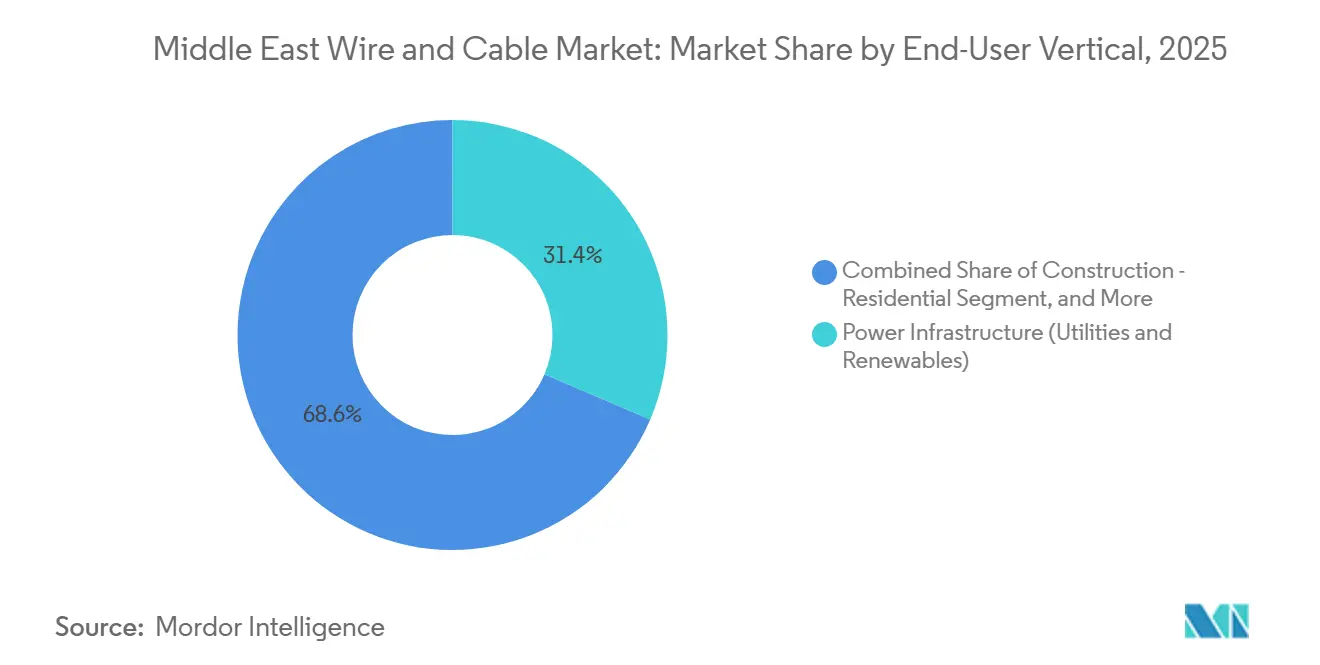
- By end-user vertical, power infrastructure, utilities, and renewables accounted for 31.42% of revenue in 2025, while telecommunications and data centers are projected to grow at a 3.76% CAGR through 2031.
- By insulation, insulated cables accounted for 89.83% revenue share in 2025 and are projected to grow at a 3.77% CAGR through 2031.
- By geography, Saudi Arabia held 33.78% revenue share in 2025, while the UAE is expected to grow at a 4.07% CAGR through 2031.
Note: Market size and forecast figures in this report are generated using Mordor Intelligence’s proprietary estimation framework, updated with the latest available data and insights as of January 2026.
Middle East Wire and Cable Market Trends and Insights
Drivers Impact Analysis*
| Driver | (~) % Impact on CAGR Forecast | Geographic Relevance | Impact Timeline |
|---|---|---|---|
| Expansion and modernization of national electricity grids | +1.1% | Regionwide, with strongest intensity in Saudi Arabia, UAE, and Qatar | Short term (≤ 2 years) |
| Utility-scale renewable energy and grid-integration projects | +0.8% | Saudi Arabia, UAE, Oman, and Qatar, with spillover to Kuwait and Bahrain | Medium term (2-4 years) |
| Mega-project, transport network, and smart-city construction | +0.6% | Saudi Arabia primarily, with UAE and Qatar secondary | Medium term (2-4 years) |
| Data center, 5G, FTTH, and submarine connectivity expansion | +0.5% | UAE and Saudi Arabia, with Qatar, Kuwait, and Oman secondary | Short term (≤ 2 years) |
| Energy diversification and industrial localization under national vision programs | +0.4% | Saudi Arabia, UAE, and Oman, with spillover to Bahrain | Long term (≥ 4 years) |
| Climate-resilient specifications for desert and coastal infrastructure | +0.2% | Saudi Arabia, UAE, Qatar, and Oman coastal corridors | Long term (≥ 4 years) |
| Source: Mordor Intelligence | |||
Expansion and Modernization of National Electricity Grids
National grid modernization remains the strongest demand driver for the Middle East wire and cable market. Saudi Electricity Company procurement supports the procurement of medium- and high-voltage systems for new load centers and residential expansion. Giga-project construction adds to the need for transmission connections and utility equipment. HVDC projects require associated feeder and substation cables in addition to their main transmission systems. This combination supports demand across more cable categories than a single procurement award may show. Suppliers with established testing credentials are well placed to respond to these requirements.
Utility-Scale Renewable Energy and Grid-Integration Projects
Renewable projects create demand for solar DC cables, collector cables, and long-distance transmission conductors. Saudi Arabia has a 58.7 GW renewable capacity target for 2030, which supports multi-year cable needs for new generation and grid connections.[1]International Energy Agency, “World Energy Outlook 2025,” International Energy Agency Remote solar and wind sites require insulation that can tolerate heat and ultraviolet exposure. These requirements make compliance with specifications important for suppliers serving premium utility projects. The Middle East wire and cable market also benefits when offshore energy systems connect to mainland grids. This work requires specialized marine cables, landfall equipment, and links to the wider grid.
Mega-Project, Transport Network, and Smart-City Construction
Saudi giga-projects require cables for buildings, distribution networks, transmission links, and digital management systems. NEOM, The Red Sea Project, Diriyah Gate, Qiddiya, and ROSHN all create layered requirements across voltage classes. Installation activity is expected to concentrate between 2027 and 2030 as project phases progress. This timing can place pressure on procurement and qualified installation capacity. Transmission infrastructure is needed to serve developments supplied by remote renewable generation. Projects in Qatar and the UAE are driving demand in transport, urban development, and smart-city infrastructure.
Data Center, 5G, FTTH, and Submarine Connectivity Expansion
Data centers, 5G networks, fiber-to-the-home systems, and submarine routes are changing the regional demand mix. Ooredoo announced the Fiber in Gulf subsea system in February 2025. The system is intended to connect 7 countries with a total capacity of 720 Tbps across 24 fiber pairs.[2]Ooredoo Group, “Ooredoo Group to Build Subsea Cable to Connect the Middle East,” Ooredoo Group Submarine networks also need landing-station equipment, inshore ducts, and terrestrial connections to data centers. This adds demand that is not limited to the undersea portion of a project. The Middle East wire and cable market therefore gains from the full network buildout around each new cable landing. Hybrid products that combine power transmission and optical sensing also support smart-grid applications.
Restraints Impact Analysis*
| Restraint | (~) % Impact on CAGR Forecast | Geographic Relevance | Impact Timeline |
|---|---|---|---|
| Copper, aluminum, and polymer price volatility | -0.5% | Regionwide, especially import-dependent UAE, Qatar, and Kuwait | Short term (≤ 2 years) |
| Fragmented national standards, testing, and certification requirements | -0.3% | Regionwide, especially Saudi Arabia, UAE, and Qatar | Medium term (2-4 years) |
| Extreme heat, ultraviolet exposure, sandstorms, and coastal corrosion | -0.2% | Saudi Arabia, UAE, Qatar, and Oman desert and coastal areas | Long term (≥ 4 years) |
| Counterfeit, substandard, and non-compliant cable imports | -0.2% | Regionwide, with greater exposure in smaller GCC markets and lower-tier segments | Medium term (2-4 years) |
| Source: Mordor Intelligence | |||
Copper, Aluminum, and Polymer Price Volatility
Raw-material volatility is the most immediate margin risk for regional cable manufacturers. Copper prices near USD 13,500 per tonne in May 2026 raised costs for products that use copper intensively. Fixed-price infrastructure contracts expose suppliers when metal prices change after contract award. Producers are responding through metal-linked adjustment clauses and more frequent price resets. Higher copper costs can also encourage engineers to consider aluminum or composite conductors where technical rules allow. Larger suppliers may gain an advantage when they can secure upstream materials or absorb short-term cost movements.
Fragmented National Standards, Testing, and Certification Requirements
Separate national standards create added testing, approval, and documentation work for regional suppliers. Saudi Arabia, the UAE, Qatar, and Turkey use different regulatory and certification frameworks. These requirements can extend cross-border supply schedules by 8-16 weeks. Smaller firms often face greater costs because they lack dedicated teams for several jurisdictions. A narrow group of already qualified manufacturers can benefit when utility tenders require established technical credentials. Continued differences between national systems can remain a cost and timing constraint for suppliers operating across the Middle East wire and cable market.
*Our forecasts treat driver/restraint impacts as directional, not additive. The impact forecasts reflect baseline growth, mix effects, and variable interactions.
Segment Analysis
By Voltage: Grid Transmission Upgrades Support Extra- and High-Voltage Growth
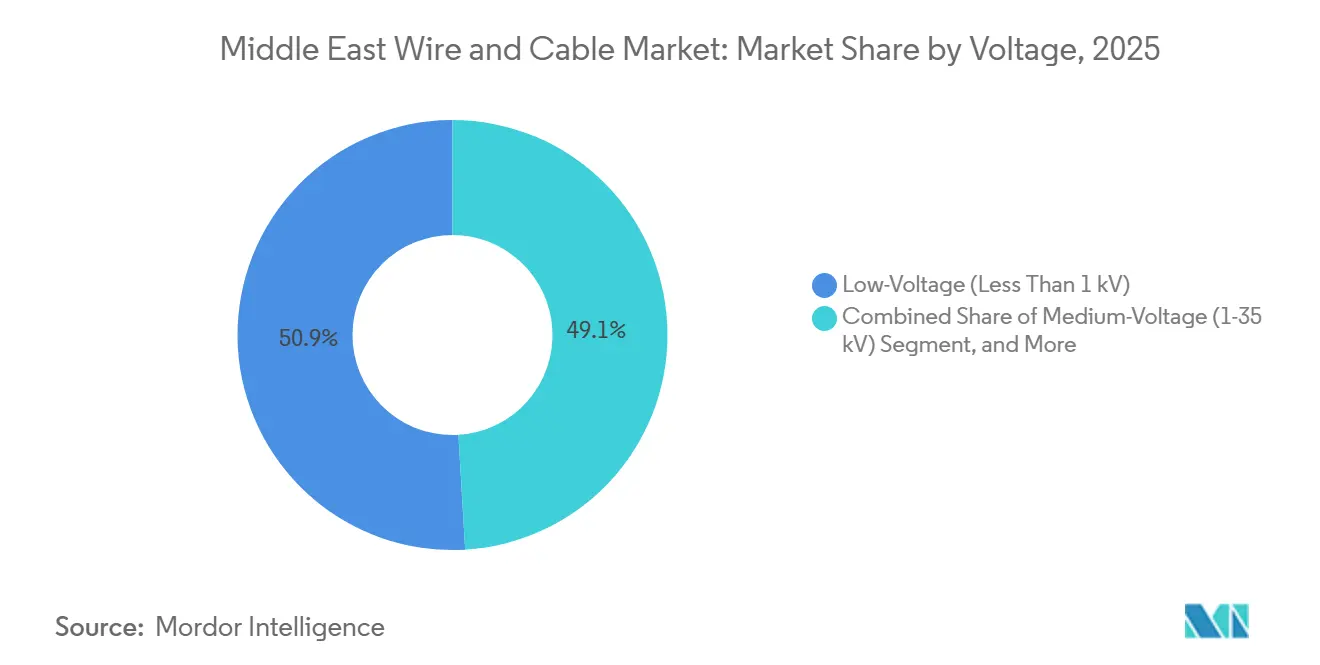
Low-voltage cables accounted for 50.94% of revenue in 2025, making them the largest voltage category in the Middle East wire and cable market. Residential and commercial construction account for much of this demand. NEOM, Diriyah Gate, and ROSHN require large volumes of building wire through phased construction programs. Low-voltage products also support internal distribution within commercial sites and public buildings. Their demand depends on construction schedules, building approvals, and contractor purchasing cycles. Extra- and high-voltage cables are forecast to grow at a 3.85% CAGR through 2031. This reflects investment in HVDC and extra-high-voltage alternating-current corridors. These systems link new load centers with national grids and remote generation assets. Medium-voltage cables remain essential for urban distribution, metro extensions, substations, and industrial parks.
Riyadh Cables Group completed type testing for a TAQA 1×2500 mm² 400 kV EHV cable system in May 2026. The testing took place at the company’s ISO 17025-accredited laboratory.[3]Riyadh Cables Group, “Riyadh Cables Group Is Proud to Announce the Successful Completion of Type Testing for TAQA 1×2500 mm² 400 kV EHV Cable System,” Riyadh Cables Group The event indicates a domestic capability for a voltage class previously supplied mainly by foreign producers. Technical qualification can improve access to premium utility tenders. IEC 60840 and IEC 62067 are increasingly important in EHV procurement requirements. These standards raise the entry threshold for suppliers without documented testing credentials. Pre-approved suppliers can benefit from this restricted qualification base. New suppliers must invest in testing, design validation, and project references. The Middle East wire and cable market retains a broad need for all voltage classes because construction and grid programs advance together. This creates a balanced opportunity across building, distribution, and transmission applications.



By Cable Type: Fiber-Optic Cables Lead Growth as Digital Infrastructure Spending Rises
Power cables commanded 61.86% of revenue in 2025 and remained the largest cable type. Energy infrastructure continues to receive a significant share of regional capital spending. Every new renewable project needs collection, distribution, and transmission systems. Saudi Arabia’s renewable energy program supports sustained power cable procurement over the forecast period. Signal and control products serve instrumentation in plants, industrial facilities, and energy sites. Coaxial and data cables support monitoring and communications functions. These applications provide recurring demand for producers with varied product portfolios. Power cable demand also benefits from urban grid upgrades and new substations. The category remains central to the Middle East wire and cable market because electricity systems underpin most regional projects. Its scale reflects the continuing priority placed on reliable power infrastructure.
Fiber-optic cable is expected to grow at a 3.98% CAGR through 2031. Terrestrial FTTH networks, 5G backhaul, and submarine systems support that expansion. Submarine projects require land-based cables at landing stations and along routes to inland data centers. This creates demand beyond the marine cable section itself. Ooredoo’s FIG project shows the scale of planned regional connectivity investment.[4]Ooredoo Group, “Ooredoo Group to Build Subsea Cable to Connect the Middle East,” Ooredoo Group Fiber products are also used in data-center interconnects and structured cabling. Hybrid cable designs can combine high-voltage transmission with optical sensing. Such products can help utilities monitor temperature and strain on a shared route. Digital infrastructure therefore broadens the cable type mix while power cable remains the dominant category. This supports a gradual shift toward higher-value specialty products.
By Conductor Material: Copper Dominance Faces Gradual Pressure
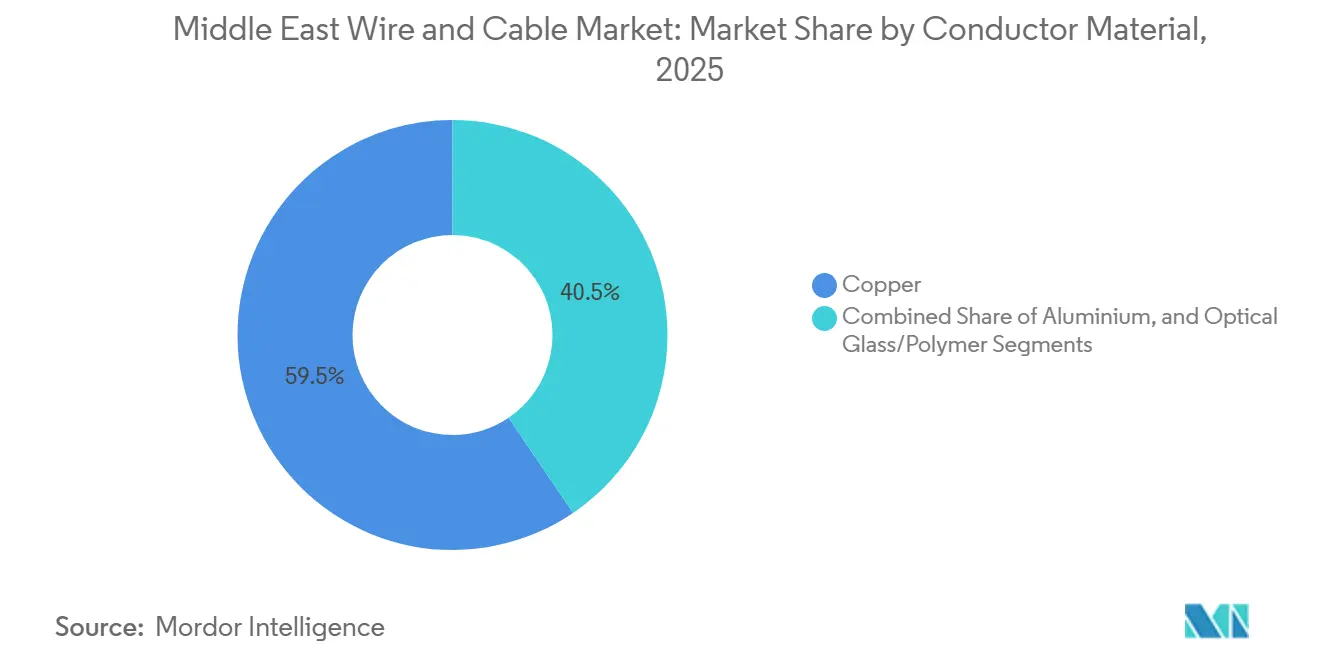
Copper cables captured 59.48% of revenue in 2025 and led the conductor material category. Copper remains widely used for its electrical conductivity and its established acceptance in technical standards. It is important in power cables used in buildings, utilities, and industrial facilities. Its high-value share reflects its role in demanding electrical applications. Higher metal prices have increased attention on material selection. Engineers may select aluminum or composite conductors where code and performance conditions allow. This shift does not necessarily reduce copper’s value position, as it has a higher unit price. Aluminum remains common in overhead transmission lines across less-dense areas. Its lower weight can benefit long-span routes in Saudi Arabia and Oman. The Middle East wire and cable market, therefore, has material demand that varies by installation environment and voltage needs.
Optical glass and polymer cables are expected to grow at a 3.82% CAGR through 2031. Their growth follows the expansion of fiber-optic networks and data-center connections. The FIG system will add major connectivity capacity across Gulf countries. Optical infrastructure includes cable landing stations, terrestrial backhaul routes, and internal data-center systems. These uses supplement traditional telecommunications networks. Growing AI workloads and cloud services increase the need for high-density data connections. Copper continues to serve power and shorter-range data needs within facilities. Optical materials support high-capacity communication over longer distances. The two material groups therefore address different parts of modern infrastructure. Suppliers that serve both can participate in energy and digital projects. Material choice will remain linked to technical performance, cost, and regulatory requirements.
By Installation: Submarine Cables Support the Fastest Growth
Underground cables held 51.62% of revenue in 2025 and led the installation category. Project owners use below-grade routes to protect infrastructure from ultraviolet radiation and surface heat. Underground systems also reduce exposure to sandstorms and physical damage in dense urban areas. These systems are common in utility, commercial, and high-occupancy projects. They need insulation that can maintain thermal performance in desert soil. Installation work can require more civil construction and careful route planning. Overhead lines remain useful in rural and inter-city corridors. They can avoid excavation costs across rocky or salt-pan terrain. Underground infrastructure will remain important as cities expand and utilities strengthen urban grids. The Middle East wire and cable market benefits from these installation needs because protection requirements favor specialized products.
Submarine installation is forecast to grow at a 4.19% CAGR through 2031. Cross-border electricity links and fiber-optic routes support this demand. Prysmian completed cable manufacturing for the Egypt-Saudi Arabia submarine power interconnector in 2024. The project provides a reference point for planned regional connections. Marine projects require specialized vessels, routing expertise, and high technical standards. Their complexity limits the number of capable suppliers and installers. Landfall infrastructure creates further demand for ducts, accessories, and terrestrial cables. Submarine growth therefore supports cable activity both offshore and onshore. It also increases the role of suppliers with proven high-voltage and marine capabilities.
By End-User Vertical: Telecommunications and Data Centers Show the Fastest Expansion
Power infrastructure, utilities, and renewables accounted for 31.42% of revenue in 2025. This was the largest end-user vertical in the Middle East wire and cable market. Grid expansion, solar projects, and wind projects support its demand. Utility projects require cables for generation connections, substations, and transmission routes. Residential and commercial construction adds further demand for low-voltage and medium-voltage products. Oil, gas, and petrochemical facilities remain important end-users, particularly in Qatar and Abu Dhabi. Their facilities require power, control, instrumentation, and communication cables. Project schedules can influence the timing of tender releases and deliveries. Power infrastructure remains the leading outlet because it is linked to the region’s wider energy transition. Its position reflects ongoing investment in both conventional and renewable energy systems.
Telecommunications and data centers are forecast to grow at a 3.76% CAGR through 2031. AI training, cloud services, and hyperscale facilities require power and data connectivity. These sites use high-current distribution cables, copper data cables, and dense fiber assemblies. Fiber networks also link facilities with landing stations and broader communications networks. The FIG system will strengthen regional data flows across several Gulf countries. Automotive and mobility applications are smaller but are gaining relevance. Electric-vehicle charging and industrial diversification broaden the addressable base for cable suppliers. Industrial manufacturing also requires control, power, and communications infrastructure. The end-user mix is becoming more varied as digital facilities expand beside traditional energy projects. This gives suppliers opportunities in both heavy infrastructure and specialized connectivity systems.
By Insulation: Insulated Cables Remain Dominant as Specifications Tighten
Insulated cables are expected to account for 89.83% of the Middle East wire and cable market share in 2025 and are projected to grow at a CAGR of 3.77% through 2031. Building, utility, and industrial applications generally require insulated conductors. Non-insulated cables are mainly used as bare overhead conductors. They are more common in lower-density areas where overhead routing remains economical. Saudi Arabia, Oman, and Turkey offer examples of those conditions. Insulated products include XLPE, EPR, LSZH, and HFFR systems. These materials help suppliers meet application-specific heat, fire, and safety requirements. Product design has become important for tenders that require premium performance. The largest share of insulated cables reflects the broad need for protected conductors across modern infrastructure. This category is central to the Middle East wire and cable market because specification standards influence almost every project.
Demand for premium insulation grades is supported by stricter technical requirements in high-occupancy and commercial projects. LSZH and HFFR products are relevant where fire performance and smoke characteristics are important. These products can provide a competitive advantage for certified manufacturers. Suppliers must demonstrate testing performance to meet demanding utility and building specifications. Technical approvals can support access to advanced grid projects. They can also increase the cost of entry for lower-specification imports. Insulation quality will remain a key area of competition as projects demand more reliable thermal and fire performance.
Geography Analysis
Saudi Arabia accounted for 33.78% of the Middle East wire and cable market in 2025 and was the largest national market. Its position reflects a substantial pipeline of construction, grid, and energy projects. NEOM, The Red Sea Project, Diriyah Gate, and Qiddiya require the installation of building wire, distribution systems, transmission links, and digital infrastructure across multiple phases. Peak cable installation is expected between 2027 and 2030 as these programs move through intensive construction periods. Riyadh Cables Group completed 400 kV EHV type testing in May 2026, showing domestic capability for technically demanding utility cable systems.
The UAE is projected to grow at a 4.07% CAGR through 2031, making it the fastest-growing national market. Data centers, renewable grid integration, urban development, and submarine connectivity support its demand. The UAE’s dense urban projects require carefully routed systems that meet demanding installation and performance requirements. Ooredoo’s planned FIG system includes the UAE among its connected markets and adds to the country’s regional digital role. Qatar contributes to demand through LNG expansion and North Field projects, while Kuwait continues grid modernization under its national development program.
Oman adds demand from renewable energy, industrial cities, and its role as a regional exporter. Turkey is a large cable consumer, manufacturer, and exporter, so its production capacity and pricing can affect Gulf supply conditions. Israel remains dependent on imports for large infrastructure applications, while Bahrain and the Rest of Middle East add demand through industrial and hospitality construction. Saudi Arabia and the UAE are likely to retain the greatest demand concentration through the 2028-2030 installation period, before activity becomes more geographically distributed.
Competitive Landscape
The Middle East wire and cable market is served by regional producers and global suppliers that meet different technical requirements. Riyadh Cables Group, Ducab Group, Elsewedy Electric, and Jeddah Cables Company compete on local production, delivery capabilities, utility approvals, and compliance with local content requirements. Prysmian S.p.A., Nexans S.A., and NKT A/S remain important in technically complex extra-high-voltage and submarine applications. Riyadh Cables Group completed TAQA 400 kV EHV type testing in May 2026, supporting participation in a more demanding voltage class. The competitive environment is moderate to high because qualification, price, lead time, and localization all influence project awards.
Prysmian completed cable manufacturing for the Egypt-Saudi Arabia interconnector, demonstrating its participation in specialist submarine infrastructure. Global suppliers retain an advantage where marine projects or EHV systems require established references and specialized production capabilities. Regional manufacturers are responding with laboratories, type testing, technical qualifications, and product development aimed at higher-value projects. High-specification LSZH and HFFR products for data centers and smart-city applications remain an area of import dependence. Suppliers with verified certification can serve that requirement more effectively and reduce the risk associated with non-compliant imports.
Riyadh Cables Group signed an agreement in January 2026 to manage and develop Syrian Modern Cables Company, extending its manufacturing footprint beyond the GCC. The company also signed an October 2025 agreement to acquire a majority stake in Artikul Aziya Kabel in Uzbekistan. These actions show a strategy focused on regional capacity, production flexibility, and wider access to nearby markets. No combined market share for the leading companies was provided, so a market concentration score cannot be assigned under the stated criteria.
Middle East Wire and Cable Industry Leaders
Riyadh Cables Group
Jeddah Cables Company
Ducab Group
Elsewedy Electric
Saudi Cable Company
- *Disclaimer: Major Players sorted in no particular order

Recent Industry Developments
- May 2026: Riyadh Cables Group completed type testing for the TAQA 1×2500 mm² 400 kV EHV cable system at its ISO 17025-accredited laboratory, demonstrating domestic capability for extra-high-voltage cable qualification previously available from European and Asian manufacturers
- January 2026: Riyadh Cables Group signed an operations agreement with the Syrian Sovereign Fund to manage, operate, and develop Syrian Modern Cables Company, extending the Group’s regional manufacturing footprint into Syria.
- October 2025: Riyadh Cables Group signed an agreement to acquire a majority stake in Artikul Aziya Kabel in Uzbekistan, expanding its manufacturing footprint into Central Asia.


Middle East Wire and Cable Market Report Scope
The Middle East Wire and Cable Market Report is Segmented by Voltage (Low, Medium, and Extra- and High-Voltage), Cable Type (Power, Fiber-Optic, Signal/Control, and Coaxial/Data), Conductor (Copper, Aluminum, and Optical Glass/Polymer), Installation (Overhead, Underground, and Submarine), End-User (Construction - Residential, Construction - Commercial, Power Infrastructure (Utilities and Renewables), Telecommunications and Data Centers, Oil and Gas and Petrochemicals, Automotive and Mobility, and Industrial Manufacturing), Insulation (Insulated and Non-Insulated), and Geography (Saudi Arabia, UAE, Qatar, Israel, Turkey, Kuwait, Oman, Bahrain, and Rest of Middle East). The Market Forecasts are Provided in Terms of Value (USD).
| Extra- and High-Voltage (Greater Than 35 kV) |
| Medium-Voltage (1-35 kV) |
| Low-Voltage (Less Than 1 kV) |
| Power Cable |
| Fiber-Optic Cable |
| Signal and Control Cable |
| Coaxial and Data Cable |
| Copper |
| Aluminum |
| Optical Glass/Polymer |
| Overhead |
| Underground |
| Submarine |
| Construction - Residential |
| Construction - Commercial |
| Power Infrastructure (Utilities and Renewables) |
| Telecommunications and Data Centers |
| Oil and Gas and Petrochemicals |
| Automotive and Mobility |
| Industrial Manufacturing |
| Insulated |
| Non-Insulated |
| Saudi Arabia |
| United Arab Emirates |
| Qatar |
| Israel |
| Turkey |
| Kuwait |
| Oman |
| Bahrain |
| Rest of Middle East |
| By Voltage | Extra- and High-Voltage (Greater Than 35 kV) |
| Medium-Voltage (1-35 kV) | |
| Low-Voltage (Less Than 1 kV) | |
| By Cable Type | Power Cable |
| Fiber-Optic Cable | |
| Signal and Control Cable | |
| Coaxial and Data Cable | |
| By Conductor Material | Copper |
| Aluminum | |
| Optical Glass/Polymer | |
| By Installation | Overhead |
| Underground | |
| Submarine | |
| By End-User Vertical | Construction - Residential |
| Construction - Commercial | |
| Power Infrastructure (Utilities and Renewables) | |
| Telecommunications and Data Centers | |
| Oil and Gas and Petrochemicals | |
| Automotive and Mobility | |
| Industrial Manufacturing | |
| By Insulation | Insulated |
| Non-Insulated | |
| By Country | Saudi Arabia |
| United Arab Emirates | |
| Qatar | |
| Israel | |
| Turkey | |
| Kuwait | |
| Oman | |
| Bahrain | |
| Rest of Middle East |


Key Questions Answered in the Report
What is the Middle East wire and cable market size?
The Middle East wire and cable market size is estimated at USD 4.81 billion in 2026 and is projected to reach USD 5.78 billion by 2031, at a 3.74% CAGR.
Which country leads regional cable demand?
Saudi Arabia led with 33.78% revenue share in 2025, supported by grid development and large construction programs.
Which cable type is growing fastest?
Fiber-optic cable is projected to expand at a 3.98% CAGR through 2031, supported by FTTH, 5G, data centers, and submarine networks.
Why are submarine cables becoming more important?
Cross-border electricity links and regional digital routes are increasing demand for submarine cable systems and their landfall infrastructure.
Which end-user category is expanding fastest?
Telecommunications and data centers are expected to grow at a 3.76% CAGR through 2031 as cloud, AI, and hyperscale infrastructure expands.
What limits cable supplier margins in the region?
Copper, aluminum, and polymer price volatility can raise input costs, especially under fixed-price infrastructure contracts.
Page last updated on:





