
Middle East and Africa Urban Design Market Size and Share
Market Overview
| Study Period | 2020 - 2031 |
|---|---|
| Forecast Data Period | 2026 - 2031 |
| Base Year Market Size (2025) | USD 5.10 Billion |
| Market Size (2026) | USD 5.5 Billion |
| Market Size (2031) | USD 8.80 Billion |
| Growth Rate (2026 - 2031) | 9.90 % |
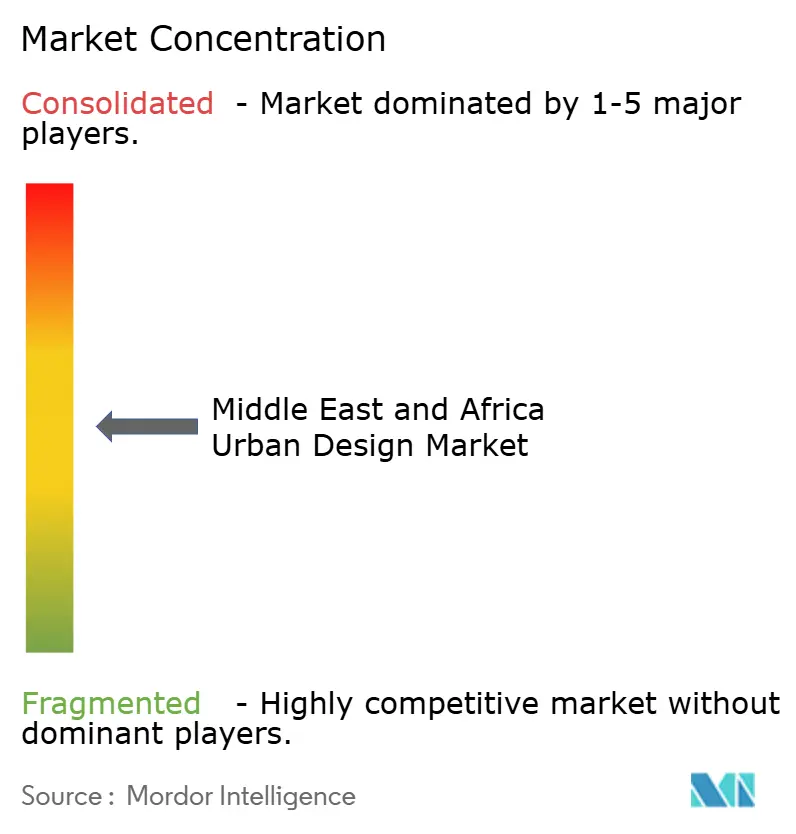
| Market Concentration | Medium |
Major Players *Disclaimer: Major Players sorted in no particular order Image © Mordor Intelligence. Reuse requires attribution under CC BY 4.0. | |
Middle East and Africa Urban Design Market Analysis by Mordor Intelligence
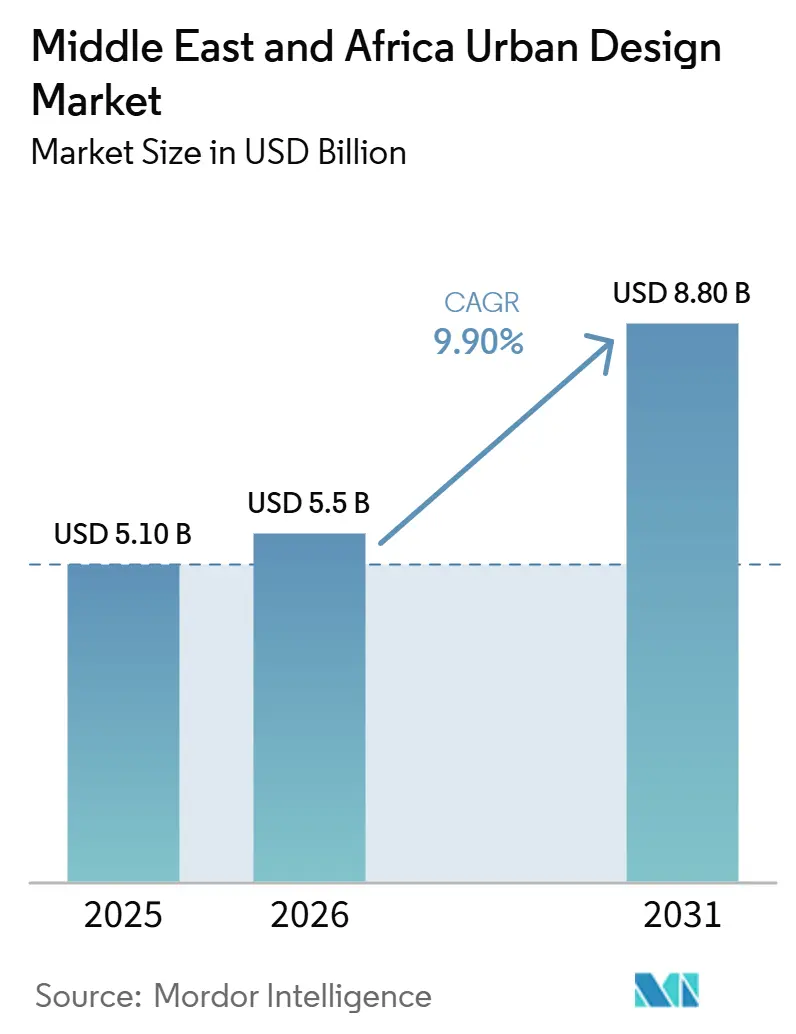
The Middle East And Africa Urban Design Market size is projected to expand from USD 5.10 billion in 2025 and USD 5.5 billion in 2026 to USD 8.80 billion by 2031, registering a CAGR of 9.90% between 2026 to 2031. Sovereign urban programs, housing demand, and smart-city planning are sustaining work across the region. Public investors held 72.8% of 2025 revenue, which gives the Middle East and Africa urban design market a stable base of long-duration work. The strongest near-term opportunities are in detailed master planning, transport corridors, and planned communities rather than in conceptual work alone. Large programs are increasingly released in phases, which favors firms that can link planning with infrastructure, public realm, and implementation support. Climate adaptation and limited planning capacity remain practical constraints because both can delay project delivery and change design requirements.
Key Report Takeaways
- By type, master planning and land-use planning held 35.2% of the Middle East and Africa urban design market share in 2025, while urban design, public realm and landscape design is projected to grow at a 10.9% CAGR through 2031.
- By sector, mixed-use and township developments accounted for 39.6% of the Middle East and Africa urban design market size in 2025, while transportation and infrastructure is forecast to expand at an 11.4% CAGR through 2031.
- By investor type, public investors accounted for 72.8% of revenue in 2025, while private investors posted the highest projected CAGR of 12.0% through 2031.
- By geography, Saudi Arabia captured 30.4% of revenue in 2025, while the UAE is projected to grow at a 13.0% CAGR through 2031.
Note: Market size and forecast figures in this report are generated using Mordor Intelligence’s proprietary estimation framework, updated with the latest available data and insights as of January 2026.
Market Trends and Insights
Drivers Impact Analysis of Middle East and Africa Urban Design Market*
| Drivers | (~) % Impact on CAGR Forecast | Geographic Relevance | Impact Timeline |
|---|---|---|---|
| Rapid Metropolitan Population Growth | +2.5% | Global MEA, most acute in Egypt, Nigeria, Ethiopia | Short term (≤ 2 years) |
| New-City and New-Town Programs | +2.3% | Saudi Arabia, UAE, Egypt | Medium term (2-4 years) |
| Metro, Rail and Urban Infrastructure Expansion | +1.8% | Saudi Arabia, UAE, Turkey | Medium term (2-4 years) |
| Affordable Housing and Planned Communities | +1.6% | UAE, Saudi Arabia, South Africa | Medium term (2-4 years) |
| Smart-City and Digital Urban Planning Adoption | +1.2% | MEA core, UAE early mover | Long term (≥ 4 years) |
| Source: Mordor Intelligence | |||
Rapid Metropolitan Population Growth
Africa’s urban population is projected to double from 700 million to 1.4 billion by 2050, raising the need for housing, services, and connected public spaces[1]Organisation for Economic Co-operation and Development and African Development Bank, “Africa’s Urbanisation Dynamics 2025,” OECD Publishing, oecd.org. The growth is not limited to large metropolitan areas because many small and medium-sized settlements also need formal land-use plans and basic infrastructure. The United Nations reported that 96% of the world’s cities have fewer than 1 million residents, underscoring the need for greater attention in planning programs for smaller cities. Many of these locations have limited local capacity to commission or manage complex design work. UN-Habitat’s 2025 to 2035 action plan for Kafr El-Battikh shows how technical assistance can connect local demand with a workable planning framework. The Middle East and Africa urban design market can therefore benefit when firms combine commercial delivery with multilateral and public-sector funding channels.
New-City and New-Town Programs
Saudi Arabia and Egypt continue to use new-city programs to accommodate population growth and concentrate infrastructure investment. Riyadh’s preliminary plan for a 456-square-kilometer northeast expansion establishes a phased framework for housing, services, green areas, and valley preservation. Egypt’s 2026 to 2027 development plan aims to increase habitable land from 7% to 14% of the country’s total land area by 2030. These programs create repeated planning requirements as districts move from land allocation to infrastructure and detailed design. The Middle East and Africa urban design market is moving toward more phased and commercially tested precincts as sponsors refine large development programs. This change raises the importance of firms that can prepare implementation-ready plans and coordinate multiple disciplines. Digital planning tools can also strengthen design review, data sharing, and monitoring as programs become more complex.
Metro, Rail and Urban Infrastructure Expansion
Urban mobility investments require coordinated planning for land use, public realm, stations, and last-mile connections. Dubai’s Roads and Transport Authority awarded an AED 2 billion contract for the Latifa bint Hamdan Corridor Development Project in July 2026, covering a 12-kilometer road expansion with 7 bridges and 8 tunnels. The project shows that corridor work involves more than road engineering, as it alters access, pedestrian movement, and surrounding development patterns. SOM’s Gateway station for Dubai’s Blue Line is designed to serve 160,000 daily commuters by 2040, linking transit design with the wider Dubai 2040 Urban Master Plan. Turkey’s National Smart Cities Strategy and Action Plan for 2024 to 2030 provides a policy basis for connected mobility and digital municipal systems. The Middle East and Africa urban design market gains from these projects because station areas and transport corridors need coordinated development rules and public-space design.
Affordable Housing and Planned Communities
Housing shortages are leading public agencies and developers to deliver larger planned communities across the region. Abu Dhabi Housing Authority progressed the Al Metlaa project, with 2,236 villas and AED 8 billion in investment, and Al Aamerah Phase 1, with 2,350 units and AED 8 billion in investment, during 2026. These projects require coordinated street layouts, utilities, open space, amenities, and density controls. Planned communities also create work over several phases because each phase needs to remain consistent with the wider master plan. In South Africa, large mixed-use housing developments show that demand extends beyond the Gulf, although delivery can involve more complex public-private coordination. The Middle East and Africa urban design market is likely to see continued demand for practical community planning that balances cost, access, and service provision. Sharjah also offers a growing opportunity as developers address households seeking lower-cost alternatives to Dubai.
Restraints Impact Analysis of Middle East and Africa Urban Design Market*
| Restraints | (~) % Impact on CAGR Forecast | Geographic Relevance | Impact Timeline |
|---|---|---|---|
| Land Acquisition and Resettlement Challenges | -1.8% | Sub-Saharan Africa, Egypt, Saudi Arabia urban fringe | Medium term (2-4 years) |
| Uneven Planning and Regulatory Capacity | -1.4% | Sub-Saharan Africa, Rest of Middle East | Long term (≥ 4 years) |
| Climate and Disaster Exposure | -1.2% | Arabian Peninsula, East African highland cities, coastal settlements | Long term (≥ 4 years) |
| Shortage of Qualified Urban Planning Professionals | -1.1% | Sub-Saharan Africa, secondary cities across MEA | Long term (≥ 4 years) |
| Source: Mordor Intelligence | |||
Land Acquisition and Resettlement Challenges
Land acquisition can delay urban projects where customary ownership overlaps with formal property systems. Delays are most difficult in locations with incomplete land records or unresolved infrastructure responsibilities. Even in Gulf markets, redevelopment in established districts can require resettlement and changes to project phasing. These issues reduce certainty for master planning teams because design scope often depends on when land becomes available. The constraint is particularly important for Master Planning and Land-Use Planning because this service begins before many later project packages. The Middle East and Africa urban design market therefore needs clearer land coordination and early stakeholder engagement to convert announced investment into delivered projects.
Uneven Planning and Regulatory Capacity
Planning rules and public-sector capability differ significantly across the region. Oman’s Royal Decree 58/2026 established an Urban Planning Law, with national, provincial, and structural planning levels linked to the Sustainable Development Goals. The new framework can support more consistent procurement, although implementation requires trained public officials and clear project processes. Smaller cities in sub-Saharan Africa often lack GIS, digital twin, or building information modeling systems, which limits their ability to manage complex planning commissions. The United Nations identifies rapid urban growth in smaller settlements as a central planning challenge, especially where local capacity is limited. This can limit commercial engagement, even where investment need is high. The Middle East and Africa urban design market will expand more consistently as regulatory systems and digital planning capacity become more widely available.
*Our forecasts treat driver/restraint impacts as directional, not additive. The impact forecasts reflect baseline growth, mix effects, and variable interactions.
Middle East and Africa Urban Design Market Segment Analysis
By Type:
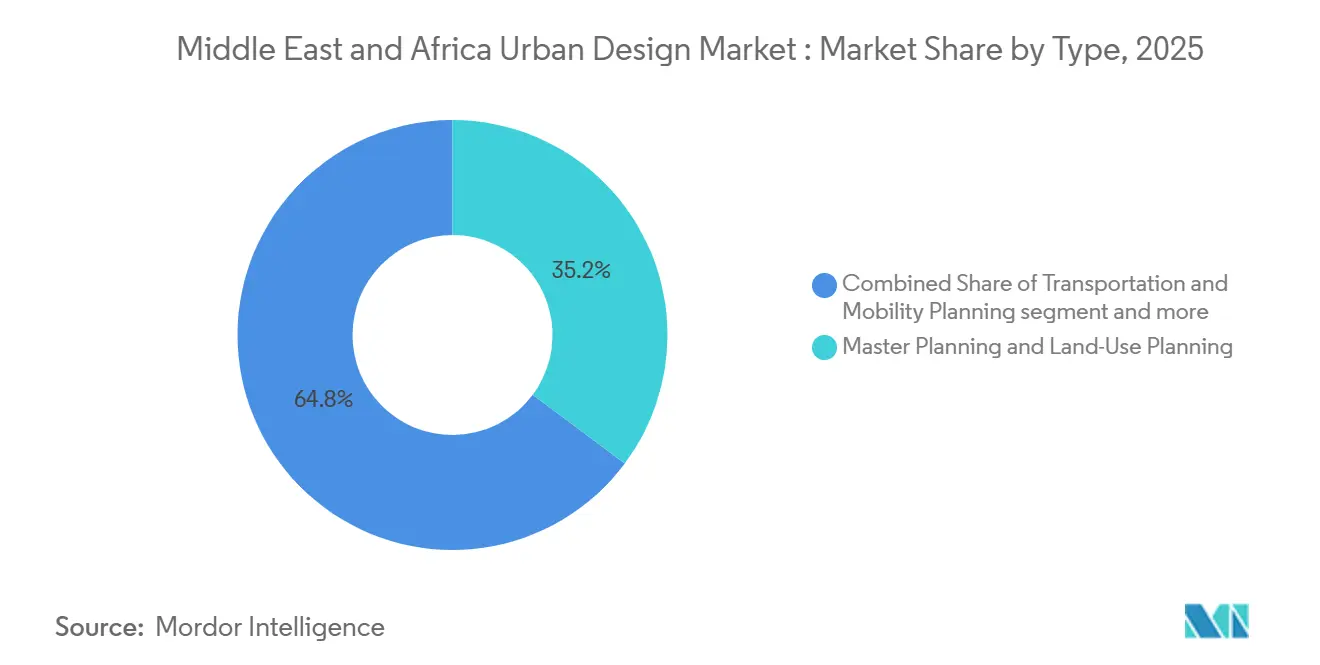
Master Planning Anchors the Portfolio as Placemaking ScalesMaster Planning and Land-Use Planning accounted for 35.2% of 2025 revenue, giving it the largest share in the Middle East and Africa urban design market. Large urban districts begin with land-use, infrastructure, public realm, and delivery plans that guide subsequent construction packages. Riyadh’s northeast expansion framework demonstrates the scale of work created by long-term city growth programs, while projects released in phases keep planning teams involved as land and infrastructure become available. Zoning, development control, and implementation advisory are becoming more important as planning rules become more formal and developers need support throughout approval and delivery. The category, therefore, benefits from both early project definition and the recurring requirements of phased implementation.
Urban Design, Public Realm, and Landscape Design is the fastest-growing type at a 10.9% CAGR through 2031. Governments and developers increasingly treat public space as a part of residential quality, tourism, and place identity. AtkinsRéalis and Futurecity formed the Futurecity Lab in February 2026 to bring cultural foresight and people-centered design into urban development programs. Transportation and mobility planning is also gaining work from station precincts, mobility corridors, and last-mile networks, while other services include urban economics, heritage conservation, and environmental assessment. These smaller fields remain relevant to historic districts and complex mixed-use destinations.



By Sector:
Mixed-Use Leads While Transportation Reshapes Urban FormMixed-Use and Township Developments accounted for 39.6% of the Middle East and Africa urban design market share in 2025. Integrated precincts combine housing, retail, workspaces, hotels, and community services within a single planning framework. This approach can reduce duplicated infrastructure and support a more balanced daily movement pattern. Major precincts require a detailed plan that accounts for service capacity, access routes, open-space networks, and the relationship between residential areas and commercial activity. The sector requires planning teams to coordinate commercial viability, access, open space, and public services across long work cycles and separate district phases.
Transportation and Infrastructure is projected to grow at an 11.4% CAGR through 2031, the highest rate among the sectors. Corridor and station projects need planning that connects technical infrastructure with adjacent neighborhoods. The Latifa bint Hamdan Corridor project illustrates the scale of urban change that can result from road upgrades in dense areas. Public, civic, and institutional projects are also supporting demand as governments invest in cultural and community facilities. The remaining sector includes special economic zones, industrial districts, and logistics hubs that require careful integration with surrounding residential and commercial land uses.
By Investor Type:
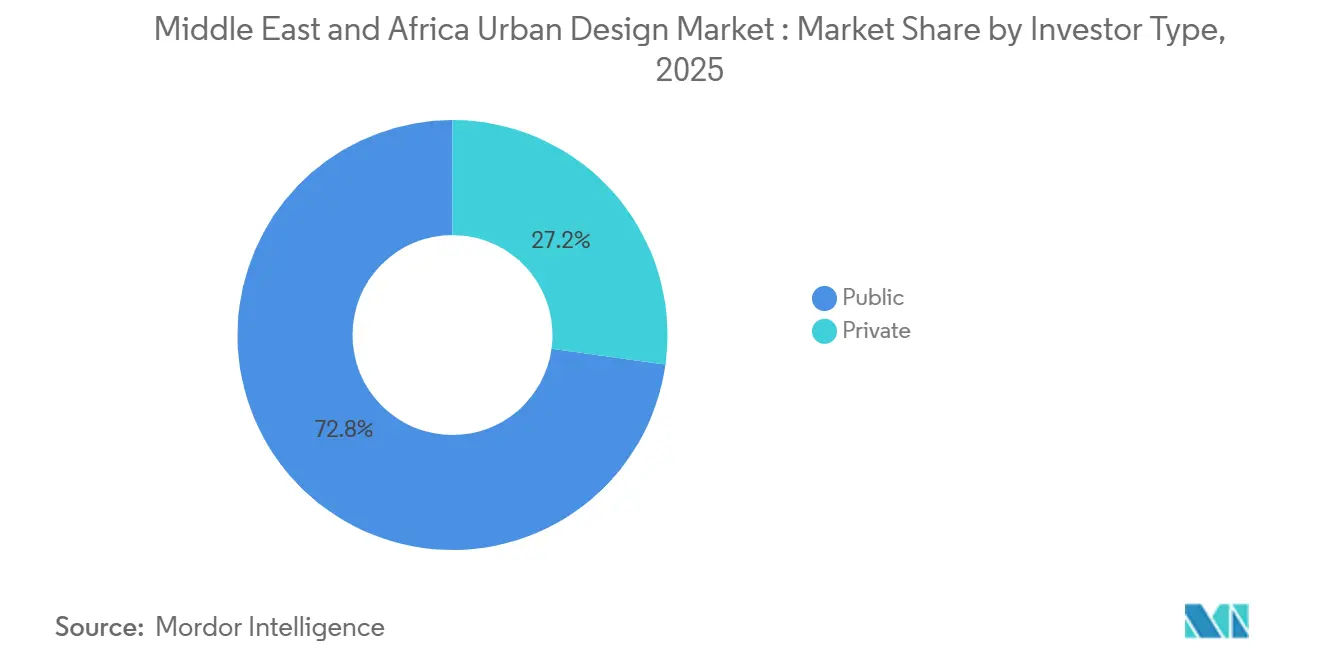
Public Capital Anchors Scale as Private Development Drives PacePublic investors accounted for 72.8% of revenue in 2025, which anchors the Middle East and Africa urban design market through sovereign and government-led programs. State-backed entities often control land, housing allocation, and major infrastructure budgets. Their projects can provide recurring work across years because delivery is organized through a sequence of studies, plans, and construction packages. Public clients also require detailed compliance, stakeholder management, and program coordination, which makes implementation experience important for firms seeking government mandates. Government activity is especially important in Saudi Arabia, the UAE, Egypt, and parts of sub-Saharan Africa.
Private investor activity is expected to expand at a 12.0% CAGR through 2031, the fastest rate among investor groups. Private developers can make decisions more quickly and often place greater value on design quality, place identity, and time to market. This supports demand for planning teams that can prepare clear and commercially usable development concepts. The Middle East and Africa urban design industry serves different needs across the two investor groups, with public clients prioritizing compliance and large program coordination, while private clients focus more on product positioning and delivery speed. Firms that can meet both sets of needs can participate in a broader range of projects.
Geography Analysis
Saudi Arabia Urban Design Market
Saudi Arabia held 30.4% of 2025 revenue, the largest country position in the Middle East and Africa urban design market. Vision 2030 continues to support work across residential districts, cultural assets, transit precincts, and entertainment destinations. The northeast Riyadh preliminary master plan covers 456 square kilometers and creates a long-term structure for new development. AECOM and Jacobs were appointed in November 2025 to provide design consultancy services for The Mukaab at New Murabba, including infrastructure, road tunnels, wadi podiums, and public realm design[2]AECOM, “AECOM Joint Venture to Provide Design Consultancy Services for Riyadh’s The Mukaab,” AECOM, aecom.com. These programs require planning, design authority, and implementation coordination across phased packages.
United Arab Emirates and Turkey Urban Design Market
The UAE is forecast to grow at a 13.0% CAGR through 2031, the fastest geographic rate in the Middle East and Africa urban design market size. Demand is supported by concurrent programs in Abu Dhabi, Dubai, and Sharjah. AtkinsRéalis was appointed in June 2026 as lead masterplan consultant for phases 3 and 4 of BAYN in Ghantoot, covering planning, infrastructure, and public realm design across a 4.8-million-square-meter coastal community. Dubai’s transport and district projects also support integrated planning work. Turkey is an additional opportunity because its smart-city policy supports mobility planning, green corridors, and digital municipal systems in Istanbul, Ankara, and Antalya.
MEA Urban Design Market
Egypt’s plans to expand habitable land support demand for new-town and community planning. South Africa provides a base for large-scale housing and mixed-use planning, although projects may face longer coordination timelines. Oman is establishing a more formal framework for commercial planning through its 2026 Urban Planning Law, while Qatar is shifting toward urban adaptation and legacy planning as event-related infrastructure is converted to civilian use. Together, these markets broaden the Middle East and Africa urban design market beyond the Gulf’s largest programs.
Competitive Landscape
The Middle East and Africa urban design market is moderately concentrated among global multidisciplinary consultancies with established delivery experience. AECOM, AtkinsRéalis, WSP, Jacobs, Arup, and SOM compete for large programs that combine master planning, infrastructure, and public realm work. Their advantage comes from depth in program management, government relationships, and broad service capabilities. AECOM and Jacobs secured the design consultancy role for The Mukaab in November 2025, covering a mix of infrastructure and public-space design[3]AECOM, “AECOM Joint Venture to Provide Design Consultancy Services for Riyadh’s The Mukaab, Covering the Mukaab Core, Road Tunnels, Wadi Podiums, and Public Realm Design,” AECOM, aecom.com. Such mandates favor firms that can coordinate many technical interfaces.
Below the largest firms, regional architecture practices, engineering consultancies, and specialist studios compete for civic, residential, and smaller mixed-use work. Local firms can benefit from national content requirements and greater familiarity with local approvals. AtkinsRéalis and Futurecity launched the Futurecity Lab in February 2026 to embed cultural placemaking in major urban development programs. The partnership shows that clients are placing greater weight on place identity alongside technical delivery. Climate-adaptive design also matters because extreme heat affects shade, materials, cooling, and the usability of public spaces.
Digital delivery is becoming more relevant as public clients use digital twin, GIS, and data-led planning requirements. These capabilities are important in mobility projects and complex phased developments. Regional BIM-led firms and spatial analytics providers can compete on local delivery and cost for mid-sized commissions, while international consultancies retain an advantage on the largest mandates. The Middle East and Africa urban design market is likely to retain strong competition among major firms while remaining open to specialists and local providers.
Middle East and Africa Urban Design Industry Leaders
Jacobs Solutions Inc.
AECOM
WSP Global Inc.
Arcadis N.V.
Stantec Inc.
- *Disclaimer: Major Players sorted in no particular order
Middle East and Africa Urban Design Market Companies Covered in this Report
- AECOM
- Jacobs Solutions Inc.
- WSP Global Inc.
- Arcadis N.V.
- Stantec Inc.
- HDR, Inc.
- AtkinsRéalis Group Inc.
- Ramboll Group A/S
- Arup Group Limited
- Gensler
- HOK
- Perkins&Will
- Sasaki Associates, Inc.
- Gehl People ApS
- Surbana Jurong Private Limited
- Foster + Partners
- Skidmore, Owings & Merrill LLP
- Nikken Sekkei Ltd.
- DP Architects Pte Ltd
- Lendlease Group

Recent Industry Developments in Middle East and Africa Urban Design Market
- July 2026: Dubai's Roads and Transport Authority awards an AED 2 billion contract for the Latifa bint Hamdan Corridor Development Project, a 12-kilometer urban road expansion with multi-level interchanges, 7 bridges, and 8 tunnels, reflecting the scale of corridor urban design complexity embedded in Dubai's infrastructure pipeline.
- June 2026: AtkinsRéalis is appointed by ORA Developers as lead masterplan consultant for BAYN phases 3 and 4 in Ghantoot, UAE, covering master planning, infrastructure design, and public realm design for Business, Sports, and Marina districts across a 4.8-million-square-meter coastal community in the Dubai-Abu Dhabi corridor.
- February 2026: AtkinsRéalis and Futurecity announce a strategic partnership at MIPIM 2026, establishing the Futurecity Lab as a shared research and cultural foresight platform, with an initial focus on embedding cultural placemaking into major urban development programs across the Middle East.
- November 2025: AECOM, in joint venture with Jacobs, is appointed by New Murabba Development Company to deliver design services for The Mukaab, the 247-acre centerpiece of New Murabba in Riyadh, covering the Mukaab Core, road tunnels, wadi podiums, and public realm design.


Middle East and Africa Urban Design Market Report Scope
| Master Planning and Land-Use Planning |
| Urban Design, Public Realm and Landscape Design |
| Transportation and Mobility Planning |
| Zoning, Development Control and Implementation Advisory |
| Others |
| Mixed-Use and Township Developments |
| Transportation and Infrastructure |
| Public, Civic and Institutional Developments |
| Others |
| Public |
| Private |
| United Arab Emirates |
| Saudi Arabia |
| Turkey |
| South Africa |
| Egypt |
| Rest of Middle East |
| By Type | Master Planning and Land-Use Planning |
| Urban Design, Public Realm and Landscape Design | |
| Transportation and Mobility Planning | |
| Zoning, Development Control and Implementation Advisory | |
| Others | |
| By Sector | Mixed-Use and Township Developments |
| Transportation and Infrastructure | |
| Public, Civic and Institutional Developments | |
| Others | |
| By Investor Type | Public |
| Private | |
| By Countries | United Arab Emirates |
| Saudi Arabia | |
| Turkey | |
| South Africa | |
| Egypt | |
| Rest of Middle East |


Key Questions Answered in the Report
What is the projected value of the Middle East and Africa urban design market by 2031?
The Middle East and Africa urban design market is projected to reach USD 8.8 billion by 2031, growing at a 9.9% CAGR from the USD 5.5 billion value recorded in 2026.
Which urban design service type is largest in the Middle East and Africa?
Master Planning and Land-Use Planning was the largest type, holding 35.2% of revenue in 2025 because large development programs begin with land-use and delivery plans.
Which sector is expected to grow fastest through 2031?
Transportation and Infrastructure is forecast to grow at an 11.4% CAGR through 2031, supported by metro, rail, station-area, and corridor planning programs.
Which country has the largest share of regional urban design revenue?
Saudi Arabia held 30.4% of 2025 revenue, supported by Vision 2030 programs across residential, cultural, transit, and entertainment districts.
Page last updated on:





