
Middle East and Africa Roads and Highways Infrastructure Construction Market Size and Share
Market Overview
| Study Period | 2020 - 2031 |
|---|---|
| Forecast Data Period | 2026 - 2031 |
| Base Year Market Size (2025) | USD 68.99 Billion |
| Market Size (2026) | USD 72.69 Billion |
| Market Size (2031) | USD 109.67 Billion |
| Growth Rate (2026 - 2031) | 8.57 % |
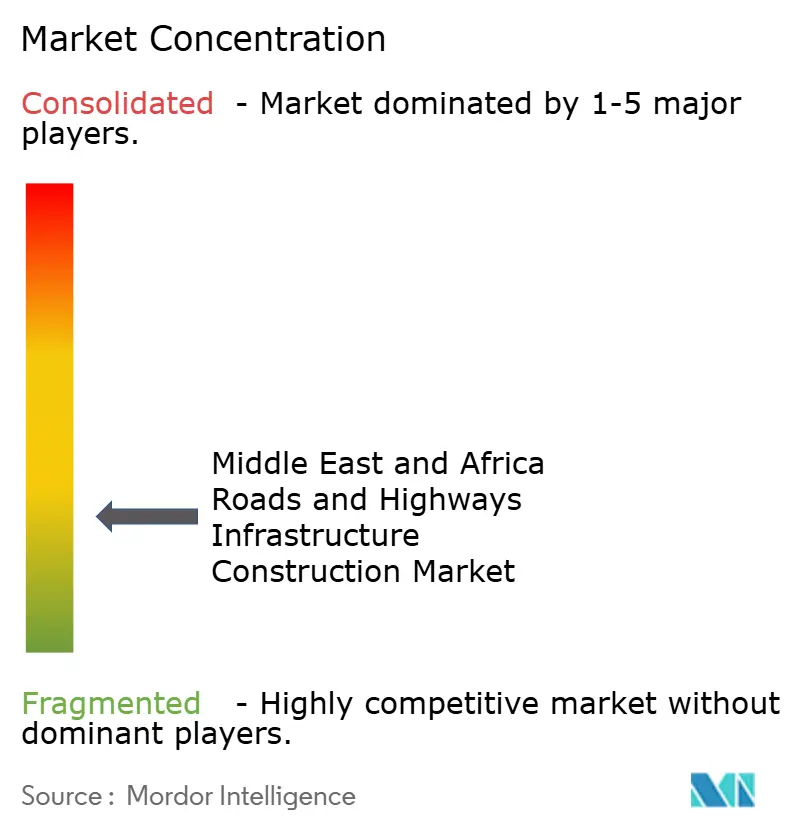
| Market Concentration | Low |
Major Players *Disclaimer: Major Players sorted in no particular order Image © Mordor Intelligence. Reuse requires attribution under CC BY 4.0. | |
Middle East and Africa Roads and Highways Infrastructure Construction Market Analysis by Mordor Intelligence
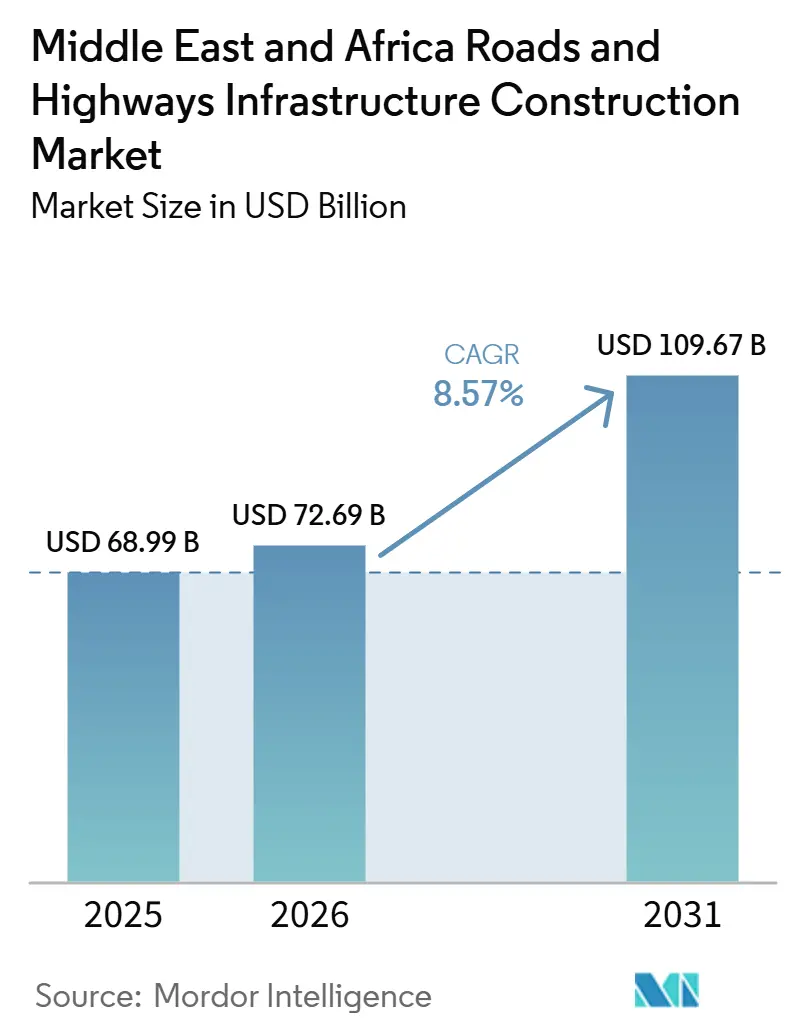
The Middle East And Africa Roads And Highways Infrastructure Construction Market size was valued at USD 68.99 billion in 2025 and is estimated to grow from USD 72.69 billion in 2026 to reach USD 109.67 billion by 2031, at a CAGR of 8.57% during the forecast period (2026-2031).
The Middle East and Africa roads and highways infrastructure construction market is supported by large public transport and corridor programs that are moving from planning into execution in Saudi Arabia and the United Arab Emirates, keeping the project base active across the forecast period. Demand is also widening because road spending is now more closely linked to port access, dry ports, industrial zones, and cross-border freight corridors, especially in Egypt and East Africa. Public funding still sets the pace, but concession models are attracting more private capital into toll roads and long-life transport assets, changing how projects are packaged and awarded. The main constraint remains uneven fiscal capacity across the region, since budget pressure in Egypt and South Africa has already delayed or narrowed parts of their road pipelines, even while better-funded Gulf markets continue to advance major works. The competitive picture also remains active, as international contractors, Chinese state-backed groups, and regional builders pursue different parts of the pipeline, keeping bidding broad but uneven across countries and project sizes.
Key Report Takeaways
- By component, roads led with 74.60% of the Middle East and Africa roads and highways infrastructure construction market share in 2025, while bridges/overpass will grow fastest at a 9.60% CAGR through 2031.
- By construction type, new construction accounted for 82.10% of the Middle East and Africa roads and highways infrastructure construction market size in 2025, while renovation is projected to expand at an 8.90% CAGR through 2031.
- By investment source, public funding accounted for 79.50% of the Middle East and Africa roads and highways infrastructure construction market in 2025, while public-private partnership recorded the highest projected CAGR of 10.20% through 2031.
- By type, national roads captured 64.30% of the Middle East and Africa roads and highways infrastructure construction market size in 2025, while state roads are forecast to advance at an 8.90% CAGR through 2031.
- By country, Saudi Arabia held 28.70% of the Middle East and Africa roads and highways infrastructure construction market share in 2025, while the United Arab Emirates is expected to grow fastest at a 9.80% CAGR through 2031.
Note: Market size and forecast figures in this report are generated using Mordor Intelligence’s proprietary estimation framework, updated with the latest available data and insights as of January 2026.
Middle East and Africa Roads and Highways Infrastructure Construction Market Trends and Insights
Drivers Impact Analysis*
| Drivers | (~) % Impact on CAGR Forecast | Geographic Relevance | Impact Timeline |
|---|---|---|---|
| Sovereign-Backed Transport Corridors and Giga Projects Drive Infrastructure Investment | +2.2% | Saudi Arabia, United Arab Emirates, Egypt | Medium term (2-4 years) |
| Freight Corridor and Port Connectivity Upgrades Strengthen Regional Logistics | +1.8% | Egypt, Kenya, Tanzania, Democratic Republic of the Congo, South Africa | Long term (≥ 4 years) |
| Public-Private Partnership Concessions Accelerate Road Development | +1.5% | Saudi Arabia, Kenya, Nigeria, South Africa | Long term (≥ 4 years) |
| Urban Expansion Increases Mobility Infrastructure Demand | +1.3% | United Arab Emirates, Saudi Arabia, Egypt, Nigeria | Short term (≤ 2 years) |
| Climate-Resilient Road Upgrades Support Infrastructure Modernization | +0.7% | Djibouti, Horn of Africa, South Africa, West Africa | Long term (≥ 4 years) |
| Digital Twin Adoption Improves Transport Planning Efficiency | +0.4% | Gulf Cooperation Council, Saudi Arabia, United Arab Emirates, Qatar | Medium term (2-4 years) |
| Source: Mordor Intelligence | |||
Sovereign-Backed Transport Corridors and Giga Projects Drive Infrastructure Investment
State-backed transport spending remains the main driver of project flow in the Middle East and Africa roads and highways infrastructure construction market, as the largest programs still sit within formal national development plans[1]Royal Commission for Riyadh City, “RCRC Launches the Fourth Group of the Main and Ring Road Axes Development Program,” Royal Commission for Riyadh City, rcrc.gov.sa. In Riyadh, the Royal Commission for Riyadh City launched the fourth group of the Main and Ring Road Axes Development Program, adding 40 kilometers of corridors, 33 bridges, and 5 tunnels with a capacity for more than 950,000 vehicles per day. In the United Arab Emirates, the Ministry of Energy and Infrastructure is administering a USD 46.2 billion roads and transport plan through 2030, which shows that highway works remain central to long-term federal mobility policy[2]Ministry of Energy and Infrastructure, “Ministry of Energy and Infrastructure Launches Strategic Project to Develop Emirates Road,” Ministry of Energy and Infrastructure, moei.gov.ae. These programs matter because they create a visible base level of demand for contractors, equipment suppliers, and engineering firms, even when project priorities shift between urban and intercity routes. The result is that the market is not relying on isolated road awards, but on multi-year public investment pipelines that continue to feed follow-on packages and related utility works across the region.
Freight Corridor and Port Connectivity Upgrades Strengthen Regional Logistics
Freight corridor spending is strengthening the Middle East and Africa roads and highways infrastructure construction market, as more road projects are linked directly to trade access and border efficiency. Egypt activated 8 international logistics corridors under the United Nations Convention on International Road Transport in July 2026, tying roads more closely to dry ports, industrial zones, and the Suez Canal trade system. Egypt also moved ahead with the upgrade of the 800-kilometer International Coastal Road from Port Said to Salloum, including 6 lanes and dedicated concrete truck lanes that improve freight separation on a major port route. Tanzania set out a USD 985 million works budget for the fiscal year 2026 to 2027 that includes completing national roads to bitumen standard and advancing cross-border links with neighboring countries. These corridor projects tend to hold strategic value beyond a single city, so they are more likely to remain funded and phased over several years than short, standalone urban expansions.
Public-Private Partnership Concessions Accelerate Road Development
Public-private partnership activity is widening the financing base for the Middle East and Africa roads and highways infrastructure construction market, as governments use concessions to move large schemes forward without relying solely on direct public budgets. In Saudi Arabia, the Roads General Authority and the National Center for Privatization and public-private partnerships prequalified 3 consortia for the Jeddah to Makkah Direct Highway concession, and the wider pipeline includes multiple Design-Build-Finance-Operate-Maintain highway schemes. In Kenya, the Nairobi-Nakuru-Mau Summit highway was restructured into a user-pay toll model in 2026, shifting demand risk to the private sector and making the project a clearer concession case. This matters because concession design is now shaping which projects become bankable and which contractors can compete, especially when toll revenue or long-term operations are part of the award structure. As a result, larger firms with financing capacity and lifecycle operating experience are gaining an edge in project origination and construction delivery.
Urban Expansion Increases Mobility Infrastructure Demand
Urban traffic pressure is driving steady expansion of the Middle East and Africa roads and highways infrastructure construction market, as fast-growing metro areas are pushing governments toward wider roads, new interchanges, and corridor upgrades. In Dubai, the number of active vehicles rose to 4.47 million by May 2025, and a local study found that 91% of residents experience daily congestion. The Fourth Federal Corridor in the United Arab Emirates is planned as a USD 1.6 billion, 68-kilometer motorway with 6 to 8 lanes and capacity for 360,000 trips per day, which reflects how road design is responding directly to inter-emirate traffic growth. Dubai’s Roads and Transport Authority awarded a USD 545 million contract for the Latifa bint Hamdan Corridor, which is expected to accommodate more than 130,000 trips per day and cut travel time on a key route by 54%. These examples show that urban demand is no longer limited to local streets but is now driving larger corridor packages that combine bridges, tunnels, and traffic-flow redesign within a single scope.
Restraints Impact Analysis*
| Restraints | (~) % Impact on CAGR Forecast | Geographic Relevance | Impact Timeline |
|---|---|---|---|
| Fiscal Constraints And Foreign Exchange Volatility Limit Spending | -1.2% | Egypt, South Africa, Democratic Republic of the Congo, Nigeria | Short term (≤ 2 years) |
| Limited Contractor Capacity And Imported Materials Dependence Increase Risks | -0.8% | Saudi Arabia, United Arab Emirates, South Africa | Short term (≤ 2 years) |
| Land Acquisition Permitting And Utility Relocation Delays | -0.5% | United Arab Emirates, Saudi Arabia, Egypt | Medium term (2-4 years) |
| Maintenance Backlogs And Funding Constraints Reduce Asset Quality | -0.4% | South Africa, Egypt, Sub-Saharan Africa | Long term (≥ 4 years) |
| Source: Mordor Intelligence | |||
Fiscal Constraints and Foreign Exchange Volatility Limit Infrastructure Spending
Fiscal pressure is creating an uneven growth pattern across the Middle East and Africa roads and highways infrastructure construction market because countries with strong sovereign balance sheets are moving faster than those facing budget compression. In Egypt, the General Authority for Roads and Bridges operated with a fiscal year 2025 to 2026 budget of USD 484 million, and the funding gap led to the deferral of 46 road and bridge projects. In South Africa, the South African National Roads Agency Limited faced a budget cut in the current financial year while also taking on 3,099 kilometers of transferred provincial roads, further straining a system already short of maintenance funding. South Africa’s own planning documents also show that available funding covers less than 50% of road requirements, which makes prioritization unavoidable even when transport demand remains high[3]Government Technical Advisory Centre, “Building SA Through Better Roads, SANRAL 2030 Presentation,” Government Technical Advisory Centre, gtac.gov.za. This means that outside the Gulf, project timing can still be slowed by fiscal limits even where the policy case for better highways remains clear.
Limited Contractor Capacity and Imported Material Dependence Increase Project Risks
Execution capacity remains a real constraint in the Middle East and Africa roads and highways infrastructure construction market because many active programs require the same pool of specialist contractors, bridge teams, and project management skills. Large corridor packages in Riyadh and Dubai combine interchanges, tunnels, bridges, and utility coordination, increasing delivery complexity and narrowing the pool of firms capable of managing the full scope. In South Africa, the South African National Roads Agency Limited cited geotechnical issues and drainage challenges as causes of delay on the N2 Wild Coast megabridge project, which shows that technical and site risks can still slow progress after award. Imported inputs and specialist equipment also keep procurement exposure high for contractors working across long supply chains, especially when multiple countries launch road packages simultaneously. The result is that well-funded projects can still face schedule pressure if labor, engineering depth, or imported materials do not arrive in line with construction sequencing.
*Our forecasts treat driver/restraint impacts as directional, not additive. The impact forecasts reflect baseline growth, mix effects, and variable interactions.
Segment Analysis
By Component: Bridges/Overpass Structures Challenge Road Dominance
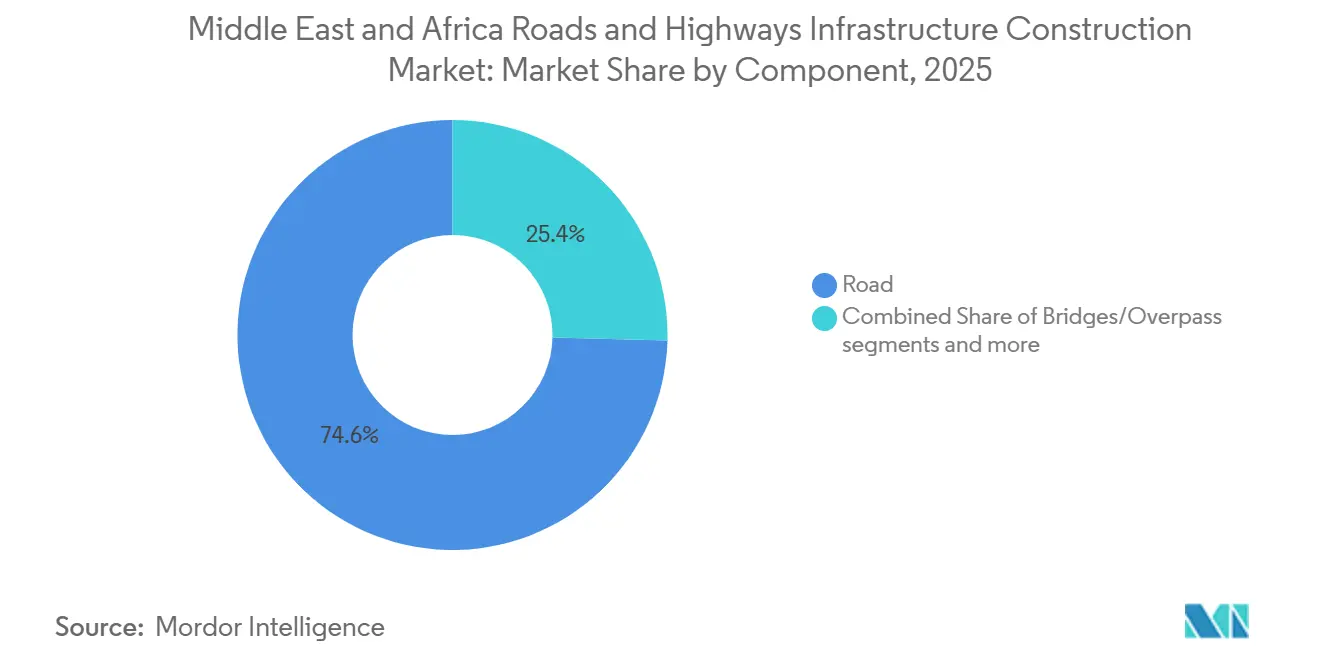
Roads held a 74.60% share in 2025, making them the largest component of the Middle East and Africa roads and highways infrastructure construction market and confirming that standard highway and corridor works still account for the majority of regional spending. This lead reflects the weight of national programs that continue to prioritize carriageway expansion, lane additions, and freight access over narrower standalone civil works. Egypt’s upgrade of the 800-kilometer International Coastal Road shows this clearly, as the project expands the route to 6 lanes and adds dedicated concrete truck lanes along a strategic Mediterranean freight corridor. Road packages also remain easier to phase across long corridors, which allows governments to split awards and keep progress visible over multiple budget cycles. That project structure aligns with the extensive road network across Saudi Arabia, Egypt, and South Africa, where long route continuity matters as much as city access.
Bridges/overpass are forecast to grow at a 9.60% CAGR through 2031, making them the fastest-moving components as urban road systems become more layered and traffic management shifts toward grade-separated designs. The Latifa bint Hamdan Corridor in Dubai includes 7 bridges with a combined length of 2,300 meters and 8 tunnels with a combined length of 900 meters, all bundled into one USD 545 million contract, which shows how elevated structures are now being bundled into full corridor upgrades. Riyadh’s fourth group of the Main and Ring Road Axes Development Program also includes 33 bridges and 5 tunnels, reflecting the same shift in dense city corridors. Tunnels and other subsegments remain smaller in value terms, but they are appearing more often in standard road packages rather than remaining isolated specialties. This is pushing the Middle East and Africa roads and highways infrastructure construction market toward more technically demanding package design. It also highlights the advantage of contractors that can handle structural design, traffic staging, and utility coordination in a single delivery model.



By Construction Type: New Construction Sustains Dominance, but Renovation Accelerates
New construction accounted for 82.10% of the market in 2025, giving it the largest share in the Middle East and Africa roads and highways infrastructure construction market, and reflecting the strong greenfield bias of several current national road programs. Governments are still extending networks, adding missing links, and developing new toll or freight routes, rather than focusing solely on rehabilitation. Senegal’s Mbour to Fatick to Kaolack toll highway illustrates that pattern, with construction starting in April 2026 on a 100-kilometer greenfield route valued at USD 738 million. Greenfield activity also aligns with the policy direction in the Gulf, where corridor buildout is tied to industrial zones, new urban nodes, and federal transportation performance targets. This keeps new construction ahead because several countries are still expanding road capacity at the national network level rather than only optimizing existing pavement.
Renovation is projected to grow at an 8.90% CAGR through 2031, which shows that the asset base is aging enough to create a second line of demand in the Middle East and Africa roads and highways infrastructure construction market. Egypt’s International Coastal Road upgrade is one example of rehabilitation at major scale, since it reworks an existing route into a broader 6-lane freight corridor. In South Africa, government reporting showed that the South African National Roads Agency Limited's broader spending program included capital projects on non-toll roads and resurfacing across 2,000 kilometers of the national network. Renovation is therefore no longer a secondary activity tied solely to patching or maintenance, but an increasingly important response to traffic wear, deferred upkeep, and climate-related pavement stress. That makes rehabilitation demand more structural than cyclical in countries where large road networks were already built in earlier phases. It also means that contractors with experience in resurfacing, pavement strengthening, and staged traffic management can capture a growing share of future awards.
By Investment Source: Public Dominance Intact, but Public-Private Partnership Rapidly Restructuring the Funding Stack
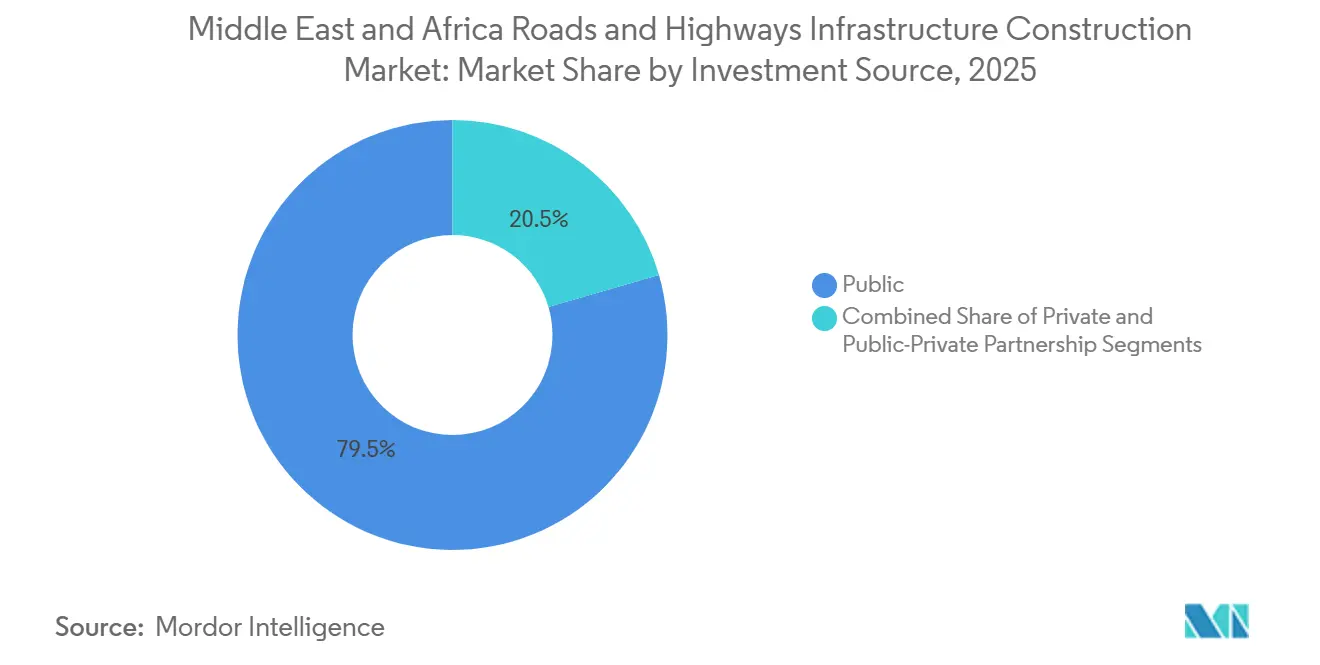
Public investment accounted for 79.50% in 2025, maintaining its position as the largest funding channel and underscoring that the Middle East and Africa roads and highways infrastructure construction market still depends primarily on government-backed capital programs. The United Arab Emirates federal transport plan and Riyadh’s ring and main road program both show that major route expansion begins with public policy commitment and public procurement. Public investment remains central because road access carries economic and political importance, especially when highways support trade corridors, inter-emirate traffic, or national logistics targets. In practice, this means that even where private capital enters, the first layer of demand still comes from the state. It also explains why countries with stronger public balance sheets continue to show faster project execution and deeper contractor participation.
Public-private partnerships are forecast to expand at a 10.20% CAGR through 2031, making them the fastest-growing funding source as governments seek a more flexible path for large transport projects. Saudi Arabia’s concession pipeline includes the Jeddah to Makkah Direct Highway, for which 3 consortia were prequalified, and the broader highway program is being structured through long-term Design-Build-Finance-Operate-Maintain models. Kenya’s Nairobi-Nakuru-Mau Summit highway was also restructured in 2026 to a user-pay toll model, which provided the concession with a clearer private revenue framework. Private investment outside formal Public-Private Partnerships remains more selective and is concentrated in access roads, industrial links, and developer-backed infrastructure, where returns are easier to map over time. This is changing competitive dynamics because balance sheet strength and concession capability now matter alongside construction scale. As that shift continues, firms that can combine design, funding, delivery, and long-term operations are likely to keep moving up the award chain.
By Type: National Roads Drive Volume as State Investments Accelerate
National roads captured a 64.30% share in 2025, making them the largest type segment and keeping intercity corridors at the center of the Middle East and Africa roads and highways infrastructure construction market. This dominance reflects the role of highways in trade movement, regional integration, and national mobility planning. Egypt’s upgrade of the International Coastal Road supports that position because the route links major Mediterranean port cities and adds freight separation features that serve national logistics goals. National roads also offer governments a visible way to improve connectivity over long distances, making them politically durable even when budgets tighten. They therefore continue to absorb the biggest share of spending in both Gulf and African project pipelines.
State roads are projected to grow at an 8.90% CAGR through 2031, making them the fastest-growing type as provincial and emirate-level agencies take on more mobility and rehabilitation work. In South Africa, the South African National Roads Agency Limited absorbed 3,099 kilometers of transferred roads, which increased the scale and urgency of work tied to sub-national networks. In the United Arab Emirates, corridor programs such as the Fourth Federal Corridor and the Latifa bint Hamdan Corridor demonstrate how state- and city-linked authorities are now shaping large-scale route upgrades for fast-growing urban areas. Local roads remain the smallest segment, but they still have strategic value because they connect highways with residential growth zones, industrial parks, and last-mile freight movement. The effect is that state-level demand is rising due to both rehabilitation pressure and urban traffic management needs. This gives the segment a faster growth path, even though national roads still account for the largest absolute volume.
Geography Analysis
Saudi Arabia held a 28.70% share in 2025, giving it the leading position and making it the volume anchor of the Middle East and Africa roads and highways infrastructure construction market. The country’s role is tied to the density of concurrent highway and corridor programs rather than to a single flagship project. Riyadh’s fourth group of the Main and Ring Road Axes Development Program adds 40 kilometers of corridors, 33 bridges, and 5 tunnels, with an expected capacity of over 950,000 vehicles per day. Saudi Arabia is also moving more of its large road pipeline into concession structures, indicating a shift in procurement and spending. That combination of route volume, urban complexity, and structured concession activity keeps Saudi Arabia at the center of the regional project base.
The United Arab Emirates is forecast to grow at a 9.80% CAGR through 2031, making it the fastest-growing country in the Middle East and Africa roads and highways infrastructure construction market. Its growth path is being led by a USD 46.2 billion transport plan that aims to improve federal road efficiency by 73% by 2030. The Emirates Road upgrade began construction in September 2025 and is expected to increase capacity by 65% while cutting travel time by 45% on the targeted stretch. The planned Fourth Federal Corridor adds another large layer to this growth, with 68 kilometers of motorway and design capacity for 360,000 trips per day. Population growth and rising vehicle ownership are making road capacity expansion more urgent, which is why the country is moving quickly on both federal and urban route programs.
Egypt remains a major market because of its corridor scale, but its fiscal year 2025 to 2026 roads budget of USD 484 million and the deferral of 46 projects show that funding pressure is affecting the pace. South Africa also carries significant network importance through the South African National Roads Agency Limited's management of a national road system totaling approximately 27,000 kilometers. Yet, funding still covers less than 50% of requirements, which constrains both new work and maintenance. The rest of the region is broadening through corridor-led programs, including Tanzania’s USD 985 million works budget for 2026 to 2027 and the Central African Republic’s USD 2.5 billion first national highway Public-Private Partnership agreement. This means regional growth is no longer coming only from the Gulf, since several African countries are also moving toward larger corridor-based road programs with cross-border and trade-focused logic.
Competitive Landscape
The Middle East and Africa roads and highways infrastructure construction market remains fragmented, with competition distributed across global engineering, procurement, and construction (EPC) firms, Chinese state-backed contractors, regional builders, and specialized local players. International contractors typically compete for large-scale Gulf infrastructure programs where technical capability, financing strength, and experience with complex projects are critical. Chinese contractors maintain a strong presence in Africa through corridor development and government-backed infrastructure programs. At the same time, regional firms continue to secure opportunities through local relationships, regulatory familiarity, and subcontracting networks. This structure creates a diverse competitive environment in which success depends heavily on geography, procurement models, funding sources, and project-specific requirements rather than on broad regional dominance. Orascom Construction’s pro forma backlog, including BESIX, reached USD 13.9 billion by mid-2025, highlighting how individual regional players can build significant scale and technical depth while still operating within a fragmented market structure.
Strategic activity across the Middle East and Africa roads and highways infrastructure construction market reflects different growth approaches among contractors. In Saudi Arabia, the Jeddah to Makkah Direct Highway concession advanced to a shortlist of three consortia, increasing opportunities for firms with financing capabilities and long-term concession expertise. In Egypt, Modon Holding awarded a USD 316 million construction contract to Orascom Construction in January 2026 for the Ras El Hekma project, strengthening its presence in large-scale infrastructure developments. In Kenya, the revised Nairobi-Nakuru-Mau Summit toll road agreement highlighted the growing importance of contractors and investors capable of operating within user-pay transport models. These developments indicate that competition is expanding beyond traditional construction execution toward concession structuring, project development capabilities, and alignment with public and private capital sources.
The competitive landscape is also shaped by increasing demand for contractors capable of delivering technically complex corridor projects involving bridges, tunnels, phased traffic management, and integrated infrastructure systems. Gulf markets are attracting international and regional firms through large urban mobility and highway programs. In contrast, African markets continue to provide opportunities through transport connectivity initiatives and cross-border corridor development. At the same time, smaller regional contractors remain important participants in local road projects, maintenance activities, and subcontracting roles due to their market knowledge and execution networks. As a result, the Middle East and Africa roads and highways infrastructure construction market is expected to remain fragmented, with competitive advantage determined by project specialization, local presence, financing capability, and the ability to deliver across diverse operating environments.
Middle East and Africa Roads and Highways Infrastructure Construction Industry Leaders
Bechtel Corporation
VINCI SA
Orascom Construction PLC
Larsen & Toubro Limited
China State Construction Engineering Corporation Ltd.
- *Disclaimer: Major Players sorted in no particular order

Recent Industry Developments
- July 2026: Egypt's Ministry of Transport activated 8 international logistics corridors under the United Nations Transports Internationaux Routiers (TIR) convention, integrating road infrastructure with dry ports, industrial zones, and the Suez Canal, reorienting national highway investment toward export-linked freight access.
- April 2026: The United Arab Emirates outlined its Fourth Federal Corridor, a USD 1.6 billion, 68-kilometer motorway linking Dubai, Sharjah, and Ajman with 6 to 8 lanes and capacity for 360,000 daily trips, part of the wider national transport plan.
- March 2026: The Central African Republic signed a USD 2.5 billion Public-Private Partnership (PPP) contract for the construction of its first national highway, covering 1,249 kilometers and connecting to East Africa, under a Build-Operate-Transfer model.


Middle East and Africa Roads and Highways Infrastructure Construction Market Report Scope
The Middle East and Africa Roads and Highways Infrastructure Construction Market Report is Segmented by Component (Road, Bridges/Overpass, Tunnels, and Others), Construction Type (New Construction and Renovation), Investment Source (Public, Private, and Public-Private Partnership), Type (National, State, and Local), and Geography (United Arab Emirates, and More). The Market Forecasts are Provided in Terms of Value (USD).
| Road |
| Bridges/Overpass |
| Tunnels |
| Others |
| New Construction |
| Renovation |
| Public |
| Private |
| Public-Private Partnership |
| National |
| State |
| Local |
| United Arab Emirates |
| Saudi Arabia |
| South Africa |
| Egypt |
| Rest of Middle East and Africa |
| By Component | Road |
| Bridges/Overpass | |
| Tunnels | |
| Others | |
| By Construction Type | New Construction |
| Renovation | |
| By Investment Source | Public |
| Private | |
| Public-Private Partnership | |
| By Type | National |
| State | |
| Local | |
| By Country | United Arab Emirates |
| Saudi Arabia | |
| South Africa | |
| Egypt | |
| Rest of Middle East and Africa |


Key Questions Answered in the Report
What is the 2026 value of the Middle East and Africa roads and highways infrastructure construction space?
The market is estimated at USD 72.69 billion in 2026 and is forecast to reach USD 109.67 billion by 2031, with an 8.57% CAGR.
Which segment holds the largest share by component?
Roads are the largest component, with a 74.60% share in 2025, supported by national highway and corridor expansion programs across the region.
Which funding model is growing the fastest through 2031?
Public-private partnership is the fastest-growing funding source, with a projected 10.20% CAGR through 2031 as concession structures become more common.
Which country leads current spending in this space?
Saudi Arabia led with a 28.70% share in 2025, supported by dense corridors, urban roads, and concession-based programs.
Which country is expected to grow the fastest by 2031?
The United Arab Emirates is projected to grow fastest at a 9.8% CAGR, driven by its federal transport plan and major urban corridor upgrades.
Why is renovation becoming more important in regional road programs?
Renovation is projected to grow at an 8.90% CAGR because aging assets, deferred upkeep, and traffic wear are pushing countries like Egypt and South Africa toward larger rehabilitation programs.
Page last updated on:


 Your data is secure and never sold or shared.


