
Market Overview
| Study Period | 2020 - 2031 |
|---|---|
| Forecast Data Period | 2026 - 2031 |
| Base Year Market Size (2025) | USD 562.27 Million |
| Market Size (2026) | USD 580.94 Million |
| Market Size (2031) | USD 684.02 Million |
| Growth Rate (2026 - 2031) | 3.32 % |
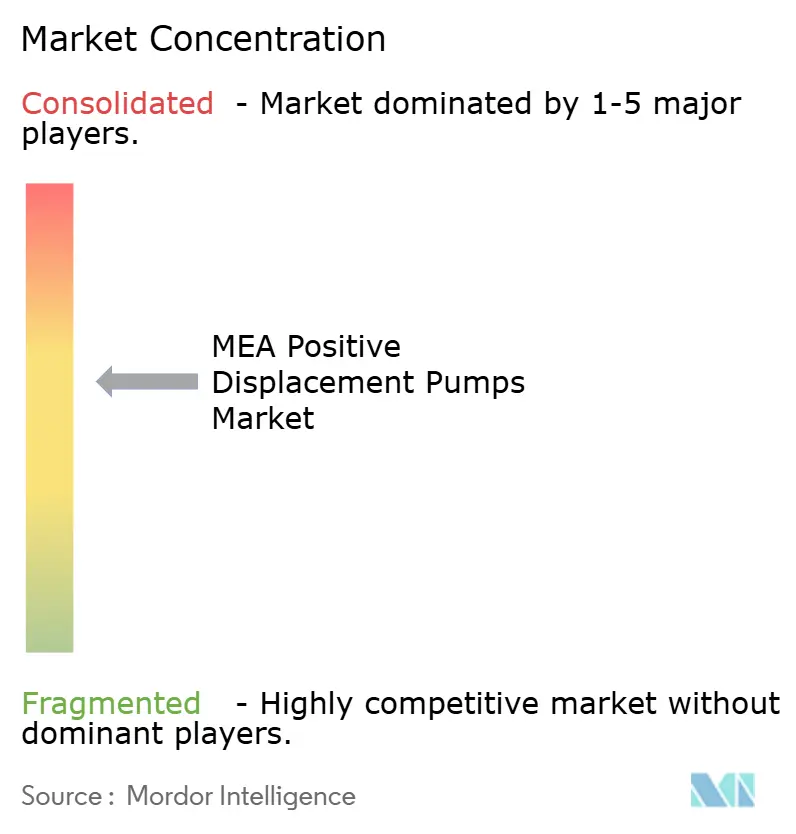
| Market Concentration | Medium |
Major Players
*Disclaimer: Major Players sorted in no particular order Image © Mordor Intelligence. Reuse requires attribution under CC BY 4.0. |
|
MEA Positive Displacement Pumps Market Analysis by Mordor Intelligence
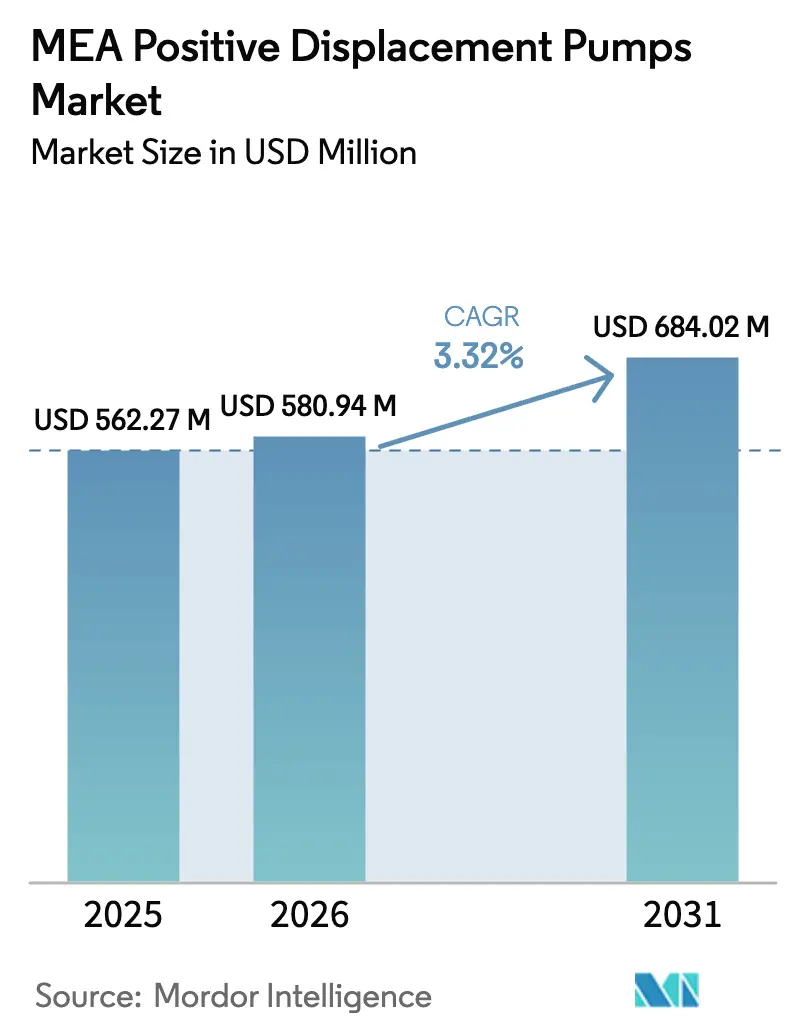
The Middle East and Africa positive displacement pump market size in 2026 is estimated at USD 580.94 million, growing from 2025 value of USD 562.27 million with 2031 projections showing USD 684.02 million, growing at 3.32% CAGR over 2026-2031. This moderate headline figure masks contrasting regional dynamics: heavy upstream spending in the Gulf Cooperation Council is supporting large‐capacity rotary screw installations, while African mining expansion is lifting demand for abrasion-resistant dewatering solutions. Oil price stability, stricter industrial water-reuse mandates and rising food-safety certifications are jointly underpinning fresh capital outlays. At the same time, localized manufacturing investments in Egypt and South Africa are shortening lead times and partially insulating buyers from currency swings. Collectively, these factors position the Middle East and Africa positive displacement pump market for steady, if unspectacular, growth despite cyclical risks.
Key Report Takeaways
- By displacement principle, rotary screw units captured 28.15% revenue share in 2025; peristaltic pumps are projected to expand at a 3.67% CAGR through 2031.
- By end-user industry, oil and gas applications held 30.85% of the Middle East and Africa positive displacement pump market share in 2025, while pharmaceuticals recorded the highest projected CAGR at 3.74% to 2031.
- By material, cast-iron constructions accounted for 46.12% of the Middle East and Africa positive displacement pump market size in 2025; alloy and specialty metals are on track for an 4.12% CAGR between 2026-2031.
- By lubrication, conventional lubricated designs commanded 68.10% share in 2025; non-lubricated variants lead growth at 3.76% CAGR on contamination-free operation advantages.
- By flow-rate, <10 m³/h models controlled 36.20% of 2025 sales, whereas >200 m³/h pumps represent the fastest growing category with a 4.85% CAGR through 2031.
- By geography, the Middle East generated 69.40% of 2025 revenue; Africa is the fastest progressing region, advancing at a 4.05% CAGR to 2031.
Note: Market size and forecast figures in this report are generated using Mordor Intelligence’s proprietary estimation framework, updated with the latest available data and insights as of 2026.
MEA Positive Displacement Pumps Market Trends and Insights
Drivers Impact Analysis*
| Driver | (~) % Impact on CAGR Forecast | Geographic Relevance | Impact Timeline |
|---|---|---|---|
| Rapid industrial water-reuse mandates | +0.8% | Middle East core, expanding to North Africa | Medium term (2–4 years) |
| Upstream oil and gas project pipeline revival | +1.2% | GCC states, Algeria, Nigeria | Short term (≤ 2 years) |
| Rising CAPEX in African mining and metals | +0.6% | Sub-Saharan Africa, South Africa core | Long term (≥ 4 years) |
| Food-grade pump demand under FSSC 22000 | +0.4% | Regional, with concentration in UAE, South Africa | Medium term (2–4 years) |
| Precision dosing for regional green-hydrogen electrolyzers | +0.3% | Egypt, Saudi Arabia, Morocco | Long term (≥ 4 years) |
| Off-grid solar powered wellhead pumping in arid zones | +0.2% | Nigeria, Algeria, remote Middle East locations | Medium term (2–4 years) |
| Source: Mordor Intelligence | |||


Upstream oil and gas project pipeline revival
Thirty upstream projects passing final investment decision in 2024 unlocked USD 125 billion in spending, with national oil companies eager to capitalize on breakeven costs near USD 47 per barrel.[1]Upstream Online, “Top contractors compete for strategic Middle East gas facility expansion deals for USD 5 billion-plus project,” upstreamonline.com ADNOC Gas alone earmarked USD 5 billion for three gas-processing facility expansions, each requiring high-pressure plunger and diaphragm pumps. Saudi Aramco’s initiative to raise gas output by 60% before 2030 further enlarges the addressable installed base. These developments translate into recurrent demand spikes for rugged rotary screw and reciprocating units able to handle sour gas and multiphase flow, lifting short-cycle orders in the Middle East and Africa positive displacement pump market.
Rapid industrial water-reuse mandates
Severe water scarcity has pushed Saudi Arabia to target 100% wastewater reuse against an 18% baseline, with the National Water Company committing USD 23 billion to sewage upgrades.[2]WaterWorld, “Middle East Gears Up for Water Reuse Technologies,” waterworld.com Industrial facilities are now obliged to install chemical dosing and sludge-handling systems that operate reliably in corrosive environments. Ceramic membrane pilots at Saudi Aramco have already achieved 85–90% recovery rates, cutting fresh-water draws by 22 million gallons annually.[3]Water Tech Online, “Recovering Filter Backwash to Reduce Groundwater Consumption,” watertechonline.com These initiatives favor diaphragm, peristaltic and progressive-cavity pumps configured in duplex stainless steel, sustaining medium-term tailwinds for the Middle East and Africa positive displacement pump market.
Rising CAPEX in African mining and metals
Underground expansion of Botswana’s Karowe diamond mine and Guinea’s Bankan gold project exemplify the USD-intensive pipeline sweeping Sub-Saharan Africa.[4]Modern Mining, “Modern Mining September 2024,” modernmining.com Hard-rock shafts now descend deeper, elevating hydrostatic head and solids loading that outstrip centrifugal capabilities. Positive displacement designs, such as Becker Mining’s PVS 80, delivering 20 l/s at 57 m head, are specified to handle slurry and entrained gas. With critical-mineral exploration ramping up for energy transition supply, the Middle East and Africa positive displacement pump market benefits from a longer-dated order book tied to mine dewatering and reagent dosing.
Food-grade pump demand under FSSC 22000
Regional processors must obtain FSSC 22000 certification to access export chains, prompting upgrades to hygienic lobe, peristaltic and twin-screw pumps capable of clean-in-place routines. UAE beverage plants, South African dairy lines and emerging Nigerian confectionery facilities are shifting toward polished stainless steel constructions with elastomers compliant to FDA and EU regulations. The resulting price premium offsets currency depreciation risks and underpins supplier margins in the Middle East and Africa positive displacement pump market.
Restraints Impact Analysis*
| Restraint | (~) % Impact on CAGR Forecast | Geographic Relevance | Impact Timeline |
|---|---|---|---|
| High CAPEX and TCO versus centrifugal alternatives | -0.7% | Regional, particularly price-sensitive African markets | Short term (≤ 2 years) |
| Skilled-labor scarcity for complex maintenance | -0.5% | Sub-Saharan Africa, remote Middle East locations | Medium term (2-4 years) |
| Proliferation of counterfeit spares eroding reliability | -0.3% | UAE, Nigeria, Egypt | Short term (≤ 2 years) |
| Currency volatility inflating imported component costs | -0.4% | Africa core, Turkey, Egypt | Medium term (2-4 years) |
| Source: Mordor Intelligence | |||
High CAPEX and TCO versus centrifugal alternatives
Procurement teams frequently judge equipment on upfront cost, a metric where centrifugal pumps offer savings of 20–30% for high-volume, low-viscosity duties. In commodity-linked African economies, cash-constrained operators select single-stage volutes even when duty conditions favor positive displacement geometry. Vendors respond with energy-efficient upgrades: Wear Reduction Technology embedded in Weir’s WARMAN AH line cuts power draw by up to 5%, narrowing lifetime-cost differentials.
Proliferation of counterfeit spares eroding reliability
Authorities in the UAE confiscated 4 000 fake water pumps retailing at one-third the authentic price. Substandard wear parts cause unplanned shutdowns, tarnish equipment reputations and inflate warranty claims. The threat is especially acute in hazardous-duty oil and gas installations where gasket failure can trigger environmental penalties. Manufacturers are expanding QR-code traceability and authorized service networks to restore confidence and safeguard growth in the Middle East and Africa positive displacement pump market.
*Our forecasts treat driver/restraint impacts as directional, not additive. The impact forecasts reflect baseline growth, mix effects, and variable interactions.
Segment Analysis
By Displacement Principle: Rotary dominance continues while peristaltic gains
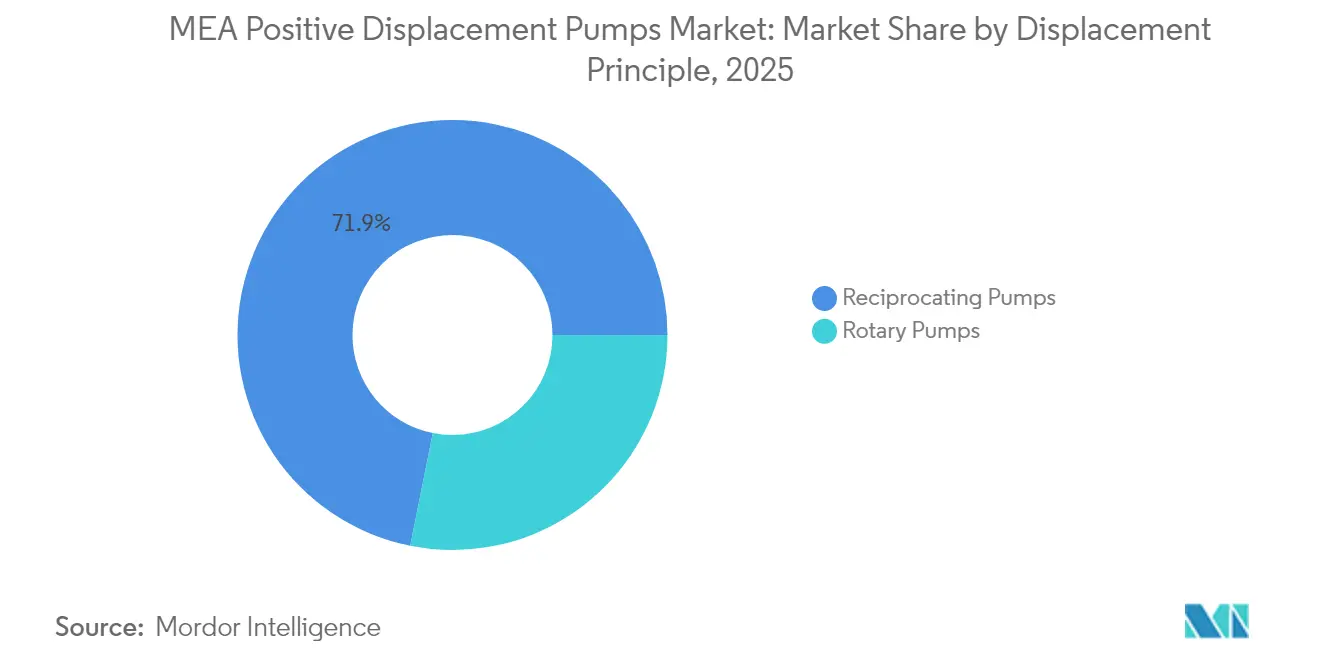
Rotary pumps generated 28.15% of 2025 revenue, underlining their entrenched role in viscous-fluid transfer across upstream oil and gas and asphalt blending. Diaphragm and piston reciprocating models together carved out a sizable niche on the strength of leak-free operation when handling aggressive chemicals. The Middle East and Africa positive displacement pump market size for peristaltic designs is projected to climb at a 3.67% CAGR as pharmaceutical formulators shift to single-use tubing for sterility assurance.
Technology roadmaps show gear pumps retaining cost leadership for moderate-pressure duties below 10 bar, while progressive-cavity machines penetrate slurry handling owing to resilient stator materials. Vogelsang’s EP series one-piece housing rated to 260 psi and 392 °F demonstrates the innovation thrust toward higher pressure envelopes. Providers are also hybridizing rotary and reciprocating architectures to optimize efficiency at variable flow demands, a trend poised to broaden solution palettes and defend pricing in the Middle East and Africa positive displacement pump market.


By End-user Industry: Oil and gas holds leadership as healthcare drives growth
Oil and gas accounted for 30.85% of 2025 sales thanks to multiphase transfer, chemical injection and blowout-preventer circuits that demand rugged plunger and twin-screw units able to manage gas entrainment. Water and wastewater followed at 26.52% on the back of desalination and sewage-network upgrades. Chemicals and petrochemicals benefiting from regional downstream integration strategies. Pharmaceuticals, while occupying a smaller base, will pace the market with a 3.74% CAGR through 2031 as sterile processing lines proliferate across UAE, Egypt and Saudi greenfield plants.
Food and beverage manufacturers energized by Gulf food-security programs favoring local production. In mining and metals, a 9.65% share hinged on abrasion-resistant pumping during dewatering and concentrate transfer. Diversifying end-markets distributes risk and cushions revenue swings, reinforcing the resilient outlook for the Middle East and Africa positive displacement pump market.
By Material: Cast-iron ubiquity coexists with specialty alloy surge
Cast-iron casings delivered 46.12% of 2025 turnover, reflecting affordability and sufficient corrosion resistance in non-aggressive water duties. Stainless steel reached 34.58% as sanitary and chemical services broadened. Specialty alloys, including duplex stainless, Hastelloy and chrome iron, register an 4.12% CAGR to 2031, propelled by high-temperature hydrocarbon processing and acidic leach circuits.
Investment in localized alloy machining, notably at Johannesburg tooling clusters, is cutting lead times for replacement stators and rotors. Becker Mining’s adoption of 28% chrome iron for hard-rock pumps demonstrates the performance dividend of metallurgical upgrades. As end-users weigh lifecycle costs, demand for premium alloys will steadily expand the Middle East and Africa positive displacement pump market size.
By Lubrication: Maintenance culture steers adoption patterns
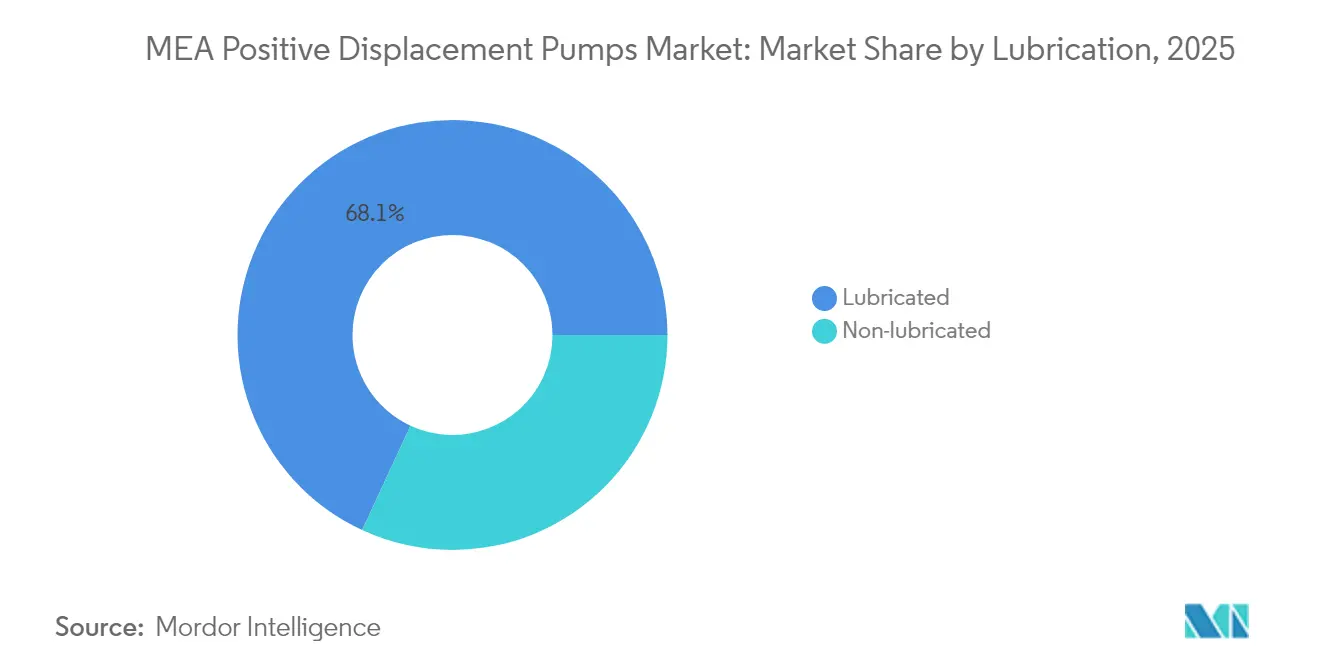
Lubricated assemblies captured 68.10% of 2025 revenue because they align with entrenched maintenance protocols in refineries and power stations. Nevertheless, contamination-sensitive industries embrace non-lubricated magnetic-drive and canned-motor designs that eliminate oil leakage risk.
Vendors emphasize extended-life bearings and dry-run tolerant elastomers to bridge the reliability perception gap, enhancing competitive footing. Momentum toward predictive maintenance via cloud-enabled vibration sensors further differentiates premium offers in the Middle East and Africa positive displacement pump market.
By Flow-rate: Precision segment still leads while large-volume units accelerate
Pumps rated below 10 m³/h maintained a 36.20% share in 2025, underpinning chemical dosing and laboratory synthesis tasks requiring ±1% flow accuracy. Units between 10–50 m³/h followed at 34.10%. Although >200 m³/h pumps form a smaller slice, their 4.85% CAGR underscores rising infrastructure megaprojects such as Egypt’s government-led irrigation schemes that specified Torishima multi-plunger trains.
Atlas Copco’s expansion of the WEDA submersible range with Wear Deflector Technology evidences engineering focus on high-volume pit and tunnel dewatering. This polarization between micro-dosing and bulk transfer reinforces the need for diverse product portfolios to secure wallet share in the Middle East and Africa positive displacement pump market.
Geography Analysis
The Middle East delivered 69.40% of 2025 revenue owing to energy-sector intensity and robust public-works outlays. Saudi Arabia’s wastewater-reuse vision and Qatar’s LNG expansion assure recurring project streams, keeping distributors’ order books healthy. The UAE’s diversified economy adds pharmaceutical, food and semiconductor capacity that requires hygienic pumping solutions. Turkish demand remains stable although lira depreciation poses import hurdles. The regional installed base is increasingly monitored via digital twins, improving mean-time-between-service and favoring value-added service contracts.
Africa supplied 30.60% of 2025 sales yet is growing faster at 4.05% CAGR. South Africa anchors the installed base through mature deep-level mining where chrome-iron casings extend pump life. Nigeria invests in wellhead remediation and modular refineries, triggering calls for chemical-injection skids. Egypt’s emergence as a production hub, illustrated by Xylem’s pump plant in 10th of Ramadan City, encourages supply-chain localization and price competitiveness.
Currency volatility remains a cross-cutting risk; rand depreciation has inflated imported spare-part costs by double digits, narrowing OEM market reach. Governments and multilaterals are responding by funding turnkey water and power assets, cushioning procurement budgets. As infrastructure densifies and mining CAPEX accelerates, Africa’s contribution to the Middle East and Africa positive displacement pump market size will keep edging higher through the decade.
Regulatory Landscape
In the GCC, market access for electrically driven pumps is increasingly tied to product conformity regimes and digital certification workflows. In Saudi Arabia, SASO technical regulations require applicable low-voltage electrical equipment to be registered and certified via the SABER platform, while products intended for use in potentially explosive atmospheres follow SASOEX/IEC certification pathways. Across GCC markets, the G-Mark framework and IEC 60335-2-41 safety requirements shape documentation, test reporting, and labeling needs for imported pump assemblies and packaged skids.
In the UAE, the Ministry of Industry and Advanced Technology (MoIAT) administers conformity assessment through its digital services, typically requiring a valid trade license, accredited laboratory test reports, and product registration to obtain conformity certification for regulated products. Energy-performance compliance is also tightening in industrial zones, with IE3 (premium efficiency) expectations for industrial water pump motor systems influencing specifications for packaged pumping systems and encouraging the adoption of variable-speed and monitored solutions that can demonstrate operating efficiency.
Value Chain Analysis
The regional value chain covers component suppliers (motors, elastomers, seals, rotors/stators, castings and specialty alloys), OEM design and assembly, third-party testing and certification, distributors and trading houses, and a service layer for commissioning, spares, overhaul, and rental. Jebel Ali (UAE) and Dammam (Saudi Arabia) function as key trading and logistics hubs for inventory positioning and re-export, while local content policies are pushing more assembly, remanufacturing, and service capability into-country to reduce lead times and improve project eligibility.
Aftermarket and lifecycle services are a major value-capture point in MEA, particularly for oil and gas, mining dewatering, and municipal water assets where uptime penalties are high. Recent supply-chain actions reflect two pressure points highlighted in the market context, counterfeit spares and long logistics cycles: OEMs and channels are deploying QR-code authentication for parts traceability, and they are expanding regional repair capacity through remanufacturing and service facilities to compress turnaround times and reduce exposure to import delays and currency volatility.
Competitive Landscape
The playing field is moderately fragmented: global majors such as Atlas Copco, Xylem, Grundfos and Flowserve coexist with regional specialists and rental firms. Top-five suppliers collectively control an estimated 60–65% of revenue, leaving room for niche entrants focused on hygienic, solar-ready or high-pressure applications. Atlas Copco’s EUR 5 million (USD 5.88 Million) acquisition of Integrated Pump Rental strengthens its footprint in Sub-Saharan Africa’s mining and construction segments. Xylem’s Egyptian factory highlights strategic localization that cuts delivery cycles from 16 weeks to 6 weeks and lowers landed costs.
Differentiation levers center on energy efficiency, wear-life, and digital monitoring. Vendors introducing duplex-steel rotors and low-shear screw geometries justify 10–15% price premiums. Service models are shifting toward outcome-based contracts guaranteeing uptime, aligning incentives with end-user productivity goals. Counterfeit mitigation through blockchain provenance tags and QR-code spare-part authentication is gaining traction, enhancing brand integrity in the Middle East and Africa positive displacement pump market.
Emergent challengers target solar-powered wellhead lifting where remote Nigerian operations lack grid access. Others focus on FSSC 22000-certified designs for regional food exporters pursuing zero-recall reputations. These white-space plays ensure competitive intensity stays balanced, sustaining innovation velocity across materials science, sealing solutions and IIoT integration.
MEA Positive Displacement Pumps Industry Leaders
-
Dover Corporation
-
Ingersoll Rand Inc.
-
Alfa Laval AB
-
Gorman-Rupp Company
-
Watson-Marlow Fluid Technology Solutions
- *Disclaimer: Major Players sorted in no particular order

Market Opportunities and Future Outlook
Industrial water reuse programs and upstream oil and gas project activity keep translating into demand for dosing, chemical injection, and sludge-handling duties, where diaphragm, peristaltic, progressing-cavity, and plunger pumps are specified for accuracy and leak containment. Compliance-driven purchasing for regulated workflows (including Saudi SASO/SABER and UAE MoIAT) also creates whitespace for suppliers that can package documentation, accredited test reports, and energy-performance compliant motor-drive combinations as part of a turnkey offering rather than selling hardware only.
A tangible opportunity is the pull-through from smart manufacturing investments into connected pumping systems and service models. In May 2026, Rockwell Automation reported that 98% of Middle Eastern manufacturers consider digital transformation essential and that nearly 30% of operating budgets are allocated to industrial technology, with broad uptake of AI for operational technology use cases such as quality control and cybersecurity. This environment supports demand for positive displacement pumps bundled with variable-frequency drives, sensor packages, and predictive maintenance integrations, particularly where end users are targeting reduced unplanned downtime and tighter management of reliability risks linked to counterfeit spares.
Recent Industry Developments
- April 2026: Allweiler (CIRCOR International) completed the integration of Swelore and Hiro Nisha, broadening its high-pressure positive displacement pump offering (cited up to 700 bar). The integration strengthens the product and engineering platform used in demanding oil and gas and process applications, supporting more standardized specification coverage across pressure ranges.
- May 2025: Roto Pumps announced upgraded manufacturing infrastructure and launched its P Range compact pumps, targeting higher penetration in oil and gas, mining, and wastewater duties. The introduction expands vendor options for compact positive displacement installations and highlights application-led product refresh cycles across core MEA end users.
- August 2024: Atlas Copco acquired South Africa-based Integrated Pump Rental for EUR 5 million, expanding its pump rental and dewatering services footprint in Sub-Saharan Africa. The acquisition underscores the role of rental fleets and service-led models in mining and construction dewatering, where rapid deployment and maintenance capability carry significant weight.


Research Methodology Framework and Report Scope
Market Definition and Coverage
This market covers positive displacement pumps sold and used across the Middle East and Africa, measured in value terms, and counted for industrial end users where a fixed volume of fluid is moved per cycle or rotation.
Scope exclusions: Standalone aftermarket services, spare parts, and installation labor are excluded, unless suppliers or buyers report them as bundled into the pump sale value.
Segmentation Overview
-
By Displacement Principle
-
Rotary Pumps
- Gear
- Lobe
- Screw (Single, Twin, Triple)
- Vane
-
Reciprocating Pumps
- Diaphragm
- Piston/Plunger
- Peristaltic
-
Rotary Pumps
-
By End-user Industry
- Oil and Gas
- Chemicals and Petrochemicals
- Water and Wastewater
- Food and Beverage
- Power Generation
- Pharmaceuticals and Life-Sciences
- Mining and Metals
- Other Industries
-
By Material
- Cast Iron
- Stainless Steel
- Alloy and Specialty Metals
-
By Lubrication
- Lubricated
- Non-lubricated
-
By Flow-rate (cubic meter/hour)
- Less than 10
- 10-50
- 50-200
- More than 200
-
By Geography
-
Middle East
- Saudi Arabia
- United Arab Emirates
- Qatar
- Kuwait
- Oman
- Bahrain
- Turkey
- Rest of Middle East
-
Africa
- Nigeria
- Egypt
- Algeria
- South Africa
- Kenya
- Rest of Africa
-
Middle East
Data Sources, Market Sizing, and Validation
Desk Research
Desk work starts with building the demand context for industries that consume these pumps in the Middle East and Africa, then mapping how pumps are specified and purchased in each end use. We leaned on public sources such as UN Comtrade trade statistics, the World Bank, OPEC, and national energy ministries, along with water authorities and utilities reporting. For cross-checks on industrial activity, we also referred to sources such as USGS mining statistics, FAOSTAT for food processing context, and peer reviewed engineering and materials papers to understand common pump selection patterns.
On the supply side, we reviewed company annual reports, investor presentations, tender portals, and project announcements to understand where new facilities and expansions were progressing. Where public reporting was thin, select paid subscriptions for company financials and intelligence, contracts and tenders, shipment level import export data, and patent databases were used to fill gaps. The sources mentioned above are illustrative rather than exhaustive, and we also used other public documents and datasets for data collection, validation, and clarification.
Primary Interviews and Surveys
Primary work focused on checking how buyers specify rotary versus reciprocating units, what drives material choices (cast iron, stainless steel, and alloys), and how lubrication and flow rate needs shift by end-user industry. We spoke with pump suppliers, distributors, EPC participants, and large end users across the Middle East and Africa so assumptions on pricing bands, replacement cycles, and project timing could be corrected before finalizing the model.
Distribution of primary research fieldwork respondents
| Company type | Respondent position |
|---|---|
| Top tier: 27% | CXOs: 12% |
| Mid tier: 59% | Functional/Unit leaders: 41% |
| Smaller Players: 14% | Managers: 47% |
Market-Sizing & Forecasting
Sizing is built using a top-down and bottom-up logic, where industrial activity and project pipelines are first translated into a pump demand pool by end-user industry and then validated using selective supplier and channel checks. On the top-down side, we reconstructed demand using indicators such as oil and gas capex and facility additions, water and wastewater treatment capacity expansion, mining output and new mine projects, and manufacturing additions in chemicals and food processing, which are then adjusted for typical pump intensity by application.
To keep the totals realistic, we corroborated the outcome with bottom-up approximations using sampled price bands by pump principle, typical unit count per project type, and distributor shipment patterns observed in trade flows and tenders. Inputs that materially shaped the model included the split of rotary versus reciprocating units, flow rate mix (for example, below 10 m3/h versus above 200 m3/h), material mix as a proxy for harsh duty applications, and replacement demand timing in utilities and process plants. Forecasts were produced using scenario analysis, where base assumptions on project awards, currency timing, and input cost pass through were reviewed with primary respondents. Any thin data pockets in smaller countries were handled using proxy ratios from similar end-use structures, and then rechecked with local feedback.
Data Validation & Update Cycle
Outputs were validated through multiple checks so that the totals reflect how the market behaves in practice. We compared modeled demand against independent signals like import intensity for key pump categories, tender activity levels, and known project commissioning schedules, and then investigated large variances country by country. Outliers were flagged, assumptions were revisited, and respondents were re-contacted when the variance could not be explained by scope or timing.
Before sign-off, the model and its inputs go through stepwise analyst reviews that focus on arithmetic checks, share logic, and consistency across end uses and pump principles. Reports are refreshed annually, and interim updates are made when material events such as major project delays, sanctions-related trade shifts, or sudden currency moves meaningfully change demand. Right before delivery, we perform a final review pass to make sure clients receive the latest updated view.
Mordor Intelligence's Middle East and Africa Positive Displacement Pumps Market Size Measured Against Other Published Estimates
Published market sizes for MEA positive displacement pumps can vary even when the topic sounds identical, because the scope line is drawn differently and the demand signals used for validation are not the same. Differences also show up when one estimate leans heavily on shipments, while another leans on project announcements, which can be early-stage and not fully converted to procurement.
Key gaps usually come from whether the estimate counts only pump sales value or also adds services and spares, how rotary and reciprocating categories are mapped, and whether the geography mix is limited to selected Gulf markets versus full Middle East and Africa coverage. Currency conversion timing, assumed price progression by material type, and the refresh cadence after major project slippages can also move the number up or down by a noticeable margin.
Benchmark comparison
| Source | Market Size | Gaps in Research Methodology |
|---|---|---|
| Mordor Intelligence | USD 562.27 M (2025) | |
| Industry Association A | USD 610.00 M (2025) | Often groups pump aftermarket services and spares together with new pump sales, and it can overstate demand in years when planned maintenance cycles are assumed to convert fully. |
| Regional Consultancy B | USD 520.00 M (2025) | Commonly narrows coverage to selected Middle East countries and applies conservative project conversion rates, which can undercount Africa-driven water and mining orders. |
The spread across figures is mainly explained by service bundling, how project timing is treated, and whether Africa is fully represented in the demand pool. When the model counts only new pump sales and is cross-checked against tenders, import flows, and end-use buildouts, that keeps the 2025 value closer to executable demand, as done by Mordor Intelligence.


Key Questions Answered in the Report
What is the forecast value of the Middle East and Africa positive displacement pump market in 2031?
The market is projected to reach USD 684.02 million by 2031, growing at a 3.32% CAGR from 2026.
Which displacement principle is expected to grow fastest in the region?
Peristaltic pumps are poised for a 3.67% CAGR through 2031 on strong demand in pharmaceutical and food applications.
Why are non-lubricated pumps gaining popularity?
They eliminate oil contamination risk and reduce maintenance, making them attractive for pharmaceuticals, food processing and remote solar-powered installations.
What major risk could slow market growth?
The spread of counterfeit spare parts undermines equipment reliability and erodes user trust, particularly in price-sensitive markets.
Page last updated on:





