
Middle East and Africa Net-Zero Energy Buildings Market Size and Share
Market Overview
| Study Period | 2020 - 2031 |
|---|---|
| Forecast Data Period | 2026 - 2031 |
| Base Year Market Size (2025) | USD 1.75 Billion |
| Market Size (2026) | USD 1.89 Billion |
| Market Size (2031) | USD 3.88 Billion |
| Growth Rate (2026 - 2031) | 15.47 % |
| Market Concentration | Low |
Major Players *Disclaimer: Major Players sorted in no particular order Image © Mordor Intelligence. Reuse requires attribution under CC BY 4.0. | |
Middle East and Africa Net-Zero Energy Buildings Market Analysis by Mordor Intelligence
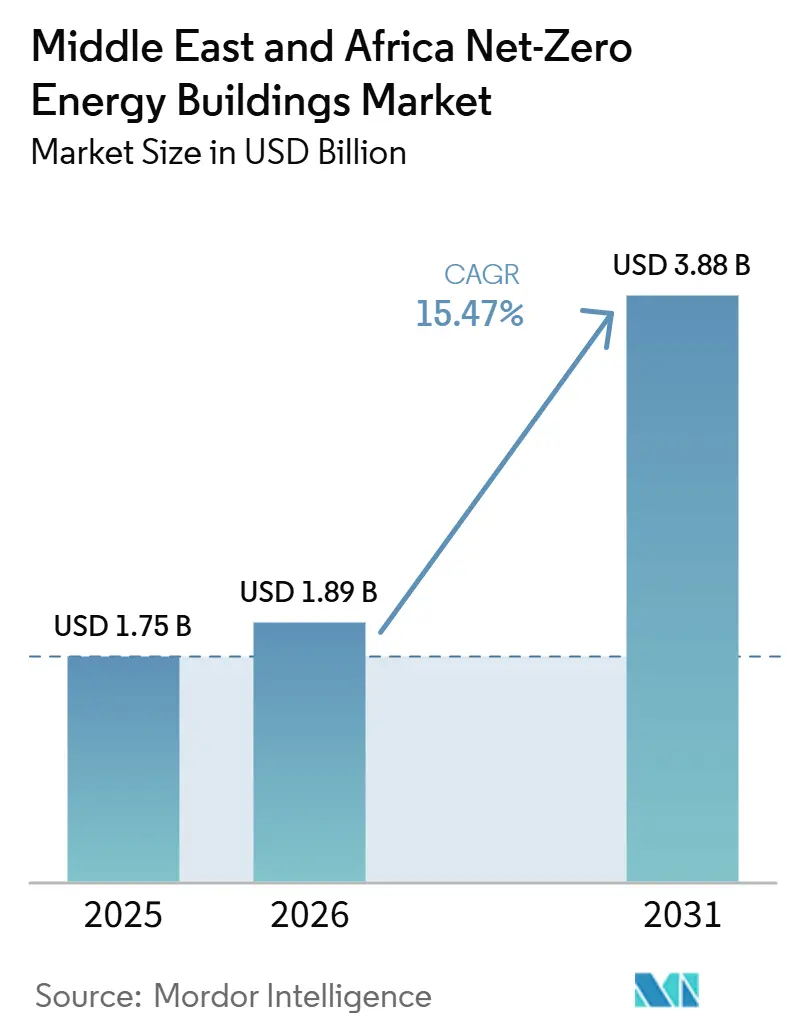
The Middle East and Africa net-zero energy buildings market size is projected to expand from USD 1.75 billion in 2025 and USD 1.89 billion in 2026 to USD 3.88 billion by 2031, registering a CAGR of 15.47% between 2026 and 2031.
The Middle East and Africa net-zero energy buildings market is being shaped by building codes that move sustainable design from a voluntary target into a permitting requirement. Dubai's framework and Saudi Arabia's building code have made compliance a more regular part of project planning, especially for large commercial developments. Electricity costs, grid pressure, and the need for reliable on-site power are also driving owners to combine efficiency measures with solar generation and storage. The Middle East and Africa net-zero energy buildings market is attracting more lender attention as green bonds, sustainability bonds, and building performance data support project financing. These conditions favor firms that can combine design, controls, equipment, commissioning, and long-term performance services.
Key Report Takeaways
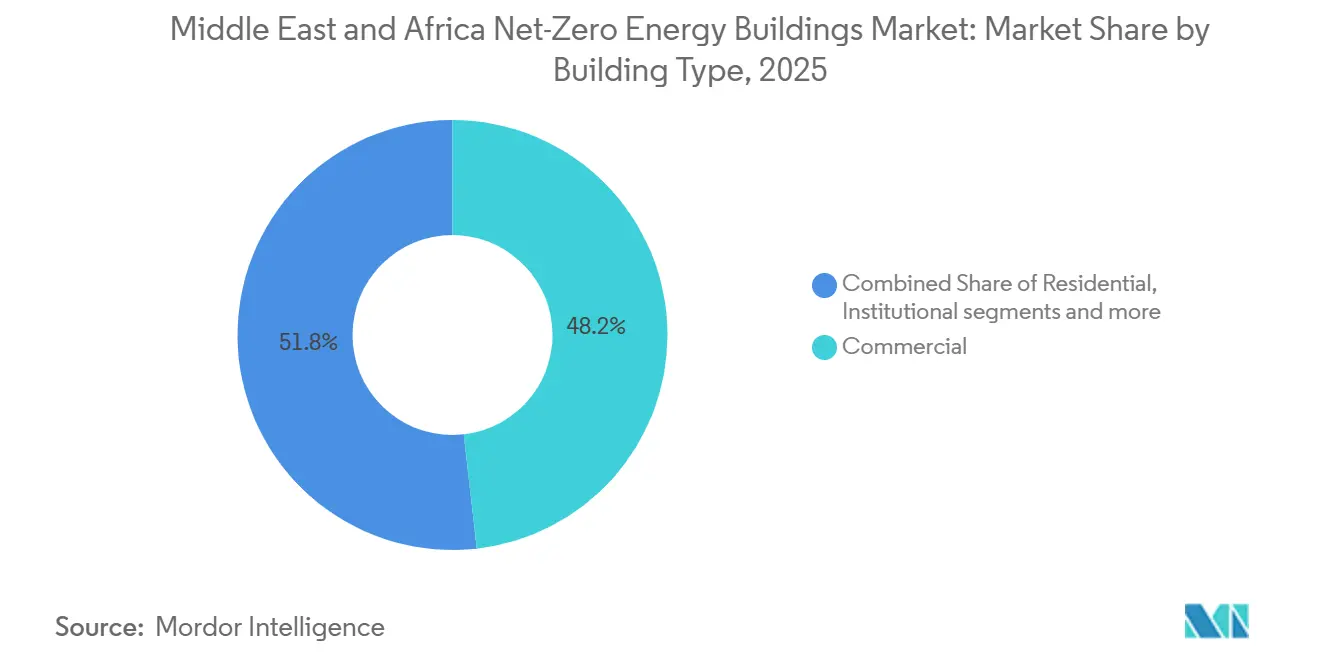
- By building type, commercial buildings held 48.20% of the Middle East and Africa net-zero energy buildings market share in 2025, while institutional buildings are forecast to grow at a 16.30% CAGR through 2031, supporting demand across the Middle East and Africa net-zero energy buildings market.
- By offerings, integrated solutions accounted for 72.10% of the Middle East and Africa net-zero energy buildings market size in 2025, while services are projected to expand at a 16.50% CAGR through 2031 as the Middle East and Africa net-zero energy buildings market shifts toward long-term performance support.
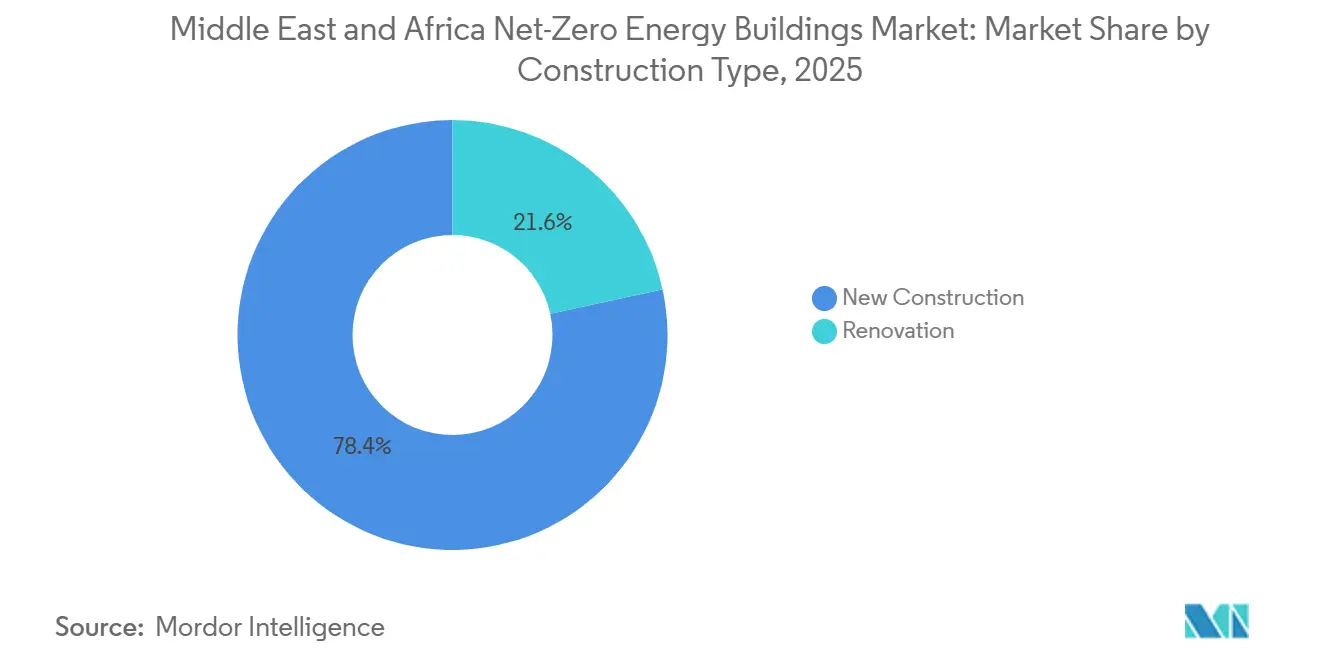
- By construction type, new construction accounted for 78.40% of revenue share in 2025, while renovation is projected to grow at a 15.80% CAGR through 2031, extending the Middle East and Africa net-zero energy buildings market to existing assets.
- By geography, the United Arab Emirates held 29.60% revenue share in 2025, while Saudi Arabia is forecast to grow at a 17.20% CAGR through 2031, increasing the Middle East and Africa net-zero energy buildings market opportunity across the region.
Note: Market size and forecast figures in this report are generated using Mordor Intelligence’s proprietary estimation framework, updated with the latest available data and insights as of January 2026.
Middle East and Africa Net-Zero Energy Buildings Market Trends and Insights
Drivers Impact Analysis*
| Drivers | (~) % Impact on CAGR Forecast | Geographic Relevance | Impact Timeline |
|---|---|---|---|
| National Net-Zero Mandates and Green Building Codes Accelerate Market Adoption | +3.8% | Gulf Cooperation Council core, with spillover to Sub-Saharan Africa | Short term (≤ 2 years) |
| Declining Costs of Solar, Storage, and Smart HVAC Systems Improve Project Viability | +2.9% | Regional | Medium term (2-4 years) |
| Utility Cost and Grid Reliability Challenges Increase Demand for Energy-Efficient Buildings | +2.5% | South Africa, Egypt, Sub-Saharan Africa | Short term (≤ 2 years) |
| Green Finance and Certification Incentives Support Net-Zero Building Investments | +2.1% | United Arab Emirates, Saudi Arabia, Egypt, South Africa | Medium term (2-4 years) |
| Cooling-Dominant Building Loads Enhance Retrofit Payback Potential | +1.7% | Middle East and Africa | Medium term (2-4 years) |
| Building Energy Performance Data Improves Access to Green Financing | +1.1% | United Arab Emirates, Saudi Arabia | Long term (≥ 4 years) |
| Source: Mordor Intelligence | |||
National Net-Zero Mandates and Green Building Codes Accelerate Adoption
Regulatory mandates are a direct source of demand for the Middle East and Africa net-zero energy buildings market. Dubai requires its Al Sa'fat Silver baseline for new building permits, linking sustainability documentation to approval and completion processes. Saudi Arabia has embedded sustainability requirements into its building code and assessment framework, moving the subject beyond pilot projects. Kenya launched its National Buildings and Construction Decarbonization Roadmap for 2026 to 2040, including minimum energy performance standards for new public buildings by 2030[1]Big3Africa, “Kenya Launches 2026-2040 Green Buildings Roadmap,” Big3Africa, big3africa.org. South Africa's Climate Change Act and its higher carbon tax rate created a clearer financial reason to reduce building emissions[2]“Implementing and Operating Net Zero Buildings in South Africa,” Buildings and Cities, journal-buildingscities.org. These measures give building owners, designers, and suppliers clearer reasons to address energy performance earlier in a project.
Declining Costs of Solar, Storage, and Smart HVAC Systems Improve Project Viability
Lower technology costs are improving the business case for the Middle East and Africa net-zero energy buildings market. A peer-reviewed study of hot-climate retrofits found that envelope upgrades combined with photovoltaic (PV) systems could yield a 3-year payback for the envelope component in Saudi Arabia[3]Bashir F. M., Alhamami A. H., Nasrallah E., et al., “Achieving Near-Net-Zero Energy in Hot Climates Through Synergistic Retrofit Interventions,” Scientific Reports, nature.com. The same source showed that combined retrofit packages can bring energy demand close to the thresholds for near-zero energy buildings. Better controls for heating, ventilation, and air conditioning, or HVAC, systems can reduce waste during daily operation. Shorter payback periods make upgrades to existing buildings more financially credible for owners who cannot replace their properties. This shift broadens the Middle East and Africa net-zero energy buildings market beyond new construction pipelines.
Utility Costs and Grid Reliability Challenges Increase Demand for Energy-Efficient Buildings
Unstable electricity supply and high energy costs are making efficiency investments more urgent in South Africa and Egypt. Professional interviews cited in the source material identified load shedding and energy costs as the leading reasons for the adoption of net-zero buildings in South Africa. A 2026 study reported that Egypt's building sector accounted for more than 51% of national energy use, while cooling and refrigeration made up 35% to 40% of nonresidential electricity use. Owners can use on-site solar power, batteries, and demand controls to support business continuity and emissions goals. In the United Arab Emirates, buildings consume 70% of total electricity, making them central to the national energy strategy. This operating need can make integrated building solutions more relevant than isolated equipment upgrades.
Green Finance and Certification Incentives Support Building Investments
Green finance is giving developers more options to fund energy-efficiency and renewable energy measures. Egypt issued JPY 80 billion (USD 500 million) in sustainability samurai bonds in 2025, with proceeds allocated to renewable energy and energy efficiency. The Arab African International Bank issued a USD 500 million sustainability bond in 2024, with 75% of the proceeds directed to green projects, including energy efficiency and green buildings. The International Climate Initiative's BUILD ME program supports the development of building standards and financing tools for the Middle East and North Africa. Energy performance information can make certification and loan assessments more usable for lenders. This funding base supports the Middle East and Africa net-zero energy buildings market, where access to conventional financing remains difficult.
Restraints Impact Analysis*
| Restraints | (~) % Impact on CAGR Forecast | Geographic Relevance | Impact Timeline |
|---|---|---|---|
| High Upfront Capital Requirements Limit Net-Zero Building Adoption | -2.2% | Regional | Short term (≤ 2 years) |
| Shortage of Specialized Net-Zero Building Professionals Delays Project Delivery | -1.6% | Gulf Cooperation Council core, South Africa, Egypt | Medium term (2-4 years) |
| Split Incentives and Weak Operational Performance Monitoring Reduce Investment Returns | -1.2% | Regional | Medium term (2-4 years) |
| Extreme Heat, Water Stress, and Renewable Energy Variability Challenge Building Performance | -0.8% | Gulf Cooperation Council, North Africa | Long term (≥ 4 years) |
| Source: Mordor Intelligence | |||
High Upfront Capital Requirements Limit Adoption
High upfront costs continue to constrain the Middle East and Africa net-zero energy buildings market. Net-zero buildings can cost 5% to 10% more to construct than conventional buildings, according to research on South Africa. South African borrowing costs reached 15% in 2024, potentially lengthening the payback periods for efficiency and renewable energy investments. A King Abdullah Petroleum Studies and Research Center survey found that 20.4% of 137 respondents identified high initial cost as a barrier to energy conservation in Gulf buildings. The survey also identified residential buildings as the most difficult segment to retrofit. Longer financing structures and better evaluation of energy performance contracts remain important for advancing projects.
Shortage of Specialized Professionals Delays Project Delivery
The shortage of qualified workers can delay projects in the Middle East and Africa's net-zero energy buildings market. The Project Management Institute projected a shortfall of 111,737 construction project management professionals in the Middle East and North Africa by 2035. Relevant skills include whole-life carbon accounting, energy modeling, verification of environmental product declarations, environmental, social, and governance reporting, and construction waste management. South Africa also faces a shortage of locally trained people for building operations and maintenance. The World Bank found that only 32% of green job postings across 6 Middle East and North Africa economies required science, technology, engineering, and mathematics skills. The gap, therefore, encompasses project delivery and sustainability management skills, as well as technical expertise.
*Our forecasts treat driver/restraint impacts as directional, not additive. The impact forecasts reflect baseline growth, mix effects, and variable interactions.
Segment Analysis
By Building Type: Commercial Buildings Lead While Institutional Demand Grows
Commercial buildings held 48.20% of the Middle East and Africa net-zero energy buildings market share in 2025. Their position reflects the concentration of offices, hotels, retail properties, and large mixed-use developments in Gulf urban centers. Developers are responding to certification requirements and to tenant requests for more credible energy performance. Schneider Electric's NEST headquarters in Dubai achieved a 37% reduction in annual energy use and Leadership in Energy and Environmental Design, or LEED, ID+C Platinum certification in 2025. The example shows how a commercial office can serve as a visible reference project for building controls and on-site generation. Commercial owners can also use verified operating data to support environmental, social, and governance disclosures.
Institutional buildings are forecast to post the fastest CAGR of 16.30% through 2031. Public agencies, universities, hospitals, and campuses control larger portfolios and can set common standards across multiple facilities. Siemens and the United Arab Emirates Higher Colleges of Technology agreed on a 5-year Smart Campus Framework that covers energy, water, waste, and clean mobility systems. Such agreements support recurring technology and services rather than a single equipment order. Residential demand is growing in South Africa and Egypt because building owners value greater self-sufficiency during unreliable power supply. Industrial facilities also widen the addressable base when manufacturers use high-performance designs for new plants.



By Offerings: Solutions Hold the Largest Position While Services Expand
Integrated solutions accounted for 72.10% of the Middle East and Africa net-zero energy buildings market size in 2025. New buildings and major retrofits often require PV modules, storage, high-performance envelopes, sensors, controls, and management platforms simultaneously. This combination gives solutions a high value per project. Dubai Electricity and Water Authority's Al Shera'a headquarters was inaugurated in May 2026 with 5 megawatts of on-site solar capacity and more than 110,000 sensors. The project is designed to generate more than 7,000 megawatt-hours of renewable electricity each year. Such projects demonstrate the scale of coordination required in the Middle East and Africa net-zero energy buildings market.
Services are forecast to grow at a 16.50% CAGR through 2031. This category includes design, engineering, commissioning, certification, consulting, and long-term building management. Honeywell's managed services agreement with Msheireb Downtown Doha illustrates the shift toward ongoing operational support. The platform combines data from more than 650,000 Internet of Things (IoT) sensors and 10,000 closed-circuit television (CCTV) cameras. Service contracts can help owners track results after handover rather than only during construction. Disclosure rules for listed property portfolios also increase demand for advisory work before and after a retrofit.
By Construction Type: New Construction Holds Volume While Renovation Gains Ground
New construction held 78.40% of revenue in 2025. This reflects the large development pipeline in Saudi Arabia and other Gulf states, where projects can address energy performance from the design stage. New projects can combine passive design, efficient systems, PV power, storage, and monitoring without requiring adaptations to older layouts. Saudi Arabia's large development agenda includes NEOM, the Red Sea Project, Diriyah Gate, and New Murabba. These programs create demand for building materials, smart controls, and engineering services that meet project standards. They also place greater emphasis on certified products and documented performance.
Renovation is projected to be the fastest-growing construction type at a 15.80% CAGR through 2031. The Middle East and Africa net-zero energy buildings industry has significant opportunities in existing buildings, as most occupied floor space will remain in use for years. Research in Saudi Arabia and Egypt found payback periods of 3 to 5.7 years for selected hot-climate retrofit packages. TAQA Energy Services signed an agreement in November 2025 to retrofit 8 building clusters at Aryam ICAD Residential City in Abu Dhabi. The work included HVAC upgrades, energy monitoring, controls, and water-saving installations. This work points to a practical route for owners who need measurable savings without rebuilding their properties.
Geography Analysis
The United Arab Emirates held 29.60% of the Middle East and Africa net-zero energy buildings market share in 2025. Federal and emirate-level rules give developers several routes to meet energy and emissions objectives. Dubai requires Al Sa'fat Silver for new permits, while Abu Dhabi's Estidama Pearl Building Rating System sets minimum requirements for new construction and government buildings. The United Arab Emirates Ministry of Energy and Infrastructure states that buildings account for 70% of total electricity consumption. This makes building efficiency a central part of the country's energy plan. Masdar City's commercial development and net-zero buildings show that high-performance standards can be used across major projects. The Middle East and Africa net-zero energy buildings market benefits when these rules are paired with renewable energy certificates and clear reporting practices.
Saudi Arabia is projected to grow at a 17.20% CAGR through 2031, the fastest rate among the source material countries. Vision 2030 supports demand for high-performance real estate across giga-projects and mainstream commercial development. Saudi Arabia submitted its second Nationally Determined Contribution in December 2025 and maintained its net-zero 2060 commitment under a Circular Carbon Economy approach. The policy direction applies to new construction and to upgrades of existing properties. Large projects also create procurement demand for materials with environmental product declarations. The country's expansion gives providers an incentive to establish local production, engineering, and servicing capacity.
South Africa and Egypt are shaped by energy needs that differ from the Gulf construction pipeline. South Africa had 34 net-zero-certified buildings between 2017 and 2023, but its 2024 climate law and carbon tax changes strengthened the basis for decarbonizing buildings. Egypt's large building energy load creates a case for improving cooling efficiency, adopting solar power, and implementing retrofit measures. The Middle East and Africa net-zero energy buildings market can also expand as public buildings serve as early reference projects. Kenya's roadmap and Ghana's building permit efficiency requirements show that standards are tightening across parts of Sub-Saharan Africa. These policies create a longer project pipeline for local and international providers.
Competitive Landscape
The Middle East and Africa Net-Zero Energy Buildings Market is fragmented, with no single company holding a dominant market position. The market includes global building technology firms, construction material manufacturers, energy service providers, and regional engineering companies. Johnson Controls, Schneider Electric, Siemens, and Honeywell compete through integrated building management platforms, digital controls, and long-term service capabilities that help customers reduce energy consumption and provide operational data for sustainability reporting. Johnson Controls, in partnership with Microsoft, deployed its OpenBlue digital twin platform at Al Shera'a in Dubai. Siemens has also pursued retrofit and campus agreements that pair equipment with longer service relationships. This model shifts competition from one-time supply toward ongoing performance support.
The Middle East and Africa net-zero energy buildings market also depends on suppliers of insulation, building envelopes, cooling equipment, and electrification systems. Kingspan, Saint-Gobain, and ROCKWOOL seek to support projects through local supply and products that can meet certification and localization requirements. Saint-Gobain opened a fiber-cement plant in Ekurhuleni, South Africa, after investing more than ZAR 500 million (USD 27 million) in 2026. Kingspan opened a manufacturing facility in Dammam in 2026 for HVAC ductwork insulation and roofing insulation boards. ABB opened a USD 2 million artificial intelligence and digital solutions training center in Dubai in 2025, with the capacity to train 2,000 engineers and technicians annually. These moves extend competition beyond product features to local capability and supply access.
Regional firms, including Masdar, Dalkia, Al-Futtaim Engineering, and ELSEWEDY ELECTRIC, can compete through government relationships and familiarity with local approval processes. Their role is important where public projects combine power systems, infrastructure, buildings, and performance commitments. Opportunities remain in performance monitoring for mid-sized commercial owners and energy performance contracting for existing buildings in Egypt and Sub-Saharan Africa. Smaller firms may find it difficult to meet the certification, data, and delivery standards required by LEED Zero Energy, LEED Zero Carbon, BREEAM, and Al Sa'fat. The Middle East and Africa net-zero energy buildings industry is therefore competitive but not dominated by a small group with disclosed combined revenue share. A market concentration score cannot be calculated from the supplied material because it does not provide the combined market share for the leading firms.
Middle East and Africa Net-Zero Energy Buildings Industry Leaders
Johnson Controls International plc
Schneider Electric SE
Siemens AG
Honeywell International Inc.
ABB Ltd.
- *Disclaimer: Major Players sorted in no particular order


Recent Industry Developments
- May 2026: Dubai's ruler officially inaugurated Al Shera'a, Dubai Electricity and Water Authority's new headquarters in Al Jaddaf, the world's tallest and largest net-positive government building. The building generates over 7,000 MWh of renewable energy annually from 5 MW of on-site photovoltaics across more than 20,000 m² of solar panels, setting a new operational benchmark for government-sector net-zero buildings in the region.
- February 2026: Honeywell, Msheireb Properties, and Ooredoo Qatar announced a strategic partnership to deploy an AI-powered city management platform integrating over 650,000 IoT sensors and 10,000 CCTV cameras across Msheireb Downtown Doha, backed by a 5-year managed services contract. This exemplifies the shift from one-time project delivery to long-run performance optimization services.
- January 2026: Saint-Gobain Africa officially launched its new fiber-cement manufacturing plant in Ekurhuleni, Gauteng, South Africa, representing an investment of more than ZAR 500 million (USD 27 million) and supporting local manufacturing, skills development, and sustainable building-material supply to the South African construction sector.


Middle East and Africa Net-Zero Energy Buildings Market Report Scope
The Middle East and Africa Net-Zero Energy Buildings Report is Segmented by Building Type (Residential, Commercial, Institutional, and Industrial), by Offerings (Solutions and Services), by Construction Type (New Construction and Renovation), and by Geography (United Arab Emirates, Saudi Arabia, South Africa, Egypt, and More). The Market Forecasts are Provided in Terms of Value (USD).
| Residential |
| Commercial |
| Institutional |
| Industrial |
| Solutions (New Net-Zero Energy Building Development, Net-Zero Building Retrofit, Integrated Design & Delivery and Smart Net-Zero Building Solutions) |
| Services (Architectural & Engineering Design, Construction Services, Commissioning & Certification Services and Consulting Services) |
| New Construction |
| Renovation |
| United Arab Emirates |
| Saudi Arabia |
| South Africa |
| Egypt |
| Rest of Middle East and Africa |
| By Building Type | Residential |
| Commercial | |
| Institutional | |
| Industrial | |
| By Offerings | Solutions (New Net-Zero Energy Building Development, Net-Zero Building Retrofit, Integrated Design & Delivery and Smart Net-Zero Building Solutions) |
| Services (Architectural & Engineering Design, Construction Services, Commissioning & Certification Services and Consulting Services) | |
| By Construction Type | New Construction |
| Renovation | |
| By Country | United Arab Emirates |
| Saudi Arabia | |
| South Africa | |
| Egypt | |
| Rest of Middle East and Africa |


Key Questions Answered in the Report
What is driving demand for net-zero energy buildings in the Middle East and Africa?
Building codes, electricity costs, grid reliability concerns, and more financing options are supporting demand. The sector is forecast to grow at a 15.47% CAGR from 2026 to 2031.
Which building type has the largest position in the Middle East and Africa net-zero energy buildings market?
Commercial buildings led with 48.20% revenue share in 2025, supported by major offices, hospitality assets, and mixed-use developments.
Which part of the Middle East and Africa net-zero energy buildings market is growing fastest?
Institutional buildings are projected to grow at a 16.30% CAGR through 2031. Services are also expected to expand at a 16.50% CAGR.
Why are building renovations becoming more important in the region?
Renovation is forecast to grow at a 15.80% CAGR through 2031, as owners pursue lower operating costs and better power resilience in existing properties.
Which country is expected to grow fastest through 2031?
Saudi Arabia is forecast to grow at a 17.20% CAGR, supported by Vision 2030, large development projects, and its commitment to net-zero by 2060.
What challenges limit the adoption of net-zero building solutions?
High upfront costs, costly borrowing, shortages of specialized workers, split incentives, and difficult operating conditions can slow project decisions.
What is the market size of the Middle East and Africa Net-Zero Energy Buildings Market?
The Middle East and Africa Net-Zero Energy Buildings Market was valued at USD 1.75 billion in 2025 and is estimated to reach USD 1.89 billion in 2026, growing at a 15.47% CAGR from 2026 to 2031 to reach USD 3.88 billion by 2031.
Page last updated on:





