Middle East And Africa Indoor LED Lighting Market Size and Share
Market Overview
| Study Period | 2018 - 2031 |
|---|---|
| Base Year Market Size (2025) | USD 4.21 Billion |
| Market Size (2026) | USD 4.46 Billion |
| Market Size (2031) | USD 5.93 Billion |
| Growth Rate (2026 - 2031) | 5.89 % |
| Fastest Growing Market | Industrial and Warehouse |
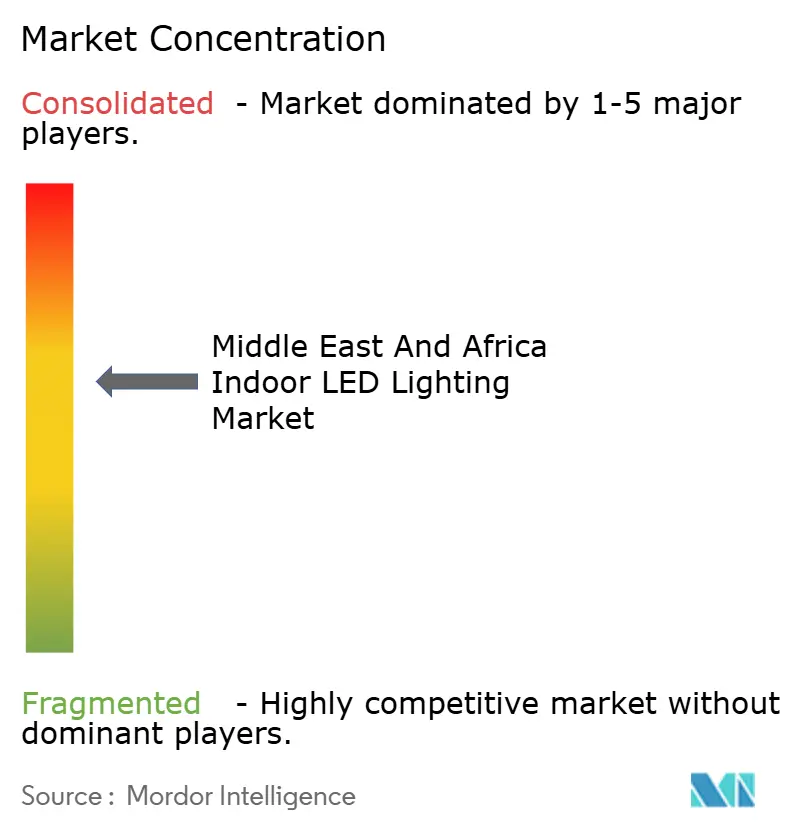
| Market Concentration | Medium |
Major Players *Disclaimer: Major Players sorted in no particular order Image © Mordor Intelligence. Reuse requires attribution under CC BY 4.0. | |
Middle East And Africa Indoor LED Lighting Market Analysis by Mordor Intelligence
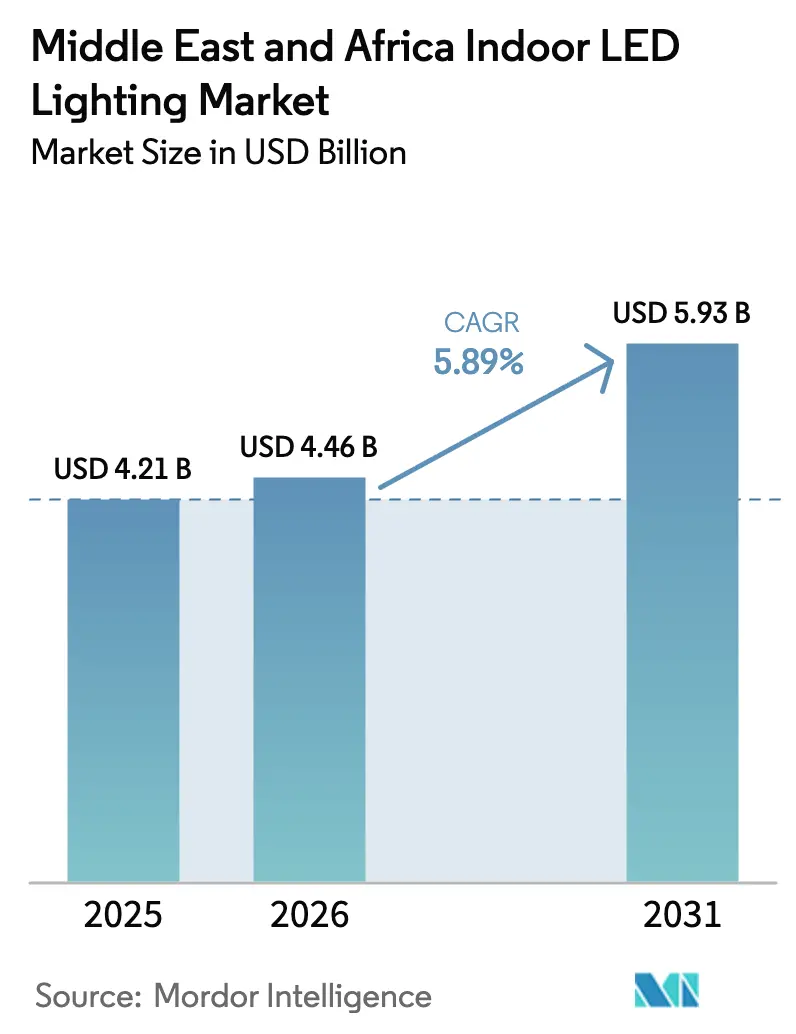
The Middle East and Africa indoor LED lighting market size was valued at USD 4.21 billion in 2025 and estimated to grow from USD 4.46 billion in 2026 to reach USD 5.93 billion by 2031, at a CAGR of 5.89% during the forecast period (2026-2031). Accelerating public-sector energy-efficiency programs, rapid cost deflation in LED components, and widening urban real-estate pipelines anchor the market’s growth momentum. Mature Middle Eastern economies continue to favour premium luminaires that maximize performance and regulatory compliance, while price-sensitive African markets accelerate lamp retrofits as affordability rises. Falling chip prices are compressing payback cycles to two years or less in many institutional projects, encouraging budget-constrained facilities to proceed with staged upgrades. Manufacturers are localizing assembly to mitigate import duties and currency volatility, a strategy exemplified by Signify’s Egypt joint venture, which underpins regional supply resiliency.
Key Report Takeaways
- By product type, luminaires accounted for 59.32% of the Middle East and Africa's indoor LED lighting market share in 2025. Lamps are projected to expand at a 9.34% CAGR through 2031.
- By installation type, retrofits accounted for 73.62% share of the Middle East and Africa indoor LED lighting market size in 2025.
- By application, residential captured a 39.25% share in 2025 and is projected to advance at an 8.71% CAGR through 2031.
- By geography, Africa is forecast to record the highest CAGR at 7.55% between 2026 and 2031. The Middle East held 32.15% revenue share in 2025.
Note: Market size and forecast figures in this report are generated using Mordor Intelligence’s proprietary estimation framework, updated with the latest available data and insights as of 2026.
Middle East And Africa Indoor LED Lighting Market Trends and Insights
Drivers Impact Analysis*
| Driver | (~) % Impact on CAGR Forecast | Geographic Relevance | Impact Timeline |
|---|---|---|---|
| Government energy-efficiency mandates across GCC and key African economies | +1.20% | GCC core, Egypt, South Africa, Morocco | Medium term (2-4 years) |
| Falling LED component costs and retail prices | +1.80% | Global, with accelerated impact in price-sensitive African markets | Short term (≤ 2 years) |
| Rapid urban real-estate expansion (commercial and residential) | +1.40% | UAE, Saudi Arabia, Qatar, Nigeria, Kenya, Egypt | Medium term (2-4 years) |
| Human-centric lighting adoption in premium Middle-East office projects | +0.60% | UAE, Saudi Arabia, Qatar, Kuwait | Long term (≥ 4 years) |
| Smart-building retrofits driven by energy benchmarking regulations | +0.80% | GCC markets, South Africa, Egypt | Medium term (2-4 years) |
| Off-grid solar-powered LED deployments in Sub-Saharan mini-grids | +0.90% | Sub-Saharan Africa, rural Middle East | Long term (≥ 4 years) |
| Source: Mordor Intelligence | |||


Government Energy-Efficiency Mandates Accelerate Institutional Adoption
Mandatory efficacy thresholds in GCC building codes, Egypt’s performance-contracting schemes, and Dubai’s USD 20 million Crescent City Connection LED retrofit demonstrate how public policy unlocks large-volume demand. Dubai initiatives alone have delivered 40–60% energy savings relative to fluorescent systems. Compliance certainty has encouraged manufacturers to site regional assembly lines, improving lead times and lowering landed costs for institutional buyers.
Falling Component Costs Transform Market Economics
Premium chip prices declined 50% between 2022 and 2025, shrinking the chip share of lamp cost structures from 50-60% to 20-40%. Chinese chip exports to Gulf distributors surged 35% in 2024, accelerating price erosion that reaches African retail shelves faster than in prior cycles. The cost shift enables producers to incorporate smart drivers and superior optics without significant price increases, unlocking pent-up replacement demand in SMEs.
Urban Real-Estate Expansion Drives Commercial Demand
The UAE alone has 2.5 million square meters of office space slated for delivery by 2026, with each project specifying LED lighting for lower operating expenditure and certification targets. Nigeria’s housing boom in Lagos and Abuja similarly fuels volume orders for cost-effective lamps that fit standard sockets. Mega-projects, such as Saudi Arabia’s NEOM, are setting specification benchmarks that ripple across regional supply chains and catalyze domestic fixture production.
Human-Centric Lighting Gains Premium Market Traction
Multinational occupiers in Dubai, Doha, and Riyadh are increasingly requiring circadian-tuned lighting that adjusts in intensity and spectrum during the workday. Such systems command premiums of 40–80% over static LED installations but are gaining market share in high-rent office towers, where wellness certifications influence tenant choice. Early adopters report energy reductions alongside measurable boosts in occupant satisfaction scores.
Restraints Impact Analysis*
| Restraint | (~) % Impact on CAGR Forecast | Geographic Relevance | Impact Timeline |
|---|---|---|---|
| High upfront costs for SMEs and small facilities | -1.10% | Africa-wide, smaller GCC markets | Short term (≤ 2 years) |
| Limited installer skillsets and consumer awareness in rural Africa | -0.80% | Sub-Saharan Africa rural areas | Medium term (2-4 years) |
| Geopolitical-driven electronic component supply disruptions | -0.70% | Global, with acute impact on import-dependent MEA markets | Short term (≤ 2 years) |
| Proliferation of counterfeit LED products hurting brand trust | -0.60% | Africa-wide, select Middle East markets with limited enforcement | Medium term (2-4 years) |
| Source: Mordor Intelligence | |||
High Upfront Costs Constrain SME Adoption
Small retailers and workshops across Africa often lack the capital to finance LED upgrades, despite the two-year payback period. Energy-service agreements remain rare, and commercial lending rates exceed 15% in several markets, resulting in thin retrofit pipelines outside large cities. As chip prices decline and plug-and-play lamps proliferate, first-time purchases are slowly shifting in favour of LEDs, but penetration remains uneven, especially among informal enterprises.
Limited Technical Infrastructure Hampers Rural Deployment
Rural installers unfamiliar with LED driver troubleshooting deliver inconsistent performance, leading to premature failures that erode consumer confidence. Distributors seldom maintain spare parts inventories outside of capitals, which prolongs downtimes. Manufacturers and NGOs have launched training programs, yet coverage gaps persist, limiting adoption rates in remote provinces where kerosene and incandescent bulbs remain prevalent.
*Our forecasts treat driver/restraint impacts as directional, not additive. The impact forecasts reflect baseline growth, mix effects, and variable interactions.
Segment Analysis
By Product Type: Luminaires Anchor Revenue Leadership
Luminaires captured 59.32% of the Middle East and Africa's indoor LED lighting market share in 2025, as buyers favored fully integrated systems with optimized optics, thermal management, and smart sensors. Commercial offices, hospitals, and airports specify high-performance troffers and downlights that ensure uniform illumination and longevity. Manufacturers bundle wireless drivers that link to building management software, unlocking occupancy analytics and predictive maintenance. Industrial high-bays with specialized heat sinks and IP65 housings command premium prices because reliability in dusty or high-temperature environments remains critical.
Lamp replacements, though smaller in value, register a 9.34% CAGR to 2031, outpacing all other categories and demonstrating that the Middle East and Africa indoor LED lighting market continues to mature through replacement cycles. Residential consumers and small shops prioritize screw-in bulbs for ease of installation and immediate energy savings. The growing availability of dimmable and filament LED lamps addresses aesthetic preferences without requiring fixture swaps, supporting volumes across both affluent Gulf households and emerging African middle-income segments.



By Application: Residential Drives Volume Growth
Residential spaces accounted for 39.25% of the Middle East and Africa indoor LED lighting market size in 2025, supported by falling shelf prices that now rival compact fluorescents in most cities. Urban apartment developers bundle LEDs as standard to market energy-efficient lifestyles to young professionals. Government subsidy schemes in the UAE and South Africa distribute high-efficacy bulbs during neighbourhood retrofits, accelerating household conversion rates.
Commercial offices form the second-largest slice as corporate sustainability targets converge with utility rebate programs that subsidize lamp-for-lamp swaps. Retailers embrace LEDs for high colour-rendering merchandising that prolongs shelf life of perishables and enhances brand presentation. Hospitality chains deploy tuneable-white fixtures to create mood-based ambiances while lowering operating costs. Healthcare and education facilities value low flicker and high reliability, switching from linear fluorescents to LED batten fixtures that deliver higher lux per watt and minimize maintenance in sensitive environments.
By Installation Type: Retrofits Dominate Current Spend
Retrofits accounted for 73.62% of 2025 revenues, underscoring a market stage where the greatest return lies in upgrading fluorescent and incandescent fittings rather than expanding new floor space. Facility managers favour plug-and-play retrofits that avoid rewiring and reduce downtime, especially in hospitals and data centers where operational continuity is paramount. In Africa, rural schools and clinics prioritize retrofit tubes that operate reliably on unstable grids, making incremental efficiency gains affordable.
New installations are projected to grow at a 7.14% CAGR, as mega-projects in the GCC specify integrated luminaires that meet stringent building codes from the outset. Specification engineers increasingly demand products with environmental product declarations, prompting manufacturers to adopt recyclable plastics and modular driver boards. These sustainability credentials differentiate bids in marquee developments such as Saudi financial districts and Qatari malls.

By Distribution Channel: Wholesale Networks Remain Indispensable
Traditional wholesalers maintained a 52.05% share in 2025, as contractors and facility engineers rely on local inventories for immediate replacement needs and warranty support. Distributors provide lamp-for-lamp cross-references and photometric files, which reduce project design time. Wholesale dominance is especially pronounced in Africa, where fragmented logistics require regional hubs capable of resolving customs hurdles and currency fluctuations.
E-commerce, however, advances at 8.55% CAGR as tech-savvy homeowners in the Gulf and South Africa prize online price transparency and home delivery. Marketplace platforms list thousands of SKUs, enabling side-by-side comparisons that pressure wholesalers to adopt omnichannel strategies. Direct sales teams focus on government tenders and airline terminals where customized photometric studies and on-site mock-ups influence high-value awards.
Competitive Landscape
Top Companies in Middle East and Africa Indoor LED Lighting Market
The Middle East and Africa indoor LED lighting market exhibits moderate concentration. The top five vendors, Signify, OSRAM, Acuity Brands, Samsung, and Panasonic, collectively account for an estimated 48% revenue share, leveraging patented optics, smart-control ecosystems, and after-sales networks. Signify’s venture with GILA Al Tawakol Electric localizes assembly in Egypt, slashing import tariffs and accelerating project lead times. OSRAM differentiates through horticultural luminaires for controlled-environment agriculture in desert climates, addressing niche demand segments.
Samsung scales regional manufacturing in Cairo and Durban to serve both domestic luminaires and display LED modules, exporting 85% of output to broader Middle East and Africa markets. Acuity Brands targets premium GCC office projects with tuneable-white troffers tied to cloud-based analytics. Patent enforcement challenges in nascent jurisdictions expose global brands to imitation risks; however, stronger after-sales and warranty terms help maintain their premium positioning.
Local assemblers in Egypt, Turkey, and South Africa capture lamp volumes by importing chips and drivers from China and packaging them for domestic codes. Their price advantage pressures global brands in commodity A-lamp categories. However, complex smart-integrated luminaires remain dominated by incumbents whose R&D pipelines outpace low-cost rivals.
Middle East And Africa Indoor LED Lighting Industry Leaders
Al Nasser Group
EGLO Leuchten GmbH
LEDVANCE GmbH (MLS Co Ltd)
OPPLE Lighting Co., Ltd
Signify (Philips)
- *Disclaimer: Major Players sorted in no particular order

Geography Analysis
The Middle East retained 32.15% of 2025 revenues, driven by robust construction pipelines and policy mandates that enforce stringent lighting efficacy thresholds. The UAE leads specification sophistication, integrating human-centric and smart-controlled luminaires in flagship towers. Saudi Arabia’s Vision 2030 compels ministries to retrofit thousands of public buildings, triggering multi-year framework agreements that favour manufacturers with local partner networks. Qatar continues to upgrade hospitality and retail venues ahead of global events, sustaining steady demand for premium fixtures.
Second-tier Gulf economies, such as Kuwait, Oman, and Bahrain, exhibit consistent replacement activity as corporate landlords pursue LEED and WELL certifications. Israel’s tech parks are adopting advanced circadian systems, although a small market size limits overall demand. Turkey serves as a gateway for European brands, exporting regional variants to both the Levant and North African markets.
Africa delivers the fastest growth at 7.55% CAGR as urbanization and electrification expand addressable demand. Nigeria tops continental volumes, propelled by Lagos condominium booms and commercial mall development that specify LED for operating cost advantages. South Africa’s corporate energy-benchmarking scheme catalyses wide-scale office retrofits in Johannesburg and Cape Town. Egypt’s dual role as consumption hub and manufacturing base attracts component suppliers seeking tariff-free market entry. Kenya, Ghana, and Morocco leverage development-finance loans to overhaul public schools and clinics with LED systems that cut grid strain.
Constraints persist rural regions face skills shortages, and smaller economies struggle with currency depreciation that inflates import costs. Yet the convergence of solar mini-grids and high-lumen LEDs opens new frontiers, especially were diesel generator reliance previously limited night-time productivity.
Recent Industry Developments
- April 2025: Samsung Electronics unveiled the Onyx Cinema LED display, featuring 4K 120 Hz capability, marking a continued investment in premium indoor LED technologies.
- January 2025: Panasonic Holdings launched “Panasonic Go,” an AI-driven initiative aimed at optimizing building energy management, including lighting controls.
- September 2024: Panasonic Energy reported delivery of 120,000 solar lanterns across Asia and Africa under the LIGHT UP THE FUTURE program, replacing kerosene lamps in off-grid communities.
- June 2024: Samsung highlighted 30 years of African manufacturing investments, with an annual capacity of 6 million units, 85% of which are exported within the Middle East and Africa.


Middle East And Africa Indoor LED Lighting Market Report Scope
Agricultural Lighting, Commercial, Industrial and Warehouse, Residential are covered as segments by Indoor Lighting.| Lamps |
| Luminaires/ Fixtures |
| Residential |
| Commercial Offices |
| Retail Stores |
| Hospitality |
| Industrial Facilities |
| Healthcare and Education |
| Other Applications |
| New Installation |
| Retrofit Installation |
| Direct Sales |
| Wholesale Retail |
| E-commerce |
| Middle East | Bahrain |
| Israel | |
| Kuwait | |
| Oman | |
| Qatar | |
| Saudi Arabia | |
| Turkey | |
| United Arab Emirates | |
| Africa | Algeria |
| Egypt | |
| Ghana | |
| Kenya | |
| Morocco | |
| Nigeria | |
| South Africa |
| By Product Type | Lamps | |
| Luminaires/ Fixtures | ||
| By Application | Residential | |
| Commercial Offices | ||
| Retail Stores | ||
| Hospitality | ||
| Industrial Facilities | ||
| Healthcare and Education | ||
| Other Applications | ||
| By Installation Type | New Installation | |
| Retrofit Installation | ||
| By Distribution Channel | Direct Sales | |
| Wholesale Retail | ||
| E-commerce | ||
| By Country | Middle East | Bahrain |
| Israel | ||
| Kuwait | ||
| Oman | ||
| Qatar | ||
| Saudi Arabia | ||
| Turkey | ||
| United Arab Emirates | ||
| Africa | Algeria | |
| Egypt | ||
| Ghana | ||
| Kenya | ||
| Morocco | ||
| Nigeria | ||
| South Africa | ||


Market Definition
- INDOOR LIGHTING - It incorporates all LED based lamps and fixtures/luminaire that are used to illuminate indoor section of residential, commercial, industrial buildings and agricultural lighting. LED offers efficient brightness with higher durability in comparison to other lighting technology.
- OUTDOOR LIGHTING - It incorporates the LED lighting fixtures that is used for illumination for exterior/outdoor illumination. For instance, LED lighting fixtures used to illuminate streets and highways, transport hubs, stadiums and other public places such as parking spaces.
- AUTOMOTIVE LIGHTING - It refers to the lighting fixtures installed for illumination and signaling purposes. It is used in both exterior and interior lighting of the vehicle. Headlamps, fog lamp, daytime running light (DRLs) are examples of exterior light whereas cabin light are interior lights.
- END USER - It refers to the end use application area where the LED fixture will be installed. For instance, in terms of indoor lighting, we have residential, commercial and industrial as end user category. For automotive lighting, primary end user considered are automotive manufacturers and aftermarket sale
| Keyword | Definition |
|---|---|
| Lumen | Lumen is a unit of luminous flux in the International System of Units that is equal to the amount of light given out through a solid angle by a source of one-candela intensity radiating equally in all directions. |
| Footcandle | A foot-candle (or foot-candle, fc, lm/ft2, or ft-c) is a measurement of light intensity. One foot-candle is defined as enough light to saturate a one-foot square with one lumen of light. |
| Colour Rendering Index (CRI) | Color Rendering Index (CRI) is a measurement of how natural colors render under an artificial white light source when compared with sunlight. The index is measured from 0-100, with a perfect 100 indicating that colors of objects under the light source appear the same as they would under natural sunlight. |
| Luminous flux | Luminous flux is a measure of the power of visible light produced by a light source or light fitting. It is measured in lumens (lm). |
| Annual Energy Cost | Annual Energy Cost means the average daily energy consumption multiplied by 365 (days per year), expressed in kilowatt hour per year (kWh/a). |
| Constant voltage drivers | Constant voltage drivers are designed for a single direct current (DC) output voltage. Most common constant voltage drivers (or Power Supplies) are 12VDC or 24VDC. An LED light that is rated for constant voltage usually specifies the amount of input voltage it needs to operate correctly. |
| Constant Current Driver | Constant current LED drivers are designed for a designated range of output voltages and a fixed output current (mA). LEDs that are rated to operate on a constant current driver require a designated supply of current usually specified in milliamps (mA) or amps (A). These drivers vary the voltage along an electronic circuit which allows current to remain constant throughout the LED system. |
| Minimum Energy Performance Standards (MEPS) | Minimum Energy Performance Standards specify the minimum level of energy performance that appliances and equipment must meet or exceed before they can supply or used for commercial purposes. |
| Luminous Efficacy | Luminous efficacy is a measurement commonly used in the lighting industry that indicates the ability of a light source to emit visible light using a given amount of power. |
| Solid State Lighting | Solid-state lighting (SSL) is a type of lighting that uses semiconductor light-emitting diodes (LEDs), organic light-emitting diodes (OLED), or polymer light-emitting diodes (PLED) as sources of illumination rather than electrical filaments, plasma (used in arc lamps such as fluorescent lamps), or gas. |
| Rated Lamp Life | Lamp life, also referred to as rated life, is the time in hours a lamp will last before a percentage of lamps will burn out. |
| Color Temperature | Colour temperature is a scale that measures how ‘warm’ (yellow) or ‘cool’ (blue) the light from a particular source is. It is measured in degrees of the Kelvin scale (abbreviated to K), and the higher the number, the ‘cooler’ the light. The lower the ‘K’ number, the ‘warmer’ the light. |
| Ingress Protection rating (IP rating) | The IP (Ingress Protection) rating of a bulb or light fixture declares the level of protection it has against dirt and water. |
| Fidelity Index | The general colour fidelity index, Rf, represents how closely the colour appearances of the entire sample set are reproduced (rendered) on average by a test light as compared to those under a reference illuminant. |
| Gamut Index | The gamut area is defined as “the area enclosed by a set of test color samples illuminated by a light source, in a two-dimensional chromaticity diagram or a plane of color space.”1 Within a defined color space, a “gamut” describes the subset of colors that can be perceived under specific lighting conditions. |
| Binning | In the lighting industry, the act of "binning" of LEDs is the process of sorting LEDs by certain characteristics, such as color, voltage, and brightness. |
| Accent lighting | Accent lighting, also called highlighting, emphasizes objects by focusing light directly on them. Accent lighting is used inside and outside the home to feature locations such as an entrance or to create dramatic effects. |
| Dimmable driver | A dimming driver has two functions: As a driver, it converts the 230V AC mains input to a low voltage DC output. As a dimmer, it reduces the amount of electrical energy flowing to the LEDs, thereby causing them to dim. |
| Flicker | Flicker is the repeated and frequent variation in the output of a light source over time. |
| Fluorescent | A property of materials defined as the ability to emit light after absorbing electromagnetic radiation such as visible or UV light. |
| Candela | The candela is the unit of luminous intensity in the International System of Units. It measures the light output per unit solid angle emitted from a light source in a specific direction. |
| LUX | Lux is used to measure the amount of light output in a given area - one lux is equal to one lumen per square meter. It enables us to measure the total "amount" of visible light present and the intensity of the illumination on a surface. |
| Uniformity (U0) | The uniformity of lighting has significant effects on visual performance in both indoor and outdoor areas. Uniformity (represented as U0) value can be found by dividing the minimum brightness (Emin) resulting from calculations according to the current lighting order, to the average brightness value (Eavg). |
| Visible Light Spectrum | The visible light spectrum is the segment of the electromagnetic spectrum that the human eye can view. More simply, this range of wavelengths is called visible light. Typically, the human eye can detect wavelengths from 380 to 700 nanometers. |
| Ambient Temperature | Ambient Temperature is the temperature of the air surrounding an electrical enclosure. |
| Current-controlled dimming control | Current-controlled dimming controls LED brightness by varying the applied current using a 0-10V dimmer. Current-controlled dimming is smooth and HD-video friendly. It can only dim to a minimum of 5% of light output. |
| Design Light Consortium | It is a partnership of energy efficiency stakeholders in the United States and Canada to “promote quality, performance and energy efficient lighting solutions for the commercial sector”. |
| Pulse Width Modulation | Pulse-width modulation, or pulse-duration modulation, is a method of controlling the average power delivered by an electrical signal. |
| Surface Mounted Device | A surface mount device (SMD) is an electronic device whose components are mounted or placed directly on the surface of a printed circuit board. |
| Alternating Current | Alternating current is an electric current which periodically reverses direction and changes its magnitude continuously with time, in contrast to direct current, which flows only in one direction. |
| Direct Current | Direct current (DC) is an electric current that is uni-directional, so the flow of charge is always in the same direction. |
| Beam Angle | Beam angle (also called beam spread) is a measure of how light is distributed. On any plane perpendicular to the centerline of the light, the beam angle is the angle between two rays where the light intensity is 50% of the maximum light intensity. |
| LED Based Solar High Mast Lighting Systems | A Solar LED High Mast Light is a raised source of High illumination lights (6~8 lights) and with high intensity on the middle of major junctions (Ring roads, Outer Ring roads), turned on or lit automatically in the absence of light (at specified timings or at periodic times, every night). |
| Surface Mounted Diode (SMD) LEDs | A surface mount diode is a type that emits light and is flat mounted and soldered onto a circuit board. |
| Chip on Board (COB) LEDs | A COB LED is basically multiple LED chips (usually 9 or more) glued directly onto a substrate by the manufacturer to form a single module. |
| Dual In-Line Package (DIP) LEDs | A dual in-line package (DIP or DIL) is an electronic component package with a rectangular case and two parallel rows of electrical connector pins. |
| Graphene LED Lights | A graphene LED light bulb is simply an LED light bulb where the filament has been coated in graphene. A graphene LED bulb is reported to be 10% more efficient than regular LED light bulbs and they are cheaper to manufacture and buy. |
| LED Corn Bulbs | LED Corn lights are designed as an energy efficient alternative to high intensity discharge (HID) and SON lamps. It uses a large number of LEDs on a metal structure to provide sufficient light. This arrangement of LEDs looks a lot like a corn cob, hence the name "corn light". |
| Per Capita Income | Per capita income or total income measures the average income earned per person in a given area in a specified year. It is calculated by dividing the area's total income by its total population. Per capita income is national income divided by population size. |
| Charging Stations | A charging station, also known as a charging station or electric vehicle utility, is a power supply that provides electrical energy for charging plug-in electric vehicles. |
| Headlight | A headlight is a light that is mounted on the front of a car and illuminates the road in front of it. Low beam and high beam LED headlights are additional categories for these LED headlights. |
| Day Time Running Light (DRLs) | A daytime running lamp is a white, yellow, or amber lighting device mounted on the front of a road-going motor vehicle or bicycle. |
| Directional Signal Light | Directional signal lights are the front and rear lights on an automobile that flash to show the direction of a turn. |
| Stop Light | A red light that is mounted to the back of a car and turns on when the brakes are used to show that the car is stopped. |
| Reverse Light | The reverse light is at the back of the vehicle to indicate its backward motion. |
| Tail Light | A red light that can be seen in the dark is mounted on the rear of a road vehicle. Stop, reverse, and directional signal lights are all part of it. |
| Fog Light | Bright lights in automobiles used to increase visibility on the road in foggy conditions or to warn other drivers of the presence of the vehicle. |
| Passenger Vehicle | A passenger vehicle is a road vehicle, other than a moped or a motorcycle, intended for the transportation of people and designed for up to 8 to 9 seats. |
| Commercial Vehicle | A commercial vehicle (Bus, Truck, Van) is any type of motor vehicle used to transport goods or pay passengers. |
| Two Wheelers (2W) | A two-wheeler is a vehicle that runs on two wheels. |
| Streets & Roadways | Both roads and streets refer to hard, flat surfaces on the ground on which vehicles, people, and animals can travel. Since streetways are usually in cities and towns, they often have houses and buildings on both sides. The roadway is in the countryside and sometimes passes through forests and fields |
| Horticulture Lighting | Horticulture is the science and art of sustainably growing, producing, marketing and using high quality, intensively cultivated food and ornamental plants. |

Research Methodology
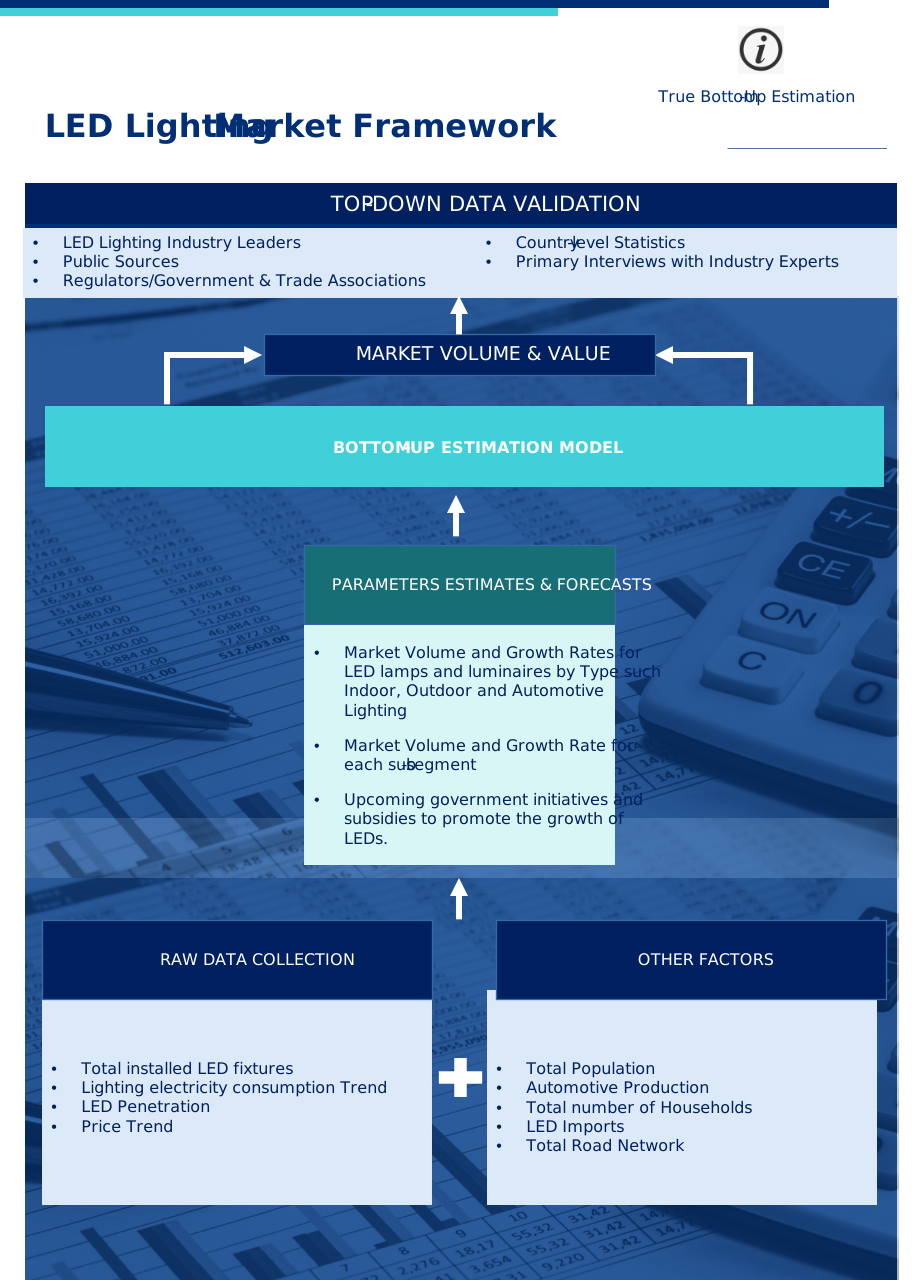
Mordor Intelligence has followed the following methodology in all our data center reports.
- Step 1: Raw Data Collection: To understand the market, initially, all crtical data points were identified. Critical information about countries and regions of interest including Per-capita Income, Population, Automotive Production, Interest rate on Auto-Loans, Number of Automobiles on Road, Total LED Import, Lighting Electricity Consumption among others were recorded or estimated based on internal calculations.
- Step 2: Identify Key Variables: To build a robust forecasting model, key variables such as Number of Households, Automotive Production, Road Networks among others were identified. Through an iterative process, the variables required for the market forecast were set, and the model was built using these variables.
- Step 3: Build a Market Model: Based on data and critical industry trend data (variables), including LED pricing, LED penetration rate, and project macro and micor economic factors were utilized for building the market forecasting.
- Step 4: Validate and Finalize: In this crucial step, all market numbers and variables derived through an internal mathematical model were validated through an extensive network of primary research experts from all the markets studied. The respondents are selected across levels and functions to generate a holistic picture of the market studied.
- Step 5: Research Outputs: Syndicated Reports, Custom Consulting Assignments, Databases & Subscription Platforms