Middle East And Africa Outdoor LED Lighting Market Size and Share
Market Overview
| Study Period | 2020 - 2031 |
|---|---|
| Forecast Data Period | 2026 - 2031 |
| Base Year Market Size (2025) | USD 1.45 Billion |
| Market Size (2026) | USD 1.56 Billion |
| Market Size (2031) | USD 2.21 Billion |
| Growth Rate (2026 - 2031) | 7.28 % |
| Market Concentration | Medium |
Major Players *Disclaimer: Major Players sorted in no particular order Image © Mordor Intelligence. Reuse requires attribution under CC BY 4.0. | |
Middle East And Africa Outdoor LED Lighting Market Analysis by Mordor Intelligence
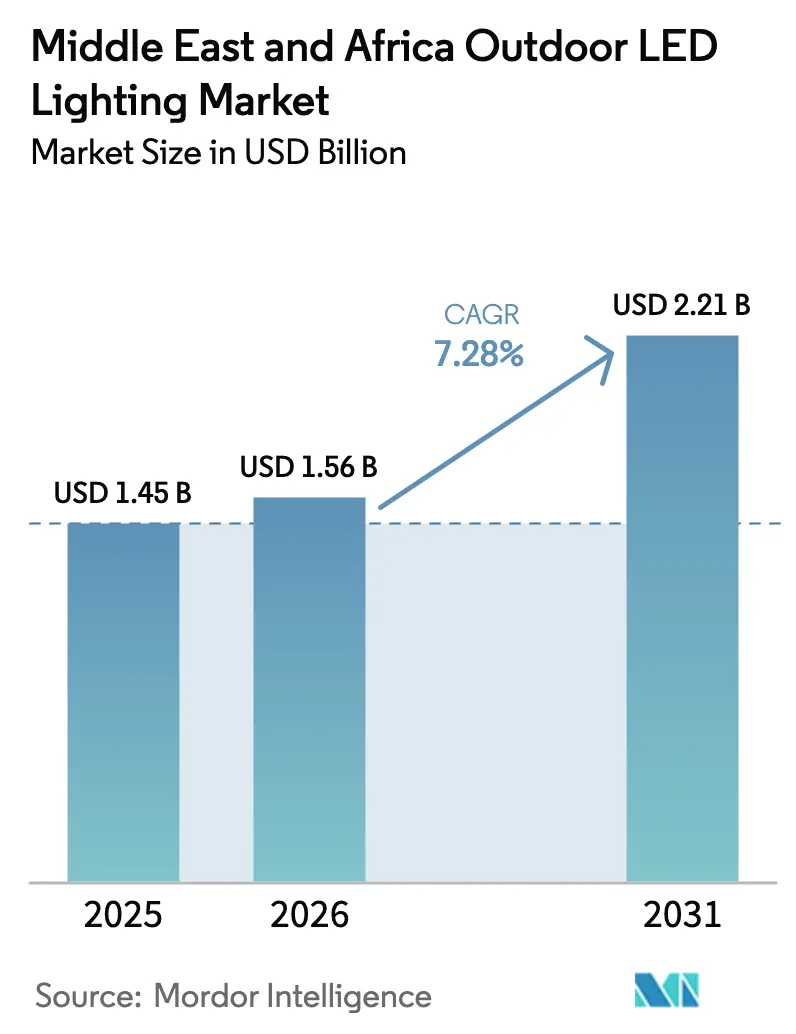
The Middle East and Africa outdoor LED lighting market size was valued at USD 1.45 billion in 2025 and estimated to grow from USD 1.56 billion in 2026 to reach USD 2.21 billion by 2031, at a CAGR of 7.28% during the forecast period (2026-2031). Rapid infrastructure programs across Saudi Arabia, the United Arab Emirates (UAE), and Qatar, combined with the acceleration of off-grid solar adoption in Nigeria, Kenya, and Ghana, expand the addressable opportunity. Falling LED price-performance ratios compress payback periods well below typical municipal budget cycles, while mega-event legacies, such as the FIFA World Cup 2022, continue to set demanding specifications that cascade to routine projects. Supply-chain normalization for drivers and semiconductors stabilizes project timelines, yet local-content rules in South Africa and Nigeria urge manufacturers to localize assembly and after-sales service. Product innovation now centers on fanless, IP66-rated luminaires designed for extreme conditions, including dust, humidity, and high temperatures, which typify many regions in the Middle East and Africa.
Key Report Takeaways
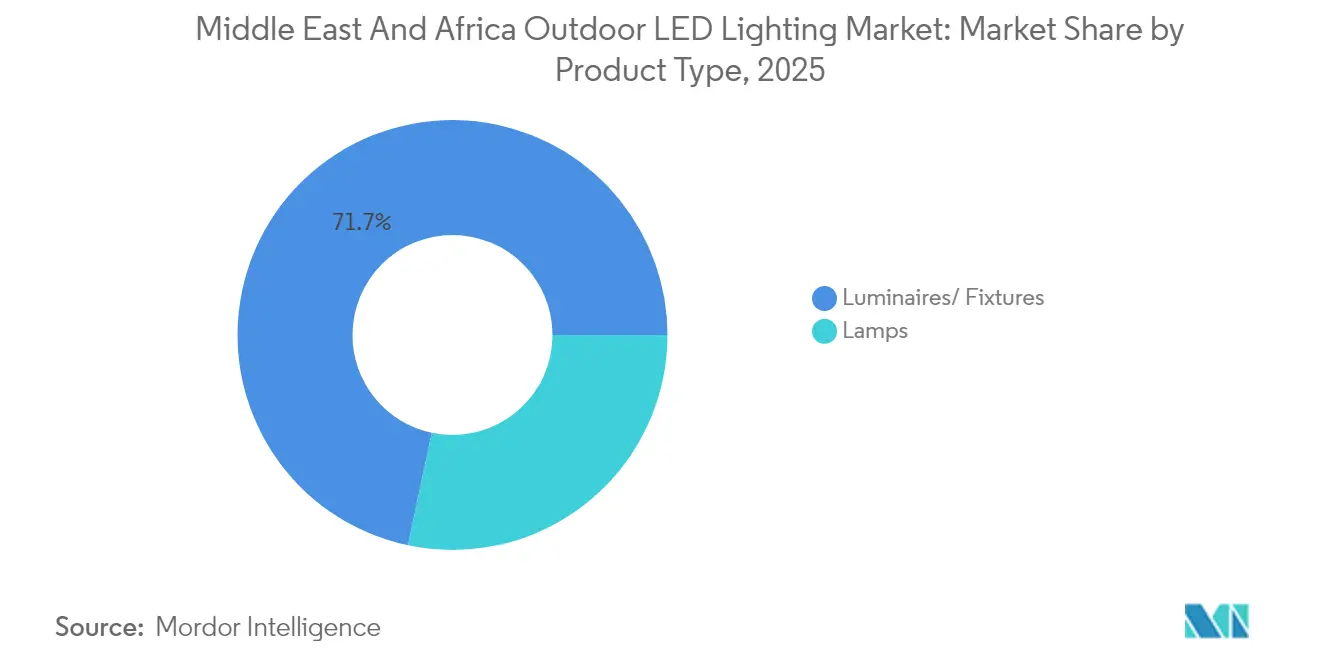
- By product type, luminaires and fixtures led with 71.68% revenue share in 2025; lamps are projected to expand at 7.65% CAGR through 2031.
- By application, street and roadway accounted for 42.15% of the Middle East and Africa outdoor LED lighting market share in 2025, while sports and stadium lighting is forecast to advance at a 8.92% CAGR to 2031.
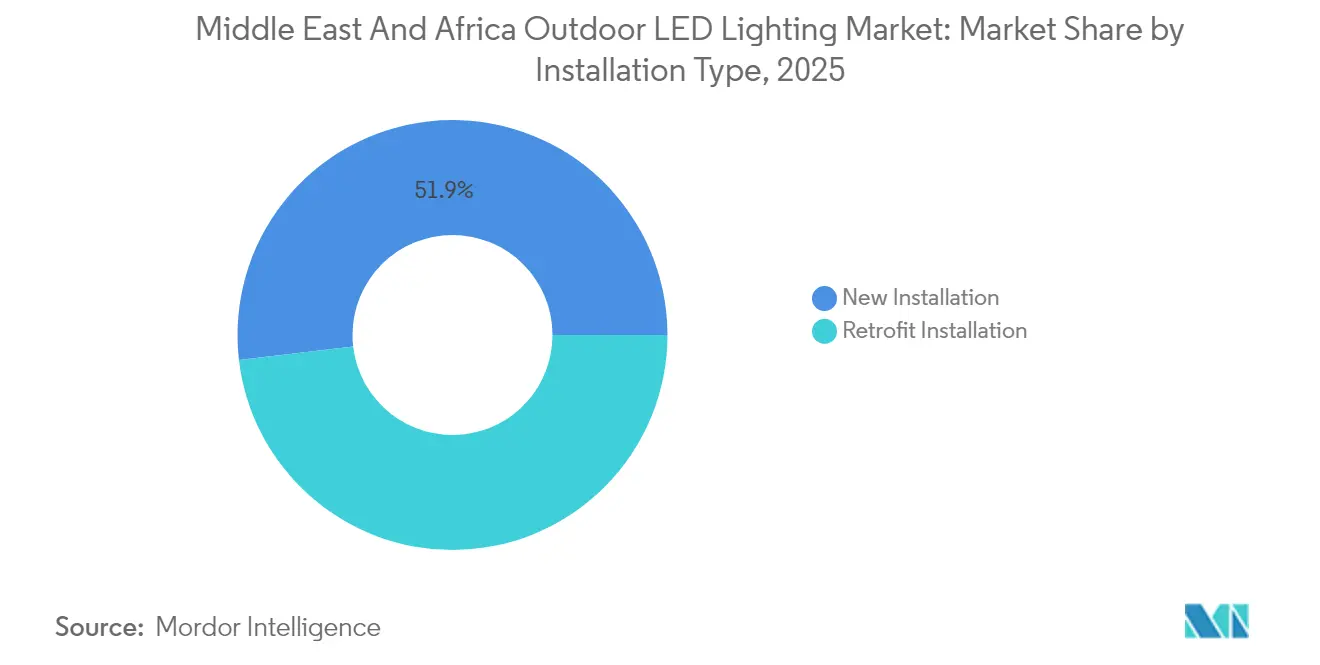
- By installation type, new installations commanded a 51.85% share of the Middle East and Africa outdoor LED lighting market size in 2025; retrofit activity is expected to grow at 7.88% CAGR between 2026 and 2031.
- By distribution channel, direct sales held a 64.62% share in 2025, whereas e-commerce is projected to post the fastest growth rate of 8.43% from 2026 to 2031.
- By country, Saudi Arabia captured 42.28% revenue share in 2025; Nigeria is poised to post the fastest 8.60% CAGR through 2031.
Note: Market size and forecast figures in this report are generated using Mordor Intelligence’s proprietary estimation framework, updated with the latest available data and insights as of 2026.
Middle East And Africa Outdoor LED Lighting Market Trends and Insights
Drivers Impact Analysis*
| Driver | (~) % Impact on CAGR Forecast | Geographic Relevance | Impact Timeline |
|---|---|---|---|
| Government retrofit and smart-city programs | +1.2% | Saudi Arabia, UAE, Qatar, Kuwait | Medium term (2-4 years) |
| Falling LED price-performance ratio | +1.1% | Global; stronger in price-sensitive African markets | Short term (≤ 2 years) |
| Mega-event led infrastructure spending | +0.8% | Saudi Arabia, Qatar, UAE | Short term (≤ 2 years) |
| Off-grid solar street-lighting boom | +0.9% | Nigeria, Kenya, Tanzania, Ghana | Long term (≥ 4 years) |
| Climate-resilient fan-less luminaires | +0.7% | Middle East core, North Africa | Medium term (2-4 years) |
| Experiential tourism facades | +0.6% | UAE, Saudi Arabia, Egypt, Morocco | Medium term (2-4 years) |
| Source: Mordor Intelligence | |||
Government Retrofit and Smart-City Programs Across GCC
Abu Dhabi aims to complete its full LED street-light conversion by 2025, while Dubai mandates LED standards for all new developments. These policies extend beyond lamp replacement to connected poles that embed 5G antennas, air-quality sensors, and emergency call points, allowing cities to monetize data services in parallel with energy savings. Saudi Arabia's NEOM positions intelligent luminaires as network edge nodes that gather traffic and environmental data for urban analytics. Qatar, building on FIFA infrastructure, specifies adaptive façade systems that adjust color temperature for tourism events. Large, phased procurement cycles created by these initiatives reward vendors with regional assembly lines and long-term performance contracts, reinforcing the Middle East and Africa outdoor LED lighting market as a strategic priority for global leaders.
Falling LED Price-Performance Ratio
Package efficacy now exceeds 200 lm/W, and driver integration has lifted expected lifetimes beyond 100,000 hours, cutting maintenance truck rolls across sprawling municipalities. Component cost deflation makes LED street lighting affordable even for towns where operating budgets previously precluded capital upgrades. In solar configurations, every lumen gain lowers battery and panel capacity, amplifying total system saving.[1]OSRAM Opto Semiconductors Editorial Team, “Efficiency Gains in Outdoor LED Systems,” osram.com African councils have begun evaluating net-present-value metrics rather than first-cost bids, accelerating the shift from sodium vapor to LED. Vendors that bundle performance guarantees with training for local technicians gain an edge as public buyers prioritize whole-life economics over lowest initial prices.
Mega-Event Led Infrastructure Spending
FIFA World Cup 2022 in Qatar and Expo 2020 in Dubai left behind stadium-grade lighting that must remain compliant with international broadcast standards. Qatar is extending these specifications to road corridors that connect airports to entertainment districts. Saudi Arabia, preparing for future global tournaments, has issued tenders for color-tunable floodlights and digital façade mesh on new sports cities. Such high-profile projects popularize strict ingress-protection ratings and dynamic control functions that eventually become baseline in municipal bids. International suppliers leverage success in these venues as proof of concept when approaching secondary cities across the Middle East and Africa's outdoor LED lighting market.
Off-Grid Solar Street-Lighting Boom in Sub-Saharan Africa
Thirty African countries endure outages severe enough to trim 2% of GDP, prompting local authorities to bypass unreliable grids via solar-integrated poles. Nigeria's state governments deploy turnkey solar LED corridors, allowing commercial hubs to extend trading hours and deter crime. World Bank mini-grid programs in Kenya and Tanzania cultivate village-level maintenance capacity, reducing downtime for autonomous luminaires. Standardized kits simplify procurement, allowing for bulk purchases financed by concessional loans. As performance data accumulates, donor agencies are increasingly treating solar street lighting as a core element of rural electrification, rather than a peripheral pilot, ensuring sustained demand in the Middle East and Africa outdoor LED lighting market.
Restraints Impact Analysis*
| Restraint | (~) % Impact on CAGR Forecast | Geographic Relevance | Impact Timeline |
|---|---|---|---|
| High upfront capital cost for municipalities | -1.8% | Sub-Saharan Africa; smaller GCC municipalities | Short term (≤ 2 years) |
| Grid unreliability in parts of Africa | -1.2% | Nigeria, South Africa, Kenya, Ghana | Long term (≥ 4 years) |
| Local-content procurement rules | -0.9% | South Africa, Nigeria, Algeria | Medium term (2-4 years) |
| LED-driver and chip supply-chain volatility | -1.1% | Global; acute on project timelines | Short term (≤ 2 years) |
| Source: Mordor Intelligence | |||
High Upfront Capital Cost for Municipalities
LED retrofits deliver 50-75% energy savings yet can exceed annual lighting budgets by as much as 400% in smaller African cities. Many procurements still default to lowest-bid rules that underweight lifetime value. South African municipalities, already coping with revenue losses tied to load shedding, are deferring upgrades despite long-term savings. Development finance institutions respond with energy-service company models that bundle equipment, installation, and multi-year repayment schedules. UNIDO's Energy Efficient Lighting and Appliances program, implemented across 21 countries, demonstrated that technical standards combined with concessional finance unlock stalled projects by mitigating risk for both vendors and public buyers.[2]East African Centre of Excellence for Renewable Energy and Efficiency, “Energy Efficient Lighting and Appliances Project,” eacreee.org
Grid Unreliability in Parts of Africa
Only one in five residents of Sub-Saharan Africa enjoys dependable electricity access, while per-capita consumption hovers at 124 kWh. Frequent curtailments jeopardize the performance of grid-tied LED assets and limit cities' willingness to invest in advanced controls. Load-shedding schedules in South Africa or voltage swings in Nigeria force municipalities to specify backup generators or battery packs, inflating bill-of-materials costs. Ironically, the same constraint propels demand for DC-native luminaires paired with solar or hybrid storage, placing technical emphasis on driver efficiency and thermal design suited for sealed enclosures in tropical climates. Vendors able to warranty autonomy during multi-day outages stand to capture growing slices of the Middle East and Africa outdoor LED lighting market.
*Our forecasts treat driver/restraint impacts as directional, not additive. The impact forecasts reflect baseline growth, mix effects, and variable interactions.
Segment Analysis
By Product Type: Luminaires Drive Retrofit Momentum
Luminaires and fixtures accounted for 71.68% of the Middle East and Africa outdoor LED lighting market in 2025 as municipal buyers favored turnkey housings that integrate optics, drivers, and surge protection into one weather-sealed unit. Saudi street programs specify aluminum die-cast bodies rated for 10 years without fan cooling, raising demand for premium thermal designs. Acuity Brands and Hydrel introduced IP66 pole-mount families that match these requirements, strengthening their visibility among GCC utilities. Lamps, while trailing in share, are projected to increase at 7.65% CAGR to 2031 as Sub-Saharan cities retrofit existing cobra-head fixtures rather than incur pole-replacement costs. Standardized retro-lamp form factors permit phased rollouts within constrained budgets, a pattern expected to widen the Middle East and Africa outdoor LED lighting market size by enabling smaller towns to participate.
Lamp uptake also reflects the growing number of distributor networks that stock modular drivers compatible with legacy housings. Nigerian contractors now combine imported LED corn bulbs with locally sourced surge suppressors to navigate customs duties, illustrating hybrid value chains. In parallel, fixture suppliers market fanless, flat-glass luminaires that resist dust caking in desert corridors linking UAE logistics hubs. The coexistence of full housing replacement in oil-rich nations and modular upgrades in cost-sensitive regions underpins steady product diversification in the outdoor LED lighting market across the Middle East and Africa.



By Application: Sports Venues Accelerate Beyond Street Lighting
Street and roadway lighting retained 42.15% share in 2025 owing to continuous urbanization, corridor widening, and safety mandates that compel provinces to prioritize roadway visibility. Dubai's RTA, for example, extends connected luminaires along bus rapid-transit lanes to feed live occupancy data into mobility dashboards. Sports and stadium projects, however, are set to be the fastest-growing slice at a 8.92% CAGR as Qatar scales post-World Cup precincts and Saudi Arabia pushes for year-round entertainment zones. These venues demand glare-free optics, broadcast-ready color-rendering indices, and integration with show-control software, thereby raising the technology threshold for vendors chasing the profitable corner of the Middle East and Africa outdoor LED lighting market.
Architectural façade and landscape lighting rides on experiential tourism plans such as City Walk Dubai, where RGBW pixel controls create immersive nightscapes. Tunnel and bridge projects are gaining momentum as cross-border freight corridors lengthen in alignment with Gulf rail ambitions, encouraging the use of vibration-resistant luminaires with specialized beam patterns. Parking and transit hubs, often bundled into larger concessions, offer incremental volume where asset owners value occupancy sensing and asset-health analytics woven into lighting controls.
By Installation Type: Retrofit Projects Balance New Construction
New projects accounted for a 51.85% share of the Middle East and Africa outdoor LED lighting market in 2025, reflecting the expansion of megacities such as NEOM and Egypt's New Administrative Capital. These greenfield developments set performance baselines that ripple through regional standards. Retrofit activity, currently representing 48.15% of the market, is forecast to grow at a faster rate of 7.88% CAGR, as mature urban cores now face energy quotas that mandate efficiency upgrades. Dubai's target of eliminating high-pressure sodium fixtures by 2026 exemplifies legislation that accelerates the scheduling of retrofits. Philips Lighting's Luma gen2 series positions "UltraEfficient" optics for such swap-out scenarios, embedded with Zhaga nodes for future-proofing.
Retrofit economics improve as lenders accept avoided-cost savings as collateral, enabling service-contract models that roll operating and financing charges into a single monthly line. Pilot projects in Mombasa and Accra demonstrate that avoiding grid fees, combined with reduced maintenance, can fund full district retrofits within five years, creating a replicable template that broadens the Middle East and Africa outdoor LED lighting market share captured by energy-service players.
By Distribution Channel: E-Commerce Disrupts Traditional Sales Models
Direct sales accounted for 64.62% of procurement in 2025, as outdoor deployments often involve site photometrics, pole spacing studies, and commissioning services that necessitate manufacturer engagement. However, standardized wattages and mounting options mean that basic roadway kits are increasingly appearing on digital marketplaces operated by OEMs or large electrical wholesalers. The e-commerce segment is projected to expand at a 8.43% CAGR as smaller town councils in Morocco and municipal utility districts in South Africa order preset bundles online, thereby trimming tender overheads. Vendor portals that embed design calculators and localized shipping lead times further reduce friction.
Wholesale and brick-and-mortar retail still serve contractor walk-in needs for replacement drivers or surge-protection accessories. Forward-looking suppliers integrate inventory APIs with distributor systems to ensure stock visibility on national procurement platforms. Combined, these digital shifts are expected to lift overall transaction velocity and transparency across the Middle East and Africa outdoor LED lighting industry.
Geography Analysis
Saudi Arabia commanded 42.28% of regional revenue in 2025 as Vision 2030 channeled capital toward NEOM corridors, Red Sea resorts, and Riyadh metro expansions, all of which specified high-end LED packages. Energy-efficiency targets complement climate-resilience requirements, prompting municipalities to favor low-maintenance, salt-mist-resistant luminaires suitable for coastal sites along the Red Sea. The UAE remains the second-largest buyer, driven by Dubai's 100% LED street-light mandate and Abu Dhabi's connected-pole pilots, which integrate environmental sensors. Qatar sustains steady orders to preserve post-World Cup infrastructure, including adaptive façade lighting that keeps tourist districts vibrant.
Nigeria is the fastest-growing country, projected to grow at a 8.60% CAGR, driven by federal and state solar street programs funded through green bonds and concessional lines. Abuja's pilot of 10,000 autonomous poles demonstrated payback within three years, influencing tenders in Lagos and Kano. Egypt and Morocco leverage tourism corridors, such as the Alexandria Corniche and Marrakech Medina upgrades, to adopt RGBW façade solutions. Municipal liquidity constraints and rolling blackouts temper South Africa's progress; however, select metros are pursuing LED retrofits through energy-performance contracts that shield their capital budgets. Kenya and Tanzania benefit from World Bank-backed mini-grid rollouts that include luminaires in turnkey packages, facilitating rural electrification and nighttime trade.
Premium, connected systems for Gulf smart-city clusters and cost-optimized solar kits for power-constrained African nations. Companies able to straddle both ends of the spectrum stand to capture disproportionate growth within the Middle East and Africa outdoor LED lighting market.
Competitive Landscape
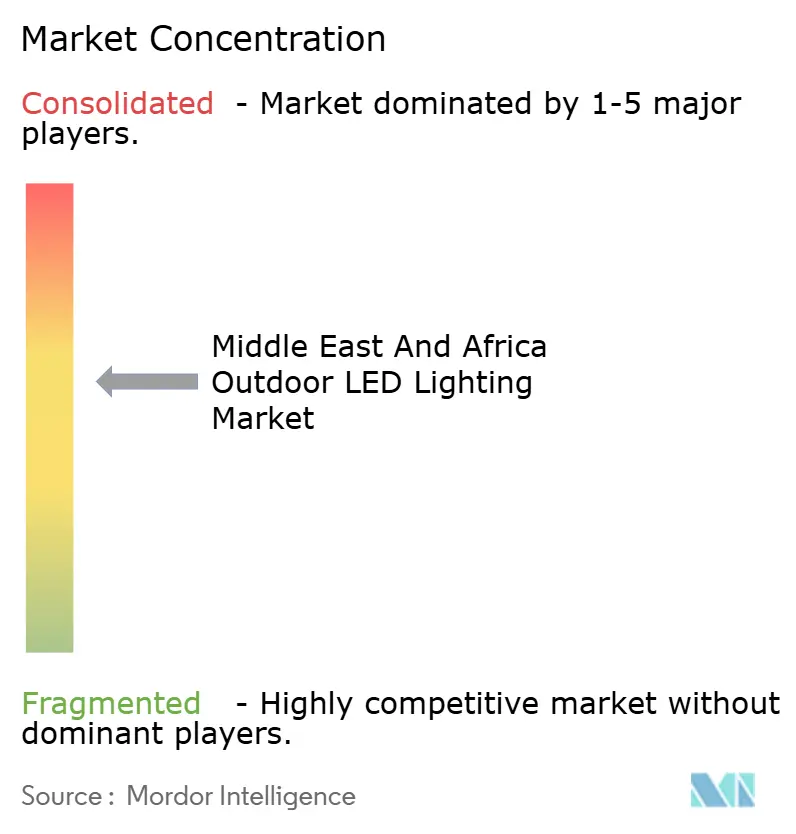
The market remains moderately fragmented. Signify leverages its Interact City platform to bundle lighting control, asset management, and cybersecurity, winning multi-year service contracts in Paris and Bordeaux. Schréder capitalizes on European manufacturing and sustainability credentials, offering circular-economy luminaires with replaceable light engines. ams-OSRAM differentiates through high-resolution EVIYOS Shape micro-LED projectors for pedestrian crossings and dynamic signage.
French solar pioneer Fonroche Lighting leverages export wins of 67,000 poles in Senegal and 15,000 in Benin to boost economies of scale, which in turn drive competitive pricing at home. Legrand's acquisition of Encelium adds robust BACnet integration, attracting facility managers seeking seamless indoor-outdoor control. Meanwhile, Chinese OEMs are increasing their participation in tenders through local integrators, which is pressuring margins on commodity luminaires.
Strategic themes center on vertical integration, smart city software ecosystems, and supply chain resilience. Leading firms establish dual assembly footprints in France and Belgium, shorten lead times to four weeks, and guarantee 10-year spare-part availability. Software partnerships with telecom operators and cloud providers add recurring revenue, shifting competition from hardware ASPs to platform stickiness. Sustainability reporting encompassed by Environmental Product Declarations and take-back schemes has become a significant differentiator as municipalities incorporate circularity clauses.
Middle East And Africa Outdoor LED Lighting Industry Leaders
Signify N.V.
ams-OSRAM AG
Acuity Brands, Inc.
Eaton Corporation plc
Wolfspeed, Inc.
- *Disclaimer: Major Players sorted in no particular order

Recent Industry Developments
- July 2025: Acuity Brands introduced the Luminis Trilo pole-mount luminaire and Hydrel Wander pathway family, expanding IP66-rated offerings for harsh-climate deployments.
- October 2024: Acuity Brands reported fiscal 2024 operating profit increase of USD 79.9 million to USD 553.3 million, highlighting cash reserves of USD 845.8 million earmarked for smart-city acquisitions.
- September 2024: Hydrel launched SAF floodlights with 100-degree distribution plus Tierra in-grade fixtures tailored for extreme temperature zones.
- July 2024: Acuity Brands unveiled Cell Connect wireless solution, enabling cellular remote management of outdoor luminaires, targeting municipalities across the Middle East and Africa.


Middle East And Africa Outdoor LED Lighting Market Report Scope
Public Places, Streets and Roadways, Others are covered as segments by Outdoor Lighting.| Lamps |
| Luminaires / Fixtures |
| Street and Roadway Lighting |
| Architectural and Landscape |
| Sports and Stadium |
| Tunnel and Bridge |
| Parking and Transit Areas |
| Other Applications |
| New Installation |
| Retrofit Installation |
| Direct Sales |
| Wholesale |
| Retail |
| E-commerce |
| Middle East | Bahrain |
| Kuwait | |
| Oman | |
| Qatar | |
| Saudi Arabia | |
| United Arab Emirates | |
| Rest of Middle East | |
| Africa | Egypt |
| Morocco | |
| Algeria | |
| Nigeria | |
| South Africa | |
| Kenya | |
| Rest of Africa |
| By Product Type | Lamps | |
| Luminaires / Fixtures | ||
| By Application | Street and Roadway Lighting | |
| Architectural and Landscape | ||
| Sports and Stadium | ||
| Tunnel and Bridge | ||
| Parking and Transit Areas | ||
| Other Applications | ||
| By Installation Type | New Installation | |
| Retrofit Installation | ||
| By Distribution Channel | Direct Sales | |
| Wholesale | ||
| Retail | ||
| E-commerce | ||
| By Country | Middle East | Bahrain |
| Kuwait | ||
| Oman | ||
| Qatar | ||
| Saudi Arabia | ||
| United Arab Emirates | ||
| Rest of Middle East | ||
| Africa | Egypt | |
| Morocco | ||
| Algeria | ||
| Nigeria | ||
| South Africa | ||
| Kenya | ||
| Rest of Africa | ||


Market Definition
- INDOOR LIGHTING - It incorporates all LED based lamps and fixtures/luminaire that are used to illuminate indoor section of residential, commercial, industrial buildings and agricultural lighting. LED offers efficient brightness with higher durability in comparison to other lighting technology.
- OUTDOOR LIGHTING - It incorporates the LED lighting fixtures that is used for illumination for exterior/outdoor illumination. For instance, LED lighting fixtures used to illuminate streets and highways, transport hubs, stadiums and other public places such as parking spaces.
- AUTOMOTIVE LIGHTING - It refers to the lighting fixtures installed for illumination and signaling purposes. It is used in both exterior and interior lighting of the vehicle. Headlamps, fog lamp, daytime running light (DRLs) are examples of exterior light whereas cabin light are interior lights.
- END USER - It refers to the end use application area where the LED fixture will be installed. For instance, in terms of indoor lighting, we have residential, commercial and industrial as end user category. For automotive lighting, primary end user considered are automotive manufacturers and aftermarket sale
| Keyword | Definition |
|---|---|
| Lumen | Lumen is a unit of luminous flux in the International System of Units that is equal to the amount of light given out through a solid angle by a source of one-candela intensity radiating equally in all directions. |
| Footcandle | A foot-candle (or foot-candle, fc, lm/ft2, or ft-c) is a measurement of light intensity. One foot-candle is defined as enough light to saturate a one-foot square with one lumen of light. |
| Colour Rendering Index (CRI) | Color Rendering Index (CRI) is a measurement of how natural colors render under an artificial white light source when compared with sunlight. The index is measured from 0-100, with a perfect 100 indicating that colors of objects under the light source appear the same as they would under natural sunlight. |
| Luminous flux | Luminous flux is a measure of the power of visible light produced by a light source or light fitting. It is measured in lumens (lm). |
| Annual Energy Cost | Annual Energy Cost means the average daily energy consumption multiplied by 365 (days per year), expressed in kilowatt hour per year (kWh/a). |
| Constant voltage drivers | Constant voltage drivers are designed for a single direct current (DC) output voltage. Most common constant voltage drivers (or Power Supplies) are 12VDC or 24VDC. An LED light that is rated for constant voltage usually specifies the amount of input voltage it needs to operate correctly. |
| Constant Current Driver | Constant current LED drivers are designed for a designated range of output voltages and a fixed output current (mA). LEDs that are rated to operate on a constant current driver require a designated supply of current usually specified in milliamps (mA) or amps (A). These drivers vary the voltage along an electronic circuit which allows current to remain constant throughout the LED system. |
| Minimum Energy Performance Standards (MEPS) | Minimum Energy Performance Standards specify the minimum level of energy performance that appliances and equipment must meet or exceed before they can supply or used for commercial purposes. |
| Luminous Efficacy | Luminous efficacy is a measurement commonly used in the lighting industry that indicates the ability of a light source to emit visible light using a given amount of power. |
| Solid State Lighting | Solid-state lighting (SSL) is a type of lighting that uses semiconductor light-emitting diodes (LEDs), organic light-emitting diodes (OLED), or polymer light-emitting diodes (PLED) as sources of illumination rather than electrical filaments, plasma (used in arc lamps such as fluorescent lamps), or gas. |
| Rated Lamp Life | Lamp life, also referred to as rated life, is the time in hours a lamp will last before a percentage of lamps will burn out. |
| Color Temperature | Colour temperature is a scale that measures how ‘warm’ (yellow) or ‘cool’ (blue) the light from a particular source is. It is measured in degrees of the Kelvin scale (abbreviated to K), and the higher the number, the ‘cooler’ the light. The lower the ‘K’ number, the ‘warmer’ the light. |
| Ingress Protection rating (IP rating) | The IP (Ingress Protection) rating of a bulb or light fixture declares the level of protection it has against dirt and water. |
| Fidelity Index | The general colour fidelity index, Rf, represents how closely the colour appearances of the entire sample set are reproduced (rendered) on average by a test light as compared to those under a reference illuminant. |
| Gamut Index | The gamut area is defined as “the area enclosed by a set of test color samples illuminated by a light source, in a two-dimensional chromaticity diagram or a plane of color space.”1 Within a defined color space, a “gamut” describes the subset of colors that can be perceived under specific lighting conditions. |
| Binning | In the lighting industry, the act of "binning" of LEDs is the process of sorting LEDs by certain characteristics, such as color, voltage, and brightness. |
| Accent lighting | Accent lighting, also called highlighting, emphasizes objects by focusing light directly on them. Accent lighting is used inside and outside the home to feature locations such as an entrance or to create dramatic effects. |
| Dimmable driver | A dimming driver has two functions: As a driver, it converts the 230V AC mains input to a low voltage DC output. As a dimmer, it reduces the amount of electrical energy flowing to the LEDs, thereby causing them to dim. |
| Flicker | Flicker is the repeated and frequent variation in the output of a light source over time. |
| Fluorescent | A property of materials defined as the ability to emit light after absorbing electromagnetic radiation such as visible or UV light. |
| Candela | The candela is the unit of luminous intensity in the International System of Units. It measures the light output per unit solid angle emitted from a light source in a specific direction. |
| LUX | Lux is used to measure the amount of light output in a given area - one lux is equal to one lumen per square meter. It enables us to measure the total "amount" of visible light present and the intensity of the illumination on a surface. |
| Uniformity (U0) | The uniformity of lighting has significant effects on visual performance in both indoor and outdoor areas. Uniformity (represented as U0) value can be found by dividing the minimum brightness (Emin) resulting from calculations according to the current lighting order, to the average brightness value (Eavg). |
| Visible Light Spectrum | The visible light spectrum is the segment of the electromagnetic spectrum that the human eye can view. More simply, this range of wavelengths is called visible light. Typically, the human eye can detect wavelengths from 380 to 700 nanometers. |
| Ambient Temperature | Ambient Temperature is the temperature of the air surrounding an electrical enclosure. |
| Current-controlled dimming control | Current-controlled dimming controls LED brightness by varying the applied current using a 0-10V dimmer. Current-controlled dimming is smooth and HD-video friendly. It can only dim to a minimum of 5% of light output. |
| Design Light Consortium | It is a partnership of energy efficiency stakeholders in the United States and Canada to “promote quality, performance and energy efficient lighting solutions for the commercial sector”. |
| Pulse Width Modulation | Pulse-width modulation, or pulse-duration modulation, is a method of controlling the average power delivered by an electrical signal. |
| Surface Mounted Device | A surface mount device (SMD) is an electronic device whose components are mounted or placed directly on the surface of a printed circuit board. |
| Alternating Current | Alternating current is an electric current which periodically reverses direction and changes its magnitude continuously with time, in contrast to direct current, which flows only in one direction. |
| Direct Current | Direct current (DC) is an electric current that is uni-directional, so the flow of charge is always in the same direction. |
| Beam Angle | Beam angle (also called beam spread) is a measure of how light is distributed. On any plane perpendicular to the centerline of the light, the beam angle is the angle between two rays where the light intensity is 50% of the maximum light intensity. |
| LED Based Solar High Mast Lighting Systems | A Solar LED High Mast Light is a raised source of High illumination lights (6~8 lights) and with high intensity on the middle of major junctions (Ring roads, Outer Ring roads), turned on or lit automatically in the absence of light (at specified timings or at periodic times, every night). |
| Surface Mounted Diode (SMD) LEDs | A surface mount diode is a type that emits light and is flat mounted and soldered onto a circuit board. |
| Chip on Board (COB) LEDs | A COB LED is basically multiple LED chips (usually 9 or more) glued directly onto a substrate by the manufacturer to form a single module. |
| Dual In-Line Package (DIP) LEDs | A dual in-line package (DIP or DIL) is an electronic component package with a rectangular case and two parallel rows of electrical connector pins. |
| Graphene LED Lights | A graphene LED light bulb is simply an LED light bulb where the filament has been coated in graphene. A graphene LED bulb is reported to be 10% more efficient than regular LED light bulbs and they are cheaper to manufacture and buy. |
| LED Corn Bulbs | LED Corn lights are designed as an energy efficient alternative to high intensity discharge (HID) and SON lamps. It uses a large number of LEDs on a metal structure to provide sufficient light. This arrangement of LEDs looks a lot like a corn cob, hence the name "corn light". |
| Per Capita Income | Per capita income or total income measures the average income earned per person in a given area in a specified year. It is calculated by dividing the area's total income by its total population. Per capita income is national income divided by population size. |
| Charging Stations | A charging station, also known as a charging station or electric vehicle utility, is a power supply that provides electrical energy for charging plug-in electric vehicles. |
| Headlight | A headlight is a light that is mounted on the front of a car and illuminates the road in front of it. Low beam and high beam LED headlights are additional categories for these LED headlights. |
| Day Time Running Light (DRLs) | A daytime running lamp is a white, yellow, or amber lighting device mounted on the front of a road-going motor vehicle or bicycle. |
| Directional Signal Light | Directional signal lights are the front and rear lights on an automobile that flash to show the direction of a turn. |
| Stop Light | A red light that is mounted to the back of a car and turns on when the brakes are used to show that the car is stopped. |
| Reverse Light | The reverse light is at the back of the vehicle to indicate its backward motion. |
| Tail Light | A red light that can be seen in the dark is mounted on the rear of a road vehicle. Stop, reverse, and directional signal lights are all part of it. |
| Fog Light | Bright lights in automobiles used to increase visibility on the road in foggy conditions or to warn other drivers of the presence of the vehicle. |
| Passenger Vehicle | A passenger vehicle is a road vehicle, other than a moped or a motorcycle, intended for the transportation of people and designed for up to 8 to 9 seats. |
| Commercial Vehicle | A commercial vehicle (Bus, Truck, Van) is any type of motor vehicle used to transport goods or pay passengers. |
| Two Wheelers (2W) | A two-wheeler is a vehicle that runs on two wheels. |
| Streets & Roadways | Both roads and streets refer to hard, flat surfaces on the ground on which vehicles, people, and animals can travel. Since streetways are usually in cities and towns, they often have houses and buildings on both sides. The roadway is in the countryside and sometimes passes through forests and fields |
| Horticulture Lighting | Horticulture is the science and art of sustainably growing, producing, marketing and using high quality, intensively cultivated food and ornamental plants. |

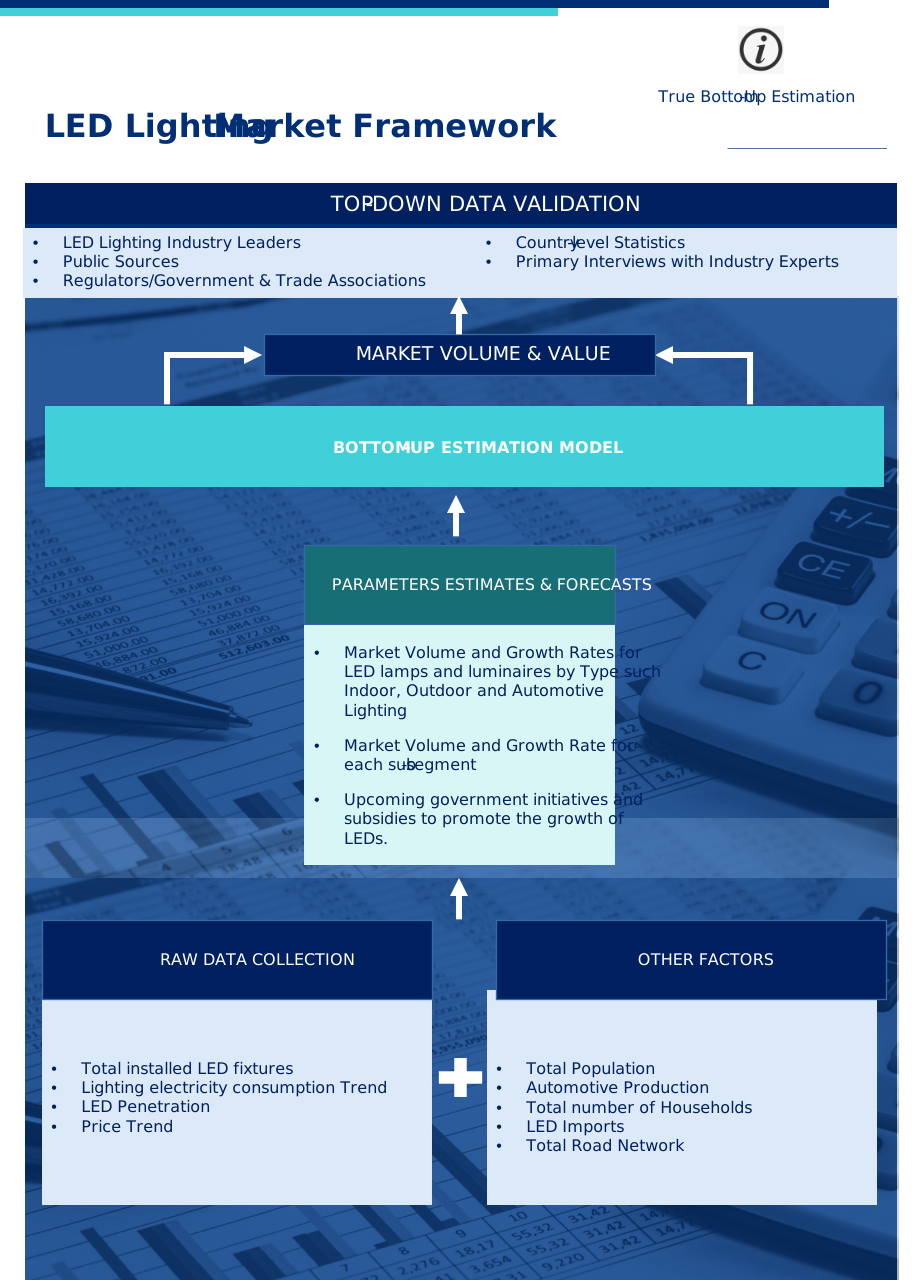
Research Methodology
Mordor Intelligence has followed the following methodology in all our data center reports.
- Step 1: Raw Data Collection: To understand the market, initially, all crtical data points were identified. Critical information about countries and regions of interest including Per-capita Income, Population, Automotive Production, Interest rate on Auto-Loans, Number of Automobiles on Road, Total LED Import, Lighting Electricity Consumption among others were recorded or estimated based on internal calculations.
- Step 2: Identify Key Variables: To build a robust forecasting model, key variables such as Number of Households, Automotive Production, Road Networks among others were identified. Through an iterative process, the variables required for the market forecast were set, and the model was built using these variables.
- Step 3: Build a Market Model: Based on data and critical industry trend data (variables), including LED pricing, LED penetration rate, and project macro and micor economic factors were utilized for building the market forecasting.
- Step 4: Validate and Finalize: In this crucial step, all market numbers and variables derived through an internal mathematical model were validated through an extensive network of primary research experts from all the markets studied. The respondents are selected across levels and functions to generate a holistic picture of the market studied.
- Step 5: Research Outputs: Syndicated Reports, Custom Consulting Assignments, Databases & Subscription Platforms