Middle East And Africa Automotive LED Lighting Market Size and Share
Market Overview
| Study Period | 2020 - 2031 |
|---|---|
| Forecast Data Period | 2026 - 2031 |
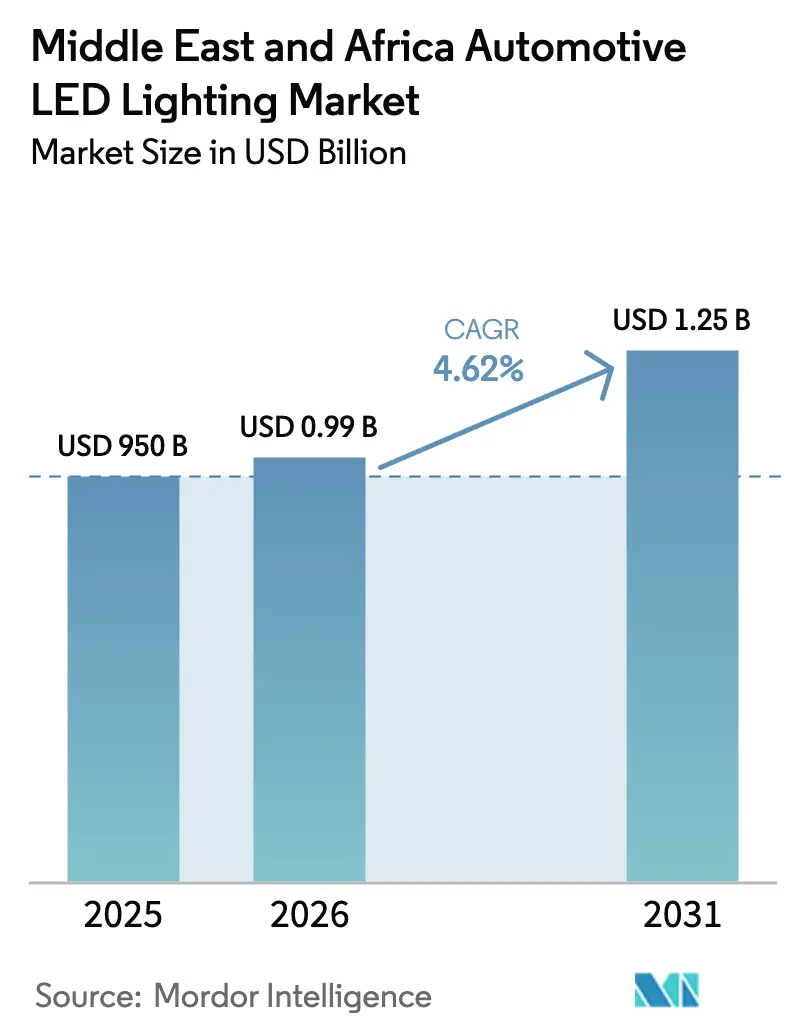
| Base Year Market Size (2025) | USD 950 Billion |
| Market Size (2026) | USD 0.99 Billion |
| Market Size (2031) | USD 1.25 Billion |
| Growth Rate (2026 - 2031) | 4.62 % |
| Market Concentration | Medium |
Major Players *Disclaimer: Major Players sorted in no particular order Image © Mordor Intelligence. Reuse requires attribution under CC BY 4.0. | |
Middle East And Africa Automotive LED Lighting Market Analysis by Mordor Intelligence
The Middle East and Africa automotive LED lighting market size was valued at USD 950 million in 2025 and estimated to grow from USD 993.89 million in 2026 to reach USD 1.25 billion by 2031, at a CAGR of 4.62% during the forecast period (2026-2031). Stricter regional lighting regulations, vehicle electrification programs, and a growing preference for energy-efficient systems propel demand. Thermal-management innovations that preserve lumen output under desert heat, along with cost declines in solid-state devices, have widened the adoption base. Original-equipment fitment dominates value creation, yet retrofit kits for aging fleets are scaling quickly as owners seek lower energy consumption and longer service intervals. Competitive intensity remains moderate, with tier-1 suppliers using advanced pixel technologies to differentiate while price-oriented Asian firms attack the replacement channel.[1]GCC Standardization Organization, “GSO Technical Regulations for Motor Vehicles (2025 Model Year),” gso.org.sa
Key Report Takeaways
- By sales channel, OEMs held 82.54% of the Middle East and Africa automotive LED lighting market share in 2025, while the aftermarket is projected to grow at a 5.18% CAGR through 2031.
- By vehicle type, passenger cars generated 68.95% of the 2025 revenue and are expected to expand at an 8.35% CAGR through 2031.
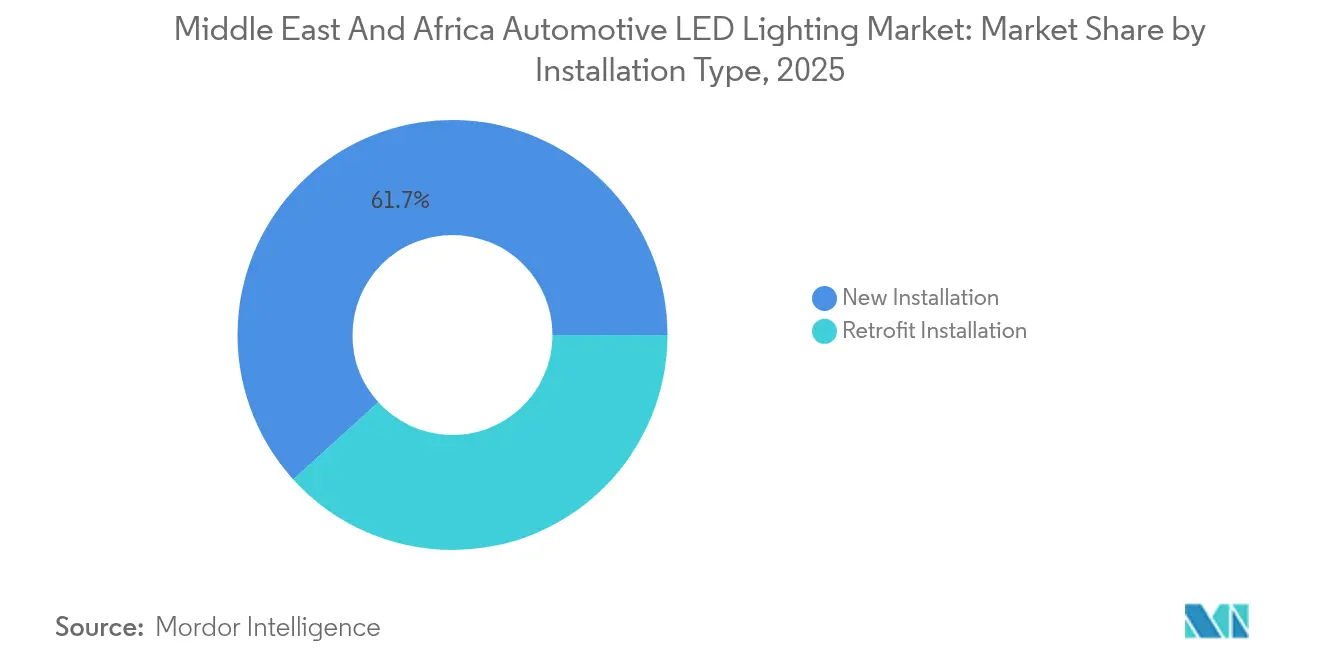
- By installation type, new installations contributed 61.72% of the 2025 value; retrofit demand is forecast to rise at a 5.55% CAGR over the outlook period.
- By application, exterior lighting accounted for a 76.88% slice of the Middle East and Africa automotive LED lighting market size in 2025; interior systems are advancing at a 5.34% CAGR.
Note: Market size and forecast figures in this report are generated using Mordor Intelligence’s proprietary estimation framework, updated with the latest available data and insights as of 2026.
Market Trends and Insights
Drivers Impact Analysis of Middle East And Africa Automotive LED Lighting Market*
| Driver | (~) % Impact on CAGR Forecast | Geographic Relevance | Impact Timeline |
|---|---|---|---|
| LED penetration mandated in GCC safety regulations | +1.20% | Saudi Arabia, UAE, Kuwait, Qatar, Bahrain, Oman | Medium term (2-4 years) |
| Falling LED unit costs vs. halogen/Xenon | +0.90% | Global, with strongest impact in Africa | Short term (≤ 2 years) |
| OEM adoption of adaptive/matrix LED headlamps | +0.80% | GCC core, spill-over to South Africa | Medium term (2-4 years) |
| LED integration with vehicle-to-infrastructure smart-road pilots | +0.60% | UAE, Saudi Arabia, select urban corridors | Long term (≥ 4 years) |
| Surge in retrofit LED kits for aging African vehicle parc | +0.70% | Sub-Saharan Africa, North Africa | Short term (≤ 2 years) |
| Rise of Islamic-compliant, low-glare interior LED packages for ride-hailing fleets | +0.40% | GCC states, urban Middle East | Medium term (2-4 years) |
| Source: Mordor Intelligence | |||


LED penetration mandated in GCC safety regulations
Uniform headlamp standards, such as GSO 1503, compel automakers to install compliant LED units, thereby accelerating replacement cycles and sidelining legacy halogen products. Saudi Arabia’s Saber certification further screens imports, closing the door on non-conforming lamps and steering purchasers to approved LED solutions. The regulatory push ripples across aftermarket channels because vehicles entering from Japan, Europe, and the United States must meet updated photometric thresholds before they can be registered. Distributors therefore stock certified retrofits, raising LED availability and reducing time-to-fit for workshops.
Falling LED unit costs vs. halogen/Xenon
Scaled wafer production, higher die yields, and simplified driver electronics have driven the LED price per kilolumen below that of Xenon capsules and made it competitive with premium halogen bulbs. ams-OSRAM’s Night Breaker LED Smart retrofit delivers a 330% brighter output with a 60% energy draw reduction, all at a retail price on par with legacy HID kits. Philips’ Ultinon Pro6000 line follows a similar trajectory, signalling that cost is no longer the impeding hurdle for mid-range buyers. The economic crossover point shortens payback to under 18 months for high-mileage taxis, catalysing mass-market uptake.
OEM adoption of adaptive/matrix LED headlamps
Premium platforms now ship with high-pixel-count modules capable of glare-free high-beam and road-symbol projection. Marelli’s h-Digi microLED package integrates 25,600 addressable pixels, while Opel’s Intelli-Lux HD array pushes controllable elements past 51,000. As these systems cascade into C-segment cars on shared architectures, their presence lifts baseline expectations across showrooms and stimulates local Tier-2 tooling for heat sinks and optics.
LED integration with vehicle-to-infrastructure pilots
Connected-road corridors in the UAE and western Saudi Arabia require lighting modules that also serve as signalling devices for roadside units. Programmable forward lamps broadcast icons to pedestrians or maintenance crews, leveraging ams-OSRAM’s dynamic forward-lighting firmware. Government concessions for autonomous shuttles stipulate upgradable light-based communication, embedding long-tail demand for high-bit-rate LED arrays.
Restraints Impact Analysis of Middle East And Africa Automotive LED Lighting Market*
| Restraint | (~) % Impact on CAGR Forecast | Geographic Relevance | Impact Timeline |
|---|---|---|---|
| High upfront cost of digital LED modules | -0.80% | Global, acute in price-sensitive African markets | Short term (≤ 2 years) |
| Counterfeit aftermarket LED imports | -0.60% | Sub-Saharan Africa, select Middle East corridors | Medium term (2-4 years) |
| Unstable electricity grids hindering LED-centric local assembly | -0.50% | Sub-Saharan Africa, select North African markets | Medium term (2-4 years) |
| Limited thermal-management know-how among regional Tier-2s | -0.40% | Regional suppliers across Middle East and Africa | Long term (≥ 4 years) |
| Source: Mordor Intelligence | |||
High upfront cost of digital LED modules
Full-matrix assemblies require custom controllers, active cooling, and proprietary optics, driving retail prices well beyond the cost of basic retrofit lamps. Budget-conscious consumers in Ethiopia and Ghana, therefore, postpone headlamp upgrades, maintaining halogen units until they fail. Global suppliers counter by phasing in pixel-block architectures, smaller sub-arrays that deliver adaptive functionality at trimmed BOM costs.
Counterfeit aftermarket LED imports
OECD seizure data list the UAE and Saudi Arabia as transit points for imitation electronics en route to Africa, with LEDs among the top categories. Substandard heat sinking drives early lumen depreciation and raises fire-risk incidents, eroding consumer trust and forcing governments to tighten port inspection actions that lengthen import cycles for genuine suppliers.
*Our forecasts treat driver/restraint impacts as directional, not additive. The impact forecasts reflect baseline growth, mix effects, and variable interactions.
Middle East And Africa Automotive LED Lighting Market Segment Analysis
By Sales Channel:
OEM scale vs. aftermarket agilityOEM contracts accounted for 82.54% of 2025 revenue in the Middle East and Africa automotive LED lighting market. High-volume sourcing secures predictable unit call-offs from tier-1 suppliers, especially for SUV and crossover builds popular in the Gulf states. Yet the aftermarket posts a 5.18% CAGR through 2031, reflecting surging demand for legal retrofit kits across Sub-Saharan repair networks. Chinese distributors leverage low-cost supply chains to undercut incumbents; however, warranty-backed, ECE-compliant upgrades from European brands are gaining traction among ride-hailing operators that prioritize uptime.
Aftermarket agility also shortens product cycles, enabling rapid introduction of colour-temperature variants or integrated DRL modules tailored to desert climates. The channel, therefore, acts as a proving ground before OEM adoption, sustaining a feedback loop that keeps the Middle East and Africa automotive LED lighting market responsive to evolving safety norms.



By Vehicle Type:
Passenger cars spearhead adoptionPassenger cars generated 68.95% of 2025 invoices and exhibit the fastest 8.35% CAGR, confirming that private-use and fleet sedans remain the prime canvas for new lighting technologies. Incentives for electrification in Saudi Arabia and the UAE are driving EV-focused brands to integrate energy-efficient LEDs, thereby reinforcing segment momentum. Light commercial vans follow as e-commerce growth leans on urban delivery, where lower amperage draw from LEDs extends battery range. Heavy trucks and buses primarily adopt LEDs for DRLs and signal lamps mandated under the Omani transport law, while motorcycle adoption remains limited by unit-price elasticity.
Enhanced cabin lighting and infotainment backlighting in passenger vehicles support higher accessory revenue per unit, allowing automakers to bundle ambient packages as option codes. This cross-sell dynamic expands the revenue pool within the Middle East and Africa automotive LED lighting market, without relying solely on headlamp upgrades.
By Installation Type:
Retrofit closes the gapNew-build fitments accounted for 61.72% of turnover in 2025, as OEM pipelines remained the primary supply route. Retrofit, however, is on a 5.55% CAGR trajectory to 2031, boosted by policy support for fleet road-worthiness inspections that flag non-compliant halogen units. Plug-and-play modules with passive cooling simplify yard-level swap-outs, lowering labour minutes and accelerating workshop throughput. The resulting volume uplift compensates for the retrofit’s lower ASP, raising total contribution to the Middle East and Africa automotive LED lighting market.
Installers report that retrofit headlamps reduce warranty callbacks by up to 40% compared to low-grade halogens, a statistic that prompts insurance companies to recommend LED transitions. Consequently, parts wholesalers expand inventory depth across socket types, cementing retrofit’s role as a growth pillar.
By Application:
Exterior dominance, interior accelerationExterior assemblies accounted for 76.88% of sales in 2025, with headlamps alone surpassing half of that share. Mandatory DRLs and adaptive rear-light signatures further embed LEDs into vehicle homologation checklists. Meanwhile, interior systems clock a 5.34% CAGR as ride-hailing fleets demand customizable ambient lighting to elevate passenger experience. OLED panels used as welcome-light carpets or door inlays showcase software-defined lighting that automakers monetize via over-the-air themes.
Instrument clusters and center stacks adopt micro-LED backlighting for high contrast under desert sunlight, enhancing driver readability. These developments help interior lines outpace cabin-electronics averages, enlarging their share inside the Middle East and Africa automotive LED lighting market over the forecast horizon.
Middle East and Africa Automotive LED Lighting Market Geography Segment Analysis
Saudi Arabia Automotive LED Lighting Market
Saudi Arabia remained the single largest buyer, accounting for 35.84% of 2024 revenue, thanks to Vision 2030 mobility investments and harmonized GCC lighting standards. Domestic assembly plants source tier-1 lamp modules under long-term agreements, ensuring steady pull-through. Government electrification roadmaps stipulate the installation of 5,000 public chargers by 2030, indirectly boosting demand for low-power headlamps that preserve vehicle range.
United Arab Emirates and Turkey Automotive LED Lighting Market
The United Arab Emirates ranks second, leveraging aggressive fast-charging rollouts and smart road corridors that require high-bit-rate LED arrays for vehicle-to-infrastructure signaling. Fleet operators in Dubai are integrating interior LED ambient packages to differentiate premium ride-hailing tiers, thereby expanding the application breadth. Turkey adds volume through export-oriented auto manufacturing clusters that adopt advanced matrix headlamps to meet EU type-approval.
MEA Automotive LED Lighting Market
South Africa delivers the fastest 7.69% CAGR, underpinned by an automotive sector that contributed 4.9% of GDP in 2024 and shipped USD 16.88 billion in parts and vehicles. Aftermarket imports increased by 18.6%, highlighting price-sensitive niches that Asian suppliers capitalize on. Egypt is positioning as a manufacturing hub: Signify’s joint venture to build an LED plant near Cairo supports local content rules and shortens lead times into North-East Africa. Nigeria and Kenya present longer-term upside as ownership per capita climbs and port authorities tighten safety inspections that favour certified LED imports. Collectively, divergent maturity levels mean growth stems both from premium feature adoption in Gulf markets and volume-driven retrofit sales across the continent, keeping the Middle East and Africa automotive LED lighting market on a balanced expansion path.[3]Signify, “Joint Venture Press Release,” signify.com
Competitive Landscape
Top Companies in Middle East and Africa Automotive LED Lighting Market
The Middle East and Africa automotive LED lighting market is moderately fragmented. Ams-OSRAM, FORVIA HELLA, Valeo, and Marelli anchor OEM supply lines with integrated thermal management and optics, while regional assemblers import diodes and lenses for final packaging. Chinese firms account for 64% of South African replacement-parts imports, leveraging freight consolidation and flexible tooling to advance up the value chain.
Technology rivalry centers on heat-dissipation breakthroughs. Aluminium-nitride substrates and vapor-chamber plates keep junction temperatures below 85 °C, a threshold beyond which lumen output halves. Patent filings for phase-change materials indicate that thermal design will decide contract wins in desert climates.
Localized production is on the rise: Signify’s Cairo facility targets EMEA exports and reduces tariff exposure, hinting at further near-shoring plays. Niche opportunities include Islamic-compliant low-glare cabin kits and LED arrays that synchronize with V2X protocols. Incumbents thus balance mass-market headlamp volumes with specialized modules, maintaining differentiation without ceding cost leadership.[4]Greyb X-Ray, “Heat Control in Automotive Lighting,” xray.greyb.com
Middle East And Africa Automotive LED Lighting Industry Leaders
GRUPO ANTOLIN IRAUSA, S.A.
HELLA GmbH & Co. KGaA (FORVIA)
HYUNDAI MOBIS
Marelli Holdings Co., Ltd.
ams-OSRAM AG
- *Disclaimer: Major Players sorted in no particular order

Middle East And Africa Automotive LED Lighting Market Companies Covered in this Report
- ams-OSRAM AG
- HELLA GmbH and Co. KGaA
- Valeo SA
- Koito Manufacturing Co., Ltd.
- Stanley Electric Co., Ltd.
- Robert Bosch GmbH
- DENSO Corporation
- Hyundai Mobis Co., Ltd.
- ZKW Group GmbH
- Magneti Marelli CK Holdings Co., Ltd.
- Lumileds Holding B.V.
- Nichia Corporation
- LG Innotek Co., Ltd.
- Seoul Semiconductor Co., Ltd.
- Lear Corporation
- Valeo Lighting Systems Egypt S.A.E.
- SirajPower FZE
- NARVA Lichtquellen GmbH + Co. KG
- Truck-Lite Co., LLC
- Osram Middle East FZE
- Phoenix Lighting (Middle East) LLC

Recent Industry Developments in Middle East And Africa Automotive LED Lighting Market
- September 2025: Space42 signed an agreement with Dynamic Map Platform to supply HD road data for General Motors’ Super Cruise rollout across UAE highways.
- September 2025: Foton debuted the eVIEW GRAND electric van in Riyadh, featuring region-tuned LED headlamps.
- August 2025: ams-OSRAM released Night Breaker LED Smart retrofit lamps compatible with 800+ vehicle models.
- July 2025: Signify and GILA Al Tawakol Electric formed an LED manufacturing joint venture near Cairo.


Middle East And Africa Automotive LED Lighting Market Report Scope
Daytime Running Lights (DRL), Directional Signal Lights, Headlights, Reverse Light, Stop Light, Tail Light, Others are covered as segments by Automotive Utility Lighting. 2 Wheelers, Commercial Vehicles, Passenger Cars are covered as segments by Automotive Vehicle Lighting.| OEM |
| Aftermarket |
| New Installation |
| Retrofit Installation |
| Passenger Cars |
| Light Commercial Vehicles |
| Heavy Commercial Vehicles |
| Two-Wheelers |
| Exterior Lighting | Headlamps |
| Daytime Running Lights | |
| Taillights | |
| Fog Lamps | |
| Turn Signals | |
| Other Exterior Lightings | |
| Interior Lighting | Dome and Map Lights |
| Ambient Lighting | |
| Instrument Cluster and Infotainment Backlighting | |
| Others Interior Lightings |
| Middle East | Israel |
| Saudi Arabia | |
| United Arab Emirates | |
| Turkey | |
| Rest of Middle East | |
| Africa | South Africa |
| Egypt | |
| Rest of Africa |
| By Sales Channel | OEM | |
| Aftermarket | ||
| By Installation Type | New Installation | |
| Retrofit Installation | ||
| By Vehicle Type | Passenger Cars | |
| Light Commercial Vehicles | ||
| Heavy Commercial Vehicles | ||
| Two-Wheelers | ||
| By Application | Exterior Lighting | Headlamps |
| Daytime Running Lights | ||
| Taillights | ||
| Fog Lamps | ||
| Turn Signals | ||
| Other Exterior Lightings | ||
| Interior Lighting | Dome and Map Lights | |
| Ambient Lighting | ||
| Instrument Cluster and Infotainment Backlighting | ||
| Others Interior Lightings | ||
| By Geography | Middle East | Israel |
| Saudi Arabia | ||
| United Arab Emirates | ||
| Turkey | ||
| Rest of Middle East | ||
| Africa | South Africa | |
| Egypt | ||
| Rest of Africa | ||


Market Definition
- INDOOR LIGHTING - It incorporates all LED based lamps and fixtures/luminaire that are used to illuminate indoor section of residential, commercial, industrial buildings and agricultural lighting. LED offers efficient brightness with higher durability in comparison to other lighting technology.
- OUTDOOR LIGHTING - It incorporates the LED lighting fixtures that is used for illumination for exterior/outdoor illumination. For instance, LED lighting fixtures used to illuminate streets and highways, transport hubs, stadiums and other public places such as parking spaces.
- AUTOMOTIVE LIGHTING - It refers to the lighting fixtures installed for illumination and signaling purposes. It is used in both exterior and interior lighting of the vehicle. Headlamps, fog lamp, daytime running light (DRLs) are examples of exterior light whereas cabin light are interior lights.
- END USER - It refers to the end use application area where the LED fixture will be installed. For instance, in terms of indoor lighting, we have residential, commercial and industrial as end user category. For automotive lighting, primary end user considered are automotive manufacturers and aftermarket sale
| Keyword | Definition |
|---|---|
| Lumen | Lumen is a unit of luminous flux in the International System of Units that is equal to the amount of light given out through a solid angle by a source of one-candela intensity radiating equally in all directions. |
| Footcandle | A foot-candle (or foot-candle, fc, lm/ft2, or ft-c) is a measurement of light intensity. One foot-candle is defined as enough light to saturate a one-foot square with one lumen of light. |
| Colour Rendering Index (CRI) | Color Rendering Index (CRI) is a measurement of how natural colors render under an artificial white light source when compared with sunlight. The index is measured from 0-100, with a perfect 100 indicating that colors of objects under the light source appear the same as they would under natural sunlight. |
| Luminous flux | Luminous flux is a measure of the power of visible light produced by a light source or light fitting. It is measured in lumens (lm). |
| Annual Energy Cost | Annual Energy Cost means the average daily energy consumption multiplied by 365 (days per year), expressed in kilowatt hour per year (kWh/a). |
| Constant voltage drivers | Constant voltage drivers are designed for a single direct current (DC) output voltage. Most common constant voltage drivers (or Power Supplies) are 12VDC or 24VDC. An LED light that is rated for constant voltage usually specifies the amount of input voltage it needs to operate correctly. |
| Constant Current Driver | Constant current LED drivers are designed for a designated range of output voltages and a fixed output current (mA). LEDs that are rated to operate on a constant current driver require a designated supply of current usually specified in milliamps (mA) or amps (A). These drivers vary the voltage along an electronic circuit which allows current to remain constant throughout the LED system. |
| Minimum Energy Performance Standards (MEPS) | Minimum Energy Performance Standards specify the minimum level of energy performance that appliances and equipment must meet or exceed before they can supply or used for commercial purposes. |
| Luminous Efficacy | Luminous efficacy is a measurement commonly used in the lighting industry that indicates the ability of a light source to emit visible light using a given amount of power. |
| Solid State Lighting | Solid-state lighting (SSL) is a type of lighting that uses semiconductor light-emitting diodes (LEDs), organic light-emitting diodes (OLED), or polymer light-emitting diodes (PLED) as sources of illumination rather than electrical filaments, plasma (used in arc lamps such as fluorescent lamps), or gas. |
| Rated Lamp Life | Lamp life, also referred to as rated life, is the time in hours a lamp will last before a percentage of lamps will burn out. |
| Color Temperature | Colour temperature is a scale that measures how ‘warm’ (yellow) or ‘cool’ (blue) the light from a particular source is. It is measured in degrees of the Kelvin scale (abbreviated to K), and the higher the number, the ‘cooler’ the light. The lower the ‘K’ number, the ‘warmer’ the light. |
| Ingress Protection rating (IP rating) | The IP (Ingress Protection) rating of a bulb or light fixture declares the level of protection it has against dirt and water. |
| Fidelity Index | The general colour fidelity index, Rf, represents how closely the colour appearances of the entire sample set are reproduced (rendered) on average by a test light as compared to those under a reference illuminant. |
| Gamut Index | The gamut area is defined as “the area enclosed by a set of test color samples illuminated by a light source, in a two-dimensional chromaticity diagram or a plane of color space.”1 Within a defined color space, a “gamut” describes the subset of colors that can be perceived under specific lighting conditions. |
| Binning | In the lighting industry, the act of "binning" of LEDs is the process of sorting LEDs by certain characteristics, such as color, voltage, and brightness. |
| Accent lighting | Accent lighting, also called highlighting, emphasizes objects by focusing light directly on them. Accent lighting is used inside and outside the home to feature locations such as an entrance or to create dramatic effects. |
| Dimmable driver | A dimming driver has two functions: As a driver, it converts the 230V AC mains input to a low voltage DC output. As a dimmer, it reduces the amount of electrical energy flowing to the LEDs, thereby causing them to dim. |
| Flicker | Flicker is the repeated and frequent variation in the output of a light source over time. |
| Fluorescent | A property of materials defined as the ability to emit light after absorbing electromagnetic radiation such as visible or UV light. |
| Candela | The candela is the unit of luminous intensity in the International System of Units. It measures the light output per unit solid angle emitted from a light source in a specific direction. |
| LUX | Lux is used to measure the amount of light output in a given area - one lux is equal to one lumen per square meter. It enables us to measure the total "amount" of visible light present and the intensity of the illumination on a surface. |
| Uniformity (U0) | The uniformity of lighting has significant effects on visual performance in both indoor and outdoor areas. Uniformity (represented as U0) value can be found by dividing the minimum brightness (Emin) resulting from calculations according to the current lighting order, to the average brightness value (Eavg). |
| Visible Light Spectrum | The visible light spectrum is the segment of the electromagnetic spectrum that the human eye can view. More simply, this range of wavelengths is called visible light. Typically, the human eye can detect wavelengths from 380 to 700 nanometers. |
| Ambient Temperature | Ambient Temperature is the temperature of the air surrounding an electrical enclosure. |
| Current-controlled dimming control | Current-controlled dimming controls LED brightness by varying the applied current using a 0-10V dimmer. Current-controlled dimming is smooth and HD-video friendly. It can only dim to a minimum of 5% of light output. |
| Design Light Consortium | It is a partnership of energy efficiency stakeholders in the United States and Canada to “promote quality, performance and energy efficient lighting solutions for the commercial sector”. |
| Pulse Width Modulation | Pulse-width modulation, or pulse-duration modulation, is a method of controlling the average power delivered by an electrical signal. |
| Surface Mounted Device | A surface mount device (SMD) is an electronic device whose components are mounted or placed directly on the surface of a printed circuit board. |
| Alternating Current | Alternating current is an electric current which periodically reverses direction and changes its magnitude continuously with time, in contrast to direct current, which flows only in one direction. |
| Direct Current | Direct current (DC) is an electric current that is uni-directional, so the flow of charge is always in the same direction. |
| Beam Angle | Beam angle (also called beam spread) is a measure of how light is distributed. On any plane perpendicular to the centerline of the light, the beam angle is the angle between two rays where the light intensity is 50% of the maximum light intensity. |
| LED Based Solar High Mast Lighting Systems | A Solar LED High Mast Light is a raised source of High illumination lights (6~8 lights) and with high intensity on the middle of major junctions (Ring roads, Outer Ring roads), turned on or lit automatically in the absence of light (at specified timings or at periodic times, every night). |
| Surface Mounted Diode (SMD) LEDs | A surface mount diode is a type that emits light and is flat mounted and soldered onto a circuit board. |
| Chip on Board (COB) LEDs | A COB LED is basically multiple LED chips (usually 9 or more) glued directly onto a substrate by the manufacturer to form a single module. |
| Dual In-Line Package (DIP) LEDs | A dual in-line package (DIP or DIL) is an electronic component package with a rectangular case and two parallel rows of electrical connector pins. |
| Graphene LED Lights | A graphene LED light bulb is simply an LED light bulb where the filament has been coated in graphene. A graphene LED bulb is reported to be 10% more efficient than regular LED light bulbs and they are cheaper to manufacture and buy. |
| LED Corn Bulbs | LED Corn lights are designed as an energy efficient alternative to high intensity discharge (HID) and SON lamps. It uses a large number of LEDs on a metal structure to provide sufficient light. This arrangement of LEDs looks a lot like a corn cob, hence the name "corn light". |
| Per Capita Income | Per capita income or total income measures the average income earned per person in a given area in a specified year. It is calculated by dividing the area's total income by its total population. Per capita income is national income divided by population size. |
| Charging Stations | A charging station, also known as a charging station or electric vehicle utility, is a power supply that provides electrical energy for charging plug-in electric vehicles. |
| Headlight | A headlight is a light that is mounted on the front of a car and illuminates the road in front of it. Low beam and high beam LED headlights are additional categories for these LED headlights. |
| Day Time Running Light (DRLs) | A daytime running lamp is a white, yellow, or amber lighting device mounted on the front of a road-going motor vehicle or bicycle. |
| Directional Signal Light | Directional signal lights are the front and rear lights on an automobile that flash to show the direction of a turn. |
| Stop Light | A red light that is mounted to the back of a car and turns on when the brakes are used to show that the car is stopped. |
| Reverse Light | The reverse light is at the back of the vehicle to indicate its backward motion. |
| Tail Light | A red light that can be seen in the dark is mounted on the rear of a road vehicle. Stop, reverse, and directional signal lights are all part of it. |
| Fog Light | Bright lights in automobiles used to increase visibility on the road in foggy conditions or to warn other drivers of the presence of the vehicle. |
| Passenger Vehicle | A passenger vehicle is a road vehicle, other than a moped or a motorcycle, intended for the transportation of people and designed for up to 8 to 9 seats. |
| Commercial Vehicle | A commercial vehicle (Bus, Truck, Van) is any type of motor vehicle used to transport goods or pay passengers. |
| Two Wheelers (2W) | A two-wheeler is a vehicle that runs on two wheels. |
| Streets & Roadways | Both roads and streets refer to hard, flat surfaces on the ground on which vehicles, people, and animals can travel. Since streetways are usually in cities and towns, they often have houses and buildings on both sides. The roadway is in the countryside and sometimes passes through forests and fields |
| Horticulture Lighting | Horticulture is the science and art of sustainably growing, producing, marketing and using high quality, intensively cultivated food and ornamental plants. |

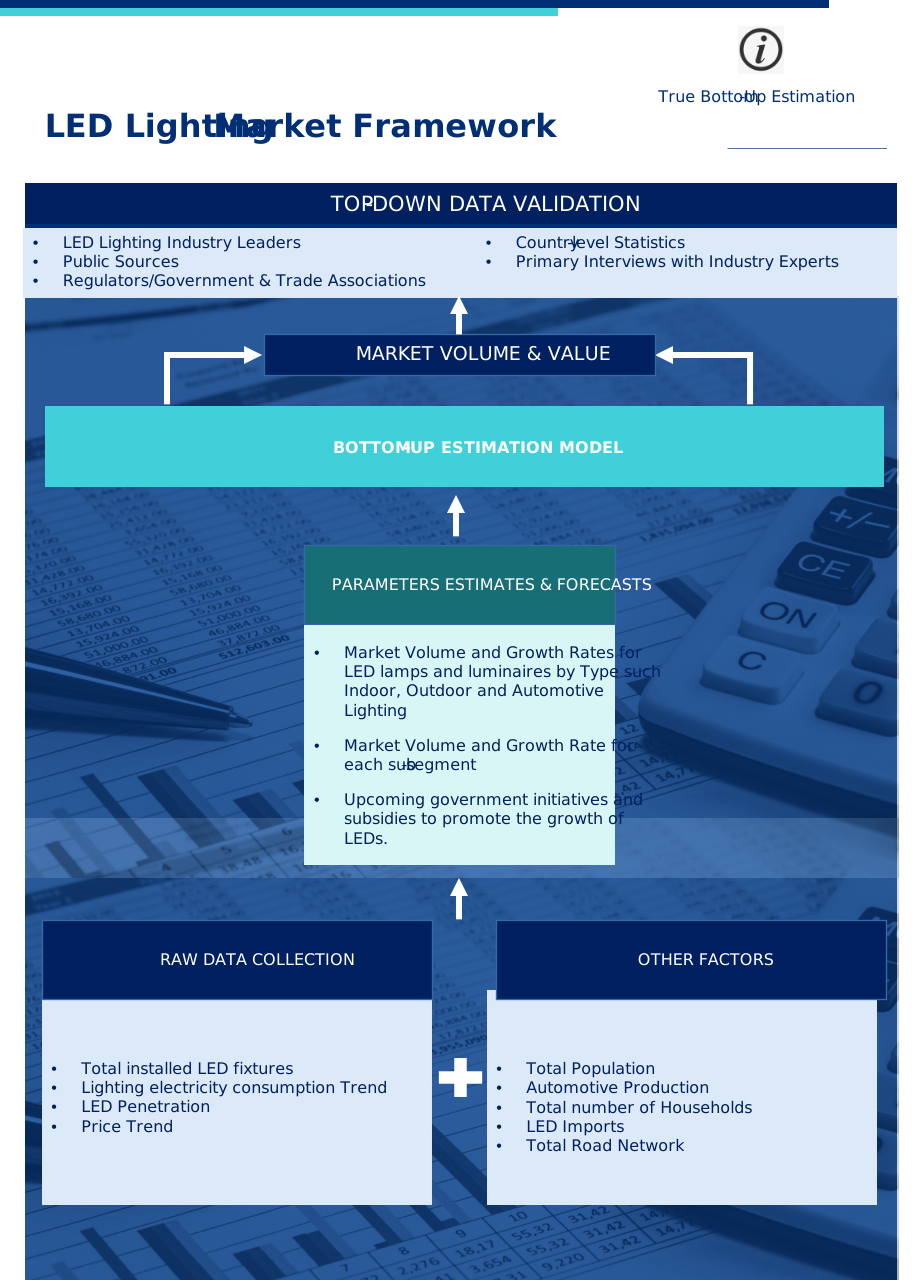
Research Methodology
Mordor Intelligence has followed the following methodology in all our data center reports.
- Step 1: Raw Data Collection: To understand the market, initially, all crtical data points were identified. Critical information about countries and regions of interest including Per-capita Income, Population, Automotive Production, Interest rate on Auto-Loans, Number of Automobiles on Road, Total LED Import, Lighting Electricity Consumption among others were recorded or estimated based on internal calculations.
- Step 2: Identify Key Variables: To build a robust forecasting model, key variables such as Number of Households, Automotive Production, Road Networks among others were identified. Through an iterative process, the variables required for the market forecast were set, and the model was built using these variables.
- Step 3: Build a Market Model: Based on data and critical industry trend data (variables), including LED pricing, LED penetration rate, and project macro and micor economic factors were utilized for building the market forecasting.
- Step 4: Validate and Finalize: In this crucial step, all market numbers and variables derived through an internal mathematical model were validated through an extensive network of primary research experts from all the markets studied. The respondents are selected across levels and functions to generate a holistic picture of the market studied.
- Step 5: Research Outputs: Syndicated Reports, Custom Consulting Assignments, Databases & Subscription Platforms