
Market Overview
| Study Period | 2021 - 2031 |
|---|---|
| Forecast Data Period | 2026 - 2031 |
| Base Year Market Size (2025) | USD 100.23 Million |
| Market Size (2026) | USD 107.99 Million |
| Market Size (2031) | USD 156.78 Million |
| Growth Rate (2026 - 2031) | 7.74 % |
| Market Concentration | Medium |
Major Players
*Disclaimer: Major Players sorted in no particular order Image © Mordor Intelligence. Reuse requires attribution under CC BY 4.0. |
|
Middle East And Africa Hand Sanitizer Market Analysis by Mordor Intelligence
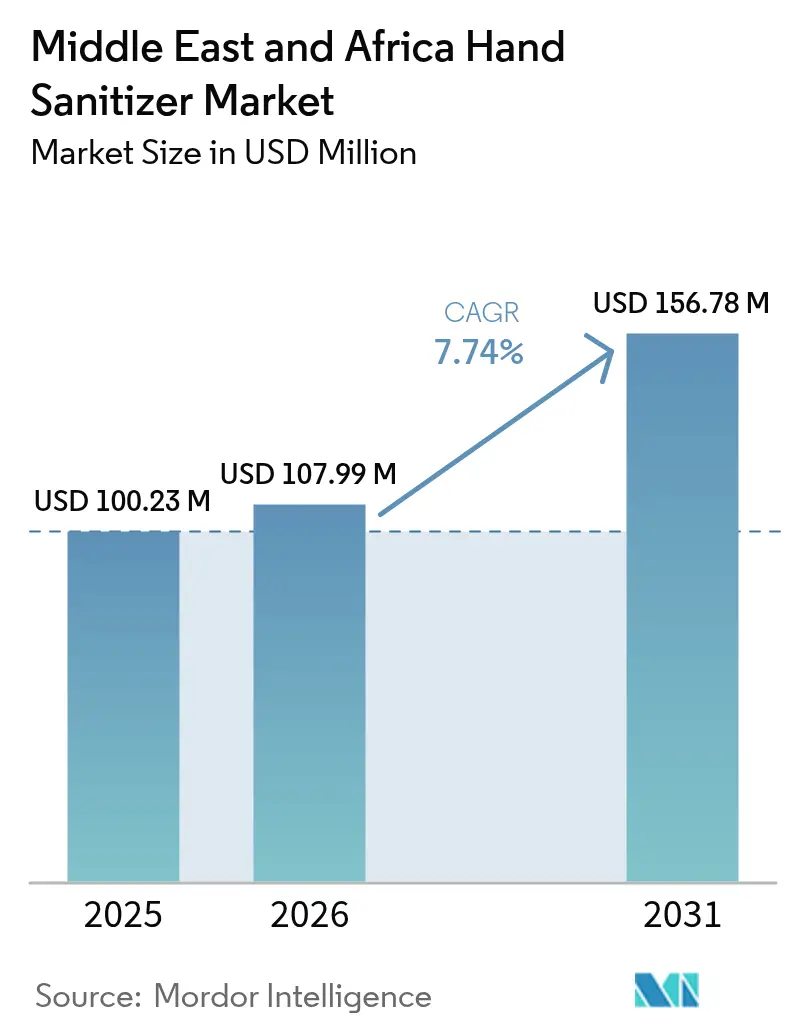
The hand sanitizer market size in the Middle East and Africa was valued at USD 100.23 million in 2025 and estimated to grow from USD 107.99 million in 2026 to reach USD 156.78 million by 2031, at a CAGR of 7.74% during the forecast period (2026-2031). This growth stems from increased public and institutional awareness of hygiene and sanitation. Hand sanitizers have established themselves as essential health products across both consumer households and commercial establishments throughout urban and rural areas. The region's varied demographic and socio-economic landscape creates distinct market dynamics. The growing population, combined with increased healthcare infrastructure investments in emerging economies, generates consistent institutional demand. The implementation of workplace health and safety programs and infection control regulations has increased sanitizer adoption in professional and public spaces. Consumer preferences have shifted toward diverse product formulations, including natural and organic options that address specific skin care requirements and cultural preferences, expanding the market reach.
Key Report Takeaways
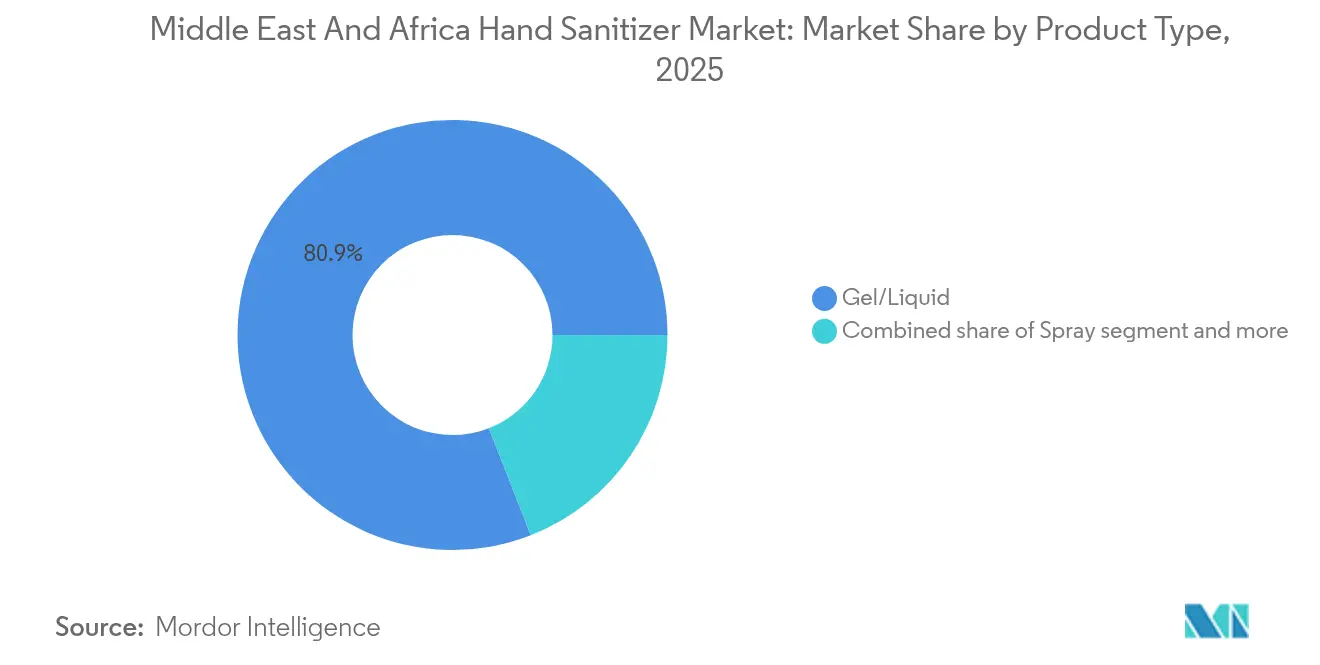
- By product type, gel and liquid formats led with 80.93% revenue share in 2025; spray formats are projected to advance at a 5.72% CAGR through 2031.
- By age group, adults captured 88.84% of the hand sanitizer market share in 2025, while kids' products are forecast to expand at a 6.29% CAGR to 2031.
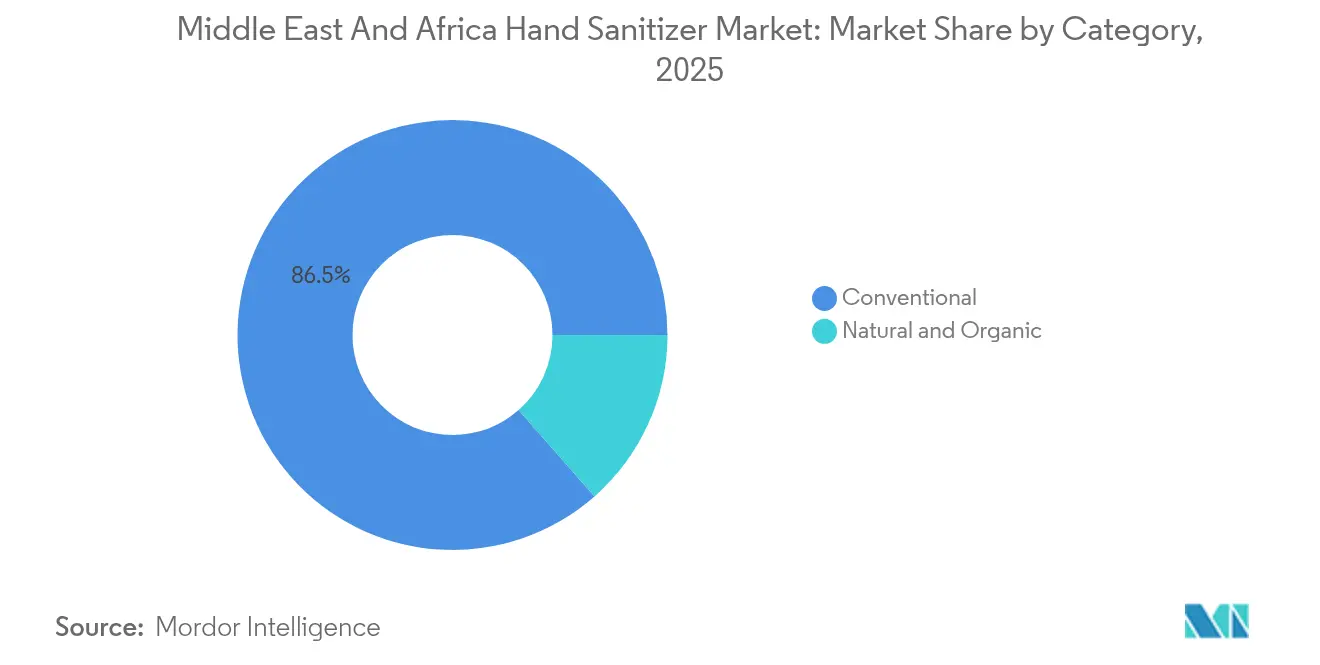
- By category, conventional formulations commanded 86.48% share of the hand sanitizer market size in 2025; natural and organic options are expected to climb at 6.95% CAGR between 2026 and 2031.
- By end-user, residential consumption accounted for 74.02% of the 2025 value, whereas commercial settings are advancing at a 7.53% CAGR to 2031, driven by compliance monitoring mandates.
- By geography, South Africa held 21.85% of the regional market value in 2025, while the United Arab Emirates posts the fastest projected growth at 6.62% CAGR through 2031.
Note: Market size and forecast figures in this report are generated using Mordor Intelligence’s proprietary estimation framework, updated with the latest available data and insights as of 2026.
Middle East And Africa Hand Sanitizer Market Trends and Insights
Drivers Impact Analysis*
| Driver | (~) % Impact on CAGR Forecast | Geographic Relevance | Impact Timeline |
|---|---|---|---|
| Growing awareness of hygiene and sanitation | +2.1% | Middle East and Africa, strongest in the United Arab Emirates and Saudi Arabia | Medium term (2-4 years) |
| Product innovation and formulation diversity | +1.8% | South Africa, United Arab Emirates, Egypt | Long term (≥ 4 years) |
| Expansion of workforce health and safety programs | +2.3% | United Arab Emirates, Saudi Arabia, South Africa | Short term (≤ 2 years) |
| Concerns over communicable diseases | +1.9% | Middle East and Africa, heightened in healthcare sectors | Medium term (2-4 years) |
| Convenience and on-the-go formats | +1.4% | Urban centers across Middle East and Africa | Long term (≥ 4 years) |
| Brand and marketing initiatives | +1.2% | Nigeria, Egypt, Morocco | Medium term (2-4 years) |
| Source: Mordor Intelligence | |||
Growing awareness of hygiene and sanitation
The Middle East and Africa hand sanitizer market is experiencing significant growth, driven by increasing awareness of hygiene and sanitation practices. The heightened understanding of communicable diseases, especially following recent global health events, has led institutions, businesses, and households to incorporate regular hand hygiene into their daily routines. Government health departments, educational initiatives, and public health campaigns continue to emphasize the importance of proper hand sanitation, establishing hand sanitizers as an essential product. For instance, the Saudi Arabian Ministry of Health mandates that alcohol-based hand sanitizers contain 60-95% alcohol content for use in clinical and public environments [1]Source: The Ministry of Health (MOH), "National Guide for Auditors in Infection Control Auditing Strategies for Healthcare Facilities", www.moh.gov.sa. The guidelines specifically recommend ethanol for its virus-fighting capabilities, while acknowledging isopropyl alcohol's effectiveness against bacterial contamination. These regulatory requirements influence institutional purchasing decisions and product development, highlighting the importance of evidence-based formulations in ensuring proper hygiene standards.
Product innovation and formulation diversity
Product innovation and formulation diversity drive growth in the Middle East and Africa hand sanitizer market, enabling companies to address diverse consumer needs and preferences. Manufacturers are increasing their research and development investments to expand beyond standard alcohol-based gels. For instance, Unilever PLC invested EUR 987 million in Research and Development (R&D) in 2024, compared to EUR 949 million in 2023. This diversification allows products to suit different usage scenarios, skin types, and cultural preferences, making hand sanitizers more accessible. Companies focus on improving user experience by developing formulas that reduce skin dryness, incorporate natural or organic ingredients, and provide pleasant textures and fragrances, which promote regular use and consumer loyalty. Additionally, specialized formulations meeting regional and religious requirements, such as halal-certified sanitizers, are gaining prominence across the Middle East and Africa, reflecting consumer demand for ethical products and ingredient transparency.
Expansion of workforce health and safety programs
The expansion of workforce health and safety programs significantly drives the Middle East and Africa hand sanitizer market growth, as organizations implement comprehensive preventive measures to enhance employee well-being and ensure strict compliance with regulatory requirements. Hand sanitizers have become essential preventive tools across industrial, commercial, and institutional settings where workers engage in daily interactions. According to the Ministry of Human Resources and Emiratisation, the United Arab Emirates experienced a substantial 6.72% workforce growth during the first half of 2025, indicating robust expansion in labor markets and industrial activities [2]Source: Ministry of Human Resources and Emiratisation, "A Holistic View on the UAE Labour Market", https://observatory.mohre.gov.ae. This significant growth intensifies the need for thorough hygiene protocols, with hand sanitizers becoming fundamental for preventing infectious diseases and maintaining optimal workplace productivity. Organizations are systematically incorporating hand hygiene practices into their occupational health programs to strengthen employee protection, minimize illness-related absenteeism, and exceed international health standards.
Concerns over Communicable Diseases
The prevalence of communicable diseases continues to drive growth in the Middle East and Africa hand sanitizer market. Regular outbreaks of infectious diseases, influenza, and bacterial infections have highlighted hand hygiene as a crucial preventive measure. The increased understanding among the public, healthcare providers, and governments about pathogen transmission through contact has increased the demand for sanitization products. This emphasis on preventing virus and bacteria transmission across households, workplaces, healthcare facilities, and public spaces maintains sanitizer use as a fundamental health measure. Hand sanitizers serve as an efficient, waterless alternative to handwashing, particularly in regions with limited clean water access or in high-traffic areas where hand hygiene is essential. Health authority recommendations and government mandates have incorporated sanitizer use into healthcare protocols and workplace safety standards. This official support, along with public education initiatives, positions sanitizer products as essential tools against disease outbreaks, extending their importance from personal hygiene to public health necessities.
Restraints Impact Analysis*
| Restraint | (~) % Impact on CAGR Forecast | Geographic Relevance | Impact Timeline |
|---|---|---|---|
| Fluctuating raw material prices | -1.7% | Middle East and Africa, acute in import-dependent markets | Short term (≤ 2 years) |
| Preference for traditional soap-and-water hygiene | -1.3% | Rural areas across Middle East and Africa, traditional communities | Long term (≥ 4 years) |
| Skin irritation and dryness issues | -0.8% | Middle East and Africa, heightened in sensitive populations | Medium term (2-4 years) |
| Counterfeit and substandard products | -1.1% | Nigeria, Egypt, Morocco, border regions | Short term (≤ 2 years) |
| Source: Mordor Intelligence | |||
Fluctuating Raw Material Prices
The Middle East and Africa hand sanitizer market faces significant constraints due to fluctuating raw material prices. The market's essential ingredients, including alcohol (ethanol and isopropyl alcohol), glycerin, and essential oils, experience price volatility due to supply chain disruptions, geopolitical tensions, and global crude oil price fluctuations that affect chemical production costs. These price variations increase manufacturing expenses, potentially raising end-product prices and reducing affordability, particularly in the region's price-sensitive markets. The market's heavy reliance on imported alcohol and specialty ingredients makes it vulnerable to international trade disruptions, currency fluctuations, and regional logistics challenges. This dependency can result in inconsistent production schedules and difficulties in meeting sudden demand increases. For example, Nigeria's import of ethyl alcohol and other spirits reached USD 23.4 million in 2023, according to the Observatory of Economic Complexity (OEC). Such import dependence exposes manufacturers to external factors like supply chain delays, trade policy changes, and foreign exchange rate fluctuations, directly affecting production costs and raw material availability.
Preference for traditional soap-and-water hygiene
The Middle East and Africa hand sanitizer market faces limitations due to the strong preference for traditional soap-and-water handwashing methods. When water and soap are available, consumers and institutions commonly choose conventional handwashing over hand sanitizers. This preference stems from established cultural practices and the belief that soap and water provide more effective cleaning, particularly for visible dirt and grime that sanitizers cannot remove effectively. Rural and underserved regions, where handwashing is deeply ingrained in daily routines, show slower sanitizer adoption rates due to limited awareness and doubts about its effectiveness compared to traditional methods. The widespread availability and lower cost of soap-and-water cleaning reduce the motivation to adopt sanitizers, which are often viewed as optional or premium products. This behavioral pattern creates market expansion challenges for sanitizer manufacturers beyond urban areas and healthcare facilities.
*Our forecasts treat driver/restraint impacts as directional, not additive. The impact forecasts reflect baseline growth, mix effects, and variable interactions.
Segment Analysis
Segment 1
Gel and liquid formulations command 80.93% of the Middle East and Africa hand sanitizer market in 2025. These formulations deliver superior application efficiency, comprehensive sanitization capabilities, and enhanced user experience compared to alternative formats. Gels maintain ideal viscosity levels, ensuring maximum hand coverage while eliminating product waste, positioning them as critical solutions across personal and institutional segments. Liquid formulations excel in rapid evaporation performance and demonstrate exceptional adaptability across healthcare facilities, commercial establishments, and household environments.
Spray formats in the Middle East and Africa hand sanitizer market demonstrate robust growth at 5.72% CAGR through 2031. This expansion stems from advanced dispensing mechanisms, validated antimicrobial efficacy, and accelerating consumer preference shifts. Sprays facilitate instantaneous application and comprehensive disinfection without the residual effects characteristic of traditional formats. The precision spray distribution ensures consistent coverage for optimal pathogen elimination, particularly crucial in high-volume commercial and public environments. Their enhanced evaporation characteristics deliver superior performance metrics in the region's distinct climatic conditions.



By Age-Group: Adult Institutional Demand Anchors Growth
In 2025, adult demographics command a significant 88.84% share in the Middle East and Africa hand sanitizer market consumption. This substantial market presence reflects adults' position as primary purchasers of hygiene products and their extensive exposure to environments demanding regular hand sanitization. Adults drive household purchasing decisions and frequently navigate urban, corporate, and social settings where hand sanitizer usage is imperative. Furthermore, public health initiatives strategically target adults as influential drivers of household hygiene practices, reinforcing their market dominance.
The kids segment in the Middle East and Africa hand sanitizer market demonstrates robust expansion, advancing at a CAGR of 6.29% through 2031. This notable growth trajectory stems from heightened parental awareness regarding children's hygiene requirements, particularly in the post-pandemic landscape. Educational institutions, childcare facilities, and pediatric healthcare centers have implemented comprehensive hygiene protocols, generating increased demand for specialized child-friendly sanitizer formulations. The segment's growth is further propelled by parents' increasing investment in safety-focused hygiene products and widespread educational campaigns promoting early hygiene habit formation among children.
By Category: Natural Alternatives Gain Regulatory Traction
Conventional formulations dominate 86.48% of the Middle East and Africa hand sanitizer market in 2025. This market leadership results from comprehensive regulatory frameworks and the scientifically proven effectiveness of alcohol-based sanitizers in antimicrobial applications. Conventional hand sanitizers have consistently demonstrated superior pathogen elimination capabilities across bacteria, viruses, and fungi through rigorous clinical validation. The robust manufacturing infrastructure and optimized supply chains ensure reliable production and distribution, particularly crucial in regions experiencing significant urbanization and healthcare system expansion.
Natural and organic hand sanitizer formulations in the Middle East and Africa market are advancing at a CAGR of 6.95% through 2031. This significant growth trajectory reflects the increasing consumer shift toward skin-friendly and environmentally conscious products. Rising awareness regarding the impact of synthetic chemicals on skin health has intensified demand for natural ingredients such as aloe vera, essential oils, and plant-based extracts that deliver both sanitization and skin nourishment. The segment's expansion corresponds with evolving wellness and sustainability preferences, particularly resonating with urban populations and premium market consumers.
By End-User: Commercial Sector Accelerates Compliance-Driven Growth
In 2025, residential usage maintains a dominant market share of 74.02% in the Middle East and Africa hand sanitizer market. Households increasingly adopt hand sanitizers as essential hygiene products, especially in urban and semi-urban areas where traditional hand washing may be less convenient. The demand for efficient and accessible hygiene solutions has established hand sanitizers as a household necessity. According to the Income and Expenditure Survey (IES) 2022/2023 by Statistics South Africa, male-headed households accounted for over 60% of total household consumption expenditure in 2023, demonstrating significant purchasing power in personal care and hygiene products, including hand sanitizers .
Commercial end-users in the Middle East and Africa hand sanitizer market are growing at a CAGR of 7.53% through 2031. This growth stems from stricter workplace hygiene standards, regulatory requirements, and increased health awareness. Businesses are implementing hand sanitizer dispensers throughout their facilities to protect employees and customers. The adoption of touch-free dispensers and bulk refill systems addresses the needs of high-traffic commercial areas. Companies are also incorporating premium hand hygiene solutions into their employee welfare programs, making sanitizer use an integral part of workplace protocols.
Geography Analysis
South Africa drives and dominates the Middle East and Africa hand sanitizer market through its established public health awareness and hygiene practices. The country's efforts to control infectious diseases have established hand hygiene as a fundamental practice. Government initiatives promote sanitation as a preventive measure, increasing sanitizer usage in households, healthcare facilities, and public institutions. Public health campaigns and healthcare information accessibility strengthen consumer adoption of regular sanitizer use. South Africa's urban population growth and expanding middle class further solidify its market position by generating sustained demand for hygiene products.
The United Arab Emirates exhibits the fastest market growth, supported by its robust regulatory framework and public health priorities in urban planning. The expansion of tourism, hospitality, and business sectors necessitates strict hygiene standards, increasing sanitizer adoption across private and public spaces. Government health initiatives and disease prevention policies promote hygiene compliance, increasing sanitizer consumption. The United Arab Emirates' diverse population and high disposable incomes support the adoption of various sanitizer formulations, driving market expansion. The combination of health governance and consumer preferences creates favorable conditions for market growth.
Saudi Arabia, Egypt, Nigeria, Morocco, and Turkey support regional growth through their health programs and awareness initiatives. Saudi Arabia's infection control policies increase sanitizer use in healthcare and public areas. Egypt's urban population growth and healthcare development drive sanitizer demand. Nigeria's market grows through urbanization and increased awareness, despite infrastructure limitations. Morocco and Turkey demonstrate increased health consciousness among middle-class consumers and alignment with international hygiene standards. While regulatory frameworks and health priorities vary across these countries, their combined focus on improved hygiene practices contributes to regional market development.
Regulatory Landscape
Hand sanitizer compliance in the Middle East and Africa spans health-product registration, national standards, and specifications that affect allowable alcohol ranges, test requirements, and labeling. In Saudi Arabia, the Saudi Food and Drug Authority (SFDA) classifies and registers hand sanitizers as health products under its registration rules and product classification guidance, with ingredient criteria commonly framed around alcohol content ranges for ethanol or isopropanol. Across parts of East Africa, the harmonized EAC standard EAS 789 (aligned for use by bodies such as the Kenya Bureau of Standards) sets quality requirements for instant hand sanitizers, including parameters such as pH and bactericidal efficacy.
Regulatory controls also address import and market surveillance risks in several African markets. Nigeria's National Agency for Food and Drug Administration and Control (NAFDAC) guidance for registration of alcohol-based hand sanitizers requires defined labeling elements (including composition, batch information, and manufacturing and expiry dates) and supporting documentation for locally made products. In Southern Africa, Namibia references NAMS/SANS 490 requirements for alcohol-based hand rubs, including specified alcohol formulation ranges and testing expectations such as efficacy and dermal irritation, which in turn shape product development and procurement specifications for institutional buyers.
Competitive Landscape
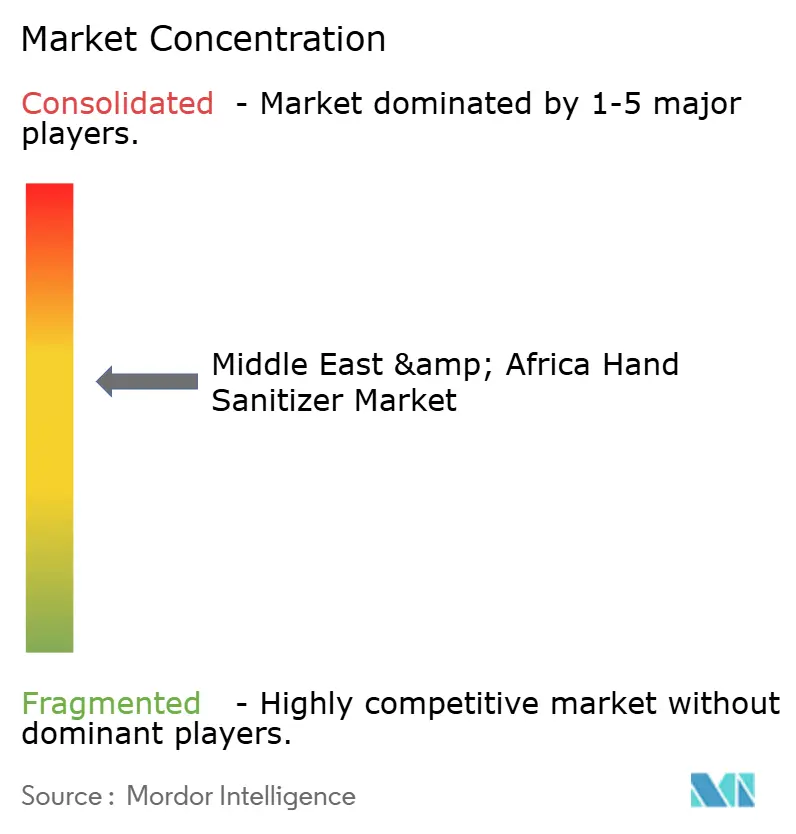
The Middle East and Africa hand sanitizer market shows moderate concentration, with multinational corporations maintaining significant market presence alongside regional and local players. Companies like Reckitt Benckiser Group PLC, Unilever PLC, S. C. Johnson & Son, Inc., The Procter & Gamble Company, and 3M Company dominate through their brand strength and distribution networks. These companies leverage their global capabilities to maintain product quality and regulatory compliance across institutional and residential segments. The market structure allows for new entrants and specialized players to participate, supported by changing consumer preferences and varied regulatory frameworks across the region.
Companies are expanding beyond basic product offerings to provide integrated hygiene solutions. Market leaders now offer comprehensive packages that combine product supply with dispenser technology, compliance monitoring systems, and dedicated service support for institutional and commercial clients. Companies are implementing automation, digital printing, robotics, and AI-driven quality control systems to improve operational efficiency. These technological capabilities enable faster production cycles and product customization, helping companies secure institutional contracts and meet specific regional requirements.
The market presents growth opportunities in rural areas, small commercial sectors, and specialized consumer segments. Demand exists for products with specific certifications, such as halal-certified sanitizers and natural formulations that meet local cultural and regulatory requirements. Success in these segments requires targeted product development and distribution strategies based on detailed end-user analysis. Companies that develop market-specific solutions, such as cost-effective dispensers for rural healthcare facilities or products for environmentally conscious consumers, are positioned to expand their market presence in the Middle East and Africa hand sanitizer market.
Middle East And Africa Hand Sanitizer Industry Leaders
-
Reckitt Benckiser Group PLC
-
Unilever PLC
-
S. C. Johnson & Son, Inc.
-
The Procter & Gamble Company
-
3M Company(Avagard)
- *Disclaimer: Major Players sorted in no particular order

Market Opportunities and Future Outlook
Opportunities in the Middle East and Africa hand sanitizer market focus on meeting more explicit quality and documentation thresholds while tailoring products to differentiated end-users. Harmonized and country standards, including EAS 789 in East Africa and Namibia's NAMS/SANS 490, create room for suppliers that can consistently deliver compliant alcohol ranges and verification testing (including bactericidal efficacy and skin-compatibility parameters). At the same time, SFDA product classification and registration routes in Saudi Arabia raise the value of registration-ready dossiers and stable, auditable supply for healthcare and public-sector channels, particularly for alcohol-based formulations aligned with institutional specifications.
Commercial adoption programs and employer hygiene protocols also widen demand for bulk, dispenser-compatible formats and service-led supply models. Evidence of workforce expansion in the United Arab Emirates (6.72% growth in the first half of 2025 per the Ministry of Human Resources and Emiratisation) supports demand for scalable workplace hygiene rollouts, where suppliers can bundle products with touch-free dispensers and refill systems. On the consumer side, formulation differentiation, including the category shift toward natural and organic options, and requirements such as halal-aligned positioning in parts of the region, supports premium and niche portfolios that can clear local registration and labeling expectations while addressing skin-comfort concerns.
Recent Industry Developments
- June 2026: SC Johnson - Fisk Johnson, CEO of SC Johnson, met with Egypt's Minister of State for Military Production to explore expanding their long-standing partnership to deepen local manufacturing and boost regional exports. The meeting solidifies efforts to strengthen regional production capacity and could enhance supply resilience for institutional and consumer segments. The discussion positions SC Johnson to capitalize on Egypt's industrial base to support exports and product localization in the Middle East and Africa.
- June 2026: Unilever - Unilever launched a new four-chamber laundry capsule featuring Nano-Power and Nano-Sense technologies, with production capacity tripled at its UK Port Sunlight hub to fuel premiumization in home care categories. The rollout expands Unilever's premium home care portfolio and accelerates capacity to meet growing demand across sophisticated consumer segments. The capacity upgrade underscores a broader strategy to scale innovative formulations while maintaining regional supply commitments.
- April 2026: Reckitt - Reckitt reported that operations and supply in its Middle East business were disrupted by ongoing war in the region, impacting Q1 2026 like-for-like net revenue growth. The disruption highlights macro risk to MEA sanitizer market dynamics and may incentivize diversification of regional supply sources. The event emphasizes the importance of resilient logistics and localized contingency planning for regional brands.


Research Methodology Framework and Report Scope
Market Definition and Coverage
For this study, the market covers hand sanitizer products sold across the Middle East and Africa for hand hygiene, measured in value (USD) and supported by volume checks (liters), across consumer and institutional purchase points.
Scope exclusions: We exclude adjacent surface disinfectants and general household cleaners that are not positioned and sold as hand sanitizers.
Segmentation Overview
-
By Product Type
- Gel/Liquid
- Spray
- Other Product Types
-
By Age-Group
- Adult
- Kids
-
By Category
- Conventional
- Natural and Organic
-
By End-User
- Residential
- Commercial
-
By Geography
- South Africa
- Saudi Arabia
- United Arab Emirates
- Nigeria
- Egypt
- Morocco
- Turkey
- Rest of Middle East and Africa
Data Sources, Market Sizing, and Validation
Desk Research
Desk research starts by setting clear boundaries on what counts as a hand sanitizer sale in the region and what does not, followed by mapping demand and supply signals to those boundaries. We refer to public health guidance and product standards for hand rubs and labeling, including sources such as the World Health Organization, national ministries of health in key MEA countries, and standards bodies that publish antiseptic and cosmetics guidance.
To size the market realistically, we also lean on trade and macro indicators that are available without paywalls, such as UN Comtrade for relevant import and export flows, World Bank population and income indicators, and national statistics offices for retail and consumer spending context. Company filings, product announcements, and reputable press coverage are used to cross-check launches, pricing direction, and channel shifts. Where needed, paid subscriptions are used only for company financials and for shipment-level import and export records to tighten assumptions in countries with limited disclosure. The desk sources mentioned here are illustrative and not exhaustive, and we referred to additional public materials to collect data, validate assumptions, and clarify open questions.
Primary Interviews and Surveys
Primary work focuses on interviews and structured surveys with manufacturers, distributors, retail channel participants, and large institutional buyers across the Middle East and Africa so we can close information gaps that desk sources cannot fully address. We use these discussions to validate what is actually selling by form and pack size, how pricing moves by channel, and how demand differs between residential and commercial use across key subregions.
Distribution of primary research fieldwork respondents
| Company type | Respondent position |
|---|---|
| Top tier: 38% | CXOs: 13% |
| Mid tier: 47% | Functional/Unit leaders: 33% |
| Smaller Players: 15% | Managers: 54% |
Market-Sizing & Forecasting
Market sizing is built using a top-down approach where population, hygiene penetration, and channel availability are used to reconstruct the demand pool, which is then converted into value using price points that fit each country cluster. To keep the totals grounded, we corroborate the outputs with selective bottom-up checks, such as supplier and distributor roll-ups for a sample of markets and sampled ASP multiplied by estimated volumes by form.
A few inputs that matter in this market include the split between residential and commercial usage, the form mix (gel or liquid, spray, and other formats), the shift toward conventional versus natural and organic products, and channel mix changes (pharmacies, modern retail, convenience, and online). Import intensity and local blending capacity are also used as practical checks in countries where the supply chain is highly trade-linked. When company disclosures are incomplete, gaps are handled by using peer-set ratios and then testing them with distributor feedback before totals are finalized.
For forecasting, we mainly use scenario analysis anchored to expected normalization in hygiene routines, policy and healthcare procurement signals, and likely price progression by pack size and alcohol content positioning. Assumptions are reviewed with regional experts so the forecast reflects realistic adoption and does not overreact to short-term demand spikes.
Data Validation & Update Cycle
Validation is done through multiple checks that compare the model outputs against independent signals like trade flows, retail availability patterns, and implied per-capita usage, and then unusual jumps are investigated country by country. When variances are seen, we re-check the scope mapping and pricing assumptions, and then we reconnect with sources if the change cannot be explained by seasonality or channel shifts.
Before sign-off, the work goes through multi-step analyst review so calculations, unit conversions, and currency handling are consistent across the region. Reports are refreshed annually, with interim updates triggered by material events such as regulation changes, major capacity additions, or abrupt shifts in institutional procurement. Right before delivery, a fresh pass is completed so clients receive the latest updated view.
Mordor Intelligence's Middle East and Africa Hand Sanitizer Market Size Versus Other Published Estimates
Published market sizes for MEA hand sanitizer can look far apart because the product boundary and the year used for comparison are not always aligned, and then pricing and channel assumptions amplify the gap. The table helps show how much a few scope and modeling choices can move a regional total.
Key gap drivers here tend to be whether sanitizing wipes and foam are counted inside the same total as gels and sprays, whether institutional and retail channels are both captured, and how volume is translated to value when ASPs differ sharply by pack size and country. The table shows a much smaller 2025 total, and in Mordor Intelligence's model the value is tied to hand sanitizer forms sold for hand hygiene (with volume in liters used as a reasonableness check) instead of folding in surface disinfectants.
Benchmark comparison
| Source | Market Size | Gaps in Research Methodology |
|---|---|---|
| Mordor Intelligence | USD 100.23 M (2025) | |
| Regional Consultancy A | USD 181.70 M (2023) | Often reflects an earlier demand spike year and may include a wider set of hygiene liquids beyond hand sanitizer, which lifts value when countries apply different retail price points. |
| Industry Portal B | USD 1.07 B (2025) | Likely uses a broader consumer hygiene and disinfectants scope and a different price basis, which can scale up the total when multiple adjacent categories are counted together. |
Across the three figures, the spread is mainly explained by what product types are counted, how channels are treated, and whether pricing is normalized across countries or taken from a few high-price benchmarks. By keeping the steps traceable to demand pool logic, form mix, and practical price checks, we get a regional number that can be repeated and stress-tested when assumptions change.


Key Questions Answered in the Report
What is the 2026 value of the hand sanitizer market in Middle East and Africa?
The market stands at USD 107.99 million in 2026.
How fast will regional demand grow through 2031?
Forecasts indicate a 7.74% CAGR, taking value to USD 156.78 million.
Which product type leads current sales?
Gel and liquid formats hold 80.93% of 2025 revenue.
Which country shows the quickest growth?
The United Arab Emirates records the fastest projected 6.62% CAGR through 2031.
Page last updated on:





