
Middle East and Africa Farm Implements Market Size and Share
Market Overview
| Study Period | 2021 - 2031 |
|---|---|
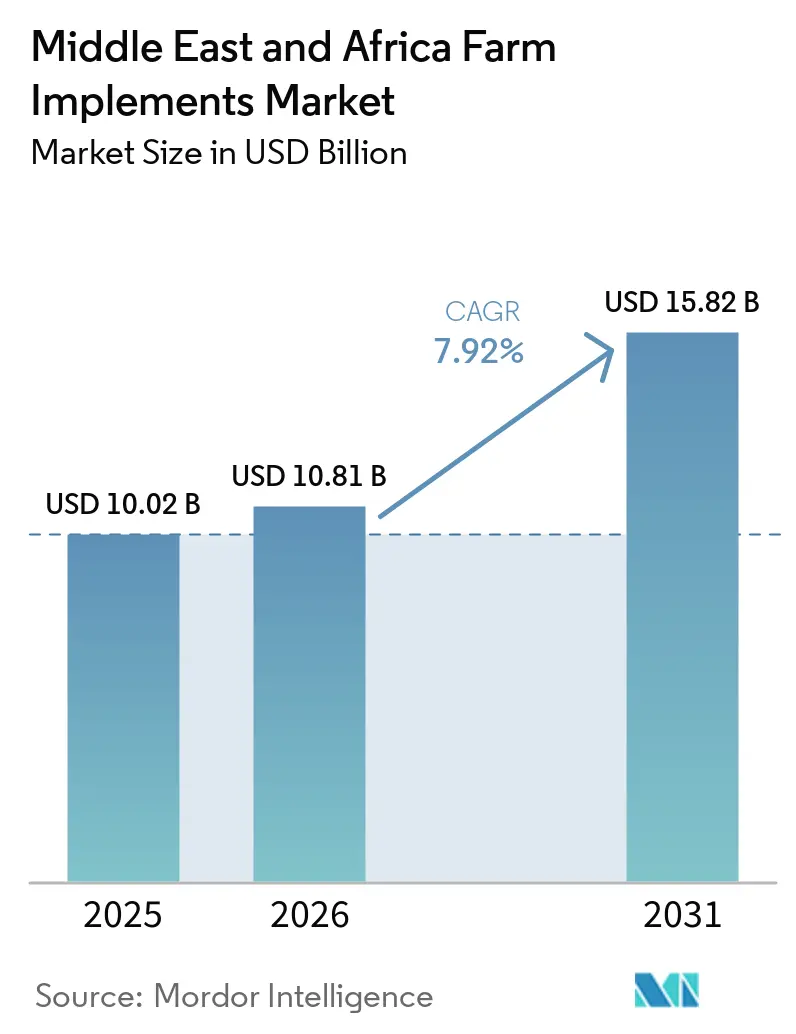
| Base Year Market Size (2025) | USD 10.02 Billion |
| Market Size (2026) | USD 10.81 Billion |
| Market Size (2031) | USD 15.82 Billion |
| Growth Rate (2026 - 2031) | 7.92 % |
| Fastest Growing Market | Africa |
| Largest Market | Africa |
Major Players *Disclaimer: Major Players sorted in no particular order Image © Mordor Intelligence. Reuse requires attribution under CC BY 4.0. | |
Middle East and Africa Farm Implements Market Analysis by Mordor Intelligence
The Middle East and Africa farm implements market size was valued at USD 10.02 billion in 2025 and is forecast to grow from USD 10.81 billion in 2026 to USD 15.82 billion by 2031, at a CAGR of 7.92% from 2026 to 2031. Demand is driving the adoption of more capable equipment by smallholder service models, expanding commercial farms, and export estates. Africa has 202 million hectares of uncultivated arable land, while its crop yields remain 56% below the global average, leaving a sizable productivity gap for mechanization to address. Public food security programs and private equipment-hire services are reducing reliance on individual ownership of equipment. Manufacturers are therefore increasing distribution coverage, local assembly, and service capacity, while precision features are becoming more relevant in water-constrained areas. Currency depreciation, limited rural repair coverage, and constrained farm credit remain material obstacles for the Middle East and Africa farm implements market.
Key Report Takeaways
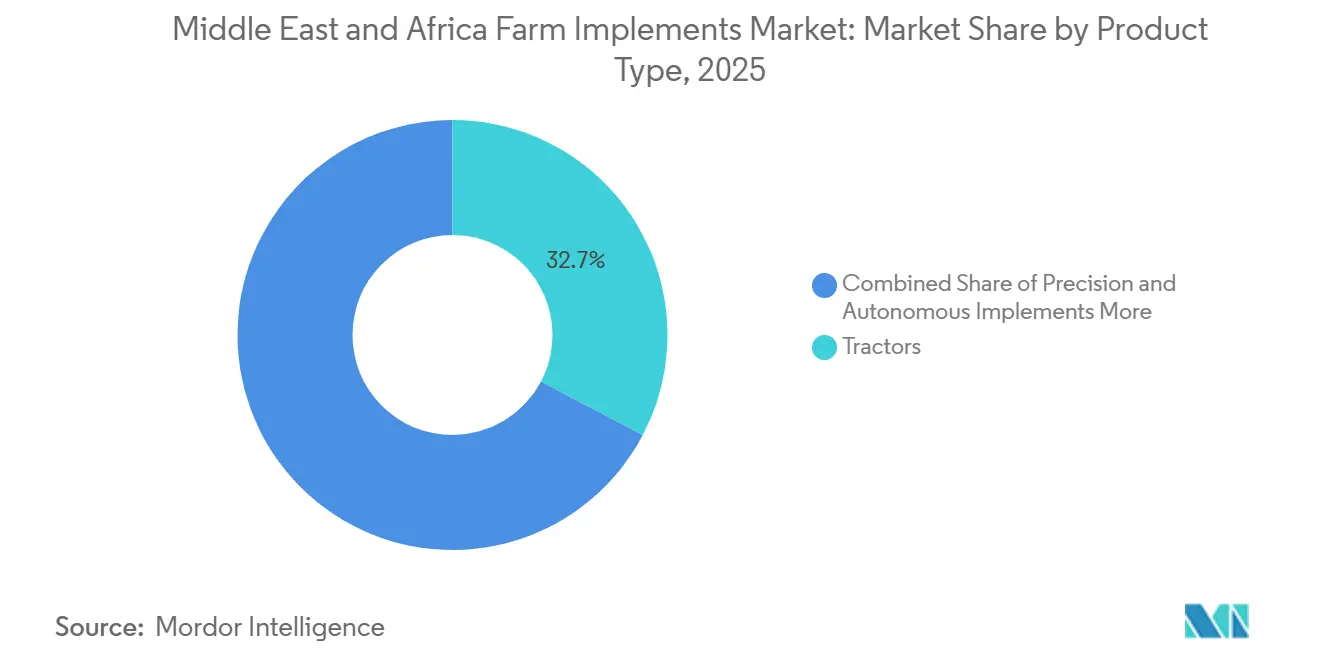
- By product type, tractors accounted for the largest Middle East and Africa farm implements market share in 2025, at 32.7%, while precision and autonomous implements are forecast to grow at the fastest CAGR of 8.2% from 2026 to 2031.
- By mode of operation, powered implements accounted for the largest share in 2025, at 68.3%, while the Middle East and Africa farm implements market size for unpowered implements is forecast to grow at the fastest CAGR of 8.8% from 2026 to 2031.
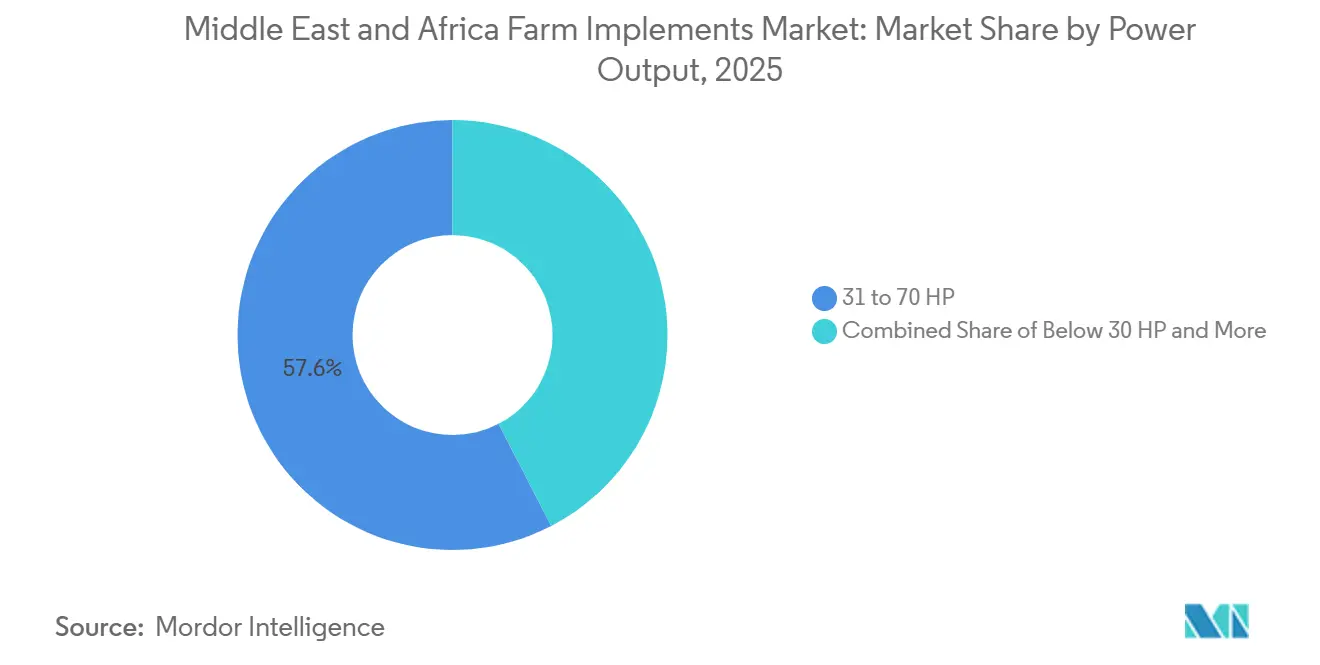
- By power output, the 31–70 horsepower segment accounted for the largest share in 2025, at 57.6%, while the above 130 horsepower segment is forecast to grow at the fastest CAGR of 8.2% from 2026 to 2031.
- Africa accounted for the largest share of the Middle East and Africa farm implements market in 2025, at 73.8%, and is forecast to be the fastest-growing geographic segment, with a CAGR of 8.9% from 2026 to 2031.
Note: Market size and forecast figures in this report are generated using Mordor Intelligence’s proprietary estimation framework, updated with the latest available data and insights as of January 2026.
Middle East and Africa Farm Implements Market Trends and Insights
Drivers Impact Analysis*
| Driver | (~) % Impact on CAGR Forecast | Geographic Relevance | Impact Timeline |
|---|---|---|---|
| Food-security-led mechanization programs | +2.0% | Middle East and Africa, led by sub-Saharan Africa and Gulf countries | Medium term (2-4 years) |
| Smallholder access through equipment-hire platforms | +1.4% | Sub-Saharan Africa, with spillover into North Africa | Short term (≤ 2 years) |
| Expansion of commercial and export-oriented farming | +1.2% | East and Southern Africa and Egypt | Medium term (2-4 years) |
| Water-efficiency requirements for precision implements | +1.0% | Gulf countries, Maghreb, and the Horn of Africa | Medium term (2-4 years) |
| Labor scarcity and rising farm labor costs | +0.8% | Morocco, West Africa, South Africa, and the Middle East | Short term (≤ 2 years) |
| Local assembly and import-substitution incentives | +0.6% | West and East Africa, Ethiopia, and the Democratic Republic of the Congo | Long term (≥ 4 years) |
| Source: Mordor Intelligence | |||
Food-Security-Led Mechanization Programs
Government food security programs are a major driver of demand for farm implements in the Middle East and Africa. In February 2026, the Food and Agriculture Organization of the United Nations and the Government of Tanzania held a regional mechanization conference, where Tanzania launched its National Agricultural Mechanization Strategy 2026-2036[1]Source: Food and Agriculture Organization of the United Nations, “Africa Launches Push to Close Agricultural Mechanization Gap as Landmark Conference Begins,” Food and Agriculture Organization of the United Nations, fao.org. The strategy aligns with the sustainable agricultural mechanization in Africa framework and supports a move from public machinery depots toward private mechanization service providers. Private operators have a stronger incentive to keep machinery in use, which supports recurring purchases of implements and parts, as well as maintenance services. In January 2026, Deere & Company, through AGCOMS International Trading Limited under the Nigerian National Agricultural Development Fund framework, signed a USD 70 million agreement for 2,000 tractors and 100 combine harvesters, including commitments for local assembly and support. These programs provide a more stable source of demand for equipment than isolated subsidy programs. These initiatives are intended to improve agricultural productivity and domestic food production, thereby increasing demand for farm implements across the region.
Smallholder Access Through Equipment-Hire Platforms
Equipment-hire platforms are expanding access to mechanization for smallholder farms that cannot afford to purchase machinery and implements outright. Hello Tractor connects more than 2.5 million smallholder farmers with over 6,500 equipment owners across more than 20 African countries. The company also reports a non-performing loan rate of below 2% for its pay-as-you-go financing portfolio, indicating that service-based access and equipment financing can support machinery utilization where conventional lending is limited.[2]Source: Hello Tractor, “Platform Overview and Impact Data,” Hello Tractor, hellotractor.comHigher utilization improves equipment owners’ asset economics and can encourage fleet expansion, creating additional demand for compatible farm implements. Research covering Kenya, Zambia, and Zimbabwe found that hired mechanization services generated statistically significant income gains, particularly among lower-income farm households. As mechanization services expand, demand for implements used in key operations such as soil preparation, planting, fertilization, and crop protection increases, including plows, harrows, cultivators, seeders, planters, fertilizer spreaders, and tractor-mounted or trailed sprayers. This allows smallholders to access mechanized farm operations without having to purchase and maintain a complete set of implements individually.
Expansion of Commercial and Export-Oriented Farming
Commercial farms and export-oriented agricultural operations require equipment that can meet scheduled planting, crop-management, and harvesting needs. Kenya’s horticulture exporters use precision sprayers, planters, and post-harvest equipment to support GlobalG.A.P. requirements. In Ethiopia, Uganda, and Tanzania, outgrower arrangements linked to commercial farms provide soil-preparation and seeding equipment through embedded financing for contracted growers. This approach draws equipment demand through the supply chain rather than relying only on direct farmer purchases. In March 2026, AGCO Corporation introduced the Massey Ferguson MF 2M Series compact tractors. Production began in late 2025, with first customer deliveries commencing in the first quarter of 2026. The 49–65 hp tractor range is designed for smaller farms and diversified agricultural operations, making it well suited to the mechanization needs of smallholder and emerging commercial farms in Africa[3]Source: AGCO Corporation, “Massey Ferguson Product Information,” AGCO Corporation, agcocorp.com. Its product launch reflects the importance of commercial farm expansion to the Middle East and Africa farm implements market. Harvesters, irrigation systems, and soil-management equipment receive greater demand where export acreage expands.
Water-efficiency Requirements for Precision Implements
Water scarcity is increasing the value of precision equipment in Gulf countries and North Africa. Saudi Arabian center-pivot irrigation systems are being fitted with soil-moisture sensors, variable-rate controllers, and global positioning system-guided application equipment to reduce water use. These technologies allow operators to link irrigation and input use more closely to field conditions. The yield gap in Africa also supports interest in tools that reduce input waste on existing cultivated land. Farmers can observe the benefit through lower water and energy use per hectare, rather than only through a possible yield improvement. This makes precision and autonomous implements the fastest product category in the Middle East and Africa farm implements market.
Restraints Impact Analysis*
| Restraint | (~) % Impact on CAGR Forecast | Geographic Relevance | Impact Timeline |
|---|---|---|---|
| High upfront cost and limited smallholder credit | -1.5% | Sub-Saharan Africa, especially West Africa and the Horn of Africa | Short term (≤ 2 years) |
| Fragmented rural service and spare-parts networks | -1.2% | Interior Africa and rural Middle East locations | Medium term (2-4 years) |
| Foreign-exchange and import-cost volatility | -1.0% | Import-dependent countries including Nigeria, Ethiopia, and Egypt | Medium term (2-4 years) |
| Land-tenure and plot-fragmentation constraints | -0.8% | Smallholder areas in West Africa and the Horn of Africa | Long term (≥ 4 years) |
| Source: Mordor Intelligence | |||
High Upfront Cost and Limited Smallholder Credit
High equipment costs remain an immediate constraint on the Middle East and Africa farm implements market. Tractors in the 31-70 horsepower range require an upfront investment that can exceed the annual cash income of many smallholder households. Research on African agrifood systems identifies access to financial services for machinery purchases as a continuing structural barrier. Formal lending for machinery remains more available to commercial farms in South Africa and participants in specific government programs. Interest-rate risk and collateral requirements can limit equipment financing for women farmers who lack documented land tenure. Hire services and pay-as-you-go structures reduce the barrier, but do not fully address the cost of moving from basic tillage tools to multi-function precision equipment.
Fragmented Rural Service and Spare-Parts Networks
Limited access to parts and trained technicians raises the total ownership cost of farm machinery. Delays in port clearance and customs procedures can lead to parts shortages outside major urban areas. These delays are particularly difficult for farmers who need machines during planting or harvesting windows. The regional strategic analysis and knowledge support system identified shortages of trained operators, technicians, and dealers across African agricultural machinery markets. Manufacturers that add authorized workshops, mobile technicians, and local parts stock can create a stronger position than companies that compete mainly on purchase price. Service coverage is consequently a central consideration for buyers in the Middle East and Africa farm implements market.
*Our forecasts treat driver/restraint impacts as directional, not additive. The impact forecasts reflect baseline growth, mix effects, and variable interactions.
Segment Analysis
By Product Type: Tractors are the Largest Category While Precision and Autonomous Implements are the Fastest
Tractors accounted for the largest Middle East and Africa farm implements market share in 2025, at 32.7%. Their role as the primary power source for towed and mounted tools supports demand for tillage equipment, planters, sprayers, and forage equipment. A tractor purchase can therefore lead to additional spending on compatible attachments. Harvesters remain an important category for South African grain and oilseed estates and government-backed combine procurement in Ethiopia. Soil preparation and cultivation equipment serve both commercial farms and smallholder upgrades. Planting, seeding, and fertilizing equipment gain relevance as producers shift from broadcast sowing toward row planting and more controlled input use. Irrigation and crop-protection implements serve Gulf markets with established drip and center-pivot systems. Haying and forage equipment retains demand in East Africa’s pastoral livestock areas.
Precision and autonomous implements are forecast to be the fastest-growing product category, with a CAGR of 8.2% from 2026 to 2031. Their Middle East and Africa farm implements market size is supported by water-efficiency needs, labor costs, and smart-agriculture programs. Most adoption is occurring as an addition to existing machinery rather than as a replacement for conventional equipment. Sensor kits, variable-rate controls, drone-linked sprayers, and guidance modules can be installed with existing tractors and implements. This supports continued sales of conventional equipment while expanding the use of precision features. Egypt’s Egrobots introduced an autonomous harvesting robot in 2025 that was developed by Egyptian engineers, according to the supplied material. Ghana’s 3Farmate received government recognition in April 2026 for its Future Agricultural Machinery and Automation (FAMA) autonomous farming robot, also according to the supplied material. These examples indicate that locally developed solutions are emerging alongside imported technology.



By Mode of Operation: Powered Implements are the Largest Category While Unpowered Implements are the Fastest
Powered implements accounted for the largest share of the Middle East and Africa farm implements market in 2025, at 68.3%. Engine-driven and power take-off-linked equipment is essential to commercial farm productivity in South Africa, Kenya, Saudi Arabia, and Egypt. Higher tractor use also increases the need for powered sprayers, seed drills, and disc harrows. Larger commercial estates often operate multiple powered attachments within a single growing season. This operating model supports the continued strength of the powered category. It also reflects demand from farms that require timely work over large planted areas. The Middle East and Africa farm implements market benefits when farms expand equipment fleets rather than relying on a single multipurpose unit.
Unpowered implements are forecast to be the fastest-growing mode of operation, with a CAGR of 8.8% from 2026 to 2031. The category grows as new tractors need complementary plows, harrows, ridgers, and planters. Each new tractor purchase can require 2-4 non-motorized attachments, which links unpowered implement demand to tractor fleet expansion. Simpler fabricated equipment can also be produced locally at a lower cost than imported alternatives. The Regional Strategic Analysis and Knowledge Support System noted the role of local manufacturers in producing simpler agricultural implements. Better local availability helps farmers obtain equipment within narrow seasonal windows. This gives unpowered equipment a practical role even as powered machinery becomes more common.
By Power Output: The 31-70 Horsepower Range is the Largest While Above 130 Horsepower is the Fastest
The 31–70 horsepower segment accounted for the largest share of the market in 2025, at 57.6%. It is suited to mixed farm sizes across East, West, and Southern Africa. Smallholder cooperatives, emerging commercial farms, and diversified producers can use this range with multiple crop types and attachments. The 71-130 horsepower category serves established operations in South Africa, Turkey, and Egypt. These farms need greater drawbar power for deep tillage and multi-row seeding. Equipment below 30 horsepower continues to serve horticulture, orchards, peri-urban farming, and smallholdings in the Nile Delta. Mahindra & Mahindra Limited introduced its OJA compact tractor range, including 23-horsepower and 26-horsepower models, in South Africa in May 2026 for orchards, vineyards, and emerging farmer operations.
The above 130-horsepower segment is forecast to be the fastest-growing power-output category, with a CAGR of 8.2% from 2026 to 2031. The Middle East and Africa farm implements market size is linked to commercial grain and oilseed farming in South Africa and center-pivot irrigated farms in Saudi Arabia. These operations require sustained power for deep tillage and large multi-row systems. Zoomlion Heavy Industry Science and Technology Co., Ltd. introduced the DV3504 hybrid tractor at NAMPO Harvest Day 2026 in South Africa, according to the supplied material. The company also stated plans to bring a 700 horsepower DX7004 model to South Africa in 2027. The 71-130 horsepower range faces pricing pressure from compact equipment at one end and specification-led demand for higher power at the other. This leaves room for regional assemblers and specialist manufacturers that can meet midrange farm requirements.
Geography Analysis
Africa accounted for the largest Middle East and Africa farm implements market share in 2025, at 73.8%, and is forecast to be the fastest-growing geographic segment, with a CAGR of 8.9% from 2026 to 2031. South Africa remains the region’s most mechanized national market, supported by commercial grain farming and fruit exports that require harvesting and post-harvest equipment. Nigeria is receiving substantial public investment in mechanization. The January 2026 Deere & Company agreement covers 2,000 tractors and 100 combine harvesters with a local assembly component. Kenya is building a recurring demand base through horticulture exporters that use GlobalG.A.P.-compliant equipment. Tanzania’s National Agricultural Mechanization Strategy 2026-2036 supports private service providers instead of public machinery depots. This supports a wider commercial base for the Middle East and Africa farm implements market.
Ethiopia and West Africa offer substantial potential as mechanization programs and commercial production develop. Ethiopia has considered restarting the BELARUS tractor's completely knocked-down assembly to supply domestic and regional markets, according to the supplied material. Morocco’s labor shortages are encouraging farmers to consider mechanized harvesting and other labor-saving equipment. Ghana’s government recognized the Future Agricultural Machinery and Automation (FAMA) autonomous farming robot in April 2026, showing interest in locally designed equipment for smaller farms, according to the supplied material. The Food and Agriculture Organization of the United Nations documented a Southern Africa project that received USD 121 million in member-state pledges for mechanization centers, tractor and implement procurement, and after-sales infrastructure. Public funding is important, but durable adoption also depends on finance, parts, and trained operators. These conditions shape the pace at which the African segment can sustain its position in the Middle East and Africa farm implements market.
The Middle East region spends more per hectare on precision irrigation and related equipment because of water constraints and concentrated public capital. Saudi Arabia is a key Gulf demand center for irrigation, greenhouse systems, and advanced agricultural technology. The United Arab Emirates supports demand through precision agriculture pilots and controlled-environment farming. Turkey’s Anatolian plains provide consistent demand for higher-horsepower tractors and implements used in cereal production. Egypt connects Gulf and sub-Saharan African equipment markets through its cultivated agricultural areas, Nile Delta programs, and desert reclamation activity. Israel’s drip-irrigation and precision systems also supply commercial operations across Kenya, South Africa, and Morocco.
Competitive Landscape
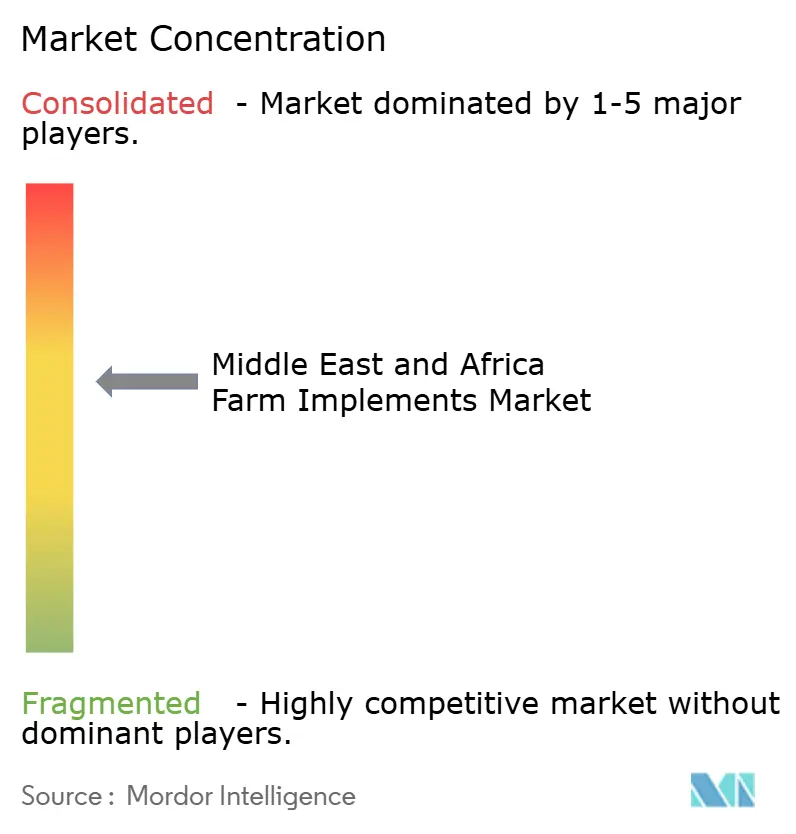
The Middle East and Africa farm implements market has moderate concentration in tractors and large implements, while simpler implement categories are more fragmented. Deere & Company, AGCO Corporation, CNH Industrial N.V., Mahindra & Mahindra Limited, and Kubota Corporation hold much of the premium equipment revenue. Manufacturers from China and India create price pressure in the midrange through lower-cost equipment and local assembly. Deere & Company uses precision agriculture software and connected equipment to support recurring service revenue and customer retention. AGCO Corporation is extending the Massey Ferguson range and dealer coverage for African farm conditions. CNH Industrial N.V. held its first African continent Case IH distributor convention in Mombasa, Kenya, in February 2026, highlighting its focus on distribution capacity. Competition depends on service coverage and parts availability as much as on the initial equipment price.
Completely knocked-down assembly is becoming an important competitive strategy in the Middle East and Africa farm implements market. It can reduce tariffs, improve delivery times, and align manufacturers with local employment goals. Zoomlion Heavy Industry Science and Technology Co., Ltd. launched the DV3504 hybrid tractor in South Africa in May 2026, according to the supplied material. The product directly targets the commercial-farm power segment that has traditionally been served by established diesel equipment suppliers. Congo Motors and CNH Industrial N.V. began work on a tractor assembly facility in Kongo Central, Democratic Republic of the Congo, in June 2026. The facility is intended to start with tractor assembly and increase local manufacturing content over time. Such projects can improve access to equipment but require reliable parts, technical training, and dealer investment.
In the Middle East, the 71-130 horsepower range is a competitive opening for companies that can offer reliable equipment between entry-level and premium high-power products. SAME Deutz-Fahr, Zetor Tractors a.s., and J.C. Bamford Excavators Ltd. have the potential to address this space through focused products and distribution investment. Regional assemblers may also benefit where they can supply equipment quickly and provide service closer to farm customers. Premium manufacturers continue to rely on precision functions, telematics, and established dealer relationships. Lower-cost entrants compete on affordability and their willingness to establish local operations. The result is a competitive market in which no single approach is sufficient across all farm types and geographies.
Middle East and Africa Farm Implements Industry Leaders
Deere & Company
CNH Industrial N.V.
AGCO Corporation
Kubota Corporation
Mahindra & Mahindra Limited
- *Disclaimer: Major Players sorted in no particular order

Recent Industry Developments
- June 2026: Congo Motors, with technological support from CNH Industrial N.V., broke ground on a tractor assembly plant in Kinzalandi, Kongo Central Province, Democratic Republic of the Congo. The facility will initially assemble tractors before progressively increasing local manufacturing content to develop a domestic agricultural equipment supply chain and reduce reliance on imported machinery.
- May 2026: Zoomlion Heavy Industry Science and Technology Co., Ltd. commercially launched the DV3504 hybrid tractor at NAMPO Harvest Day in Bothaville, South Africa. The company also announced plans to introduce the 700-horsepower DX7004 hybrid tractor to the South African market in 2027, marking its entry into the premium high-horsepower segment for large-scale commercial farming.
- May 2026: Mahindra & Mahindra Limited officially launched its OJA compact tractor range at NAMPO Harvest Day 2026 in Bothaville, South Africa. The range includes 23 hp and 26 hp hydrostatic transmission models designed for orchards, vineyards, berry production, lifestyle farms, and emerging farmer operations, strengthening Mahindra's presence in the compact specialty tractor segment.


Middle East and Africa Farm Implements Market Report Scope
The Farm Implements Market refers to the market for agricultural tools and equipment used for farming operations, including land preparation, planting, fertilizing, crop protection, harvesting, and post-harvest handling.
The Middle East and Africa Farm Implements Market Report is segmented by product type (Tractors, Harvesters, Soil Preparation and Cultivation Equipment, Planting, Seeding, and Fertilizing Equipment, Irrigation and Crop-Protection Implements, Precision and Autonomous Implements, Haying and Forage Equipment, and Other Implements), by mode of operation (Powered Implements and Unpowered Implements), by power output (Below 30 HP, 31–70 HP, 71–130 HP, and Above 130 HP), and by geography (Middle East and Africa). The market forecasts are provided in terms of value (USD)
| Tractors |
| Harvesters |
| Soil Preparation and Cultivation Equipment |
| Planting, Seeding, and Fertilizing Equipment |
| Irrigation and Crop-Protection Implements |
| Precision and Autonomous Implements |
| Haying and Forage Equipment |
| Other Implements |
| Powered Implements |
| Unpowered Implements |
| Below 30 HP |
| 31-70 HP |
| 71-130 HP |
| Above 130 HP |
| Middle East | Saudi Arabia |
| United Arab Emirates | |
| Turkey | |
| Israel | |
| Egypt | |
| Rest of Middle East | |
| Africa | South Africa |
| Nigeria | |
| Kenya | |
| Ethiopia | |
| Rest of Africa |
| By Product Type | Tractors | |
| Harvesters | ||
| Soil Preparation and Cultivation Equipment | ||
| Planting, Seeding, and Fertilizing Equipment | ||
| Irrigation and Crop-Protection Implements | ||
| Precision and Autonomous Implements | ||
| Haying and Forage Equipment | ||
| Other Implements | ||
| By Mode of Operation | Powered Implements | |
| Unpowered Implements | ||
| By Power Output | Below 30 HP | |
| 31-70 HP | ||
| 71-130 HP | ||
| Above 130 HP | ||
| By Geography | Middle East | Saudi Arabia |
| United Arab Emirates | ||
| Turkey | ||
| Israel | ||
| Egypt | ||
| Rest of Middle East | ||
| Africa | South Africa | |
| Nigeria | ||
| Kenya | ||
| Ethiopia | ||
| Rest of Africa | ||


Key Questions Answered in the Report
What is the forecast growth rate for the Middle East and Africa farm implements market?
The Middle East and Africa farm implements market is forecast to grow at a CAGR of 7.92% from 2026 to 2031, reaching USD 15.82 billion by 2031.
Which product category is largest in the Middle East and Africa farm implements market?
Tractors accounted for the largest Middle East and Africa farm implements market share in 2025, at 32.7%, because they provide the power base for several attached implements.
What is the fastest-growing farm implement category in the region?
Precision and autonomous implements are forecast to be the fastest-growing product category, with a CAGR of 8.2% from 2026 to 2031, supported by water-efficiency needs and labor constraints.
Which geographic area leads regional demand?
Africa accounted for the largest share of the Middle East and Africa farm implements market in 2025, at 73.8%, and is forecast to be the fastest-growing geographic segment, with a CAGR of 8.9% from 2026 to 2031.
Why are equipment-hire platforms important for agricultural mechanization?
Hire platforms give smallholder farms access to tractors and attachments without requiring a full equipment purchase, helping providers increase machine utilization.
What limits adoption of farm implements across the region?
High equipment costs, limited agricultural credit, fragmented service networks, currency volatility, and small or fragmented plots continue to limit adoption.
Page last updated on:





