
Market Overview
| Study Period | 2021 - 2031 |
|---|---|
| Forecast Data Period | 2026 - 2031 |
| Base Year Market Size (2025) | USD 2.12 Billion |
| Market Size (2026) | USD 2.24 Billion |
| Market Size (2031) | USD 2.94 Billion |
| Growth Rate (2026 - 2031) | 5.58 % |
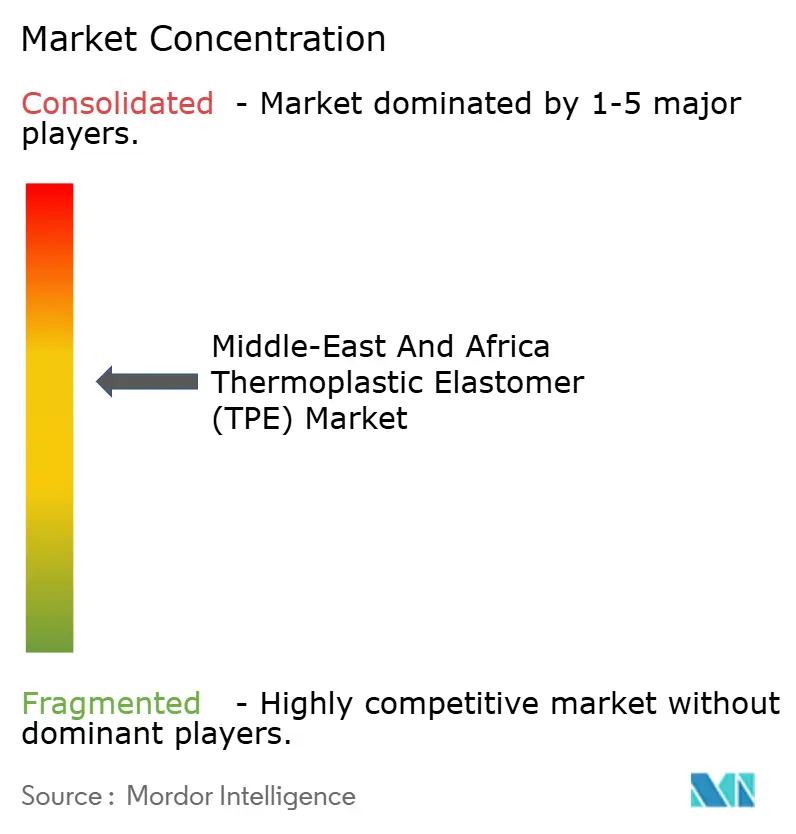
| Market Concentration | Medium |
Major Players *Disclaimer: Major Players sorted in no particular order Image © Mordor Intelligence. Reuse requires attribution under CC BY 4.0. | |
Middle-East And Africa Thermoplastic Elastomer (TPE) Market Analysis by Mordor Intelligence
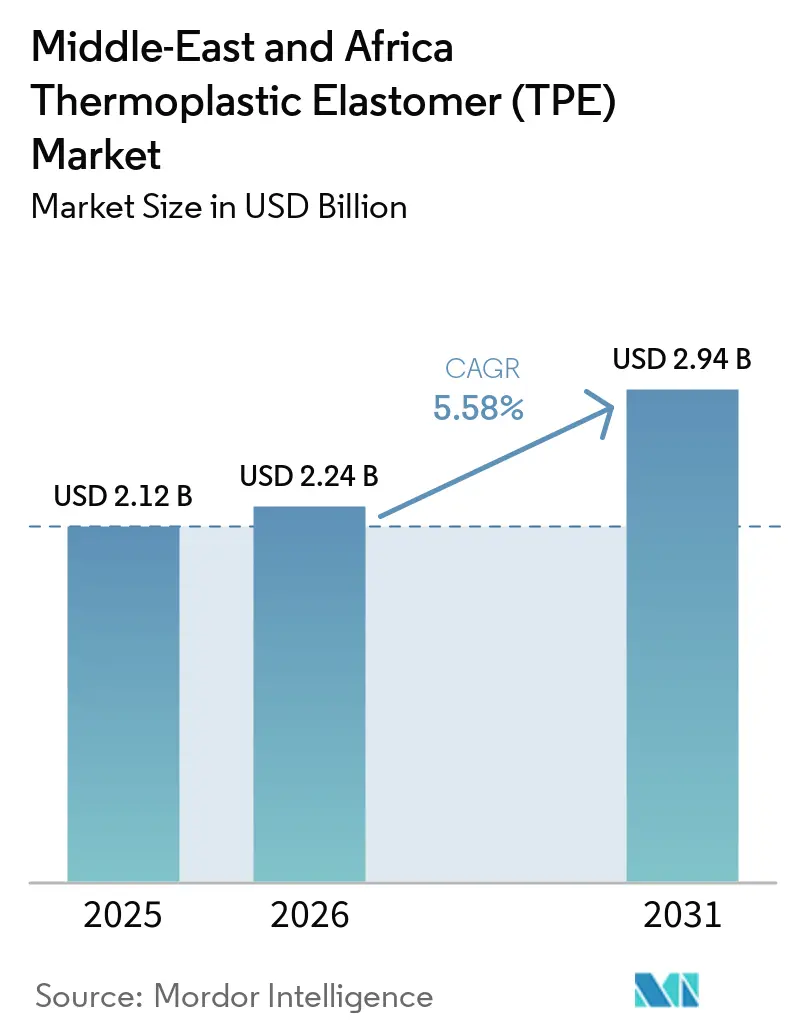
The Middle-East and Africa Thermoplastic Elastomer Market size is expected to grow from USD 2.12 billion in 2025 to USD 2.24 billion in 2026 and is forecast to reach USD 2.94 billion by 2031 at 5.58% CAGR over 2026-2031. The region’s shift from import-dependence to integrated petrochemical manufacturing, led by Saudi Arabia’s liquids-to-chemicals program and the UAE’s AED 294 billion (USD 80 billion) petrochemical pipeline, is reinforcing cost leadership in propylene and ethylene feedstocks. Automotive light-weighting, footwear offshoring to North Africa, and regulatory moves away from PVC in infusion devices are widening the application base for olefinic and polyurethane grades. Vertical integration, exemplified by ADNOC’s 2025 acquisition of Covestro and Borouge’s capacity surge, allows regional suppliers to absorb feedstock swings better than merchant compounders. Rising localization requirements in Morocco and South Africa foster demand for in-region formulation, while additive-manufactured thermoplastic polyurethane (TPU) spare parts emerge as a logistical hedge for offshore oil and gas operators.
Key Report Takeaways
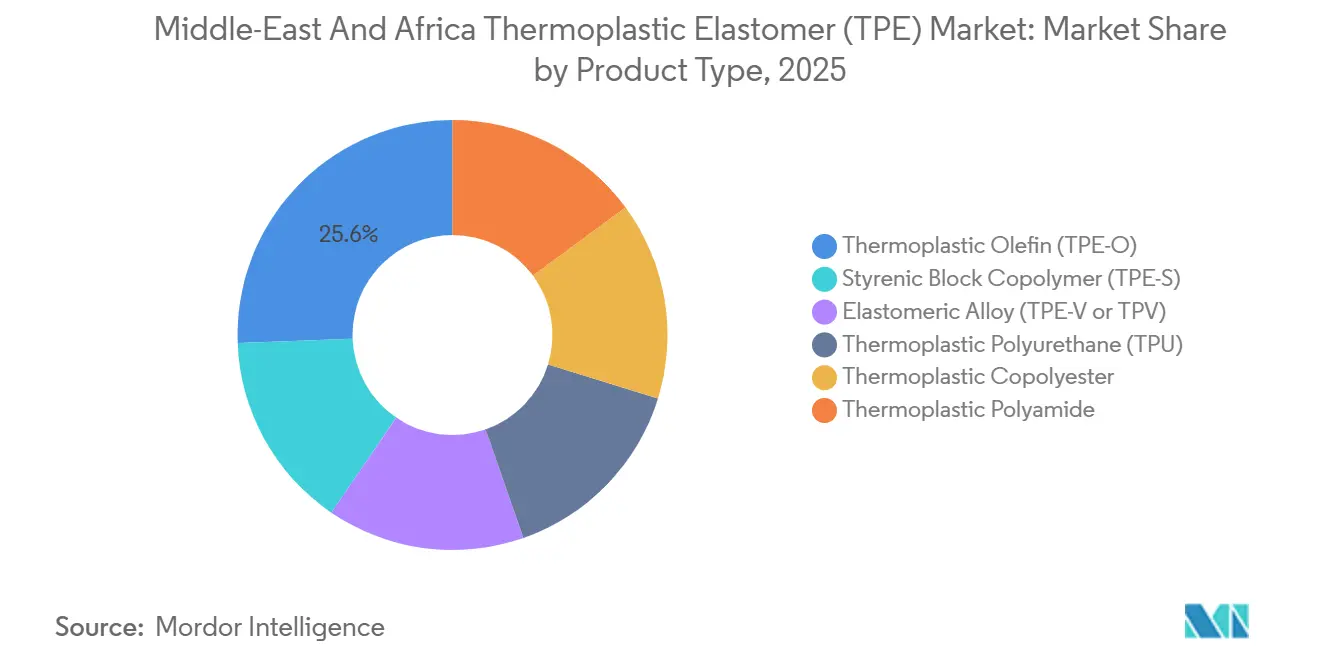
- By product type, thermoplastic olefin (TPE-O) captured 25.59% of the Middle-East and Africa Thermoplastic Elastomer (TPE) market in 2025, and elastomeric alloy (TPE-V or TPV) is expected to register the fastest growth at a CAGR of 5.86% during the forecast period (2026-2031).
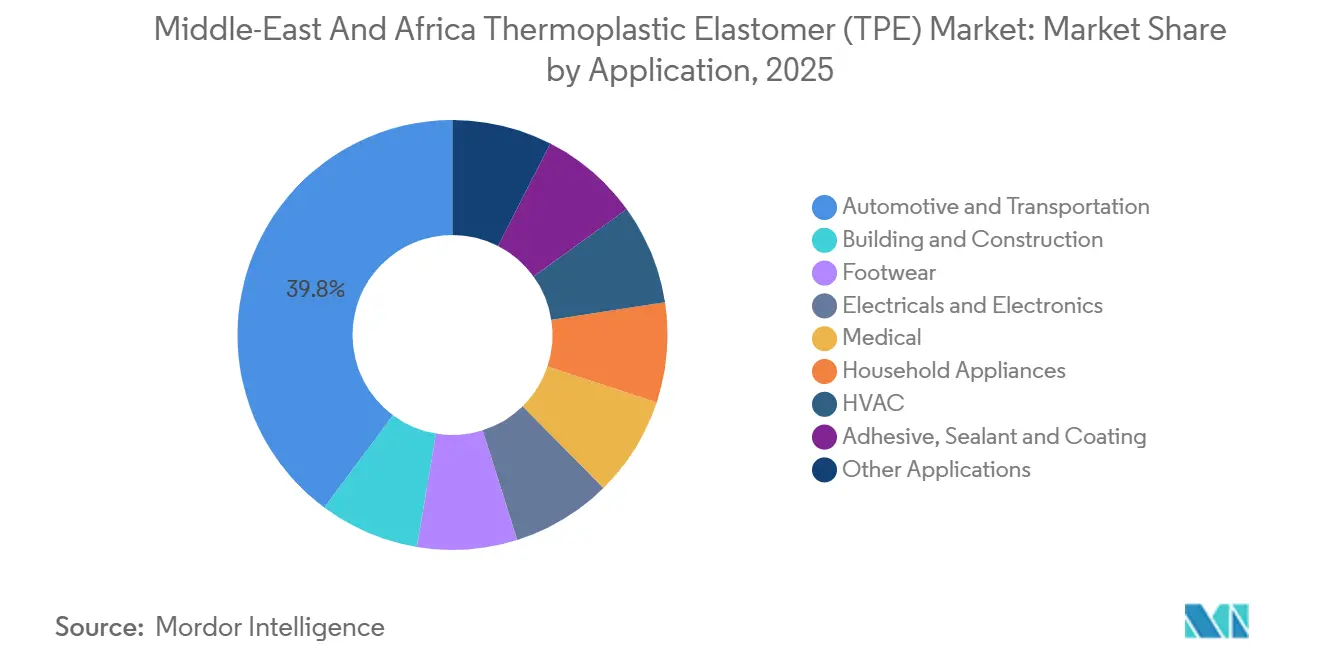
- By application, automotive and transportation had the largest market share of 39.83% in 2025. However, the share of medical is expected to grow with the fastest CAGR of 8.67% during the forecast period (2026-2031).
- By geography, Saudi Arabia held the largest share of 25.87% in 2025, and this share is expected to grow at the fastest CAGR of 6.23% during the forecast period (2026-2031).
Note: Market size and forecast figures in this report are generated using Mordor Intelligence’s proprietary estimation framework, updated with the latest available data and insights as of January 2026.
Market Trends and Insights
Drivers Impact Analysis of Middle-East And Africa Thermoplastic Elastomer (TPE) Market*
| Driver | (~) % Impact on CAGR Forecast | Geographic Relevance | Impact Timeline |
|---|---|---|---|
| Automotive light-weighting demand | +1.2% | Saudi Arabia, South Africa, Morocco | Medium term (2-4 years) |
| Regulatory push replacing PVC in medical devices | +0.8% | Saudi Arabia, UAE, South Africa | Long term (≥4 years) |
| Expanding regional footwear manufacturing bases | +0.6% | Morocco, Ethiopia, Kenya | Short term (≤2 years) |
| GCC integrated crackers enabling bespoke olefinic grades | +1.4% | Saudi Arabia, UAE, Qatar | Medium term (2-4 years) |
| 3-D-printing-grade TPU for oil and gas logistics | +0.3% | Saudi Arabia, UAE | Long term (≥4 years) |
| Source: Mordor Intelligence | |||
Automotive Light-Weighting Demand
Vehicle makers in Morocco and South Africa are replacing EPDM (ethylene propylene diene monomer) thermosets with olefinic TPEs in bumper fascia, glazing encapsulation, and air-intake ducts to curb weight and extend electric vehicle (EV) range[1]Department of Trade, Industry and Competition, “South Africa Automotive Investment Plan,” thedtic.gov.za. Stellantis’s R3 billion (USD 165 million) Coega plant targets 50,000 units yearly with 35% local content, directly stimulating the Middle-East and Africa Thermoplastic Elastomer market demand for interior soft-touch skins, door seals, and NVH (noise, vibration, and harshness) components. Morocco’s output surpassed 1 million vehicles in 2025, intensifying regional pull for polypropylene-based blends. Tax deductions of 150% for new-energy-vehicle facilities in South Africa from March 2026 sharpen the cost case for TPU wire-harness jackets that outperform PVC (polyvinyl chloride) in abrasion and smoke density.
Regulatory Push Replacing PVC in Medical Devices
Gulf regulators are progressively aligning with European REACH (Registration, Evaluation, Authorisation, and Restriction of Chemicals) listings that classify DEHP (Di(2-ethylhexyl) phthalate)-plasticized PVC as a Substance of Very High Concern. A December 2025 audit placed Saudi Arabia’s DEHP-free penetration at roughly 30%, highlighting substantial headroom for medical-grade TPU and SEBS (styrene ethylene butylene styrene) tubing. Once the Saudi FDA (food and drug administration) ties hospital accreditation to DEHP-free sourcing, the Middle-East and Africa thermoplastic elastomer market volume for hydrolysis-resistant TPU could double within three years. Procurement reforms in the UAE and Egypt are likewise critical, as cost-driven purchasing still favors lower-priced PVC even in pediatric oncology units.
Expanding Regional Footwear Manufacturing Bases
Brands detouring from Asian concentration are piloting production in Morocco, Ethiopia, and Kenya, where special economic zones offer tariff relief and proximity to EU buyers. Morocco’s MAD 6.7 billion (USD 1.7 billion) tire complex in Driouch shares feedstock and compounding utilities with SBS and TPU footwear sole producers, trimming cycle times to 30-60 seconds versus 10-15 minutes for vulcanized rubber. The Middle-East and Africa thermoplastic elastomer market stands to gain rapid-turn orders for midsole and heel-counter components as exporters meet European fast-fashion lead times.
GCC Integrated Crackers Enabling Bespoke Olefinic TPE Grades
Borouge’s EU2 cracker upgrade adds 230,000 tpa ethylene by 2028, pairing with PE4 and PE5 expansions to lift capacity beyond 6.6 million tpa (tons per annum). Access to metallocene-LLDPE soft segments lets compounders in Ruwais and Jubail tailor melt-flow and crystallinity, shrinking prototyping lead times from eight weeks (Asia imports) to two weeks. Saudi Aramco’s Jafurah gas project will inject 420 MMscfd of ethane by 2030, further balancing olefin availability. These upstream moves anchor the Middle-East and Africa thermoplastic elastomer market to competitive feedstock costs through 2031.
Restraints Impact Analysis of Middle-East And Africa Thermoplastic Elastomer (TPE) Market*
| Restraint | (~) % Impact on CAGR Forecast | Geographic Relevance | Impact Timeline |
|---|---|---|---|
| Volatile petro-feedstock prices | -0.9% | Saudi Arabia, UAE | Short term (≤2 years) |
| Competition from thermoset rubber at high-temperature service | -0.5% | Saudi Arabia, UAE | Medium term (2-4 years) |
| Skilled-labor gap in local TPU compounding | -0.4% | South Africa, East Africa | Long term (≥4 years) |
| Source: Mordor Intelligence | |||
Volatile Petro-Feedstock Prices
Spot propylene in February 2026 averaged USD 1.00 per kg in the Gulf, but a USD 10 per-barrel Brent jump can lift propylene by USD 0.10 per kg, stripping 400-600 basis-points of margin from converters lacking index-linked contracts. Integrated majors such as SABIC hedge naturally by monetizing upstream cracks, while standalone compounders must rely on filler dilution or long-term offtake deals, both of which curb flexibility.
Competition from Thermoset Rubber at High-Temperature Service
Acrylic rubber, liquid silicone rubber, and ethylene-acrylic elastomers sustain more than 150°C and outperform TPUs in turbocharger hoses and EV battery seals. Momentive’s Silopren LSR 3366/50 posts less than 40% compression set after 1,008 hours at 175°C, double the stability of aromatic TPU grades[2]Momentive Performance Materials, “Silopren LSR 3366/50 Datasheet,” momentive.com. Until regional compounders co-develop high-temperature TPUs, thermosets will defend this niche.
*Our forecasts treat driver/restraint impacts as directional, not additive. The impact forecasts reflect baseline growth, mix effects, and variable interactions.
Middle-East And Africa Thermoplastic Elastomer (TPE) Market Segment Analysis
By Product Type:
Olefinic Leadership with Specialty GrowthThermoplastic Olefin captured 25.59% of the Middle-East and Africa Thermoplastic Elastomer market share in 2025, fueled by bumper fascia, door trims, and footwear soles that balance cost and light weight. The segment benefits from an in-region polypropylene supply that anchors gross margins even when ethylene contracts soften. Elastomeric Alloy is accelerating at a 5.86% CAGR during the forecast period (2026-2031), nearing thermoset EPDM compression-set performance but curing in one-shot injection cycles, which trims takt times for under-hood seals. Specialty streams such as TPU leverage BASF’s 2026 flame-retardant line, while styrenic block copolymers gain scale under DL Chemical’s stewardship.
Continuous innovation is evident in copolyester and polyamide blends that thrive above 120°C, commanding premium pricing but serving limited volumes. Covestro’s capital injection post-acquisition by ADNOC is earmarked for Gulf-based polyether polyol lines, strengthening downstream TPU resilience. The Middle-East and Africa thermoplastic elastomer market continues to skew toward olefinic grades, yet specialty resin uptake will edge higher as medical-device and EV architectures require tighter modulus windows.



By Application:
Automotive Dominates as Medical AcceleratesAutomotive and Transportation contributed 39.83% revenue in 2025, reflecting Morocco’s 1 million-vehicle output and South Africa’s localization drive. Weight savings, NVH damping, and EV battery-pack insulation sustain robust demand through 2031, even as total vehicle assemblies plateau. Medical applications are expected to grow with the fastest CAGR of 8.67% during the forecast period (2026-2031), primed to capitalize on DEHP-free mandates. Footwear’s share expands as Ethiopian and Kenyan clusters plug into EU duty-free corridors, while building-and-construction uptake rides Saudi gigaproject timelines that specify long-life gaskets and vibration isolators.
Second-tier applications, electrical appliances, adhesives, and mining hoses grow steadily on the back of Haier Egypt’s USD 500 million appliance hub and Kraton’s tall-oil resin security pact with International Paper. As styrenic resins price competitively against SEBS imports, construction adhesives and asphalt modifiers will widen their pull on the Middle-East and Africa thermoplastic elastomer market.
Geography Analysis
Saudi Arabia Thermoplastic Elastomer (TPE) Market
Saudi Arabia’s 25.87% share is anchored in over SAR 64 billion (USD 17 billion) in petrochemical projects sanctioned since 2024, from the YASREF 1.8 million-tpa cracker to Jafurah-sourced ethane ramp-ups. The iktva program, aiming for 75% local procurement by 2030, funnels TPE compounding investments into Jubail and Yanbu, shrinking reliance on imports and stabilizing the Middle-East and Africa thermoplastic elastomer market. Moreover, Saudi Arabia's market share is expected to grow with a CAGR of 6.23% during the forecast period (2026-2031).
South Africa and Morocco Thermoplastic Elastomer (TPE) Market
South Africa lags vehicle output after Morocco’s 2025 surge but seeks to rebound via Stellantis’s Coega plant and a 150% NEV tax deduction effective March 2026. Energy-security improvements are pivotal; a stable grid supply could unlock latent demand for door seals, HVAC gaskets, and EV cable sheathing.
MEA Thermoplastic Elastomer (TPE) Market
Morocco’s Driouch tire complex and Egypt’s Haier appliance park together push footwear, appliance, and tire adjunct applications, while the UAE’s USD 60 billion Borouge-Borealis-Nova merger secures polyolefin feedstocks for downstream converters. These diversifying hubs collectively reinforce the Middle-East and Africa thermoplastic elastomer market against single-country shocks.
Competitive Landscape
The Middle-East And Africa Thermoplastic Elastomer (TPE) market is moderately consolidated. R&D priorities revolve around bio-circulated raw materials, enzymatic biodegradation, and chemical recycling. A 2026 Green Chemistry paper recorded 31.1% TPU biodegradation in 90 days using thermostable cutinase versus 3.5% baseline, presenting a prospect for single-use agricultural films in arid zones. Companies that commercialize such technologies will gain early-mover ESG credentials in the Middle-East and Africa thermoplastic elastomer market.
Middle-East And Africa Thermoplastic Elastomer (TPE) Industry Leaders
SABIC
BASF
LG Chem
Exxon Mobil Corporation
Kraton Corporation
- *Disclaimer: Major Players sorted in no particular order
Middle-East And Africa Thermoplastic Elastomer (TPE) Market Companies Covered in this Report
- Arkema
- BASF SE
- Covestro AG
- DSM
- DuPont
- Evonik Industries AG
- Exxon Mobil Corporation
- Huntsman International LLC
- LANXESS
- LCY GROUP
- LG Chem
- Mitsubishi Chemical Corporation
- SABIC
- Sumitomo Chemicals Co. Ltd
- Kraton Corporation
Read Analysis of Middle-East And Africa Thermoplastic Elastomer (TPE) Companies

Recent Industry Developments in Middle-East And Africa Thermoplastic Elastomer (TPE) Market
- February 2026: Alujain Corporation and Beaulieu International Group signed a Memorandum of Understanding and marked the inception of a joint venture in Saudi Arabia. This collaboration melds Alujain's regional manufacturing prowess in polymers with Beaulieu's expertise in synthetic fibres and non-wovens. Such a union is poised to boost the thermoplastic elastomer market.
- July 2025: STOCKMEIER Urethanes Group commenced construction on a state-of-the-art production facility of polyurethane systems (including Thermoplastic Polyurethane (TPU)) in Dubai, UAE. This move bolsters the company's capacity to cater to clients spanning the Middle-East, Africa, and the Asia-Pacific.


Middle-East And Africa Thermoplastic Elastomer (TPE) Market Report Scope
Thermoplastic Elastomers (TPE) blend the rubber-like flexibility of elastomers with the moldable nature of plastics, enabling melting, molding, and recycling. With standout features like high elasticity, durability, and minimal creep, TPEs find applications in automotive, medical, footwear, and consumer goods sectors.
The Middle-East and Africa Thermoplastic Elastomer (TPE) market report is segmented by product type, application, and geography. By product type, the market is segmented into styrenic block copolymer (TPE-S), thermoplastic olefin (TPE-O), elastomeric alloy (TPE-V or TPV), thermoplastic polyurethane (TPE), thermoplastic copolyester, and thermoplastic polyamide. By application, the market is segmented into automotive and transportation, building and construction, footwear, electricals and electronics, medical, household appliances, HVAC, adhesive, sealant and coating, and other applications. By geography, the market is segmented into Saudi Arabia, South Africa, and the Rest of the Middle-East and Africa. The report provides market sizes and forecasts in terms of value (USD).
By Product Type
| Styrenic Block Copolymer (TPE-S) |
| Thermoplastic Olefin (TPE-O) |
| Elastomeric Alloy (TPE-V or TPV) |
| Thermoplastic Polyurethane (TPU) |
| Thermoplastic Copolyester |
| Thermoplastic Polyamide |
By Application
| Automotive and Transportation |
| Building and Construction |
| Footwear |
| Electricals and Electronics |
| Medical |
| Household Appliances |
| HVAC |
| Adhesive, Sealant and Coating |
| Other Applications |
By Geography
| Saudi Arabia |
| South Africa |
| Rest of Middle-East and Africa |
| By Product Type | Styrenic Block Copolymer (TPE-S) |
| Thermoplastic Olefin (TPE-O) | |
| Elastomeric Alloy (TPE-V or TPV) | |
| Thermoplastic Polyurethane (TPU) | |
| Thermoplastic Copolyester | |
| Thermoplastic Polyamide | |
| By Application | Automotive and Transportation |
| Building and Construction | |
| Footwear | |
| Electricals and Electronics | |
| Medical | |
| Household Appliances | |
| HVAC | |
| Adhesive, Sealant and Coating | |
| Other Applications | |
| By Geography | Saudi Arabia |
| South Africa | |
| Rest of Middle-East and Africa |


Key Questions Answered in the Report
What is the expected size of the Middle-East and Africa Thermoplastic Elastomer (TPE) market by 2031?
The Middle-East and Africa Thermoplastic Elastomer (TPE) market is expected to grow from USD 2.24 billion in 2026 to USD 2.94 billion in 2031 at a CAGR of 5.58% during the forecast period (2026-2031).
What recent corporate moves impact supply dynamics?
ADNOC’s acquisition of Covestro and Borouge’s capacity expansion tighten feedstock integration, supporting regional feedstock security.
What share of regional consumption does Saudi Arabia represent?
Saudi Arabia accounted for 25.87% of 2025 market size and is growing at 6.23% annually during the forecast period (2026-2031) on new cracker and compounding investments.
Which product segment is expanding quickest through 2031?
Elastomeric Alloy (TPV) is the fastest-growing, advancing at 5.86% CAGR during the forecast period (2026-2031) due to under-hood sealing advantages.
How significant is medical-device demand for TPEs in the region?
Medical applications hold a small base but lead growth at 8.67% CAGR during the forecast period (2026-2031) as regulators push DEHP-free alternatives.
Page last updated on:


 Your data is secure and never sold or shared.


