
Market Overview
| Study Period | 2020 - 2031 |
|---|---|
| Forecast Data Period | 2026 - 2031 |
| Historical Data Period | 2020 - 2024 |
| Market Size (2026) | USD 1.34 Billion |
| Market Size (2031) | USD 1.67 Billion |
| Growth Rate (2026 - 2031) | 4.48 % |
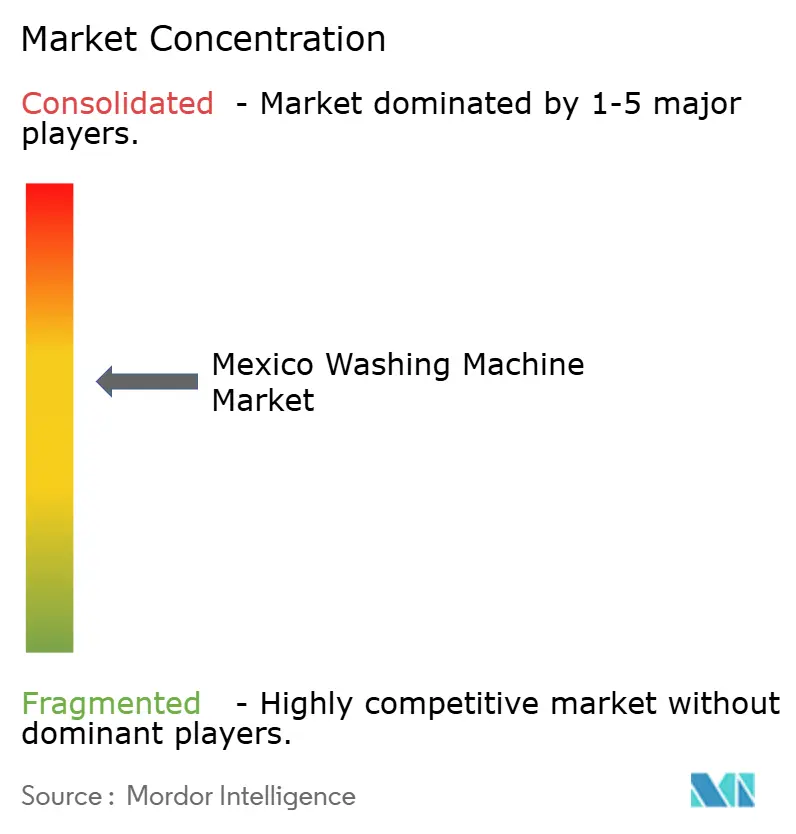
| Market Concentration | Medium |
Major Players *Disclaimer: Major Players sorted in no particular order Image © Mordor Intelligence. Reuse requires attribution under CC BY 4.0. | |
Mexico Washing Machine Market Analysis by Mordor Intelligence
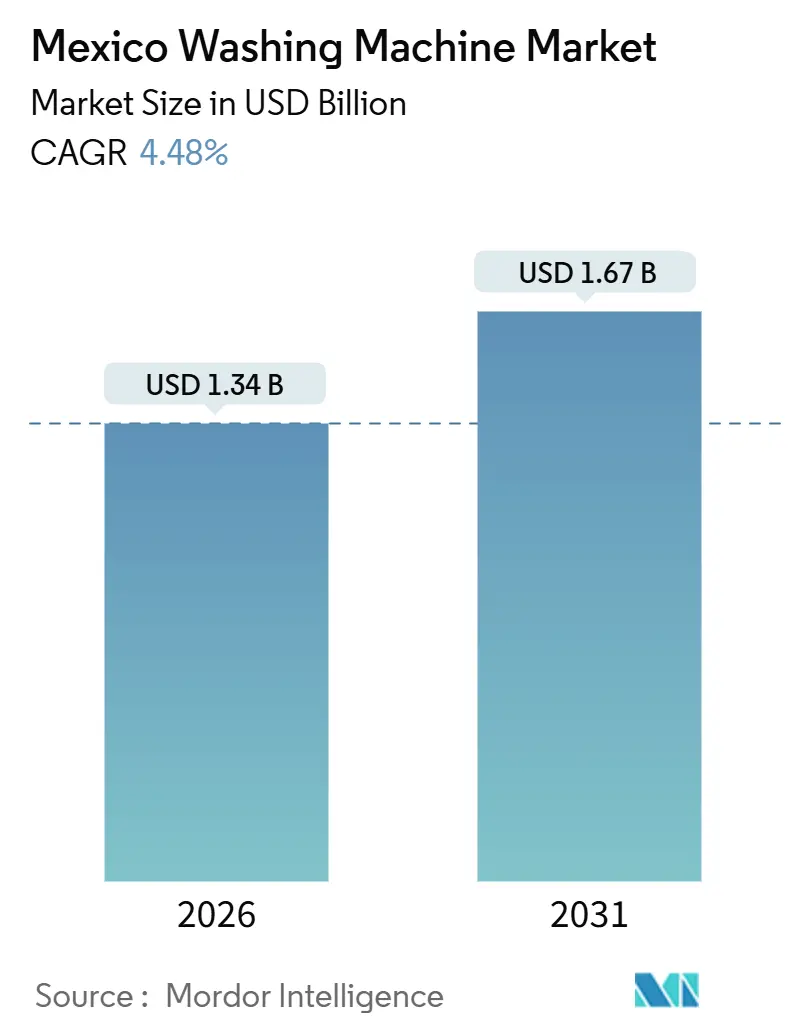
The Mexico washing machine market size is USD 1.34 billion in 2026 and is forecast to reach USD 1.67 billion by 2031, at a 4.48% CAGR. The Mexico washing machine market is being reshaped by localized manufacturing that shortens lead times and helps reduce landed costs, by a steady rise in digital purchasing with installment financing, and by a gradual shift from conventional motors to connected and energy-efficient models where benefits align with household needs. Brands with strong in-country operations improve price competitiveness and service responsiveness, while retailer-integrated credit expands access for households that prefer bi-weekly payment plans that mirror income cycles. The product mix also differentiates by usage patterns, with front-load formats favored for efficiency and fabric care in dense urban zones, while top-loaders expand on convenience, quick cycles, and daily practicality for dual earners. As connectivity matures, smart features gain traction in higher-income municipalities and among early adopters who value remote control and self-diagnostics, which lowers service friction and enables proactive maintenance.
Key Report Takeaways
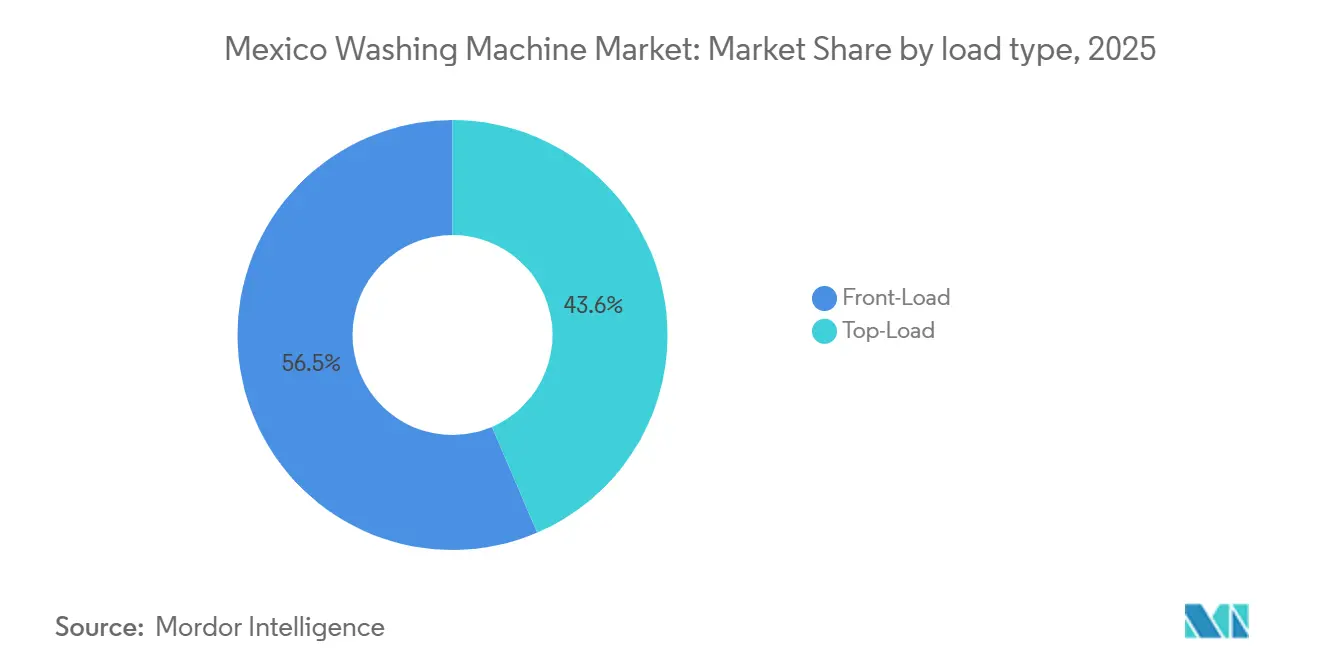
- By load type, front-load machines led with 56.45% revenue share in 2025, while top-load designs recorded the fastest projected CAGR at 5.46% through 2031.
- By capacity, the 6.1–8 kg tier accounted for 47.51% share in 2025 and is forecast to expand at a 5.13% CAGR through 2031.
- By technology, conventional fixed-frequency motor models held 72.31% share in 2025, as smart-connected and IoT-enabled units posted the highest projected CAGR at 4.84% through 2031.
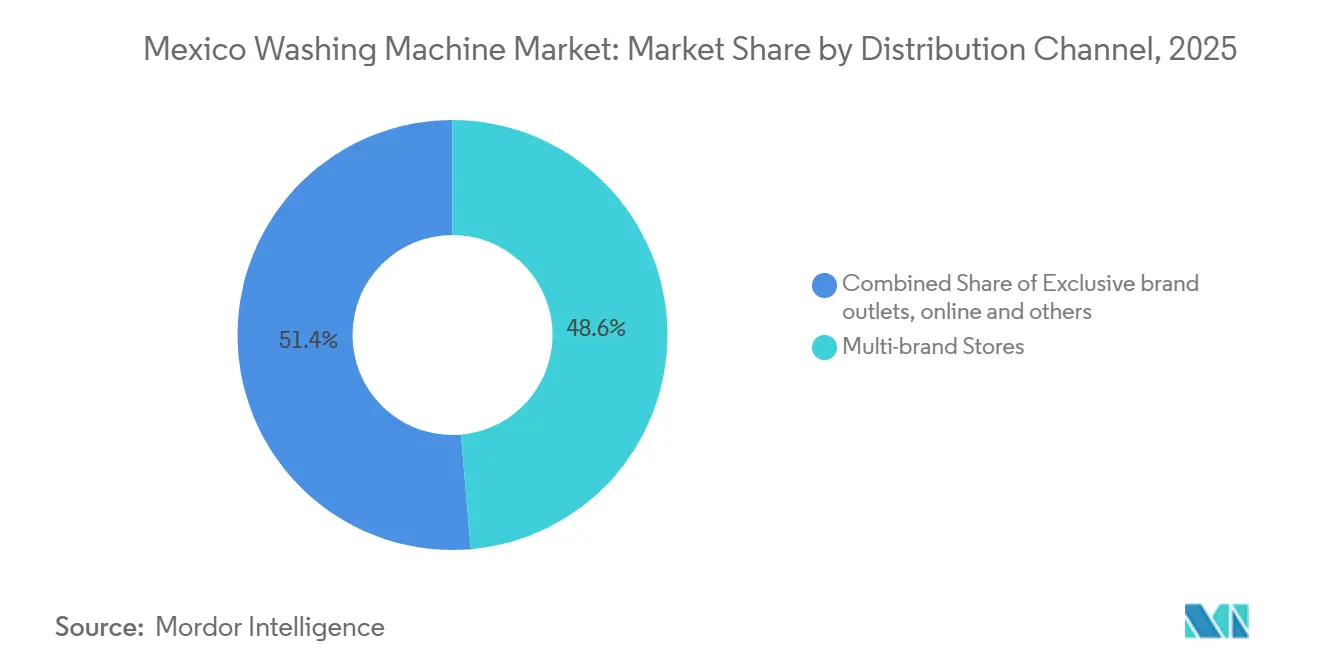
- By distribution channel, multi-brand stores held 48.64% share in 2025, while online channels are projected to grow fastest at a 5.95% CAGR to 2031.
- By end-user, residential households represented 90.24% of demand in 2025, and the commercial segment is projected to grow at a 4.98% CAGR through 2031.
- By geography, the Central region commanded a 34.92% share in 2025, while the North region is projected to expand at a 5.71% CAGR to 2031.
Note: Market size and forecast figures in this report are generated using Mordor Intelligence’s proprietary estimation framework, updated with the latest available data and insights as of January 2026.
Mexico Washing Machine Market Trends and Insights
Drivers Impact Analysis*
| Driver | (~) % Impact on CAGR Forecast | Geographic Relevance | Impact Timeline |
|---|---|---|---|
| Rising disposable incomes & middle-class expansion | +1.2% | National, with pronounced effects in the Central, North, and West regions | Medium term (2-4 years) |
| Urbanization and the growth of smaller households | +0.9% | National, concentrated in metropolitan zones (CDMX, Monterrey, Guadalajara) | Long term (≥ 4 years) |
| Energy-efficiency regulations & labeling (NOM-015-ENER-2018) | +0.7% | National, with higher uptake in urban centers and high-income municipalities | Medium term (2-4 years) |
| E-commerce & "meses sin intereses" financing boom | +1.3% | National, led by the Central and North regions, with the highest internet penetration | Short term (≤ 2 years) |
| Near-shoring of appliance manufacturing lowers prices | +0.8% | National, with supply-chain concentration in North and Bajío | Medium term (2-4 years) |
| Retailers' trade-in programmes are accelerating the replacement cycle | +0.5% | National, strongest in regions with dense multi-brand store networks | Short term (≤ 2 years) |
| Source: Mordor Intelligence | |||
Rising Disposable Incomes & Middle-Class Expansion
Mexico's January 2025 minimum-wage increase to MXN 278.80 (MXN 419.88 in border zones) marks the twelfth consecutive year of real-wage growth, yet the strategic insight lies in geographic bifurcation: northern states now enjoy a wage premium over the national floor, creating parallel appliance markets where Monterrey households can access inverter front-loaders at effective monthly costs below what central-region buyers pay for conventional top-loaders[1]. The regional lens matters because northern industrial hubs often show higher formal employment and steadier wage dynamics, which align with stronger adoption of inverter and front-load formats at the point of replacement. Retail-integrated credit helps translate wage growth and remittance flows into completed orders by smoothing payments through bi-weekly schedules that match household cash flow. Together, these conditions move latent demand into realized purchases, while product education at retail and online helps buyers understand the operating cost benefits of newer platforms that support fabric care, water savings, and lower energy bills over the life of the unit.
Urbanization and Growth of Smaller Households
Urban living patterns and smaller household sizes are reshaping format and capacity choices in the Mexico washing machine market. As apartment footprints compress laundry spaces, demand tilts toward slim-profile washers and well-balanced mid-capacity units that handle bedding and towels without occupying large footprints, reflecting a practical balance between space and load flexibility that fits urban lifestyles. Front-loaders remain the preferred choice where resource efficiency and fabric care rank highly, yet top-loaders are gaining as families weigh cycle speed and ease of use for daily routines.
Energy-Efficiency Regulations & Labeling (NOM-015-ENER-2018)
Energy-performance labeling shapes purchase decisions by making consumption visible and comparable on the sales floor, which nudges demand toward efficient configurations that reduce long-term operating costs. Compliance steers manufacturers to invest in motor control, drum dynamics, and wash algorithms that maintain performance while managing electricity and water use, which resonates in urban municipalities facing resource constraints. Smart and inverter lines showcase features that reduce energy loads and improve control precision, while brands use connected ecosystems to add usage insights that help consumers optimize wash times and settings. As efficiency expectations rise, retailers and brand stores allocate more space to models that meet or exceed label thresholds, helping the Mexico washing machine market migrate to better performance profiles. Mabe's Aqua Saver Green technology, certified to save 76% water and 55% energy, topped PROFECO's 2026 quality rankings, demonstrating that regulatory alignment translates into reputational capital[2]. Where service networks are robust, connected diagnostics support timely maintenance and reduce downtime, which enhances the perceived value of efficient platforms and shortens the upgrade cycle for households that prioritize total cost of ownership.
E-commerce & "Meses Sin Intereses" Financing Boom
Digital channels expand reach and streamline the path to purchase, with zero-interest installment programs converting upfront sticker prices into predictable monthly or bi-weekly payments. Retailers embed financing options at checkout that align with household cash flow patterns, which reduces friction and elevates conversion for appliances that require higher ticket commitments[3]. Product discovery and comparison improve on mobile storefronts that present capacity, cycle coverage, noise levels, and energy labels in a clear format with transparent delivery and installation options, which builds confidence for large-item orders. Marketplace platforms and brand pages reinforce category education with buying guides and brand story content that simplifies choices within the Mexico washing machine market, while social proof mechanisms increase trust at the SKU level. The rise of digital logistics and scheduled installations makes delivery predictable and supports a wider geographic footprint, which complements physical retail presence, enhances assortment availability, and sustains a hybrid path to purchase.
Restraints Impact Analysis*
| Restraint | (~) % Impact on CAGR Forecast | Geographic Relevance | Impact Timeline |
|---|---|---|---|
| High upfront cost of fully-automatic & smart models | -0.8% | National, most acute in South-Southeast and rural municipalities | Medium term (2-4 years) |
| Peso inflation & economic volatility | -0.6% | National, with amplified effects in import-dependent border states | Short term (≤ 2 years) |
| Intensifying competition from low-cost Asian imports | -0.3% | National, concentrated in price-sensitive segments and online channels | Medium term (2-4 years) |
| Rising household water-tariff concerns | -0.2% | Regional, focused on North and Gulf municipalities | Long term (≥ 4 years) |
| Source: Mordor Intelligence | |||
High Upfront Cost of Fully Automatic & Smart Models
Smart-connected platforms and fully automatic models command higher price bands that extend payback horizons, which narrows the buyer pool in municipalities with tighter discretionary budgets. Financing mitigates the upfront gap, yet tenure and perceived feature value still govern purchase timing because households weigh expected usage against total monthly outlay. Some consumers remain cautious about app-based features that require stable connectivity, which means offline functionality and service coverage influence willingness to pay for premium models. Brands that clarify the durability, warranty terms, and service benefits of their connected platforms reduce uncertainty and improve uptake, especially when diagnostics ease maintenance and minimize disruptions. Where internet access is uneven, manufacturers that ensure core cycles and essential controls operate without connectivity lower adoption barriers and protect satisfaction. These conditions keep part of the demand anchored to conventional tiers in the Mexico washing machine market, even as connected adoption advances in urban and higher-income zones.
Peso Inflation & Economic Volatility
Periods of price volatility and above-target inflation pressure household budgets and can delay large-ticket purchases, which shifts volumes into promotion windows where discounts and bundled financing offset concerns. Currency swings also change cost structures for imported components, which influences pricing strategies and compels manufacturers to diversify sourcing or to emphasize localized content. Retailers adjust financing terms and eligibility criteria to manage risk when input costs move during installment periods, which can shorten tenors or require higher down payments for select models. In this environment, brands with peso-denominated cost bases and established in-country manufacturing gain tactical pricing flexibility that helps sustain throughput. Manufacturers and retailers rely more on targeted promotions and clear value messaging to reassure buyers who are sensitive to price changes in the Mexico washing machine market. As macro conditions stabilize, deferred demand can return, but the pace depends on income confidence and credit access in local micro-markets[4].
*Our forecasts treat driver/restraint impacts as directional, not additive. The impact forecasts reflect baseline growth, mix effects, and variable interactions.
Segment Analysis
By Load Type: Front-Loaders Face Top-Load Pragmatism
Front-load models held 56.45% of sales in 2025 due to their energy and water efficiency, fabric care performance, and alignment with labeling expectations in large metropolitan zones. This positioning supports higher attachment to households that prioritize resource management and garment protection, which is reinforced by clear label displays and brand-led education at retail. Practical considerations continue to shape the Mexico washing machine market, with noise, vibration control, and installation constraints steering many apartment buyers to tightly specified front-load footprints. Service coverage and technician familiarity also reinforce confidence in these platforms because urban networks support timely repairs and routine maintenance. Over the forecast window, front-loaders remain a mainstay of the installed base even as households evaluate faster cycles and convenience features in competitive formats.
Top-load machines are expected to grow faster, at a 5.46% CAGR through 2031, as time savings and ease of use appeal to dual-income families that manage frequent, smaller loads throughout the week. Their simple user paths and quick wash selections fit morning and evening routines and support on-demand laundering without complex programming. These strengths improve category access in the Mexico washing machine market, especially where buyers prefer intuitive controls and familiar ergonomics. As brands add inverter options and refine wash action to protect fabrics, the perceived efficiency gap narrows, which broadens top-load appeal beyond budget-conscious households. The balance between efficiency and speed remains central to buyer decisions, and retailers position assortments to reflect both preferences across store formats and online catalogs.

By Capacity: Mid-Range Dominance, Large Bucking Trend
The 6.1–8 kg tier accounted for 47.51% of 2025 sales, and this mid-range segment is projected to grow at a 5.13% CAGR as floor plans and laundry closets favor well-balanced capacity. Mid-capacity units offer flexibility for bedding, towels, and weekly loads without exceeding space or budget constraints, and they anchor the Mexico washing machine market where demand converges around practical use cases. Product development in this band continues to improve wash algorithms, cycle variety, and noise control while maintaining price points that align with installment financing comfort zones. In dense urban districts, these models fit standard cutouts and can be paired with stacked or adjacent dryers where space allows, further supporting placement. Over the forecast period, mid-capacity leadership reflects the intersection of unit economics, footprint realities, and household laundry patterns in core metro areas.
Large-capacity machines retain resilient pockets of demand among households that prefer fewer, larger wash days, which aligns with the need to process linens and heavier textiles efficiently. As manufacturers refine energy management and drum dynamics in higher-capacity platforms, operating costs remain competitive for users who batch loads by habit or necessity. The Mexico washing machine market continues to present a spectrum of capacity preferences because rural and peri-urban laundry routines differ from apartment-based patterns, which sustains a tiered assortment strategy. Compact formats serve specific niches where space is highly constrained, yet most buyers favor the flexibility of mid-range units that handle a wider variety of textile types. Brands that offer clear capacity guidance at the point of sale improve sizing decisions and reduce returns, which strengthens satisfaction and supports favorable reviews online.
By Technology: Conventional Holds, Smart Finds Foothold
Conventional fixed-frequency motor models held a 72.31% share in 2025, supported by perceived reliability, familiar operation, and broad repair network coverage across population centers. Replacement parts availability and technician experience underpin confidence in these platforms, which is critical for households that prioritize predictability and manageable service costs. This foundation keeps conventional models significant in the Mexico washing machine market, even as inverter and connected tiers expand. In regions where consumers value straightforward controls and steady wash performance over advanced features, conventional platforms remain the default choice in entry and mid-price bands. As inflation and currency shifts influence budgets, these models also preserve accessibility for value-focused segments.
Smart-connected and IoT-enabled lines are projected to grow at a 4.84% CAGR through 2031, propelled by remote control convenience, self-diagnostics, and tighter integration with home ecosystems. Samsung reports significant growth in SmartThings users in Latin America, which signals rising comfort with connected appliances and supports uptake in Mexico’s higher-income municipalities and early adopter clusters. Inverter platforms bridge conventional and smart by improving energy management and motor efficiency without requiring deep ecosystem integration, which positions them well for step-up buyers. As brands expand affordable connected tiers, they reduce feature premiums and bring app-based benefits to a wider audience in the Mexico washing machine market. Clear messaging on warranty coverage, offline usability, and service support helps buyers evaluate value and reduces hesitation at the point of upgrade.
By Distribution Channel: Physical Anchors, Digital Surges
Multi-brand stores accounted for 48.64% of 2025 sales, supported by nationwide footprints, broad assortments, and proprietary credit that expedites financing decisions in-store. Embedded credit platforms align with pay cycles and streamline approvals, which is decisive for households that balance multiple expenses over bi-weekly periods. Floor displays allow hands-on evaluation of drum design, controls, and finishes, and staff-led demonstrations reinforce understanding of features before purchase. Service offerings such as delivery and installation complete the value proposition and reduce friction for large appliance fulfillment. These strengths explain the staying power of multi-brand retail in the Mexico washing machine market, even as digital channels scale.
Online channels are projected to grow fastest at a 5.95% CAGR through 2031, driven by mobile-first storefronts, transparent pricing, and fast delivery with scheduled installation. Marketplace platforms and brand sites increasingly mirror or exceed in-store assortment depth, while reviews and Q&A features improve buyer confidence. Direct application of meses sin intereses at checkout reduces drop-off and helps buyers match models to budgets without visiting a store. As logistics networks improve appointment windows and damage control, customer satisfaction rises, and repeat purchases increase in related product categories. The Mexico washing machine market, therefore, relies on an omnichannel play that blends showroom validation with online convenience and financing flexibility.
By End-User: Residential Dominates, Commercial Expands
Residential households represented 90.24% of sales in 2025, reflecting the category’s core status as a household necessity and the steady march of ownership in urban zones. As replacement cycles turn and efficiency preferences evolve, households upgrade from legacy fixed-frequency models to step-up tiers that deliver better energy profiles, fabric care, and quieter operation. Financing availability and seasonal promotions align residential timing with peak events, which concentrates volume in specific retail periods and supports inventory planning. Brand stores emphasize installation quality and extended service coverage to attract households that value after-sales support and total ownership experience. These dynamics anchor residential demand within the Mexico washing machine market and define feature sets most likely to convert at common price points.
The commercial segment is projected to grow at a 4.98% CAGR through 2031, led by laundromats, hospitality, healthcare, and multifamily developments that require durable platforms and faster throughput. Operators evaluate cycle times, machine life, and ease of maintenance to maximize uptime and reduce service costs across fleets. IoT-ready payment systems and remote diagnostics attract newer chains and property managers that want to minimize truck rolls and monitor usage patterns across locations. Expanded service coverage and parts availability accelerate repairs for operators who cannot afford extended downtime, which drives supplier selection and brand loyalty. As business travel and tourism rebound, the Mexico washing machine market benefits from replacement and expansion orders in commercial nodes that require consistent laundry capabilities.
Geography Analysis
The Central region, including Mexico City and Estado de México, held 34.92% of sales in 2025, reflecting concentrated purchasing power and a higher mix of premium and connected models. This region’s dense urban fabric supports the strongest online penetration, robust service networks, and fast fulfillment, all of which align with higher willingness to pay for efficiency and convenience. The Mexico washing machine market in Central municipalities also benefits from brand-store clusters that reinforce product education and installation quality. As digital financing integrates into checkout, households with steady incomes and predictable expenses close purchases faster and show more interest in step-up features. These conditions make Central a bellwether for format and technology shifts that later expand to other large cities.
The North region is projected to grow at a 5.71% CAGR through 2031, supported by nearshoring dynamics and deeper manufacturing ecosystems that increase household formation and durable-goods purchases. As industrial clusters raise the number of formal jobs, appliance demand strengthens across entry and mid tiers, while service density improves in secondary cities. Buyers in the North favor practical features and faster cycles that fit dual-earner routines, which sustains healthy growth for top-loaders and mid-capacity units. Localized manufacturing enhances availability and compresses delivery times for popular SKUs, which reduces stockouts during regional promotion windows. This environment supports steady gains for formats that balance convenience, price, and operating cost in the Mexico washing machine market.
The West, Gulf and Peninsula, and South-Southeast regions show varied adoption patterns that reflect differences in household incomes, urbanization, and property types. The West enjoys tech-oriented demand in its largest metro, which supports a higher share of connected units and brand-store influence on product education and installation. The Gulf and Peninsula mix residential needs with hospitality demand in tourism corridors, where installation quality and service responsiveness rank high in purchase decisions. The South-Southeast presents a more gradual progression in ownership and upgrade cycles, which sustains value tiers while preserving interest in durable platforms that are easy to maintain. Across these regions, brands calibrate assortments, financing visibility, and service coverage to align with local preferences, which supports broader participation in the Mexico washing machine market.
Regulatory Landscape
Mexico regulates household washing machines through mandatory energy-efficiency and safety standards, and through trade measures that affect sourcing economics. Energy performance requirements apply under NOM-005-ENER-2016, while electrical safety conformity assessment is required under NOM-003-SCFI-2014 for electrical products commercialized in Mexico. Together, these obligations shape product design, testing, labeling, and go-to-market timelines.
On the trade side, Mexico tightened its tariff framework for non-FTA imports via a decree amending the Tariff Schedule of the General Import and Export Tax Law (LIGIE) and the Sectoral Promotion Programs (PROSEC). The decree was published April 23, 2026 and became effective April 24, 2026. This increases the importance of specification-level compliance for firms seeking PROSEC benefits, while raising the relative advantage of in-country manufacturing and North America-aligned sourcing for major appliances and components.
Value Chain Analysis
The Mexico washing machine value chain starts with raw materials and resins, then moves through fabricated metals and molded plastics, motors and control boards, and final assembly. Distribution follows through multi-brand retailers and fast-growing online channels that include delivery and installation. Manufacturing and supplier ecosystems concentrate in the northern corridor and Bajio, and logistics advantages are tied to cross-border flows and routes serving the Laredo commercial gateway, reinforcing Mexico's role as both a domestic supply base and an export platform for the Americas.
Industry coordination and compliance support are anchored by associations and conformity infrastructure. ANFAD provides sector representation, while ANCE plays a key role in standardization and certification support for NOM conformity assessment. In 2025, ANFAD signaled a stronger focus on circular-economy initiatives and regulatory participation, including USMCA-related discussions, aligning upstream material choices, product design-for-service, and end-of-life considerations with evolving compliance expectations and retailer-led replacement programs.
Competitive Landscape
The Mexico washing machine market shows moderate concentration, with the top group of brands collectively exceeding a majority but without a dominant single leader, which leaves room for challengers to compete with price and feature parity. Competition hinges on local manufacturing scale, distributor partnerships, and after-sales service coverage that ensures repairs and parts availability beyond the largest cities. As connected features gain awareness, ecosystem compatibility and app simplicity influence brand choice in higher-income municipalities, but conventional tiers remain vital to reach the widest set of buyers. Retail-integrated financing and omnichannel presence continue to differentiate sellers that can match inventory to local demand and deliver installation on predictable timelines. These levers, combined with clear price-value messaging, define share movements in the core segments across regions.
Whirlpool highlights a multi-plant presence in Mexico and has achieved World Class Manufacturing Silver at selected facilities, signaling a focus on operational excellence, quality, and safety across its footprint. Localized sourcing and regional production support on-time replenishment and enable responsive planning for promotion periods that concentrate volumes. Brands with similar in-country capabilities strengthen resilience during logistics pressure and improve landed cost profiles, which enhances competitiveness at mid-price points. On the technology front, connected ecosystems that offer diagnostics and energy optimization help justify step-up tiers for households that value peace of mind and lower operating costs. As these features expand into more price bands, the Mexico washing machine market sees a steady broadening of the connected base.
Samsung reports strong growth in its SmartThings user base across Latin America, which underscores rising comfort with connected appliances and supports adoption in Mexico’s higher-income neighborhoods and early adopter clusters. Retailers reinforce momentum by demonstrating app features at the point of sale and by bundling installation and warranty extensions that reduce adoption risk. Embedded credit continues to be a competitive differentiator because it improves conversion at the SKU level for shoppers who prefer to evaluate models in store and then close purchases with flexible payments. Over the forecast period, the balance of price, feature integration, and service quality remains central, with share gains favoring manufacturers that manage cost structures well and deliver dependable ownership experiences across the Mexico washing machine market.
Mexico Washing Machine Industry Leaders
-
Whirlpool
-
Samsung
-
Mabe
-
LG
-
Winia Daewoo
- *Disclaimer: Major Players sorted in no particular order
Market Opportunities and Future Outlook
Nearshoring-driven manufacturing modernization is creating room for suppliers and service partners that can shorten lead times, localize higher-value components, and strengthen after-sales capabilities for both conventional and connected platforms. Mabe's USD 668 million 2025-2027 investment program to refurbish and expand 15 manufacturing facilities across Mexico underscores ongoing capacity and capability upgrades. It also supports a wider ecosystem for parts, tooling, electronics, and service logistics, which can improve price competitiveness and availability for core 6.1-8 kg and top-load SKUs.
Opportunities linked to technology and compliance center on efficiency-led product refreshes and on operationalizing connectivity for diagnostics and maintenance. Mexico's mandatory appliance efficiency framework under CONUEE-linked NOMs, along with the country's testing and certification infrastructure (authorized laboratories and certification bodies), reinforces demand for validated energy and water performance. As retailer and brand service networks expand connected feature offerings into higher-income municipalities, they can commercialize predictive maintenance and faster repair cycles. Separately, 2026 tariff changes under LIGIE/PROSEC introduce incentives for compliant sourcing strategies and greater localization, favoring players that can document inputs and qualify under the applicable programs while keeping cost targets aligned within value tiers.
Recent Industry Developments
- July 2026: Whirlpool announced plans to close its Supsa manufacturing plant in Apodaca, Nuevo Leon, with operations set to cease by the second quarter of 2027 and production shifting within its Mexico network. The announcement points to ongoing footprint optimization that can affect supplier allocations, inbound logistics patterns, and regional labor pools used for major appliance platforms.
- March 2025: Mabe announced a USD 668 million investment program for 2025-2027 to refurbish and expand 15 manufacturing plants across Mexico. The multi-site program is designed to support higher local content and faster replenishment for domestic retail cycles, strengthening competitive positioning for manufacturers with in-country scale.
- September 2024: Samsung Electronics Mexico reported that its Queretaro plant consolidated its role as an export hub for the Americas, producing over 4 million units annually with about 20% allocated to the domestic market. The scale of this hub reinforces Mexico's importance in regional appliance supply chains and supports broader omnichannel availability through higher throughput.
Research Methodology Framework and Report Scope
Market Definition and Coverage
For this methodology, the market covers the value of washing machines sold in Mexico, counted as manufacturer and importer sales into the country and reported in USD for the stated year.
Scope exclusions: We exclude after sales service-only revenue, spare parts sold separately, and stand-alone installation or extended warranty plans.
Segmentation Overview
- By Load Type
- Front-Load
- Top-Load
- By Capacity (kg)
- Less than 6 kg
- 6.1 - 8 kg
- Greater than 8 kg
- By Technology
- Conventional (Fixed-Frequency Motor)
- Inverter (Variable-Frequency Motor)
- Smart Connected / IoT and High-Efficiency (HE) Certified
- By Distribution Channel
- Multi-brand Stores
- Exclusive Brand Outlets
- Online
- Other Distribution Channels
- By End-User
- Residential Households
- Commercial
- By Region
- North
- Central
- West
- Gulf & Peninsula
- South-Southeast
Data Sources, Market Sizing, and Validation
Desk Research
Desk work started with hard demand and supply signals that can be checked year over year, and then it was aligned to the appliance definitions used in Mexico. We used public statistical and trade sources such as INEGI for household and income context, Banco de Mexico for FX and inflation signals, and Mexico's trade data portals (including HS code level imports and exports) to understand shipment flows.
To avoid sizing the market in a vacuum, we also referenced sources such as UN Comtrade for cross-checking trade direction, the International Energy Agency for efficiency and electrification context, and NOM related public documentation where it affects product standards. Company filings, investor presentations, retailer announcements, and reputable business press were used to sense check pricing moves and channel shifts, and then a paid subscription for company financials and a shipment-level import database were used selectively to validate key supplier and importer footprints. The sources listed here are not exhaustive, and many other public documents were used for data collection, validation, and clarification.
Primary Interviews and Surveys
Primary work focused on validating what really drives yearly value changes in Mexico, which includes unit mix between top load and front load, promotion intensity, and channel margins across offline and online routes. We spoke with a mix of manufacturers, importers, distributors, large format retailers, and repair and service ecosystem participants to pressure test the desk assumptions, and then we rechecked regional dynamics inside Mexico when feedback suggested different adoption and pricing patterns.
Distribution of primary research fieldwork respondents
| Company type | Respondent position |
|---|---|
| Top tier: 36% | CXOs: 13% |
| Mid tier: 45% | Functional/Unit leaders: 36% |
| Smaller Players: 19% | Managers: 51% |
Market-Sizing & Forecasting
Our sizing starts with a top-down build where Mexico demand is reconstructed using a mix of trade flows, domestic shipment signals, and household appliance replacement behavior, and then results are checked with selective bottom-up roll ups. In practice, we compare implied unit volumes and value against a supplier and importer sample, and then we adjust for gaps where coverage is thin, such as smaller online sellers and informal retail pockets.
Key inputs used in the model include washing machine import values and volumes by relevant HS lines, the split of unit sales by technology (fully automated versus semi-automated) and by loading type, replacement cycle indicators tied to household formation and housing turnover, and observed ASP movement driven by feature mix and FX pass-through. Channel dynamics also matter, so offline versus online share shifts and promotion seasonality were treated as variables that move price realization and timing.
For the forecast, scenario analysis was used with a base case anchored to expected macro stability, appliance affordability, and steady adoption of higher value models. The future path of unit demand and ASP was reviewed with primary respondents, and then the model was rerun to keep the CAGR logic consistent with what the channel expects to sell, not only what factories can ship.
Data Validation & Update Cycle
Outputs are reviewed through multiple checks, and differences are explained before the number is accepted. We compare the implied market value against independent signals such as trade totals, category growth commentary from large sellers, and supplier shipment direction, and then any large variance triggers a deeper cut by type and channel to locate the mismatch.
Before sign-off, the work goes through an analyst review where assumptions, FX conversions, and ASP steps are rechecked, and we re-contact experts when the model starts to drift from what they see in orders and promotions. The report is refreshed annually, with interim updates when there is a material event that can shift pricing, imports, or demand, and a final pre-delivery pass is completed so clients receive the most current view.
Mordor Intelligence's Mexico Washing Machine Market Size Versus Other Published Estimates
It is normal to see different market values for the same washing machine market because publishers choose different timing, price logic, and even different boundaries on what counts as a sale inside Mexico. Differences also show up when some studies use shipment value, while others use retail value, or when older FX rates are kept unchanged even though pricing moves quickly.
In this study, the refresh cadence and the FX timing are treated as first-order inputs, and ASP is rebuilt from recent mix and promotion checks before the final number is set, which helps explain why the table spread exists when compared to Mordor Intelligence.
Benchmark comparison
| Source | Market Size | Gaps in Research Methodology |
|---|---|---|
| Mordor Intelligence | USD 1.34 B (2026) | |
| Trade Journal A | USD 1.21 B (2026) | Often closer to factory gate shipment value and may not fully capture importer markups and channel price realization, which can understate value when mix shifts toward higher priced fully automated models. |
| Industry Association B | USD 1.49 B (2026) | May reflect retail sell-out value and includes taxes and broader laundry equipment adjacencies in some member reporting, which can lift totals versus a washing machine only revenue definition. |
The comparison points to two repeatable drivers behind the spread, which are whether the value is measured at shipment or at retail, and how fast price and currency assumptions are updated. By keeping the scope to washing machines only and tying ASP to observed mix and channel behavior, the final estimate stays traceable to clear inputs that can be reviewed and updated each year.
Key Questions Answered in the Report
What is the current size and growth outlook for the Mexico washing machine market?
The Mexico washing machine market size is USD 1.34 billion in 2026 and is projected to reach USD 1.67 billion by 2031 at a 4.48% CAGR.
Which load type is growing fastest in Mexico?
Top-load designs are projected to grow fastest at a 5.46% CAGR through 2031, while front-loaders held 56.45% of the 2025 base.
What capacity band leads sales in Mexico?
The 6.1–8 kg capacity tier led the Mexico washing machine market with 47.51% share in 2025 and is forecast at a 5.13% CAGR through 2031.
How is nearshoring influencing appliance availability in Mexico?
Regionalized sourcing and assembly shorten lead times, improve availability, and support more competitive pricing, reinforced by manufacturing investment momentum into Mexico.
What role do financing options play in Mexico’s appliance purchases?
Meses sin intereses at checkout reduces upfront barriers and aligns payments with household cash flow, improving conversion both online and in-store.
Are connected washers gaining traction in Mexico?
Yes, connected platforms are expanding from higher-income municipalities as ecosystem awareness grows, supported by SmartThings adoption trends in Latin America.