
Mexico Urban Logistics Market Size and Share
Market Overview
| Study Period | 2020 - 2031 |
|---|---|
| Forecast Data Period | 2026 - 2031 |
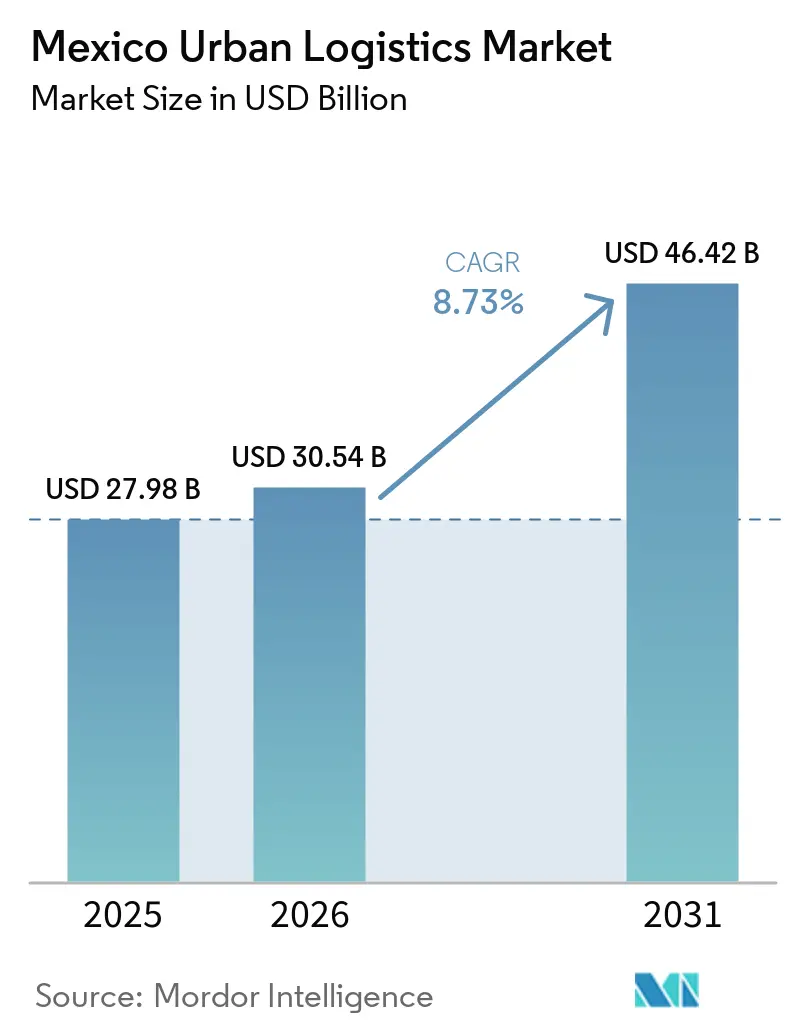
| Base Year Market Size (2025) | USD 27.98 Billion |
| Market Size (2026) | USD 30.54 Billion |
| Market Size (2031) | USD 46.42 Billion |
| Growth Rate (2026 - 2031) | 8.73 % |
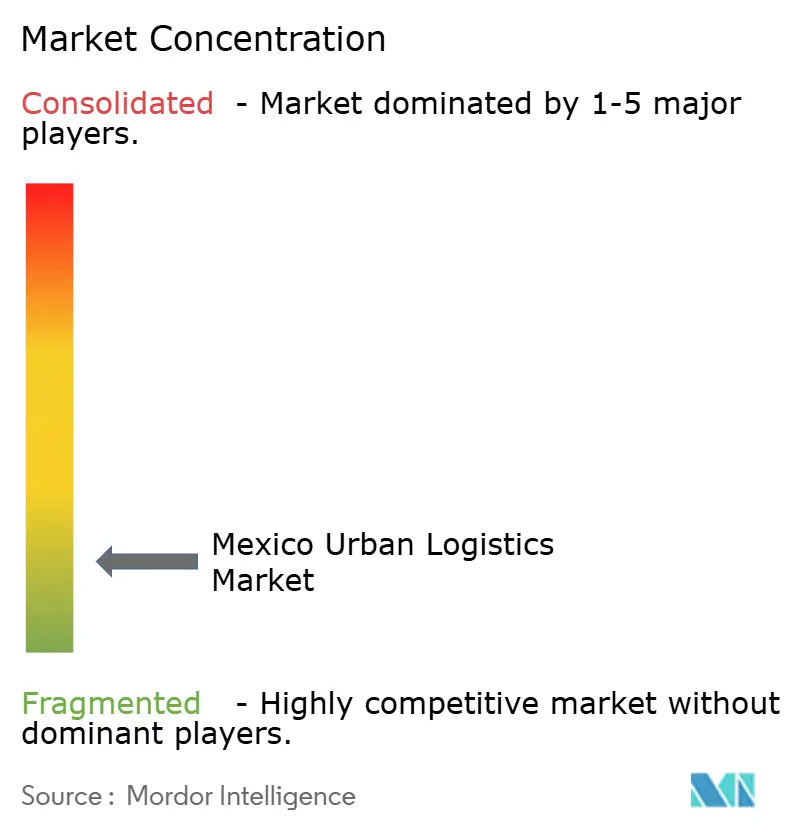
| Market Concentration | Low |
Major Players *Disclaimer: Major Players sorted in no particular order Image © Mordor Intelligence. Reuse requires attribution under CC BY 4.0. | |
Mexico Urban Logistics Market Analysis by Mordor Intelligence
The Mexico urban logistics market size was valued at USD 27.98 billion in 2025 and is estimated to grow from USD 30.54 billion in 2026 to reach USD 46.42 billion by 2031, at a CAGR of 8.73% during the forecast period (2026-2031).
Digital commerce, manufacturing relocation, and rising expectations for reliable delivery are expanding demand across major urban areas. Mexico’s trade relationship with the United States under USMCA supports higher logistics activity, especially around industrial corridors and border-linked cities. Urban density gives fulfillment providers and carriers a larger addressable base, but it also raises operating pressure on routes, facilities, and delivery labor. Competitive advantage increasingly depends on combining transportation, fulfillment, shipment visibility, and returns handling rather than offering a single service. The Mexican urban logistics market, therefore, offers room for established carriers, specialized providers, and technology platforms that can operate effectively across dense metropolitan and secondary-city networks.
Key Report Takeaways
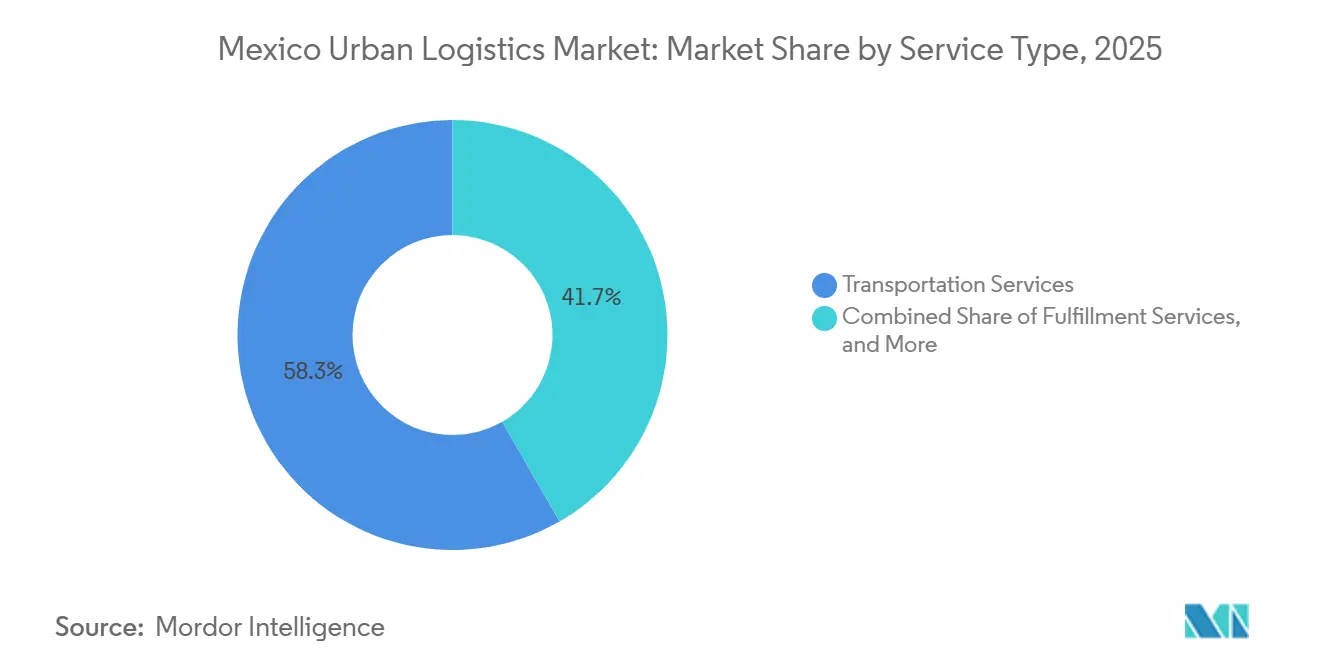
- By service type, transportation services held 58.28% of the Mexico urban logistics market share in 2025, while fulfillment services are forecast to expand at a 10.65% CAGR through 2031.
- By delivery speed, standard delivery held 53.76% of the Mexico urban logistics market size in 2025, while the instant and same-day delivery segment is projected to grow at a 9.82% CAGR through 2031.
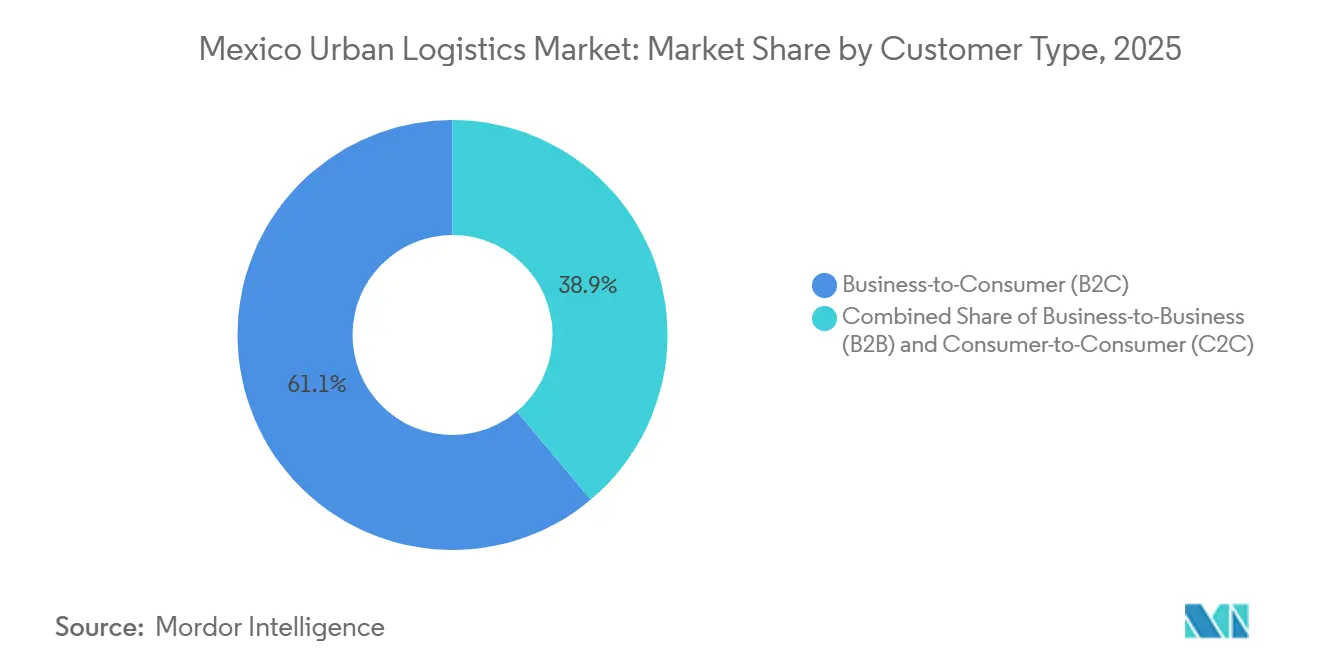
- By customer type, B2C accounted for 61.12% of the Mexico urban logistics market share in 2025, while C2C is forecast to grow at an 11.60% CAGR through 2031.
- By end-use industry, e-commerce and retail held 28.30% of the Mexico urban logistics market size in 2025, while the healthcare and pharmaceuticals segment is projected to expand at an 11.37% CAGR through 2031.
- By city, Mexico City held 19.00% of the revenue in 2025, while Monterrey is forecast to grow at a 10.20% CAGR through 2031.
Note: Market size and forecast figures in this report are generated using Mordor Intelligence’s proprietary estimation framework, updated with the latest available data and insights as of January 2026.
Mexico Urban Logistics Market Trends and Insights
Drivers Impact Analysis*
| Driver | (~) % Impact on CAGR Forecast | Geographic Relevance | Impact Timeline |
|---|---|---|---|
| E-commerce and Omnichannel Order Growth | +2.8% | National, concentrated in Mexico City, Guadalajara, and Monterrey | Short term (≤ 2 years) |
| Nearshoring-Driven B2B Parcel Density | +2% | Nuevo Leon, Coahuila, and Baja California industrial corridors | Medium term (2-4 years) |
| Mobile-First Ordering and Digital Delivery Visibility | +1.3% | National, with early gains in major metropolitan areas | Short term (≤ 2 years) |
| Healthcare and Grocery Cold-Chain Expansion | +1% | National, anchored in Mexico City and Monterrey | Medium term (2-4 years) |
| Micro-Fulfillment and Pickup-Point Density | +0.8% | Mexico City, Guadalajara, Monterrey, and Tijuana | Medium term (2-4 years) |
| FIFA World Cup 2026 Event-Driven Urban Capacity Demand | +0.4% | Mexico City, Guadalajara, and Monterrey | Short term (≤ 2 years) |
| Source: Mordor Intelligence | |||
E-commerce and Omnichannel Order Growth
Mexico’s e-commerce retail sales reached MXN 941 billion (USD 52.3 billion) in 2025, increasing 19.2% from the prior year[1]. This demand created more parcel movements between fulfillment facilities, stores, pickup points, and households. Retailers with physical stores are increasingly using those locations to support order collection and localized fulfillment. That approach has proven to reduce the distance between inventory and the final customer. Carriers that serve store replenishment and consumer deliveries on shared routes are improving vehicle use and route economics.
Nearshoring-Driven B2B Parcel Density
Manufacturing investment increased demand for logistics services in industrial areas of Nuevo Leon, Jalisco, Guanajuato, Baja California, and Coahuila in 2025. This activity added a business-to-business requirement to a sector historically shaped mainly by consumer parcel deliveries. Manufacturers using time-sensitive replenishment systems increasingly require reliable movements between supplier parks, warehouses, and assembly sites. These shipments now place greater value on delivery windows, shipment tracking, and proof of delivery than on the lowest available price. Providers that serve business and consumer shipments are balancing demand across their active networks.
Mobile-First Ordering and Digital Delivery Visibility
Mobile ordering solidified the importance of clear delivery dates, real-time tracking, and simple communication with customers. Consumers now consistently judge the purchase experience through the quality of the delivery process as well as the product itself. Retailers, therefore, expect carriers to provide package-level updates across sorting, dispatch, and final delivery. Carrier comparison tools and shipping platforms continue to help smaller merchants access several delivery providers through one interface.
Healthcare and Grocery Cold-Chain Expansion
Healthcare and pharmaceutical deliveries continue to require careful temperature control and documented handling during transport and temporary storage. These requirements have created a barrier for providers that lack refrigerated fleets, trained staff, and monitoring systems. Demand currently includes pharmaceutical distribution, direct-to-patient deliveries, biologics, vaccines, and oncology treatments. Grocery delivery also requires reliable refrigerated handling, especially where retailers offer scheduled orders and recurring subscriptions. Shared cold-chain networks are improving asset use when they serve compatible healthcare and grocery routes.
Restraints Impact Analysis*
| Restraint | (~) % Impact on CAGR Forecast | Geographic Relevance | Impact Timeline |
|---|---|---|---|
| Congestion, Road Quality and Restricted Curb Access | -1.4% | National, most severe in Mexico City and Guadalajara | Long term (≥ 4 years) |
| Fuel, Labor, Insurance and Vehicle-Cost Volatility | -1% | National | Medium term (2-4 years) |
| Fragmented Addressing and Building-Level Delivery Friction | -0.8% | National, acute in peri-urban and informal zones | Long term (≥ 4 years) |
| Cargo Theft, Driver Safety and Route-Risk Premiums | -0.6% | State of Mexico, Puebla, Jalisco, and Guanajuato | Medium term (2-4 years) |
| Source: Mordor Intelligence | |||
Congestion, Road Quality, and Restricted Curb Access
Mexico City registered 184 hours of peak-hour delay per driver per year according to the TomTom Traffic Index 2025, placing it among the most congested urban environments in the Western Hemisphere and imposing direct costs on every planned delivery route. Road congestion continues to limit the number of deliveries that a vehicle and driver are able to complete during a working day. This has remained particularly important in Mexico City and Guadalajara, where traffic conditions frequently disrupt planned delivery schedules. Restricted curb access and limited unloading space also continue to make it harder for carriers to serve dense commercial zones.
Cargo Theft, Driver Safety and Route-Risk Premiums
Mexican logistics providers continue to face deep-rooted operational hurdles due to cargo theft. Notably, 82% of recorded hijackings in 2025 were characterized by violence directed at drivers and vehicle personnel. Cargo theft and driver safety concerns consistently elevate the risk for high-value shipments in the State of Mexico, Puebla, Jalisco, and Guanajuato. Carriers are now facing higher insurance costs and more difficulty retaining drivers as route risks remain high. Real-time route monitoring, driver verification, and location tracking are increasingly helping providers manage these operating pressures.
*Our forecasts treat driver/restraint impacts as directional, not additive. The impact forecasts reflect baseline growth, mix effects, and variable interactions.
Segment Analysis
By Service Type: Transportation Services Lead While Fulfillment Platforms Expand
Transportation services held 58.28% of the Mexico urban logistics market size in 2025. Road-based delivery remains essential for moving goods through large urban corridors and connecting fulfillment facilities to customers. Established carriers benefit from fleet scale, broad coverage, and lower unit costs on high-volume routes. These strengths make transportation services a core choice for major retailers and industrial shippers with regular replenishment needs. The Mexico urban logistics industry also depends on transportation capacity to connect pickup points, stores, distribution sites, and final delivery locations. Service reliability remains important because delays can affect customer satisfaction and inventory availability.
Fulfillment services are forecast to grow at a 10.65% CAGR through 2031. E-commerce operators are moving away from fully self-managed warehouse operations where outside providers can offer flexible inventory placement, order processing, and returns handling. The Mercado Libre and Vesta investment in the XEM3 cross-dock facility in Cuautitlan Izcalli demonstrates the scale of capital required for modern fulfillment infrastructure[2]. Smaller storage nodes can support faster replenishment inside metropolitan areas. Reverse logistics is also becoming more important as e-commerce volume produces more consumer returns. Value-added services, including customized packaging, kitting, and quality checks, can help nearshoring manufacturers support selected assembly needs without dedicated in-plant investment.

By Delivery Speed: Standard Delivery Holds Volume While Faster Services Build Demand
Standard delivery accounted for 53.76% of the Mexico urban logistics market share in 2025. Cost-sensitive consumers and small and medium-sized merchants continue to prioritize accessible delivery prices, especially outside the largest metropolitan areas. This pattern shows that digital commerce adoption is broad, but expectations for very fast delivery are not uniform across cities. Standard services are important in secondary cities and semi-urban areas where delivery infrastructure is still developing. Maintaining route coverage and predictable service without making costs uncompetitive remains essential for providers. This gives standard delivery a lasting role in the Mexico urban logistics market.
Instant and same-day delivery is forecast to grow at a 9.82% CAGR through 2031. Urban density in Mexico City, Guadalajara, and Monterrey can support faster fulfillment across more product categories than food and quick-commerce. Next-day delivery continues to serve many B2C orders where certainty matters more than immediate delivery. Scheduled delivery has relevance in grocery and healthcare, where customers may prefer defined arrival windows for perishable or high-value orders. Flexible last-mile networks can route a package through same-day, next-day, scheduled, or standard services according to customer preference. Retailers may favor carriers that can manage these choices through a single checkout and fulfillment process.
By Customer Type: B2C Remains Largest While C2C Adds New Parcel Patterns
B2C transactions represented 61.12% of the Mexico urban logistics market share in 2025. Domestic and international marketplaces have shaped consumer expectations around delivery speed, tracking, payments, and returns. Their integrated delivery systems can make it harder for consumers and merchants to switch between platforms. B2C volume supports regular movement through carrier networks and creates demand for dependable last-mile capacity. Smaller merchants also rely on carrier services that can provide broad coverage without complex procurement arrangements. The Mexico urban logistics market remains closely linked to the continued development of online retail and marketplace fulfillment.
C2C is projected to grow at an 11.60% CAGR through 2031. Peer-to-peer resale of electronics, fashion, and consumer goods creates parcel flows from many separate origins instead of a concentrated seller location. This can produce irregular volumes and require simpler ways for individuals to print labels, drop off shipments, or request pickups. Returns services may also become more important as resale platforms gain wider use. B2B logistics is smaller by share but can carry greater value per shipment because industrial, healthcare, and automotive customers need time-specific delivery and documentation. Nearshoring can increase B2B movements in northern and central industrial corridors, helping providers diversify their customer mix.
By End-Use Industry: E-Commerce and Retail Lead While Healthcare Grows Fastest
E-commerce and retail held 28.30% of the Mexico urban logistics market size in 2025. This end-use group drives demand for transportation and fulfillment across each delivery-speed category. Its delivery standards, including rapid service, package tracking, and simple returns, influence expectations in other customer sectors. Retail demand supports carrier investment in more frequent routes, local inventory locations, and customer communication tools. The Mexico urban logistics industry has adapted many of its operating practices to meet the needs of online sellers and omnichannel retailers. These requirements continue to shape how providers design networks in major cities and emerging delivery areas.
The healthcare and pharmaceuticals segment is forecast to grow at an 11.37% CAGR through 2031. Direct-to-patient distribution, biopharmaceutical deliveries, and Mexico’s role in North American pharmaceutical manufacturing support demand for specialized services. Food and beverage logistics need dense refrigerated capacity and short fulfillment windows for grocery services. Consumer electronics require secure and traceable transportation because of their high unit value. Fashion and apparel logistics require effective management of returns and seasonal order peaks, while automotive parts deliveries demand precision for service centers and dealerships. Industrial and manufacturing shipments will become more relevant in urban areas as nearshoring increases component movements between supplier parks and assembly facilities.
Geography Analysis
Mexico City, with a market share of 19.00%, remains the country’s principal urban logistics center because it combines corporate purchasing, healthcare distribution, digital commerce, and activity connected with the State of Mexico. Guadalajara serves the Jalisco consumer base, the Bajio industrial zone, and Pacific coast resupply routes. These cities offer dense delivery demand, which supports investment in fulfillment facilities, pickup networks, and transportation capacity. Mexico’s transport, mail, and storage sector received USD 2.7 billion in foreign direct investment during the first half of 2026[3]. This investment supports the operating environment for the Mexico urban logistics market in high-volume metropolitan corridors.
Monterrey is forecast to grow at a 10.20% CAGR through 2031. Monterrey’s logistics ecosystem is expanding as manufacturers seek proximity to the United States border, industrial labor, and established cross-border infrastructure. Nearshoring is creating more frequent B2B parcel movements between suppliers, warehouses, and assembly operations. Demand for industrial space is increasing interest in compact and multi-level facilities inside the urban perimeter. Providers that secured well-located facilities earlier may have a cost advantage over later entrants. Mexico urban logistics market size growth in Monterrey is supported by both consumer demand and industrial parcel activity. The city remains important for providers seeking to connect urban fulfillment with USMCA-linked supply chains.
Tijuana and Ciudad Juarez benefit from cross-border freight linked to trade with the United States and manufacturing activity in Baja California and Chihuahua. Puebla and Leon are also gaining B2B demand from automotive and consumer goods supply chains. In 2026, more than 55% of Mexican consumers shop online on a regular basis. This broader digital participation supports investment in standard and scheduled delivery networks beyond the largest cities. Providers that build affordable coverage in the Rest of Cities category can address demand that was previously underserved. These locations give the Mexico urban logistics market a wider geographic base for future network expansion.
Competitive Landscape
The Mexico urban logistics market is highly fragmented. Global integrators have air networks, customs capabilities, and established relationships with multinational shippers. Domestic operators are investing in route optimization, real-time tracking, and cross-docking to close the service gap. Competition is also shaped by the need to provide more services around each shipment. Carriers are expanding beyond basic transportation to include fulfillment, customs support, warehousing, and shipment management. This approach can increase customer retention and create longer commercial relationships.
99minutos launched Freight99 in August 2025, expanding from last-mile delivery into middle-mile and full truckload transport. Traxion acquired Solistica in July 2025 for USD 80 million, strengthening its logistics presence in Mexico. DSV is integrating major acquisitions across the Americas to expand its network presence in Mexico. These moves show that scale, service breadth, and network control are becoming more important competitive factors. The Mexico urban logistics industry also includes platform providers that help small and medium-sized merchants compare rates, automate shipments, and track packages across carriers.
Cold-chain last-mile delivery, C2C returns infrastructure, and secondary-city coverage remain areas where specialized networks can compete. Global carriers are responding through electric-vehicle fleets in major cities, standardized service agreements for nearshoring manufacturers, and integrated customs and bonded warehousing services. Mexico’s National Infrastructure Plan 2025 included MXN 811 billion (USD 45.1 billion), for more than 3,000 km of rail and highway connections[4]. Better connections could improve delivery economics in secondary corridors over the medium term. Providers with capital to expand before those improvements are complete may strengthen their network positions. The Mexico urban logistics market is therefore competitive, but it still provides openings for companies that solve specific service gaps.
Mexico Urban Logistics Industry Leaders
-
DHL Group
-
Estafeta
-
FedEx Corporation
-
United Parcel Service, Inc.
-
Operadora de Servicios Paquetexpress, S.A. de C.V.
- *Disclaimer: Major Players sorted in no particular order
Recent Industry Developments
- July 2026: DSV disclosed plans to deploy 10 Windrose Technology electric Class 8 trucks on the I-35 corridor connecting Dallas, San Antonio, and Laredo. A second phase targets Monterrey in 2027 and includes 6 dedicated Green Hubs between Monterrey and Dallas.
- December 2025: DHL Express Mexico invested more than EUR 70 million (USD 82.3 million) to add 1,000 vehicles to its ground fleet. The company expanded capacity by 20% and opened 100 service points, increasing its network from 730 to 830 locations.
- December 2025: J&T Express added 21 Foton GTL-2490 heavy-duty trucks to its Mexico fleet to support rising parcel volume from cross-border e-commerce platforms.
- August 2025: 99minutos officially launched Freight99 on August 26, expanding from last-mile delivery into middle-mile and full truckload transport. The platform deployed more than 400 owned units, 40 carrier partners, and operator validation linked to more than 60 GPS systems.
Mexico Urban Logistics Market Report Scope
| Transportation Services |
| Warehousing and Urban Storage Services |
| Fulfillment Services |
| Reverse Logistics Services |
| Value-Added Logistics (VAL) Services |
| Instant and Same-Day Delivery |
| Next-Day Delivery |
| Scheduled Delivery |
| Standard Delivery |
| Business-to-Business (B2B) |
| Business-to-Consumer (B2C) |
| Consumer-to-Consumer (C2C) |
| E-commerce and Retail |
| Food and Beverage |
| Healthcare and Pharmaceuticals |
| Consumer Electronics |
| Fashion and Apparel |
| Automotive Parts |
| Industrial and Manufacturing |
| Others |
| Mexico City |
| Tijuana |
| Ecatepec de Morelos |
| Leon |
| Puebla |
| Ciudad Juarez |
| Guadalajara |
| Monterrey |
| Nezahualcoyotl |
| Rest of Cities |
| By Service Type | Transportation Services |
| Warehousing and Urban Storage Services | |
| Fulfillment Services | |
| Reverse Logistics Services | |
| Value-Added Logistics (VAL) Services | |
| By Delivery Speed | Instant and Same-Day Delivery |
| Next-Day Delivery | |
| Scheduled Delivery | |
| Standard Delivery | |
| By Customer Type | Business-to-Business (B2B) |
| Business-to-Consumer (B2C) | |
| Consumer-to-Consumer (C2C) | |
| By End-Use Industry | E-commerce and Retail |
| Food and Beverage | |
| Healthcare and Pharmaceuticals | |
| Consumer Electronics | |
| Fashion and Apparel | |
| Automotive Parts | |
| Industrial and Manufacturing | |
| Others | |
| By City | Mexico City |
| Tijuana | |
| Ecatepec de Morelos | |
| Leon | |
| Puebla | |
| Ciudad Juarez | |
| Guadalajara | |
| Monterrey | |
| Nezahualcoyotl | |
| Rest of Cities |
Key Questions Answered in the Report
What is the Mexico urban logistics market size in 2026?
The Mexico urban logistics market size is USD 30.54 billion in 2026 and is forecast to reach USD 46.42 billion by 2031 at an 8.73% CAGR.
What is driving urban logistics demand in Mexico?
Digital commerce, omnichannel retail, nearshoring, and customer expectations for reliable delivery are supporting demand.
Which service type holds the largest share in Mexico urban logistics?
Transportation services led with 58.28% share in 2025, reflecting the importance of road-based delivery networks.
Which delivery speed is growing the fastest in Mexico?
Instant and same-day delivery is projected to grow at a 9.82% CAGR through 2031.
Which customer group has the largest share in urban delivery services?
B2C held 61.12% share in 2025, supported by marketplace and online retail delivery volumes.
Which end-use segment is expanding fastest?
Healthcare and pharmaceuticals is forecast to grow at an 11.37% CAGR through 2031, supported by specialized delivery and temperature-control needs.