
Market Overview
| Study Period | 2020 - 2031 |
|---|---|
| Forecast Data Period | 2026 - 2031 |
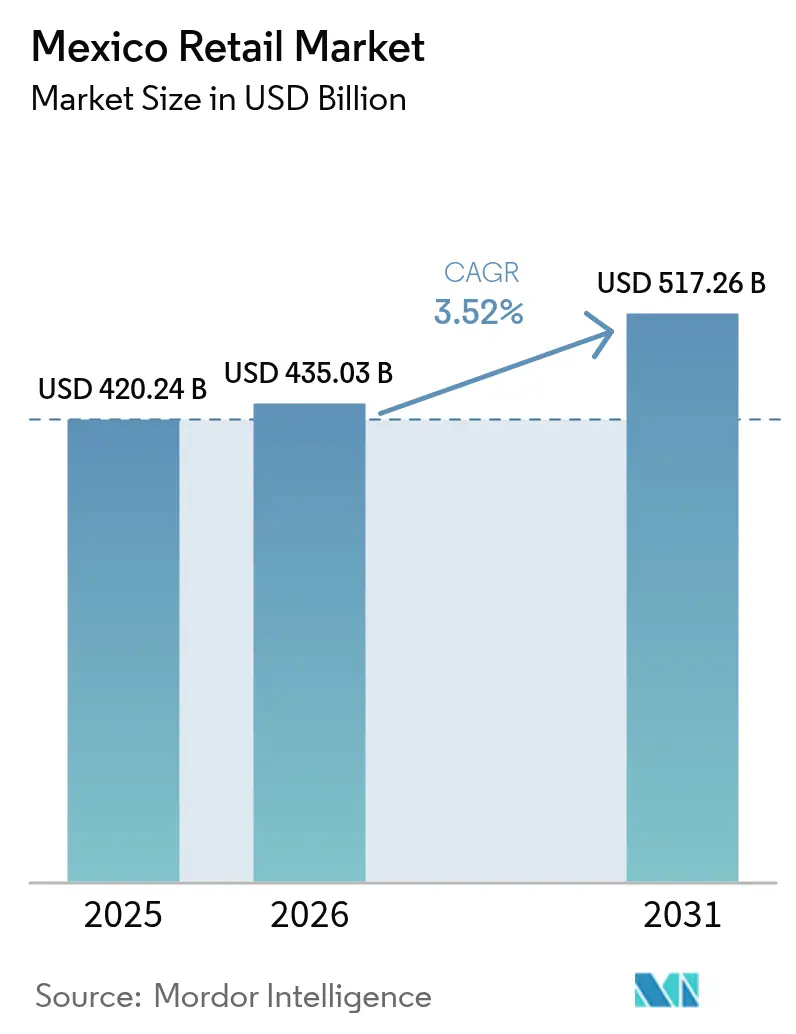
| Base Year Market Size (2025) | USD 420.24 Billion |
| Market Size (2026) | USD 435.03 Billion |
| Market Size (2031) | USD 517.26 Billion |
| Growth Rate (2026 - 2031) | 3.52 % |
| Market Concentration | Low |
Major Players *Disclaimer: Major Players sorted in no particular order Image © Mordor Intelligence. Reuse requires attribution under CC BY 4.0. | |
Mexico Retail Market Analysis by Mordor Intelligence
The Mexico retail market size was valued at USD 420.24 billion in 2025 and estimated to grow from USD 435.03 billion in 2026 to reach USD 517.26 billion by 2031, at a CAGR of 3.52% during the forecast period (2026-2031). Nearshoring-driven wage gains in northern industrial hubs are lifting discretionary spending on electronics, home improvement supplies, and automotive accessories, while Mexico’s large informal economy continues to anchor grocery and personal-care demand in traditional corner stores. E-commerce adoption is accelerating as smartphone penetration surpasses 85% of adults and digital payments reach 45% of retailers, encouraging omnichannel investments among incumbent chains. Fintech micro-lending models expand purchasing power for low-income households and help modern retailers penetrate cash-dominant rural markets. Retail real-estate additions of more than 500,000 square meters in 2024 illustrate developers’ confidence in modern trade growth potential, even as organized crime-related cargo theft raises distribution costs for high-value consumer goods. Competitive intensity remains moderate, with the top five players accounting for 36.2% of total revenues, leaving white-space opportunities for specialty formats and discount chains to capture share in underserved geographies.
Key Report Takeaways
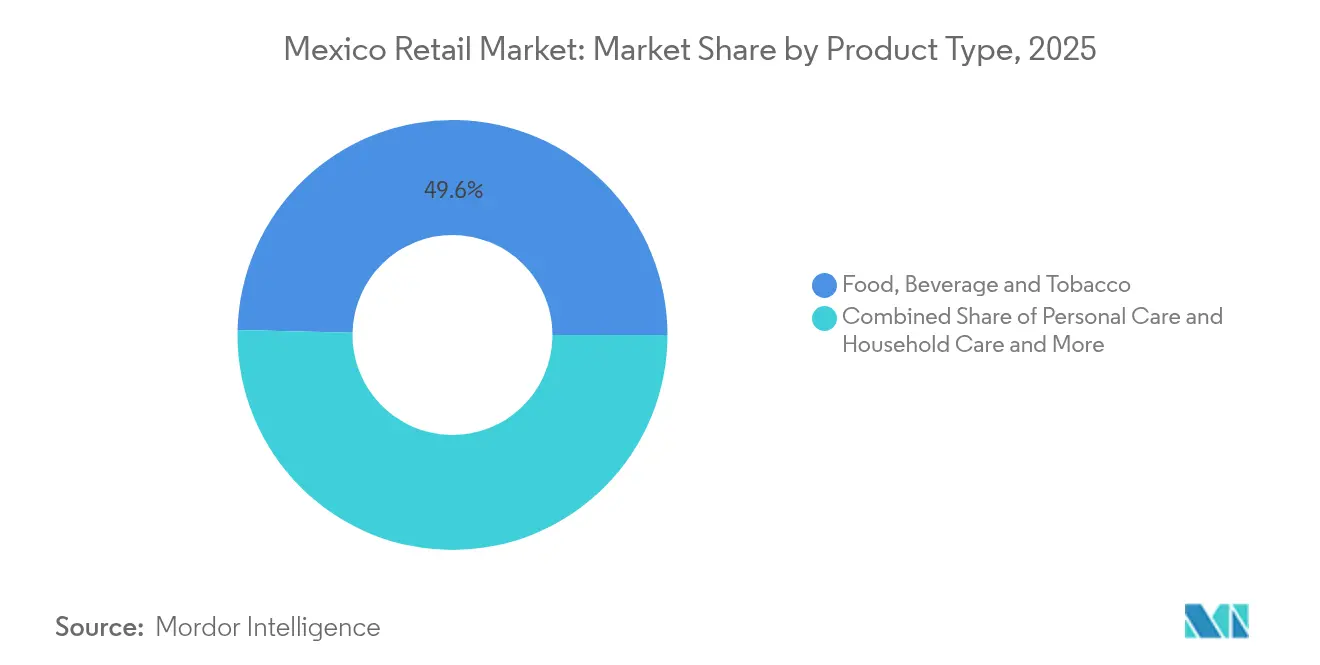
- By product type, food, beverage & tobacco held 49.63% of the Mexico retail market share in 2025, while electronic & household appliances are forecast to advance at a 10.21% CAGR through 2031.
- By retail channel, traditional mom & pop stores controlled 41.25% of the Mexico retail market size in 2025, yet e-commerce & others are growing at a brisk 15.44% CAGR to 2031.
- By format, convenience stores led with 28.94% of the Mexico retail market share in 2025, whereas specialty stores are set to expand at a 10.35% CAGR during the outlook period.
Note: Market size and forecast figures in this report are generated using Mordor Intelligence’s proprietary estimation framework, updated with the latest available data and insights as of 2026.
Mexico Retail Market Trends and Insights
Drivers Impact Analysis*
| Driver | (~) % Impact on CAGR Forecast | Geographic Relevance | Impact Timeline |
|---|---|---|---|
| Rising disposable income & middle-class expansion | +0.8% | Mexico, with concentrated gains in Central and Northern regions | Medium term (2-4 years) |
| Accelerating e-commerce & digital payment adoption | +1.2% | National, with urban concentration in CDMX, Guadalajara, Monterrey | Short term (≤ 2 years) |
| Rapid roll-out of modern trade formats | +0.6% | Mexico, strongest in Central and Southeast regions | Medium term (2-4 years) |
| Near-shoring boom lifting industrial & auto retail | +0.5% | Northern Mexico, spillover to Central regions | Long term (≥ 4 years) |
| Front-of-pack labelling driving healthier product mixes | +0.3% | National, with higher compliance in urban areas | Medium term (2-4 years) |
| Fintech micro-credit unlocking rural consumption | +0.4% | Rural Mexico, expanding to semi-urban markets | Long term (≥ 4 years) |
| Source: Mordor Intelligence | |||
Rising Disposable Income and Middle-Class Expansion
Nearshoring investment of USD 46 billion over five years has raised manufacturing wages 15-20% above national averages, boosting purchasing power around industrial corridors[1]. Elevated income levels translate into premiumization across electronics, appliances, and automotive accessories, encouraging retailers to widen assortments of higher-margin branded goods. Consumption upgrades spur format diversification as workers seek modern trade conveniences absent in traditional outlets. Retailers located in Monterrey, Ciudad Juárez, and Tijuana report double-digit same-store sales growth in discretionary categories, indicating robust elasticity to rising wages. Regional spillovers reach service sectors, expanding demand for dining, fashion, and wellness products. These patterns reinforce the Mexico retail market’s resilience to macro volatility by diversifying consumer spending sources.
Accelerating E-Commerce and Digital Payment Adoption
Digital payment acceptance climbed from 22% to 45% of retail merchants between 2014 and 2022, and online purchases now account for two-thirds of smartphone transactions[2]. E-commerce revenues grew 24.6% year-on-year in 2024 and are set to surpass USD 63 billion in 2025, making Mexico Latin America’s fastest-rising digital retail arena. Buy-now-pay-later (BNPL) offerings from startups such as Aplazo extend micro-credit to unbanked consumers, raising average ticket sizes in fashion and electronics stores. Amazon’s partnership with Kueski exemplifies how global platforms adapt to local financial infrastructure gaps to stimulate demand. Domestic chains respond by integrating click-and-collect services, while 56% of retail executives deploy AI-based marketing tools to personalize promotions and boost conversion. Collectively, these shifts accelerate the Mexico retail market’s channel migration from cash-heavy legacy systems to data-rich digital ecosystems.
Rapid Roll-Out of Modern Trade Formats
Shopping-center inventory expanded 234,000 square meters in 2023, with an additional 500,000 square meters scheduled for completion in 2024. Developers concentrate 61% of new space in Central and Southeast regions, where urban density supports small-format supermarkets and hybrid convenience-supermarket concepts. Retailers optimize footprints by combining broad assortments with quick-service kiosks to fit Mexico’s compact living spaces and frequent shopping habits. OXXO’s financial-service counters and Soriana’s 24-hour stores reveal experimentation aimed at increasing trip frequency and basket size. Specialty stores in electronics and home improvement increasingly cluster within mixed-use real-estate projects to capture weekend leisure traffic. As modern trade spreads, supply-chain efficiencies improve, narrowing price gaps with informal outlets and strengthening the Mexico retail market’s formalization trend.
Near-Shoring Boom Lifting Industrial and Auto Retail
Mexico became the United States’ top trading partner in 2024, catalyzing demand for industrial supplies, tools, and automotive components. Home Depot earmarked USD 1.3 billion for Mexico through 2030, with 100% local sourcing targets that boost domestic manufacturing linkages. Warehouse-club operators expand bulk-purchase assortments of industrial consumables, addressing newfound demand from factory contractors. Automotive aftermarket retailers add distribution centers near assembly plants to support higher vehicle output and cross-border service requirements. Rising industrial employment also fuels B2C spending on durable goods, reinforcing multi-format retailers’ push into northern states. The Mexico retail market benefits from these dual B2B-B2C revenue streams, raising cyclical stability compared with purely consumer-driven economies.
Restraints Impact Analysis*
| Restraint | (~) % Impact on CAGR Forecast | Geographic Relevance | Impact Timeline |
|---|---|---|---|
| High informality limits modern retail penetration | -0.7% | National, most pronounced in rural and semi-urban areas | Long term (≥ 4 years) |
| Logistics bottlenecks inflate distribution costs | -0.5% | National, severe impact on North-South corridors | Medium term (2-4 years) |
| Security concerns in key commercial zones deter investment | -0.6% | Regional, with elevated risk in northern and border states | Medium term (2–4 years) |
| Regulatory complexity and slow permitting for new stores | -0.4% | National, especially in high-density urban municipalities | Short to medium term (1–3 years) |
| Source: Mordor Intelligence | |||
High Informality Limits Modern Retail Penetration
Informal employment covers 56% of Mexico’s workforce, preserving the dominance of cash-based corner stores in food and personal-care categories. These merchants offer flexible credit, personalized service, and doorstep proximity that organized chains find costly to replicate. CFDI 4.0 e-invoicing rules, while promoting tax compliance, impose technology costs that many small operators cannot absorb, risking further entrenchment of informal practices. As a result, modern retailers must maintain dual cash-and-digital systems, complicating inventory and accounting processes. The persistent informal share dilutes economies of scale, constrains pricing power, and slows the Mexico retail market’s path to full formalization. Without targeted fiscal incentives or infrastructure support, uptake of modern trade among micro-merchants will likely remain gradual.
Logistics Bottlenecks Inflate Distribution Costs
More than 24,000 cargo-theft incidents in 2024 raised insurance premiums and security outlays for retail fleets, particularly in high-value electronics and liquor shipments[3]. Highway congestion between Mexico City and northern border crossings limits reliable delivery windows, forcing retailers to keep extra safety stock. Port delays in Manzanillo and Veracruz add days to lead times for imported apparel and home furnishings, shortening fashion seasons and markdown windows. Mid-tier chains lacking advanced route-optimization tools incur disproportionate costs, hampering price competitiveness against larger peers. Adoption of GPS tracking and private security escorts mitigates risk but adds operating expense that ultimately passes to consumers. Together, these factors drag down the Mexico retail market’s supply-chain efficiency and squeeze retail margins.
*Our forecasts treat driver/restraint impacts as directional, not additive. The impact forecasts reflect baseline growth, mix effects, and variable interactions.
Segment Analysis
By Product Type: Food Dominates, Electronics Accelerate
Food, beverage & tobacco sustained 49.63% of the Mexico retail market size in 2025 as grocery purchases remained households’ largest expenditure. Electronics & household appliances delivered a leading 10.21% CAGR and are set to capture a higher slice of the Mexico retail market share by 2031 as nearshoring lifts industrial wages and stimulates demand for home-improvement gadgets. Personal-care and household-care brands capitalize on premiumization, while apparel growth softens under 35% textile import tariffs that lift prices and encourage resale channels. Furniture and hobby products follow disposable-income trajectories, but seasonal tourism in coastal states adds niche demand for décor and sports equipment. Industrial and automotive products benefit from supplier proximity to new manufacturing plants, enabling shorter replenishment cycles. Cross-category marketing via loyalty apps promotes bundle purchases, smoothing category volatility and reinforcing revenue diversification inside the Mexico retail market.
Consumer electronics retailers intensify omnichannel tactics, integrating BNPL at checkout to raise conversion among credit-thin millennials, whereas grocery chains test dark-store micro-fulfillment to shorten delivery windows. Beverage manufacturers reformulate recipes to avoid front-of-pack warning labels, supplying retailers with healthier alternatives that carry higher margins. Tobacco volumes drift downward as excise taxes climb, but vaping accessories emerge as replacement sub-category. Retailer-owned brands scale in personal-care aisles, capturing price-sensitive shoppers without eroding premium brand allocations. Apparel specialists face sourcing challenges from tariff changes but remain competitive through rapid private-label design cycles and influencer marketing. Overall, diversified category performance stabilizes the Mexico retail market size against macro shocks.

By Retail Channel: Traditional Resilience Meets Digital Disruption
Traditional mom & pop outlets retained 41.25% of the Mexico retail market share in 2025, underpinned by cultural preference for neighborhood service and flexible store credit. E-Commerce & others, however, posted a vigorous 15.44% CAGR, supported by smartphone penetration, BNPL adoption, and logistical innovations like pickup lockers. Modern trade retailers merge physical and digital channels through click-and-collect counters and app-based loyalty programs that offer cashback on repeat purchases. CFDI 4.0 compliance affords large chains operational transparency that streamlines invoicing and inventory reconciliation, widening efficiency gaps versus informal rivals. Government social-assistance deposits on digital wallets stimulate low-income e-commerce spend, further attracting platform investments. This channel migration diversifies revenue streams and elevates data analytics capabilities essential to the Mexico retail industry’s next phase of growth.
Despite digital momentum, informal tiendas remain defenders of last-mile convenience in rural towns, where logistic infrastructure lags and cash wages dominate. Modern chains experiment with nano-store formats under 150 square meters to match informal proximity while preserving assortment advantages. Online marketplaces supplement rural coverage by partnering with taxi networks for same-day delivery, blending informal transport with formal retail tech stacks. Increasingly, omnichannel strategies hinge on trust-building, requiring clear return policies and localized fulfillment to lure habitual cash shoppers online. Competitive tension between legacy and emerging channels sustains innovation that ultimately broadens customer choice across the Mexico retail market.
By Format: Convenience Stores Lead, Specialty Formats Surge
Convenience stores captured 28.94% of the Mexico retail market size in 2025, thanks to high urban density and consumers’ frequent small-basket shopping behavior. Specialty stores, ranging from beauty boutiques to hardware shops, are forecast to outpace all other formats with a 10.35% CAGR, reflecting demand for curated assortments and service expertise. Hypermarkets and supermarkets preserve scale benefits in fresh food and general merchandise but confront margin pressure as online grocers add price comparison tools. Department stores modernize loyalty programs and introduce cross-border e-commerce to revive footwear and cosmetics sales. Warehouse clubs pursue aggressive expansion, adding 30 new locations annually to address bulk purchase appetite among growing middle-class households. Format innovation such as cash-free micro-markets inside office parks and autonomous kiosks at transport hubs expands pathways to capture incremental spend in the Mexico retail market.
FEMSA’s OXXO integrates bill-payment counters and fintech kiosks that broaden revenue per square meter while locking in daily footfall. Amazon leverages its Just Walk Out technology in pilot grocery sites, encouraging local competitors to trial self-checkout to cut labor costs. Costco’s largest store in Mexico City includes expanded seasonal aisles and fresh-food courts that extend dwell time and basket size. Specialty electronics chains deploy in-store service labs, differentiating on repairs and installations beyond online competitors’ capabilities. Format convergence accelerates as supermarkets add ready-to-eat meals and drugstore sections, while convenience stores trial fresh produce, blurring traditional boundaries. This dynamism secures multiple growth vectors within the Mexico retail market share.

Regulatory Landscape
Mexico retail activity is primarily governed by the Ley Federal de Proteccion al Consumidor, enforced by Procuraduria Federal del Consumidor (PROFECO) through rules on commercial information, pricing transparency, promotions, returns, and complaint handling. Product compliance is also shaped by Official Mexican Standards (NOMs) that set labeling and commercial information requirements across many consumer-goods categories, making documentation and in-store execution (shelf tags, receipts, warranties, and packaging information) a core operating requirement for both modern trade and e-commerce sellers.
On the trade side, import conditions can shift via updates to the Ley de los Impuestos Generales de Importacion y de Exportacion (LIGIE), affecting landed costs and assortment economics for categories such as apparel, footwear, and selected consumer goods. Retailers and importers also track the annual National Quality Infrastructure Program (PNIC) published in the Diario Oficial de la Federacion by the Ministry of Economy, since it signals upcoming standardization priorities and helps plan compliance, supplier onboarding, and port-of-entry documentation for regulated merchandise.
Value Chain Analysis
Mexico retail value creation begins with brand owners and manufacturers (domestic and imported) and extends through importers, wholesalers, and direct-store-delivery networks into organized chains (hypermarkets, supermarkets, convenience, department, specialty) and the fragmented traditional channel. The digital layer increasingly sits across the chain through marketplaces and omnichannel platforms that require order orchestration, last-mile partners, and digital payments to convert demand beyond major metros. GS1 Mexico also supports this layer through supplier enablement and retailer-platform engagement, alongside standards and data-sharing practices.
Distribution and fulfillment are central cost and service battlegrounds due to congestion, port delays at gateways such as Manzanillo and Veracruz, and security risk on key freight corridors. Leading chains are responding with asset-heavy logistics upgrades and automation: Walmart de Mexico y Centroamerica announced a MXN 43 billion 2026 program with a defined allocation to supply-chain infrastructure, and in May 2026 inaugurated an expanded GTP 2.0 automation system at its Megapark e-commerce distribution center in the State of Mexico. The value chain is also moving toward multi-seller ecosystems that raise requirements for centralized inventory visibility, returns processing, and seller performance controls, as illustrated by Farmacias del Ahorro announcing deployment of KIBO Order Management System in July 2026 to orchestrate marketplace fulfillment.
Competitive Landscape
The Mexico retail market is moderately fragmented, with the top five chains holding a significant share of the market, while a mix of regional specialists and informal shops dominates the rest. Walmart Mexico earmarked USD 6 billion to expand supercenter, Bodega Aurrera, and e-commerce operations, underlining incumbents’ intent to fortify leadership positions. Chedraui plans 140 openings in secondary cities, signaling aggressive turf battles outside core metros. Tiendas 3B’s MXN 1.6 billion (USD 94.10 million) spent for 420 stores demonstrates momentum in discount formats appealing to cost-conscious shoppers. Dollar General’s Mexico entry intensifies competition in the value segment, leveraging U.S. sourcing efficiencies to challenge local discounters. Ulta Beauty’s partnership with Axo introduces global cosmetics brands, elevating specialty beauty competition. AI deployment across merchandising and logistics systems accelerates among leading players, with 90% adopting predictive analytics for inventory optimization.
Sustainability emerges as a differentiation lever, evidenced by FEMSA and Coca-Cola FEMSA securing spots in the S&P Global Sustainability Yearbook 2025. ESG transparency not only attracts socially responsible investors but also resonates with younger consumers, influencing brand affinity. Regulatory compliance prowess, particularly with new CINIF sustainability disclosure standards, offers large firms reputation advantages over smaller peers struggling with data capture. Cargo-theft mitigation strategies, such as jointly funded secure corridors, foster industry collaboration while raising barriers for new entrants. Overall, competitive dynamics pivot on omnichannel capability, operational efficiency, and ESG credentials, with scale players consolidating share yet leaving room for nimble specialists to thrive.
Mexico Retail Industry Leaders
-
Walmart de México y Centroamérica (Walmex)
-
Organización Soriana
-
FEMSA Comercio (OXXO)
-
Chedraui
-
Liverpool
- *Disclaimer: Major Players sorted in no particular order

Market Opportunities and Future Outlook
Omnichannel scaling and faster fulfillment remain a key whitespace as e-commerce growth raises service expectations outside the largest metros. 2026 capex announcements show operators funding both store modernization and logistics automation in parallel, which supports demand for micro-fulfillment, order-management software, and carrier networks that can reduce delivery variability and improve returns economics. Walmart de Mexico y Centroamerica detailed a 2026 investment plan (MXN 43 billion) spanning store renovation, new store construction, supply-chain automation, and technology, while Mercado Libre announced a USD 4.6 billion 2026 investment in Mexico aimed at logistics, e-commerce, and financial services expansion.
Formalization and monetization opportunities are also building around digital payments, SME enablement, and retail media. Digital payment acceptance has expanded to 45% of retail merchants (2014-2022), and smartphone penetration surpasses 85% of adults, supporting targeted promotion and closed-loop measurement across apps and point-of-sale networks. Programs that equip smaller merchants with terminals provide a practical on-ramp: DigitalizaTE in Yucatan reported 526 SMEs modernized across 45 municipalities by adding digital payment terminals in July 2026, and BNPL partnerships such as Amazon with Kueski show how financing integrations can lift conversion in higher-ticket categories. Alongside store expansion and proximity formats, such as Grupo Coppel MXN 14.3 billion 2026 plan and Chedraui multi-year State of Mexico store-opening program, these moves expand addressable inventory for retail media networks and private-label penetration while increasing demand for trade marketing analytics and compliant customer data practices.
Recent Industry Developments
- July 2026: Walmart de Mexico y Centroamerica rolled out 1.7 million smart shelf labels across its Mexico store network. The deployment strengthens price agility and execution consistency for promotions, while reducing labor devoted to manual label changes and improving in-store accuracy for omnichannel pickup and returns.
- May 2026: Walmart de Mexico y Centroamerica announced a MXN 4,000 million investment for the State of Mexico for 2026-2027 and inaugurated an automated e-commerce center in Tepotzotlan. The upgrade expands fulfillment capacity closer to the country's largest consumption zone and supports faster delivery and pickup cycles, reinforcing the shift toward automation-led cost-to-serve improvements.
- August 2024: FEMSA completed the acquisition of Delek US for USD 385 million, adding 249 U.S. convenience stores slated for rebranding under OXXO. The transaction extends FEMSA's operating footprint and provides scale and learnings that can be applied to convenience retail formats and supply-chain practices.
Research Methodology Framework and Report Scope
Market Definition and Coverage
For this study, the Mexico retail sector is defined as the value of goods sold to end consumers through store-based and online retail formats across the country, measured at retail sales value in USD for the stated years.
Scope exclusions: B2B wholesale trade, pure foodservice sales, and sales taxes are not counted when they sit outside the retail transaction value captured by retailers.
Segmentation Overview
- By Product Type
- Food, Beverage & Tobacco Products
- Personal Care & Household Care
- Apparel, Footwear & Accessories
- Furniture, Toys & Hobby
- Industrial & Automotive
- Electronic & Household Appliances
- Other Products
- By Retail Channel
- Traditional Mom & Pop Retail
- Modern Trade Retail
- E-Commerce & Others
- By Format
- Hypermarkets
- Supermarkets
- Convenience Stores
- Department Stores
- Specialty Stores
- Others (drugstore, cash-&-carry, wholesaler)
Data Sources, Market Sizing, and Validation
Desk Research
Desk work starts with building the size of Mexico retail from public demand and macro signals, and then aligning them with how retail is tracked by format and product baskets. We typically rely on sources such as INEGI retail trade indicators and national accounts, Banco de Mexico inflation and exchange rate series, OECD household consumption datasets, UN Comtrade for trade signals that influence stocked categories, and customs-level import and export statistics where applicable.
To keep the model tied to real market behavior, we also review retailer annual reports and investor decks, public press releases on store openings and closures, and association pages that discuss modern trade and traditional trade trends. A paid subscription for company financials and news is used selectively to normalize reporting periods and identify one-off events that distort sales. These desk research sources are illustrative only, and many other public and paid references are also used for data collection, validation, and clarification.
Primary Interviews and Surveys
Primary validation is done through expert interviews and structured surveys with retail operators, distributors, brand managers, and logistics or real estate participants who track store traffic and expansion plans. Coverage stays broad across Mexico, and respondent input is used to confirm channel mix shifts (such as convenience and online), expected pricing progression, and the pace at which formal retail gains share over informal trade.
Distribution of primary research fieldwork respondents
| Company type | Respondent position |
|---|---|
| Top tier: 31% | CXOs: 22% |
| Mid tier: 47% | Functional/Unit leaders: 20% |
| Smaller Players: 22% | Managers: 58% |
Market-Sizing & Forecasting
Sizing is built using a top-down approach where household consumption patterns and retail trade indicators are reconstructed into a retail sales value pool for Mexico, and then adjusted to match format level realities. To make sure the totals stay grounded in what retailers can sell, results are cross-checked with selective bottom-up approximations like sampled store productivity, channel share checks, and price per basket assumptions applied to volume indicators.
A few key inputs that matter in this market include consumer price inflation by retail basket, MXN to USD conversion timing, modern trade store count expansion and closures, e-commerce penetration within total retail, and shifts between informal and organized selling. When an input is weak for a sub-category, we fill gaps using proxy indicators that move in the same direction, then validate the direction with primary feedback. For forecasting, we lean on scenario analysis supported by simple regression checks, where retail value growth is linked to household consumption growth, inflation outlook, and channel mix changes shared by interviewees.
Data Validation & Update Cycle
Validation is done by triangulating the model output against independent signals like retail trade growth rates, inflation series, and retailer commentary on same-store sales and ticket size. Large variances are flagged, and the drivers are rechecked, which often triggers follow-up calls if the change is tied to a channel shift or a pricing reset.
Before sign-off, the full model is reviewed in steps by another analyst to catch unit errors, currency timing issues, and unrealistic jumps by year. The report is refreshed annually, and interim updates are made when material events occur that can shift retail value, such as sharp inflation swings or major format expansion. Right before delivery, we run a final pass so clients receive the latest updated view.
Mordor Intelligence's Mexico Retail Sector Market Sizing Compared With Other Published Estimates
Published market sizes for Mexico retail often do not match each other, even when the title looks similar. Scope and timing choices vary, especially around what is counted as retail value and how informal trade is handled, and the USD series can also change depending on the currency conversion window.
The main gap comes from whether informal and unorganized sales are fully added and then carried forward with strong structural formalization assumptions, where Mordor Intelligence counts retail value only when it is supported by observable retail trade signals and format level checks rather than assuming a fast structural shift. Differences also show up when pricing is carried forward using a single inflation path without checking category mix changes, and when the refresh cycle lags behind new inflation and FX realities, which can move USD values quickly.
Benchmark comparison
| Source | Market Size | Gaps in Research Methodology |
|---|---|---|
| Mordor Intelligence | USD 420.24 B (2025) | |
| Global Research Publisher A | USD 475.20 B (2025) | Tends to apply broader inclusions across products and channels with stronger forward assumptions on channel expansion, which can lift the 2025 retail value level versus a signal-checked retail trade and format mix build. |
| Industry Research Publisher B | USD 345.09 B (2025) | Often uses a more conservative retail value starting point and different handling of informal trade and currency timing, which can pull down the USD value even if local currency growth expectations are similar. |
The comparison shows that most of the spread can be explained by scope choices around informal trade, the way pricing and mix are carried through, and the specific FX conversion timing used for USD reporting. By keeping assumptions traceable to repeatable indicators and rechecking them with market participants, we end up with a balanced estimate that is easier to reconcile year to year.
Key Questions Answered in the Report
How large is the Mexico retail market in 2026 and what growth is expected by 2031?
The market is valued at USD 435.03 billion in 2026 and is forecast to reach USD 517.26 billion by 2031, reflecting a 3.52% CAGR.
Which product category generates the highest revenue in Mexican stores today?
Food, Beverage & Tobacco products lead, accounting for 49.63% of retail sales in 2025.
Which retail channel is expanding fastest across Mexico?
E-Commerce & Others is the fastest, registering a 15.44% CAGR through 2031 as smartphone and digital-payment usage rises.
What regulatory changes will most affect retailers in the next few years?
Mandatory sustainability disclosures under CINIF and continued rollout of CFDI 4.0 e-invoicing will raise compliance demands and favor organized chains.