
Market Overview
| Study Period | 2020 - 2031 |
|---|---|
| Forecast Data Period | 2026 - 2031 |
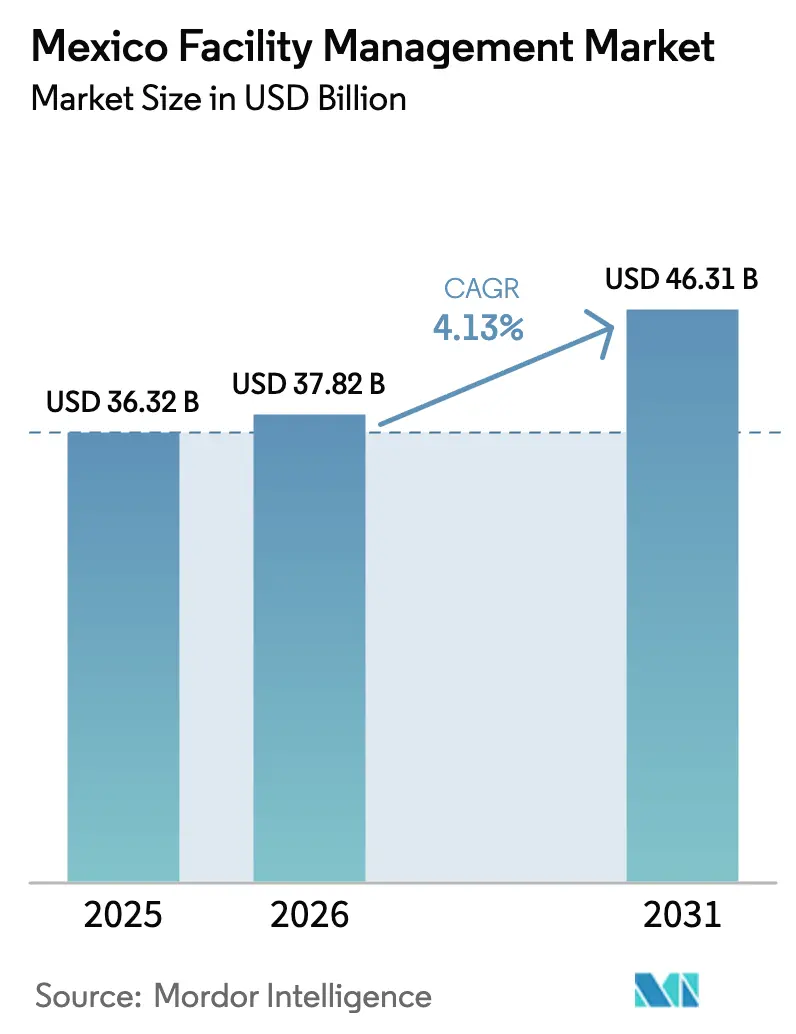
| Base Year Market Size (2025) | USD 36.32 Billion |
| Market Size (2026) | USD 37.82 Billion |
| Market Size (2031) | USD 46.31 Billion |
| Growth Rate (2026 - 2031) | 4.13 % |
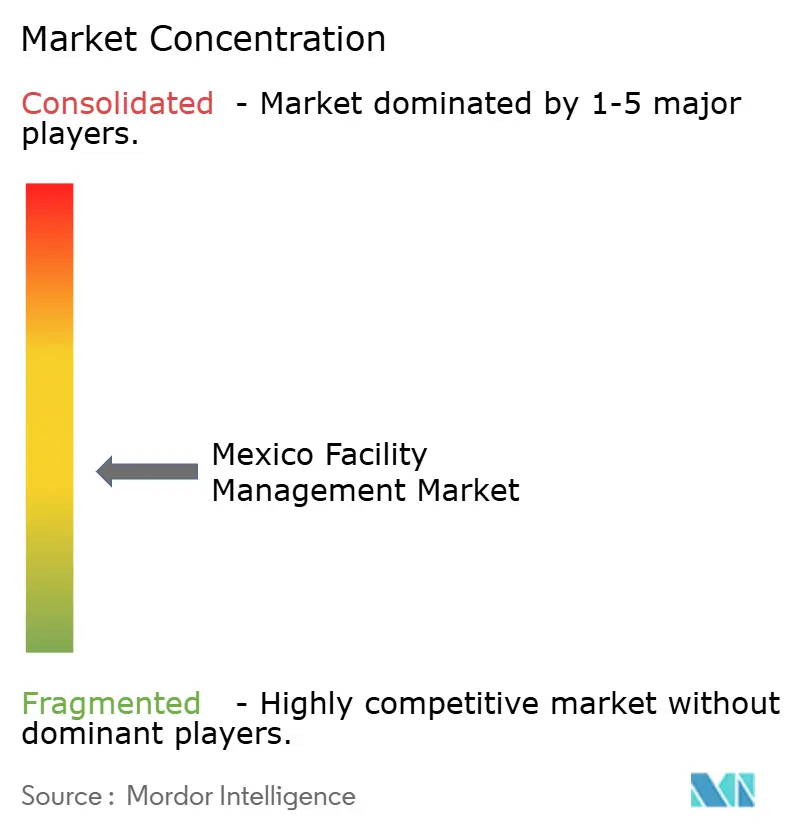
| Market Concentration | Medium |
Major Players *Disclaimer: Major Players sorted in no particular order Image © Mordor Intelligence. Reuse requires attribution under CC BY 4.0. | |
Mexico Facility Management Market Analysis by Mordor Intelligence
The Mexico Facility Management Market size is expected to grow from USD 36.32 billion in 2025 to USD 37.82 billion in 2026 and is forecast to reach USD 46.31 billion by 2031 at 4.13% CAGR over 2026-2031.
This trajectory confirms the resilience of the Mexico facility management market amid accelerating nearshoring, large-scale infrastructure investment, and stricter labor-compliance frameworks. Intensified foreign direct investment, particularly from manufacturing companies relocating supply chains closer to the United States, is enlarging the national inventory of industrial plants that require outsourced maintenance and engineering support. Parallel federal commitments—such as the Federal Electricity Commission’s USD 23 billion modernization program—are raising demand for hard-service expertise spanning generation, transmission, and distribution assets. Corporations are also outsourcing real-estate operations to integrated facility management (IFM) providers to lower cost and meet rising ESG and USMCA labor-compliance mandates. Finally, PropTech adoption and IoT-enabled predictive maintenance platforms are reshaping service delivery models and creating data-driven value propositions within the Mexico facility management market.[1]
Key Report Takeaways
- By service type, soft services led with 61.25% of the Mexico facility management market share in 2025; hard services are projected to accelerate at a 7.88% CAGR through 2031.
- By offering type, in-house solutions accounted for 53.20% share of the Mexico facility management market size in 2025, while integrated facility management is poised for the fastest growth at a 9.31% CAGR through 2031.
- By end-user industry, commercial facilities held 37.45% revenue share in 2025; healthcare facilities are forecast to expand at a 7.72% CAGR to 2031.
Note: Market size and forecast figures in this report are generated using Mordor Intelligence’s proprietary estimation framework, updated with the latest available data and insights as of 2026.
Mexico Facility Management Market Trends and Insights
Drivers Impact Analysis*
| Driver | (~) % Impact on CAGR Forecast | Geographic Relevance | Impact Timeline |
|---|---|---|---|
| Nearshoring-driven expansion of industrial facilities | 1.20% | Northern Mexico, Bajío region | Medium term (2-4 years) |
| Uptick in corporate real-estate outsourcing to IFM providers | 0.80% | Mexico City, Guadalajara, Monterrey | Short term (≤ 2 years) |
| Federal mega-projects fueling hard-service demand | 0.60% | National, concentrated in southern states | Long term (≥ 4 years) |
| Growth in Grade-A office & mixed-use real-estate stock | 0.40% | Mexico City, Guadalajara, Monterrey | Medium term (2-4 years) |
| PropTech & IoT-enabled predictive maintenance platforms | 0.30% | Major metropolitan areas | Long term (≥ 4 years) |
| USMCA-linked ESG compliance push for certified green FM services | 0.20% | Border states, manufacturing hubs | Medium term (2-4 years) |
| Source: Mordor Intelligence | |||
Nearshoring-driven expansion of industrial facilities
Nearshoring has re-defined Mexico’s role in North American supply chains, with manufacturing contributing nearly 17% of national GDP in 2025 and industrial property requirements projected to surge 80% versus 2023 levels. Electronics, automotive, and aerospace producers have announced multi-billion-dollar upgrades, including French commitments totalling USD 3 billion that cover Valeo’s USD 800 million modernization and Hydrogène de France’s green-hydrogen projects. This wave of investment is swelling demand for specialized mechanical-electrical-plumbing (MEP) services, safety systems, and environmental monitoring—capabilities that the Mexico facility management market must scale rapidly. Semiconductor consortiums analysing USD 3 trillion in global fab outlays over the next decade identify Mexico as an emerging node, further underpinning long-term service demand. Providers that combine local labour expertise with global engineering standards stand to capture high-value contracts as plant operators seek turnkey compliance and operational continuity.[2]
Uptick in corporate real estate outsourcing to IFM providers
Corporations headquartered in Mexico City, Monterrey, and Guadalajara are transitioning from fragmented, in-house maintenance to bundled IFM contracts that consolidate cleaning, security, technical, and energy-management services. Healthcare networks illustrate the value proposition, reporting 10-15% cost savings and tighter regulatory compliance after adopting unified solutions. The December 2023 rollout of NOM-037 telework standards added complexity to workplace oversight, propelling companies toward professional providers who track space utilization, air quality, and ergonomic parameters in hybrid offices. Digital dashboards that visualize service-level metrics in real time are now standard bid requirements, pushing the Mexico facility management market toward data-centric operations and performance-based pricing.
Federal mega-projects fuelling hard-service demand
Mexico’s National Infrastructure Program allocates USD 196 billion to energy, transport, and public-works schemes, with signature undertakings such as the Maya Train, Tulum International Airport, and hydropower refurbishments demanding sophisticated maintenance regimes. ANDRITZ’s USD 892 million contract to modernize nine hydro plants exemplifies the specialized industrial services pipeline that facility managers must support. Hard-service providers skilled in fire protection, HVAC optimization, and security electronics are negotiating multi-year agreements covering preventive maintenance, spares logistics, and remote system diagnostics. The concentration of projects in the south is reshaping geographic footprints, compelling firms to recruit and train technicians in states historically underserved by corporate FM.
Growth in Grade-A office & mixed-use real-estate stock
Developers are adding smart, amenity-rich towers in core urban zones, integrating building-management systems that require continuous fine-tuning and cybersecurity oversight. Luxury hotel investment climbed 50% in 2024, and the hospitality pipeline foresees expansion from USD 107.77 billion to USD 157.59 billion by 2029, catalysing premium service contracts. Parallel momentum in carrier-neutral data centers—expected to generate 14,688 indirect jobs—demands strict uptime and environment control specifications. Facility managers capable of coupling sustainability reporting with occupant-experience analytics are differentiating their bids as ESG metrics weigh heavily in tenant decisions.
Restraints Impact Analysis*
| Restraint | (~) % Impact on CAGR Forecast | Geographic Relevance | Impact Timeline |
|---|---|---|---|
| High informality of FM labor market limits service quality & scalability | -0.90% | National, acute in rural areas | Long term (≥ 4 years) |
| Intense price competition and low switching costs compress margins | -0.60% | Major metropolitan areas | Short term (≤ 2 years) |
| Stricter labor-safety regulations increasing compliance costs | -0.40% | Manufacturing hubs, border states | Medium term (2-4 years) |
| Frequent regional power outages causing unplanned maintenance spikes | -0.30% | National, severe in industrial zones | Medium term (2-4 years) |
| Source: Mordor Intelligence | |||
High informality of FM labour market limits service quality & scalability
Around 60% of Mexico’s workforce operates in the informal economy, depriving many facility services of standardized training, social-security coverage, and quality certifications. Past initiatives to formalize 200,000 service workers under International Labour Organization guidance achieved only partial success, hampered by high payroll taxes and weak enforcement. Multinational clients now insert clauses mandating documented worker benefits, forcing FM providers to shoulder added administrative burdens or risk disqualification. Informality perpetuates a pricing gap, squeezing formal firms that comply with taxes and benefits yet compete against cheaper, unregistered vendors.
Intense price competition and low switching costs compress margins
Cleaning, security, and landscaping contracts are frequently rebid on annual cycles, with clients leveraging low barriers to exit to negotiate steep discounts. The abundance of small local vendors drives a race to the bottom in metro areas, eroding profitability for large IFM operators that invest in technology and training. Some global players respond by tiering service levels, offering “lite” packages that meet basic performance metrics while reserving advanced analytics and ESG reporting for premium tiers.
*Our forecasts treat driver/restraint impacts as directional, not additive. The impact forecasts reflect baseline growth, mix effects, and variable interactions.
Segment Analysis
By Service Type: Hard services accelerate despite soft-service dominance
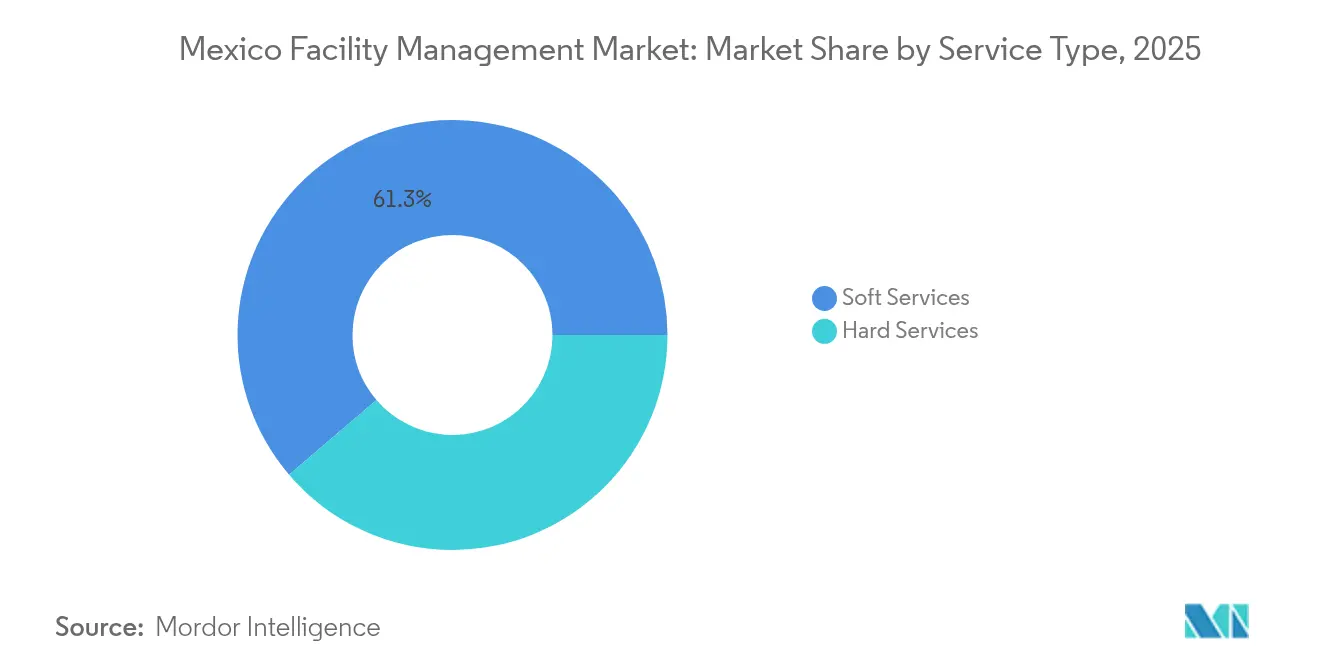
Soft services retained 61.25% revenue weight within the Mexico facility management market in 2025, reflecting enduring demand for cleaning, catering, reception, and security across commercial and institutional premises. However, the hard-service category is registering the fastest CAGR at 7.88% through 2031, driven by modernization of energy plants, smart-building retrofits, and rising legal mandates for fire and life-safety systems. Hard-service sub-segments such as MEP maintenance are benefiting from predictive analytics that can raise equipment availability by 25% and trim repair spend 20%.The segment’s outlook is also influenced by high-performance automation offerings like Johnson Controls’ Metasys BAS v14.0, which supports 800 IP devices and integrates BACnet clients for streamlined energy management. As clients adopt these platforms, the Mexico facility management market size for hard services is expected to expand steadily, rewarding vendors that pair engineering depth with data analytics. By 2025, asset owners view preventive maintenance compliance scores as a decisive KPI when awarding long-term contracts, tilting the landscape toward qualified, tech-enabled providers

By Offering Type: Integrated FM emerges as growth leader
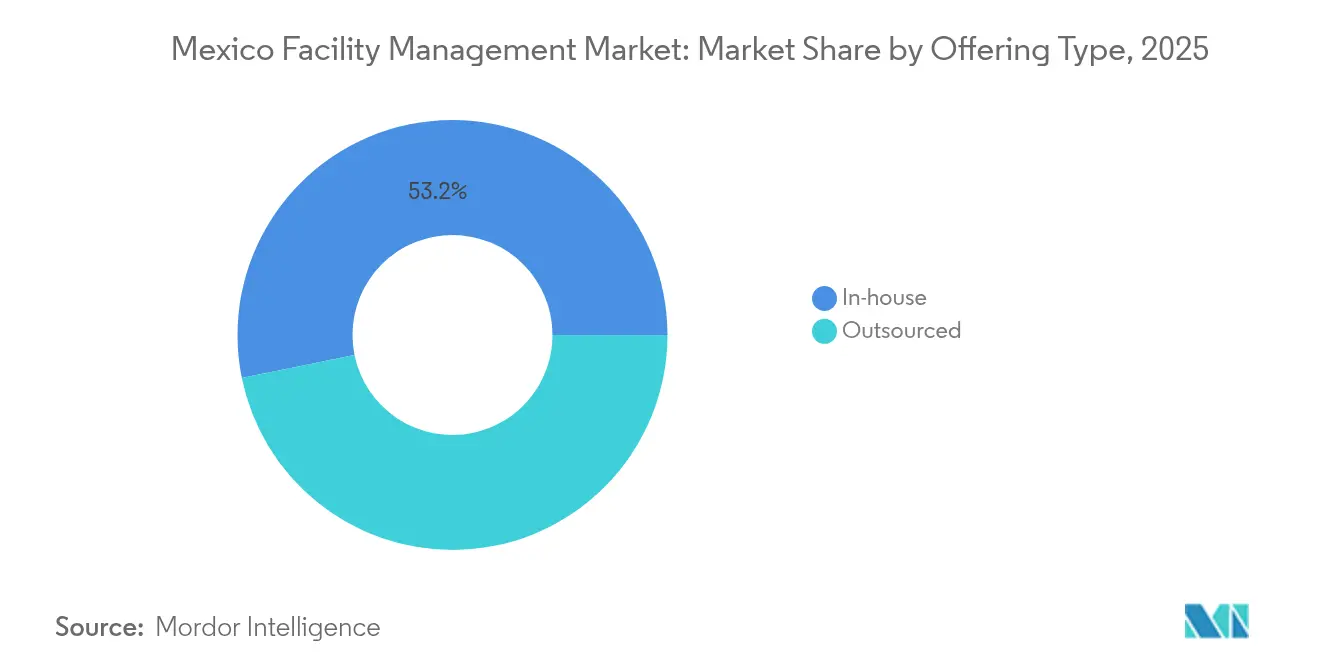
In-house teams still control 53.20% of 2025 spending, particularly in government offices and state-owned utilities that Favor direct oversight. Yet demand for integrated outsourcing is climbing at a 9.31% CAGR, the fastest within the Mexico facility management market. Single-service and bundled offerings remain relevant for organizations testing outsourcing or focusing on niche activities, but IFM unlocks economies of scale and coordinated compliance. Healthcare systems cite 10-15% cost gains after migrating from scattered vendor rosters to master agreements managed by a single provider.
Digital command centers that consolidate building systems, labour scheduling, and supply chains underpin the IFM value case. Providers differentiate by embedding IoT sensors that feed AI engines capable of flagging anomalies in real time, thereby improving asset uptime and ESG metrics. Consequently, the Mexico facility management market size addressed by IFM vendors is expanding both in absolute dollar terms and in strategic importance to C-suite agendas.
By End-User Industry: Healthcare drives growth amid commercial stability
Commercial facilities—including offices, retail warehouses, and telecom switching centers—accounted for 37.45% of 2025 expenditure, providing a steady revenue base for soft-service specialists. The healthcare segment, however, is forecast to log the quickest 7.72% CAGR to 2031, propelled by new hospital builds, biomedical lab expansions, and stringent sterility and traceability standards. Baxter-owned Vantive’s nationwide home-delivery network highlights the operational complexity that specialized FM must support.
Hospitality receives a boost from luxury hotel pipelines and wellness resorts growing at 13% annually, demanding front-of-house excellence and back-of-house technical precision. Institutional and public infrastructure projects tied to the Maya Train and new airports require multi-disciplinary FM frameworks spanning crowd management, structural monitoring, and multi-utility integration. Industrial and process facilities remain the backbone of nearshoring, adding clean-room, battery-assembly, and hydrogen-handling infrastructure that widens the technical scope—and revenue potential—of the Mexico facility management market.
Geography Analysis
Mexico facility management market, anchored by near-border manufacturing clusters in Baja California, Nuevo León, and Chihuahua. Tijuana’s industrial vacancy breached 2% for the first time in three years during mid-2024 as developers raced to deliver factories for electronics and EV suppliers. Monterrey alone has added 22 million ft² of new industrial space since 2022, with construction costs rising a contained 3.2% year on year. A dense ecosystem of suppliers, logistics corridors, and bilingual workforce keeps service demand high for both soft- and hard-FM specialists.
Central Mexico—Mexico City, Guadalajara, Querétaro—represents the fastest-growing geography through 2030 as tech campuses, cloud data centers, and corporate headquarters proliferate. Developers are integrating LEED-certified systems and tenant-experience applications that favour IFM providers with digital competencies. The Mexico facility management market size for Central Mexico thus carries an outsized share of high-margin, technology-rich contracts.
Regulatory Landscape
Facility management delivery in Mexico is shaped by mandatory safety and quality compliance at the workplace, and by telecom and wireless-conformity requirements that are increasingly embedded in smart-building deployments. The Secretariat of Labor and Social Security (STPS) sets core workplace safety requirements through Official Mexican Standards (NOMs), including NOM-001-STPS-2008 on safety conditions for buildings, facilities, and work areas, which affects contractor procedures for electrical works, MEP maintenance, and onsite service operations.
For technology-enabled FM, Mexico maintains an autonomous telecom regulator, the Instituto Federal de Telecomunicaciones (IFT), which governs technical provisions, homologation, and conformity assessment for equipment using radio spectrum. IFT technical provisions for wireless equipment, including IFT-017-2023 (effective November 7, 2025) for WLAN and digital modulation systems in the 5 GHz and 6 GHz bands, add a formal compliance layer for IoT sensors, connectivity gateways, and building-network upgrades used in predictive maintenance and digital building management. In parallel, the Secretariat of Economy coordinates standardization through the annually published National Quality Infrastructure Program (PNIC) in the Official Gazette of the Federation (DOF), which signals upcoming standardization activity relevant to facility technologies, procurement, and service specifications.
Competitive Landscape
The Mexico facility management market remains moderately fragmented, with global conglomerates competing alongside regional specialists. ISS reports global revenue of DKK 83.7 billion and 5.8% organic growth in Q2 2024, balancing broad service catalogs with local regulatory expertise. Sodexo generated EUR 12.5 billion in H1 2025, leveraging integrated food and FM packages and prioritizing sustainability innovation. Johnson Controls, a frontrunner in building systems, posted USD 5.4 billion Q1 2025 sales and grew its Building Solutions backlog to USD 13.2 billion, underscoring appetite for automation platforms.
Strategic moves include CBRE’s January 2025 acquisition of Industrious National Management Company, merging workplace experience with operations and targeting USD 20 billion in BOE revenue. Aramark’s December 2024 purchase of Quantum Cost Consultancy Group added nearly USD 500 million in procurement spend, strengthening supply-chain leverage across Latin America. Meanwhile, ISS has embedded ESG officers at corporate level to align Mexican contracts with global decarbonization goals, reinforcing credibility with multinational tenants.
White-space opportunities revolve around IFM for mid-market manufacturers and data-center operators, plus specialized services for renewable-energy assets. PropTech entrants offering AI-assisted fault detection and drone-based façade inspections are forging partnerships to penetrate large portfolios. Competitive intensity is most pronounced in cleaning and security, where low entry barriers and informal labour keep prices under pressure. Providers that can certify labour practices, deploy IoT-backed transparency, and finance technology upgrades are positioned to consolidate share in the evolving Mexico facility management market.
Mexico Facility Management Industry Leaders
-
ISS Mexico
-
Sodexo Facilities Management Services
-
CBRE Mexico
-
Grupo EULEN Mexico
-
JLL Mexico
- *Disclaimer: Major Players sorted in no particular order
Market Opportunities and Future Outlook
Nearshoring-led industrial expansion and large public infrastructure programs are expanding the addressable base for hard services and integrated facility management, especially where clients require documented labor practices and repeatable engineering standards. Mexico also uses programs such as IMMEX to enable duty-free import of manufacturing inputs and equipment, which supports higher adoption of automation and Industry 4.0 assets and increases demand for MEP maintenance, safety systems, and energy-management services in export-oriented facilities.
Technology-rich facilities are also creating whitespace for providers that can combine traditional FM with digital infrastructure operations and measurable energy outcomes. In February 2026, C3ntro Telecom secured syndicated DFI financing from PROPARCO and DEG (KfW Group) for the Mexican segment of Project TIKVA, a 2,700 km cross-border fiber network connecting Querétaro and Phoenix, reinforcing investment around data-center and connectivity corridors where uptime-centric FM capabilities, including power, cooling, environment monitoring, and critical-maintenance processes, are procurement priorities. In April 2026, Siemens highlighted its Mitras facility in Nuevo Leon as its first global LEED Platinum site and a lab for scaling industrial IoT automation and energy-efficiency compliance, which reinforces active customer reference points for outcome-based energy services and retrofits that bring building automation, monitoring, and maintenance under integrated contracts.
Recent Industry Developments
- May 2026: Sodexo announced a seven-year contract with Rio Tinto for integrated facility services in the Pilbara region of Australia, starting in June 2026. The award highlights continued demand for large, bundled FM delivery models that combine multi-service execution with operational continuity requirements. Such global wins reinforce scale-driven operating playbooks that multinational customers also seek when tendering integrated contracts in Mexico.
- April 2026: Siemens highlighted its Mitras facility in Nuevo Leon as its first global LEED Platinum site and a lab for scaling industrial IoT automation and energy-efficiency compliance. The update shows active customer reference points for outcome-based energy services and retrofits that align building automation, monitoring, and maintenance under integrated contracts. It also points to growing interest from clients in measurable efficiency improvements across manufacturing campuses in northern Mexico.
- January 2025: CBRE acquired Industrious National Management Company, creating a Building Operations and Experience segment. The acquisition ties workplace experience more tightly to building operations and portfolio management, reflecting a broader move among global providers toward integrated offerings. In Mexico, it supports competitive differentiation as corporates consolidate vendors and use performance dashboards and employee experience metrics as bid requirements.
Research Methodology Framework and Report Scope
Market Definition and Coverage
For this study, the Mexico facility management market is defined as the revenue generated from outsourced and in-house services used to operate, maintain, and support buildings and sites across commercial, industrial, and institutional end users.
Scope exclusions: This sizing does not count construction and major capital retrofit work as part of facility management services.
Segmentation Overview
- By Service Type
- Hard Services
- Asset Management
- MEP and HVAC Services
- Fire Systems and Safety
- Other Hard FM Services
- Soft Services
- Office Support and Security
- Cleaning Services
- Catering Services
- Other Soft FM Services
- Hard Services
- By Offering Type
- In-house
- Outsourced
- Single FM
- Bundled FM
- Integrated FM
- By End-user Industry
- Commercial (IT and Telecom, Retail and Warehouses, etc.)
- Hospitality (Hotels, Eateries, Large-scale Restaurants)
- Institutional and Public Infrastructure (Govt, Education, Transportation)
- Healthcare (Public and Private Facilities)
- Industrial and Process (Manufacturing, Energy, Mining)
- Other End-user Industries (Multi-housing, Entertainment, Sports and Leisure)
Data Sources, Market Sizing, and Validation
Desk Research
Desk research started with public statistics that help us map the addressable base of buildings and service activity in Mexico. We reviewed sources such as INEGI economic census tables, Banco de Mexico macro series, Mexico trade data for selected equipment categories, and public procurement portals that signal outsourced services demand. We also used materials from standards bodies, such as ISO guidance for FM terms and scope alignment, which helps keep definitions consistent.
To connect the market to real spending, we cross-checked listed company filings, investor presentations, and reputable press coverage of contract wins and service expansion. For areas where public reporting is thin, we used paid subscriptions focused on company financials and intelligence, news and financials, and shipment-level import/export data to sanity check service intensity in hard FM categories. The desk sources named above are illustrative rather than exhaustive, and many other public and paid references were used for data collection, validation, and clarification.
Primary Interviews and Surveys
Primary work was used to confirm what is actually counted under hard and soft FM in Mexico and how the in-house versus outsourced split moves by end user. We spoke with a mix of FM providers, subcontractors, property and plant managers, and procurement teams, and we used these inputs to validate price bands, contract structures (single, bundled, and integrated), and typical scope boundaries across major Mexican demand centers.
Distribution of primary research fieldwork respondents
| Company type | Respondent position |
|---|---|
| Top tier: 28% | CXOs: 18% |
| Mid tier: 54% | Functional/Unit leaders: 30% |
| Smaller Players: 18% | Managers: 52% |
Market-Sizing & Forecasting
The model uses a top-down and bottom-up logic where Mexico service-sector output and building stock signals are reconstructed into an FM demand pool, and then split by hard versus soft services and by delivery model based on observed outsourcing behavior. Once this structure is in place, results are corroborated with selective bottom-up approximations, such as sampled contract values by end user, channel checks with service providers, and volume times average selling price checks for repeatable hard FM activities.
Key inputs used in the model include the mix of commercial and industrial floor space, the rate of outsourcing by end-user group, labor cost movement for FM roles, typical contract length and rebid cycles, and how hard FM frequency changes with asset age and utilization. Where direct observations were missing, gaps were handled by applying conservative ranges from interview consensus and then narrowing them using observable indicators like employment and public tender activity.
For forecasting, scenario analysis was applied around macro drivers that move FM spend in Mexico, and then blended into a central case using expert-validated assumptions. This keeps the forecast practical because it links growth to measurable changes in occupancy, industrial activity, wage inflation, and outsourcing penetration, followed by a final sense check against recent contract and pricing commentary.
Data Validation & Update Cycle
Outputs are checked in several steps so that one unusual assumption does not swing the total market. We compare totals against independent signals like service sector growth, employment trends tied to support services, and observed pricing movement for common FM tasks, and then we review any large variances at segment and end-user levels.
Before sign-off, the model is peer-reviewed, and we re-contact selected interviewees when results fall outside expected ranges or when a new contract structure becomes common in the market. Reports are refreshed annually, with interim updates when material events occur, and a final pre-delivery review is completed so clients receive the latest updated view.
Mordor Intelligence's Mexico Facility Management Report Market Size Compared Against Other Published Estimates
Published market values for facility management in Mexico often vary because the scope is not always kept consistent, especially around whether in-house activity is counted and how integrated contracts are treated. Differences also come from the base year selected, currency conversion timing, and how price inflation is applied to labor-heavy services.
By tracking contract mix, outsourcing penetration, and hard versus soft service definitions, Mordor Intelligence keeps the Mexico number aligned to recurring FM delivered to operating sites (including in-house delivery), and it excludes construction and major retrofit work that can be mixed into some totals.
Benchmark comparison
| Source | Market Size | Gaps in Research Methodology |
|---|---|---|
| Mordor Intelligence | USD 37.82 B (2026) | |
| Regional Consultancy A | USD 17.50 B (2024) | Uses an earlier base year and is described as combining FM and IFM in a way that can undercount in-house FM activity and treat bundled contracts differently, which shifts the total versus a like-for-like FM definition. |
| Trade Journal B | USD 5.20 B (2026) | Presented as an FM services market, which likely narrows coverage to selected outsourced services and leaves out parts of hard FM and broader bundled or integrated delivery models that are commonly purchased in Mexico. |
Overall, the spread is explained less by math and more by what is included, when it is measured, and how integrated delivery is treated. Our steps stay traceable to observable demand signals and repeatable checks, so users can reconcile the market total back to building activity, outsourcing behavior, and service pricing in Mexico.
Key Questions Answered in the Report
What is the current value of the Mexico facility management market?
The market was valued at USD 37.82 billion in 2026 and is projected to reach USD 46.31 billion by 2031.
Which service type is growing fastest?
Hard services are expected to post a 7.88% CAGR through 2031, driven by infrastructure upgrades and smart-building adoption.
Why is integrated facility management gaining traction?
Integrated contracts deliver 10-15% cost savings, simplify compliance, and leverage IoT analytics for better asset performance.
Which end-user industry offers the highest growth potential?
Healthcare facilities are forecast to expand at a 7.72% CAGR because modernization demands specialized compliance and sterility controls.
How does nearshoring influence facility management demand?
Foreign manufacturers relocating to Mexico are adding millions of square meters of industrial space, boosting demand for technical FM services.
What regions present new opportunities for service providers?
Southern states benefit from mega-projects like the Maya Train and Dos Bocas Refinery, requiring providers to establish new operations there.