
Marine Tugboat and Harbour Towage Services Market Size and Share
Market Overview
| Study Period | 2021 - 2032 |
|---|---|
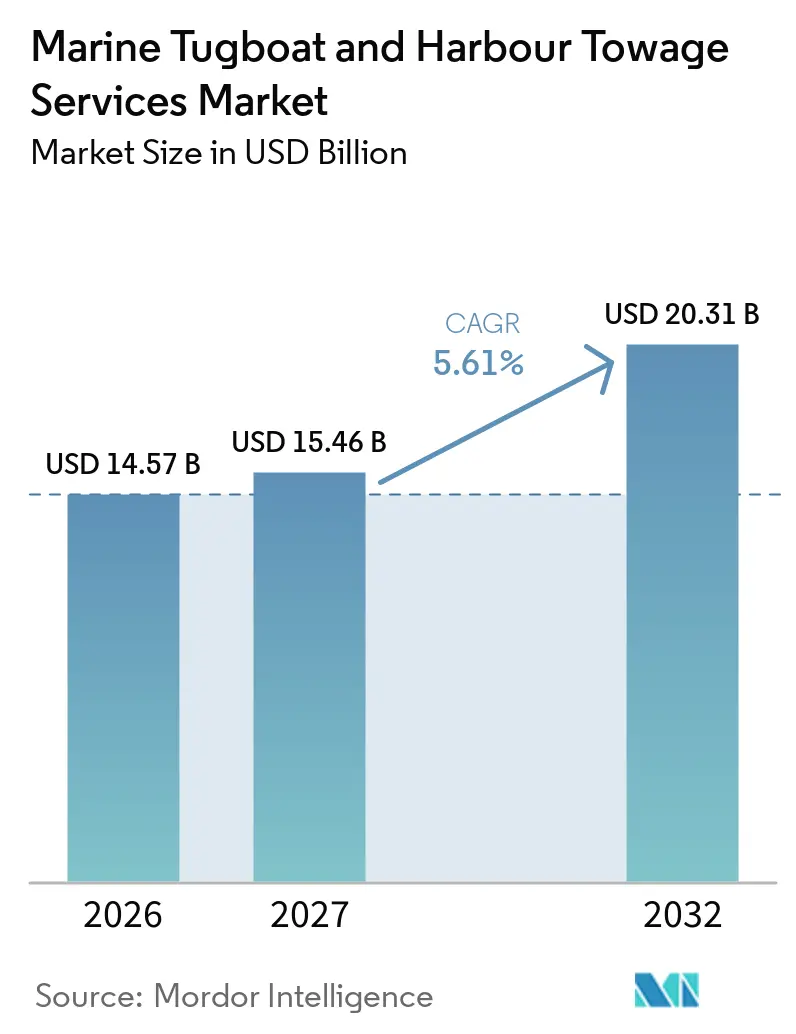
| Market Size (2027) | USD 15.46 Billion |
| Market Size (2032) | USD 20.31 Billion |
| Growth Rate (2027 - 2032) | 5.61 % |
| Fastest Growing Market | Asia-Pacific |
| Largest Market | Asia-Pacific |
| Market Concentration | Medium |
Major Players *Disclaimer: Major Players sorted in no particular order Image © Mordor Intelligence. Reuse requires attribution under CC BY 4.0. | |
Marine Tugboat and Harbour Towage Services Market Analysis by Mordor Intelligence
The marine tugboat and harbour towage services market size is projected to expand from USD 14.57 billion in 2026 to USD 15.46 billion in 2027 and reach USD 20.31 billion by 2032 at a 5.61% CAGR over 2027-2032.
Port expansion, deeper berths, and larger vessel calls continue to increase the need for capable ship-assist services at ports where maneuvering space and schedules are tightly managed.[1] The Marine tugboat and harbour towage services market also benefits from LNG terminals and floating offshore wind projects, which require specialized vessels and longer service arrangements. New environmental rules are moving fleet investment forward because operators need vessels that can remain eligible for future port tenders and demonstrate practical compliance in daily operations. Larger operators can spread vessel, compliance, and training costs across more locations, while regional operators face a narrower path into high-value contracts.
Key Report Takeaways
- By service type, harbour towage held 45.65% of the marine tugboat and harbour towage services market share in 2026, while offshore and specialized towage recorded the highest projected CAGR at 8.12% through 2032.
- By application, commercial ports held 37.05% of the marine tugboat and harbour towage services market size in 2026, while offshore energy bases recorded the highest projected CAGR at 8.43% through 2032.
- By vessel type, ASD tugs held 34.18% of the marine tugboat and harbour towage services market share in 2026 and recorded the highest projected CAGR at 7.96% through 2032.
- By end user, shipping lines and vessel owners held 35.31% of the marine tugboat and harbour towage services market size in 2026, while offshore wind and renewable-energy developers recorded the highest projected CAGR at 9.10% through 2032.
- By geography, Asia-Pacific held a 37.39% of the marine tugboat and harbour towage services market share in 2026 and recorded the highest projected CAGR at 7.16% through 2032.
Note: Market numbers in this report are based on Mordor Intelligence's proprietary estimation framework, which combines nine months of actuals with Q4 projections for base year 2026.
Market Trends and Insights
Drivers Impact Analysis of Marine Tugboat and Harbour Towage Services Market*
| Driver | (~) % Impact on CAGR Forecast | Geographic Relevance | Impact Timeline |
|---|---|---|---|
| Seaborne Trade Growth and Vessel Upsizing | +1.3% | Global, with intensity in Asia-Pacific and North America | Medium term (2-4 years) |
| Port Expansion and Terminal Modernization | +1.1% | Global, with early gains in Asia-Pacific, Europe, and MEA | Long term (≥ 4 years) |
| Demand for Safety, Escort, and Emergency Response | +0.7% | Global, concentrated in LNG and high-traffic commercial corridors | Short term (≤ 2 years) |
| Offshore Energy and Marine Infrastructure Projects | +0.9% | North Sea, MEA, Asia-Pacific offshore wind zones, and Latin American LNG hubs | Long term (≥ 4 years) |
| Tug Availability as Port-Resilience Capacity | +0.5% | North America, Australia, and major transshipment hubs | Medium term (2-4 years) |
| Data-Driven Dispatch and Simulation-Based Productivity | +0.4% | Global, led by Asia-Pacific and Northern European operators | Medium term (2-4 years) |
| Source: Mordor Intelligence | |||
Seaborne Trade Growth and Vessel Upsizing
Seaborne trade is a central demand base for the marine tugboat and harbour towage services market. The WTO raised its 2026 merchandise trade volume growth to 3.9%, which supported port activity and ship-assist demand[2]. Larger ships need several high-bollard-pull tugs during a single call, increasing service needs even where call volumes rise at a slower pace. Penang Port commissioned a 50-ton bollard-pull ASD tug in 2026, compared with its prior 45-ton standard, showing how vessel dimensions were changing tug requirements. This shift raises the cost of keeping older fleets competitive and favors operators with vessels suited to congested berths in the marine tugboat and harbour towage services market.
Port Expansion and Terminal Modernization
Port investment creates service demand over several years for the marine tugboat and harbour towage services market. Hamburg Port Authority announced a EUR 1.1 billion (USD 1.4 billion) modernization program for Waltershofer Hafen in July 2025, including an expansion of the turning circle from 480 to 600 meters. The change increases maneuvering work for larger vessels and strengthens reliance on capable tugs. AD Ports Group signed a dredging agreement for Karachi Gateway Terminal in September 2025 to accommodate vessels up to 350 meters long. Deeper berths and wider basins can permanently change the power and handling standards that port-assigned tugs need to meet. Those standards form a practical barrier for operators who cannot renew lower-powered vessels in the marine tugboat and harbour towage services market.
Offshore Energy and Marine Infrastructure Projects
Offshore projects are widening the service mix beyond conventional harbour work in the marine tugboat and harbour towage services market. Floating wind developments need tug support during mooring preparation, tow-out, hook-up, and related marine work. LNG terminal construction also requires escort, fire-fighting, and long-endurance capabilities. KOTUG completed delivery of five 80-ton bollard-pull tugs in September 2025 for long-term LNG offshore terminal operations in Mauritania, Senegal, and Congo. These contracts can run for 7 to 10 years and can support investment in vessels designed for a specific duty. The resulting revenue profile differs from harbour concessions in the Marine tugboat and harbour towage services market, where providers usually compete for renewal at set intervals.
Data-Driven Dispatch and Simulation-Based Productivity
Digital dispatch and simulation tools are becoming more relevant to the marine tugboat and harbour towage services market. PSA Marine installed full-mission ship bridge and tug bridge simulators certified to DNV Class A in January 2025 to train pilots and tug masters for automated navigation and emergency scenarios. Better planning can reduce idle steaming, improve vessel allocation, and support training for difficult calls without reducing the safety margins required for complex harbor maneuvers. IMO reporting and fuel-intensity requirements add value to reliable fuel and operating data because ports increasingly review environmental performance. The IMO adopted the Net-Zero Framework in 2025, and the framework seeks to move international shipping toward net-zero greenhouse gas emissions by or close to 2050.[3] Operators with documented operational performance can present stronger evidence during concession reviews than operators relying only on bollard-pull capacity.
Restraints Impact Analysis of Marine Tugboat and Harbour Towage Services Market*
| Restraint | (~) % Impact on CAGR Forecast | Geographic Relevance | Impact Timeline |
|---|---|---|---|
| High Fleet Capital Expenditure and Financing Burden | -0.5% | Global, most acute for mid-tier operators in Europe and Latin America | Long term (≥ 4 years) |
| Crew Shortage and Training Costs | -0.4% | Global, most severe in North America, Northern Europe, and Australia | Medium term (2-4 years) |
| Concession Volatility and Idle-Asset Risk | -0.3% | Europe, particularly Turkey and Italy, and Australia | Short term (≤ 2 years) |
| Grid and Bunkering Readiness Gaps for Low-Emission Tugs | -0.4% | Developing-market ports in South America, MEA, and Southeast Asia | Long term (≥ 4 years) |
| Source: Mordor Intelligence | |||
High Fleet Capital Expenditure and Financing Burden
Fleet renewal places heavy financial pressure on the marine tugboat and harbour towage services market. Modern ASD tugs with LNG readiness, fire-fighting systems, and IMO Tier III compliance cost more than conventional diesel vessels. Tender documents increasingly call for these capabilities, which limits the choices available to operators with restricted financing capacity and makes financing conditions more important when contracts are renewed or when several vessels need replacement. The challenge becomes sharper when a company faces several concession renewals while committing funds to new vessels. A lost tender can leave a specialized vessel without an immediate equivalent assignment. This financial exposure can keep smaller operators out of LNG and offshore wind work in the Marine tugboat and harbour towage services market, where high bollard pull and financial guarantees are common requirements.
Crew Shortage and Training Costs
A shortage of certified tug masters and engineers limits vessel use even when fleet capacity is available. The United States Maritime Administration designated Centers of Excellence for Domestic Maritime Workforce Training and Education in 2026 to support workforce development across the maritime sector.[4] The British Tugowners Association introduced its Zero to Hero apprenticeship in March 2025, with funding of GBP 27,000 (USD 36,426) over 4 years and simulator-based training. Port of Antwerp-Bruges also created a deckhand entry role, and its first cohort completed a 9-month supervised program in September 2025. Training takes time, while new vessel programs add demand for qualified personnel across ports, coastal routes, and specialized offshore assignments. Higher crewing costs and slower activation can limit the near-term benefit from fleet expansion in the marine tugboat and harbour towage services market.
*Our forecasts treat driver/restraint impacts as directional, not additive. The impact forecasts reflect baseline growth, mix effects, and variable interactions.
Marine Tugboat and Harbour Towage Services Market Segment Analysis
By Service Type:
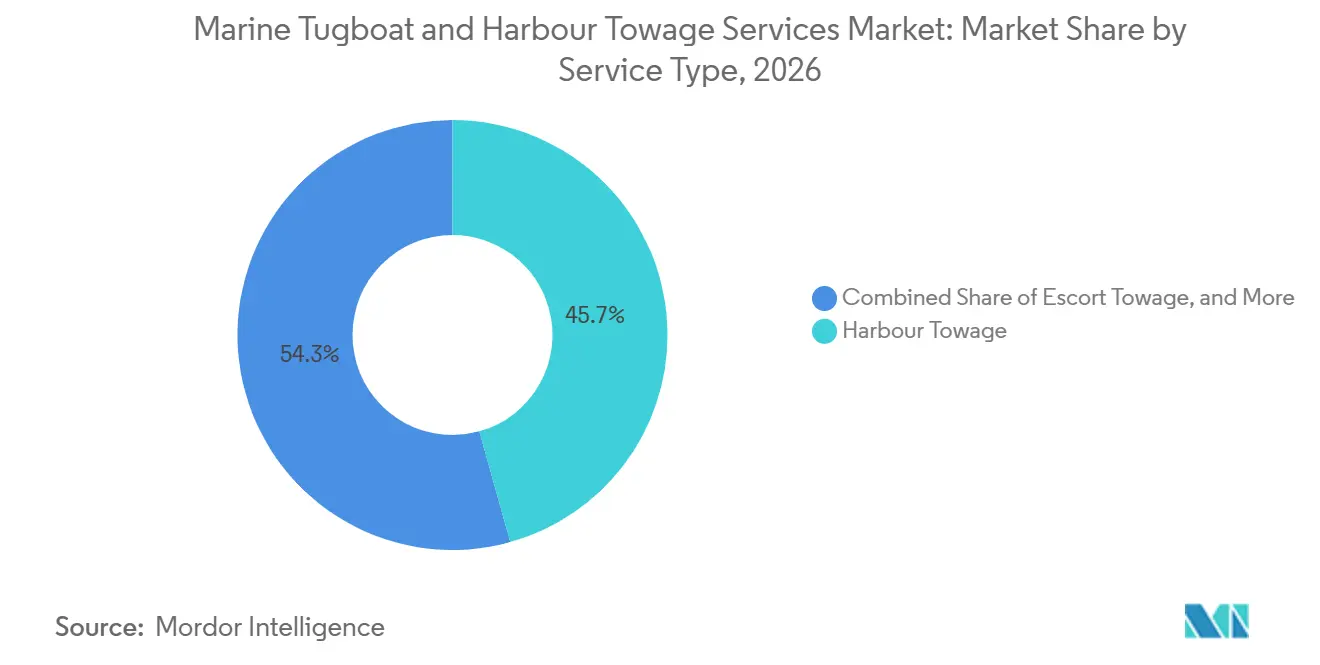
Offshore Demand Reshapes a Harbor-Dominant MarketHarbour towage held 45.65% of the marine tugboat and harbour towage services market share in 2026. Its position reflects its required role at major commercial ports and its close connection to seaborne cargo traffic. Escort Towage serves approach channels where safety rules require close tug support, especially for LNG carriers. Terminal and intra-port towage, coastal towage, and salvage and emergency towage address separate operating needs.
Offshore and specialized towage recorded the highest projected CAGR at 8.12% through 2032 within the marine tugboat and harbour towage services market size. LNG export projects in West Africa and South Asia, together with floating wind activity in Europe and Asia-Pacific, support this growth. KOTUG's 2025 program for LNG infrastructure in Mauritania, Senegal, and Congo showed the specialized capacity required for these assignments. Offshore vessels require high bollard pull, extended endurance, and fire-fighting capability. These assets are not readily redeployed into ordinary harbor work without losing operational fit, because offshore assignments depend on equipment, endurance, and crews matched to a defined project scope. This division of work influences capacity planning across the Marine tugboat and harbour towage services market. Large operators, therefore, maintain distinct procurement plans for harbor and offshore fleets.

By Application:
Commercial Ports Lead, Offshore Energy AcceleratesCommercial ports accounted for 37.05% of the marine tugboat and harbour towage services market size in 2026. Large container and bulk terminals generate repeated service needs because of vessel movements and berth constraints. The WTO's 3.9% forecast for merchandise trade volume growth in 2026 supports the demand base for these locations. Industrial and Energy Ports, Naval and Government Ports, and Cruise and Ferry Terminals serve more specialized operating patterns.
Offshore energy bases are projected to expand at an 8.43% CAGR through 2032. LNG terminals and offshore wind staging areas are driving activity across several regions. Long-duration LNG support agreements can cover fire-fighting, escort, pilot boarding, and diving support. Multi-year offshore assignments can withdraw tugs from harbor supply for 3 to 9 years. That constraint can improve availability discipline in commercial port work across the Marine tugboat and harbour towage services market.
By Vessel Type:
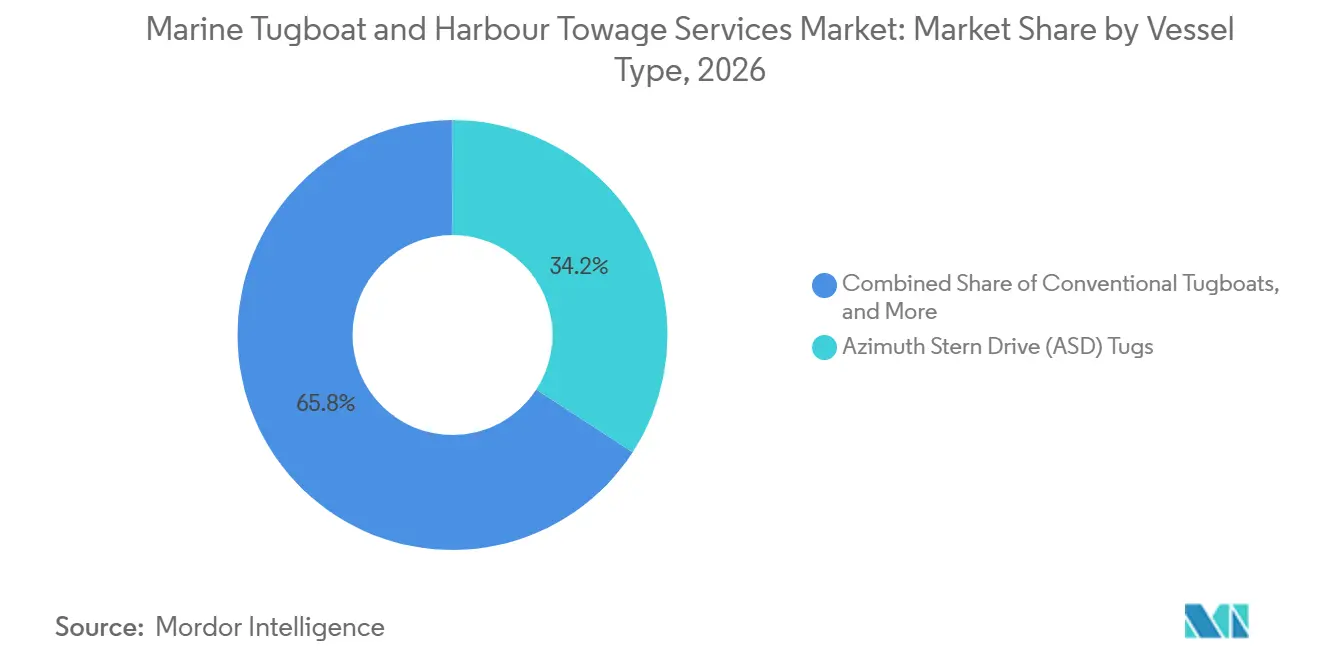
ASD Tugs Define the Modernization StandardASD Tugs accounted for 34.18% of the marine tugboat and harbour towage services market share in 2026. They also recorded the highest projected CAGR at 7.96% through 2032. Azimuthing propulsion delivers 360-degree maneuverability and strong lateral thrust in confined berths. This capability can reduce maneuvering time and reduce contact risk for ships and port infrastructure during demanding berthing, unberthing, and escort operations. It also provides operators with a practical response to berth constraints, crosscurrents, and higher safety requirements in the Marine tugboat and harbour towage services market.
New vessel orders increasingly favor ASD designs in the Marine tugboat and harbour towage services industry. Svitzer agreed with Cochin Shipyard in December 2025 to build at least 4 battery-electric Transverse 2600e tugs in India, with an option for 4 more vessels. McAllister Towing deployed the 84-ton bollard-pull Isabel McAllister to Baltimore in April 2025, illustrating the demand for higher-capacity, compliant harbor tugs. Newbuilds are increasingly specified with emission-control equipment, even in ports that have not yet introduced local requirements. This practice can preserve eligibility as port procurement requirements tighten. The direction of investment gives modern vessels a longer competitive life across jurisdictions in the Marine tugboat and harbour towage services market.
By End User:
Shipping Lines Anchor Revenue, Offshore Wind Fastest GrowingShipping lines and vessel owners held 35.31% of the marine tugboat and harbour towage services market size in 2026. They carry the direct commercial cost of tug assistance at each port call. Larger customers increasingly seek service arrangements that cover several ports, which favors operators with broad networks. Their preference for consistent operating procedures and available vessels adds value to scale in the marine tugboat and harbour towage services market. Port authorities and terminal operators are also important contracting parties, especially where one provider receives a concession for a defined area. Oil and gas companies purchase both harbor-adjacent and offshore support services.
Offshore wind and renewable-energy developers recorded the highest projected CAGR at 9.10% through 2032. Their requirements include anchor handling, tow-out work, and support during installation. Floating wind projects can require vessel availability over a long construction and commissioning period. Svitzer's Oman LNG agreement demonstrates the revenue certainty that long-duration marine support contracts can provide. Naval procurement can also restrict entry through national-security requirements in the marine tugboat and harbour towage services market.
Geography Analysis
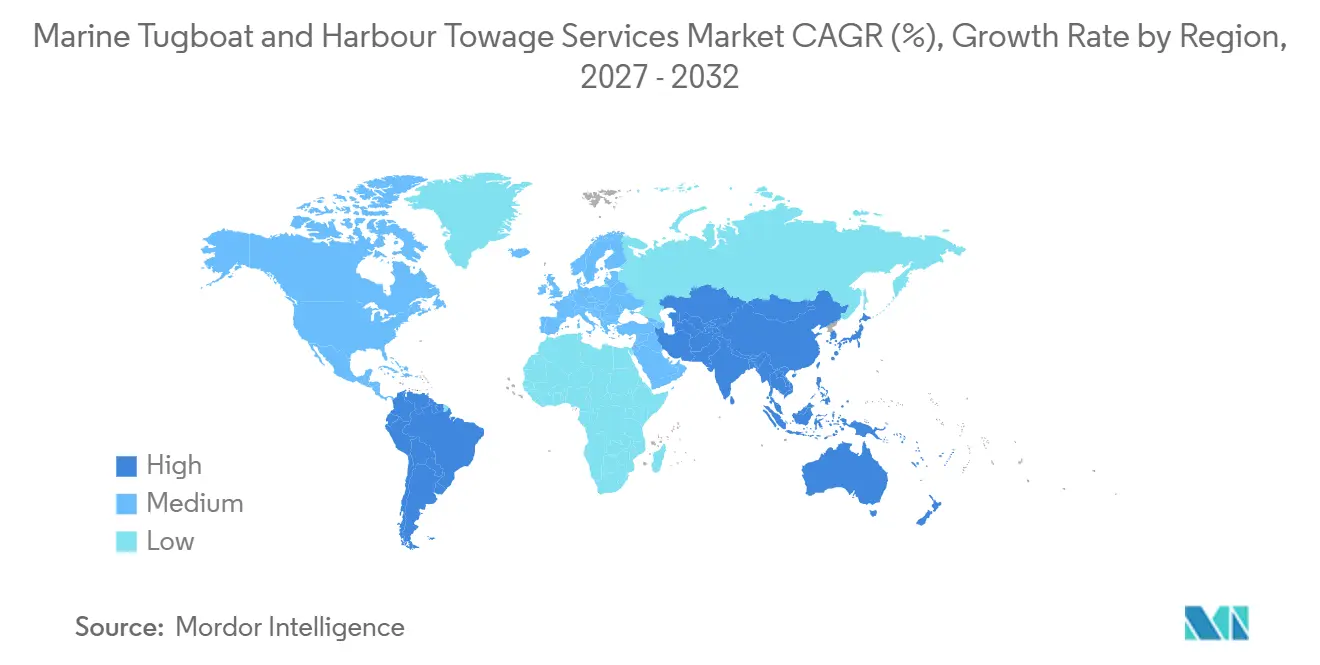
Asia-Pacific held 37.39% of the marine tugboat and harbour towage services market share in 2026 and recorded the highest projected CAGR at 7.16% through 2032. The region combines high port-call volumes with a large pipeline of offshore energy and port infrastructure activity, giving operators several sources of vessel utilization. China, South Korea, and Singapore remain important production and operating centers. India is also building domestic capacity through Svitzer's agreement with Cochin Shipyard for battery-electric Transverse 2600e tugs. Vietnam, Malaysia, and Indonesia contribute additional newbuild activity from regional yards.
The marine tugboat and harbour towage services market in North America is shaped by fleet renewal and environmental requirements. The United States EPA Tier 4 engine standards and California Air Resources Board requirements support demand for newer tugs in coastal and inland waters. Crowley extended integrated mooring and ship-assist services to Los Angeles and Long Beach in November 2025. Moran acquired Bisso Towboat in October 2025, extending its ship-assist capability on the Lower Mississippi River. Workforce availability remains a constraint despite vessel investment, as the federal training initiative shows.
Europe has a competitive concession environment and a demanding regulatory setting that favors compliant fleets and proven operating records. Fairplay placed newbuild orders from 2025 through 2026 and joined the Tug Network Team in March 2026 to strengthen its ability to bid across regions. South America continues to consolidate around experienced local operators, and SAAM acquired the remaining 30% of Intertug's Colombia and Mexico operations for USD 30.5 million in October 2025. Middle East and Africa are gaining importance through port concessions, LNG development, and locally backed fleet programs, as Boluda and Marsa Maroc secured a 20-year authorization for towage services at Nador West Med in April 2025.
Competitive Landscape
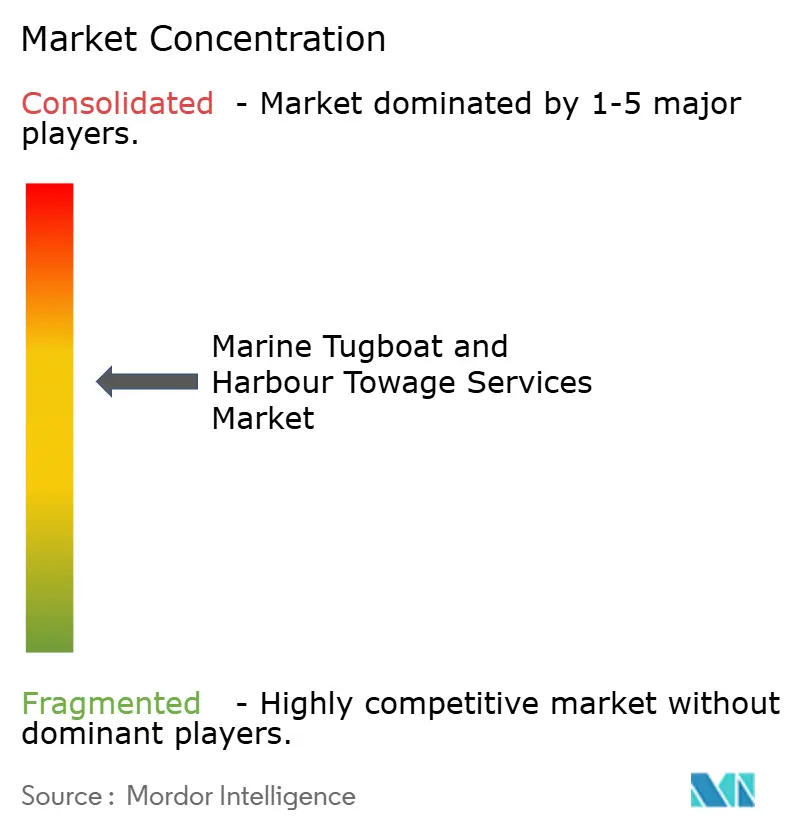
The marine tugboat and harbour towage services market is moderately concentrated at the global level, while regional and national providers remain active alongside Boluda Corporacion Maritima's fleet exceeding 500 vessels. Its acquisition-led scale supports multi-port arrangements with major liner customers and improves its position in large concession tenders. Svitzer competes through vessel technology and lower-emission fleet development. Its TRAnsverse design and battery-electric program at Cochin Shipyard position the company for tenders where environmental performance affects selection.
Compliance is becoming a more visible basis for competition in the marine tugboat and harbour towage services market. The IMO Net-Zero Framework adds direction to future fleet and fuel choices for international shipping. Operators that can document fuel use, vessel performance, and operating practices can strengthen their tender submissions and provide evidence that supports the requirements set by port authorities. Boluda's joint venture with Marsa Maroc holds 51% and 49%, respectively, in the company authorized to operate at Nador West Med. The structure combines global operating experience with domestic port participation. It also gives the concession a 20-year operating horizon.
West Africa and South Asia offer room for further specialized offshore growth. KOTUG's LNG support program in Mauritania, Senegal, and Congo shows that specialized fleets are already entering these corridors. Fairplay's newbuilding plans illustrate the mid-tier response to larger rivals and show how fleet renewal remains central to regional competitive positions. The company ordered 4 Damen tugs in May 2025 with LNG compatibility, FiFi-1 fire-fighting systems, and IMO Tier III compliance. Wilson Sons, PSA Marine, and Rimorchiatori Riuniti Group retain strong regional positions. Their ability to invest in compliant vessels and dispatch capability will shape their position as global operators broaden their footprints.
Marine Tugboat and Harbour Towage Services Industry Leaders
-
Boluda Corporacion Maritima
-
Svitzer A/S
-
SAAM S.A.
-
KOTUG International B.V.
-
Crowley Maritime Corporation
- *Disclaimer: Major Players sorted in no particular order
Marine Tugboat and Harbour Towage Services Market Companies Covered in this Report
- Boluda Corporacion Maritima
- Svitzer A/S
- SAAM S.A.
- KOTUG International B.V.
- Crowley Maritime Corporation
- Wilson Sons S.A.
- Moran Towing Corporation
- McAllister Towing and Transportation Company, Inc.
- The Great Lakes Towing Company
- Multraship Towage and Salvage
- Fairplay Towage Group
- PSA Marine (Pte) Ltd.
- Rimorchiatori Riuniti Group
- Centerline Logistics Corporation
- Foss Maritime Company
- Atlantic Towing Limited
- Ocean Group
- Bay-Houston Towing Company
- Suderman & Young Towing Company
- Bisso Towboat Co., Inc.
Recent Industry Developments in Marine Tugboat and Harbour Towage Services Market
- October 2026: Fairplay Towage signed a contract for 6 new tugs, 4 harbor and 2 offshore, ranging from 6,390 hp to 10,580 hp, with up to 120 tons bollard pull, built to Robert Allan Ltd designs, IMO Tier III-compliant, and ice-classed for LNG carrier support. Offshore tug service entry is targeted for the first half of 2028.
- January 2026: Under the patronage of the Oman Investment Authority, Svitzer and Asyad Drydock signed an agreement to build Oman's first locally manufactured tugboat for Oman LNG, advancing In-Country Value objectives and extending the industrial dimension of the 9-year Oman LNG towage contract.
- November 2025: Crowley expanded integrated mooring and ship-assist services to the ports of Los Angeles and Long Beach in California, combining its escort tug fleet with mooring coordination under the International Longshore and Warehouse Union Local 13. The move extended its Pacific Northwest one-stop service model to the United States West Coast's 2 busiest container gateways.
- October 2025: Moran Towing acquired Bisso Towboat Co., Inc., a New Orleans-based ship-assist specialist for the Lower Mississippi River corridor. The acquisition extended Moran's 17-port East and Gulf Coast network and added an ASD tractor tug fleet during growth in Gulf Coast LNG export activity.
Global Marine Tugboat and Harbour Towage Services Market Report Scope
Segmentation Overview
| Harbour Towage |
| Escort Towage |
| Terminal and Intra-Port Towage |
| Coastal Towage |
| Salvage and Emergency Towage |
| Offshore and Specialized Towage |
| Commercial Ports |
| Industrial and Energy Ports |
| Naval and Government Ports |
| Cruise and Ferry Terminals |
| Offshore Energy Bases |
| Dredging, Construction and Project-Cargo Operations |
| Conventional Tugboats |
| Azimuth Stern Drive (ASD) Tugs |
| Azimuth Tractor Drive (ATD) Tugs |
| Voith Schneider Tractor Tugs |
| Rotor Tugs |
| Other Specialized Tug Configurations |
| Shipping Lines and Vessel Owners |
| Port Authorities and Terminal Operators |
| Oil and Gas Companies |
| Offshore Wind and Renewable-Energy Developers |
| Government and Naval Agencies |
| Construction, Dredging and Salvage Contractors |
| Other Maritime and Industrial Operators |
| North America | United States |
| Canada | |
| Mexico | |
| South America | Brazil |
| Argentina | |
| Peru | |
| Chile | |
| Rest of South America | |
| Europe | Germany |
| United Kingdom | |
| France | |
| Italy | |
| Spain | |
| Russia | |
| Nordics (Denmark, Finland, Iceland, Norway, and Sweden) | |
| Rest of Europe | |
| Asia-Pacific | China |
| India | |
| Japan | |
| South Korea | |
| Australia | |
| Southeast Asia (ASEAN) | |
| Rest of Asia-Pacific | |
| Middle East and Africa | Saudi Arabia |
| United Arab Emirates | |
| Qatar | |
| South Africa | |
| Nigeria | |
| Egypt | |
| Rest of Middle East and Africa |
| By Service Type | Harbour Towage | |
| Escort Towage | ||
| Terminal and Intra-Port Towage | ||
| Coastal Towage | ||
| Salvage and Emergency Towage | ||
| Offshore and Specialized Towage | ||
| By Application | Commercial Ports | |
| Industrial and Energy Ports | ||
| Naval and Government Ports | ||
| Cruise and Ferry Terminals | ||
| Offshore Energy Bases | ||
| Dredging, Construction and Project-Cargo Operations | ||
| By Vessel Type | Conventional Tugboats | |
| Azimuth Stern Drive (ASD) Tugs | ||
| Azimuth Tractor Drive (ATD) Tugs | ||
| Voith Schneider Tractor Tugs | ||
| Rotor Tugs | ||
| Other Specialized Tug Configurations | ||
| By End User | Shipping Lines and Vessel Owners | |
| Port Authorities and Terminal Operators | ||
| Oil and Gas Companies | ||
| Offshore Wind and Renewable-Energy Developers | ||
| Government and Naval Agencies | ||
| Construction, Dredging and Salvage Contractors | ||
| Other Maritime and Industrial Operators | ||
| By Geography | North America | United States |
| Canada | ||
| Mexico | ||
| South America | Brazil | |
| Argentina | ||
| Peru | ||
| Chile | ||
| Rest of South America | ||
| Europe | Germany | |
| United Kingdom | ||
| France | ||
| Italy | ||
| Spain | ||
| Russia | ||
| Nordics (Denmark, Finland, Iceland, Norway, and Sweden) | ||
| Rest of Europe | ||
| Asia-Pacific | China | |
| India | ||
| Japan | ||
| South Korea | ||
| Australia | ||
| Southeast Asia (ASEAN) | ||
| Rest of Asia-Pacific | ||
| Middle East and Africa | Saudi Arabia | |
| United Arab Emirates | ||
| Qatar | ||
| South Africa | ||
| Nigeria | ||
| Egypt | ||
| Rest of Middle East and Africa | ||
Key Questions Answered in the Report
What is the size of the marine tugboat and harbour towage services sector?
The sector is valued at USD 14.57 billion in 2026 and is projected to reach USD 20.31 billion by 2032, at a 5.61% CAGR from 2027 to 2032. Port investment, trade activity, and specialized offshore work shape this outlook. Fleet renewal, crew availability, concession terms, and access to specialized equipment influence how operators can serve that demand over the forecast period.
Which service type leads marine tugboat and harbour towage services?
Harbour towage leads with a 45.65% revenue share in 2026, supported by its required role at commercial ports.
Which application is growing fastest for tug services?
Offshore energy bases record the highest projected CAGR at 8.43% through 2032, supported by LNG and offshore wind activity, including support work that requires purpose-built vessels, trained crews, and longer operating commitments.
Why are ASD tugs important to operators?
ASD Tugs hold 34.18% revenue share in 2026 and have the highest projected vessel-type CAGR at 7.96% through 2032 because of their maneuverability in confined berths.
Which region leads global tugboat and harbour towage activity?
Asia-Pacific holds 37.39% revenue share in 2026 and records the highest projected regional CAGR at 7.16% through 2032.
Who are the major buyers of tugboat and harbor towage services?
Shipping lines and vessel owners hold 35.31% revenue share in 2026, while offshore wind and renewable-energy developers record the highest projected CAGR at 9.10% through 2032.